

The DOI matches its Crossref record; 117 of the 118 references it cites were found in a registry or an index.
The role of interleukin-18 in the metabolic syndrome
Open accessAbstract
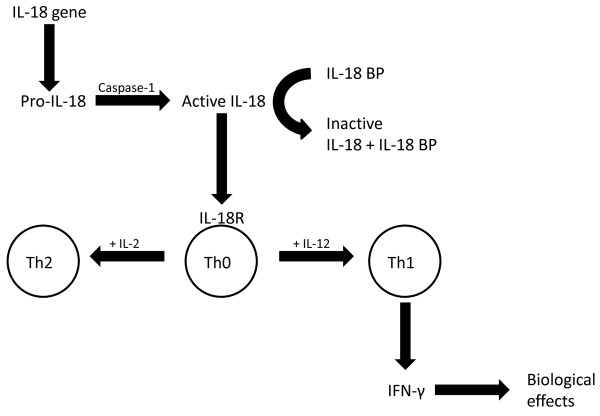
The metabolic syndrome is thought to be associated with a chronic low-grade inflammation, and a growing body of evidence suggests that interleukin-18 (IL-18) might be closely related to the metabolic syndrome and its consequences. Circulating levels of IL-18 have been reported to be elevated in subjects with the metabolic syndrome, to be closely associated with the components of the syndrome, to predict cardiovascular events and mortality in populations with the metabolic syndrome and to precede the development of type 2 diabetes. IL-18 is found in the unstable atherosclerotic plaque, in adipose tissue and in muscle tissue, and is subject to several regulatory steps including cleavage by caspase-1, inactivation by IL-18 binding protein and the influence of other cytokines in modulating its interaction with the IL-18 receptor. The purpose of this review is to outline the role of IL-18 in the metabolic syndrome, with particular emphasis on cardiovascular risk and the potential effect of life style interventions.
Overview
The claims and statistics of this paper haven’t been checked yet.
Run the check — free, no account needed. It reads the open-access text and checks the sources it cites.
Integrity signals
Registry
Cites
Statistics
Figures
Verification
Claims the paper makes
The claims and statistics of this paper haven’t been checked yet.
Run the check — free, no account needed. It reads the open-access text and checks the sources it cites.
Claims other papers make about this one
Each is checked against this paper’s own text: does it say what the citing paper says it does?
In the citing paper
“For instance, in combination with IL-2, IL-18 can promote a Th2 response, while a Th1 response will be promoted in response to IL-12 (reviewed here [239]).”
From Mitochondrial Uncoupling: A Key Controller of Biological Processes in Physiology and Diseases (2019) · cites this paper as [239]
In the citing paper
“IL-18 is known to enhance both T cell and natural killer cell maturation and promote proinflammatory cytokine release [239].”
From Mitochondrial Uncoupling: A Key Controller of Biological Processes in Physiology and Diseases (2019) · cites this paper as [239]
Self-check
Percentages, sums and reported differences re-computed from the paper’s own numbers.
The self-check needs the paper’s full text.
Citations
Cites
Alberti, K. G. M. M., Eckel, R. H., Grundy, S. M., Zimmet, P. Z., Cleeman, J. I., Donato, K. A., Fruchart, J.-C., James, W. P. T., Loria, C. M., & Smith, S. C. (2009) · Circulation · doi:10.1161/circulationaha.109.192644 · Cited by 14,860
Grundy, S. M., Cleeman, J. I., Daniels, S. R., Donato, K. A., Eckel, R. H., Franklin, B. A., Gordon, D. J., Krauss, R. M., Savage, P. J., Smith, S. C., et al. (2005) · Circulation · doi:10.1161/circulationaha.105.169404 · Cited by 11,961
Tuomilehto, J., Lindström, J., Eriksson, J. G., Valle, T. T., Hämäläinen, H., Ilanne-Parikka, P., Keinänen-Kiukaanniemi, S., Laakso, M., Louheranta, A., Rastas, M., et al. (2001) · New England Journal of Medicine · doi:10.1056/nejm200105033441801 · Cited by 10,873 · cited 1×
“Lifestyle interventions consisting of diet and exercise have been shown to improve several cardiovascular risk factors including the metabolic syndrome and to reduce the risk of developing type 2 diabetes [89,90].”
BackgroundObesity is associated with macrophage accumulation in adipose tissue
Weisberg, S. P., McCann, D., Desai, M., Rosenbaum, M., Leibel, R. L., & Ferrante, A. W. (2003) · Journal of Clinical Investigation · doi:10.1172/jci200319246 · Cited by 10,041
The metabolic syndrome—a new worldwide definition
Alberti, K. G. M., Zimmet, P., & Shaw, J. (2005) · The Lancet · doi:10.1016/s0140-6736(05)67402-8 · Cited by 9,352
Xu, H., Barnes, G. T., Yang, Q., Tan, G., Yang, D., Chou, C. J., Sole, J., Nichols, A., Ross, J. S., Tartaglia, L. A., et al. (2003) · Journal of Clinical Investigation · doi:10.1172/jci200319451 · Cited by 6,760
Ford, E. S., Giles, W. H., & Dietz, W. H. (2002) · JAMA · doi:10.1001/jama.287.3.356 · Cited by 6,698
Eckel, R. H., Alberti, K., Grundy, S. M., & Zimmet, P. (2010) · The Lancet · doi:10.1016/s0140-6736(09)61794-3 · Cited by 6,317
Eckel, R. H., Grundy, S. M., & Zimmet, P. (2005) · The Lancet · doi:10.1016/s0140-6736(05)66378-7 · Cited by 5,755
Cloning of a new cytokine that induces IFN-γ production by T cells
Okamura, H., Tsutsui, H., Komatsu, T., Yutsudo, M., Hakura, A., Tanimoto, T., Torigoe, K., Okura, T., Nukada, Y., Hattori, K., et al. (1995) · Nature · doi:10.1038/378088a0 · Cited by 2,602
Cited by
Sorted by citations
Overview of the IL ‐1 family in innate inflammation and acquired immunity
Dinarello, C. A. (2018) · Immunological Reviews · doi:10.1111/imr.12621 · Cited by 1,866
Chronic Inflammation in Obesity and the Metabolic Syndrome
Monteiro, R., & Azevedo, I. (2010) · Mediators of Inflammation · doi:10.1155/2010/289645 · Cited by 1,186
“As already stated, adipocytes behave as immune cells [72– 75] and are able to synthesize and release a huge amount of proinflammatory adipokines and cytokines including leptin, resistin, PAI-1, IL-6, TNFα, retinol-binding protein 4 (see [16]), IL-1β, monocyte chemoattractant protein-1 (MCP1), CRP, macrophage migration…”
BackgroundInterleukin-18 and IL-18 Binding Protein
Dinarello, C. A., Novick, D., Kim, S., & Kaplanski, G. (2013) · Frontiers in Immunology · doi:10.3389/fimmu.2013.00289 · Cited by 938
Interleukin‐18: Biological properties and role in disease pathogenesis
Kaplanski, G. (2017) · Immunological Reviews · doi:10.1111/imr.12616 · Cited by 621
Recent Advances on the Role of Cytokines in Atherosclerosis
Ait‐Oufella, H., Taleb, S., Mallat, Z., & Tedgui, A. (2011) · Arteriosclerosis Thrombosis and Vascular Biology · doi:10.1161/atvbaha.110.207415 · Cited by 606
Metadata
- Authors
- Trøseid, M., Seljeflot, I., & Arnesen, H.
- Affiliations
- Oslo University Hospital (NO)
- Corresponding author
- Trøseid, Marius
- Venue
- Cardiovascular Diabetology
- Published
- 2010
- Volume
- 9
- Issue
- 1
- Pages
- 11
- ISSN
- 1475-2840 (ISSN-L)
- PMC
- PMC2858122
- OpenAlex
- W2116389925
- Cited by
- 155
- References
- 117
- Citations by year
- 2026: 5 · 2025: 9 · 2024: 8 · 2023: 10 · 2022: 4 · 2021: 11 · 2020: 9 · 2019: 9 · 2018: 7 · 2017: 13 · 2016: 10 · 2015: 6 · 2014: 11 · 2013: 18 · 2012: 8
- FWCI
- 1.52
- Type
- journal article
- Language
- en
- Open access
- gold
- doi.org
- Licence
- cc-by
- Locations
- Cardiovascular Diabetology (publishedVersion, cc-by)
- PubMed Central (publishedVersion, cc-by)
- PubMed (publishedVersion)
- DOAJ (DOAJ: Directory of Open Access Journals) (submittedVersion, cc-by-sa)
- Topics
- Health Sciences › Medicine › Endocrinology, Diabetes and Metabolism › Adipokines, Inflammation, and Metabolic Diseases
- Health Sciences › Medicine › Endocrinology, Diabetes and Metabolism › Diabetes, Cardiovascular Risks, and Lipoproteins
- Health Sciences › Medicine › Cardiology and Cardiovascular Medicine › Cardiovascular Disease and Adiposity
- Keywords
- IL-18, metabolic syndrome, low-grade inflammation, cardiovascular risk, type 2 diabetes, atherosclerotic plaque, adipose tissue, caspase-1, IL-18 binding protein, IL-18 receptor, lifestyle intervention
- MeSH terms
- Adipose Tissue, Cardiovascular Diseases, Diabetes Mellitus, Type 2, Humans, Life Style, Muscles, Risk Factors, Cytokines, Caspase 1, Interleukin-18, Metabolic Syndrome, Intercellular Signaling Peptides and Proteins, Atherosclerosis
About these checks
Registry, retraction, Cites and statistics results are computed, not judged, with one exception: a printed reference that no index lists is read once by a model before it counts as a citation error. Claims are extracted by a model and kept only when their quote appears verbatim in the text; each cited source is then checked, with a model’s help, for whether it says what the claim relies on. Those verdicts can be wrong — read the claim’s quote and the cited source before relying on one.
Statistics and arithmetic are recomputed, not judged.
Confidence bands are shown only for fields calibrated on our annotated test set. None is calibrated yet, so no band is shown.
What counts as a claim ›How we measure confidence ›How we check this ›
Are you an author, or do you see a problem with this page? Request a review
