

The DOI matches its Crossref record; 130 of the 131 references it cites were found in a registry or an index.
Systems solutions by lactic acid bacteria: from paradigms to practice
Open accessAbstract
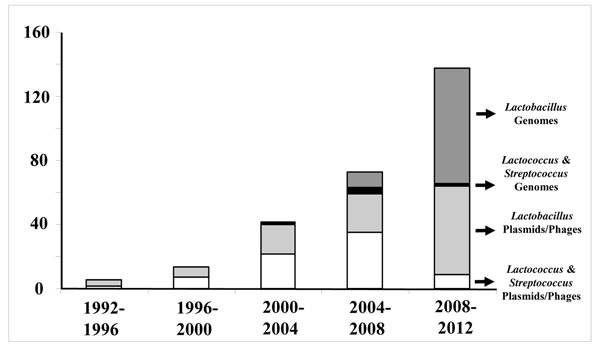
Lactic acid bacteria are among the powerhouses of the food industry, colonize the surfaces of plants and animals, and contribute to our health and well-being. The genomic characterization of LAB has rocketed and presently over 100 complete or nearly complete genomes are available, many of which serve as scientific paradigms. Moreover, functional and comparative metagenomic studies are taking off and provide a wealth of insight in the activity of lactic acid bacteria used in a variety of applications, ranging from starters in complex fermentations to their marketing as probiotics. In this new era of high throughput analysis, biology has become big science. Hence, there is a need to systematically store the generated information, apply this in an intelligent way, and provide modalities for constructing self-learning systems that can be used for future improvements. This review addresses these systems solutions with a state of the art overview of the present paradigms that relate to the use of lactic acid bacteria in industrial applications. Moreover, an outlook is presented of the future developments that include the transition into practice as well as the use of lactic acid bacteria in synthetic biology and other next generation applications.
Overview
The claims and statistics of this paper haven’t been checked yet.
Run the check — free, no account needed. It reads the open-access text and checks the sources it cites.
Integrity signals
Registry
Cites
Statistics
Figures
Verification
Claims the paper makes
The claims and statistics of this paper haven’t been checked yet.
Run the check — free, no account needed. It reads the open-access text and checks the sources it cites.
Claims other papers make about this one
Each is checked against this paper’s own text: does it say what the citing paper says it does?
The source backs part of the claim, not all of it — or backs it for a different population, condition or comparison.
In the citing paper
“Mixed-strain undefined cultures result in more resilience and robustness in dairy processes as compared with selected ones, characterized by a low strain diversity [53,113].”
From Microbiota of Cheese Ecosystems: A Perspective on Cheesemaking (2025) · cites this paper as [113]
Experimental — accuracy not yet measured
Self-check
Percentages, sums and reported differences re-computed from the paper’s own numbers.
The self-check needs the paper’s full text.
Citations
Cites
CRISPR Provides Acquired Resistance Against Viruses in Prokaryotes
Barrangou, R., Fremaux, C., Deveau, H., Richards, M., Boyaval, P., Moineau, S., Romero, D. A., & Horvath, P. (2007) · Science · doi:10.1126/science.1138140 · Cited by 5,947
CRISPR/Cas, the Immune System of Bacteria and Archaea
Horvath, P., & Barrangou, R. (2010) · Science · doi:10.1126/science.1179555 · Cited by 2,471
Small CRISPR RNAs Guide Antiviral Defense in Prokaryotes
Brouns, S. J. J., Jore, M. M., Lundgren, M., Westra, E. R., Slijkhuis, R. J. H., Snijders, A. P. L., Dickman, M. J., Makarova, K. S., Koonin, E. V., & van der Oost, J. (2008) · Science · doi:10.1126/science.1159689 · Cited by 2,460
The CRISPR/Cas bacterial immune system cleaves bacteriophage and plasmid DNA
Garneau, J. E., Dupuis, M.-È., Villion, M., Romero, D. A., Barrangou, R., Boyaval, P., Fremaux, C., Horvath, P., Magadán, A. H., & Moineau, S. (2010) · Nature · doi:10.1038/nature09523 · Cited by 2,336
Complete genome sequence of Lactobacillus plantarum WCFS1
Kleerebezem, M., Boekhorst, J., van Kranenburg, R., Molenaar, D., Kuipers, O. P., Leer, R., Tarchini, R., Peters, S. A., Sandbrink, H. M., Fiers, M. W. E. J., et al. (2003) · Proceedings of the National Academy of Sciences · doi:10.1073/pnas.0337704100 · Cited by 1,472
Comparative genomics of the lactic acid bacteria.
Makarova, K., Slesarev, A., Wolf, Y., Sorokin, A., Mirkin, B., Koonin, E., Pavlov, A., Pavlova, N., Karamychev, V., Polouchine, N., et al. (2006) · Proceedings of the National Academy of Sciences · doi:10.1073/pnas.0607117103 · Cited by 1,391
Gasson, M. J. (1983) · Journal of Bacteriology · doi:10.1128/jb.154.1.1-9.1983 · Cited by 1,313
The Complete Genome Sequence of the Lactic Acid Bacterium Lactococcus lactis ssp. lactis IL1403Preprint
Bolotin, A., Wincker, P., Mauger, S., Jaillon, O., Malarme, K., Weissenbach, J., Ehrlich, S. D., & Sorokin, A. (2001) · Genome Research · doi:10.1101/gr.169701 · Cited by 1,161
The Complete Genome Sequence of the Lactic Acid Bacterium Lactococcus lactis ssp. lactis IL1403
Bolotin, A., Wincker, P., Mauger, S., Jaillon, O., Malarme, K., Weissenbach, J., Ehrlich, S. D., & Sorokin, A. (2001) · Genome Research · doi:10.1101/gr.gr-1697r · Cited by 1,139
Host interactions of probiotic bacterial surface molecules: comparison with commensals and pathogens
Lebeer, S., Vanderleyden, J., & De Keersmaecker, S. C. J. (2010) · Nature Reviews Microbiology · doi:10.1038/nrmicro2297 · Cited by 1,062
Research works printed but not linked: 1
- 10.1016/j.fmrre.2005.04.009 · DOI
Cited by
Sorted by citations
Kimchi microflora: history, current status, and perspectives for industrial kimchi production
Jung, J. Y., Lee, S. H., & Jeon, C. O. (2014) · Applied Microbiology and Biotechnology · doi:10.1007/s00253-014-5513-1 · Cited by 333
Douillard, F. P., Ribbera, A., Kant, R., Pietilä, T. E., Järvinen, H. M., Messing, M., Randazzo, C. L., Paulin, L. G., Laine, P., Ritari, J., et al. (2013) · PLoS Genetics · doi:10.1371/journal.pgen.1003683 · Cited by 238
Multifactorial Diversity Sustains Microbial Community Stability
Erkus, O., de Jager, V. C. L., Spus, M., van Alen-Boerrigter, I. J., van Rijswijck, I. M. H., Hazelwood, L., Janssen, P. W. M., van Hijum, S. A. F. T., Kleerebezem, M., & Smid, E. J. (2013) · The ISME Journal · doi:10.1038/ismej.2013.108 · Cited by 217
Functional genomics of lactic acid bacteria: from food to health
Douillard, F. P., & de Vos, W. M. (2014) · Microbial Cell Factories · doi:10.1186/1475-2859-13-s1-s8 · Cited by 209
Blaya, J., Barzideh, Z., & LaPointe, G. (2018) · Journal of Dairy Science · doi:10.3168/jds.2017-13345 · Cited by 200
Metadata
- Authors
- de Vos, W. M.
- Venue
- Microbial Cell Factories
- Published
- 2011
- Volume
- 10
- Issue
- Suppl 1
- Pages
- S2
- ISSN
- 1475-2859 (ISSN-L)
- PMC
- PMC3231926
- OpenAlex
- W2097603527
- Cited by
- 134
- References
- 131
- Citations by year
- 2026: 4 · 2025: 10 · 2024: 4 · 2023: 6 · 2022: 10 · 2021: 5 · 2020: 8 · 2019: 9 · 2018: 12 · 2017: 7 · 2016: 8 · 2015: 12 · 2014: 18 · 2013: 12 · 2012: 9
- Type
- conference abstract
- Language
- en
- Open access
- gold
- doi.org
- Licence
- cc-by
- Locations
- Microbial Cell Factories (publishedVersion, cc-by)
- Europe PMC (PubMed Central) (publishedVersion, cc-by)
- PubMed Central (publishedVersion, cc-by)
- PubMed (publishedVersion)
- Socio-Environmental Systems Modeling (acceptedVersion)
- Data Archiving and Networked Services (DANS) (submittedVersion, other-oa)
- Funders
- Academy of Finland
- Topics
- Life Sciences › Agricultural and Biological Sciences › Food Science › Probiotics and Fermented Foods
- Life Sciences › Biochemistry, Genetics and Molecular Biology › Molecular Biology › Microbial Metabolic Engineering and Bioproduction
- Life Sciences › Biochemistry, Genetics and Molecular Biology › Genetics › Bacterial Genetics and Biotechnology
- Keywords
- lactic acid bacteria, probiotics, starter cultures, metagenomics, comparative genomics, synthetic biology, industrial applications, self-learning systems
- MeSH terms
- Animals, Bifidobacterium, Biotechnology, Fermentation, Food-Processing Industry, Humans, Lactic Acid, Probiotics, Lactobacillales
About these checks
Registry, retraction, Cites and statistics results are computed, not judged, with one exception: a printed reference that no index lists is read once by a model before it counts as a citation error. Claims are extracted by a model and kept only when their quote appears verbatim in the text; each cited source is then checked, with a model’s help, for whether it says what the claim relies on. Those verdicts can be wrong — read the claim’s quote and the cited source before relying on one.
Statistics and arithmetic are recomputed, not judged.
Confidence bands are shown only for fields calibrated on our annotated test set. None is calibrated yet, so no band is shown.
What counts as a claim ›How we measure confidence ›How we check this ›
Are you an author, or do you see a problem with this page? Request a review
