

Spatial repellents: from discovery and development to evidence-based validation
Open accessThe DOI matches its Crossref record; 40 of the 40 references it cites were found in a registry or an index; 18 of the 73 sources its claims cite were checked for support.
Abstract
Spatial repellents are chemicals that work in the vapor phase to prevent human-vector contact by disrupting normal behavioural patterns within a designated area or safe zone.
Overview
CoChat Summary
## TL;DR
This paper is a perspective/review arguing that spatial repellents could become an important vector-control tool because they reduce human-vector contact without relying on acute toxicity. It calls for a formal development pathway, standardized endpoints, and epidemiological trials to validate their public-health impact.
## Key findings
- Spatial repellents are defined as vapor-phase chemicals that disrupt vector behavior within a designated “safe zone,” reducing or preventing human-vector contact and thus transmission risk.
- The authors argue that current vector-control tools are limited: WHO-recommended adult insect vector actives are restricted to 15 compounds in only four chemical classes, with etofenprox added in 1999, and pyrethroid overreliance is contributing to resistance.
- The paper cites one randomized controlled trial of house screening with untreated netting that produced a 50% reduction in malaria vectors entering the house and a 50% reduction in anaemia in young children.
- The authors note that no published accounts had linked epidemiological and entomological components for spatial repellents at the time, and they call for Phase III community trials that measure infection incidence alongside vector metrics such as parity, sporozoite rates, blood meal indices, and abundance.
## Methods
- Not an experimental study; this is a working-group perspective/synthesis article drawing on prior laboratory, field, and observational studies.
- It reviews existing evidence on spatial repellency, DDT, house screening, and other sub-lethal/vector-behavior approaches, and uses that evidence to propose a critical path of development for spatial repellent products (SRCPD).
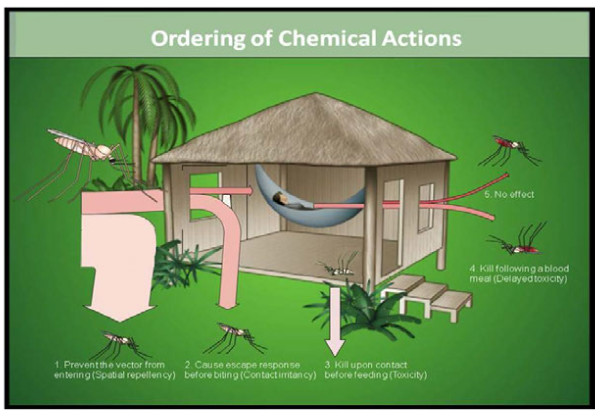
- The main analytical approach is argumentation and evidence synthesis, including identification of three major hurdles: generating epidemiological data, validating entomological endpoints, and changing screening protocols.
## Limitations
- The paper explicitly states that no controlled study design had yet been implemented to specifically correlate spatial repellency with real-time disease incidence.
- It also states that no published accounts linking epidemiological and entomological components existed for spatial repellents at the time.
- Evident from the text: the paper is largely conceptual and does not present new primary data, so its recommendations depend on prior studies and proposed future research rather than direct outcome testing.
Model-written summary. Check it against the paper before relying on it.
Integrity signals
Registry
Cites
Statistics
Figures


Verification
Claims the paper makes
15 Valid · 0 Not valid · 11 Not checked · 6 Own results and interpretations
The sources with a verdict support this claim; the rest weren’t checked yet, have no full text we could read, or their verdicts aren’t rated yet.
In the paper
“The use of spatial repellents to create a vector-free space, thereby preventing contact between human and vector, thus preventing disease transmission, is demonstrably effective [9-22].”
§ Spatial repellents: from discovery and development to evidence-based validation > Background
What the sources say
- Not matchedcites [9] Muirhead-Thomson RC: Mosquito behavior in relation to malaria transmission and control in the tropics. 1953, Edward Arnold and Co., London
Couldn’t be matched to a paper in Crossref, so it can’t be checked.
- Not checked — no full text of the sourcecites [10] Gabaldon A: The nation-wide campaign against malaria in Venezuela: Part II. Trans R Soc Trop Med Hyg. 1949, 43: 133-164. source
- Not matchedcites [11] Gabaldon A: The effect of DDT on the population of anopheline vectors in Venezuela. Riv Parasitol. 1952, 8: 24-41.
Couldn’t be matched to a paper in Crossref, so it can’t be checked.
- Not checked — no full text of the sourcecites [12] Kennedy JS: The excitant and repellent effects on mosquitoes of sublethal contacts with DDT. Bull Entomol Res. 1947, 37: 593-607. 10.1017/S0007485300030091. source
- Not checked — no full text of the sourcecites [13] De Zulueta J, Cullen JR: Deterrent effect of insecticides on malaria vectors. Nature. 1963, 200: 860-861. 10.1038/200860a0. source
- Not checked — no full text of the sourcecites [14] Smith A, Webley DJ: A verandah trap for studying the house-frequenting habits of mosquitoes and for assessing insecticides. Part 3. The effect of DDT on behavior and mortality. Bull Entomol Res. 1969, 59: 33-46. 10.1017/S000748530000300X. source
- Not checked — no full text of the sourcecites [15] Grieco JP, Achee NL, Andre RG, Roberts DR: A comparison study of house entering and exiting behavior of Anopheles vestitipennis using experimental huts sprayed with DDT or deltamethrin in the southern district of Toledo, Belize, C.A. J Vector Ecol. 2000, 25: 62-73.
- Supportedcites [16] Grieco JP, Achee NL, Chareonviriyaphap T, Suwonkerd W, Chauhan K, Sardelis MR, Roberts DR: A new classification system for the actions of IRS chemicals traditionally used for malaria control. PLoS One. 2007, 2: e716-10.1371/journal.pone.0000716. source
The Results report significant spatial repellency for DDT, and the Abstract says it kept mosquitoes outside treated huts. The Discussion describes this barrier as breaking human–vector contact and preventing disease transmission. The paper supports the claim through mosquito-response and hut findings, rather than a direct measurement of disease incidence. (LLM, conf=0.88)
- Not checked — no full text of the sourcecites [17] Roberts DR: DDT and house spraying and re-emerging malaria. Lancet. 2000, 356: 330-332. 10.1016/S0140-6736(00)02516-2. source
- Not checked — no full text of the sourcecites [18] Roberts DR, Alecrim WD, Hshieh P, Grieco JP, Bangs M, Andre RG, Chareonviriyaphap T: A probability model of vector behavior: effects of DDT repellency, irritancy, and toxicity in malaria control. J Vector Ecol. 2000, 25: 48-61.
boostedstates a cause- Asserted: passes — The authors put it forward as true.
- Checkable: passes — It can be checked against evidence.
- Load-bearing: passes — The paper’s conclusions depend on it.
- Based: passes — The paper gives a reason why it holds.
- Not matched
Every source the paper cites for this claim was checked and supports it.
In the paper
“It is likely that, the longer a vector remains exposed to harsher and more demanding outdoor conditions the more likely it is that the vector will die.”
§ Spatial repellents: from discovery and development to evidence-based validation > Background > Making choices: repel or kill? Evidence of value
What the sources say
- Supportedcites [19] Killeen GF, Smith TA: Exploring the contributions of bed nets, cattle, insecticides and excitorepellency to malaria control: a deterministic model of mosquito host-seeking behaviour and mortality. Trans R Soc Trop Med Hyg. 2007, 101: 867-880. 10.1016/j.trstmh.2007.04.022. source
The Methods section says foraging is dangerous for mosquitoes and that survival during foraging is almost certainly lower than while resting in houses. The Discussion also describes a survival cost of extended periods outside houses. Together, these support the citing sentence’s hedged claim. (LLM, conf=0.91)
hedgedstates a possible cause- Asserted: passes — The authors put it forward as true.
- Checkable: passes — It can be checked against evidence.
- Load-bearing: passes — The paper’s conclusions depend on it.
- Based: passes — The paper gives a reason why it holds.
- Supported
The cited sources support only part of this claim — read each source’s verdict below.
In the paper
“Studies evaluating physical barriers (e.g. house screening and untreated bed nets) have shown reduction on disease burden in the absence of vector lethality [20,21].”
§ Spatial repellents: from discovery and development to evidence-based validation > Background > Making choices: repel or kill? Evidence of value
What the sources say
- Not checked — no full text of the sourcecites [20] Lindsay SW, Emerson PM, Charlwood JD: Reducing malaria by mosquito-proofing houses. Trends Parasitol. 2002, 18: 510-514. 10.1016/S1471-4922(02)02382-6. source
- Partly supportedcites [21] Ogoma SB, Lweitoijera DW, Ngonyani H, Furer B, Russell TL, Mukabana WR, Killeen GF, Moore SJ: Screening mosquito house entry points as a potential method for integrated control of endophagic filariasis, arbovirus and malaria vectors. PLoS Negl Trop Dis. 2010, 4 (8): e773-10.1371/journal.pntd.0000773. sourceExperimental — accuracy not yet measured
The Introduction reports that houses with closed eaves or ceilings have a lower malaria burden than houses with open eaves or no ceilings. However, this study measured mosquito densities, not disease burden; although the Methods (Ethics) mention providing untreated bed nets to volunteers, the paper does not report a disease-burden reduction from those nets. Pages are not specified in our copy. (LLM, conf=0.86)
plainstates a cause- Asserted: passes — The authors put it forward as true.
- Checkable: passes — It can be checked against evidence.
- Load-bearing: passes — The paper’s conclusions depend on it.
- Based: passes — The paper gives a reason why it holds.
The cited sources support only part of this claim — read each source’s verdict below.
In the paper
“The accumulated long-term effects of such deterrent events upon mosquito life histories can reduce malaria transmission by forcing mosquitoes to either feed upon non-human hosts or to search more broadly for alternative blood (and subsequently oviposition sites), thereby reducing human blood indices, vector survival, feeding frequency and reproduction rates.”
§ Spatial repellents: from discovery and development to evidence-based validation > Background > Making choices: repel or kill? Evidence of value
What the sources say
- Partly supportedcites [19] Killeen GF, Smith TA: Exploring the contributions of bed nets, cattle, insecticides and excitorepellency to malaria control: a deterministic model of mosquito host-seeking behaviour and mortality. Trans R Soc Trop Med Hyg. 2007, 101: 867-880. 10.1016/j.trstmh.2007.04.022. sourceExperimental — accuracy not yet measured
Split into 2 atoms — 0 confirmed, 2 partially supported, 0 disputed, 0 misattributed, 0 unverifiable. Expand the claim to see per-atom verdicts.
plainstates a cause- Asserted: passes — The authors put it forward as true.
- Checkable: passes — It can be checked against evidence.
- Load-bearing: passes — The paper’s conclusions depend on it.
- Based: passes — The paper gives a reason why it holds.
- Partly supported
The cited sources support only part of this claim — read each source’s verdict below.
In the paper
“The reduction in host-contact/feeding success could ultimately lead to reduced overall numbers and survival of older mosquitoes that transmit mature infectious stage parasites, thereby suppressing transmission at the community level –a more subtle means to achieve the desired outcome of traditional adulticidal strategies [19].”
§ Spatial repellents: from discovery and development to evidence-based validation > Background > Making choices: repel or kill? Evidence of value
What the sources say
- Partly supportedcites [19] Killeen GF, Smith TA: Exploring the contributions of bed nets, cattle, insecticides and excitorepellency to malaria control: a deterministic model of mosquito host-seeking behaviour and mortality. Trans R Soc Trop Med Hyg. 2007, 101: 867-880. 10.1016/j.trstmh.2007.04.022. sourceExperimental — accuracy not yet measured
The Methods section on foraging mortality predicts that diversion can reduce mosquito survival, sporozoite prevalence and transmission when continued foraging is hazardous. But the Results report that lower sporozoite prevalence can be offset by more bites on non-users, leaving their transmission exposure largely unchanged; the Discussion says purely diversionary measures will probably have minimal community-level impact. The paper therefore supports a possible survival mechanism, not the implied general suppression of community transmission or a demonstrated reduction in overall mosquito numbers. Page numbers are unavailable in our copy. (LLM, conf=0.86)
hedgedstates a possible cause- Asserted: passes — The authors put it forward as true.
- Checkable: passes — It can be checked against evidence.
- Load-bearing: passes — The paper’s conclusions depend on it.
- Based: passes — The paper gives a reason why it holds.
- Partly supported
12 more claims · 4 with their cited sources checked
Create a free account to see all 32 claims and to verify the 9 references still open.
- It may state two separate claims as one. 14
- Probably not a substantial claim. 3
Claims other papers make about this one
Each is checked against this paper’s own text: does it say what the citing paper says it does?
The check wasn’t confident either way, so it gives no verdict — never disputed.
In the citing paper
“Ongoing studies are investigating a range of novel trap designs for Aedes spp. surveillance and control [106–108] but to date, evidence of traps preventing any mosquito-borne disease remains elusive.”
From Is Dengue Vector Control Deficient in Effectiveness or Evidence?: Systematic Review and Meta-analysis (2016) · cites this paper as [108]
Experimental — accuracy not yet measured
Self-check
Percentages, sums and reported differences re-computed from the paper’s own numbers.
Each contradiction between two passages listed here was confirmed by an independent check.
Rated minor: it would not touch a result — a value no result rests on, a p-value that stays on the same side of the significance level, or a conflict that is clerical, resolved elsewhere in the paper, or outside its own findings.
In the paper
§ Spatial repellents: from discovery and development to evidence-based validation > Authors’ contributions
“MJB, RF, GFK, SL, JGL, SJM, MR, KS, ST, LZ and JPG participated in the revision of the manuscript.”
§ Spatial repellents: from discovery and development to evidence-based validation > Competing interests
“MJB, SL, MR, KS, SJT declare that they have no competing financial interests.”
Citations
Cites
Dengue and Dengue Hemorrhagic Fever
Gubler, D. J. (1998) · Clinical Microbiology Reviews · doi:10.1128/cmr.11.3.480 · Cited by 4,310
Weltgesundheitsorganisation (2005) · Cited by 3,799
The Use of Push-Pull Strategies in Integrated Pest Management
Cook, S. M., Khan, Z. R., & Pickett, J. A. (2007) · Annual Review of Entomology · doi:10.1146/annurev.ento.52.110405.091407 · Cited by 1,572 · cited 1×
“Indeed, strategies such as a push-pull system that integrates repellents or mating disruptors with attractants and trapping methods, have successfully been implemented for agricultural pest control and are currently under investigation for vector control [23].”
BackgroundRussell, T. L., Govella, N. J., Azizi, S., Drakeley, C. J., Kachur, S. P., & Killeen, G. F. (2011) · Malaria Journal · doi:10.1186/1475-2875-10-80 · Cited by 698 · cited 1×
“When one considers the human population at risk of transmission outdoors, the niche for spatial repellents becomes increasingly evident due to the lack of current control products for those humans becoming infected in these areas [34,35] (Figure 3).”
BackgroundSelf-citationA Research Agenda to Underpin Malaria Eradication
Alonso, P. L., Brown, G., Arevalo-Herrera, M., Binka, F., Chitnis, C., Collins, F., Doumbo, O. K., Greenwood, B., Hall, B. F., Levine, M. M., et al. (2011) · PLoS Medicine · doi:10.1371/journal.pmed.1000406 · Cited by 667 · cited 1×
“With current efforts focused on the elimination and eventual eradication of vector-borne diseases such as malaria, this must change [43].”
BackgroundGriffin, J. T., Hollingsworth, T. D., Okell, L. C., Churcher, T. S., White, M., Hinsley, W., Bousema, T., Drakeley, C. J., Ferguson, N. M., Basáñez, M.-G., et al. (2010) · PLoS Medicine · doi:10.1371/journal.pmed.1000324 · Cited by 595 · cited 1×
“The result will be reductions in numbers of both humans and vectors being infected and this result has a dramatic effect on mathematical models of malaria transmission [27].”
BackgroundEcology: A Prerequisite for Malaria Elimination and Eradication
Ferguson, H. M., Dornhaus, A., Beeche, A., Borgemeister, C., Gottlieb, M., Mulla, M. S., Gimnig, J. E., Fish, D., & Killeen, G. F. (2010) · PLoS Medicine · doi:10.1371/journal.pmed.1000303 · Cited by 374 · cited 1×
“In fact, in the face of elimination/eradication of malaria, it is becoming more evident that those vectors with behaviours which are not controlled by conventional IRS and ITNs or spaces where physical structures are absent, will become the focus of residual transmission and will be the barrier to success or failure […”
BackgroundSelf-citationInsect Odorant Receptors Are Molecular Targets of the Insect Repellent DEET
Ditzen, M., Pellegrino, M., & Vosshall, L. B. (2008) · Science · doi:10.1126/science.1153121 · Cited by 368 · cited 1×
“The promising news is that there are several electrophysiological and behavioural assays with correspondingly robust analyses currently being used in vector biology research that could be incorporated into such schemes once adopted by WHOPES and the wider scientific community [16,36-42].”
BackgroundMosquitoes smell and avoid the insect repellent DEET
Syed, Z., & Leal, W. S. (2008) · Proceedings of the National Academy of Sciences · doi:10.1073/pnas.0805312105 · Cited by 334 · cited 1×
“The promising news is that there are several electrophysiological and behavioural assays with correspondingly robust analyses currently being used in vector biology research that could be incorporated into such schemes once adopted by WHOPES and the wider scientific community [16,36-42].”
BackgroundThe Innovative Vector Control Consortium: improved control of mosquito-borne diseases
Hemingway, J., Beaty, B. J., Rowland, M., Scott, T. W., & Sharp, B. L. (2006) · Trends in Parasitology · doi:10.1016/j.pt.2006.05.003 · Cited by 287
Self-citation
Research works printed but not linked: 2
- The “Repellent and Consumer Product” working group of the Vector Control Consultation Workshop held in Seattle, WA July 2008 organized by the Bill & Melinda Gates Foundation; The “Identification of Current Spatial Repellent Research” meeting held in New Orleans, LA at the 2008 ASTMH conference; The “Outlining Behavioral Terminology Related to Spatial Repellency Research” meeting held in New Orleans, LA at the 2009 AMCA conference; and the “Advancing Repellents to Recommendation (ARR)” meeting held in London, UK at the London School of Tropical Health and Medicine May 2009:
- Boston Consulting Group: Market assessment for public health pesticide products. 2006
Cited by
The importance of vector control for the control and elimination of vector-borne diseases
Wilson, A. L., Courtenay, O., Kelly-Hope, L. A., Scott, T. W., Takken, W., Torr, S. J., & Lindsay, S. W. (2020) · PLOS Neglected Tropical Diseases · doi:10.1371/journal.pntd.0007831 · Cited by 874
“Spatial repellents are chemicals that prevent a vector from entering a space occupied by a potential human host to reduce encounters between the vector and the host [16].”
BackgroundSelf-citationCharacterizing, controlling and eliminating residual malaria transmission
Killeen, G. F. (2014) · Malaria Journal · doi:10.1186/1475-2875-13-330 · Cited by 506
Self-citationBowman, L. R., Donegan, S., & McCall, P. J. (2016) · PLOS Neglected Tropical Diseases · doi:10.1371/journal.pntd.0004551 · Cited by 449
“Both opinion and evidence are weighed against the use of skin repellents for prevention of vector-borne diseases [109], and attention has moved towards a new generation of spatial repellents, to be deployed within or close to houses to prevent mosquito entry, possibly in combination with attractant lethal traps in wha…”
BackgroundA Critical Assessment of Vector Control for Dengue Prevention
Achee, N. L., Gould, F., Perkins, T. A., Reiner, R. C., Morrison, A. C., Ritchie, S. A., Gubler, D. J., Teyssou, R., & Scott, T. W. (2015) · PLOS Neglected Tropical Diseases · doi:10.1371/journal.pntd.0003655 · Cited by 458
“Unlike the traditional use of chemicals that are designed to kill following contact of vectors with a treated surface, these active ingredients are volatile and are released into a space, such as inside a home, to prevent mosquito entry and/or disrupt sensory perception required to detect and locate a human host [93,9…”
BackgroundSelf-citationAlternative strategies for mosquito-borne arbovirus control
Achee, N. L., Grieco, J. P., Vatandoost, H., Seixas, G., Pinto, J., Ching-NG, L., Martins, A. J., Juntarajumnong, W., Corbel, V., Gouagna, C., et al. (2019) · PLOS Neglected Tropical Diseases · doi:10.1371/journal.pntd.0006822 · Cited by 353
“Spatial repellents are products designed to release volatile chemicals into an air space, induce insect behavior modification to reduce human-vector contact, and thereby reduce pathogen transmission [22].”
BackgroundSelf-citation
Metadata
- Authors
- Achee, N. L., Bangs, M. J., Farlow, R., Killeen, G. F., Lindsay, S., Logan, J. G., Moore, S. J., Rowland, M., Sweeney, K., Torr, S. J., Zwiebel, L. J., & Grieco, J. P.
- Affiliations
- Uniformed Services University of the Health Sciences (US)
- Liverpool School of Tropical Medicine (GB)
- London School of Hygiene & Tropical Medicine (GB)
- Environmental Protection Agency (US)
- Vanderbilt University (US)
- Corresponding author
- Achee, Nicole L
- ORCID
- Venue
- Malaria Journal
- Published
- 2012-05-14
- Volume
- 11
- Issue
- 1
- Pages
- 164-164
- ISSN
- 1475-2875 (ISSN-L)
- PMC
- PMC3453515
- OpenAlex
- W2118516781
- Semantic Scholar
- 23fda3693aa0847ed18456fa78de4757fb337d51
- Cited by
- 303
- References
- 39
- Citations by year
- 2026: 30 · 2025: 15 · 2024: 28 · 2023: 15 · 2022: 34 · 2021: 32 · 2020: 23 · 2019: 20 · 2018: 23 · 2017: 13 · 2016: 20 · 2015: 10 · 2014: 22 · 2013: 15 · 2012: 1
- FWCI
- 2.38
- Type
- journal article
- Language
- en
- Open access
- gold
- doi.org
- Licence
- cc-by
- creativecommons.org/licenses/by/2.0 (tdm)
- Locations
- Malaria Journal (publishedVersion, cc-by)
- Europe PMC (PubMed Central) (publishedVersion, cc-by)
- PubMed Central (publishedVersion, cc-by)
- PubMed (publishedVersion)
- LSTM Online Archive (Liverpool School of Tropical Medicine) (acceptedVersion)
- Greenwich Academic Literature Archive (University of Greenwich) (acceptedVersion)
- IHI Repository (acceptedVersion)
- LSHTM Research Online (London School of Hygiene and Tropical Medicine) (acceptedVersion)
- Durham Research Online (Durham University) (acceptedVersion, other-oa)
- Durham Research Online (Durham University) (submittedVersion, cc-by)
- DOAJ (DOAJ: Directory of Open Access Journals) (submittedVersion)
- Funders
- Bill and Melinda Gates Foundation
- National Institute of Allergy and Infectious Diseases (R01AI056402)
- Topics
- Health Sciences › Medicine › Public Health, Environmental and Occupational Health › Malaria Research and Control
- Life Sciences › Agricultural and Biological Sciences › Plant Science › Insect Pest Control Strategies
- Health Sciences › Medicine › Public Health, Environmental and Occupational Health › Mosquito-borne diseases and control
- Keywords
- spatial repellents, vector control, arthropod-borne diseases, malaria control
- MeSH terms
- Animals, Humans, Insect Control, Insect Repellents
About these checks
Registry, retraction, Cites and statistics results are computed, not judged, with one exception: a printed reference that no index lists is read once by a model before it counts as a citation error. Claims are extracted by a model and kept only when their quote appears verbatim in the text; each cited source is then checked, with a model’s help, for whether it says what the claim relies on. Those verdicts can be wrong — read the claim’s quote and the cited source before relying on one.
The claim verdicts this report counts are experimental: their accuracy is not yet measured.
A language model drew the claims from the paper on 2026-10-10, under version 3 of the claim definition (model deepseek-v4.1-flash, prompt extract-v3).
A second model labelled each claim on 2026-10-10 (model jev-1.13-20260917, definition revision gold-guideline-v0.2).
Cited sources are checked with a language model’s help (gpt-6-sol).
Statistics and arithmetic are recomputed, not judged.
Confidence bands are shown only for fields calibrated on our annotated test set. None is calibrated yet, so no band is shown.
What counts as a claim ›How we measure confidence ›How we check this ›
Are you an author, or do you see a problem with this page? Request a review
How to cite
Cite CoChat for the checks on this page, and the paper for its own findings.
- This page
- CoChat. (2026). Citation check: Spatial repellents: from discovery and development to evidence-based validation. https://app.cochat.ai/papers/10.1186/1475-2875-11-164
- The paper
- Achee, N. L., Bangs, M. J., Farlow, R., Killeen, G. F., Lindsay, S., Logan, J. G., Moore, S. J., Rowland, M., Sweeney, K., Torr, S. J., Zwiebel, L. J., & Grieco, J. P. (2012). Spatial repellents: from discovery and development to evidence-based validation. Malaria Journal. https://doi.org/10.1186/1475-2875-11-164
Data sources
Bibliographic data: Semantic Scholar, OpenAlex, Crossref.
Contains information from the Semantic Scholar Academic Graph Datasets, made available under the ODC Attribution License (ODC-BY 1.0).
Semantic Scholar’s data is described in: Kinney, R., et al. (2023). The Semantic Scholar Open Data Platform. arXiv:2301.10140.
