

The DOI matches its Crossref record; 39 of the 39 references it cites were found in a registry or an index.
Evaluation of PermaNet 3.0 a deltamethrin-PBO combination net against Anopheles gambiae and pyrethroid resistant Culex quinquefasciatus mosquitoes: an experimental hut trial in Tanzania
Open accessAbstract
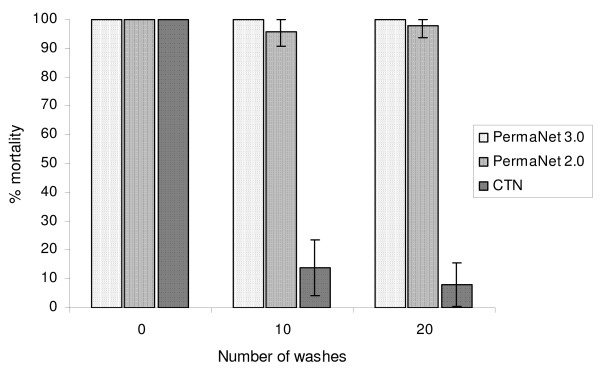
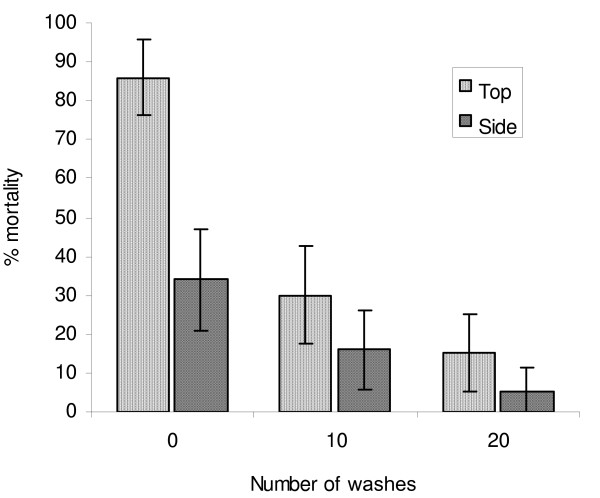
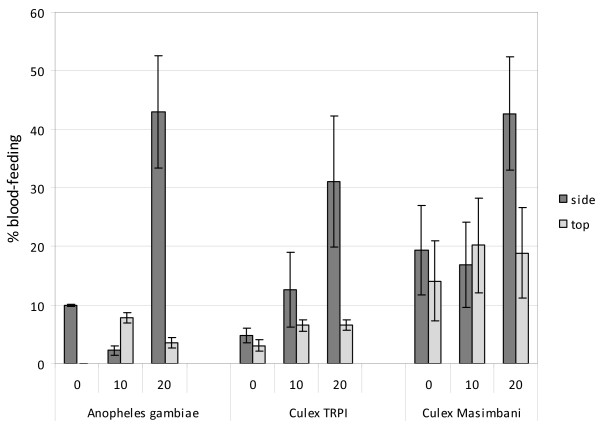
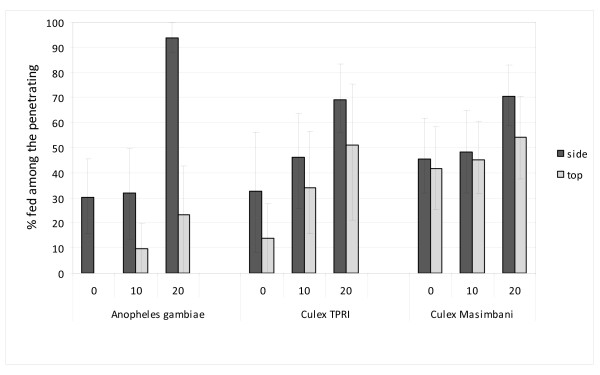
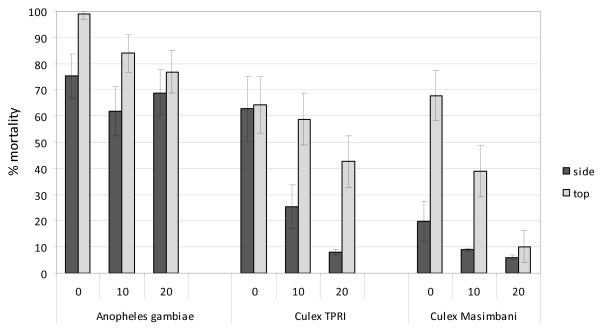
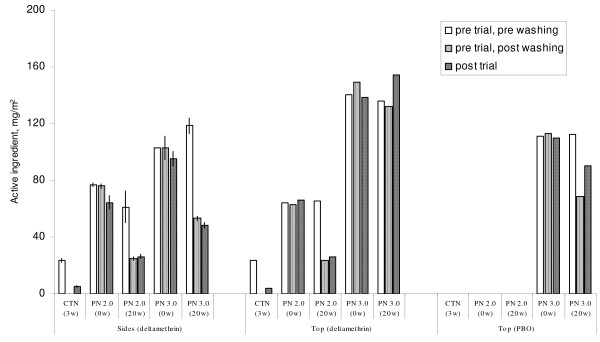
Background: Combination mosquito nets incorporating two unrelated insecticides or insecticide plus synergist are designed to control insecticide resistant mosquitoes. PermaNet 3.0 is a long-lasting combination net incorporating deltamethrin on the side panels and a mixture of deltamethrin and synergist piperonyl butoxide (PBO) on the top panel. PBO is an inhibitor of mixed function oxidases implicated in pyrethroid resistance. Method: An experimental hut trial comparing PermaNet 3.0, PermaNet 2.0 and a conventional deltamethrin-treated net was conducted in NE Tanzania using standard WHOPES procedures. The PermaNet arms included unwashed nets and nets washed 20 times. PermaNet 2.0 is a long-lasting insecticidal net incorporating deltamethrin as a single active. Results: Against pyrethroid susceptible Anopheles gambiae the unwashed PermaNet 3.0 showed no difference to unwashed PermaNet 2.0 in terms of mortality (95% killed), but showed differences in blood-feeding rate (3% blood-fed with PermaNet 3.0 versus 10% with PermaNet 2.0). After 20 washes the two products showed no difference in feeding rate (10% with 3.0 and 9% with 2.0) but showed small differences in mortality (95% with 3.0 and 87% with 2.0). Against pyrethroid resistant Culex quinquefasciatus, mediated by elevated oxidase and kdr mechanisms, the unwashed PermaNet 3.0 killed 48% and PermaNet 2.0 killed 32% but after 20 washes there was no significant difference in mortality between the two products (32% killed by 3.0 and 30% by 2.0). For protecting against Culex PermaNet 3.0 showed no difference to PermaNet 2.0 when either unwashed or after 20 washes; both products were highly protective against biting. Laboratory tunnel bioassays confirmed the loss of biological activity of the PBO/deltamethrin-treated panel after washing. Conclusion: Both PermaNet products were highly effective against susceptible Anopheles gambiae. As a long-lasting net to control or protect against pyrethroid resistant mosquitoes PermaNet 3.0 showed limited improvement over PermaNet 2.0 against Culex quinquefasciatus.
Overview
The claims and statistics of this paper haven’t been checked yet.
Run the check — free, no account needed. It reads the open-access text and checks the sources it cites.
Integrity signals
Registry
Cites
Statistics
Figures
Verification
Claims the paper makes
The claims and statistics of this paper haven’t been checked yet.
Run the check — free, no account needed. It reads the open-access text and checks the sources it cites.
Claims other papers make about this one
Each is checked against this paper’s own text: does it say what the citing paper says it does?
The cited source doesn’t support the claim as written.
In the citing paper
“Some of these have shown promising results against wild free-flying multi-resistant An. gambiae (s.s.) in experimental huts [34, 43–45].”
From Mapping insecticide resistance in Anopheles gambiae (s.l.) from Côte d'Ivoire (2018) · cites this paper as [43]
Checked by a reasoning model — may be wrong.
Experimental — accuracy not yet measuredThe cited source says what the claim attributes to it.
In the citing paper
“several of these new molecules or formulations are now in the pipe line [73, 78, 121–127].”
From Evolution of insecticide resistance and its mechanisms in Anopheles stephensi in the WHO Eastern Mediterranean Region (2020) · cites this paper as [126]
Self-check
Percentages, sums and reported differences re-computed from the paper’s own numbers.
The self-check needs the paper’s full text.
Citations
Cites
Statistical Methods in Medical Research
Lachenbruch, P. A., & Armitage, P. (1972) · Technometrics · doi:10.2307/1266938 · Cited by 1,728
Ecological Genetics Of Insecticide And Acaricide Resistance
Roush, R. T., & McKenzie, J. A. (1987) · Annual Review of Entomology · doi:10.1146/annurev.en.32.010187.002045 · Cited by 983
Artemisinin-Based Combination Treatment of Falciparum Malaria
Nosten, F. H., & White, N. J. (2007) · American Journal of Tropical Medicine and Hygiene · doi:10.4269/ajtmh.2007.77.181 · Cited by 663
Bhattarai, A., Ali, A. S., Kachur, S. P., Mårtensson, A., Abbas, A. K., Khatib, R., Al-mafazy, A.-W., Ramsan, M., Rotllant, G., Gerstenmaier, J. F., et al. (2007) · PLoS Medicine · doi:10.1371/journal.pmed.0040309 · Cited by 647 · cited 1×
“Recent trends confirm that the scale up of these two tools is making inroads into the malaria burden in many African countries [2-6].”
BackgroundAregawi, M. W., Cibulskis, R. E., Otten, M. W., Williams, R. O., & Dye, C. (2008) · Cited by 582
N’Guessan, R., Corbel, V., Akogbéto, M., & Rowland, M. (2007) · Emerging Infectious Diseases · doi:10.3201/eid1302.060631 · Cited by 548
Self-citationAnopheles funestus resistant to pyrethroid insecticides in South Africa
Hargreaves, K., Koekemoer, L. L., Brooke, B. D., Hunt, R. H., Mthembu, J., & Coetzee, M. (2000) · Medical and Veterinary Entomology · doi:10.1046/j.1365-2915.2000.00234.x · Cited by 530
Nosten, F., van Vugt, M., Price, R., Luxemburger, C., Thway, K., Brockman, A., McGready, R., ter Kuile, F., Looareesuwan, S., & White, N. (2000) · The Lancet · doi:10.1016/s0140-6736(00)02505-8 · Cited by 500
Changes in malaria indices between 1999 and 2007 in The Gambia: a retrospective analysis
Ceesay, S. J., Casals-Pascual, C., Erskine, J., Anya, S. E., Duah, N. O., Fulford, A. J., Sesay, S. S., Abubakar, I., Dunyo, S., Sey, O., et al. (2008) · The Lancet · doi:10.1016/s0140-6736(08)61654-2 · Cited by 425
Tactics for Managing Pesticide Resistance in Arthropods: Theory and Practice
Denholm, I., & Rowland, M. (1992) · Annual Review of Entomology · doi:10.1146/annurev.en.37.010192.000515 · Cited by 413
Self-citationThe Evolution of Resistance to Pesticides
Georghiou, G. P. (1972) · Annual Review of Ecology and Systematics · doi:10.1146/annurev.es.03.110172.001025 · Cited by 393
Corbel, V., N’Guessan, R., Brengues, C., Chandre, F., Djogbénou, L., Martin, T., Akogbeto, M. C., Hougard, J.-M., & Rowland, M. (2007) · Acta Tropica · doi:10.1016/j.actatropica.2007.01.005 · Cited by 382
Self-citationMüller, P., Warr, E., Stevenson, B. J., Pignatelli, P. M., Morgan, J. C., Steven, A., Yawson, A. E., Mitchell, S. N., Ranson, H., Hemingway, J., et al. (2008) · PLoS Genetics · doi:10.1371/journal.pgen.1000286 · Cited by 355
Designing resistance management programs: How can you choose?
Roush, R. T. (1989) · Pesticide Science · doi:10.1002/ps.2780260409 · Cited by 294
The decline in paediatric malaria admissions on the coast of Kenya
Okiro, E. A., Hay, S. I., Gikandi, P. W., Sharif, S. K., Noor, A. M., Peshu, N. M., Marsh, K., & Snow, R. W. (2007) · Malaria Journal · doi:10.1186/1475-2875-6-151 · Cited by 254
Nyarango, P. M., Gebremeskel, T., Mebrahtu, G., Mufunda, J., Abdulmumini, U., Ogbamariam, A., Kosia, A., Gebremichael, A., Gunawardena, D., Ghebrat, Y., et al. (2006) · Malaria Journal · doi:10.1186/1475-2875-5-33 · Cited by 254
SHARP, B. L., Ridl, F. C., Govender, D., Kuklinski, J., & Kleinschmidt, I. (2007) · Malaria Journal · doi:10.1186/1475-2875-6-52 · Cited by 240
Fegan, G. W., Noor, A. M., Akhwale, W. S., Cousens, S., & Snow, R. W. (2007) · The Lancet · doi:10.1016/s0140-6736(07)61477-9 · Cited by 237
Managing Resistance with Multiple Pesticide Tactics: Theory, Evidence, and Recommendations
Tabashnik, B. E. (1989) · Journal of Economic Entomology · doi:10.1093/jee/82.5.1263 · Cited by 230
Theoretical models of the use of insecticide mixtures for the management of resistance
Curtis, C. F. (1985) · Bulletin of Entomological Research · doi:10.1017/s0007485300014346 · Cited by 213
A new global malaria eradication strategy
Feachem, R., & Sabot, O. (2008) · The Lancet · doi:10.1016/s0140-6736(08)60424-9 · Cited by 183
Pyrethroid resistance in Culex quinquefasciatus from West Africa
Chandre, F., Darriet, F., Darder, M., Cuany, A., Doannio, J. M. C., Pasteur, N., & Guillet, P. (1998) · Medical and Veterinary Entomology · doi:10.1046/j.1365-2915.1998.00120.x · Cited by 176
Malaria eradication back on the table
Tanner, M., & de Savigny, D. (2008) · Bulletin of the World Health Organization · doi:10.2471/blt.07.050633 · Cited by 147
Berns, A. J. M. (2005) · Nature · doi:10.1038/436787a · Cited by 145
Guillet, P., N’Guessan, R., Darriet, F., Traore-Lamizana, M., Chandre, F., & Carnevale, P. (2001) · Medical and Veterinary Entomology · doi:10.1046/j.1365-2915.2001.00288.x · Cited by 137
Czeher, C., Labbo, R., Arzika, I., & Duchemin, J.-B. (2008) · Malaria Journal · doi:10.1186/1475-2875-7-189 · Cited by 134
Hill, J., Lines, J., & Rowland, M. (2006) · Advances in Parasitology/Advances in parasitology · doi:10.1016/s0065-308x(05)61003-2 · Cited by 124
Self-citationAsidi, A. N., N’Guessan, R., KOFFI, A. A., Curtis, C. F., Hougard, J., Chandre, F., Corbel, V., Darriet, F., Zaim, M., & Rowland, M. (2005) · Malaria Journal · doi:10.1186/1475-2875-4-25 · Cited by 108
Self-citationKolaczinski, J. H., Fanello, C. A., Hervé, J. P., Conway, D. J., Carnevale, P., & Curtis, C. F. (2000) · Bulletin of Entomological Research · doi:10.1017/s0007485300000237 · Cited by 100
Prospects for Malaria Eradication in Sub-Saharan Africa
Aguas, R. J., White, L. J., Snow, R. W., & Gomes, M. G. M. (2008) · PLoS ONE · doi:10.1371/journal.pone.0001767 · Cited by 88
Hougard, J.-M., Corbel, V., N’Guessan, R., Darriet, F., Chandre, F., Akogbeto, M. C., Baldet, T., Guillet, P., Carnevale, P., & Traore-Lamizana, M. (2003) · Bulletin of Entomological Research · doi:10.1079/ber2003261 · Cited by 84
McKenzie, C. L., & Byford, R. L. (1993) · Journal of Economic Entomology · doi:10.1093/jee/86.4.1040 · Cited by 51
Smith, A. (1965) · Bulletin of Entomological Research · doi:10.1017/s0007485300057114 · Cited by 50
Bortel, W. V., Chandre, F., Coosemans, M., Corbel, V., Gimnig, J. E., Hougard, J.-M., Ichimori, K., Jambulingam, P., Ladonni, H., Mulla, M. S., et al. (2009) · Cited by 39
Self-citationBhatt, R. M., Boakye, D. A., Chandre, F., Coosemans, M., Corbel, V., Gimnig, J. E., Nkuni, J., Lines, J. A., Pigeon, O., Rowland, M., et al. (2009) · Cited by 36
Self-citationOxborough, R. M., Mosha, F. W., Matowo, J., Mndeme, R., Feston, E., Hemingway, J., & Rowland, M. (2008) · Annals of Tropical Medicine and Parasitology · doi:10.1179/136485908x337553 · Cited by 34
Self-citationIs malaria eradication possible?
Lancet, T. (2007) · The Lancet · doi:10.1016/s0140-6736(07)61609-2 · Cited by 33
Khayrandish, A., & Wood, R. J. (1993) · Bulletin of Entomological Research · doi:10.1017/s0007485300041808 · Cited by 23
[Control of parasitic diseases].
Tarczyñski, S., Fagasiński, A., & Kuźmicki, R. (1970) · PubMed · Cited by 3
Research works printed but not linked: 2
- WHO: Report of the 11th WHOPES Working Group Meeting, 10-13 December 2007, Review of: Spinosad 7.48% DT, Netprotect®, Duranet®, Dawaplus®, ICON Maxx®. WHO Pesticide Evaluation Scheme. 2008
- WHO: Pesticides and their application. For the control of vectors and pests of public health importance. WHO/CDS/NTD/WHOPES/GCDPP/20061. 2006, Sixth
Cited by
Sorted by citations
Churcher, T. S., Lissenden, N., Griffin, J. T., Worrall, E., & Ranson, H. (2016) · eLife · doi:10.7554/elife.16090 · Cited by 312
Strode, C., Donegan, S., Garner, P., Enayati, A. A., & Hemingway, J. (2014) · PLoS Medicine · doi:10.1371/journal.pmed.1001619 · Cited by 274
Okumu, F. O., & Moore, S. (2011) · Malaria Journal · doi:10.1186/1475-2875-10-208 · Cited by 247
Implication of haematophagous arthropod salivary proteins in host-vector interactions
Fontaine, A., Diouf, I., Bakkali, N., Missé, D., Pagès, F., Fusaı̈, T., Rogier, C., & Alméras, L. (2011) · Parasites & Vectors · doi:10.1186/1756-3305-4-187 · Cited by 205
Linking human behaviours and malaria vector biting risk in south-eastern Tanzania
Finda, M. F., Moshi, I. R., Monroe, A. C., Limwagu, A. J., Nyoni, A. P., Swai, J. K., Ngowo, H. S., Minja, E. G., Toe, L. P., Kaindoa, E. W., et al. (2019) · PLoS ONE · doi:10.1371/journal.pone.0217414 · Cited by 179
Metadata
- Authors
- Tungu, P., Magesa, S., Maxwell, C., Malima, R., Masue, D., Sudi, W., Myamba, J., Pigeon, O., & Rowland, M.
- Affiliations
- National Institute for Medical Research (TZ)
- London School of Hygiene & Tropical Medicine (GB)
- Walloon Agricultural Research Centre (BE)
- Corresponding author
- Rowland, Mark
- Venue
- Malaria Journal
- Published
- 2010-01-19
- Volume
- 9
- Issue
- 1
- Pages
- 21-21
- ISSN
- 1475-2875 (ISSN-L)
- PMC
- PMC2817703
- OpenAlex
- W2150372462
- Cited by
- 119
- References
- 39
- Citations by year
- 2026: 5 · 2025: 5 · 2024: 2 · 2023: 8 · 2022: 4 · 2021: 12 · 2020: 5 · 2019: 6 · 2018: 9 · 2017: 7 · 2016: 5 · 2015: 9 · 2014: 9 · 2013: 11 · 2012: 6
- FWCI
- 10.50
- Type
- journal article
- Language
- en
- Open access
- gold
- doi.org
- Licence
- cc-by
- Locations
- Malaria Journal (publishedVersion, cc-by)
- PubMed Central (publishedVersion, cc-by)
- PubMed (publishedVersion)
- IHI Repository (acceptedVersion)
- LSHTM Research Online (London School of Hygiene and Tropical Medicine) (acceptedVersion)
- DOAJ (DOAJ: Directory of Open Access Journals) (submittedVersion, cc-by-sa)
- Topics
- Health Sciences › Medicine › Public Health, Environmental and Occupational Health › Malaria Research and Control
- Life Sciences › Agricultural and Biological Sciences › Plant Science › Insect Pest Control Strategies
- Life Sciences › Biochemistry, Genetics and Molecular Biology › Molecular Biology › Insect Resistance and Genetics
- Keywords
- long-lasting insecticidal nets, deltamethrin, piperonyl butoxide, pyrethroid resistance, Anopheles gambiae, Culex quinquefasciatus, insecticide resistance management, net washing, blood-feeding rate, mosquito mortality, kdr mutation, mixed function oxidase
- MeSH terms
- Animals, Anopheles, Culex, Drug Resistance, Feeding Behavior, Humans, Insecticides, Mosquito Control, Nitriles, Piperonyl Butoxide, Pyrethrins, Tanzania, Survival Analysis, Insecticide-Treated Bednets
About these checks
Registry, retraction, Cites and statistics results are computed, not judged, with one exception: a printed reference that no index lists is read once by a model before it counts as a citation error. Claims are extracted by a model and kept only when their quote appears verbatim in the text; each cited source is then checked, with a model’s help, for whether it says what the claim relies on. Those verdicts can be wrong — read the claim’s quote and the cited source before relying on one.
Statistics and arithmetic are recomputed, not judged.
Confidence bands are shown only for fields calibrated on our annotated test set. None is calibrated yet, so no band is shown.
What counts as a claim ›How we measure confidence ›How we check this ›
Are you an author, or do you see a problem with this page? Request a review
