

Design, implementation and validation of a novel open framework for agile development of mobile health applications
Open accessThe DOI matches its Crossref record; 49 of the 49 references it cites were found in a registry or an index.
Abstract
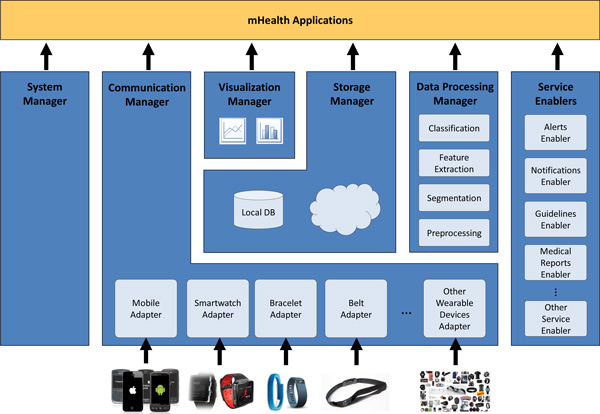
The delivery of healthcare services has experienced tremendous changes during the last years. Mobile health or mHealth is a key engine of advance in the forefront of this revolution. Although there exists a growing development of mobile health applications, there is a lack of tools specifically devised for their implementation. This work presents mHealthDroid, an open source Android implementation of a mHealth Framework designed to facilitate the rapid and easy development of mHealth and biomedical apps. The framework is particularly planned to leverage the potential of mobile devices such as smartphones or tablets, wearable sensors and portable biomedical systems. These devices are increasingly used for the monitoring and delivery of personal health care and wellbeing. The framework implements several functionalities to support resource and communication abstraction, biomedical data acquisition, health knowledge extraction, persistent data storage, adaptive visualization, system management and value-added services such as intelligent alerts, recommendations and guidelines. An exemplary application is also presented along this work to demonstrate the potential of mHealthDroid. This app is used to investigate on the analysis of human behavior, which is considered to be one of the most prominent areas in mHealth. An accurate activity recognition model is developed and successfully validated in both offline and online conditions.
Overview
The claims and statistics of this paper haven’t been checked yet.
Free: it reads the open-access text and checks the first 5 claims that cite a source we can check. Create a free account to check every claim.
Integrity signals
Registry
Cites
Statistics
Figures
Verification
Claims the paper makes
The claims and statistics of this paper haven’t been checked yet.
Free: it reads the open-access text and checks the first 5 claims that cite a source we can check. Create a free account to check every claim.
Claims other papers make about this one
Each is checked against this paper’s own text: does it say what the citing paper says it does?
In the citing paper
“Sensors placed at the left, chest, and right handles of 10 volunteers collected body signals and emergent indicators (swing rate, acceleration, magnet field direction), while performing 12 physical activities, such as Sitting and relaxing (Sit), Climbing stairs (CS), Walking (Walk), Standing still (Std), Waist bends forward (WBF), Climbing stairs (CS), Frontal elevation of arms (FEA), Jogging (Jog”
From Deep CNN-LSTM With Self-Attention Model for Human Activity Recognition Using Wearable Sensor (2022) · cites this paper as [21]
Self-check
Percentages, sums and reported differences re-computed from the paper’s own numbers.
The self-check needs the paper’s full text.
Citations
Cites
(1992) · Cited by 23,431
Book Review: Pattern Recognition and Machine Learning
Nasrabadi, N. M. (2007) · Journal of Electronic Imaging · doi:10.1117/1.2819119 · Cited by 22,066
The WEKA data mining software: an update
Hall, M., Frank, E., Holmes, G., Pfahringer, B., Reutemann, P., & Witten, I. H. (2009) · ACM SIGKDD Explorations Newsletter · doi:10.1145/1656274.1656278 · Cited by 17,750
Applied Linear Statistical Models
Ziegel, E. R., Neter, J., Wasserman, W., & Kutner, M. (1992) · Technometrics · doi:10.2307/1269588 · Cited by 9,907
A systematic analysis of performance measures for classification tasks
Sokolova, M., & Lapalme, G. (2009) · Information Processing & Management · doi:10.1016/j.ipm.2009.03.002 · Cited by 7,515
A survey of cross-validation procedures for model selection
Arlot, S., & Célisse, A. (2010) · LillOA (Université de Lille (University Of Lille)) · Cited by 3,663
A survey of cross-validation procedures for model selection
Arlot, S., & Celisse, A. (2010) · Statistics Surveys · doi:10.1214/09-ss054 · Cited by 3,522 · cited 1×
“In this study the latter validation technique is particularly considered since it leads to a better estimate of the performance of the recognition model [60].”
MethodActivity Recognition from User-Annotated Acceleration Data
Bao, L., & Intille, S. S. (2004) · Lecture Notes in Computer Science · doi:10.1007/978-3-540-24646-6_1 · Cited by 3,147
Activity recognition using cell phone accelerometers
Kwapisz, J. R., Weiss, G. M., & Moore, S. A. (2011) · ACM SIGKDD Explorations Newsletter · doi:10.1145/1964897.1964918 · Cited by 2,912 · cited 1×
“These features are typically used in activity recognition for their discrimination potential and easy interpretation in the acceleration domain [52-57].”
BackgroundA Survey on Human Activity Recognition using Wearable Sensors
Lara, O. D., & Labrador, M. A. (2013) · IEEE Communications Surveys & Tutorials · doi:10.1109/surv.2012.110112.00192 · Cited by 2,662
Research works printed but not linked: 1
- Bishop CM Pattern Recognition and Machine Learning 2006 1 Springer
Cited by
Deep multimodal learning: a survey on recent advances and trends
Ramachandram, D., & Taylor, G. W. (2017) · IEEE Signal Processing Magazine · doi:10.1109/msp.2017.2738401 · Cited by 1,139
Sensor-based and vision-based human activity recognition: A comprehensive survey
Minh Dang, L., Min, K., Wang, H., Jalil Piran, M., Hee Lee, C., & Moon, H. (2020) · Pattern Recognition · doi:10.1016/j.patcog.2020.107561 · Cited by 730
UniMiB SHAR: A Dataset for Human Activity Recognition Using Acceleration Data from Smartphones
Micucci, D., Mobilio, M., & Napoletano, P. (2017) · doi:10.20944/preprints201706.0033.v2 · Cited by 596
Deep Learning in Human Activity Recognition with Wearable Sensors: A Review on Advances
Zhang, S., Li, Y., Zhang, S., Shahabi, F., Xia, S., Deng, Y., & Alshurafa, N. (2022) · Sensors · doi:10.3390/s22041476 · Cited by 625
“6 50–200 Hz 37 Daily & Sports Activities [19] Locomotion 9D IMU 19 25 Hz 37 MHEALTH [30, 31] Locomotion & gesture 9D IMU & ECG 12 50 Hz 33 Opportunity [59] Locomotion & gesture 9D IMU 16 50 Hz 32 PAMAP2 [228] Locomotion & activities 9D IMU & HR monitor 18 100 Hz 32 Daphnet [23] Freezing of gait 3D Acc.”
BackgroundMethodUniMiB SHAR: A Dataset for Human Activity Recognition Using Acceleration Data from Smartphones
Micucci, D., Mobilio, M., & Napoletano, P. (2017) · Applied Sciences · doi:10.3390/app7101101 · Cited by 596
Ramanujam, E., Perumal, T., & Padmavathi, S. (2021) · IEEE Sensors Journal · doi:10.1109/jsen.2021.3069927 · Cited by 455
The Use and Effectiveness of Mobile Apps for Depression: Results From a Fully Remote Clinical Trial
Arean, P. A., Hallgren, K. A., Jordan, J. T., Gazzaley, A., Atkins, D. C., Heagerty, P. J., & Anguera, J. A. (2016) · Journal of Medical Internet Research · doi:10.2196/jmir.6482 · Cited by 376
Deep CNN-LSTM With Self-Attention Model for Human Activity Recognition Using Wearable Sensor
Khatun, M. A., Yousuf, M. A., Ahmed, S., Uddin, M. Z., Alyami, S. A., Al-Ashhab, S., Akhdar, H. F., Khan, A., Azad, A., & Moni, M. A. (2022) · IEEE Journal of Translational Engineering in Health and Medicine · doi:10.1109/jtehm.2022.3177710 · Cited by 288
“H-Activity and two additional publicly available datasets, namely MHEALTH [20], [21] and UCI-HAR [22] were used for evaluating the proposed method.”
A comprehensive survey on multimodal medical signals fusion for smart healthcare systems
Muhammad, G., Alshehri, F., Karray, F., Saddik, A. E., Alsulaiman, M., & Falk, T. H. (2021) · Information Fusion · doi:10.1016/j.inffus.2021.06.007 · Cited by 287
A comparative review on multi-modal sensors fusion based on deep learning
Tang, Q., Liang, J., & Zhu, F. (2023) · Signal Processing · doi:10.1016/j.sigpro.2023.109165 · Cited by 280
A Comprehensive Analysis on Wearable Acceleration Sensors in Human Activity Recognition
Janidarmian, M., Roshan Fekr, A., Radecka, K., & Zilic, Z. (2017) · Sensors · doi:10.3390/s17030529 · Cited by 217
“(8) [22] 10 accelerometer gyroscope magnetometer (Shimmer) 50 Hz chest, right wrist, left ankle (3) walking, sitting and relaxing, standing still, lying down, climbing stairs, running, cycling, etc.”
BackgroundSensor-Based Datasets for Human Activity Recognition – A Systematic Review of Literature
De-La-Hoz-Franco, E., Ariza-Colpas, P., Quero, J. M., & Espinilla, M. (2018) · IEEE Access · doi:10.1109/access.2018.2873502 · Cited by 209
“The mHealth dataset [63], [80] (also available in the UCI repository), contains body motion and vital sign recordings for ten volunteers performing several physical actions (standing still, sitting and relaxing, lying down, walking, climbing stairs, bending waist forward, front arm elevation, knee bending, cycling, jo…”
BackgroundDeep ConvLSTM With Self-Attention for Human Activity Decoding Using Wearable Sensors
Singh, S. P., Sharma, M. K., Lay-Ekuakille, A., Gangwar, D., & Gupta, S. (2021) · IEEE Sensors Journal · doi:10.1109/jsen.2020.3045135 · Cited by 199
Gholamiangonabadi, D., Kiselov, N., & Grolinger, K. (2020) · IEEE Access · doi:10.1109/access.2020.3010715 · Cited by 196
“This section reviews recent works on a sensor-based HAR and focuses on the studies that used the MHEALTH dataset [28], [29] because this dataset allows us to compare results with literature.”
ResultSmart healthcare framework for ambient assisted living using IoMT and big data analytics techniques
Syed, L., Jabeen, S., S., M., & Alsaeedi, A. (2019) · Future Generation Computer Systems · doi:10.1016/j.future.2019.06.004 · Cited by 195
Uddin, M. Z., Hassan, M. M., Alsanad, A., & Savaglio, C. (2020) · Information Fusion · doi:10.1016/j.inffus.2019.08.004 · Cited by 194
Uddin, M. Z. (2019) · Journal of Parallel and Distributed Computing · doi:10.1016/j.jpdc.2018.08.010 · Cited by 181
Zdravevski, E., Lameski, P., Trajkovik, V., Kulakov, A., Chorbev, I., Goleva, R., Pombo, N., & Garcia, N. (2017) · IEEE Access · doi:10.1109/access.2017.2684913 · Cited by 170
“The sensor positioned on the chest also provided 2-lead ECG measurements, which were not used in the original study [12], however they are analyzed in our study.”
BackgroundMethodInfluentialA Hybrid Deep Learning Model for Human Activity Recognition Using Multimodal Body Sensing Data
Gumaei, A., Hassan, M. M., Alelaiwi, A., & Alsalman, H. (2019) · IEEE Access · doi:10.1109/access.2019.2927134 · Cited by 157
Continuous health monitoring of sportsperson using IoT devices based wearable technology
Huifeng, W., Kadry, S. N., & Raj, E. D. (2020) · Computer Communications · doi:10.1016/j.comcom.2020.04.025 · Cited by 155
IoT based mobile healthcare system for human activity recognition
Subasi, A., Radhwan, M., Kurdi, R., & Khateeb, K. (2018) · 2018 15th Learning and Technology Conference (L&T) · doi:10.1109/lt.2018.8368507 · Cited by 146
Semwal, V. B., Gupta, A., & Lalwani, P. (2021) · The Journal of Supercomputing · doi:10.1007/s11227-021-03768-7 · Cited by 151
“To validate our collected data set, the previously available MHEALTh data set is considered as benchmark data set for comparing results with our collected data [31].”
ResultUddin, M. Z., & Soylu, A. (2021) · Scientific Reports · doi:10.1038/s41598-021-95947-y · Cited by 147
Noorbergen, T. J., Adam, M. T. P., Teubner, T., & Collins, C. E. (2021) · JMIR mhealth and uhealth · doi:10.2196/27896 · Cited by 146
MÉTODOS PARA DESENVOLVIMENTO DE APLICATIVOS MÓVEIS EM SAÚDE: REVISÃO INTEGRATIVA DA LITERATURA
Barra, D. C. C., Paim, S. M. S., Sasso, G. T. M. D., & Colla, G. W. (2018) · Texto & Contexto - Enfermagem · doi:10.1590/0104-07072017002260017 · Cited by 237
Tahir, S. B. U. D., Jalal, A., & Kim, K. (2020) · Entropy · doi:10.3390/e22050579 · Cited by 118
Theoretical Advancements in mHealth: A Systematic Review of Mobile Apps
Chib, A., & Lin, S. H. (2018) · Journal of Health Communication · doi:10.1080/10810730.2018.1544676 · Cited by 107
Edge-Cloud Computing for IoT Data Analytics: Embedding Intelligence in the Edge with Deep Learning
Ghosh, A. M., & Grolinger, K. (2020) · IEEE Transactions on Industrial Informatics · doi:10.1109/tii.2020.3008711 · Cited by 210
A Decade of Internet of Things: Analysis in the Light of Healthcare Applications
Din, I. U., Almogren, A., Guizani, M., & Zuair, M. (2019) · IEEE Access · doi:10.1109/access.2019.2927082 · Cited by 110
Human activity recognition from sensor data using spatial attention-aided CNN with genetic algorithm
Sarkar, A., Hossain, S., & Sarkar, R. (2022) · Neural Computing and Applications · doi:10.1007/s00521-022-07911-0 · Cited by 119
(2021) · doi:10.2196/29512 · Cited by 91
Physical Activity Recognition Using Posterior-Adapted Class-Based Fusion of Multiaccelerometer Data
Chowdhury, A. K., Tjondronegoro, D., Chandran, V., & Trost, S. G. (2017) · IEEE Journal of Biomedical and Health Informatics · doi:10.1109/jbhi.2017.2705036 · Cited by 98
Deep Learning for Heterogeneous Human Activity Recognition in Complex IoT Applications
Abdel‐Basset, M., Hawash, H., Chang, V. I. C., Chakrabortty, R. K., & Ryan, M. J. (2020) · IEEE Internet of Things Journal · doi:10.1109/jiot.2020.3038416 · Cited by 88
Older adults’ attitudes and barriers toward the use of mobile phones
Ghaffari, F., Navabi, N., & Alipoor, Z. J. (2016) · Clinical Interventions in Aging · doi:10.2147/cia.s112893 · Cited by 97
TS-GAN: Time-series GAN for Sensor-based Health Data Augmentation
Yang, Z., Li, Y., & Zhou, G. (2023) · ACM Transactions on Computing for Healthcare · doi:10.1145/3583593 · Cited by 102
Edge computing based secure health monitoring framework for electronic healthcare system
Singh, A., & Chatterjee, K. (2023) · Cluster Computing · doi:10.1007/s10586-022-03717-w · Cited by 69
Trends in human activity recognition with focus on machine learning and power requirements
Nguyen, B., Coelho, Y., Bastos-Filho, T., & Krishnan, S. (2021) · Machine Learning with Applications · doi:10.1016/j.mlwa.2021.100072 · Cited by 93
FedStack: Personalized activity monitoring using stacked federated learning
Shaik, T., Tao, X., Higgins, N., Gururajan, R., Li, Y., Zhou, X., & Acharya, U. R. (2022) · Knowledge-Based Systems · doi:10.1016/j.knosys.2022.109929 · Cited by 85
Multi-sensor fusion based on multiple classifier systems for human activity identification
Nweke, H. F., Wah, T. Y., Mujtaba, G., Alo, U. R., & Al-Garadi, M. A. (2019) · Human-centric Computing and Information Sciences · doi:10.1186/s13673-019-0194-5 · Cited by 78
A Lightweight Framework for Human Activity Recognition on Wearable Devices
Coelho, Y. L., Santos, F. D. A. S. D., Frizera-Neto, A., & Bastos-Filho, T. F. (2021) · IEEE Sensors Journal · doi:10.1109/jsen.2021.3113908 · Cited by 57
Extending the framework for mobile health information systems Research: A content analysis
Miah, S. J., Gammack, J. G., & Hasan, N. (2017) · Information Systems · doi:10.1016/j.is.2017.04.001 · Cited by 76
Edge-Assisted Solutions for IoT-Based Connected Healthcare Systems: A Literature Review
Hayyolalam, V., Aloqaily, M., Özkasap, Ö., & Guizani, M. (2021) · IEEE Internet of Things Journal · doi:10.1109/jiot.2021.3135200 · Cited by 73
The Mining Minds digital health and wellness framework
Baños, O., Amin, M. B., Khan, W. A., Afzal, M., Hussain, M., Kang, B. H., & Lee, S. Y. (2016) · BioMedical Engineering OnLine · doi:10.1186/s12938-016-0179-9 · Cited by 65
Self-citationChest-Worn Inertial Sensors: A Survey of Applications and Methods
Rahmani, M. H., Berkvens, R., & Weyn, M. (2021) · Sensors · doi:10.3390/s21082875 · Cited by 62
Healthcare support for underserved communities using a mobile social media platform
Miah, S. J., Hasan, N., Hasan, R., & Gammack, J. G. (2017) · Information Systems · doi:10.1016/j.is.2017.01.001 · Cited by 66
Ye, Q., Deng, Z., Chen, Y., Liao, J., Li, G., & Lu, Y. (2019) · JMIR mhealth and uhealth · doi:10.2196/13491 · Cited by 55
Choosing the Best Sensor Fusion Method: A Machine-Learning Approach
Brena, R., Aguileta, A. A., Trejo, L. A., Minero, E. M., & Mayora, O. (2020) · Sensors · doi:10.3390/s20082350 · Cited by 68
Fujiwara, T., Shilpika, Sakamoto, N., Nonaka, J., Yamamoto, K., & Ma, K. (2020) · IEEE Transactions on Visualization and Computer Graphics · doi:10.1109/tvcg.2020.3028889 · Cited by 59
Avaliação de aplicativos móveis para promoção da saúde de gestantes com pré-eclâmpsia
Gomes, M. L. D. S., Rodrigues, I. R., Moura, N. D. S., Bezerra, K. D. C., Lopes, B. B., Teixeira, J. J. D., Vasconcelos, C. T. M., & Oriá, M. O. B. (2019) · Acta Paulista de Enfermagem · doi:10.1590/1982-0194201900038 · Cited by 47
MyoGym: introducing an open gym data set for activity recognition collected using myo armband
Koskimäki, H., Siirtola, P., & Röning, J. (2017) · Proceedings of the 2017 ACM International Joint Conference on Pervasive and Ubiquitous Computing and Proceedings of the 2017 ACM International Symposium on Wearable Computers · doi:10.1145/3123024.3124400 · Cited by 46
“Although, there currently are several open data sets [1, 20, 5, 3, 25, 6, 7, 8, 24, 19, 27, 11] many of those are based merely on IMU data and more versatile data sets would be needed to renew the approaches.”
BackgroundGhaleb, F. A. A., Kamat, M. B., Salleh, M., Rohani, M. F., & Razak, S. B. A. (2018) · PLoS ONE · doi:10.1371/journal.pone.0207176 · Cited by 50
Pinheiro, H. M., & da Costa, R. M. (2021) · Journal of Biomedical Informatics · doi:10.1016/j.jbi.2021.103757 · Cited by 44
A smart e-health framework for monitoring the health of the elderly and disabled
Yazıcı, A., Zhumabekova, D. Z., Nurakhmetova, A., Yergaliyev, Z., Yatbaz, H. Y., Makisheva, Z., Lewis, M., & Ever, E. (2023) · Internet of Things · doi:10.1016/j.iot.2023.100971 · Cited by 52
Zdravevski, E., Stojkoska, B. R., Standl, M., & Schulz, H. (2017) · PLoS ONE · doi:10.1371/journal.pone.0184216 · Cited by 52
Real-Time Physical Activity Recognition on Smart Mobile Devices Using Convolutional Neural Networks
Πέππας, Κ., Tsolakis, A. C., Krinidis, S., & Tzovaras, D. (2020) · Applied Sciences · doi:10.3390/app10238482 · Cited by 43
Deep Triplet Networks with Attention for Sensor-based Human Activity Recognition
Khaertdinov, B., Ghaleb, E., & Asteriadis, S. (2021) · IEEE International Conference on Pervasive Computing and Communications · doi:10.1109/percom50583.2021.9439116 · Cited by 52
Virtual grasps recognition using fusion of Leap Motion and force myography
Jiang, X., Xiao, Z. G., & Menon, C. (2018) · Virtual Reality · doi:10.1007/s10055-018-0339-2 · Cited by 42
Real‐world multimodal lifelog dataset for human behavior study
Chung, S., Jeong, C. Y., Lim, J., Lim, J., Noh, K. J., Kim, G., & Jeong, H. (2021) · ETRI Journal · doi:10.4218/etrij.2020-0446 · Cited by 49
MIMU-Wear: Ontology-based sensor selection for real-world wearable activity recognition
Villalonga, C., Pomares, H., Rojas, I., & Baños, O. (2017) · Neurocomputing · doi:10.1016/j.neucom.2016.09.125 · Cited by 42
Self-citationUnsupervised Learning with Contrastive Latent Variable Models
Severson, K., Ghosh, S., & Ng, K. (2019) · Proceedings of the AAAI Conference on Artificial Intelligence · doi:10.1609/aaai.v33i01.33014862 · Cited by 33
Chen, T. (2020) · Health Policy and Technology · doi:10.1016/j.hlpt.2020.02.005 · Cited by 41
Human activity recognition: suitability of a neuromorphic approach for on-edge AIoT applications
Fra, V., Forno, E., Pignari, R., Stewart, T. C., Macii, E., & Urgese, G. (2022) · Neuromorphic Computing and Engineering · doi:10.1088/2634-4386/ac4c38 · Cited by 60
A Wrist-Worn Piezoelectric Sensor Array for Gesture Input
Booth, R., & Goldsmith, P. B. (2017) · Journal of Medical and Biological Engineering · doi:10.1007/s40846-017-0303-8 · Cited by 42
Recurrence and Self-attention vs the Transformer for Time-Series Classification: A Comparative Study
Katrompas, A., Ntakouris, T., & Metsis, V. (2022) · Lecture notes in computer science · doi:10.1007/978-3-031-09342-5_10 · Cited by 57
Suglia, V., Palazzo, L., Bevilacqua, V., Passantino, A., Pagano, G., & D’Addio, G. (2024) · Sensors · doi:10.3390/s24072199 · Cited by 50
A time-efficient convolutional neural network model in human activity recognition
Gholamrezaii, M., & Almodarresi, S. M. T. (2021) · Multimedia Tools and Applications · doi:10.1007/s11042-020-10435-1 · Cited by 40
Current Knowledge and Future Possibilities of Medical Digital Technologies based on Mobile Health
Salameh, A. A. M., Abu-AlSondos, I. A., Abu, N. H., & Harun, A. N. (2023) · International Journal of Interactive Mobile Technologies (iJIM) · doi:10.3991/ijim.v17i17.42801 · Cited by 43
Deep Transfer Learning with Graph Neural Network for Sensor-Based Human Activity Recognition
Liao, T., Zhao, J., Liu, Y., Ivanov, K., Xiong, J., & Yan, Y. (2022) · 2022 IEEE International Conference on Bioinformatics and Biomedicine (BIBM) · doi:10.1109/bibm55620.2022.9995660 · Cited by 36
“Further details on the experimental data collection can be found in [47], [48]”
BackgroundChen, K., Yao, L., Wang, X., Zhang, D., Gu, T., Yu, Z., & Yang, Z. (2018) · 2018 International Joint Conference on Neural Networks (IJCNN) · doi:10.1109/ijcnn.2018.8489767 · Cited by 36
Agile Software Development in Healthcare: A Synthetic Scoping Review
Kokol, P. (2022) · Applied Sciences · doi:10.3390/app12199462 · Cited by 45
Digital Twin Enabled Asynchronous SplitFed Learning in E-Healthcare Systems
Stephanie, V., Khalil, I., & Atiquzzaman, M. (2023) · IEEE Journal on Selected Areas in Communications · doi:10.1109/jsac.2023.3310103 · Cited by 43
Design for mobile mental health: an exploratory review
Aryana, B., Brewster, L., & Abdelnour-Nocera, J. (2018) · Health and Technology · doi:10.1007/s12553-018-0271-1 · Cited by 41
Gradient Boosted Neural Decision Forest
Dong, M., Yao, L., Wang, X., Benatallah, B., Zhang, S., & Sheng, Q. Z. (2021) · IEEE Transactions on Services Computing · doi:10.1109/tsc.2021.3133673 · Cited by 46
User stories as lightweight requirements for agile clinical decision support development
Kannan, V., Basit, M. A., Bajaj, P., Carrington, A., Donahue, I. B., Flahaven, E. L., Medford, R. J., Melaku, T., Moran, B., Saldana, L., et al. (2019) · Journal of the American Medical Informatics Association · doi:10.1093/jamia/ocz123 · Cited by 39
Bento, N., Rebelo, J., Barandas, M., Carreiro, A. V., Campagner, A., Cabitza, F., & Gamboa, H. F. S. (2022) · Sensors · doi:10.3390/s22197324 · Cited by 51
Birjiniuk, J., Timmins, L. H., Young, M., Leshnower, B. G., Oshinski, J. N., Ku, D. N., & Veeraswamy, R. K. (2017) · Cardiovascular Engineering and Technology · doi:10.1007/s13239-017-0312-3 · Cited by 32
Personalized Activity Recognition with Deep Triplet Embeddings
Burns, D., Boyer, P., Arrowsmith, C., & Whyne, C. M. (2022) · Sensors · doi:10.3390/s22145222 · Cited by 42
Human Activity Recognition Using Wearable Sensors Based on Image Classification
Zebhi, S. (2022) · IEEE Sensors Journal · doi:10.1109/jsen.2022.3174280 · Cited by 37
Development and Feasibility of Self-Management Application in Left-Ventricular Assist Devices
Casida, J. M., Aikens, J. E., Craddock, H., Aldrich, M. W., & Pagani, F. D. (2017) · ASAIO Journal · doi:10.1097/mat.0000000000000673 · Cited by 35
A Public Domain Dataset for Human Activity Recognition in Free-Living Conditions
Cruciani, F., Sun, C., Zhang, S., Nugent, C., Li, C., Song, S., Cheng, C., Cleland, I., & McCullagh, P. J. (2019) · IEEE SmartWorld, Ubiquitous Intelligence & Computing, Advanced & Trusted Computing, Scalable Computing & Communications, Cloud & Big Data Computing, Internet of People and Smart City Innovation (SmartWorld/SCALCOM/UIC/ATC/CBDCom/IOP/SCI) · doi:10.1109/smartworld-uic-atc-scalcom-iop-sci.2019.00071 · Cited by 38
Smartphone Sensor-Based Human Activity Recognition Robust to Different Sampling Rates
Hasegawa, T. (2020) · IEEE Sensors Journal · doi:10.1109/jsen.2020.3038281 · Cited by 32
El‐Shafai, W., & Hemdan, E. E. (2021) · Journal of Ambient Intelligence and Humanized Computing · doi:10.1007/s12652-021-03494-1 · Cited by 30
Amoon, M., Altameem, T. A., & Altameem, A. (2020) · Measurement · doi:10.1016/j.measurement.2020.107861 · Cited by 37
UniMiB SHAR: a new dataset for human activity recognition using acceleration data from smartphones
Micucci, D., Mobilio, M., & Napoletano, P. (2016) · arXiv (Cornell University) · doi:10.48550/arxiv.1611.07688 · Cited by 30
In-depth analysis of design & development for sensor-based human activity recognition system
Choudhury, N. A., & Soni, B. (2023) · Multimedia Tools and Applications · doi:10.1007/s11042-023-16423-5 · Cited by 30
A compressive multi-kernel method for privacy-preserving machine learning
Chanyaswad, T., Chang, J. M., & Kung, S. (2017) · International Joint Conference on Neural Networks (IJCNN) · doi:10.1109/ijcnn.2017.7966371 · Cited by 28
Oleh, U., Obermaisser, R., & Ahammed, A. S. (2024) · Algorithms · doi:10.3390/a17100434 · Cited by 40
The effect of coarctation degrees on wall shear stress indices
Rafiei, D., Abazari, M. A., Soltani, M., & Alimohammadi, M. (2021) · Scientific Reports · doi:10.1038/s41598-021-92104-3 · Cited by 30
Advances in Machine Learning for Sensing and Condition Monitoring
Ao, S.-I., Gelman, L., Karimi, H. R., & Tiboni, M. (2022) · Applied Sciences · doi:10.3390/app122312392 · Cited by 34
A Review and Analysis of Mobile Health Applications for Alzheimer Patients and Caregivers
Gupta, G., Gupta, A. R., Jaiswal, V., & Ansari, M. D. (2018) · International Conference on Parallel, Distributed and Grid Computing (PDGC) · doi:10.1109/pdgc.2018.8745995 · Cited by 30
Larian, H., & Safi-Esfahani, F. (2025) · Computing · doi:10.1007/s00607-024-01388-6 · Cited by 25
Ram, S. S., Apduhan, B. O., & Shiratori, N. (2019) · Lecture notes in computer science · doi:10.1007/978-3-030-24302-9_30 · Cited by 31
Desenvolvimento de aplicativo móvel para o acompanhamento pré-natal e validação de conteúdo
Souza, F. M. D. L. C., dos Santos, W. N., Dantas, J. D. C., de Sousa, H. R. A., Moreira, O. A. A., & da Silva, R. A. R. (2022) · Acta Paulista de Enfermagem · doi:10.37689/acta-ape/2022ao01861 · Cited by 62
CareToy: Stimulation and Assessment of Preterm Infant’s Activity Using a Novel Sensorized System
Rihar, A., Sgandurra, G., Beani, E., Cecchi, F., Pašič, J., Cioni, G., Dario, P., Mihelj, M., & Munih, M. (2016) · Annals of Biomedical Engineering · doi:10.1007/s10439-016-1669-4 · Cited by 24
Nonlinear Dimensionality Reduction for Discriminative Analytics of Multiple Datasets
Chen, J., Wang, G., & Giannakis, G. B. (2018) · IEEE Transactions on Signal Processing · doi:10.1109/tsp.2018.2885478 · Cited by 24
Hur, T., Bang, J., Kim, D., Baños, O., & Lee, S. (2017) · Sensors · doi:10.3390/s17040931 · Cited by 23
Self-citationEffect of plaque compositions on fractional flow reserve in a fluid–structure interaction analysis
Wu, C., Liu, X., Ghista, D. N., Yin, Y., & Zhang, H. (2021) · Biomechanics and Modeling in Mechanobiology · doi:10.1007/s10237-021-01529-2 · Cited by 23
GraFeHTy: Graph Neural Network using Federated Learning for Human Activity Recognition
Sarkar, A., Sen, T., & Roy, A. K. (2021) · International Conference on Machine Learning and Applications · doi:10.1109/icmla52953.2021.00184 · Cited by 31
Guardians of the Deep Fog: Failure-Resilient DNN Inference from Edge to Cloud
Yousefpour, A., Devic, S., Nguyen, B., Kreidieh, A., Liao, A., Bayen, A. M., & Jue, J. P. (2019) · International Workshop on Challenges in Artificial Intelligence and Machine Learning for Internet of Things (AIChallengeIoT) · doi:10.1145/3363347.3363366 · Cited by 34
Liyakathunisa, Alsaeedi, A., Jabeen, S., & Kolivand, H. (2021) · Journal of Ambient Intelligence and Smart Environments · doi:10.3233/ais-210162 · Cited by 28
Metadata
- Authors
- Banos, O., Villalonga, C., Garcia, R., Saez, A., Damas, M., Holgado-Terriza, J. A., Lee, S., Pomares, H., & Rojas, I.
- Affiliations
- Universidad de Granada (ES)
- Kyung Hee University (KR)
- ORCID
- Venue
- BioMedical Engineering OnLine
- Published
- 2015
- Volume
- 14
- Issue
- Suppl 2
- Pages
- S6
- ISSN
- 1475-925X (ISSN-L)
- PMC
- PMC4547155
- OpenAlex
- W1852728451
- Cited by
- 321
- References
- 49
- Citations by year
- 2026: 13 · 2025: 21 · 2024: 36 · 2023: 36 · 2022: 42 · 2021: 48 · 2020: 32 · 2019: 29 · 2018: 24 · 2017: 28 · 2016: 9 · 2015: 3
- Type
- conference abstract
- Language
- en
- Open access
- gold
- doi.org
- Licence
- cc-by
- Locations
- BioMedical Engineering OnLine (publishedVersion, cc-by)
- Europe PMC (PubMed Central) (publishedVersion, cc-by)
- PubMed Central (publishedVersion, cc-by)
- PubMed (publishedVersion)
- Funders
- Ministry of Trade, Industry and Energy (10049079)
- Topics
- Health Sciences › Health Professions › General Health Professions › Mobile Health and mHealth Applications
- Physical Sciences › Computer Science › Computer Vision and Pattern Recognition › Context-Aware Activity Recognition Systems
- Health Sciences › Health Professions › Health Information Management › Innovation in Digital Healthcare Systems
- Keywords
- mobile health, open source software framework, Android, wearable sensors, adaptive visualization, human behavior analysis, activity recognition, personal health monitoring
- MeSH terms
- Humans, Time Factors, Health Behavior, Information Storage and Retrieval, Telemedicine, Electronic Health Records, Mobile Applications
About these checks
Registry, retraction, Cites and statistics results are computed, not judged, with one exception: a printed reference that no index lists is read once by a model before it counts as a citation error. Claims are extracted by a model and kept only when their quote appears verbatim in the text; each cited source is then checked, with a model’s help, for whether it says what the claim relies on. Those verdicts can be wrong — read the claim’s quote and the cited source before relying on one.
Statistics and arithmetic are recomputed, not judged.
Confidence bands are shown only for fields calibrated on our annotated test set. None is calibrated yet, so no band is shown.
What counts as a claim ›How we measure confidence ›How we check this ›
Are you an author, or do you see a problem with this page? Request a review
Data sources
Bibliographic data: Semantic Scholar, OpenAlex, Crossref.
Contains information from the Semantic Scholar Academic Graph Datasets, made available under the ODC Attribution License (ODC-BY 1.0).
Semantic Scholar’s data is described in: Kinney, R., et al. (2023). The Semantic Scholar Open Data Platform. arXiv:2301.10140.
