

Design, implementation and validation of a novel open framework for agile development of mobile health applications
Open accessThe DOI matches its Crossref record; 49 of the 49 references it cites were found in a registry or an index.
Abstract
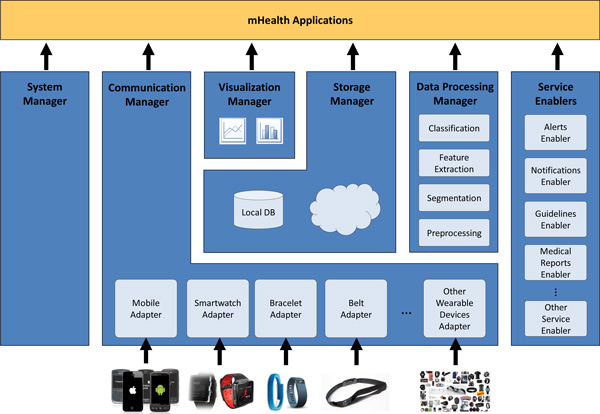
The delivery of healthcare services has experienced tremendous changes during the last years. Mobile health or mHealth is a key engine of advance in the forefront of this revolution. Although there exists a growing development of mobile health applications, there is a lack of tools specifically devised for their implementation. This work presents mHealthDroid, an open source Android implementation of a mHealth Framework designed to facilitate the rapid and easy development of mHealth and biomedical apps. The framework is particularly planned to leverage the potential of mobile devices such as smartphones or tablets, wearable sensors and portable biomedical systems. These devices are increasingly used for the monitoring and delivery of personal health care and wellbeing. The framework implements several functionalities to support resource and communication abstraction, biomedical data acquisition, health knowledge extraction, persistent data storage, adaptive visualization, system management and value-added services such as intelligent alerts, recommendations and guidelines. An exemplary application is also presented along this work to demonstrate the potential of mHealthDroid. This app is used to investigate on the analysis of human behavior, which is considered to be one of the most prominent areas in mHealth. An accurate activity recognition model is developed and successfully validated in both offline and online conditions.
Overview
The claims and statistics of this paper haven’t been checked yet.
Free: it reads the open-access text and checks the first 5 claims that cite a source we can check. Create a free account to check every claim.
Integrity signals
Registry
Cites
Statistics
Figures
Verification
Claims the paper makes
The claims and statistics of this paper haven’t been checked yet.
Free: it reads the open-access text and checks the first 5 claims that cite a source we can check. Create a free account to check every claim.
Claims other papers make about this one
Each is checked against this paper’s own text: does it say what the citing paper says it does?
In the citing paper
“Sensors placed at the left, chest, and right handles of 10 volunteers collected body signals and emergent indicators (swing rate, acceleration, magnet field direction), while performing 12 physical activities, such as Sitting and relaxing (Sit), Climbing stairs (CS), Walking (Walk), Standing still (Std), Waist bends forward (WBF), Climbing stairs (CS), Frontal elevation of arms (FEA), Jogging (Jog”
From Deep CNN-LSTM With Self-Attention Model for Human Activity Recognition Using Wearable Sensor (2022) · cites this paper as [21]
Self-check
Percentages, sums and reported differences re-computed from the paper’s own numbers.
The self-check needs the paper’s full text.
Citations
Cites
(1992) · Cited by 23,431
Book Review: Pattern Recognition and Machine Learning
Nasrabadi, N. M. (2007) · Journal of Electronic Imaging · doi:10.1117/1.2819119 · Cited by 22,066
The WEKA data mining software: an update
Hall, M., Frank, E., Holmes, G., Pfahringer, B., Reutemann, P., & Witten, I. H. (2009) · ACM SIGKDD Explorations Newsletter · doi:10.1145/1656274.1656278 · Cited by 17,750
Applied Linear Statistical Models
Ziegel, E. R., Neter, J., Wasserman, W., & Kutner, M. (1992) · Technometrics · doi:10.2307/1269588 · Cited by 9,907
A systematic analysis of performance measures for classification tasks
Sokolova, M., & Lapalme, G. (2009) · Information Processing & Management · doi:10.1016/j.ipm.2009.03.002 · Cited by 7,515
A survey of cross-validation procedures for model selection
Arlot, S., & Célisse, A. (2010) · LillOA (Université de Lille (University Of Lille)) · Cited by 3,662
A survey of cross-validation procedures for model selection
Arlot, S., & Celisse, A. (2010) · Statistics Surveys · doi:10.1214/09-ss054 · Cited by 3,522 · cited 1×
“In this study the latter validation technique is particularly considered since it leads to a better estimate of the performance of the recognition model [60].”
MethodActivity Recognition from User-Annotated Acceleration Data
Bao, L., & Intille, S. S. (2004) · Lecture Notes in Computer Science · doi:10.1007/978-3-540-24646-6_1 · Cited by 3,147
Activity recognition using cell phone accelerometers
Kwapisz, J. R., Weiss, G. M., & Moore, S. A. (2011) · ACM SIGKDD Explorations Newsletter · doi:10.1145/1964897.1964918 · Cited by 2,912 · cited 1×
“These features are typically used in activity recognition for their discrimination potential and easy interpretation in the acceleration domain [52-57].”
BackgroundA Survey on Human Activity Recognition using Wearable Sensors
Lara, O. D., & Labrador, M. A. (2013) · IEEE Communications Surveys & Tutorials · doi:10.1109/surv.2012.110112.00192 · Cited by 2,662
Activity recognition from accelerometer data
Ravi, N., Dandekar, N., Mysore, P., & Littman, M. L. (2005) · Innovative Applications of Artificial Intelligence · Cited by 1,818
A tutorial on human activity recognition using body-worn inertial sensors
Bulling, A., Blanke, U., & Schiele, B. (2014) · ACM Computing Surveys · doi:10.1145/2499621 · Cited by 1,668
Activity sensing in the wild: a field trial of ubifit garden
Consolvo, S., McDonald, D. W., Toscos, T., Chen, M. Y., Froehlich, J., Harrison, B., Klasnja, P., LaMarca, A., LeGrand, L., Libby, R., et al. (2008) · Proceedings of the SIGCHI Conference on Human Factors in Computing Systems · doi:10.1145/1357054.1357335 · Cited by 1,131
Sensor-Based Activity Recognition
Chen, L., Hoey, J., Nugent, C. D., Cook, D. J., & Yu, Z. (2012) · IEEE Transactions on Systems, Man, and Cybernetics, Part C (Applications and Reviews) · doi:10.1109/tsmcc.2012.2198883 · Cited by 1,074
Application of majority voting to pattern recognition: an analysis of its behavior and performance
Lam, L., & Suen, S. Y. (1997) · IEEE Transactions on Systems, Man, and Cybernetics - Part A: Systems and Humans · doi:10.1109/3468.618255 · Cited by 863
Fish’n’Steps: Encouraging Physical Activity with an Interactive Computer Game
Lin, J. J., Mamykina, L., Lindtner, S., Delajoux, G., & Strub, H. B. (2006) · Lecture Notes in Computer Science · doi:10.1007/11853565_16 · Cited by 839
Activity Classification Using Realistic Data From Wearable Sensors
Parkka, J., Ermes, M., Korpipaa, P., Mantyjarvi, J., Peltola, J., & Korhonen, I. (2006) · IEEE Transactions on Information Technology in Biomedicine · doi:10.1109/titb.2005.856863 · Cited by 760
Window Size Impact in Human Activity Recognition
Banos, O., Galvez, J.-M., Damas, M., Pomares, H., & Rojas, I. (2014) · Sensors · doi:10.3390/s140406474 · Cited by 648
Self-citationActivity Recognition and Monitoring Using Multiple Sensors on Different Body Positions
Maurer, U., Smailagic, A., Siewiorek, D. P., & Deisher, M. (2006) · International Workshop on Wearable and Implantable Body Sensor Networks (BSN'06) · doi:10.1109/bsn.2006.6 · Cited by 601
Preprocessing techniques for context recognition from accelerometer data
Figo, D., Diniz, P. C., Ferreira, D. R., & Cardoso, J. M. P. (2010) · Personal and Ubiquitous Computing · doi:10.1007/s00779-010-0293-9 · Cited by 578 · cited 1×
“These features are typically used in activity recognition for their discrimination potential and easy interpretation in the acceleration domain [52-57].”
BackgroundSHIMMER™ – A Wireless Sensor Platform for Noninvasive Biomedical Research
Burns, A., Greene, B. R., McGrath, M. J., O'Shea, T. J., Kuris, B., Ayer, S. M., Stroiescu, F., & Cionca, V. (2010) · IEEE Sensors Journal · doi:10.1109/jsen.2010.2045498 · Cited by 576
The JavaScript Object Notation (JSON) Data Interchange Format
(2014) · doi:10.17487/rfc7159 · Cited by 478
Oresko, J. J., Jin, Z., Cheng, J., Huang, S., Sun, Y., Duschl, H., & Cheng, A. C. (2010) · IEEE Transactions on Information Technology in Biomedicine · doi:10.1109/titb.2010.2047865 · Cited by 446
Enabling Effective Programming and Flexible Management of Efficient Body Sensor Network Applications
Fortino, G., Giannantonio, R., Gravina, R., Kuryloski, P., & Jafari, R. (2013) · IEEE Transactions on Human-Machine Systems · doi:10.1109/tsmcc.2012.2215852 · Cited by 412
Erratum to “Next Generation Sequencing: Potential and Application in Drug Discovery”
Yadav, N. K., Shukla, P., Omer, A., Pareek, S., Srivastava, A. K., Bansode, F. W., & Singh, R. K. (2014) · The Scientific World Journal · doi:10.1155/2014/621354 · Cited by 391
A survey on service quality description
Kritikos, K., Pernici, B., Plebani, P., Cappiello, C., Comuzzi, M., Benrernou, S., Brandic, I., Kertész, A., Parkin, M., & Carro, M. (2013) · ACM Computing Surveys · doi:10.1145/2522968.2522969 · Cited by 323
Apnea medassist: Real-time sleep apnea monitor using single-lead ECG
Bsoul, M., Minn, H., & Tamil, L. (2011) · IEEE Transactions on Information Technology in Biomedicine · doi:10.1109/titb.2010.2087386 · Cited by 297
Barometric Pressure and Triaxial Accelerometry-Based Falls Event Detection
Bianchi, F., Redmond, S. J., Narayanan, M. R., Cerutti, S., & Lovell, N. H. (2010) · IEEE Transactions on Neural Systems and Rehabilitation Engineering · doi:10.1109/tnsre.2010.2070807 · Cited by 296
Asymptotics for and against cross-validation
STONE, M. (1977) · Biometrika · doi:10.1093/biomet/64.1.29 · Cited by 264
Online Detection of Freezing of Gait with Smartphones and Machine Learning Techniques
Mazilu, S., Hardegger, M., Zhu, Z., Roggen, D., Troester, G., Plotnik, M., & Hausdorff, J. (2012) · Proceedings of the 6th International Conference on Pervasive Computing Technologies for Healthcare · doi:10.4108/icst.pervasivehealth.2012.248680 · Cited by 231 · cited 1×
“Built-in motion sensors readily available in smartphones are used, for example, to detect abnormal conducts such as elderly falls [9] or freezing of gait in Parkinson ’ s patients [10].”
A Wearable Airbag to Prevent Fall Injuries
Tamura, T., Yoshimura, T., Sekine, M., Uchida, M., & Tanaka, O. (2009) · IEEE Transactions on Information Technology in Biomedicine · doi:10.1109/titb.2009.2033673 · Cited by 223
Smartphone-Based Solutions for Fall Detection and Prevention: Challenges and Open Issues
Habib, M., Mohktar, M., Kamaruzzaman, S., Lim, K., Pin, T., & Ibrahim, F. (2014) · Sensors · doi:10.3390/s140407181 · Cited by 219
Fall Detection and Activity Recognition with Machine Learning
Luštrek, M., & Kaluža, B. (2009) · Informatica · Cited by 188
A mobile data collection platform for mental health research
Gaggioli, A., Pioggia, G., Tartarisco, G., Baldus, G., Corda, D., Cipresso, P., & Riva, G. (2013) · Personal and Ubiquitous Computing · doi:10.1007/s00779-011-0465-2 · Cited by 162
Dealing with the Effects of Sensor Displacement in Wearable Activity Recognition
Banos, O., Toth, M., Damas, M., Pomares, H., & Rojas, I. (2014) · Sensors · doi:10.3390/s140609995 · Cited by 159 · cited 1×
“These features are typically used in activity recognition for their discrimination potential and easy interpretation in the acceleration domain [52-57].”
BackgroundSelf-citationSazonov, E. S., Makeyev, O., Schuckers, S., Lopez-Meyer, P., Melanson, E. L., & Neuman, M. R. (2010) · IEEE Transactions on Biomedical Engineering · doi:10.1109/tbme.2009.2033037 · Cited by 157
Ihrig, C. J. (2013) · Pro Node.js for Developers · doi:10.1007/978-1-4302-5861-2_17 · Cited by 135
Banos, O., Villalonga, C., Damas, M., Gloesekoetter, P., Pomares, H., & Rojas, I. (2014) · The Scientific World Journal · doi:10.1155/2014/490824 · Cited by 98
Self-citationHuman activity recognition based on a sensor weighting hierarchical classifier
Banos, O., Damas, M., Pomares, H., Rojas, F., Delgado-Marquez, B., & Valenzuela, O. (2013) · Soft Computing · doi:10.1007/s00500-012-0896-3 · Cited by 79 · cited 1×
“…introduced during the description of the Data Processing Manager, that mainly combine signal processing, pattern recognition and machine learning techniques to define a specific activity In brackets are the number of repetitions (N × ) or the duration of the exercises (min). recognition model [48].”
BackgroundSelf-citationBanos, O., Damas, M., Pomares, H., & Rojas, I. (2012) · Sensors · doi:10.3390/s120608039 · Cited by 57
Self-citationPatel, S., Mancinelli, C., Healey, J., Moy, M., & Bonato, P. (2009) · 2009 Sixth International Workshop on Wearable and Implantable Body Sensor Networks · doi:10.1109/bsn.2009.53 · Cited by 51
Chen, K.-Y., Harniss, M. K., Patel, S., & Johnson, K. L. (2013) · Disability and Rehabilitation Assistive Technology · doi:10.3109/17483107.2013.805824 · Cited by 43
Open source Java-based ECG analysis software and Android app for Atrial Fibrillation screening
Oster, J., Behar, J. A., Colloca, R., Li, Q., Li, Q., & Clifford, G. D. (2013) · Cited by 36
RF hand gesture sensor for monitoring of cigarette smoking
Sazonov, E. E., Metcalfe, K., Lopez‐Meyer, P., & Tiffany, S. T. (2011) · International Conference on Sensing Technology · doi:10.1109/icsenst.2011.6137014 · Cited by 33
Mobile Resources for Nursing Students and Nursing Faculty
Havelka, S. (2011) · Journal of Electronic Resources in Medical Libraries · doi:10.1080/15424065.2011.576623 · Cited by 23
Provenance framework for mHealth
Prasad, A., Peterson, R., Mare, S., Sorber, J. M., Paul, K., & Kotz, D. F. (2013) · doi:10.1109/comsnets.2013.6465599 · Cited by 16
Spina, G., Roberts, F., Weppner, J., Lukowicz, P., & Amft, O. (2013) · Proceedings of the ICTs for improving Patients Rehabilitation Research Techniques · doi:10.4108/icst.pervasivehealth.2013.252039 · Cited by 13
-, H. C., & -, P. C. (2012) · Journal of Convergence Information Technology · doi:10.4156/jcit.vol7.issue12.35 · Cited by 11
(1996)
Research works printed but not linked: 1
- Bishop CM Pattern Recognition and Machine Learning 2006 1 Springer
Cited by
Deep multimodal learning: a survey on recent advances and trends
Ramachandram, D., & Taylor, G. W. (2017) · IEEE Signal Processing Magazine · doi:10.1109/msp.2017.2738401 · Cited by 1,139
Sensor-based and vision-based human activity recognition: A comprehensive survey
Minh Dang, L., Min, K., Wang, H., Jalil Piran, M., Hee Lee, C., & Moon, H. (2020) · Pattern Recognition · doi:10.1016/j.patcog.2020.107561 · Cited by 730
UniMiB SHAR: A Dataset for Human Activity Recognition Using Acceleration Data from Smartphones
Micucci, D., Mobilio, M., & Napoletano, P. (2017) · doi:10.20944/preprints201706.0033.v2 · Cited by 596
Deep Learning in Human Activity Recognition with Wearable Sensors: A Review on Advances
Zhang, S., Li, Y., Zhang, S., Shahabi, F., Xia, S., Deng, Y., & Alshurafa, N. (2022) · Sensors · doi:10.3390/s22041476 · Cited by 625
“6 50–200 Hz 37 Daily & Sports Activities [19] Locomotion 9D IMU 19 25 Hz 37 MHEALTH [30, 31] Locomotion & gesture 9D IMU & ECG 12 50 Hz 33 Opportunity [59] Locomotion & gesture 9D IMU 16 50 Hz 32 PAMAP2 [228] Locomotion & activities 9D IMU & HR monitor 18 100 Hz 32 Daphnet [23] Freezing of gait 3D Acc.”
BackgroundMethodUniMiB SHAR: A Dataset for Human Activity Recognition Using Acceleration Data from Smartphones
Micucci, D., Mobilio, M., & Napoletano, P. (2017) · Applied Sciences · doi:10.3390/app7101101 · Cited by 596
Metadata
- Authors
- Banos, O., Villalonga, C., Garcia, R., Saez, A., Damas, M., Holgado-Terriza, J. A., Lee, S., Pomares, H., & Rojas, I.
- Affiliations
- Universidad de Granada (ES)
- Kyung Hee University (KR)
- ORCID
- Venue
- BioMedical Engineering OnLine
- Published
- 2015
- Volume
- 14
- Issue
- Suppl 2
- Pages
- S6
- ISSN
- 1475-925X (ISSN-L)
- PMC
- PMC4547155
- OpenAlex
- W1852728451
- Cited by
- 321
- References
- 49
- Citations by year
- 2026: 13 · 2025: 21 · 2024: 36 · 2023: 36 · 2022: 42 · 2021: 48 · 2020: 32 · 2019: 29 · 2018: 24 · 2017: 28 · 2016: 9 · 2015: 3
- Type
- conference abstract
- Language
- en
- Open access
- gold
- doi.org
- Licence
- cc-by
- Locations
- BioMedical Engineering OnLine (publishedVersion, cc-by)
- Europe PMC (PubMed Central) (publishedVersion, cc-by)
- PubMed Central (publishedVersion, cc-by)
- PubMed (publishedVersion)
- Funders
- Ministry of Trade, Industry and Energy (10049079)
- Topics
- Health Sciences › Health Professions › General Health Professions › Mobile Health and mHealth Applications
- Physical Sciences › Computer Science › Computer Vision and Pattern Recognition › Context-Aware Activity Recognition Systems
- Health Sciences › Health Professions › Health Information Management › Innovation in Digital Healthcare Systems
- Keywords
- mobile health, open source software framework, Android, wearable sensors, adaptive visualization, human behavior analysis, activity recognition, personal health monitoring
- MeSH terms
- Humans, Time Factors, Health Behavior, Information Storage and Retrieval, Telemedicine, Electronic Health Records, Mobile Applications
About these checks
Registry, retraction, Cites and statistics results are computed, not judged, with one exception: a printed reference that no index lists is read once by a model before it counts as a citation error. Claims are extracted by a model and kept only when their quote appears verbatim in the text; each cited source is then checked, with a model’s help, for whether it says what the claim relies on. Those verdicts can be wrong — read the claim’s quote and the cited source before relying on one.
Statistics and arithmetic are recomputed, not judged.
Confidence bands are shown only for fields calibrated on our annotated test set. None is calibrated yet, so no band is shown.
What counts as a claim ›How we measure confidence ›How we check this ›
Are you an author, or do you see a problem with this page? Request a review
Data sources
Bibliographic data: Semantic Scholar, OpenAlex, Crossref.
Contains information from the Semantic Scholar Academic Graph Datasets, made available under the ODC Attribution License (ODC-BY 1.0).
Semantic Scholar’s data is described in: Kinney, R., et al. (2023). The Semantic Scholar Open Data Platform. arXiv:2301.10140.
