

Polybrominated diphenyl ethers in relation to autism and developmental delay: a case-control study
Open accessThe DOI matches its Crossref record; 47 of the 47 references it cites were found in a registry or an index.
Abstract
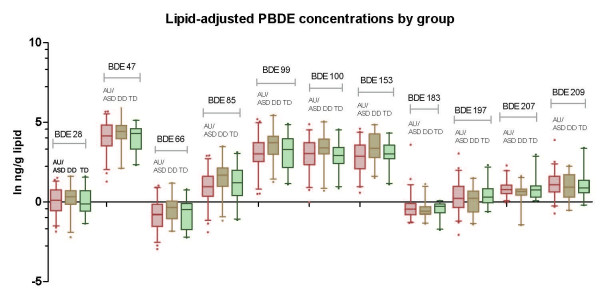
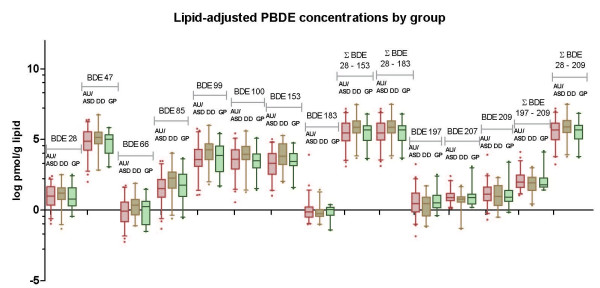
BACKGROUND: Polybrominated diphenyl ethers (PBDEs) are flame retardants used widely and in increasing amounts in the U.S. over the last few decades. PBDEs and their metabolites cross the placenta and studies in rodents demonstrate neurodevelopmental toxicity from prenatal exposures. PBDE exposures occur both via breastfeeding and hand-to-mouth activities in small children. METHODS: Participants were 100 children from the CHARGE (CHildhood Autism Risk from Genetics and the Environment) Study, a case-control epidemiologic investigation of children with autism/autism spectrum disorder, with developmental delay and from the general population. Diagnoses of autism were confirmed by the Autism Diagnostic Observation Schedule and Autism Diagnostic Inventory-Revised, and of developmental delay using the Mullen's Scales of Early Learning and the Vineland Adaptive Behavior Scales. Typically developing controls were those with no evidence of delay, autism, or autism spectrum disorder. Eleven PBDE congeners were measured by gas chromatography/mass spectrometry from serum specimens collected after children were assessed. Logistic regression was used to evaluate the association between plasma PBDEs and autism. RESULTS: Children with autism/autism spectrum disorder and developmental delay were similar to typically developing controls for all PBDE congeners, but levels were high for all three groups. CONCLUSIONS: Plasma samples collected post-diagnosis in this study may not represent early life exposures due to changes in diet and introduction of new household products containing PBDEs. Studies with direct measurements of prenatal or infant exposures are needed to assess the possible causal role for these compounds in autism spectrum disorders.
Overview
The claims and statistics of this paper haven’t been checked yet.
Free: it reads the open-access text and checks the first 5 claims that cite a source we can check. Create a free account to check every claim.
Integrity signals
Registry
Cites
Statistics
Figures
Verification
Claims the paper makes
The claims and statistics of this paper haven’t been checked yet.
Free: it reads the open-access text and checks the first 5 claims that cite a source we can check. Create a free account to check every claim.
Claims other papers make about this one
Each is checked against this paper’s own text: does it say what the citing paper says it does?
In the citing paper
“the CHARGE study reported no differences in plasma PBDE levels in autism and typical control cases [216].”
From The contribution of environmental exposure to the etiology of autism spectrum disorder (2019) · cites this paper as [216]
Self-check
Percentages, sums and reported differences re-computed from the paper’s own numbers.
The self-check needs the paper’s full text.
Citations
Cites
Sick individuals and sick populations
Rose, G. (2001) · International Journal of Epidemiology · doi:10.1093/ije/30.3.427 · Cited by 3,736 · cited 1×
“It has previously been noted [44] that when exposure is high and ubiquitous, no study will be able to detect the effect of that exposure; within such populations, diseases will instead appear to have only genetic influences.”
BackgroundSick individuals and sick populations
ROSE, G. (1985) · International Journal of Epidemiology · doi:10.1093/ije/14.1.32 · Cited by 2,701
Neuroglial activation and neuroinflammation in the brain of patients with autism
Vargas, D. L., Nascimbene, C., Krishnan, C., Zimmerman, A. W., & Pardo, C. A. (2005) · Annals of Neurology · doi:10.1002/ana.20315 · Cited by 2,149 · cited 1×
“Meanwhile, increasing research suggests neuroimmune pathways could contribute to autism [20,21].”
BackgroundBrominated flame retardants: cause for concern?
Birnbaum, L. S., & Staskal, D. F. (2004) · Environmental Health Perspectives · doi:10.1289/ehp.6559 · Cited by 1,702 · cited 1×
“The foam products have contained primarily penta-BDEs; plastic casings on small appliances and computers have been primarily octaBDEs; and television sets, electrical wiring, and backings on draperies have generally been deca-BDEs [1].”
BackgroundPolybrominated Diphenyl Ethers in the Environment and in People: A Meta-Analysis of Concentrations
Hites, R. A. (2004) · Environmental Science & Technology · doi:10.1021/es035082g · Cited by 1,503 · cited 3×
“Concentrations reported in human blood are consistently higher in the U.S. than in Europe [3,4] and recent reports suggest that body burdens in California are among the highest worldwide [5-7].”
BackgroundOrganohalogen compounds: Conference volumes from “Dioxin ’95” and backlist
(1995) · Environmental Science and Pollution Research · doi:10.1007/bf02986737 · Cited by 1,115
A Neuroligin-3 Mutation Implicated in Autism Increases Inhibitory Synaptic Transmission in Mice
Tabuchi, K., Blundell, J., Etherton, M. R., Hammer, R. E., Liu, X., Powell, C. M., & Südhof, T. C. (2007) · Science · doi:10.1126/science.1146221 · Cited by 997 · cited 2×
“remain high; data from animals [11,14] and humans [35] have shown neurodevelopmental effects following prenatal exposures; and experimental research suggests several relevant mechanisms of toxicity [15,22-25].”
BackgroundChlorinated hydrocarbon levels in human serum: Effects of fasting and feeding
Phillips, D. L., Pirkle, J. L., Burse, V. W., Bernert, J. T., Henderson, L. O., & Needham, L. L. (1989) · Archives of Environmental Contamination and Toxicology · doi:10.1007/bf01055015 · Cited by 884 · cited 1×
“Serum triglycerides and cholesterols were measured at the UC Davis clinical chemistry laboratory and total serum lipids were estimated [31].”
MethodPrenatal Exposure to PBDEs and Neurodevelopment
Herbstman, J. B., Sjödin, A., Kurzon, M., Lederman, S. A., Jones, R. S., Rauh, V., Needham, L. L., Tang, D., Niedzwiecki, M., Wang, R. Y., et al. (2010) · Environmental Health Perspectives · doi:10.1289/ehp.0901340 · Cited by 689 · cited 3×
“remain high; data from animals [11,14] and humans [35] have shown neurodevelopmental effects following prenatal exposures; and experimental research suggests several relevant mechanisms of toxicity [15,22-25].”
BackgroundResultComponents of plastic: experimental studies in animals and relevance for human health
Talsness, C. E., Andrade, A. J. M., Kuriyama, S. N., Taylor, J. A., & vom Saal, F. S. (2009) · Philosophical Transactions of the Royal Society B: Biological Sciences · doi:10.1098/rstb.2008.0281 · Cited by 633 · cited 1×
“Possible mechanisms relevant to neurodevelopmental toxicity include disruption of thyroid hormone or sex steroid homeostasis during the prenatal period [ 15-18 ], a period in which these systems play critical roles in fetal development, particularly in the formation of the external granule cell layer of the cerebellum…”
Background
Cited by
Items 101–168 of 168
Xu, K., Li, Z., Qiao, J.-C., Wang, S., Xie, P., Zong, Z., & Hu, C. (2023) · Environmental Pollution · doi:10.1016/j.envpol.2023.122439 · Cited by 20
Arsenic from gold mining in marine and stream sediments in Baja California Sur, Mexico
Ayala, I. H. P., Murillo-Jiménez, J. M., Shumilin, E. N., Marmolejo-Rodríguez, A. J., & Nava‐Sánchez, E. H. (2016) · Environmental Earth Sciences · doi:10.1007/s12665-016-5550-4 · Cited by 19
Autism, Mitochondria and Polybrominated Diphenyl Ether Exposure
Wong, S., & Giulivi, C. (2016) · CNS & Neurological Disorders - Drug Targets · doi:10.2174/1871527315666160413122624 · Cited by 21
Wang, G., Liu, Y., Wei, T., Zhao, X., Wang, H., Lou, Y., Li, N., & Liu, Y. (2020) · Environmental Pollution · doi:10.1016/j.envpol.2020.114014 · Cited by 17
Global Impact of Chemicals and Toxic Substances on Human Health and the Environment
Adeola, F. O. (2021) · Springer eBooks · doi:10.1007/978-3-030-45009-0_96 · Cited by 19
Annual Effective Dose of 210Po from Sea Food Origin (Oysters and Mussels) in Korea
Cho, B., Hong, G. H., Kim, S. H., & Lee, H. (2016) · Journal of Radiation Protection and Research · doi:10.14407/jrpr.2016.41.3.245 · Cited by 17
Binkowski, Ł. J., Błaszczyk, M., Przystupińska, A., Ożgo, M., & Massányi, P. (2019) · Chemosphere · doi:10.1016/j.chemosphere.2019.04.190 · Cited by 17
Dhanasekaran, P., Sai, P. M. S., Babu, C. A., Prabhu, R. K., & Rajan, K. K. (2015) · Water Science & Technology Water Supply · doi:10.2166/ws.2015.119 · Cited by 18
Environmental Factors in the Preconception and Prenatal Periods in Relation to Risk for ASD
Lyall, K., Schmidt, R. J., & Hertz‐Picciotto, I. (2014) · Wiley eBooks · doi:10.1002/9781118911389.hautc18 · Cited by 21
Self-citationBrominated flame retardants, a cornelian dilemma
Morel, C., Schroeder, H., Emond, C., Turner, J. D., Lichtfouse, É., & Grova, N. (2022) · Environmental Chemistry Letters · doi:10.1007/s10311-022-01392-2 · Cited by 19
“Brominated flame-retardants are suspected to disrupt the thyroid axis, the oxidative stress system, immune response, and neuroinflammation (Hertz-Picciotto et al. 2011; Messer 2010).”
BackgroundPotential Dangers with Open Access Data Files in the Expanding Open Data Movement
da Silva, J. A. T., & Dobránszki, J. (2015) · Publishing Research Quarterly · doi:10.1007/s12109-015-9420-9 · Cited by 16
Terwoert, J., Verbist, K., & Heussen, H. (2015) · Safety and Health at Work · doi:10.1016/j.shaw.2015.12.002 · Cited by 16
Jung, Y., Lee, J., Seo, J., & Hwang, G. (2016) · Environmental Toxicology · doi:10.1002/tox.22322 · Cited by 16
“, 2006, 2008), neurodevelopmental toxicity (Herbstman et al., 2010; Hertz-Picciotto et al., 2011), and cancer (Li et al.”
BackgroundVázquez‐Boucard, C., Lee‐Cruz, L., Mercier, L., Ramírez-Orozco, M., Pinto, V. V. S., Anguiano, G., Cazares, L., & Díaz, D. (2017) · Environmental and Molecular Mutagenesis · doi:10.1002/em.22111 · Cited by 19
Kapwata, T., Wright, C. Y., Reddy, T., Street, R. A., Kunene, Z., & Mathee, A. (2023) · Environmental Science and Pollution Research · doi:10.1007/s11356-023-26813-9 · Cited by 16
Dietrich, M. J., & Filippelli, G. M. (2023) · Environmental Science and Pollution Research · doi:10.1007/s11356-023-26319-4 · Cited by 14
Darwish, E. R., Kalil, H., Alqahtani, W., Moalla, S. M. N., Hosny, N. M., Amin, A. S., Martin, H. B., & Bayachou, M. (2021) · Nanotechnology Science and Applications · doi:10.2147/nsa.s296722 · Cited by 14
Forecasts of cardiac and respiratory mortality in Tehran, Iran, using ARIMAX and CNN-LSTM models
Mahmudimanesh, M., Mirzaee, M., Dehghan, A., & Bahrampour, A. (2022) · Environmental Science and Pollution Research · doi:10.1007/s11356-021-18205-8 · Cited by 15
Zewdie, A., Degefa, G. H., & Donacho, D. O. (2023) · BMJ Open · doi:10.1136/bmjopen-2022-067678 · Cited by 15
Extreme Weather Events in the UK and Resulting Public Health Outcomes
Dickinson, N., Spencer, L. H., Shu-hua, Y., Miller, C., Hursthouse, A. S., & Lynch, M. (2025) · International Journal of Public Health · doi:10.3389/ijph.2025.1607904 · Cited by 12
Gentry, P. R., Yager, J. W., Clewell, R. A., & M.A., H. J. C. I. (2014) · Toxicology in Vitro · doi:10.1016/j.tiv.2014.05.011 · Cited by 12
Environmental Endocrine Disruptor Affects Voluntary Physical Activity in Mice
Schmitt, E. E., Vellers, H. L., Porter, W. W., & Lightfoot, J. T. (2016) · Medicine & Science in Sports & Exercise · doi:10.1249/mss.0000000000000908 · Cited by 12
Leong, Y., Azmi, N. I., Majid, M. I. A., & Wen, S. (2021) · Food Additives & Contaminants Part A · doi:10.1080/19440049.2021.1922758 · Cited by 12
“Exposure to these pollutants during stages of early life, including breastfeeding period, have been associated with subtle developmental, immunological and endocrinological effects in children (Herbstman et al. 2010; Gascon et al. 2011; Hertz-Picciotto et al. 2011).”
BackgroundBaird, A., Papachristou, E., Hassiotis, A., & Flouri, E. (2022) · Environmental Research · doi:10.1016/j.envres.2022.112837 · Cited by 14
Becker, A., & Axelrad, D. M. (2014) · Journal of Epidemiology & Community Health · doi:10.1136/jech-2013-203463 · Cited by 13
Tsai, M., Chao, H., Hsu, W., Tsai, C., Lin, C.-W., & Chen, C. (2021) · International Journal of Environmental Research and Public Health · doi:10.3390/ijerph182111501 · Cited by 11
Aktaş, Y. D., Reeslev, M., Altamirano, H., May, N., & D'Ayala, D. F. (2020) · UCL Open Environment · doi:10.14324/111.444/ucloe.000005 · Cited by 11
Monitoring and Evaluation of Pesticide Residues in Aquatic Systems
Mondal, R., & Kole, R. K. (2020) · Sustainable agriculture reviews · doi:10.1007/978-3-030-54712-7_3 · Cited by 14
Leuthner, T. C., Zhang, S., Kohrn, B. F., Stapleton, H. M., & Baugh, L. R. (2025) · Toxicological Sciences · doi:10.1093/toxsci/kfaf014 · Cited by 11
Gong, X., Zhan, F. B., Brender, J. D., Langlois, P. H., & Lin, Y. (2016) · The Science of The Total Environment · doi:10.1016/j.scitotenv.2016.04.088 · Cited by 11
Spatial analysis of binary health indicators with local smoothing techniques
Girardi, P., Marcon, A., Rava, M., Pironi, V., Ricci, P., & de Marco, R. (2011) · The Science of The Total Environment · doi:10.1016/j.scitotenv.2011.10.020 · Cited by 10
Ellegaard, O., & Wallin, J. A. (2013) · SpringerPlus · doi:10.1186/2193-1801-2-255 · Cited by 12
Esmaeili, S. V., Shakerian, M., lotfi, S., Karimi, A., Ghasemian, H., Nakheipour, M., Jalali, M., Mohebi, S., & Esmaeili, R. (2025) · BMC Public Health · doi:10.1186/s12889-025-22161-0 · Cited by 10
The use of hedgerows to mitigate pesticide exposure of a population living in a rural area
Langenbach, T., Mager, A. H., Campos, M. M., Falco, A. D., Aucélio, R. Q., de Campos, T. M. P., & Caldas, L. Q. A. (2021) · Integrated Environmental Assessment and Management · doi:10.1002/ieam.4452 · Cited by 9
Environmental Factors and Autism Spectrum Disorder
Persico, A. M., & Merelli, S. (2015) · Key issues in mental health (Online)/Key issues in mental health (Print) · doi:10.1159/000363611 · Cited by 12
Poston, R. G., Murphy, L., Rejepova, A., Ghaninejad-Esfahani, M., Segales, J. S., Mulligan, K. A., & Saha, R. N. (2020) · Journal of Biological Chemistry · doi:10.1074/jbc.ra119.011138 · Cited by 9
Investigating the impacts of airborne dust on herbicide performance on Amaranthus retroflexus
Kalyani, F. S., Babaei, S., Zafarsohrabpour, Y., Nosratti, I., Gage, K. L., & Sadeghpour, A. (2024) · Scientific Reports · doi:10.1038/s41598-024-54134-5 · Cited by 8
Evaluation of Glycol Ether as an Alternative to Perchloroethylene in Dry Cleaning
Hesari, N., Francis, C., & Halden, R. U. (2014) · Toxics · doi:10.3390/toxics2020115 · Cited by 8
Mass Spectrometry for the Study of Autism and Neurodevelopmental Disorders
Wormwood, K. L., Wetie, A. G. N., Ryan, J. P., Darie, C. C., & Woods, A. G. (2019) · Advances in experimental medicine and biology · doi:10.1007/978-3-030-15950-4_28 · Cited by 7
Hassauer, M., Kaiser, E., Schneider, K., & Schuhmacher‐Wolz, U. (2012) · EFSA Supporting Publications · doi:10.2903/sp.efsa.2012.en-297 · Cited by 7
Assessing Exposures to Emerging Environmental Contaminants In Children
Heffernan, A. L. (2013) · Journal of Enviromental Immunology and Toxicology · doi:10.7178/jeit.2 · Cited by 6
Mass Spectrometry for the Study of Autism and Neurodevelopmental Disorders
Wetie, A. G. N., DeKroon, R. M., Mocanu, M., Ryan, J. P., Darie, C. C., & Woods, A. G. (2014) · Advances in experimental medicine and biology · doi:10.1007/978-3-319-06068-2_26 · Cited by 6
Flame Retardants: Exposure, Biomarkers, and Health Risks
Jin, Y., & Chen, S. (2019) · Springer eBooks · doi:10.1007/978-981-32-9535-3_8 · Cited by 6
Tao, Y., Sánchez, B. N., & Mukherjee, B. (2014) · Statistics in Medicine · doi:10.1002/sim.6401 · Cited by 5
Wang, C., Qu, Y., Niu, H., Pan, Y., He, Y., Liu, J., Yao, N., Wang, H., Guo, Y., Yang, P., et al. (2021) · Risk Management and Healthcare Policy · doi:10.2147/rmhp.s295553 · Cited by 5
The Environment in Autism Spectrum Disorders
Lyall, K., Schmidt, R. J., & Hertz‐Picciotto, I. (2012) · Elsevier eBooks · doi:10.1016/b978-0-12-391924-3.00014-4 · Cited by 8
Self-citationGenes and Environment in Autism Spectrum Disorders: An Integrated Perspective
Bakulski, K. M., Singer, A. B., & Fallin, M. D. (2014) · WORLD SCIENTIFIC eBooks · doi:10.1142/9789814602167_0014 · Cited by 5
Holuka, C., Morel, C., Roth, S., Lamartinière, Y., Mériaux, S. B., Paoli, J., Guébels, P., Duca, R. C., Godderis, L., Nieuwenhuyse, A. V., et al. (2023) · Environment International · doi:10.1016/j.envint.2023.108103 · Cited by 4
Wildfire smoke exposures and adult health outcomesPreprint
Marlier, M. E., Crnosija, N., & Benmarhnia, T. (2022) · doi:10.1002/essoar.10510602.1 · Cited by 8
Intellectual Developmental Disability Syndromes and Organic Chemicals
Carpenter, D. O. (2013) · Wiley eBooks · doi:10.1002/9781118679654.ch16 · Cited by 3
Jung, K.-S., Kim, N.-S., Ahn, S., & Lee, B.-K. (2012) · Korean Journal of Environmental Health Sciences · doi:10.5668/jehs.2012.38.4.323 · Cited by 3
Yang, Y., Chen, S., Li, P., Jing, Y., Cheng, B., Hu, Y., Zheng, Q., & Wang, C. (2021) · Chemosphere · doi:10.1016/j.chemosphere.2021.131967 · Cited by 3
The Study of Groundwater Source by Using KNN Classification
Zaib, S., Najib, M. S., Daud, S. M., Zahari, M. F., & Mohamad, M. (2022) · Lecture notes in electrical engineering · doi:10.1007/978-981-16-8690-0_51 · Cited by 3
Environmental Chemicals and Neurodevelopmental Disorders in Children
Bellinger, D. C. (2024) · Oxford University Press eBooks · doi:10.1093/oso/9780197662526.003.0049 · Cited by 2
Rahaman, M. S., & Rahman, M. M. (2021) · Journal of Enterprising Communities People and Places in the Global Economy · doi:10.1108/jec-03-2021-0038 · Cited by 2
Måleegenskaper ved den norske versjonen av Mullen Scales of Early Learning (MSEL)
Martinussen, M., & Siqveland, T. S. (2013) · PsykTestBarn · doi:10.21337/0019 · Cited by 3
“Det systematiske søket etter dokumentasjon på psykometriske egenskaper for den norske versjonen av MSEL resulterte i tre treff, hvorav alle ble vurdert i fulltekst for inklusjon (Kaale et al., 2011; Selås, 2010; Wie, 2010).”
BackgroundSkills and Training for the 21st Century Chemical Toxicologist
Gant, T. W. (2011) · Chemical Research in Toxicology · doi:10.1021/tx200204q · Cited by 2
Measuring Heatwaves and Their Impacts
Disher, B., Edwards, B., Lawler, T., & Radford, D. (2020) · Springer eBooks · doi:10.1007/978-1-4939-2493-6_1102-1 · Cited by 2
Kozlova, E. V., Denys, M. E., Bishay, A. E., Luna, C. N., Angelis, M. D., Campoy, L., Habbal, A., Lam, A. A., Luvsanravdan, N., Colton, A. G., et al. (2025) · bioRxiv (Cold Spring Harbor Laboratory) · doi:10.1101/2025.07.28.667293 · Cited by 2
Human Risk Assessment of Perchloroethylene Considering Multi-media Exposure
Seo, J., Kim, T., Jo, A., Kim, P., & Choi, K. (2014) · Korean Journal of Environmental Health Sciences · doi:10.5668/jehs.2014.40.5.397 · Cited by 1
Kozlova, E. V., Gonzalez, G. M., Denys, M. E., Bishay, A. E., Gutiérrez, R., Reid, J., Krum, J. M., Lampel, G., Luvsanravdan, N., Rabbani, K. M., et al. (2026) · Journal of Neuroendocrinology · doi:10.1111/jne.70237 · Cited by 1
“28, 29, 111 – 113 In Sex-specific differences using our toxicant model of ASD are evident when comparing our present findings using males with previous findings generated using females.”
Fadzlah, A. F. A. (2016) · Advances in intelligent systems and computing · doi:10.1007/978-3-319-38884-7_18 · Cited by 1
Ayubi, E., & Khazaei, S. (2023) · Journal of Public Health · doi:10.1007/s10389-023-01889-2 · Cited by 2
Disease Diagnosis and Management Using Bioinformatics and Cyber-Physical Systems
Rout, T., Mohapatra, A., Kar, M., & Muduly, D. K. (2025) · Studies in big data · doi:10.1007/978-981-97-5734-3_9 · Cited by 1
Sone, H., Win‐Shwe, T., Qin, X., Akanuma, H., & Imanishi, S. (2012) · InTech eBooks · doi:10.5772/30745
“…aromatic hydrocarbon Children study Walhovd et al. 2007; Bandstra et al. 2010; van Elderen et al. 2010 Phenol Children study Gross et al. 1987; Hertz-Picciotto et al. 2011 Industrial solvents Children study Uzun and Kendirli 2005a; Dick et al. 2010 Industrial solvents Workers Hanninen et al.…”
BackgroundChildren's Health and Exposure to Chemicals in the Natural and Built Environment
Goldhaber, S. B., Slover, R., Mullikin, A., Tulve, N. S., & Hubal, E. A. C. (2024) · Wiley eBooks · doi:10.1002/9781119742975.ch19 · Cited by 1
Sullivan, D. L. (2015) · ScholarWorks (Walden University)
Degroote, S. (2016) · Knowledge UdeS (Institutional Deposit of the University of Sherbrooke) · Cited by 1
Metadata
- Authors
- Hertz-Picciotto, I., Bergman, Å., Fängström, B., Rose, M., Krakowiak, P., Pessah, I., Hansen, R., & Bennett, D. H.
- Affiliations
- Stockholm University (SE)
- University of California, Davis (US)
- Venue
- Environmental Health
- Published
- 2011-01-05
- Volume
- 10
- Issue
- 1
- Pages
- 1-1
- ISSN
- 1476-069X (ISSN-L)
- PMC
- PMC3029221
- OpenAlex
- W2145402394
- Cited by
- 167
- References
- 47
- Citations by year
- 2026: 1 · 2025: 6 · 2024: 6 · 2023: 6 · 2022: 7 · 2021: 20 · 2020: 13 · 2019: 4 · 2018: 3 · 2017: 18 · 2016: 14 · 2015: 13 · 2014: 19 · 2013: 21 · 2012: 13
- FWCI
- 12.95
- Type
- journal article
- Language
- en
- Open access
- gold
- doi.org
- Licence
- Locations
- Environmental Health (publishedVersion, cc-by)
- PubMed Central (publishedVersion, cc-by)
- PubMed (publishedVersion)
- DOAJ (DOAJ: Directory of Open Access Journals) (submittedVersion)
- eScholarship (California Digital Library) (submittedVersion)
- Funders
- Autism Speaks (R01-ES015359)
- National Institute of Environmental Health Sciences (P01-ES-11269, ES015359, R01ES015359, P01ES011269, ES11269, R833292)
- Topics
- Physical Sciences › Environmental Science › Health, Toxicology and Mutagenesis › Toxic Organic Pollutants Impact
- Life Sciences › Neuroscience › Cognitive Neuroscience › Autism Spectrum Disorder Research
- Physical Sciences › Environmental Science › Health, Toxicology and Mutagenesis › Effects and risks of endocrine disrupting chemicals
- Keywords
- polybrominated diphenyl ethers, flame retardants, autism spectrum disorder, developmental delay, prenatal exposure, developmental neurotoxicity, children, CHARGE study
- MeSH terms
- Autistic Disorder, California, Developmental Disabilities, Child, Preschool, Environmental Exposure, Female, Humans, Male, Logistic Models, Case-Control Studies, Halogenated Diphenyl Ethers
About these checks
Registry, retraction, Cites and statistics results are computed, not judged, with one exception: a printed reference that no index lists is read once by a model before it counts as a citation error. Claims are extracted by a model and kept only when their quote appears verbatim in the text; each cited source is then checked, with a model’s help, for whether it says what the claim relies on. Those verdicts can be wrong — read the claim’s quote and the cited source before relying on one.
Statistics and arithmetic are recomputed, not judged.
Confidence bands are shown only for fields calibrated on our annotated test set. None is calibrated yet, so no band is shown.
What counts as a claim ›How we measure confidence ›How we check this ›
Are you an author, or do you see a problem with this page? Request a review
Data sources
Bibliographic data: Semantic Scholar, OpenAlex, Crossref.
Contains information from the Semantic Scholar Academic Graph Datasets, made available under the ODC Attribution License (ODC-BY 1.0).
Semantic Scholar’s data is described in: Kinney, R., et al. (2023). The Semantic Scholar Open Data Platform. arXiv:2301.10140.
