

Polybrominated diphenyl ethers in relation to autism and developmental delay: a case-control study
Open accessThe DOI matches its Crossref record; 47 of the 47 references it cites were found in a registry or an index.
Abstract
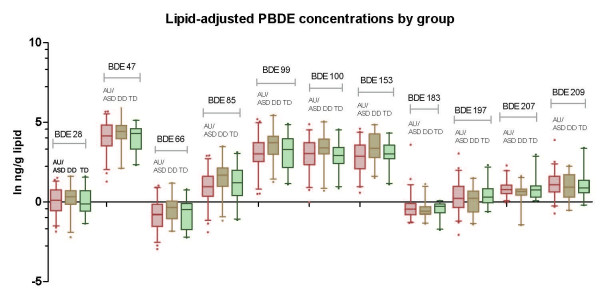
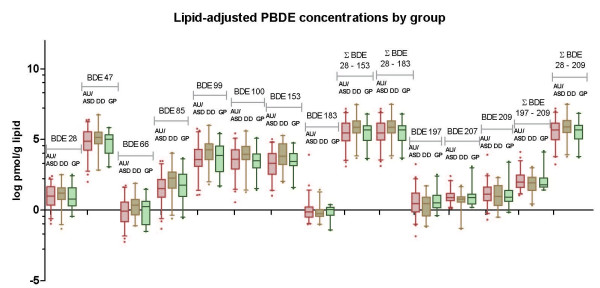
BACKGROUND: Polybrominated diphenyl ethers (PBDEs) are flame retardants used widely and in increasing amounts in the U.S. over the last few decades. PBDEs and their metabolites cross the placenta and studies in rodents demonstrate neurodevelopmental toxicity from prenatal exposures. PBDE exposures occur both via breastfeeding and hand-to-mouth activities in small children. METHODS: Participants were 100 children from the CHARGE (CHildhood Autism Risk from Genetics and the Environment) Study, a case-control epidemiologic investigation of children with autism/autism spectrum disorder, with developmental delay and from the general population. Diagnoses of autism were confirmed by the Autism Diagnostic Observation Schedule and Autism Diagnostic Inventory-Revised, and of developmental delay using the Mullen's Scales of Early Learning and the Vineland Adaptive Behavior Scales. Typically developing controls were those with no evidence of delay, autism, or autism spectrum disorder. Eleven PBDE congeners were measured by gas chromatography/mass spectrometry from serum specimens collected after children were assessed. Logistic regression was used to evaluate the association between plasma PBDEs and autism. RESULTS: Children with autism/autism spectrum disorder and developmental delay were similar to typically developing controls for all PBDE congeners, but levels were high for all three groups. CONCLUSIONS: Plasma samples collected post-diagnosis in this study may not represent early life exposures due to changes in diet and introduction of new household products containing PBDEs. Studies with direct measurements of prenatal or infant exposures are needed to assess the possible causal role for these compounds in autism spectrum disorders.
Overview
The claims and statistics of this paper haven’t been checked yet.
Free: it reads the open-access text and checks the first 5 claims that cite a source we can check. Create a free account to check every claim.
Integrity signals
Registry
Cites
Statistics
Figures
Verification
Claims the paper makes
The claims and statistics of this paper haven’t been checked yet.
Free: it reads the open-access text and checks the first 5 claims that cite a source we can check. Create a free account to check every claim.
Claims other papers make about this one
Each is checked against this paper’s own text: does it say what the citing paper says it does?
In the citing paper
“the CHARGE study reported no differences in plasma PBDE levels in autism and typical control cases [216].”
From The contribution of environmental exposure to the etiology of autism spectrum disorder (2019) · cites this paper as [216]
Self-check
Percentages, sums and reported differences re-computed from the paper’s own numbers.
The self-check needs the paper’s full text.
Citations
Cites
Sick individuals and sick populations
Rose, G. (2001) · International Journal of Epidemiology · doi:10.1093/ije/30.3.427 · Cited by 3,736 · cited 1×
“It has previously been noted [44] that when exposure is high and ubiquitous, no study will be able to detect the effect of that exposure; within such populations, diseases will instead appear to have only genetic influences.”
BackgroundSick individuals and sick populations
ROSE, G. (1985) · International Journal of Epidemiology · doi:10.1093/ije/14.1.32 · Cited by 2,701
Neuroglial activation and neuroinflammation in the brain of patients with autism
Vargas, D. L., Nascimbene, C., Krishnan, C., Zimmerman, A. W., & Pardo, C. A. (2005) · Annals of Neurology · doi:10.1002/ana.20315 · Cited by 2,149 · cited 1×
“Meanwhile, increasing research suggests neuroimmune pathways could contribute to autism [20,21].”
BackgroundBrominated flame retardants: cause for concern?
Birnbaum, L. S., & Staskal, D. F. (2004) · Environmental Health Perspectives · doi:10.1289/ehp.6559 · Cited by 1,702 · cited 1×
“The foam products have contained primarily penta-BDEs; plastic casings on small appliances and computers have been primarily octaBDEs; and television sets, electrical wiring, and backings on draperies have generally been deca-BDEs [1].”
BackgroundPolybrominated Diphenyl Ethers in the Environment and in People: A Meta-Analysis of Concentrations
Hites, R. A. (2004) · Environmental Science & Technology · doi:10.1021/es035082g · Cited by 1,503 · cited 3×
“Concentrations reported in human blood are consistently higher in the U.S. than in Europe [3,4] and recent reports suggest that body burdens in California are among the highest worldwide [5-7].”
BackgroundOrganohalogen compounds: Conference volumes from “Dioxin ’95” and backlist
(1995) · Environmental Science and Pollution Research · doi:10.1007/bf02986737 · Cited by 1,115
A Neuroligin-3 Mutation Implicated in Autism Increases Inhibitory Synaptic Transmission in Mice
Tabuchi, K., Blundell, J., Etherton, M. R., Hammer, R. E., Liu, X., Powell, C. M., & Südhof, T. C. (2007) · Science · doi:10.1126/science.1146221 · Cited by 997 · cited 2×
“remain high; data from animals [11,14] and humans [35] have shown neurodevelopmental effects following prenatal exposures; and experimental research suggests several relevant mechanisms of toxicity [15,22-25].”
BackgroundChlorinated hydrocarbon levels in human serum: Effects of fasting and feeding
Phillips, D. L., Pirkle, J. L., Burse, V. W., Bernert, J. T., Henderson, L. O., & Needham, L. L. (1989) · Archives of Environmental Contamination and Toxicology · doi:10.1007/bf01055015 · Cited by 884 · cited 1×
“Serum triglycerides and cholesterols were measured at the UC Davis clinical chemistry laboratory and total serum lipids were estimated [31].”
MethodPrenatal Exposure to PBDEs and Neurodevelopment
Herbstman, J. B., Sjödin, A., Kurzon, M., Lederman, S. A., Jones, R. S., Rauh, V., Needham, L. L., Tang, D., Niedzwiecki, M., Wang, R. Y., et al. (2010) · Environmental Health Perspectives · doi:10.1289/ehp.0901340 · Cited by 689 · cited 3×
“remain high; data from animals [11,14] and humans [35] have shown neurodevelopmental effects following prenatal exposures; and experimental research suggests several relevant mechanisms of toxicity [15,22-25].”
BackgroundResultComponents of plastic: experimental studies in animals and relevance for human health
Talsness, C. E., Andrade, A. J. M., Kuriyama, S. N., Taylor, J. A., & vom Saal, F. S. (2009) · Philosophical Transactions of the Royal Society B: Biological Sciences · doi:10.1098/rstb.2008.0281 · Cited by 633 · cited 1×
“Possible mechanisms relevant to neurodevelopmental toxicity include disruption of thyroid hormone or sex steroid homeostasis during the prenatal period [ 15-18 ], a period in which these systems play critical roles in fetal development, particularly in the formation of the external granule cell layer of the cerebellum…”
BackgroundHuman internal and external exposure to PBDEs – A review of levels and sources
Frederiksen, M., Vorkamp, K., Thomsen, M., & Knudsen, L. E. (2009) · International Journal of Hygiene and Environmental Health · doi:10.1016/j.ijheh.2008.04.005 · Cited by 618 · cited 2×
“Food, dust and air are the main routes of exposure [ 4 ,8].”
BackgroundResultDevelopmental neurotoxicity of polybrominated diphenyl ether (PBDE) flame retardants
COSTA, L., & GIORDANO, G. (2007) · NeuroToxicology · doi:10.1016/j.neuro.2007.08.007 · Cited by 579 · cited 2×
“remain high; data from animals [11,14] and humans [35] have shown neurodevelopmental effects following prenatal exposures; and experimental research suggests several relevant mechanisms of toxicity [15,22-25].”
BackgroundA comparison of eating behaviors between children with and without autism
Schreck, K. A., Williams, K., & Smith, A. F. (2004) · Journal of Autism and Developmental Disorders · doi:10.1023/b:jadd.0000037419.78531.86 · Cited by 536 · cited 1×
“The issue is further complicated when comparing children with developmental disorders to those with typical development: the former may have different timing or frequency in their hand to mouth activity, delays in explorative play, or a more limited diet due to feeding difficulties [ 39-41 ].”
BackgroundThe Rise in Autism and the Role of Age at Diagnosis
Hertz-Picciotto, I., & Delwiche, L. (2009) · Epidemiology · doi:10.1097/ede.0b013e3181902d15 · Cited by 522 · cited 1×
“Similar to the findings at an older age [43], during the first two years of life, children with autism were less likely to eat ocean fish Hertz-Picciotto et al.”
ResultSelf-citationJohnson-Restrepo, B., & Kannan, K. (2009) · Chemosphere · doi:10.1016/j.chemosphere.2009.02.068 · Cited by 453 · cited 3×
“Food, dust and air are the main routes of exposure [4,8].”
BackgroundHertz-Picciotto, I., Croen, L. A., Hansen, R., Jones, C. R., van de Water, J., & Pessah, I. N. (2006) · Environmental Health Perspectives · doi:10.1289/ehp.8483 · Cited by 422 · cited 2×
“Launched in 2003, the CHARGE Study has enrolled well over 1000 children with the primary goal of identifying causes and contributing factors for autism, focusing especially on the chemical environment [ 27 ].”
BackgroundMethodSelf-citationHallgren, S., & Darnerud, P. O. (2002) · Toxicology · doi:10.1016/s0300-483x(02)00222-6 · Cited by 390 · cited 2×
“Possible mechanisms relevant to neurodevelopmental toxicity include disruption of thyroid hormone or sex steroid homeostasis during the prenatal period [ 15-18 ], a period in which these systems play critical roles in fetal development, particularly in the formation of the external granule cell layer of the cerebellum…”
BackgroundSchecter, A., Päpke, O., Harris, T. R., Tung, K. C., Musumba, A., Olson, J., & Birnbaum, L. (2006) · Environmental Health Perspectives · doi:10.1289/ehp.9121 · Cited by 364
Sjödin, A., Wong, L.-Y., Jones, R. S., Park, A., Zhang, Y., Hodge, C., DiPietro, E., McClure, C., Turner, W., Needham, L. L., et al. (2008) · Environmental Science & Technology · doi:10.1021/es702451p · Cited by 358
Eriksson, P., Viberg, H., Jakobsson, E., Orn, U., & Fredriksson, A. (2002) · Toxicological Sciences · doi:10.1093/toxsci/67.1.98 · Cited by 318 · cited 2×
“showing adverse neurodevelopmental consequences following prenatal and early life exposures [11-14].”
BackgroundThuresson, K., Höglund, P., Hagmar, L., Sjödin, A., Bergman, Å., & Jakobsson, K. (2006) · Environmental Health Perspectives · doi:10.1289/ehp.8350 · Cited by 301 · cited 1×
“, 15 days for #209, 39 days for #207, and 94 days for #183, based on a study involving occupational exposures [32] and therefore, correlations of internal measurements over a period of years would not be expected to be high.”
BackgroundSelf-citationGeyer, H. J., Schramm, K., Darnerud, P. O., Aune, M., Feicht, A., Fried, K. W., Henkelmann, B., Lenoir, D., Schmid, P., McDonald, T., et al. (2004) · OSTI OAI (U.S. Department of Energy Office of Scientific and Technical Information) · Cited by 283
Autism: Maternally derived antibodies specific for fetal brain proteins
BRAUNSCHWEIG, D., ASHWOOD, P., KRAKOWIAK, P., HERTZPICCIOTTO, I., HANSEN, R., CROEN, L., PESSAH, I., & VANDEWATER, J. (2007) · NeuroToxicology · doi:10.1016/j.neuro.2007.10.010 · Cited by 273 · cited 1×
“Meanwhile, increasing research suggests neuroimmune pathways could contribute to autism [20,21].”
BackgroundSelf-citationHormone Disruption by PBDEs in Adult Male Sport Fish Consumers
Turyk, M. E., Persky, V. W., Imm, P., Knobeloch, L., Chatterton, R., & Anderson, H. A. (2008) · Environmental Health Perspectives · doi:10.1289/ehp.11707 · Cited by 265 · cited 1×
“Possible mechanisms relevant to neurodevelopmental toxicity include disruption of thyroid hormone or sex steroid homeostasis during the prenatal period [15-18], a period in which these systems play critical roles in fetal development, particularly in the formation of the external granule cell layer of the cerebellum […”
BackgroundExtraction and Cleanup Methods for Analysis of Phenolic and Neutral Organohalogens in Plasma
Hovander, L., Athanasiadou, M., Asplund, L., Jensen, S., & Wehler, E. K. (2000) · Journal of Analytical Toxicology · doi:10.1093/jat/24.8.696 · Cited by 251 · cited 1×
“The extraction and cleanup procedure is described elsewhere [29].”
MethodCritical factors in assessing exposure to PBDEs via house dust
Allen, J. G., McClean, M. D., Stapleton, H. M., & Webster, T. F. (2008) · Environment International · doi:10.1016/j.envint.2008.03.006 · Cited by 239 · cited 1×
“Breakdown of the deca-BDE (209) may occur in house dust, but for other congeners, stability of levels in house dust may be an indication that it serves as a more valid repository of long-term exposures than blood plasma, at least in young children [42].”
BackgroundStapleton, H. M., Kelly, S. M., Allen, J. G., McClean, M. D., & Webster, T. F. (2008) · Environmental Science & Technology · doi:10.1021/es7029625 · Cited by 230 · cited 1×
“As children start to interact more independently with their environment toward the second half of the first year, intake becomes increasingly influenced by what is present in the home environment, in large part due to increases in frequency of contact with surfaces, hand to mouth activity, and object to mouth activity…”
BackgroundZota, A. R., Rudel, R. A., Morello-Frosch, R. A., & Brody, J. G. (2008) · Environmental Science & Technology · doi:10.1021/es801792z · Cited by 227 · cited 1×
“than in Europe [3,4] and recent reports suggest that body burdens in California are among the highest worldwide [5-7].”
BackgroundGómara, B., Herrero, L., Ramos, J. J., Mateo, J. R., Fernández, M. A., García, J. F., & González, M. J. (2007) · Environmental Science & Technology · doi:10.1021/es0714484 · Cited by 218 · cited 1×
“PBDEs cross the placenta and are mobilized into breast milk during lactation [9,10].”
BackgroundDingemans, M. M. L., de Groot, A., van Kleef, R. G. D. M., Bergman, Å., van den Berg, M., Vijverberg, H. P. M., & Westerink, R. H. S. (2008) · Environmental Health Perspectives · doi:10.1289/ehp.11059 · Cited by 210 · cited 2×
“remain high; data from animals [11,14] and humans [35] have shown neurodevelopmental effects following prenatal exposures; and experimental research suggests several relevant mechanisms of toxicity [15,22-25].”
BackgroundSelf-citationToms, L.-M. L., Sjödin, A., Harden, F., Hobson, P., Jones, R., Edenfield, E., & Mueller, J. F. (2009) · Environmental Health Perspectives · doi:10.1289/ehp.0900596 · Cited by 192 · cited 2×
“Higher concentrations have been found in toddlers than in school-age children or adults, supporting a critical role for non-food ingestion during the early years [36].”
BackgroundHigh body burdens of 2,2',4,4'-tetrabromodiphenyl ether (BDE-47) in California women.
Petreas, M., She, J., Brown, F. R., Winkler, J., Windham, G., Rogers, E., Zhao, G., Bhatia, R., & Charles, M. J. (2003) · Environmental Health Perspectives · doi:10.1289/ehp.6220 · Cited by 182 · cited 1×
“than in Europe [3,4] and recent reports suggest that body burdens in California are among the highest worldwide [5-7].”
BackgroundAntignac, J.-P., Cariou, R., Zalko, D., Berrebi, A., Cravedi, J.-P., Maume, D., Marchand, P., Monteau, F., Riu, A., Andre, F., et al. (2009) · Environmental Pollution · doi:10.1016/j.envpol.2008.07.008 · Cited by 172 · cited 1×
“PBDEs cross the placenta and are mobilized into breast milk during lactation [9,10].”
BackgroundRegression in Autism: Prevalence and Associated Factors in the CHARGE Study
Hansen, R. L., Ozonoff, S., Krakowiak, P., Angkustsiri, K., Jones, C., Deprey, L. J., Le, D.-N., Croen, L. A., & Hertz-Picciotto, I. (2008) · Ambulatory Pediatrics · doi:10.1016/j.ambp.2007.08.006 · Cited by 164 · cited 1×
“Regression versus early onset status was defined as loss of either language or social skills using ADI-R and EDQ questions [28].”
MethodSelf-citationViberg, H., Fredriksson, A., & Eriksson, P. (2006) · NeuroToxicology · doi:10.1016/j.neuro.2006.08.006 · Cited by 158 · cited 1×
“showing adverse neurodevelopmental consequences following prenatal and early life exposures [11-14].”
BackgroundThe Flame Retardants, Polybrominated Diphenyl Ethers, Are Pregnane X Receptor Activators
Pacyniak, E. K., Cheng, X., Cunningham, M. L., Crofton, K., Klaassen, C. D., & Guo, G. L. (2007) · Toxicological Sciences · doi:10.1093/toxsci/kfm025 · Cited by 147 · cited 1×
“Several congeners activate the pregnane X receptor, resulting in induction of cytochrome P450 enzymes [26].”
BackgroundFängström, B., Athanassiadis, I., Odsjö, T., Norén, K., & Bergman, Å. (2008) · Molecular Nutrition & Food Research · doi:10.1002/mnfr.200700182 · Cited by 132 · cited 2×
“All instrumentation settings are reported elsewhere [2].”
BackgroundSelf-citationPBDEs in 2−5 Year-Old Children from California and Associations with Diet and Indoor Environment
Rose, M., Bennett, D. H., Bergman, Å., Fängström, B., Pessah, I. N., & Hertz-Picciotto, I. (2010) · Environmental Science & Technology · doi:10.1021/es903240g · Cited by 108 · cited 5×
“than in Europe [3,4] and recent reports suggest that body burdens in California are among the highest worldwide [5-7].”
BackgroundResultSelf-citationThe Effects of Developmental Delay on Sustained Attention in Young Children
Krakow, J. B., & Kopp, C. B. (1983) · Child Development · doi:10.2307/1129670 · Cited by 102
Xue, J., Zartarian, V. G., Tulve, N. S., Moya, J., Freeman, N. C. G., AuYeung, W., & Beamer, P. I. (2009) · Journal of Exposure Science & Environmental Epidemiology · doi:10.1038/jes.2009.42 · Cited by 81 · cited 1×
“As children start to interact more independently with their environment toward the second half of the first year, intake becomes increasingly influenced by what is present in the home environment, in large part due to increases in frequency of contact with surfaces, hand to mouth activity, and object to mouth activity…”
BackgroundMini-review: polybrominated diphenyl ether (PBDE) flame retardants as potential autism risk factors
Messer, A. (2010) · Physiology & Behavior · doi:10.1016/j.physbeh.2010.01.011 · Cited by 81 · cited 1×
“Possible mechanisms relevant to neurodevelopmental toxicity include disruption of thyroid hormone or sex steroid homeostasis during the prenatal period [15-18], a period in which these systems play critical roles in fetal development, particularly in the formation of the external granule cell layer of the cerebellum […”
BackgroundSuvorov, A., Girard, S., Lachapelle, S., Abdelouahab, N., Sebire, G., & Takser, L. (2009) · Neonatology · doi:10.1159/000155651 · Cited by 81 · cited 3×
“remain high; data from animals [11,14] and humans [35] have shown neurodevelopmental effects following prenatal exposures; and experimental research suggests several relevant mechanisms of toxicity [15,22-25].”
BackgroundKim, K. H., Bose, D. D., Ghogha, A., Riehl, J., Zhang, R., Barnhart, C. D., Lein, P. J., & Pessah, I. N. (2011) · Environmental Health Perspectives · doi:10.1289/ehp.1002728 · Cited by 77
Self-citationBjörklund, J., Tollbäck, P., & Östman, C. E. (2003) · Journal of Mass Spectrometry · doi:10.1002/jms.451 · Cited by 57 · cited 1×
“2 for C-BDE-209 [30].”
Defining Autism Subgroups: A Taxometric Solution
Ingram, D. G., Takahashi, T. N., & Miles, J. H. (2008) · Journal of Autism and Developmental Disorders · doi:10.1007/s10803-007-0469-y · Cited by 54 · cited 1×
“The issue is further complicated when comparing children with developmental disorders to those with typical development: the former may have different timing or frequency in their hand to mouth activity, delays in explorative play, or a more limited diet due to feeding difficulties [39-41].”
BackgroundViberg, H. (2009) · International Journal of Developmental Neuroscience · doi:10.1016/j.ijdevneu.2009.05.007 · Cited by 49 · cited 2×
“remain high; data from animals [11,14] and humans [35] have shown neurodevelopmental effects following prenatal exposures; and experimental research suggests several relevant mechanisms of toxicity [15,22-25].”
BackgroundLundgren, M., Darnerud, P. O., Blomberg, J., Friman, G., & Ilbäck, N. (2008) · Toxicology Letters · doi:10.1016/j.toxlet.2008.10.021 · Cited by 24 · cited 1×
“PBDEs also show evidence of immunotoxic effects in rodent experiments [19].”
Background
Cited by
The contribution of environmental exposure to the etiology of autism spectrum disorder
Bölte, S., Girdler, S., & Marschik, P. B. (2019) · Cellular and Molecular Life Sciences · doi:10.1007/s00018-018-2988-4 · Cited by 509
Braun, J. M., Kalkbrenner, A. E., Just, A. C., Yolton, K., Calafat, A. M., Sjödin, A., Hauser, R., Webster, G. M., Chen, A., & Lanphear, B. P. (2014) · Environmental Health Perspectives · doi:10.1289/ehp.1307261 · Cited by 328
Kalkbrenner, A. E., Schmidt, R. J., & Penlesky, A. C. (2014) · Current Problems in Pediatric and Adolescent Health Care · doi:10.1016/j.cppeds.2014.06.001 · Cited by 268
Therapeutic effect of forest bathing on human hypertension in the elderly
Mao, G.-X., Cao, Y.-B., Lan, X.-G., He, Z.-H., Chen, Z.-M., Wang, Y.-Z., Hu, X.-L., Lv, Y.-D., Wang, G.-F., & Yan, J. (2012) · Journal of Cardiology · doi:10.1016/j.jjcc.2012.08.003 · Cited by 235
Health consequences of exposure to brominated flame retardants: A systematic review
Kim, Y. R., Harden, F. A., Toms, L.-M. L., & Norman, R. E. (2014) · Chemosphere · doi:10.1016/j.chemosphere.2013.12.064 · Cited by 202
“Neurobehavioral and developmental disorders Four studies explored neurobehavioral and developmental disorders, such as alteration in neurodevelopment, autism, and alteration in neuropsychological status with inconsistent outcomes reported (Herbstman et al., 2010; Fitzgerald et al., 2011; Gascon et al., 2011; Hertz-Pic…”
BackgroundInfluential
Metadata
- Authors
- Hertz-Picciotto, I., Bergman, Å., Fängström, B., Rose, M., Krakowiak, P., Pessah, I., Hansen, R., & Bennett, D. H.
- Affiliations
- Stockholm University (SE)
- University of California, Davis (US)
- Venue
- Environmental Health
- Published
- 2011-01-05
- Volume
- 10
- Issue
- 1
- Pages
- 1-1
- ISSN
- 1476-069X (ISSN-L)
- PMC
- PMC3029221
- OpenAlex
- W2145402394
- Cited by
- 167
- References
- 47
- Citations by year
- 2026: 1 · 2025: 6 · 2024: 6 · 2023: 6 · 2022: 7 · 2021: 20 · 2020: 13 · 2019: 4 · 2018: 3 · 2017: 18 · 2016: 14 · 2015: 13 · 2014: 19 · 2013: 21 · 2012: 13
- FWCI
- 12.95
- Type
- journal article
- Language
- en
- Open access
- gold
- doi.org
- Licence
- Locations
- Environmental Health (publishedVersion, cc-by)
- PubMed Central (publishedVersion, cc-by)
- PubMed (publishedVersion)
- DOAJ (DOAJ: Directory of Open Access Journals) (submittedVersion)
- eScholarship (California Digital Library) (submittedVersion)
- Funders
- Autism Speaks (R01-ES015359)
- National Institute of Environmental Health Sciences (P01-ES-11269, ES015359, R01ES015359, P01ES011269, ES11269, R833292)
- Topics
- Physical Sciences › Environmental Science › Health, Toxicology and Mutagenesis › Toxic Organic Pollutants Impact
- Life Sciences › Neuroscience › Cognitive Neuroscience › Autism Spectrum Disorder Research
- Physical Sciences › Environmental Science › Health, Toxicology and Mutagenesis › Effects and risks of endocrine disrupting chemicals
- Keywords
- polybrominated diphenyl ethers, flame retardants, autism spectrum disorder, developmental delay, prenatal exposure, developmental neurotoxicity, children, CHARGE study
- MeSH terms
- Autistic Disorder, California, Developmental Disabilities, Child, Preschool, Environmental Exposure, Female, Humans, Male, Logistic Models, Case-Control Studies, Halogenated Diphenyl Ethers
About these checks
Registry, retraction, Cites and statistics results are computed, not judged, with one exception: a printed reference that no index lists is read once by a model before it counts as a citation error. Claims are extracted by a model and kept only when their quote appears verbatim in the text; each cited source is then checked, with a model’s help, for whether it says what the claim relies on. Those verdicts can be wrong — read the claim’s quote and the cited source before relying on one.
Statistics and arithmetic are recomputed, not judged.
Confidence bands are shown only for fields calibrated on our annotated test set. None is calibrated yet, so no band is shown.
What counts as a claim ›How we measure confidence ›How we check this ›
Are you an author, or do you see a problem with this page? Request a review
Data sources
Bibliographic data: Semantic Scholar, OpenAlex, Crossref.
Contains information from the Semantic Scholar Academic Graph Datasets, made available under the ODC Attribution License (ODC-BY 1.0).
Semantic Scholar’s data is described in: Kinney, R., et al. (2023). The Semantic Scholar Open Data Platform. arXiv:2301.10140.
