

Allotment gardening and health: a comparative survey among allotment gardeners and their neighbors without an allotment
Open accessThe DOI matches its Crossref record; 45 of the 45 references it cites were found in a registry or an index.
Abstract
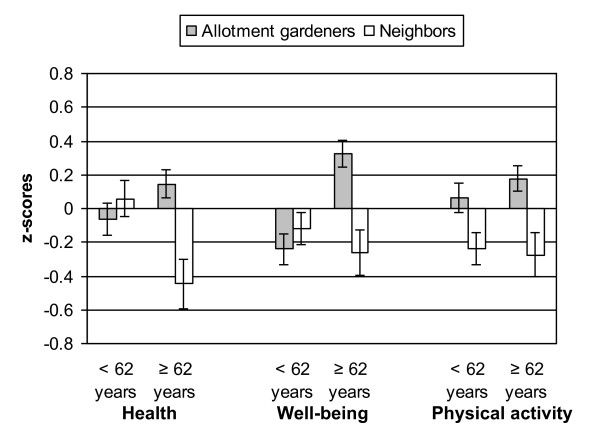
BACKGROUND: The potential contribution of allotment gardens to a healthy and active life-style is increasingly recognized, especially for elderly populations. However, few studies have empirically examined beneficial effects of allotment gardening. In the present study the health, well-being and physical activity of older and younger allotment gardeners was compared to that of controls without an allotment. METHODS: A survey was conducted among 121 members of 12 allotment sites in the Netherlands and a control group of 63 respondents without an allotment garden living next to the home addresses of allotment gardeners. The survey included five self-reported health measures (perceived general health, acute health complaints, physical constraints, chronic illnesses, and consultations with GP), four self-reported well-being measures (stress, life satisfaction, loneliness, and social contacts with friends) and one measure assessing self-reported levels of physical activity in summer. Respondents were divided into a younger and older group at the median of 62 years which equals the average retirement age in the Netherlands. RESULTS: After adjusting for income, education level, gender, stressful life events, physical activity in winter, and access to a garden at home as covariates, both younger and older allotment gardeners reported higher levels of physical activity during the summer than neighbors in corresponding age categories. The impacts of allotment gardening on health and well-being were moderated by age. Allotment gardeners of 62 years and older scored significantly or marginally better on all measures of health and well-being than neighbors in the same age category. Health and well-being of younger allotment gardeners did not differ from younger neighbors. The greater health and well-being benefits of allotment gardening for older gardeners may be related to the finding that older allotment gardeners were more oriented towards gardening and being active, and less towards passive relaxation. CONCLUSIONS: These findings are consistent with the notion that having an allotment garden may promote an active life-style and contribute to healthy aging. However, the findings may be limited by self selection and additional research is needed to confirm and extend the current findings.
Overview
The claims and statistics of this paper haven’t been checked yet.
Free: it reads the open-access text and checks the first 5 claims that cite a source we can check. Create a free account to check every claim.
Integrity signals
Registry
Cites
Statistics
Figures
Verification
Claims the paper makes
The claims and statistics of this paper haven’t been checked yet.
Free: it reads the open-access text and checks the first 5 claims that cite a source we can check. Create a free account to check every claim.
Claims other papers make about this one
Each is checked against this paper’s own text: does it say what the citing paper says it does?
The source backs part of the claim, not all of it — or backs it for a different population, condition or comparison.
In the citing paper
“Indeed, previous studies have shown that gardening increases individual's life satisfaction, vigor, psychological wellbeing, positive affects, sense of community, and cognitive function (Gigliotti and Jarrott, 2005, Gonzalez et al., 2010, van den Berg et al., 2010, Wakefield et al., 2007, Wichrowski et al., 2005, Wood et al., 2016).”
From Gardening is beneficial for health: A meta-analysis (2017) · cites this paper as van den Berg et al., 2010
Experimental — accuracy not yet measuredThe source backs part of the claim, not all of it — or backs it for a different population, condition or comparison.
In the citing paper
“Second, and somewhat more indirectly, gardening is likely to encourage people to undertake physical exercise, which in turn would contribute to improving both the physical and psychological health of gardeners (Park et al., 2009, van den Berg et al., 2010, Zick et al., 2013).”
From Gardening is beneficial for health: A meta-analysis (2017) · cites this paper as van den Berg et al., 2010
Experimental — accuracy not yet measuredThe source backs part of the claim, not all of it — or backs it for a different population, condition or comparison.
In the citing paper
“Third, gardens, especially allotment and community gardens, provide opportunities to interact with other members of local communities, which is likely to forge and reinforce social ties, community networks, and sense of community (van den Berg et al., 2010, Wakefield et al., 2007).”
From Gardening is beneficial for health: A meta-analysis (2017) · cites this paper as van den Berg et al., 2010
Experimental — accuracy not yet measured
Self-check
Percentages, sums and reported differences re-computed from the paper’s own numbers.
The self-check needs the paper’s full text.
Citations
Cites
Effect of exposure to natural environment on health inequalities: an observational population study
Mitchell, R., & Popham, F. (2008) · The Lancet · doi:10.1016/s0140-6736(08)61689-x · Cited by 2,099 · cited 1×
“These alleged health benefits of allotment gardens receive some indirect support from epidemiological studies which have consistently shown positive relationships between urban green space and people’s health and well-being [7-13].”
Ware, J. E., Kosinski, M. R., Bayliss, M. S., McHorney, C. A., Rogers, W. H., & Raczek, A. E. (1995) · PubMed · Cited by 2,014
Green space, urbanity, and health: how strong is the relation?
Maas, J., Verheij, R. A., Groenewegen, P. P., de Vries, S., & Spreeuwenberg, P. (2006) · Journal of Epidemiology and Community Health · doi:10.1136/jech.2005.043125 · Cited by 1,976 · cited 1×
“These alleged health benefits of allotment gardens receive some indirect support from epidemiological studies which have consistently shown positive relationships between urban green space and people’s health and well-being [7-13].”
Wendel-Vos, G. (2003) · Journal of Clinical Epidemiology · doi:10.1016/s0895-4356(03)00220-8 · Cited by 1,401 · cited 4×
“Abbreviations ANOVA: Analysis Of VAriance; ANCOVA: Analysis of COVAriance; GP: General Practitioner; SPSS 17.0: Statistical Package for the Social Science 17; SF-36: Short-Form 36; Statistical Package for the Social Sciences version 17.0; SQUASH: Short QUestionnaire to ASses Health enhancing physical activity.”
InfluentialTakano, T., Nakamura, K., & Watanabe, M. (2002) · Journal of Epidemiology and Community Health · doi:10.1136/jech.56.12.913 · Cited by 1,314 · cited 1×
“These alleged health benefits of allotment gardens receive some indirect support from epidemiological studies which have consistently shown positive relationships between urban green space and people’s health and well-being [7-13].”
de Vries, S., Verheij, R. A., Groenewegen, P. P., & Spreeuwenberg, P. (2003) · Environment and Planning A: Economy and Space · doi:10.1068/a35111 · Cited by 1,258 · cited 1×
“These alleged health benefits of allotment gardens receive some indirect support from epidemiological studies which have consistently shown positive relationships between urban green space and people’s health and well-being [7-13].”
Green space as a buffer between stressful life events and health
van den Berg, A. E., Maas, J., Verheij, R. A., & Groenewegen, P. P. (2010) · Social Science & Medicine · doi:10.1016/j.socscimed.2010.01.002 · Cited by 1,126
Grahn, P., & Stigsdotter, U. A. (2003) · Urban Forestry & Urban Greening · doi:10.1078/1618-8667-00019 · Cited by 969
Armstrong, D. (2000) · Health & Place · doi:10.1016/s1353-8292(00)00013-7 · Cited by 832 · cited 2×
“The higher self-reported activity levels of allotment gardeners are also consistent with recurrent findings of previous research that physical activity is among the primary self-reported reasons why people engage in gardening [14,15,41].”
Standardized Mortality Ratios and the "Healthy Worker Effect": Scratching Beneath the Surface
McMichael, A. J. (1976) · Journal of Occupational and Environmental Medicine · doi:10.1097/00043764-197603000-00009 · Cited by 767 · cited 1×
“Such selection may have caused a “healthy gardener effect” (comparable to the “healthy worker effect” [43]) so that morbidity rates among the gardeners were underestimated.”
Sugiyama, T., Leslie, E., Giles-Corti, B., & Owen, N. (2008) · Journal of Epidemiology and Community Health · doi:10.1136/jech.2007.064287 · Cited by 728 · cited 1×
“These alleged health benefits of allotment gardens receive some indirect support from epidemiological studies which have consistently shown positive relationships between urban green space and people’s health and well-being [7-13].”
Growing urban health: community gardening in South-East Toronto
Wakefield, S., Yeudall, F., Taron, C., Reynolds, J., & Skinner, A. (2007) · Health Promotion International · doi:10.1093/heapro/dam001 · Cited by 612 · cited 2×
“The higher self-reported activity levels of allotment gardeners are also consistent with recurrent findings of previous research that physical activity is among the primary self-reported reasons why people engage in gardening [14,15,41].”
Fruit and Vegetable Intake among Urban Community Gardeners
Alaimo, K., Packnett, E., Miles, R. A., & Kruger, D. J. (2008) · Journal of Nutrition Education and Behavior · doi:10.1016/j.jneb.2006.12.003 · Cited by 576 · cited 1×
“By including more food production sites, future research may uncover additional dietary benefits of allotment gardening, preferably measured through objective registrations of food intake [47].”
‘Cultivating health’: Therapeutic landscapes and older people in northern England
Milligan, C., Gatrell, A., & Bingley, A. (2004) · Social Science & Medicine · doi:10.1016/s0277-9536(03)00397-6 · Cited by 571 · cited 4×
“The stronger health and well-being impacts of allotment gardening in the group of older respondents fit well with anecdotal and qualitative information that allotment gardens are especially beneficial for the elderly [23,24].”
InfluentialNielsen, T. S., & Hansen, K. B. (2007) · Health & Place · doi:10.1016/j.healthplace.2007.02.001 · Cited by 561 · cited 1×
“These alleged health benefits of allotment gardens receive some indirect support from epidemiological studies which have consistently shown positive relationships between urban green space and people’s health and well-being [7-13].”
Barthel, S., Folke, C., & Colding, J. (2010) · Global Environmental Change · doi:10.1016/j.gloenvcha.2010.01.001 · Cited by 557 · cited 1×
“Nowadays, there are an estimated three million individual allotment gardens across Europe, which serve a variety of purposes for diverse populations [ 2 ].”
Vitamin G: effects of green space on health, well-being, and social safety
Groenewegen, P. P., van den Berg, A. E., de Vries, S., & Verheij, R. A. (2006) · BMC Public Health · doi:10.1186/1471-2458-6-149 · Cited by 476 · cited 1×
“The present study formed part of the “Vitamin G” research program on relationships between green space and health [30].”
Gardening promotes neuroendocrine and affective restoration from stress
Van Den Berg, A. E., & Custers, M. H. G. (2011) · Journal of Health Psychology · doi:10.1177/1359105310365577 · Cited by 470 · cited 1×
“After half an hour of gardening on the allotment, elevated salivary cortisol levels decreased by 22 percent, against a decrease of 11 percent in a control group assigned to a passive indoor reading task [19].”
Maas, J., Verheij, R. A., Spreeuwenberg, P., & Groenewegen, P. P. (2008) · BMC Public Health · doi:10.1186/1471-2458-8-206 · Cited by 411 · cited 1×
“thus far failed to demonstrate a general relationship between presence of green space and physical activity among adults [42].”
What Information Do Consumers Want and How Will They Use It?
WARE, J. E. (1995) · Medical Care · doi:10.1097/00005650-199501001-00005 · Cited by 401
Community Gardens: Lessons Learned From California Healthy Cities and Communities
Twiss, J., Dickinson, J., Duma, S., Kleinman, T., Paulsen, H., & Rilveria, L. (2003) · American Journal of Public Health · doi:10.2105/ajph.93.9.1435 · Cited by 361 · cited 1×
“The findings have consistently shown that allotment gardens, like other types of community gardens, are perceived to improve general health conditions as well as to provide specific benefits related to recovery from stress, increased life satisfaction, more social contacts, and increased activity levels [14-18].”
Reliability and Validity of 2 Single-Item Measures of Psychosocial Stress
Littman, A. J., White, E., Satia, J. A., Bowen, D. J., & Kristal, A. R. (2006) · Epidemiology · doi:10.1097/01.ede.0000219721.89552.51 · Cited by 266 · cited 1×
“Well-being: Stress was assessed with two items [34].”
Agropolis: the social, political, and environmental dimensions of urban agriculture
(2006) · Choice Reviews Online · doi:10.5860/choice.43-4642 · Cited by 252
Ottosson, J., & Grahn, P. (2005) · Landscape Research · doi:10.1080/0142639042000324758 · Cited by 246 · cited 2×
“These findings are also in agreement with increasing experimental evidence for a causal effect of contact with gardens on the health and well-being of elderly people [25,26].”
(2010) · Routledge eBooks · doi:10.4324/9781849775892 · Cited by 228
Conceptualizations and measures of loneliness: a comparison of subscales
Cramer, K. M., & Barry, J. E. (1999) · Personality and Individual Differences · doi:10.1016/s0191-8869(98)00257-8 · Cited by 184 · cited 1×
“Loneliness was assessed by two items measuring the frequency of feelings of loneliness (0 = seldom/ never; 1 = sometimes or frequently) and the need for social contacts (0 = no; 1 = yes) [36].”
den Berg, A. E. V., & van Winsum-Westra, M. (2010) · Urban forestry & urban greening · doi:10.1016/j.ufug.2010.01.006 · Cited by 151
Irvine, S., Johnson, L., & Peters, K. (1999) · Local Environment · doi:10.1080/13549839908725579 · Cited by 150 · cited 1×
“Background Allotment gardens originated in Europe during the 18 century when plots of land were made available to poor laborers for the production of vegetables and fruits [1].”
Perceived Benefits to Human Well-being of Urban Gardens
Dunnett, N., & Qasim, M. (2000) · HortTechnology · doi:10.21273/horttech.10.1.40 · Cited by 150 · cited 1×
“The higher self-reported activity levels of allotment gardeners are also consistent with recurrent findings of previous research that physical activity is among the primary self-reported reasons why people engage in gardening [14,15,41].”
Development of Life Satisfaction in Old Age: Another View on the "Paradox''
Schilling, O. K. (2006) · Social Indicators Research · doi:10.1007/s11205-004-5297-2 · Cited by 150 · cited 1×
“Finally, as health and well-being may decline in old age, a pattern that was generally confirmed in our control group, it is also possible that there was more room for an influence of allotment gardening to appear among the older respondents [45].”
Daugbjerg, S. B., Kahlmeier, S., Racioppi, F., Martin-Diener, E., Martin, B., Oja, P., & Bull, F. (2009) · Journal of Physical Activity and Health · doi:10.1123/jpah.6.6.805 · Cited by 136 · cited 1×
“Indeed, allotment gardens may play a vital role in developing active and healthy living policies and programs [51,52].”
Eisen, E. A., & Robins, J. M. (2001) · Encyclopedia of Environmetrics · doi:10.1002/9780470057339.vah007 · Cited by 136
Wagenmakers, R., Akker-Scheek, I. V. D., Groothoff, J. W., Zijlstra, W., Bulstra, S. K., Kootstra, J. W., Wendel-Vos, G. W., van Raaij, J. J., & Stevens, M. (2008) · BMC Musculoskeletal Disorders · doi:10.1186/1471-2474-9-141 · Cited by 136
Health, well-being and social inclusion: Therapeutic horticulture in the UK
Sempik, J., Aldridge, J., & Becker, S. (2005) · Loughborough University Institutional Repository (Loughborough University) · Cited by 85
Gardening's Socioeconomic Impacts: Community Gardening in an Urban Setting.
Patel, I. C. (1991) · Journal of Extension · Cited by 85
The Life Satisfaction Index: a Methodological and Theoretical Critique
Hoyt, D. R., & Creech, J. C. (1983) · Journal of Gerontology · doi:10.1093/geronj/38.1.111 · Cited by 85 · cited 1×
“Life satisfaction was assessed with the 8-item version of the Life Satisfaction Index [35].”
Method(2002) · Cited by 82
The Influence of Gardening Activities on Consumer Perceptions of Life Satisfaction
Waliczek, T. M., Zajicek, J. M., & Lineberger, R. D. (2005) · HortScience · doi:10.21273/hortsci.40.5.1360 · Cited by 78 · cited 1×
“Home gardeners, the majority of whom were past retirement age, rated their overall health, physical activity, and life satisfaction higher than a matched group of non-gardeners [27].”
Assessing Benefits from Allotments as a Component of Urban Agriculture in England
Pérez-Vásquez, A., Anderson, S., & Rogers, A. W. (2010) · doi:10.4324/9781849775892-18 · Cited by 30 · cited 1×
“The findings have consistently shown that allotment gardens, like other types of community gardens, are perceived to improve general health conditions as well as to provide specific benefits related to recovery from stress, increased life satisfaction, more social contacts, and increased activity levels [14-18].”
Horticultural Therapy and the Older Adult Population
Wells, S. (2014) · Routledge eBooks · doi:10.4324/9781315821825 · Cited by 25
REINVENTING ALLOTMENTS FOR THE TWENTY-FIRST CENTURY: THE UK EXPERIENCE
Crouch, D. (2000) · Acta Horticulturae · doi:10.17660/actahortic.2000.523.18 · Cited by 24 · cited 1×
“Around the world, allotment gardens are increasingly under pressure from building and infrastructure developments [20,48,49].”
Hartig, T., & Fransson, U. (2009) · Environment and Planning A: Economy and Space · doi:10.1068/a401 · Cited by 23 · cited 1×
“These studies found that men who owned a leisure home were less likely to suffer premature departure from the paid labor force due to early retirement for health reasons [28] or early death [29].”
Horticultural Therapy and the Older Adult Population
Bloomfield, C. (1998) · Physiotherapy · doi:10.1016/s0031-9406(05)66169-x · Cited by 21
Leisure home ownership and early death: A longitudinal study in Sweden
Fransson, U., & Hartig, T. (2009) · Health & Place · doi:10.1016/j.healthplace.2009.08.005 · Cited by 15 · cited 1×
“These studies found that men who owned a leisure home were less likely to suffer premature departure from the paid labor force due to early retirement for health reasons [28] or early death [ 29 ].”
Wiltshire, R., & Burn, D. (2008) · Research Portal (King's College London) · Cited by 6
Research works printed but not linked: 10
- 4. Ministry of Housing Spatial Planning and the Environment: National spatial strategy The Hague; 2004.
- 6. Hope N, Ellis V: Can you dig it? Meeting community demands for allotments London: New Local Government Network; 2009 [http://www.nlgn.org.uk/ public/wp-content/uploads/can-you-dig-it.pdf], Accessed September 14, 2010.
- 20. Allaert G, Leinfelder H, Verhoestraete D: Description of allotment sites in Flanders from a sociological and spatial perspective. Brussels: University of Ghent, Department of Mobility and Spatial Planning 2007 [http://www2. vlaanderen.be/ned/sites/landbouw/downloads/volt/64.pdf], Accessed September 14, 2010.
- 21. BMVBS/BBR: Urban development-related, ecological, and social significance of allotment gardening Bonn: BMVBS; 2008 [http://www.bbr.bund.de/ nn_147036/BBSR/EN/Publications/BMVBS/Forschungen/2008/133abstract. html], Accessed September 14, 2010.
- 22. Dienst Ruimtelijke Ordening Amsterdam: Nota volkstuinen in Amsterdam [Policy report on allotment gardens in Amsterdam] Amsterdam 2004 [http://www.dro.amsterdam.nl/aspx/download.aspx?file=/contents/pages/ 96890/notavolkstuinen.pdf], Accessed September 14, 2010.
- 32. van den Berg et al. Environmental Health 2010, 9:74 http://www.ehjournal.net/content/9/1/74
- 34. Ormel J, Koeter MWJ: De Groningse Gebeurtenissen Lijst. Groningen [The Groningen Events List] Groningen: University of Groningen, Department of Social Psychiatry; 1985, Accessed.
- 40. Ministry of Health Welfare and Sport: Time for sport: exercise, participate, perform The Hague; 2005 [http://english.minvws.nl/includes/dl/openbestand. asp?File=/images/time-for-sport-excercise-participate-perform3_tcm20- 108198.pdf], Accessed September 14, 2010.
- 41. Netherlands Statistics: Average retirement age higher The Hague; 2010 [http://www.cbs.nl/en-GB/menu/themas/inkomen-bestedingen/publicaties/ artikelen/archief/2010/2010-023-pb.htm?Languageswitch=on], Accessed September 14, 2010.
- 53. World Health Organization: Population approaches to increasing levels of physical activity Geneva: WHO Press; 2007.
Cited by
Hartig, T., Mitchell, R., de Vries, S., & Frumkin, H. (2014) · Annual Review of Public Health · doi:10.1146/annurev-publhealth-032013-182443 · Cited by 3,638
“In one study, older allotment gardeners reported having more contacts with friends and felt less lonely than did nongardening neighbors in the same age category (131).”
BackgroundExtinction of experience: the loss of human–nature interactions
Soga, M., & Gaston, K. J. (2016) · Frontiers in Ecology and the Environment · doi:10.1002/fee.1225 · Cited by 1,802
“…a positive relationship between levels of exposure to nature and people ’ s physical health and psychological well- being (Figure 4 , a and b; van den Berg et al. 2010 ; Kardan et al. 2015 ), as well as social contacts and cohesion (Figure 4 c; Sugiyama et al. 2008 ; van den Berg et al. 2010 ).”
Demuzere, M., Orru, K., Heidrich, O., Olazabal, E., Geneletti, D., Orru, H., Bhave, A. G., Mittal, N., Feliu, E., & Faehnle, M. (2014) · Journal of Environmental Management · doi:10.1016/j.jenvman.2014.07.025 · Cited by 972
“Neighborhood green space enhances health by mitigating stressful life events, e.g. at times of social and environmental perturbations (van den Berg et al., 2010).”
BackgroundGardening is beneficial for health: A meta-analysis
Soga, M., Gaston, K. J., & Yamaura, Y. (2017) · Preventive Medicine Reports · doi:10.1016/j.pmedr.2016.11.007 · Cited by 688
“…a subjective scale (e.g. depression, anxiety, quality of life, life satisfaction) (Ghanbari et al., 2015; Kam and Siu, 2010; Kotozaki, 2014; van den Berg et al., 2010; Waliczek et al., 2005; Wood et al., 2016), they were more likely to respond immediately than objective health outcomes (e.g. BMI)…”
InfluentialPast results and future directions in urban community gardens research
Guitart, D., Pickering, C., & Byrne, J. (2012) · Urban Forestry & Urban Greening · doi:10.1016/j.ufug.2012.06.007 · Cited by 602
“…by improving the diet of gardeners and others (Blair et al., 1991; Somerset et al., 2005; Alaimo et al., 2008; Mundel and Chapman, 2010; Van Den Berg et al., 2010), by increased exercise (Austin et al., 2006; Wakefield et al., 2007; Teig et al., 2009), and/or by improving mental health by…”
Metadata
- Authors
- van den Berg, A. E., van Winsum-Westra, M., de Vries, S., & van Dillen, S. M.
- Venue
- Environmental Health
- Published
- 2010-11-23
- Volume
- 9
- Issue
- 1
- Pages
- 74-74
- ISSN
- 1476-069X (ISSN-L)
- PMC
- PMC3001426
- OpenAlex
- W2124048226
- Cited by
- 293
- References
- 45
- Citations by year
- 2026: 5 · 2025: 23 · 2024: 21 · 2023: 23 · 2022: 27 · 2021: 35 · 2020: 33 · 2019: 19 · 2018: 14 · 2017: 18 · 2016: 20 · 2015: 15 · 2014: 16 · 2013: 10 · 2012: 9
- FWCI
- 9.21
- Type
- journal article
- Language
- en
- Open access
- gold
- doi.org
- Licence
- Locations
- Environmental Health (publishedVersion, cc-by)
- PubMed Central (publishedVersion, cc-by)
- PubMed (publishedVersion)
- Socio-Environmental Systems Modeling (acceptedVersion)
- DOAJ (DOAJ: Directory of Open Access Journals) (submittedVersion)
- Data Archiving and Networked Services (DANS) (submittedVersion, other-oa)
- Topics
- Social Sciences › Urban Studies › Urban Agriculture and Sustainability
- Social Sciences › Urban Studies › Urban Green Space and Health
- Health Sciences › Medicine › Public Health, Environmental and Occupational Health › Physical Activity and Health
- Keywords
- allotment gardening, health, well-being, physical activity, older adults, healthy aging, life satisfaction, loneliness, stress, social contact, age differences, self-selection, active lifestyle
- MeSH terms
- Aged, Female, Health Status, Health Surveys, Humans, Male, Middle Aged, Netherlands, Personal Satisfaction, Stress, Psychological, Urban Health, Linear Models, Gardening, Self Report
About these checks
Registry, retraction, Cites and statistics results are computed, not judged, with one exception: a printed reference that no index lists is read once by a model before it counts as a citation error. Claims are extracted by a model and kept only when their quote appears verbatim in the text; each cited source is then checked, with a model’s help, for whether it says what the claim relies on. Those verdicts can be wrong — read the claim’s quote and the cited source before relying on one.
Statistics and arithmetic are recomputed, not judged.
Confidence bands are shown only for fields calibrated on our annotated test set. None is calibrated yet, so no band is shown.
What counts as a claim ›How we measure confidence ›How we check this ›
Are you an author, or do you see a problem with this page? Request a review
Data sources
Bibliographic data: Semantic Scholar, OpenAlex, Crossref.
Contains information from the Semantic Scholar Academic Graph Datasets, made available under the ODC Attribution License (ODC-BY 1.0).
Semantic Scholar’s data is described in: Kinney, R., et al. (2023). The Semantic Scholar Open Data Platform. arXiv:2301.10140.
