

The DOI matches its Crossref record; 34 of the 35 references it cites were found in a registry or an index.
A UK validation of a general measure of subjective well-being: the modified BBC subjective well-being scale (BBC-SWB)
Open accessAbstract
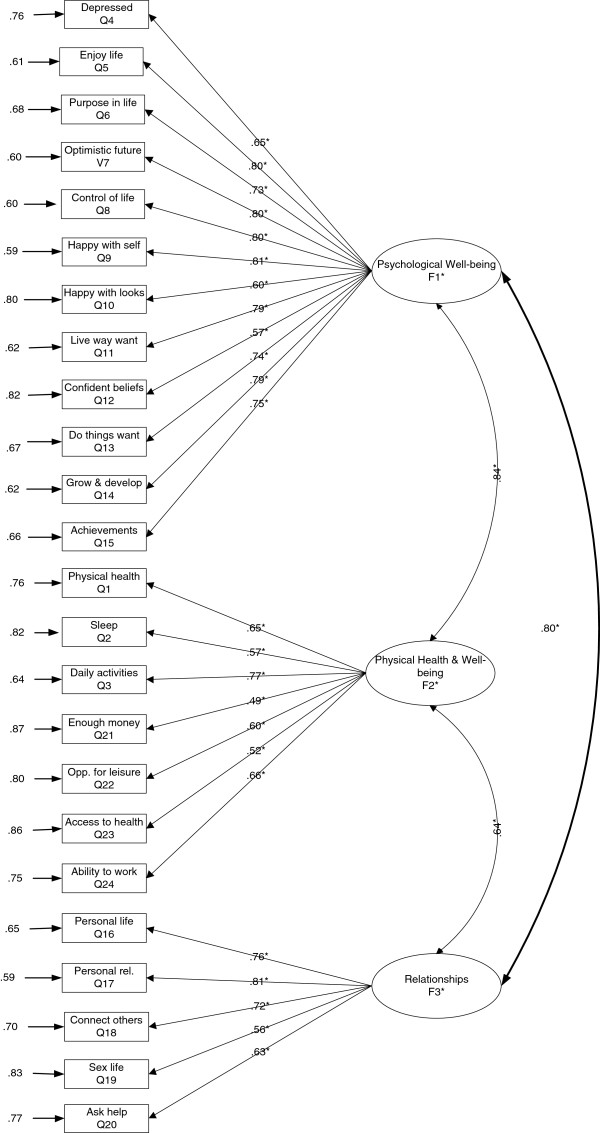
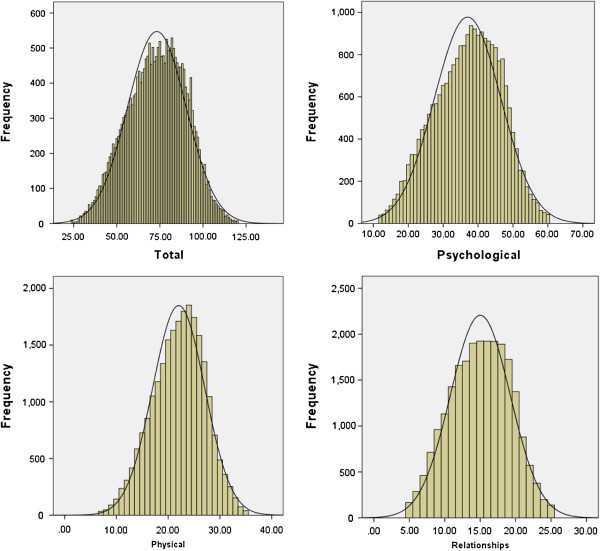
BACKGROUND: The BBC Subjective Well-being scale (BBC-SWB) is a recently developed questionnaire designed to measure people's subjective experiences across the wide breadth of domains commonly included in definitions of well-being. Although it has previously been shown to be a reliable and valid measure of subjective well-being in the general population with good psychometric properties, a limitation of the initial version was that it was developed using responses on a 4-point Likert-style scale. This paper presents the psychometric properties, validity and reliability of a revised version of the scale conducted using 5-point Likert-style responses and tests the hypothesis that the scale measures three underlying dimensions of well-being; psychological; physical health; and relationships. METHODS: A sample of 23,341 participants completed the revised BBC-SWB as part of an on-line open-access battery of self-report measures. Confirmatory factor analysis was used to test the pre-hypothesised three factor structure, and internal consistency was investigated using Cronbach's alpha. Concurrent validity was assessed through analysis of correlations with demographic variables, scores on the Goldberg Anxiety and Depression Scales, and the List of Threatening Experiences Questionnaire. RESULTS: Confirmatory factor analysis supported three factor structure of the measure in the whole sample and for subsamples of males and females. Both the total 24-item scale and the three subscales had good internal consistency, showed no evidence of floor and ceiling effects and correlated significantly with measures of concurrent validity. CONCLUSIONS: This study provided further confirmation of the validity and utility of the BBC Subjective Well-being scale. The modified version is a reliable and valid measure for the online assessment of subjective well-being in the general population with good psychometric properties.
Overview
The claims and statistics of this paper haven’t been checked yet.
Run the check — free, no account needed. It reads the open-access text and checks the sources it cites.
Integrity signals
Registry
Cites
Statistics
Figures
Verification
Claims the paper makes
The claims and statistics of this paper haven’t been checked yet.
Run the check — free, no account needed. It reads the open-access text and checks the sources it cites.
Claims other papers make about this one
Each is checked against this paper’s own text: does it say what the citing paper says it does?
In the citing paper
“Greater specificity was provided by definitions that partitioned well-being into a subjective domain, and a separate objective domain.42”
From Review of 99 self-report measures for assessing well-being in adults: exploring dimensions of well-being and developments over time (2016) · cites this paper as [42]
Self-check
Percentages, sums and reported differences re-computed from the paper’s own numbers.
The self-check needs the paper’s full text.
Citations
Cites
Coefficient Alpha and the Internal Structure of Tests
Cronbach, L. J. (1951) · Psychometrika · doi:10.1007/bf02310555 · Cited by 43,931
The satisfaction with life scale
Diener, E., Emmons, R. A., Larsen, R. J., & Griffin, S. (1985) · Journal of Personality Assessment · doi:10.1207/s15327752jpa4901_13 · Cited by 31,768 · cited 1×
“In addition, measures of subjective well-being have been developed such as the Diener scale [15] which focuses on beliefs and attitudes related to well-being, and the Lyubomirsky scale [16] which assesses an individual’s sense of comparison with peers; although they fail to serve as adequate replacements to measures o…”
BackgroundAlternative Ways of Assessing Model Fit
Browne, M. W., & Cudeck, R. (1992) · Sociological Methods & Research · doi:10.1177/0049124192021002005 · Cited by 27,200
Comparative fit indexes in structural models.
Bentler, P. M. (1990) · Psychological Bulletin · doi:10.1037/0033-2909.107.2.238 · Cited by 25,266 · cited 11×
“Whilst this revealed an acceptable fit of the data; (S-B χ2 = (249, N = 23, 341) = 25204.8, P < 0.001; RCFI = .909; RMSEA = .066 (.065-.066), it was not as good fit as the hypothesised three-factor model.”
MethodInfluentialConvergent and discriminant validation by the multitrait-multimethod matrix.
Campbell, D. T., & Fiske, D. W. (1959) · Psychological Bulletin · doi:10.1037/h0046016 · Cited by 17,116 · cited 1×
“85 indicate that the factors are measuring different underlying constructs [33].”
BackgroundEuroQol: a new facility for the measurement of health-related quality of life
(1990) · Health Policy · doi:10.1016/0168-8510(90)90421-9 · Cited by 15,736
Happiness is everything, or is it? Explorations on the meaning of psychological well-being.
Ryff, C. D. (1989) · Journal of Personality and Social Psychology · doi:10.1037/0022-3514.57.6.1069 · Cited by 14,847 · cited 3×
“Items were chosen to reflect the four domains (physical health, psychological health, social relationships and environment) of the WHOQOL-BREF [13], and the six domains (self-acceptance, autonomy, environmental mastery, purpose in life, positive relations with others and personal growth) of the Psychological Well-Bein…”
BackgroundMethodThe structure of psychological well-being revisited.
Ryff, C. D., & Keyes, C. L. M. (1995) · Journal of Personality and Social Psychology · doi:10.1037//0022-3514.69.4.719 · Cited by 10,285
EQS : structural equations program manual
Bentler, P. M. (1989) · Medical Entomology and Zoology · Cited by 9,669
Testing Structural Equation Models.
Clogg, C. C., Bollen, K. A., & Long, J. S. (1995) · Social Forces · doi:10.2307/2580595 · Cited by 8,246
Cited by
Sorted by citations
Linton, M.-J., Dieppe, P., & Medina-Lara, A. (2016) · BMJ Open · doi:10.1136/bmjopen-2015-010641 · Cited by 638
“Greater specificity was provided by definitions that partitioned wellbeing into a subjective domain, and a separate objective domain.(42)”
BackgroundAllen, J. J., & Anderson, C. A. (2018) · Computers in Human Behavior · doi:10.1016/j.chb.2018.02.034 · Cited by 210
Measuring Well-Being in Sport Performers: Where are We Now and How do we Progress?
Giles, S., Fletcher, D., Arnold, R., Ashfield, A., & Harrison, J. (2020) · Sports Medicine · doi:10.1007/s40279-020-01274-z · Cited by 145
Causal and mediating factors for anxiety, depression and well-being
Kinderman, P., Tai, S., Pontin, E. E., Schwannauer, M., Jarman, I. H., & Lisboa, P. J. G. (2015) · The British Journal of Psychiatry · doi:10.1192/bjp.bp.114.147553 · Cited by 106
Self-citationPeach, H. D., Gaultney, J. F., & Gray, D. D. (2016) · Cogent Psychology · doi:10.1080/23311908.2016.1168768 · Cited by 90
“A study (Pontin et al., 2013) validated the scale in a sample of 23,341 participants and demonstrated significant correlations with scores on the Goldberg Anxiety and Depression Scales and the List of Threatening Experiences Questionnaire.”
Method
Metadata
- Authors
- Pontin, E., Schwannauer, M., Tai, S., & Kinderman, P.
- Affiliations
- University of Liverpool (GB)
- University of Edinburgh (GB)
- University of Manchester (GB)
- Corresponding author
- Pontin, Eleanor
- Venue
- Health and Quality of Life Outcomes
- Published
- 2013
- Volume
- 11
- Issue
- 1
- Pages
- 150
- ISSN
- 1477-7525 (ISSN-L)
- PMC
- PMC3868314
- OpenAlex
- W2141240900
- Cited by
- 134
- References
- 35
- Citations by year
- 2026: 12 · 2025: 17 · 2024: 21 · 2023: 21 · 2022: 16 · 2021: 13 · 2020: 9 · 2019: 3 · 2018: 7 · 2017: 1 · 2016: 6 · 2015: 5 · 2014: 3
- FWCI
- 6.98
- Type
- journal article
- Language
- en
- Open access
- gold
- doi.org
- Licence
- cc-by
- Locations
- Health and Quality of Life Outcomes (publishedVersion, cc-by)
- Europe PMC (PubMed Central) (publishedVersion, cc-by)
- PubMed Central (publishedVersion, cc-by)
- PubMed (publishedVersion)
- Edinburgh Research Explorer (University of Edinburgh) (submittedVersion, cc-by)
- Topics
- Social Sciences › Psychology › Social Psychology › Psychological Well-being and Life Satisfaction
- Social Sciences › Decision Sciences › Management Science and Operations Research › Psychometric Methodologies and Testing
- Health Sciences › Health Professions › General Health Professions › Health, psychology, and well-being
- Keywords
- subjective well-being, psychometric validation, scale revision, factor structure, psychological well-being, physical health, interpersonal relationships, concurrent validity, reliability statistics, general population
- MeSH terms
- Adolescent, Adult, Aged, Factor Analysis, Statistical, Female, United Kingdom, Humans, Male, Middle Aged, Personal Satisfaction, Surveys and Questionnaires, Young Adult
About these checks
Registry, retraction, Cites and statistics results are computed, not judged, with one exception: a printed reference that no index lists is read once by a model before it counts as a citation error. Claims are extracted by a model and kept only when their quote appears verbatim in the text; each cited source is then checked, with a model’s help, for whether it says what the claim relies on. Those verdicts can be wrong — read the claim’s quote and the cited source before relying on one.
Statistics and arithmetic are recomputed, not judged.
Confidence bands are shown only for fields calibrated on our annotated test set. None is calibrated yet, so no band is shown.
What counts as a claim ›How we measure confidence ›How we check this ›
Are you an author, or do you see a problem with this page? Request a review
