

The DOI matches its Crossref record; 61 of the 62 references it cites were found in a registry or an index.
Measuring the impact of caregiving on informal carers: a construct validation study of the CarerQol instrument
Open accessAbstract
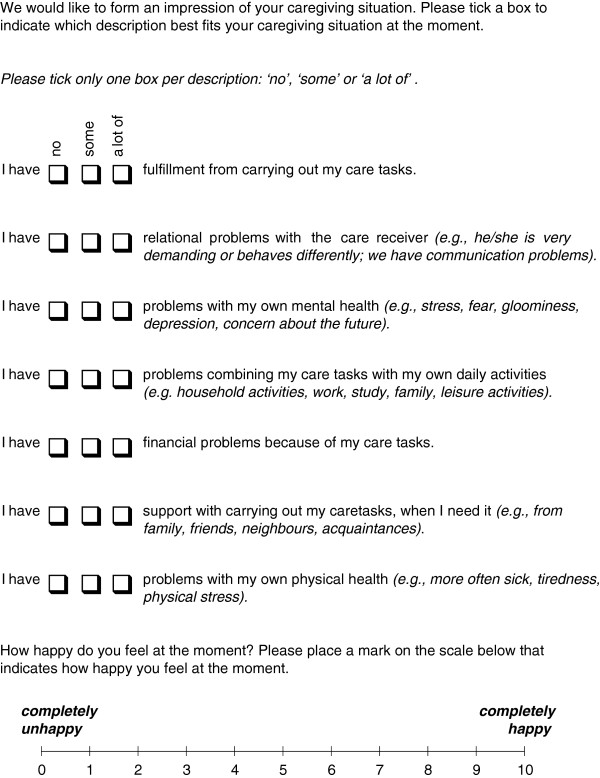
BACKGROUND: Informal caregivers provide a significant part of the total care needed by ill or disabled persons. Although informal care is often the preferred option of those who provide and those who receive informal care, caring can nevertheless be very straining. This study investigates construct validation of an instrument of the impact of caregiving, the CarerQol. METHODS: Data was collected among adult caregivers (n = 1,244) selected from the general population using an online questionnaire in October 2010, in the Netherlands. The CarerQol measures and values the impact of informal care. The CarerQol measures subjective burden (CarerQol-7D) and well-being (CarerQol-VAS). Construct validation comprised clinical, convergent and discriminative validity tests. RESULTS: Clinical validity was supported by statistically significant associations of CarerQol-VAS and caregivers' health, income and employment status, care recipients' health, and the relationship between caregiver and care recipient. Convergent validity was supported by positive associations of CarerQol-VAS with the two positive CarerQol-7D dimensions (fulfillment and support) and negative associations with the five negative CarerQol-7D dimensions (relational problems, mental health problems, problems combining daily activities, financial problems and physical health problems). Moreover, CarerQol-VAS was negatively associated with other instruments measuring caregiving burden. CONCLUSIONS: Construct validity tests in a large, heterogeneous sample of caregivers show that the CarerQol validly measures the impact of caregiving. The CarerQol can be used in informal care research and economic evaluations of health care interventions. Hence, its use can facilitate informed decision making in health care.
Overview
The claims and statistics of this paper haven’t been checked yet.
Run the check — free, no account needed. It reads the open-access text and checks the sources it cites.
Integrity signals
Registry
Cites
Statistics
Figures
Verification
Claims the paper makes
The claims and statistics of this paper haven’t been checked yet.
Run the check — free, no account needed. It reads the open-access text and checks the sources it cites.
Claims other papers make about this one
Each is checked against this paper’s own text: does it say what the citing paper says it does?
The cited source says what the claim attributes to it.
In the citing paper
“The psychometric properties of the CarerQol were shown to be satisfactory [48–50].”
Self-check
Percentages, sums and reported differences re-computed from the paper’s own numbers.
The self-check needs the paper’s full text.
Citations
Cites
EuroQol: a new facility for the measurement of health-related quality of life
(1990) · Health Policy · doi:10.1016/0168-8510(90)90421-9 · Cited by 15,736
Methods for the Economic Evaluation of Health Care Programmes
Drummond, M. E., Sculpher, M. J., Torrance, G. W., O’Brien, B. J., & Stoddart, G. L. (2005) · doi:10.1093/oso/9780198529446.001.0001 · Cited by 13,648
Health Measurement Scales: A Practical Guide to Their Development and Use
Streiner, D. L., Norman, G. R., & Cairney, J. (1989) · Cited by 9,595
Cost-Effectiveness in Health and Medicine
(1996) · doi:10.1093/oso/9780195108248.001.0001 · Cited by 7,193
(1997) · doi:10.1097/00005650-199711000-00002 · Cited by 4,544 · cited 1×
“Like common health-related quality of life measures for patients [49,50], the tariffs for the CarerQol-7D were based on preferences of the general public for different care situations as described with the seven dimensions (and three levels) of the instrument.”
BackgroundProgress in Development of the Index of ADL
Katz, S., Downs, T. D., Cash, H., & Grotz, R. C. (1970) · The Gerontologist · doi:10.1093/geront/10.1_part_1.20 · Cited by 4,129 · cited 1×
“Care recipient characteristics included age, gender, health (using EQ-5D [38]), level of independence (using KATZ scale [52,53]), need for 24/7 surveillance and type of health problem (defined as a temporary or chronic condition).”
MethodCaregiving as a Risk Factor for Mortality: The Caregiver Health Effects Study
Schulz, R., & Beach, S. R. (1999) · JAMA · doi:10.1001/jama.282.23.2215 · Cited by 3,340 · cited 1×
“; licensee BioMed Centr Commons Attribution License (http://creativec reproduction in any medium, provided the or negative effects on the health and general well-being of informal caregivers [7-13].”
BackgroundDolan, P., Peasgood, T., & White, M. (2008) · Journal of Economic Psychology · doi:10.1016/j.joep.2007.09.001 · Cited by 3,121 · cited 1×
“[23,62], well-being of carers was positively influenced by more general aspects of life, not necessarily (directly) related to caregiving [64], such as having a full-time paid work position or a high income.”
BackgroundKatz, S. (1963) · JAMA · doi:10.1001/jama.1963.03060120024016 · Cited by 2,421
Multiple Imputation of Missing Values: Update
Royston, P. (2005) · The Stata Journal Promoting communications on statistics and Stata · doi:10.1177/1536867x0500500204 · Cited by 1,683 · cited 6×
“supplemented in the multivariate analysis using the multiple imputation by chained equations (MICE) command in Stata [56,57].”
Influential
Cited by
Sorted by citations
Hoefman, R., Payakachat, N., van Exel, J. N. A., Kuhlthau, K. A., Kovacs, E. A., Pyne, J. M., & Tilford, J. M. (2014) · Journal of Autism and Developmental Disorders · doi:10.1007/s10803-014-2066-1 · Cited by 199
Self-citationImplementation of Value Based Breast Cancer Care
van Egdom, L. S. E., Lagendijk, M., van der Kemp, M. H., van Dam, J. H., Mureau, M. A. M., Hazelzet, J. A., & Koppert, L. B. (2019) · European Journal of Surgical Oncology · doi:10.1016/j.ejso.2019.01.007 · Cited by 145
Verbakel, E., Metzelthin, S., & Kempen, G. I. J. M. (2016) · The Journals of Gerontology Series B · doi:10.1093/geronb/gbw047 · Cited by 128
“, 2015), also referred to as well-being (Hoefman et al., 2013).”
BackgroundBorges-Machado, F., Barros, D., Ribeiro, Ó., & Carvalho, J. (2020) · American Journal of Alzheimer's Disease & Other Dementias® · doi:10.1177/1533317520976720 · Cited by 116
“The Care-related Quality of Life instrument (CarerQol) was used to address subjective burden (CarerQol-7D), and caregivers’ well-being (CarerQol-VAS).(31,32) Subjective burden was measured in 7 dimensions: fulfillment, relational problems, mental health, daily activities problems, physical health and support; caregive…”
MethodSpillover Effects on Caregivers’ and Family Members’ Utility: A Systematic Review of the Literature
Wittenberg, E., James, L. P., & Prosser, L. (2019) · PharmacoEconomics (Auckland) · doi:10.1007/s40273-019-00768-7 · Cited by 100
Measuring the impact of informal elderly caregiving: a systematic review of tools
Mosquera, I., Vergara, I., Larrañaga, I., Machón, M., del Río, M., & Calderón, C. (2015) · Quality of Life Research · doi:10.1007/s11136-015-1159-4 · Cited by 106
Caregiver burden of parents of young children with cystic fibrosis.
Fitzgerald, C., George, S., Somerville, R., Linnane, B., & Fitzpatrick, P. (2018) · Journal of Cystic Fibrosis · doi:10.1016/j.jcf.2017.08.016 · Cited by 86
Metzelthin, S., Verbakel, E., Veenstra, M. Y., van Exel, J. N. A., Ambergen, A. W., & Kempen, G. I. J. M. (2017) · BMC Geriatrics · doi:10.1186/s12877-017-0620-3 · Cited by 87
“However, it is a remarkable finding that caregivers in both settings experienced relatively high levels of care-related quality of life despite their burden [3, 28].”
BackgroundHoefman, R., van Exel, J. N. A., & Brouwer, W. B. F. (2016) · PharmacoEconomics · doi:10.1007/s40273-016-0477-x · Cited by 85
“informal caregivers in the Netherlands [17].”
Self-citationThe Inclusion of Spillover Effects in Economic Evaluations: Not an Optional Extra
Brouwer, W. B. F. (2018) · PharmacoEconomics · doi:10.1007/s40273-018-0730-6 · Cited by 73
Self-citationBeing the Family Caregiver of a Patient With Dementia During the Coronavirus Disease 2019 Lockdown
Zucca, M., Isella, V., Lorenzo, R. D., Marra, C., Cagnin, A., Cupidi, C., Bonanni, L., Laganà, V., Rubino, E., Vanacore, N., et al. (2021) · Frontiers in Aging Neuroscience · doi:10.3389/fnagi.2021.653533 · Cited by 70
The impact of cleft lip and/or palate on parental quality of life: A pilot study
Cuyper, E. D., Dochy, F., Leenheer, E. D., & Hoecke, H. V. (2019) · International Journal of Pediatric Otorhinolaryngology · doi:10.1016/j.ijporl.2019.109598 · Cited by 62
Batink, T., Bakker, J., Vaessen, T., Kasanova, Z., Collip, D., van Os, J., Wichers, M., Germeys, I., & Peeters, F. (2016) · JMIR mhealth and uhealth · doi:10.2196/mhealth.5437 · Cited by 48
“The Dutch QoL-VAS has good construct validity [35].”
How useful is the EQ-5D in assessing the impact of caring for people with Alzheimer's disease?
Reed, C., Barrett, A., Lebrec, J., Dodel, R., Jones, R. W., Vellas, B., Wimo, A., Argimon, J. M., Bruno, G., & Haro, J. M. (2017) · Health and Quality of Life Outcomes · doi:10.1186/s12955-017-0591-2 · Cited by 49
“Other instruments have been developed that measure the impact of caregiving on informal caregivers, which can be used in economic evaluations; these include the Carerelated Quality of Life instrument (CarerQoL) [27, 28] and the Caregiver Experience Scale (CES) [29, 30].”
MethodFifer, S. J., Ho, K.-A., Lybrand, S., Axford, L. J., & Roach, S. (2020) · BMC Cancer · doi:10.1186/s12885-020-07018-6 · Cited by 51
Canaway, A., Al‐Janabi, H., Kinghorn, P., Bailey, C., & Coast, J. (2016) · Palliative Medicine · doi:10.1177/0269216316650616 · Cited by 47
Burden and happiness in head and neck cancer carers: the role of supportive care needs
Hanly, P. A., Maguire, R., Balfe, M., Hyland, P., Timmons, A., O’Sullivan, E. M., Butow, P. N., & Sharp, L. (2016) · Supportive Care in Cancer · doi:10.1007/s00520-016-3261-8 · Cited by 46
Hoefman, R., Al‐Janabi, H., McCaffrey, N., Currow, D. C., & Ratcliffe, J. (2014) · Quality of Life Research · doi:10.1007/s11136-014-0848-8 · Cited by 45
Self-citationBaji, P., Golicki, D., Rupel, V. P., Brouwer, W. B. F., Zrubka, Z., Gulàcsi, L., & Péntek, M. (2019) · The European Journal of Health Economics · doi:10.1007/s10198-019-01058-x · Cited by 45
Self-citationNeeds, Perceptions and Education in Sarcoidosis: A Live Interactive Survey of Patients and Partners
Moor, C. C., van Manen, M. J. G., van Hagen, P. M., Miedema, J., van den Toorn, L. M., Gür-Demirel, Y., Berendse, A. P. C., van Laar, J. A. M., & Wijsenbeek, M. S. (2018) · Lung · doi:10.1007/s00408-018-0144-4 · Cited by 44
Schreuder, A. M., Eskes, A. M., van Langen, R. G. M., van Dieren, S., & van Dijkum, E. J. M. N. (2019) · Surgery · doi:10.1016/j.surg.2019.05.032 · Cited by 43
“This validated questionnaire assesses two positive (fulfilment and support) and five negative domains (relational problems, mental health problems, problems combining daily activities, financial problems and physical health problems), resulting in a score from 0-100, a higher score representing favorable outcome.(27)…”
BackgroundMcLoughlin, C., Goranitis, I., & Al‐Janabi, H. (2020) · Value in Health · doi:10.1016/j.jval.2020.01.015 · Cited by 43
“Spearman rank correlation is a widely used correlation statistic to measure the degree of the relationship between continuous variables.(29,30) Correlation values less than 0.”
MethodResultShah, R., Ali, F. M., Finlay, A. Y., & Salek, S. (2021) · Health and Quality of Life Outcomes · doi:10.1186/s12955-021-01819-4 · Cited by 39
Kong, Y., Anis-Syakira, J., Jawahir, S., Tan, Y.-R., Rahman, N. H. A., & Tan, E. (2021) · BMC Public Health · doi:10.1186/s12889-021-11022-1 · Cited by 47
Cooper, C., Vickerstaff, V., Barber, J., Phillips, R., Ogden, M., Walters, K. R., Lang, I., Rapaport, P., Orgeta, V., Rockwood, K. J., et al. (2024) · The Lancet Healthy Longevity · doi:10.1016/s2666-7568(23)00262-3 · Cited by 36
Vloothuis, J. D. M., Mulder, M., Nijland, R. H. M., Konijnenbelt, M. H., Mulder, H., Hertogh, C. M. P. M., van Tulder, M. W., Kwakkel, G., & van Wegen, E. E. H. (2015) · BMC Neurology · doi:10.1186/s12883-015-0440-z · Cited by 37
“It consists of seven questions with each three-answer options (no, some, a lot) and a VAS scale (‘how happy are you at this moment?’) [63–65].”
BackgroundPatient and partner empowerment programme for idiopathic pulmonary fibrosis
van Manen, M. J. G., Spijker, A. V. ’., Tak, N. C., Baars, C. T., Jongenotter, S. M., Roon, L. V., Kraan, J. W., Hoogsteden, H. C., & Wijsenbeek, M. S. (2017) · European Respiratory Journal · doi:10.1183/13993003.01596-2016 · Cited by 31
Mowforth, O. D., Davies, B. M., & Kotter, M. (2019) · Interactive Journal of Medical Research · doi:10.2196/12381 · Cited by 31
“Numerous construct validation studies support the validity of the CarerQol instrument [26-29].”
McDaid, D., & Park, A. (2022) · International Journal of Environmental Research and Public Health · doi:10.3390/ijerph19052858 · Cited by 31
“The survey questionnaire included key metrics needed to accurately value informal care including a carer-specific quality of life instrument originally developed in the Netherlands, the CarerQoL-7D, and tested and validated in a number of European countries, to measure the impact of caring on carer quality of life [26…”
Brown, C. C., Tilford, J. M., Payakachat, N., Williams, D. K., Kuhlthau, K. A., Pyne, J. M., Hoefman, R., & Brouwer, W. B. F. (2019) · PharmacoEconomics · doi:10.1007/s40273-019-00789-2 · Cited by 31
“Caregivers reported information on their demographic characteristics, depressive symptoms (Center for Epidemiologic Studies Depression Scale [CES-D] [46]), care-related quality of life (Care-related Quality of Life instrument [CarerQol-7D] [47, 48]), family-related quality of life (Family Quality of Life Scale [FQLS]…”
InfluentialSelf-citationDückert, S., Gewohn, P., König, H., Schöttle, D., Konnopka, A., Rahlff, P., Vogeley, K. T., Schulz, H., David, N., & Peth, J. (2023) · Review Journal of Autism and Developmental Disorders · doi:10.1007/s40489-023-00414-1 · Cited by 33
Hoefman, R., van Exel, J. N. A., & Brouwer, W. B. F. (2018) · PharmacoEconomics · doi:10.1007/s40273-018-0724-4 · Cited by 30
Self-citationVoormolen, D. C., van Exel, J. N. A., Brouwer, W. B. F., Sköldunger, A., Gonçalves‐Pereira, M., Irving, K., Bieber, A., Selbæk, G., Woods, B. T., Zanetti, O. O., et al. (2020) · Quality of Life Research · doi:10.1007/s11136-020-02657-5 · Cited by 28
Self-citationCare-related Quality of Life of informal caregivers of the elderly after a hip fracture
van de Ree, C. L. P., Ploegsma, K., Kanters, T. A., Roukema, J. A., de Jongh, M. A. C., & Gosens, T. (2018) · Journal of Patient-Reported Outcomes · doi:10.1186/s41687-018-0048-3 · Cited by 28
“7) found in this study is similar to that in earlier CarerQoL-7D studies [31, 32].”
BackgroundResultCanaway, A., Al‐Janabi, H., Kinghorn, P., Bailey, C., & Coast, J. (2019) · PharmacoEconomics · doi:10.1007/s40273-019-00786-5 · Cited by 26
Quality of life of caregivers of breast cancer patients: a cross-sectional evaluation
Clarijs, M. E., Oemrawsingh, A., Bröker, M. E. E., Verhoef, C. K., Lingsma, H. F., & Koppert, L. B. (2022) · Health and Quality of Life Outcomes · doi:10.1186/s12955-022-01930-0 · Cited by 25
Broekema, S., Paans, W., Roodbol, P. F., & Luttik, M. L. (2020) · Journal of Advanced Nursing · doi:10.1111/jan.14599 · Cited by 22
Bailey, C., Dalziel, K., Jones, R., Hiscock, H., Devlin, N. J., & Peasgood, T. (2024) · PharmacoEconomics · doi:10.1007/s40273-024-01351-5 · Cited by 21
“Caregiving for children living with autism spectrum disorder has also been found to have a negative impact on quality of life [19] as has cerebral palsy [20].”
BackgroundBurton, A., Rapaport, P., Palomo, M., Lord, K., Budgett, J., Barber, J., Hunter, R. M., Butler, L. T., Vickerstaff, V., Rockwood, K. J., et al. (2021) · Trials · doi:10.1186/s13063-021-05851-z · Cited by 21
“…[24]; Neuropsychiatric symptoms as measured by the Neuropsychiatric Inventory (NPI) [25]; Family carer quality of life as measured by the CarerQol [26]; Apathy in the person living with dementia as measured by the brief Dimensional Apathy Scale (b-DAS) [27]; Family carer anxiety and depression as…”
MethodYoo, H. K., Porteous, A., Ng, A., Haria, K., Griffiths, A., Lloyd, A. J., Yang, X., Kazeem, G., & Barut, V. (2023) · BMC Neurology · doi:10.1186/s12883-023-03429-7 · Cited by 20
Estimating Informal Caregiving Time from Patient EQ-5D Data: The Informal CARE Effect (iCARE) Tool
Gheorghe, M., Hoefman, R., Versteegh, M., & van Exel, J. (2018) · PharmacoEconomics (Auckland) · doi:10.1007/s40273-018-0706-6 · Cited by 18
Self-citationMulders‐Manders, C. M., Kanters, T. A., van Daele, P. L. A., Hoppenreijs, E., Legger, G. E., van Laar, J. A. M., Simon, A., & Roijen, L. H. (2018) · Orphanet Journal of Rare Diseases · doi:10.1186/s13023-018-0799-1 · Cited by 19
“1 for caregivers in the general Dutch population [21].”
BackgroundParent Preferences for Health Outcomes Associated with Autism Spectrum Disorders
Lavelle, T. A., Weinstein, M. C., Newhouse, J. P., Münir, K., Kuhlthau, K. A., & Prosser, L. A. (2019) · PharmacoEconomics · doi:10.1007/s40273-019-00783-8 · Cited by 17
Radder, D. L. M., Lennaerts, H. H., Vermeulen, H., van Asseldonk, T., Delnooz, C. C. S., Hagen, R. H., Munneke, M., Bloem, B. R., & de Vries, N. M. (2020) · Trials · doi:10.1186/s13063-019-3926-y · Cited by 17
Burden on Informal Caregivers of Elderly Cancer Survivors: Risk Versus Resilience
Jones, S. B. W., Whitford, H. S., & Bond, M. J. (2015) · Journal of Psychosocial Oncology · doi:10.1080/07347332.2014.1002657 · Cited by 16
Vreeken, H. L., van Nispen, R. M. A., Kramer, S. E., & van Rens, G. H. M. B. (2020) · Frontiers in Psychology · doi:10.3389/fpsyg.2020.570339 · Cited by 16
Technology‐based support for stroke caregiving: A rapid review of evidence
Lobo, E. H., Abdelrazek, M., Kensing, F., Rasmussen, L. J., Livingston, P. M., Grundy, J., Islam, S. M. S., & Frølich, A. (2021) · Journal of Nursing Management · doi:10.1111/jonm.13439 · Cited by 15
Enzing, J. J., van Krugten, F. C. W., Sabat, I., Neumann‐Böhme, S., Boer, B., Knies, S., Brouwer, W. B. F., Barros, P. P., van Exel, J. N. A., Schreyögg, J., et al. (2022) · Health and Quality of Life Outcomes · doi:10.1186/s12955-022-02041-6 · Cited by 14
Self-citationde Wit, J., Beelen, A., Drossaert, C. H. C., Kolijn, R., van den Berg, L. H., Visser-Meily, J. M. A., & Schröder, C. D. (2018) · BMC Psychology · doi:10.1186/s40359-018-0232-5 · Cited by 12
Cejalvo, E., Vilar, M. M., Gisbert-Pérez, J., & Badenes‐Ribera, L. (2025) · Journal of Clinical Medicine · doi:10.3390/jcm14061916 · Cited by 16
“Relational Problems and Higher Caregiving Tasks Hoefman et al. [31,44,45] observed a negative relationship among relational problems, higher caregiving tasks, and CarerQol-VAS.”
InfluentialTouzery, S. H., Trkman, M., & Dolničar, V. (2022) · International Journal of Environmental Research and Public Health · doi:10.3390/ijerph192114496 · Cited by 13
Caregiver Burden and Quality of Life Across Alzheimer’s Disease Severity Stages
Wester, V., Handels, R. L. H., Wolfs, C. A. G., & Kanters, T. A. (2023) · Alzheimer Disease & Associated Disorders · doi:10.1097/wad.0000000000000558 · Cited by 13
“Informal care outcomes Caregiver age in years, mean (SD) 46 (17) 54 (17) 49 (17) 0.”
BackgroundInfluentialRichters, A., Melis, R. J. F., van Exel, J. N. A., Rikkert, M. G. M. O., & van der Marck, M. A. (2017) · Alzheimer s Research & Therapy · doi:10.1186/s13195-017-0251-0 · Cited by 13
“The study referred to as study B did not require ethics approval under Dutch law, because it was a voluntary online panel, and all data were anonymously collected [7].”
BackgroundBaji, P., Brouwer, W. B. F., van Exel, J. N. A., Golicki, D., Rupel, V. P., Zrubka, Z., Gulàcsi, L., Brodszky, V., Rencz, F., & Péntek, M. (2020) · Quality of Life Research · doi:10.1007/s11136-020-02662-8 · Cited by 13
Self-citationMulder, M., Nikamp, C. D. M., Nijland, R. H. M., van Wegen, E. E. H., Prinsen, E. C., Vloothuis, J. D. M., Buurke, J. H., & Kwakkel, G. (2022) · BMC Neurology · doi:10.1186/s12883-021-02533-w · Cited by 12
Assessment of burden and needs of family caregivers for the elderly, a scoping review
LETOULLEC, E., Gagne, A. L., Leblong, É., Somat, A., & Piette, P. (2025) · Frontiers in Aging · doi:10.3389/fragi.2025.1578911 · Cited by 11
Isaaq, A., Cooper, C., Vickerstaff, V., Barber, J., Walters, K. R., Lang, I., Rapaport, P., Orgeta, V., Rockwood, K. J., Butler, L. T., et al. (2025) · The Lancet Healthy Longevity · doi:10.1016/j.lanhl.2024.100676 · Cited by 11
Carvalho, J., Borges‐Machado, F., Barros, D. G. M., Sampaio, A., Marques‐Aleixo, I., Bohn, L., Pizarro, A. I. N., Teixeira, L., Magalhães, J., & Ribeiro, Ó. M. (2021) · BMC Geriatrics · doi:10.1186/s12877-021-02104-1 · Cited by 19
“The Care-related Quality of Life instrument (CarerQol) will be used to address subjective burden (CarerQol-7D), and caregivers’ well-being (CarerQol-VAS), using a visual analogue scale to ask about happiness between 0 and 10 (completely happy) [78, 79].”
MethodNarasimha, S., Wilson, M. K., Dixon, E., Davis, N., & Madathil, K. C. (2019) · Journal of Consumer Health on the Internet · doi:10.1080/15398285.2019.1682757 · Cited by 11
“…has an impact on the physical and mental health, overall wellbeing and social relationships of the informal caregivers (Committee on Family Caregiving for Older Adults 2016; Pleasant et al. 2017; Sch€uz et al. 2015; Cuijpers 2005; Andr en and Elmståhl 2005; Hoefman, van Exel, and Brouwer 2013).”
BackgroundRappoldt, L. R., van der Pol, M. M., de Wit, C., Slaghekke, S., Houben, C., Sondaar, T., Kan, K., van Steensel, F. J. A., Denys, D. A. J. P., Vulink, N. C. C., et al. (2023) · Contemporary Clinical Trials Communications · doi:10.1016/j.conctc.2023.101105 · Cited by 10
Bally, E., van Grieken, A., Ye, L., Ferrando, M., Fernández-Salido, M., Dix, R., Zanutto, O., Gallucci, M., Vasiljev, V., Carroll, Á. M., et al. (2022) · BMC Geriatrics · doi:10.1186/s12877-022-03333-8 · Cited by 12
van Duuren, I. C., Smits, H. H., Duijts, L., Penders, J., & Tramper‐Stranders, G. A. (2024) · ERJ Open Research · doi:10.1183/23120541.00591-2024 · Cited by 8
Carries, S., Mkhwanazi, Z., Sigwadhi, L. N., Moshabela, M., Nyirenda, M., Goudge, J., & Govindasamy, D. (2023) · Pilot and Feasibility Studies · doi:10.1186/s40814-023-01237-x · Cited by 9
“Clinical and convergent validity have also been supported [66].”
BackgroundNorheim, I., Pedersen, R., Selle, M. L., Røssberg, J. I., Hestmark, L., Heiervang, K. S., Ruud, T., Åsholt, V. M., Hansson, K. M., Møller, P., et al. (2024) · Frontiers in Psychiatry · doi:10.3389/fpsyt.2024.1381007 · Cited by 7
“Quality of life was assessed using The Care Related Quality of Life questionnaire (CarerQoL) (56).”
Mukherjee, S., Shupo, F., Wayi-Wayi, G., Zibelnik, N., Jones, E., Mason, N., Franklin, M. K., & Brazier, J. E. (2023) · EClinicalMedicine · doi:10.1016/j.eclinm.2023.102192 · Cited by 7
Cox, V. C., Schepers, V. P. M., Ketelaar, M., Heugten, C. M. V., & Visser‐Meily, J. M. A. (2018) · JMIR Research Protocols · doi:10.2196/resprot.9108 · Cited by 7
Trukeschitz, B., Hajji, A., Batchelder, L., Saloniki, E., Linnosmaa, I., & Malley, J. (2021) · Quality of Life Research · doi:10.1007/s11136-021-02775-8 · Cited by 7
Validity and Reliability of the EQ-HWB in Parents of Children With Health Conditions
Bailey, C., Dalziel, K., Constable, L. N., & Peasgood, T. (2025) · Value in Health · doi:10.1016/j.jval.2025.05.013 · Cited by 6
Psychometric validation and cultural adaptation of the Chinese version of the CarerQol-7D instrument
Xu, R. H., Xu, Y., Zhao, M., Liu, N., Pei, W., Liang, X., & Zhou, L.-M. (2025) · Health and Quality of Life Outcomes · doi:10.1186/s12955-025-02379-7 · Cited by 7
“It is di�cult to determine whether this is a language or technical issue, as few previous studies have reported on the factor structure of the CarerQol-7D, but most of them supported the it is a unidimensional tool by several studies for utility purposes [13, 29, 45].”
Beck, D. K., Tielen, M., Rechards, M., Timman, R., Boonstra, C., Versteegh, J., van de Wetering, J., Zietse, R., van Gelder, T., Weimar, W. W., et al. (2020) · BMC Nephrology · doi:10.1186/s12882-020-02008-z · Cited by 6
Costs and benefits of investing in transformative care policy packages
Henau, J. D. (2022) · International Labour Office eBooks · doi:10.54394/akyj8893 · Cited by 6
Cox, V. C., Schepers, V. P. M., Ketelaar, M., Kruithof, W. J., Heugten, C. M. V., & Visser‐Meily, J. M. A. (2017) · Clinical Rehabilitation · doi:10.1177/0269215517732821 · Cited by 5
Gatopoulou, X., Iraqi, W., Morgan, K., Helme, K., Spain, V. A., Redfearn, J., & Gardiner, B. (2022) · ClinicoEconomics and Outcomes Research · doi:10.2147/ceor.s367458 · Cited by 5
Welten, J. J. E., Cox, V. C., van Eijk, R. P. A., Heugten, C. M. V., Visser‐Meily, J. M. A., & Schepers, V. P. M. (2023) · Archives of Physical Medicine and Rehabilitation · doi:10.1016/j.apmr.2023.08.024 · Cited by 5
McCaffrey, N., Engel, L., Karnon, B., Ratcliffe, J., Hoefman, R., Rand, S. E., Al‐Janabi, H., Currow, D. C., Frith, M., & Hutchinson, C. L. (2025) · Social Science & Medicine · doi:10.1016/j.socscimed.2025.118762 · Cited by 4
Self-citationHilton, C., Jones, S. H., Akers, N., Panagaki, K., & Sellwood, W. (2022) · Frontiers in Psychology · doi:10.3389/fpsyg.2022.926981 · Cited by 5
“Based on the COSMIN criteria two out of the three studies scored ‘excellent’ for content validity (Brouwer et al., 2006; Hoefman et al., 2013).”
BackgroundMethodWhen Is Self-perceived Burden an Acceptable Reason to Hasten Death?
Gill, M. B. (2023) · The International Library of Bioethics · doi:10.1007/978-3-031-25315-7_18 · Cited by 3
Parental Stress in Caring for Children with Disability
Fong, C. Y., & Ali, M. M. (2023) · International Journal of Academic Research in Business and Social Sciences · doi:10.6007/ijarbss/v13-i5/16822 · Cited by 3
“This finding is consistent with the findings of Hoefman et al (2013) that parents with children with disability derive satisfaction from caring for their children.”
Robinson, J., Speirs, B., KAY‐LAMBKIN, F. J., & Hanstock, T. L. (2025) · Bipolar Disorders · doi:10.1111/bdi.70033 · Cited by 2
“The quantitative survey data are presented using descriptive statistics and frequency tables to gain an understanding of participants’ scores on the burden dimensions of the CarerQol-7D [32] and overall scores of happiness on the CarerQol-VAS [32].”
Stedal, K., & Funderud, I. (2026) · Frontiers in Psychology · doi:10.3389/fpsyg.2026.1734105 · Cited by 2
Chow, A., Iverson, R., Lamoureux, M., Tingley, K., Jordán, I., Pallone, N., Smith, M. P., Al‐Baldawi, Z., Chakraborty, P. K., Brehaut, J., et al. (2022) · BMJ Open · doi:10.1136/bmjopen-2021-055664 · Cited by 2
A Virtual Music-Assisted Wellness Workshop for Family Caregivers: A Pilot Study
Steiner, A. C., & Basu, R. (2023) · Music Therapy Perspectives · doi:10.1093/mtp/miad025 · Cited by 2
Choi, E. J., Seo, H., Choo, I. H., Kim, S. M., Park, J. M., & Choi, Y. (2024) · Public Health Nursing · doi:10.1111/phn.13368 · Cited by 2
Effects of a mindfulness-based stress reduction group programme on family carers
Appleton, P., Barrasin, E., Trotman, A., Appleton, D., Lesley, R., & Melluish, S. (2019) · Mental Health Practice · doi:10.7748/mhp.2019.e1362 · Cited by 2
Elmanowski, J., Seelen, H. A. M., Geers, R. P. J., Kleynen, M., & Verbunt, J. (2023) · Trials · doi:10.1186/s13063-023-07139-w · Cited by 3
Bremmers, L. G. M., Roijen, L. H., Groot, C. A. U., & Fabbricotti, I. N. (2025) · BMJ Open · doi:10.1136/bmjopen-2025-099565 · Cited by 1
“Preferably, these concepts should reflect the lived experiences of informal caregivers and quantify their impact and be employed across a variety of caregiving populations.”
Carries, S., Mkhwanazi, Z., Sithole, N., Sigwadhi, L. N., Moshabela, M., Nyirenda, M., Goudge, J., Davids, E. L., & Govindasamy, D. (2025) · PLOS Global Public Health · doi:10.1371/journal.pgph.0003799 · Cited by 2
“We postulated that the variance between means would be in the range of 2.3 to 2.6, with a correlation between repeated measurements at baseline versus endline of 0.7 (S4 Table) [30].”
InfluentialSun, J., Xue, J., & Li, X. (2026) · BMC Nursing · doi:10.1186/s12912-026-04410-8 · Cited by 1
“Care-related quality of life (CarerQoL-7D) increased by approximately 13–14 points, exceeding thresholds in prior caregiver research that signal meaningful gains in daily functioning and overall quality of life [68, 69].”
Carlozzi, N. E., Lombard, W. L., Fansher, M., Freeman, J. L., Capellari, E. C., GRAVES, C. M., Miner, J. A., Hampstead, B. M., Lai, J., & Leggett, A. N. (2026) · Frontiers in Dementia · doi:10.3389/frdem.2026.1824829 · Cited by 1
Budgett, J., Demnitz‐King, H., Sommerlad, A., Kupeli, N., Vickerstaff, V., & Cooper, C. (2026) · Age and Ageing · doi:10.1093/ageing/afag260 · Cited by 1
“Agreement on the five-point attainment ratings was quantified using weighted Cohen’s kappa, with values ≥ 0.60 considered indicative of substantial agreement [ 14].”
InfluentialProfiling young carers' lives: An examination of individual, family, and social contexts
Lakman, Y. (2015) · Brock University Digital Repository (Brock University) · Cited by 1
Partners of patients with acquired brain injury
Cox, V. C. (2020) · doi:10.33540/381
Enzing, J. J., van Krugten, F. C. W., Sabat, I., Neumann‐Böhme, S., Boer, B., Knies, S., & Brouwer, W. B. F. (2022) · Figshare · doi:10.6084/m9.figshare.20786995
Self-citationShah, R., Ali, F. M., Finlay, A. Y., & Salek, M. S. (2021) · Figshare · doi:10.6084/m9.figshare.15123826
Shah, R., Ali, F. M., Finlay, A. Y., & Salek, M. S. (2021) · Figshare · doi:10.6084/m9.figshare.15123820
Yoo, H. K., Porteous, A., Ng, A., Haria, K., Griffiths, A., Lloyd, A., Yang, X., Kazeem, G., & Barut, V. (2023) · Figshare · doi:10.6084/m9.figshare.24630240
Norheim, I., Røssberg, J. I., Selle, M. L., Woodberry, K. A., O’Brien, M. P., Pedersen, R., Hestmark, L., Fosse, R., Hansson, K. M., Heiervang, K. S., et al. (2026) · BMC Psychiatry · doi:10.1186/s12888-026-07868-7
Fonseca, L. D., Carnes, S., & Kumar, G. (2026) · Brain and Development · doi:10.1016/j.braindev.2026.104526
Prommersberger, M., Witzmann, M., & Schuwerk, T. (2026) · Prävention und Gesundheitsförderung · doi:10.1007/s11553-026-01325-9
Metadata
- Authors
- Hoefman, R. J., van Exel, J., & Brouwer, W. B.
- Affiliations
- Erasmus University Rotterdam (NL)
- Corresponding author
- Hoefman, Renske J
- Venue
- Health and Quality of Life Outcomes
- Published
- 2013
- Volume
- 11
- Issue
- 1
- Pages
- 173
- ISSN
- 1477-7525 (ISSN-L)
- PMC
- PMC4015499
- OpenAlex
- W2169882001
- Cited by
- 101
- References
- 62
- Citations by year
- 2026: 9 · 2025: 9 · 2024: 5 · 2023: 12 · 2022: 11 · 2021: 9 · 2020: 10 · 2019: 11 · 2018: 8 · 2017: 6 · 2016: 5 · 2015: 4 · 2014: 2
- FWCI
- 6.96
- Type
- journal article
- Language
- en
- Open access
- gold
- doi.org
- Licence
- cc-by
- Locations
- Health and Quality of Life Outcomes (publishedVersion, cc-by)
- Europe PMC (PubMed Central) (publishedVersion, cc-by)
- PubMed Central (publishedVersion, cc-by)
- PubMed (publishedVersion)
- EUR Research Repository (Erasmus University Rotterdam) (publishedVersion, other-oa)
- EUR Research Repository (Erasmus University Rotterdam) (submittedVersion, other-oa)
- RePub (Erasmus University Rotterdam) (submittedVersion, other-oa)
- Open Scholarship Institutional Repository (Washington University in St. Louis) (submittedVersion, cc-by)
- Topics
- Health Sciences › Nursing › Research and Theory › Nursing care and research
- Social Sciences › Sociology and Political Science › Intergenerational Family Dynamics and Caregiving
- Social Sciences › Psychology › Clinical Psychology › Family Caregiving in Mental Illness
- Keywords
- informal caregivers, caregiver burden, caregiver well-being, construct validity, subjective burden, quality of life, caregiver-care recipient relationship, financial stress, mental illness
- MeSH terms
- Adult, Female, Humans, Male, Middle Aged, Netherlands, Quality of Life, Surveys and Questionnaires, Caregivers
About these checks
Registry, retraction, Cites and statistics results are computed, not judged, with one exception: a printed reference that no index lists is read once by a model before it counts as a citation error. Claims are extracted by a model and kept only when their quote appears verbatim in the text; each cited source is then checked, with a model’s help, for whether it says what the claim relies on. Those verdicts can be wrong — read the claim’s quote and the cited source before relying on one.
Statistics and arithmetic are recomputed, not judged.
Confidence bands are shown only for fields calibrated on our annotated test set. None is calibrated yet, so no band is shown.
What counts as a claim ›How we measure confidence ›How we check this ›
Are you an author, or do you see a problem with this page? Request a review
