

The DOI matches its Crossref record; 61 of the 62 references it cites were found in a registry or an index.
Measuring the impact of caregiving on informal carers: a construct validation study of the CarerQol instrument
Open accessAbstract
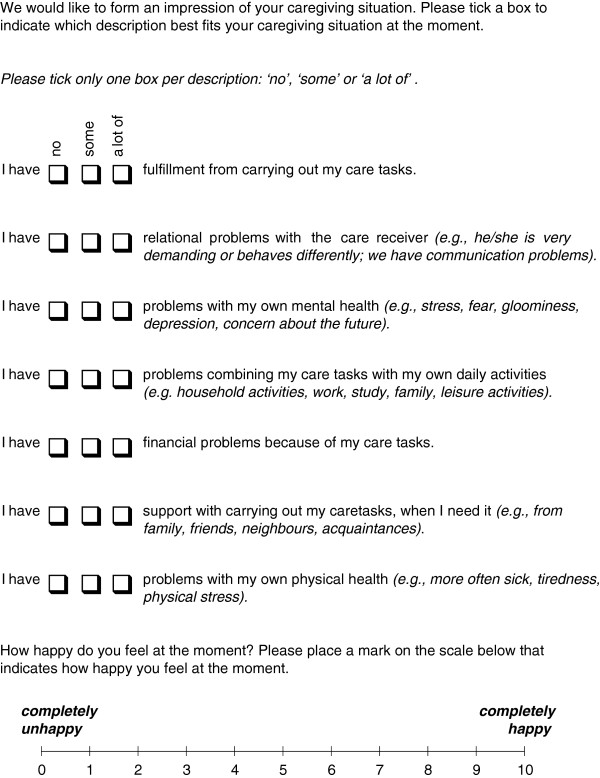
BACKGROUND: Informal caregivers provide a significant part of the total care needed by ill or disabled persons. Although informal care is often the preferred option of those who provide and those who receive informal care, caring can nevertheless be very straining. This study investigates construct validation of an instrument of the impact of caregiving, the CarerQol. METHODS: Data was collected among adult caregivers (n = 1,244) selected from the general population using an online questionnaire in October 2010, in the Netherlands. The CarerQol measures and values the impact of informal care. The CarerQol measures subjective burden (CarerQol-7D) and well-being (CarerQol-VAS). Construct validation comprised clinical, convergent and discriminative validity tests. RESULTS: Clinical validity was supported by statistically significant associations of CarerQol-VAS and caregivers' health, income and employment status, care recipients' health, and the relationship between caregiver and care recipient. Convergent validity was supported by positive associations of CarerQol-VAS with the two positive CarerQol-7D dimensions (fulfillment and support) and negative associations with the five negative CarerQol-7D dimensions (relational problems, mental health problems, problems combining daily activities, financial problems and physical health problems). Moreover, CarerQol-VAS was negatively associated with other instruments measuring caregiving burden. CONCLUSIONS: Construct validity tests in a large, heterogeneous sample of caregivers show that the CarerQol validly measures the impact of caregiving. The CarerQol can be used in informal care research and economic evaluations of health care interventions. Hence, its use can facilitate informed decision making in health care.
Overview
The claims and statistics of this paper haven’t been checked yet.
Run the check — free, no account needed. It reads the open-access text and checks the sources it cites.
Integrity signals
Registry
Cites
Statistics
Figures
Verification
Claims the paper makes
The claims and statistics of this paper haven’t been checked yet.
Run the check — free, no account needed. It reads the open-access text and checks the sources it cites.
Claims other papers make about this one
Each is checked against this paper’s own text: does it say what the citing paper says it does?
The cited source says what the claim attributes to it.
In the citing paper
“The psychometric properties of the CarerQol were shown to be satisfactory [48–50].”
Self-check
Percentages, sums and reported differences re-computed from the paper’s own numbers.
The self-check needs the paper’s full text.
Citations
Cites
EuroQol: a new facility for the measurement of health-related quality of life
(1990) · Health Policy · doi:10.1016/0168-8510(90)90421-9 · Cited by 15,736
Methods for the Economic Evaluation of Health Care Programmes
Drummond, M. E., Sculpher, M. J., Torrance, G. W., O’Brien, B. J., & Stoddart, G. L. (2005) · doi:10.1093/oso/9780198529446.001.0001 · Cited by 13,648
Health Measurement Scales: A Practical Guide to Their Development and Use
Streiner, D. L., Norman, G. R., & Cairney, J. (1989) · Cited by 9,595
Cost-Effectiveness in Health and Medicine
(1996) · doi:10.1093/oso/9780195108248.001.0001 · Cited by 7,193
(1997) · doi:10.1097/00005650-199711000-00002 · Cited by 4,544 · cited 1×
“Like common health-related quality of life measures for patients [49,50], the tariffs for the CarerQol-7D were based on preferences of the general public for different care situations as described with the seven dimensions (and three levels) of the instrument.”
BackgroundProgress in Development of the Index of ADL
Katz, S., Downs, T. D., Cash, H., & Grotz, R. C. (1970) · The Gerontologist · doi:10.1093/geront/10.1_part_1.20 · Cited by 4,129 · cited 1×
“Care recipient characteristics included age, gender, health (using EQ-5D [38]), level of independence (using KATZ scale [52,53]), need for 24/7 surveillance and type of health problem (defined as a temporary or chronic condition).”
MethodCaregiving as a Risk Factor for Mortality: The Caregiver Health Effects Study
Schulz, R., & Beach, S. R. (1999) · JAMA · doi:10.1001/jama.282.23.2215 · Cited by 3,340 · cited 1×
“; licensee BioMed Centr Commons Attribution License (http://creativec reproduction in any medium, provided the or negative effects on the health and general well-being of informal caregivers [7-13].”
BackgroundDolan, P., Peasgood, T., & White, M. (2008) · Journal of Economic Psychology · doi:10.1016/j.joep.2007.09.001 · Cited by 3,121 · cited 1×
“[23,62], well-being of carers was positively influenced by more general aspects of life, not necessarily (directly) related to caregiving [64], such as having a full-time paid work position or a high income.”
BackgroundKatz, S. (1963) · JAMA · doi:10.1001/jama.1963.03060120024016 · Cited by 2,421
Multiple Imputation of Missing Values: Update
Royston, P. (2005) · The Stata Journal Promoting communications on statistics and Stata · doi:10.1177/1536867x0500500204 · Cited by 1,683 · cited 6×
“supplemented in the multivariate analysis using the multiple imputation by chained equations (MICE) command in Stata [56,57].”
Influential
Cited by
Sorted by citations
Hoefman, R., Payakachat, N., van Exel, J. N. A., Kuhlthau, K. A., Kovacs, E. A., Pyne, J. M., & Tilford, J. M. (2014) · Journal of Autism and Developmental Disorders · doi:10.1007/s10803-014-2066-1 · Cited by 199
Self-citationImplementation of Value Based Breast Cancer Care
van Egdom, L. S. E., Lagendijk, M., van der Kemp, M. H., van Dam, J. H., Mureau, M. A. M., Hazelzet, J. A., & Koppert, L. B. (2019) · European Journal of Surgical Oncology · doi:10.1016/j.ejso.2019.01.007 · Cited by 145
Verbakel, E., Metzelthin, S., & Kempen, G. I. J. M. (2016) · The Journals of Gerontology Series B · doi:10.1093/geronb/gbw047 · Cited by 128
“, 2015), also referred to as well-being (Hoefman et al., 2013).”
BackgroundBorges-Machado, F., Barros, D., Ribeiro, Ó., & Carvalho, J. (2020) · American Journal of Alzheimer's Disease & Other Dementias® · doi:10.1177/1533317520976720 · Cited by 116
“The Care-related Quality of Life instrument (CarerQol) was used to address subjective burden (CarerQol-7D), and caregivers’ well-being (CarerQol-VAS).(31,32) Subjective burden was measured in 7 dimensions: fulfillment, relational problems, mental health, daily activities problems, physical health and support; caregive…”
MethodSpillover Effects on Caregivers’ and Family Members’ Utility: A Systematic Review of the Literature
Wittenberg, E., James, L. P., & Prosser, L. (2019) · PharmacoEconomics (Auckland) · doi:10.1007/s40273-019-00768-7 · Cited by 100
Metadata
- Authors
- Hoefman, R. J., van Exel, J., & Brouwer, W. B.
- Affiliations
- Erasmus University Rotterdam (NL)
- Corresponding author
- Hoefman, Renske J
- Venue
- Health and Quality of Life Outcomes
- Published
- 2013
- Volume
- 11
- Issue
- 1
- Pages
- 173
- ISSN
- 1477-7525 (ISSN-L)
- PMC
- PMC4015499
- OpenAlex
- W2169882001
- Cited by
- 101
- References
- 62
- Citations by year
- 2026: 9 · 2025: 9 · 2024: 5 · 2023: 12 · 2022: 11 · 2021: 9 · 2020: 10 · 2019: 11 · 2018: 8 · 2017: 6 · 2016: 5 · 2015: 4 · 2014: 2
- FWCI
- 6.96
- Type
- journal article
- Language
- en
- Open access
- gold
- doi.org
- Licence
- cc-by
- Locations
- Health and Quality of Life Outcomes (publishedVersion, cc-by)
- Europe PMC (PubMed Central) (publishedVersion, cc-by)
- PubMed Central (publishedVersion, cc-by)
- PubMed (publishedVersion)
- EUR Research Repository (Erasmus University Rotterdam) (publishedVersion, other-oa)
- EUR Research Repository (Erasmus University Rotterdam) (submittedVersion, other-oa)
- RePub (Erasmus University Rotterdam) (submittedVersion, other-oa)
- Open Scholarship Institutional Repository (Washington University in St. Louis) (submittedVersion, cc-by)
- Topics
- Health Sciences › Nursing › Research and Theory › Nursing care and research
- Social Sciences › Sociology and Political Science › Intergenerational Family Dynamics and Caregiving
- Social Sciences › Psychology › Clinical Psychology › Family Caregiving in Mental Illness
- Keywords
- informal caregivers, caregiver burden, caregiver well-being, construct validity, subjective burden, quality of life, caregiver-care recipient relationship, financial stress, mental illness
- MeSH terms
- Adult, Female, Humans, Male, Middle Aged, Netherlands, Quality of Life, Surveys and Questionnaires, Caregivers
About these checks
Registry, retraction, Cites and statistics results are computed, not judged, with one exception: a printed reference that no index lists is read once by a model before it counts as a citation error. Claims are extracted by a model and kept only when their quote appears verbatim in the text; each cited source is then checked, with a model’s help, for whether it says what the claim relies on. Those verdicts can be wrong — read the claim’s quote and the cited source before relying on one.
Statistics and arithmetic are recomputed, not judged.
Confidence bands are shown only for fields calibrated on our annotated test set. None is calibrated yet, so no band is shown.
What counts as a claim ›How we measure confidence ›How we check this ›
Are you an author, or do you see a problem with this page? Request a review
