

The DOI matches its Crossref record; 26 of the 26 references it cites were found in a registry or an index.
Physical activity, sedentary behavior and total wellness changes among sedentary adults: a 4-week randomized controlled trial
Open accessAbstract
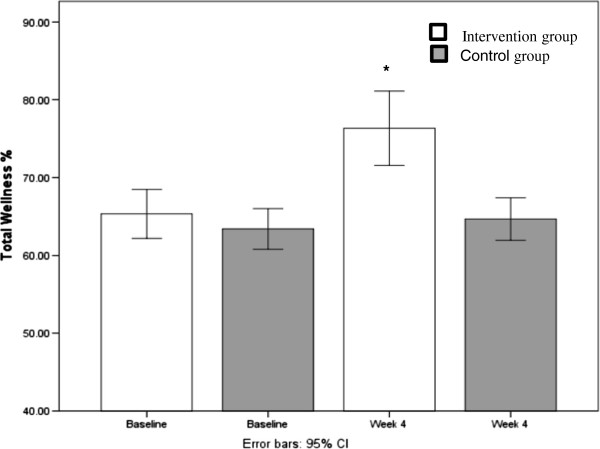
BACKGROUND: The construct of total wellness includes a holistic approach to the body, mind and spirit components of life. While the health benefits of reducing sedentary behavior and increasing physical activity are well documented, little is known about the influence on total wellness of an internet-based physical activity monitor designed to help people to achieve higher physical activity levels. PURPOSE: The purpose of this four-week, personal activity monitor-based intervention program was to reduce sedentary behavior and increase physical activity levels in daily living for sedentary adults and to determine if these changes would also be associated with improvement in total wellness. METHODS: Twenty-two men and 11 women (27 years ± 4.0) were randomly assigned to either an intervention (n = 18) or control group (n = 15). The intervention group interacted with an online personal activity monitor (Gruve Solution™) designed to reduce sedentary time and increase physical activity during activities of daily living. The control group did not interact with the monitor, as they were asked to follow their normal daily physical activities and sedentary behavior routines. The Wellness Evaluation of Lifestyle (WEL) inventory was used to assess total wellness. Sedentary time, light, walking, moderate and vigorous intensity physical activities were assessed for both intervention and control groups at baseline and at week-4 by the 7-day Sedentary and Light Intensity Physical Activity Log (7-day SLIPA Log) and the International Physical Activity Questionnaire (IPAQ). RESULTS: Significant increases in pre-post total wellness scores (from 64% ± 5.7 to 75% ± 8.5) (t(17) = -6.5, p < 0.001) were observed in the intervention group by the end of week four. Intervention participants decreased their sedentary time (21%, 2.3 hours/day) and increased their light (36.7%, 2.5 hours/day), walking (65%, 1057 MET-min/week), moderate (67%, 455 MET-min/week) and vigorous intensity (60%, 442 MET-min/week) physical activity (all p < 0.001). No significant differences for total wellness were observed between the groups at baseline and no pre-post significant differences were observed for any outcome variable in the control group. CONCLUSION: Total wellness is improved when sedentary, but sufficiently physically active adults, reduce sedentary time and increase physical activity levels (i.e. light, waking, moderate and vigorous).
Overview
The claims and statistics of this paper haven’t been checked yet.
Run the check — free, no account needed. It reads the open-access text and checks the sources it cites.
Integrity signals
Registry
Cites
Statistics
Figures
Verification
Claims the paper makes
The claims and statistics of this paper haven’t been checked yet.
Run the check — free, no account needed. It reads the open-access text and checks the sources it cites.
Claims other papers make about this one
Each is checked against this paper’s own text: does it say what the citing paper says it does?
The source backs part of the claim, not all of it — or backs it for a different population, condition or comparison.
In the citing paper
“Less time was spent in sedentary behavior for those receiving a consumer-based wearable activity tracker intervention compared with control groups; however, the finding was not significant, and the quality of the evidence was graded as very low [29,31-33,37-40].”
From Consumer-based wearable activity trackers increase physical activity participation: systematic review and meta-analysis (2019) · cites this paper as [31]
Experimental — accuracy not yet measuredThe cited source says what the claim attributes to it.
In the citing paper
“Blinding of outcome assessors (detection bias) was assessed as high risk for 7 studies [31,43,45-48,52] because of the use of subjective outcome measures.”
From Consumer-based wearable activity trackers increase physical activity participation: systematic review and meta-analysis (2019) · cites this paper as [31]
The cited source says what the claim attributes to it.
In the citing paper
“A total of 26 studies were included across all meta-analyses [21,22,29-48,50-53].”
From Consumer-based wearable activity trackers increase physical activity participation: systematic review and meta-analysis (2019) · cites this paper as [31]
The cited source says what the claim attributes to it.
In the citing paper
“Thirteen studies included young adults (≤39.9 years) [30-34,37,38,42,44,46-48,50], 15 included middle-aged adults (40-64.9 years) [21,22,29,35,36,39-41, 43,45,51-54], and 1 study included adults aged over 65 years [49].”
From Consumer-based wearable activity trackers increase physical activity participation: systematic review and meta-analysis (2019) · cites this paper as [31]
The cited source says what the claim attributes to it.
In the citing paper
“This result was potentially because of the inclusion of 1 study [31] in the wearable-based meta-analysis that reported a 21% reduction in sitting time.”
From Consumer-based wearable activity trackers increase physical activity participation: systematic review and meta-analysis (2019) · cites this paper as [31]
The cited source says what the claim attributes to it.
In the citing paper
“Similarly, many studies showed that PHT successfully increases physical activity and decreases a sedentary lifestyle [91-93].”
From Digital Health Interventions to Prevent Type 2 Diabetes Mellitus: Systematic Review (2025) · cites this paper as [91]
Self-check
Percentages, sums and reported differences re-computed from the paper’s own numbers.
The self-check needs the paper’s full text.
Citations
Cites
International physical activity questionnaire: 12-country reliability and validity
CRAIG, C. L., MARSHALL, A. L., SJ??STR??M, M., BAUMAN, A. E., BOOTH, M. L., AINSWORTH, B. E., PRATT, M., EKELUND, U., YNGVE, A., SALLIS, J. F., et al. (2003) · Medicine & Science in Sports & Exercise · doi:10.1249/01.mss.0000078924.61453.fb · Cited by 21,619
Amount of Time Spent in Sedentary Behaviors in the United States, 2003-2004
Matthews, C. E., Chen, K. Y., Freedson, P. S., Buchowski, M. S., Beech, B. M., Pate, R. R., & Troiano, R. P. (2008) · American Journal of Epidemiology · doi:10.1093/aje/kwm390 · Cited by 2,631
Changes in diet and lifestyle and long-term weight gain in women and men
Mozaffarian, D., Hao, T., Rimm, E. B., Willett, W. C., & Hu, F. B. (2011) · New England Journal of Medicine · doi:10.1056/nejmoa1014296 · Cited by 2,527
Physiological and health implications of a sedentary lifestyle
Tremblay, M. S., Colley, R. C., Saunders, T. J., Healy, G. N., & Owen, N. G. (2010) · Applied Physiology, Nutrition, and Metabolism · doi:10.1139/h10-079 · Cited by 1,572
The Wheel of Wellness Counseling for Wellness: A Holistic Model for Treatment Planning
Myers, J. E., Sweeney, T. J., & Witmer, J. M. (2000) · Journal of Counseling & Development · doi:10.1002/j.1556-6676.2000.tb01906.x · Cited by 979
Grøntved, A. (2011) · JAMA · doi:10.1001/jama.2011.812 · Cited by 873
Position statement on physical activity and exercise intensity terminology.
Norton, K., Norton, L., & Sadgrove, D. (2010) · Journal of Science and Medicine in Sport · doi:10.1016/j.jsams.2009.09.008 · Cited by 804
Interindividual variation in posture allocation: possible role in human obesity
Levine, J. A., Lanningham-Foster, L. M., McCrady, S. K., Krizan, A. C., Olson, L. R., Kane, P. H., Jensen, M. D., & Clark, M. M. (2005) · Science · doi:10.1126/science.1106561 · Cited by 705
Too much sitting – A health hazard
Dunstan, D. W., Howard, B., Healy, G. N., & Owen, N. G. (2012) · Diabetes Research and Clinical Practice · doi:10.1016/j.diabres.2012.05.020 · Cited by 637
Sedentary Activity Associated With Metabolic Syndrome Independent of Physical Activity
Bankoski, A., Harris, T. B., McClain, J. J., Brychta, R. J., Caserotti, P., Chen, K. Y., Berrigan, D., Troiano, R. P., & Koster, A. (2011) · Diabetes Care · doi:10.2337/dc10-0987 · Cited by 535
Cited by
Sorted by citations
Brickwood, K.-J., Watson, G., O'Brien, J., & Williams, A. D. (2019) · JMIR mHealth and uHealth · doi:10.2196/11819 · Cited by 689
Lyons, E. J., Lewis, Z. H., Mayrsohn, B. G., & Rowland, J. L. (2014) · Journal of Medical Internet Research · doi:10.2196/jmir.3469 · Cited by 547
Gardner, B., Smith, L., Lorencatto, F., Hamer, M., & Biddle, S. (2015) · Health Psychology Review · doi:10.1080/17437199.2015.1082146 · Cited by 518
Prince, S. A., Saunders, T. J., Gresty, K., & Reid, R. D. (2014) · Obesity Reviews · doi:10.1111/obr.12215 · Cited by 382
Patient-centered activity monitoring in the self-management of chronic health conditions
Chiauzzi, E. J., Rodarte, C., & DasMahapatra, P. (2015) · BMC Medicine · doi:10.1186/s12916-015-0319-2 · Cited by 342
Metadata
- Authors
- Barwais, F. A., Cuddihy, T. F., & Tomson, L.
- Affiliations
- Queensland University of Technology (AU)
- Griffith University (AU)
- Corresponding author
- Barwais, Faisal A
- ORCID
- Barwais, Faisal A
- Venue
- Health and Quality of Life Outcomes
- Published
- 2013
- Volume
- 11
- Issue
- 1
- Pages
- 183
- ISSN
- 1477-7525 (ISSN-L)
- PMC
- PMC4228472
- OpenAlex
- W1519074130
- Cited by
- 104
- References
- 23
- Citations by year
- 2026: 4 · 2025: 5 · 2024: 4 · 2023: 2 · 2022: 8 · 2021: 11 · 2020: 12 · 2019: 14 · 2018: 12 · 2017: 8 · 2016: 9 · 2015: 12 · 2014: 3
- FWCI
- 5.56
- Type
- journal article
- Language
- en
- Open access
- gold
- doi.org
- Licence
- cc-by
- Locations
- Health and Quality of Life Outcomes (publishedVersion, cc-by)
- Europe PMC (PubMed Central) (publishedVersion, cc-by)
- PubMed Central (publishedVersion, cc-by)
- PubMed (publishedVersion)
- QUT ePrints (Queensland University of Technology) (submittedVersion, cc-by)
- Griffith Research Online (submittedVersion, cc-by)
- Faculty of Health; Institute of Health and Biomedical Innovation
- Topics
- Health Sciences › Medicine › Public Health, Environmental and Occupational Health › Physical Activity and Health
- Physical Sciences › Computer Science › Computer Vision and Pattern Recognition › Context-Aware Activity Recognition Systems
- Health Sciences › Health Professions › General Health Professions › Mobile Health and mHealth Applications
- Keywords
- sedentary behavior, physical activity, sedentary adults, light physical activity, walking, moderate-to-vigorous physical activity, wellness interventions, activities of daily living, sedentary time reduction, holistic health, online health interventions
- MeSH terms
- Adult, Female, Health Promotion, Health Status, Humans, Male, Motor Activity, Queensland, Exercise, Walking, Risk Reduction Behavior, Young Adult, Actigraphy, Sedentary Behavior
About these checks
Registry, retraction, Cites and statistics results are computed, not judged, with one exception: a printed reference that no index lists is read once by a model before it counts as a citation error. Claims are extracted by a model and kept only when their quote appears verbatim in the text; each cited source is then checked, with a model’s help, for whether it says what the claim relies on. Those verdicts can be wrong — read the claim’s quote and the cited source before relying on one.
Statistics and arithmetic are recomputed, not judged.
Confidence bands are shown only for fields calibrated on our annotated test set. None is calibrated yet, so no band is shown.
What counts as a claim ›How we measure confidence ›How we check this ›
Are you an author, or do you see a problem with this page? Request a review
