

The DOI matches its Crossref record; 26 of the 26 references it cites were found in a registry or an index.
Physical activity, sedentary behavior and total wellness changes among sedentary adults: a 4-week randomized controlled trial
Open accessAbstract
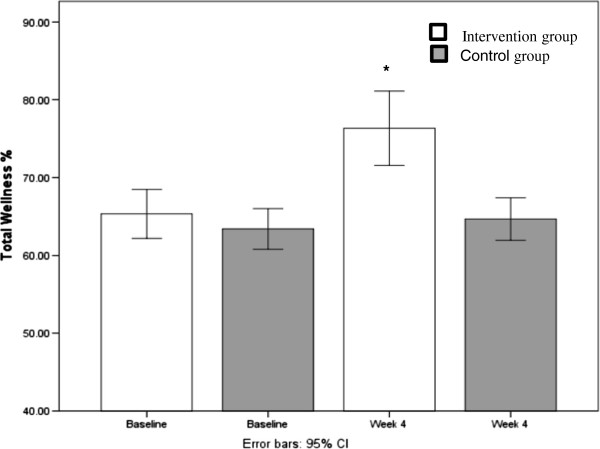
BACKGROUND: The construct of total wellness includes a holistic approach to the body, mind and spirit components of life. While the health benefits of reducing sedentary behavior and increasing physical activity are well documented, little is known about the influence on total wellness of an internet-based physical activity monitor designed to help people to achieve higher physical activity levels. PURPOSE: The purpose of this four-week, personal activity monitor-based intervention program was to reduce sedentary behavior and increase physical activity levels in daily living for sedentary adults and to determine if these changes would also be associated with improvement in total wellness. METHODS: Twenty-two men and 11 women (27 years ± 4.0) were randomly assigned to either an intervention (n = 18) or control group (n = 15). The intervention group interacted with an online personal activity monitor (Gruve Solution™) designed to reduce sedentary time and increase physical activity during activities of daily living. The control group did not interact with the monitor, as they were asked to follow their normal daily physical activities and sedentary behavior routines. The Wellness Evaluation of Lifestyle (WEL) inventory was used to assess total wellness. Sedentary time, light, walking, moderate and vigorous intensity physical activities were assessed for both intervention and control groups at baseline and at week-4 by the 7-day Sedentary and Light Intensity Physical Activity Log (7-day SLIPA Log) and the International Physical Activity Questionnaire (IPAQ). RESULTS: Significant increases in pre-post total wellness scores (from 64% ± 5.7 to 75% ± 8.5) (t(17) = -6.5, p < 0.001) were observed in the intervention group by the end of week four. Intervention participants decreased their sedentary time (21%, 2.3 hours/day) and increased their light (36.7%, 2.5 hours/day), walking (65%, 1057 MET-min/week), moderate (67%, 455 MET-min/week) and vigorous intensity (60%, 442 MET-min/week) physical activity (all p < 0.001). No significant differences for total wellness were observed between the groups at baseline and no pre-post significant differences were observed for any outcome variable in the control group. CONCLUSION: Total wellness is improved when sedentary, but sufficiently physically active adults, reduce sedentary time and increase physical activity levels (i.e. light, waking, moderate and vigorous).
Overview
The claims and statistics of this paper haven’t been checked yet.
Run the check — free, no account needed. It reads the open-access text and checks the sources it cites.
Integrity signals
Registry
Cites
Statistics
Figures
Verification
Claims the paper makes
The claims and statistics of this paper haven’t been checked yet.
Run the check — free, no account needed. It reads the open-access text and checks the sources it cites.
Claims other papers make about this one
Each is checked against this paper’s own text: does it say what the citing paper says it does?
The source backs part of the claim, not all of it — or backs it for a different population, condition or comparison.
In the citing paper
“Less time was spent in sedentary behavior for those receiving a consumer-based wearable activity tracker intervention compared with control groups; however, the finding was not significant, and the quality of the evidence was graded as very low [29,31-33,37-40].”
From Consumer-based wearable activity trackers increase physical activity participation: systematic review and meta-analysis (2019) · cites this paper as [31]
Experimental — accuracy not yet measuredThe cited source says what the claim attributes to it.
In the citing paper
“Blinding of outcome assessors (detection bias) was assessed as high risk for 7 studies [31,43,45-48,52] because of the use of subjective outcome measures.”
From Consumer-based wearable activity trackers increase physical activity participation: systematic review and meta-analysis (2019) · cites this paper as [31]
The cited source says what the claim attributes to it.
In the citing paper
“A total of 26 studies were included across all meta-analyses [21,22,29-48,50-53].”
From Consumer-based wearable activity trackers increase physical activity participation: systematic review and meta-analysis (2019) · cites this paper as [31]
The cited source says what the claim attributes to it.
In the citing paper
“Thirteen studies included young adults (≤39.9 years) [30-34,37,38,42,44,46-48,50], 15 included middle-aged adults (40-64.9 years) [21,22,29,35,36,39-41, 43,45,51-54], and 1 study included adults aged over 65 years [49].”
From Consumer-based wearable activity trackers increase physical activity participation: systematic review and meta-analysis (2019) · cites this paper as [31]
The cited source says what the claim attributes to it.
In the citing paper
“This result was potentially because of the inclusion of 1 study [31] in the wearable-based meta-analysis that reported a 21% reduction in sitting time.”
From Consumer-based wearable activity trackers increase physical activity participation: systematic review and meta-analysis (2019) · cites this paper as [31]
The cited source says what the claim attributes to it.
In the citing paper
“Similarly, many studies showed that PHT successfully increases physical activity and decreases a sedentary lifestyle [91-93].”
From Digital Health Interventions to Prevent Type 2 Diabetes Mellitus: Systematic Review (2025) · cites this paper as [91]
Self-check
Percentages, sums and reported differences re-computed from the paper’s own numbers.
The self-check needs the paper’s full text.
Citations
Cites
International physical activity questionnaire: 12-country reliability and validity
CRAIG, C. L., MARSHALL, A. L., SJ??STR??M, M., BAUMAN, A. E., BOOTH, M. L., AINSWORTH, B. E., PRATT, M., EKELUND, U., YNGVE, A., SALLIS, J. F., et al. (2003) · Medicine & Science in Sports & Exercise · doi:10.1249/01.mss.0000078924.61453.fb · Cited by 21,619
Amount of Time Spent in Sedentary Behaviors in the United States, 2003-2004
Matthews, C. E., Chen, K. Y., Freedson, P. S., Buchowski, M. S., Beech, B. M., Pate, R. R., & Troiano, R. P. (2008) · American Journal of Epidemiology · doi:10.1093/aje/kwm390 · Cited by 2,631
Changes in diet and lifestyle and long-term weight gain in women and men
Mozaffarian, D., Hao, T., Rimm, E. B., Willett, W. C., & Hu, F. B. (2011) · New England Journal of Medicine · doi:10.1056/nejmoa1014296 · Cited by 2,527
Physiological and health implications of a sedentary lifestyle
Tremblay, M. S., Colley, R. C., Saunders, T. J., Healy, G. N., & Owen, N. G. (2010) · Applied Physiology, Nutrition, and Metabolism · doi:10.1139/h10-079 · Cited by 1,572
The Wheel of Wellness Counseling for Wellness: A Holistic Model for Treatment Planning
Myers, J. E., Sweeney, T. J., & Witmer, J. M. (2000) · Journal of Counseling & Development · doi:10.1002/j.1556-6676.2000.tb01906.x · Cited by 979
Grøntved, A. (2011) · JAMA · doi:10.1001/jama.2011.812 · Cited by 873
Position statement on physical activity and exercise intensity terminology.
Norton, K., Norton, L., & Sadgrove, D. (2010) · Journal of Science and Medicine in Sport · doi:10.1016/j.jsams.2009.09.008 · Cited by 804
Interindividual variation in posture allocation: possible role in human obesity
Levine, J. A., Lanningham-Foster, L. M., McCrady, S. K., Krizan, A. C., Olson, L. R., Kane, P. H., Jensen, M. D., & Clark, M. M. (2005) · Science · doi:10.1126/science.1106561 · Cited by 705
Too much sitting – A health hazard
Dunstan, D. W., Howard, B., Healy, G. N., & Owen, N. G. (2012) · Diabetes Research and Clinical Practice · doi:10.1016/j.diabres.2012.05.020 · Cited by 637
Sedentary Activity Associated With Metabolic Syndrome Independent of Physical Activity
Bankoski, A., Harris, T. B., McClain, J. J., Brychta, R. J., Caserotti, P., Chen, K. Y., Berrigan, D., Troiano, R. P., & Koster, A. (2011) · Diabetes Care · doi:10.2337/dc10-0987 · Cited by 535
Cited by
Sorted by citations
Brickwood, K.-J., Watson, G., O'Brien, J., & Williams, A. D. (2019) · JMIR mHealth and uHealth · doi:10.2196/11819 · Cited by 689
Lyons, E. J., Lewis, Z. H., Mayrsohn, B. G., & Rowland, J. L. (2014) · Journal of Medical Internet Research · doi:10.2196/jmir.3469 · Cited by 547
Gardner, B., Smith, L., Lorencatto, F., Hamer, M., & Biddle, S. (2015) · Health Psychology Review · doi:10.1080/17437199.2015.1082146 · Cited by 518
Prince, S. A., Saunders, T. J., Gresty, K., & Reid, R. D. (2014) · Obesity Reviews · doi:10.1111/obr.12215 · Cited by 382
Patient-centered activity monitoring in the self-management of chronic health conditions
Chiauzzi, E. J., Rodarte, C., & DasMahapatra, P. (2015) · BMC Medicine · doi:10.1186/s12916-015-0319-2 · Cited by 342
Interventions with potential to reduce sedentary time in adults: systematic review and meta-analysis
Martin, A., Fitzsimons, C., Jepson, R., Saunders, D. H., van der Ploeg, H. P., Teixeira, P. J., Gray, C. M., & Mutrie, N. (2015) · British Journal of Sports Medicine · doi:10.1136/bjsports-2014-094524 · Cited by 326
Stephenson, A., McDonough, S. M., Murphy, M. H., Nugent, C. D., & Mair, J. L. (2017) · International Journal of Behavioral Nutrition and Physical Activity · doi:10.1186/s12966-017-0561-4 · Cited by 290
Older Adults’ Physical Activity and Exergames: A Systematic Review
Kappen, D. L., Mirza-Babaei, P., & Nacke, L. E. (2018) · International Journal of Human-Computer Interaction · doi:10.1080/10447318.2018.1441253 · Cited by 234
Using an electronic activity monitor system as an intervention modality: A systematic review
Lewis, Z. H., Lyons, E., Jarvis, J. M., & Baillargeon, J. (2015) · BMC Public Health · doi:10.1186/s12889-015-1947-3 · Cited by 193
Mönninghoff, A., Kramer, J.-N., Hess, A. J., Ismailova, K., Teepe, G. W., Car, L. T., Müller‐Riemenschneider, F., & Kowatsch, T. (2021) · Journal of Medical Internet Research · doi:10.2196/26699 · Cited by 206
Lynch, B. M., Nguyen, N. H., Moore, M. M., Reeves, M. M., Rosenberg, D. E., Boyle, T., Vallance, J. K., Milton, S., Friedenreich, C. M., & English, D. R. (2019) · Cancer · doi:10.1002/cncr.32143 · Cited by 171
Evaluating the Impact of Physical Activity Apps and Wearables: Interdisciplinary Review
McCallum, C., Rooksby, J., & Gray, C. M. (2018) · JMIR mhealth and uhealth · doi:10.2196/mhealth.9054 · Cited by 126
Trends in Persuasive Technologies for Physical Activity and Sedentary Behavior: A Systematic Review
Aldenaini, N., Alqahtani, F., Orji, R., & Sampalli, S. (2020) · Frontiers in Artificial Intelligence · doi:10.3389/frai.2020.00007 · Cited by 106
Effectiveness of physical activity monitors in adults: systematic review and meta-analysis
Larsen, R. T., Wagner, V., Korfitsen, C. B., Keller, C., Juhl, C. B., Langberg, H., & Christensen, J. (2022) · BMJ · doi:10.1136/bmj-2021-068047 · Cited by 98
Advancing an Integrative Framework to Evaluate Sustainability in National Dietary Guidelines
Ahmed, S., Downs, S., & Fanzo, J. (2019) · Frontiers in Sustainable Food Systems · doi:10.3389/fsufs.2019.00076 · Cited by 93
Hickey, A. M., & Freedson, P. S. (2016) · Progress in Cardiovascular Diseases · doi:10.1016/j.pcad.2016.02.006 · Cited by 77
Activity Tracker to Prescribe Various Exercise Intensities in Breast Cancer Survivors
McNeil, J., Brenner, D. R., Stone, C. R., O’Reilly, R., Ruan, Y., Vallance, J. K., Courneya, K. S., Thorpe, K. E., Klein, D., & Friedenreich, C. M. (2019) · Medicine & Science in Sports & Exercise · doi:10.1249/mss.0000000000001890 · Cited by 75
Blackburn, N. E., Wilson, J. J., McMullan, I., Caserotti, P., Giné‐Garriga, M., Wirth, K., Coll‐Planas, L., Alias, S. B., Figuls, M. R. I., Deidda, M., et al. (2020) · International Journal of Behavioral Nutrition and Physical Activity · doi:10.1186/s12966-020-00957-0 · Cited by 73
Ellingson, L. D., Meyer, J. D., Shook, R. P., Dixon, P. M., Hand, G. A., Wirth, M. D., Paluch, A. E., Burgess, S., Hébert, J. R., & Blair, S. N. (2018) · Preventive Medicine Reports · doi:10.1016/j.pmedr.2018.07.013 · Cited by 70
Peachey, M., Richardson, J. A., Tang, A., Bello-Haas, V. P. M. D., & Gravesande, J. (2018) · British Journal of Sports Medicine · doi:10.1136/bjsports-2017-098968 · Cited by 68
Use of Mobile Health Technology in the Prevention and Management of Diabetes Mellitus
Hartz, J., Yingling, L., & Powell-Wiley, T. M. (2016) · Current Cardiology Reports · doi:10.1007/s11886-016-0796-8 · Cited by 64
Lynch, C., Bird, S., Lythgo, N., & Selva-Raj, I. (2020) · American Journal of Health Promotion · doi:10.1177/0890117119895204 · Cited by 58
Leinonen, A., Pyky, R., Ahola, R., Kangas, M., Siirtola, P., Luoto, T., Enwald, H., Ikäheimo, T. M., Röning, J., Keinanen-Kiukaanniemi, S. M., et al. (2017) · JMIR mhealth and uhealth · doi:10.2196/mhealth.6675 · Cited by 53
Cajita, M., Kline, C. E., Burke, L. E., Bigini, E. G., & Imes, C. C. (2020) · Current Epidemiology Reports · doi:10.1007/s40471-020-00229-2 · Cited by 56
Gamification through the Application of Motivational Affordances for Physical Activity Technology
Kappen, D. L., Mirza-Babaei, P., & Nacke, L. E. (2017) · Annual Symposium on Computer-Human Interaction in Play · doi:10.1145/3116595.3116604 · Cited by 56
Gamification of Older Adults’ Physical Activity: An Eight-Week Study
Kappen, D. L., Mirza-Babaei, P., & Nacke, L. E. (2018) · Hawaii International Conference on System Sciences (HICSS) · doi:10.24251/hicss.2018.149 · Cited by 39
Lynch, B. M., van Roekel, E. H., & Vallance, J. K. (2016) · Expert Review of Quality of Life in Cancer Care · doi:10.1080/23809000.2016.1129902 · Cited by 35
Marin, T. S., Kourbelis, C., Foote, J., Newman, P., Brown, A., Daniel, M., Coffee, N. T., Nicholls, S. J., Ganesan, A., Versace, V. L., et al. (2019) · European Journal of Preventive Cardiology · doi:10.1177/2047487318805580 · Cited by 33
Huh, U., Tak, Y. J., Song, S., Chung, S. W., Sung, S. M., Lee, C. W., Bae, M., & Ahn, H. Y. (2019) · JMIR mhealth and uhealth · doi:10.2196/13381 · Cited by 33
A Comparison of Sedentary Behavior as Measured by the Fitbit and ActivPAL in College Students
Carpenter, C. A., Yang, C., & West, D. S. (2021) · International Journal of Environmental Research and Public Health · doi:10.3390/ijerph18083914 · Cited by 34
Molina‐Recio, G., García‐Hernández, L., Molina‐Luque, R., & Salas‐Morera, L. (2016) · BioMedical Engineering OnLine · doi:10.1186/s12938-016-0185-y · Cited by 31
Ramji, R., Carlson, E., Kottorp, A., Shleev, S., Awad, E. Y. A., & Rämgård, M. (2020) · BMC Public Health · doi:10.1186/s12889-020-8202-2 · Cited by 30
Barwais, F. A., & Cuddihy, T. F. (2015) · International Journal of Environmental Research and Public Health · doi:10.3390/ijerph120100414 · Cited by 28
Self-citationZhang, Y., Yin, Y., Liu, J., Yang, M. J., Liu, Z., & Ma, X. (2020) · International Journal of Environmental Research and Public Health · doi:10.3390/ijerph17093026 · Cited by 25
IoT-inspired machine learning-assisted sedentary behavior analysis in smart healthcare industry
Manocha, A., Kumar, G., Bhatia, M., & Sharma, A. K. (2021) · Journal of Ambient Intelligence and Humanized Computing · doi:10.1007/s12652-021-03371-x · Cited by 25
Wearable Technology Reduces Prolonged Bouts of Sedentary Behavior
Ellingson, L. D., Meyer, J. D., & Cook, D. B. (2016) · Translational Journal of the American College of Sports Medicine · doi:10.1249/tjx.0000000000000001 · Cited by 24
Kreitzberg, D. S., Dailey, S. L., Vogt, T. M., Robinson, D., & Zhu, Y. (2016) · Qualitative Research Reports in Communication · doi:10.1080/17459435.2016.1220418 · Cited by 27
Interventions outside the workplace for reducing sedentary behaviour in adults under 60 years of age
Murtagh, E., MURPHY, M. H., Milton, K. E., Roberts, N. W., O’Gorman, C. S., & Foster, C. E. (2020) · Cochrane Database of Systematic Reviews · doi:10.1002/14651858.cd012554.pub2 · Cited by 24
Mood modeling: accuracy depends on active logging and reflection
Springer, A., Hollis, V., & Whittaker, S. (2018) · Personal and Ubiquitous Computing · doi:10.1007/s00779-018-1123-8 · Cited by 21
Curran, F., Blake, C. M., Cunningham, C., Perrotta, C., van der Ploeg, H. P., Matthews, J. J., & O’Donoghue, G. (2021) · PLoS ONE · doi:10.1371/journal.pone.0256828 · Cited by 22
Alturki, R. (2016) · International Journal of Research in Engineering and Technology · doi:10.15623/ijret.2016.0509032 · Cited by 22
The Point-of-Choice Prompt or the Always-On Progress Bar?
Wang, Y., & Reiterer, H. (2019) · CHI Conference Extended Abstracts on Human Factors in Computing Systems (CHI EA) · doi:10.1145/3290607.3313050 · Cited by 21
Seeley, M. K., Evans-Pickett, A., Collins, G. Q., Tracy, J., Tuttle, N. J., Rosquist, P. G., Merrell, A. J., Christensen, W. F., Fullwood, D. T., & Bowden, A. E. (2020) · Journal of Sports Sciences · doi:10.1080/02640414.2020.1757361 · Cited by 21
Rees‐Punia, E., Newton, C. C., Westmaas, J. L., Chantaprasopsuk, S., Patel, A. V., & Leach, C. R. (2021) · Mental health and physical activity · doi:10.1016/j.mhpa.2021.100425 · Cited by 20
Choi, J. Y., Chang, A. K., & Choi, E.-J. (2018) · Holistic Nursing Practice · doi:10.1097/hnp.0000000000000282 · Cited by 21
Psychophysical health status of breast cancer survivors and effects of 12 weeks of aerobic training
Blasio, A. D., Morano, T., Cianchetti, E., Gallina, S., Bucci, I., Santo, S. D., Tinari, C., Donato, F., Izzicupo, P., Baldassarre, A. D., et al. (2017) · Complementary Therapies in Clinical Practice · doi:10.1016/j.ctcp.2017.01.004 · Cited by 17
Sypes, E. E., Newton, G. S., & Lewis, Z. H. (2019) · Journal of Physical Activity and Health · doi:10.1123/jpah.2017-0660 · Cited by 16
Clayton, C., Feehan, L. M., Goldsmith, C. H., Miller, W. C., Grewal, N., Ye, J., Yoo, J. Y., & LI, L. C. (2015) · Pilot and Feasibility Studies · doi:10.1186/s40814-015-0027-x · Cited by 15
Study design and methods for the ACTIVity And TEchnology (ACTIVATE) trial
Lynch, B. M., Nguyen, N. H., Reeves, M. M., Moore, M. M., Rosenberg, D. E., Wheeler, M. J., Boyle, T., Vallance, J. K., Friedenreich, C. M., & English, D. R. (2017) · Contemporary Clinical Trials · doi:10.1016/j.cct.2017.10.015 · Cited by 15
Digital Health Interventions to Prevent Type 2 Diabetes Mellitus: Systematic Review
Duong, T., Olsen, Q., Menon, A., Woods, L., Wang, W., Varnfield, M., Jiang, L., & Sullivan, C. (2025) · Journal of Medical Internet Research · doi:10.2196/67507 · Cited by 14
McCormack, G. R., Petersen, J. A., Ghoneim, D., Blackstaffe, A., Naish, C., & Doyle–Baker, P. K. (2022) · JMIR Formative Research · doi:10.2196/37348 · Cited by 14
Suorsa, K., Leskinen, T., Pulakka, A., Pentti, J., Löyttyniemi, E., HEINONEN, I. H. A., Vahtera, J., & Stenholm, S. (2021) · The Journals of Gerontology Series A · doi:10.1093/gerona/glab107 · Cited by 13
Sports interest mediating exercise and compulsive internet use among undergraduates
Ting, J., Chien, K.-P., Dhir, A., & Chen, S. (2018) · Health Promotion International · doi:10.1093/heapro/day046 · Cited by 12
Kappen, D. L., Mirza-Babaei, P., & Nacke, L. E. (2020) · Lecture notes in computer science · doi:10.1007/978-3-030-50249-2_22 · Cited by 11
Sedentary Behavior and the Use of Wearable Technology: An Editorial
O’Keeffe, N., Scheid, J. L., & West, S. (2020) · International Journal of Environmental Research and Public Health · doi:10.3390/ijerph17124181 · Cited by 14
Chen, X., Gao, H., Shu, B., & Zou, Y. (2022) · PLoS ONE · doi:10.1371/journal.pone.0269237 · Cited by 12
Whelan, M., Kingsnorth, A. P., Orme, M. W., Sherar, L. B., & Esliger, D. (2017) · BMJ Open · doi:10.1136/bmjopen-2017-018282 · Cited by 10
Kossi, O., Bonnechère, B., Agbétou, M., Somasse, R., Hokpo, A., Houéhanou, C., Adoukonou, T., & Mandigout, S. (2023) · Topics in Stroke Rehabilitation · doi:10.1080/10749357.2023.2207286 · Cited by 9
Molina‐Recio, G., García‐Hernández, L., Castilla-Melero, A., Palomo-Romero, J. M., Molina‐Luque, R., Sánchez-Muñoz, A. A., Araúzo-Azofra, A., & Salas‐Morera, L. (2015) · Lecture notes in computer science · doi:10.1007/978-3-319-16480-9_3 · Cited by 9
Bonacaro, A., Rubbi, I., & Sookhoo, D. (2019) · PROFESSIONI INFERMIERISTICHE · Cited by 9
The Evaluation of Biomarkers of Physical Activity on Stress Resistance and Wellness
Muradyan, A., Macheiner, T., Mardiyan, M. A., Sekoyan, E., & Sargsyan, K. (2022) · Applied Psychophysiology and Biofeedback · doi:10.1007/s10484-022-09538-2 · Cited by 8
Healthy longevity: a systematic review of nutrological and lifestyle aspects
Junqueira, R. A. C., & Pinto, A. C. (2023) · International Journal of Nutrology · doi:10.54448/ijn23302 · Cited by 6
The impact of the COVID-19 pandemic on physical activity habits at a residential university
Hudgins, B. L., Kurti, S. P., Edwards, E. S., & Hargens, T. A. (2021) · Journal of American College Health · doi:10.1080/07448481.2021.2016772 · Cited by 7
He, Z., Zhao, G., Li, C., Xing, Y., Xu, A., Yang, J., & Wang, R. (2024) · BMJ Open · doi:10.1136/bmjopen-2023-080186 · Cited by 6
Kourbelis, C., Franzon, J., Foote, J. W., Brown, A. D. H., Daniel, M., Coffee, N. T., Newman, P. K., Ganesan, A. N., Nicholls, S. J., & Clark, R. A. (2018) · The JBI Database of Systematic Reviews and Implementation Reports · doi:10.11124/jbisrir-2017-003584 · Cited by 5
Murray, K. E., Villafana, V. A. H., Mohamed, A. S., Linke, S., Bowen, D. J., & Marcus, B. H. (2021) · Translational Behavioral Medicine · doi:10.1093/tbm/ibab064 · Cited by 4
Understanding the Habitual Use of Wearable Activity Trackers
Rieder, A., Lehrer, C., & Jung, R. (2019) · Alexandria (UniSG) (University of St.Gallen) · Cited by 4
Exploring Strategies to Promote Exercise as a Viable Obesity and Chronic Disease Treatment
Flack, K. D., Stults‐Kolehmainen, M., Anderson, R. E., Handlery, R., Creasy, S. A., & Catenacci, V. A. (2025) · Nutrients · doi:10.3390/nu17121997 · Cited by 5
Physical activity and lifestyle intervention
Nishiwaki, M., & Matsumoto, N. (2015) · The Journal of Physical Fitness and Sports Medicine · doi:10.7600/jpfsm.4.187 · Cited by 3
Don’t sit this one out: Moderating the negative health impact of sedentary behavior at work
Bagwell, M. T., & Fiedler, B. A. (2020) · Elsevier eBooks · doi:10.1016/b978-0-12-819008-1.00002-x · Cited by 4
Multimedia for Social Good: Green Energy Donation for Healthier Societies
Laamarti, F., & Saddik, A. E. (2018) · IEEE Access · doi:10.1109/access.2018.2863114 · Cited by 3
Wafi, A. M., Zaeri, M. A., Khudier, A. A., Abushara, A. N., Adawi, M. M., Zakri, L., Madkhali, M. M., Othaymeen, A. S. A., Qawfashi, W., Alnami, R. M., et al. (2024) · Healthcare · doi:10.3390/healthcare12212133 · Cited by 3
Berninger, N. M., Plasqui, G., Crutzen, R., Ruiter, R. A. C., Kok, G., & ten Hoor, G. A. (2022) · International Journal of Behavioral Medicine · doi:10.1007/s12529-022-10054-0 · Cited by 2
Physical activity for a meaningful and purposeful life in typical adults: a cross-sectional study
Abaoğlu, H., & Doğu, S. E. (2022) · Cadernos Brasileiros de Terapia Ocupacional · doi:10.1590/2526-8910.ctoao23783103 · Cited by 2
Vats, U., & Patra, P. (2015) · International journal of medical and health sciences · Cited by 2
Reducing Sedentary Behaviour In University Students Using A Text Message-Based Intervention
Cotten, E. (2015) · Scholarship@Western (Western University) · Cited by 2
Towards Standardized Digital Twins for Health, Sport, and Well-being
Laamarti, F. (2019) · uO Research (University of Ottawa) · doi:10.20381/ruor-23746 · Cited by 2
Analysing the distribution of walking in the Swiss population
Christie, D. P., Ravalet, E., & Kaufmann, V. (2015) · Infoscience (Ecole Polytechnique Fédérale de Lausanne) · doi:10.13140/rg.2.1.2245.9041 · Cited by 1
Holistic Health Approaches: Engineering Multi-Disciplinary Solutions
Kalukusu, A. T. (2025) · IAA Journal of Biological Sciences · doi:10.59298/iaajb/2025/1315158 · Cited by 1
Formative Assessment: Design of a Web-Connected Sedentary Behavior Intervention for Females
Kinsey, A. W., Whipple, M., Reid, L. A., & Affuso, O. (2017) · JMIR Human Factors · doi:10.2196/humanfactors.7670 · Cited by 1
(2022) · Založba Univerze v Ljubljani (University of Ljubljana Press) eBooks · doi:10.51746/9789617128215 · Cited by 2
Cajita, M., Kline, C. E., Burke, L. E., Bigini, E. G., & Imes, C. C. (2020) · Current Epidemiology Reports · doi:10.1007/s40471-020-00251-4 · Cited by 2
Management information system for hajj pilgrim's total wellness
Idris, T., & Iqbal, M. N. (2017) · Cited by 1
Hall, J. F., Corepal, R., Crocker, T. F., Lam, N., Burton, L.-J., Birch, K. M., Carter, G., Clarke, D. J., English, C., Farrin, A. J., et al. (2021) · medRxiv · doi:10.1101/2021.05.27.21256673 · Cited by 2
Wongsirikul, N. (2014) · D-Scholarship@Pitt (University of Pittsburgh)
An Inventory of Community Wellness Programs in Biddeford, Maine
Silver, A. (2015)
Sedentary Behavior in Honors College Freshmen
Hintermeier, L. (2016) · SUNY Digital Repository Support (State University of New York System)
Associations among Task Self-Efficacy, Physical Activity and Subjective Wellbeing
Nehrkorn-Bailey, A. M. (2016) · doi:10.33915/etd.6303
Exploring the role of the general practitioner in obesity management in Australian primary care
Sturgiss, E. A. (2018) · ANU Open Research (Australian National University) · doi:10.25911/5d6512531e41e
Fitness interactive technology in promoting exercise performance and adherence.
Labbé, E. E., Huennekens, A. O., & Naylor, P. D. (2019) · American Psychological Association eBooks · doi:10.1037/0000124-015
Nehrkorn-Bailey, A. M. (2019) · The Research Repository @ WVU (West Virginia University) · doi:10.33915/etd.3896
Physiological Parameter Response to the Aerobic Training on Obese Boys
Anand Selva Kumar, K., & Giridharaprasath, R. (2019)
การพัฒนาโปรแกรมการลดพฤติกรรมเนือยนิ่งในพนักงานออฟฟิศตามโครงสร้างของทฤษฎีกระบวนการรับรู้ทางสังคม
มาพงษ์, ร. (2020) · Chula Digiverse · doi:10.58837/chula.the.2020.998
Hodgson, W., Kirk, A. F., Lennon, M., & Janssen, X. (2024) · doi:10.2196/preprints.60066
Hodgson, W., Kirk, A. F., Lennon, M., & Janssen, X. (2024) · JMIR Diabetes · doi:10.2196/60066
Routine Change in Obesity and Type 2 Diabetes
Bassin, S. R., Vaca, R., & Srinath, R. (2025) · Springer eBooks · doi:10.1007/978-3-031-82888-1_29
Wang, Y.-H., Lai, T., Liao, Y., Cheng, I.-L., & Hsueh, M. (2025) · Experimental Gerontology · doi:10.1016/j.exger.2025.112979 · Cited by 1
Phiri, L., Tomaz, S. A., Clamp, L. D., Micklesfield, L. K., Goedecke, J. H., & Mendham, A. E. (2026) · Research Square · doi:10.21203/rs.3.rs-8670309/v1
Metadata
- Authors
- Barwais, F. A., Cuddihy, T. F., & Tomson, L.
- Affiliations
- Queensland University of Technology (AU)
- Griffith University (AU)
- Corresponding author
- Barwais, Faisal A
- ORCID
- Barwais, Faisal A
- Venue
- Health and Quality of Life Outcomes
- Published
- 2013
- Volume
- 11
- Issue
- 1
- Pages
- 183
- ISSN
- 1477-7525 (ISSN-L)
- PMC
- PMC4228472
- OpenAlex
- W1519074130
- Cited by
- 104
- References
- 23
- Citations by year
- 2026: 4 · 2025: 5 · 2024: 4 · 2023: 2 · 2022: 8 · 2021: 11 · 2020: 12 · 2019: 14 · 2018: 12 · 2017: 8 · 2016: 9 · 2015: 12 · 2014: 3
- FWCI
- 5.56
- Type
- journal article
- Language
- en
- Open access
- gold
- doi.org
- Licence
- cc-by
- Locations
- Health and Quality of Life Outcomes (publishedVersion, cc-by)
- Europe PMC (PubMed Central) (publishedVersion, cc-by)
- PubMed Central (publishedVersion, cc-by)
- PubMed (publishedVersion)
- QUT ePrints (Queensland University of Technology) (submittedVersion, cc-by)
- Griffith Research Online (submittedVersion, cc-by)
- Faculty of Health; Institute of Health and Biomedical Innovation
- Topics
- Health Sciences › Medicine › Public Health, Environmental and Occupational Health › Physical Activity and Health
- Physical Sciences › Computer Science › Computer Vision and Pattern Recognition › Context-Aware Activity Recognition Systems
- Health Sciences › Health Professions › General Health Professions › Mobile Health and mHealth Applications
- Keywords
- sedentary behavior, physical activity, sedentary adults, light physical activity, walking, moderate-to-vigorous physical activity, wellness interventions, activities of daily living, sedentary time reduction, holistic health, online health interventions
- MeSH terms
- Adult, Female, Health Promotion, Health Status, Humans, Male, Motor Activity, Queensland, Exercise, Walking, Risk Reduction Behavior, Young Adult, Actigraphy, Sedentary Behavior
About these checks
Registry, retraction, Cites and statistics results are computed, not judged, with one exception: a printed reference that no index lists is read once by a model before it counts as a citation error. Claims are extracted by a model and kept only when their quote appears verbatim in the text; each cited source is then checked, with a model’s help, for whether it says what the claim relies on. Those verdicts can be wrong — read the claim’s quote and the cited source before relying on one.
Statistics and arithmetic are recomputed, not judged.
Confidence bands are shown only for fields calibrated on our annotated test set. None is calibrated yet, so no band is shown.
What counts as a claim ›How we measure confidence ›How we check this ›
Are you an author, or do you see a problem with this page? Request a review
