

Algorithms for enhancing public health utility of national causes-of-death data
Open accessThe DOI matches its Crossref record; 39 of the 42 references it cites were found in a registry or an index.
Abstract
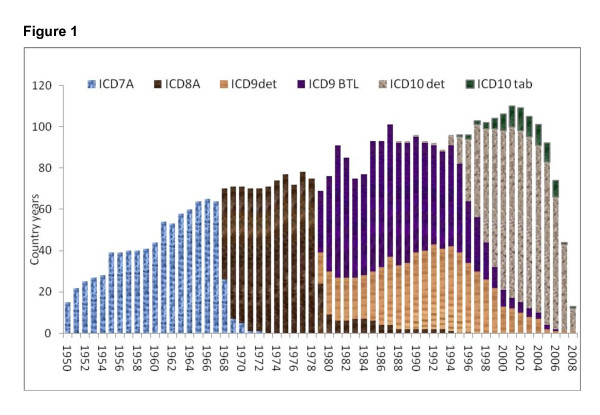
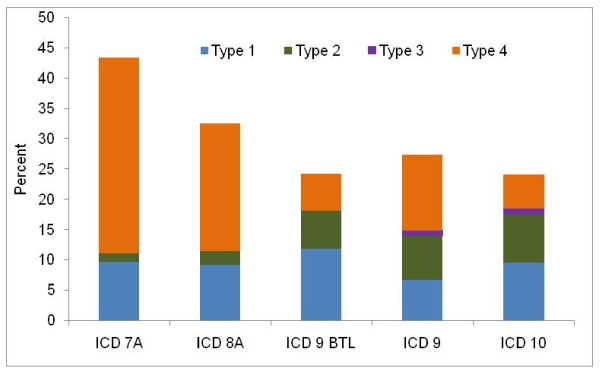
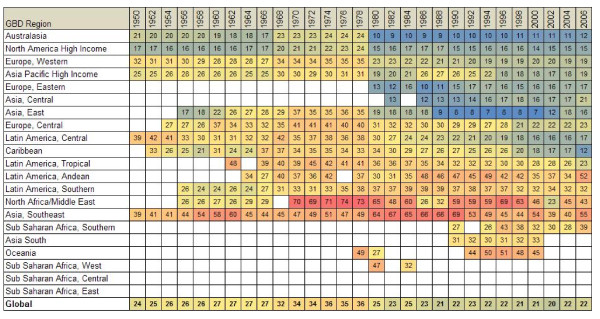
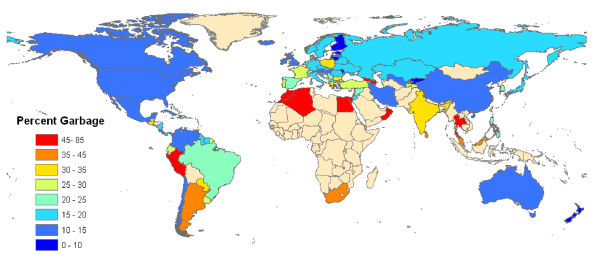
BACKGROUND: Coverage and quality of cause-of-death (CoD) data varies across countries and time. Valid, reliable, and comparable assessments of trends in causes of death from even the best systems are limited by three problems: a) changes in the International Statistical Classification of Diseases and Related Health Problems (ICD) over time; b) the use of tabulation lists where substantial detail on causes of death is lost; and c) many deaths assigned to causes that cannot or should not be considered underlying causes of death, often called garbage codes (GCs). The Global Burden of Disease Study and the World Health Organization have developed various methods to enhance comparability of CoD data. In this study, we attempt to build on these approaches to enhance the utility of national cause-of-death data for public health analysis. METHODS: Based on careful consideration of 4,434 country-years of CoD data from 145 countries from 1901 to 2008, encompassing 743 million deaths in ICD versions 1 to 10 as well as country-specific cause lists, we have developed a public health-oriented cause-of-death list. These 56 causes are organized hierarchically and encompass all deaths. Each cause has been mapped from ICD-6 to ICD-10 and, where possible, they have also been mapped to the International List of Causes of Death 1-5. We developed a typology of different classes of GCs. In each ICD revision, GCs have been identified. Target causes to which these GCs should be redistributed have been identified based on certification practice and/or pathophysiology. Proportionate redistribution, statistical models, and expert algorithms have been developed to redistribute GCs to target codes for each age-sex group. RESULTS: The fraction of all deaths assigned to GCs varies tremendously across countries and revisions of the ICD. In general, across all country-years of data available, GCs have declined from more than 43% in ICD-7 to 24% in ICD-10. In some regions, such as Australasia, GCs in 2005 are as low as 11%, while in some developing countries, such as Thailand, they are greater than 50%. Across different age groups, the composition of GCs varies tremendously - three classes of GCs steadily increase with age, but ambiguous codes within a particular disease chapter are also common for injuries at younger ages. The impact of redistribution is to change the number of deaths assigned to particular causes for a given age-sex group. These changes alter ranks across countries for any given year by a number of different causes, change time trends, and alter the rank order of causes within a country. CONCLUSIONS: By mapping CoD through different ICD versions and redistributing GCs, we believe the public health utility of CoD data can be substantially enhanced, leading to an increased demand for higher quality CoD data from health sector decision-makers.
Overview
The claims and statistics of this paper haven’t been checked yet.
Free: it reads the open-access text and checks the first 5 claims that cite a source we can check. Create a free account to check every claim.
Integrity signals
Registry
Cites
Statistics
Figures
Verification
Claims the paper makes
The claims and statistics of this paper haven’t been checked yet.
Free: it reads the open-access text and checks the first 5 claims that cite a source we can check. Create a free account to check every claim.
Claims other papers make about this one
Each is checked against this paper’s own text: does it say what the citing paper says it does?
The source backs part of the claim, not all of it — or backs it for a different population, condition or comparison.
In the citing paper
“The phenomenon of misattribution of indirect maternal causes of death, resulting in underestimation of 20-90% of maternal deaths, has been described in a number of settings. 25-30”
From Global causes of maternal death: a WHO systematic analysis (2014) · cites this paper as [27]
Experimental — accuracy not yet measuredThe cited source says what the claim attributes to it.
In the citing paper
“For the GBD 2010, we identified causes that should not be assigned as underlying cause of death at a much more detailed level.50”
In the citing paper
“there is still uncertainty surrounding the redistribution algorithms employed [13].”
From Liver cirrhosis mortality in 187 countries between 1980 and 2010: a systematic analysis (2014) · cites this paper as [13]
Self-check
Percentages, sums and reported differences re-computed from the paper’s own numbers.
The self-check needs the paper’s full text.
Citations
Cites
Bulletin of the World Health Organization
van der Sande, M. A. B., Walraven, G. E. L., Milligan, P. J., BANYA, W. A. S., CEESAY, S. M., Nyan, O. A., & McAdam, K. P. W. J. (2001) · Bulletin of the World Health Organization · Cited by 7,097
(1996) · Cited by 6,884
Mortality by cause for eight regions of the world: Global Burden of Disease Study
Murray, C. J., & Lopez, A. D. (1997) · The Lancet · doi:10.1016/s0140-6736(96)07493-4 · Cited by 4,043 · cited 1×
“causes of death; for this reason, WHO and other analysts have sought to reassign deaths coded to GCs to other causes following various methods [11-16].”
BackgroundBulletin of the World Health Organization
Frick, K. D., Lynch, M. C., West, S. K., Muñoz, B., & Mkocha, H. A. (2003) · Bulletin of the World Health Organization · Cited by 2,660
Global Burden of Disease and Risk Factors
(2006) · World Bank, Washington, DC eBooks · doi:10.1596/978-0-8213-6262-4 · Cited by 2,605
(2005) · Europe PMC (PubMed Central) · Cited by 1,975
Bulletin of the World Health Organization
(2006) · Bulletin of the World Health Organization · doi:10.2471/blt.00.00000 · Cited by 1,602
(2001) · PubMed · Cited by 612
The Kaohsiung Journal of Medical Sciences
(2019) · The Kaohsiung Journal of Medical Sciences · doi:10.1002/(issn)2410-8650 · Cited by 446
Mortality Patterns in National Populations. With Special Reference to Recorded Causes of Death
Preston, S. H. (1977) · Population (French Edition) · doi:10.2307/1532019 · Cited by 208
Underreporting of pregnancy-related mortality in the United States and Europe
Deneux-Tharaux, C., Berg, C., Bouvier-Colle, M.-H., Gissler, M., Harper, M., Nannini, A., Alexander, S., Wildman, K., Breart, G., & Buekens, P. (2005) · Obstetrics & Gynecology · doi:10.1097/01.aog.0000174580.24281.e6 · Cited by 187
Roosen, J., Frans, E., Wilmer, A., Knockaert, D. C., & Bobbaers, H. (2000) · Mayo Clinic Proceedings · doi:10.4065/75.6.562 · Cited by 177 · cited 1×
“Given the importance of cause-of-death data for public health analysis, we attempted in this paper to build on prior cause-of-death analysis work [1,7,17-25] and to create a more detailed approach to these problems of comparability of ICD-coded cause-of-death data.”
MethodValidation of death certificate diagnosis for coronary heart disease
Coady, S., Sorlie, P. D., Cooper, L. S., Folsom, A. R., Rosamond, W. D., & Conwill, D. E. (2001) · Journal of Clinical Epidemiology · doi:10.1016/s0895-4356(00)00272-9 · Cited by 158 · cited 1×
“Ideally, for validation, one would like to collect a dataset where the "true" underlying cause is known based on autopsy or extensive clinical records but the deaths have been assigned to a GC in the normal course of death registration [37-39].”
BackgroundMurray, C. J. (2007) · The Lancet · doi:10.1016/s0140-6736(07)60415-2 · Cited by 144 · cited 1×
“Application of the algorithms in this study may help national authorities to demonstrate the extent of garbage coding and therefore motivate further action at the local level to improve the quality of certification [41,42].”
MethodJanssen, F., & Kunst, A. E. (2004) · Europe PMC (PubMed Central) · Cited by 138
From data to policy: good practices and cautionary tales
AbouZahr, C., Adjei, S., & Kanchanachitra, C. (2007) · The Lancet · doi:10.1016/s0140-6736(07)60463-2 · Cited by 129
Autopsy findings and clinical diagnoses: A review of 1,000 cases
Sarode, V. R., Datta, B. N., Ak, B., Banerjee, C. K., Joshi, K., Bhusnurmath, B., & Radotra, B. D. (1993) · Human Pathology · doi:10.1016/0046-8177(93)90300-6 · Cited by 121 · cited 1×
“Given the importance of cause-of-death data for public health analysis, we attempted in this paper to build on prior cause-of-death analysis work [1,7,17-25] and to create a more detailed approach to these problems of comparability of ICD-coded cause-of-death data.”
MethodIves, D. G., Samuel, P., Psaty, B. M., & Kuller, L. H. (2009) · Journal of the American Geriatrics Society · doi:10.1111/j.1532-5415.2008.02056.x · Cited by 108 · cited 1×
“Ideally, for validation, one would like to collect a dataset where the "true" underlying cause is known based on autopsy or extensive clinical records but the deaths have been assigned to a GC in the normal course of death registration [37-39].”
BackgroundMortality Patterns in National Populations: With Special Reference to Recorded Causes of Death.
Joewono, T. B., & Preston, S. H. (1977) · Population and Development Review · doi:10.2307/1971774 · Cited by 97
Alpérovitch, A., Bertrand, M., Jougla, É., Vidal, J., Ducimetière, P., Helmer, C., Ritchie, K. A., Pavillon, G., & Tzourio, C. (2009) · European Journal of Epidemiology · doi:10.1007/s10654-009-9383-2 · Cited by 87 · cited 1×
“Ideally, for validation, one would like to collect a dataset where the "true" underlying cause is known based on autopsy or extensive clinical records but the deaths have been assigned to a GC in the normal course of death registration [37-39].”
BackgroundUnderreporting of maternal mortality in The Netherlands
SCHUITEMAKER, N., VANROOSMALEN, J., DEKKER, G., VANDONGEN, P., VANGEIJN, H., & GRAVENHORST, J. (1997) · Obstetrics & Gynecology · doi:10.1016/s0029-7844(97)00128-2 · Cited by 81 · cited 1×
“0, which provides some external validation of this approach [26-35].”
BackgroundReconstructing Long-Term Series of Causes of Death
Meslé, F., & Vallin, J. (1996) · Historical Methods A Journal of Quantitative and Interdisciplinary History · doi:10.1080/01615440.1996.10112731 · Cited by 75 · cited 2×
“Time series analyses [7-9] for selected causes have attempted to map national ICD revisions over time, but idiosyncratic national use of the ICD has limited more general approaches to bridge coding that are applicable across all countries.”
BackgroundMethodGissler, M., Deneux‐Tharaux, C., Alexander, S., Berg, C. J., Bouvier‐Colle, M., Harper, M., Nannini, A., Bréart, G., & Buekens, P. M. (2006) · European Journal of Obstetrics & Gynecology and Reproductive Biology · doi:10.1016/j.ejogrb.2006.08.013 · Cited by 56 · cited 1×
“0, which provides some external validation of this approach [26-35].”
BackgroundUnder-reporting of direct and indirect obstetrical deaths in Austria, 1980-98
Karimian‐Teherani, D., Haidinger, G., Waldhoer, T., Beck, A., & Vutuc, C. (2002) · Acta Obstetricia et Gynecologica Scandinavica · doi:10.1034/j.1600-0412.2002.810408.x · Cited by 52
Under-reporting of maternal mortality in Canada: a question of definition.
Turner, L. A., Cyr, M., Kinch, R. A. H., Liston, R., Kramer, M. S., Fair, M. E., & Heaman, M. I. (2002) · PubMed · Cited by 49
Mortalidade segundo causas: considerações sobre a fidedignidade dos dados
Laurenti, R., Jorge, M. H. P. D. M., & Gotlieb, S. L. D. (2008) · Revista Panamericana de Salud Pública · doi:10.1590/s1020-49892008000500007 · Cited by 46
Reliability of death certificate diagnoses
Moussa, M. A. A., Shafie, M., Khogali, M., El-Sayed, A. M., Sugathan, T. N., Cherian, G., Abdel-khalik, A.-Z. H., Garada, M. T., & Verma, D. (1990) · Journal of Clinical Epidemiology · doi:10.1016/0895-4356(90)90094-6 · Cited by 45 · cited 1×
“Given the importance of cause-of-death data for public health analysis, we attempted in this paper to build on prior cause-of-death analysis work [1,7,17-25] and to create a more detailed approach to these problems of comparability of ICD-coded cause-of-death data.”
MethodMaternal deaths in Australia: 2000-2002
Kildea, S. V. (2006) · Cited by 43
Reclassifying causes of death to study the epidemiological transition in The Netherlands, 1875–1992
den Bosch, J. H. W.-V., van Poppel, F. W. A., & Mackenbach, J. P. (1996) · European Journal of Population / Revue européenne de Démographie · doi:10.1007/bf01796912 · Cited by 40
The role of diagnostic inconsistency in changing rates of occurrence for coronary heart disease
Burnand, B., & Feinstein, A. R. (1992) · Journal of Clinical Epidemiology · doi:10.1016/0895-4356(92)90109-z · Cited by 40 · cited 1×
“Given the importance of cause-of-death data for public health analysis, we attempted in this paper to build on prior cause-of-death analysis work [1,7,17-25] and to create a more detailed approach to these problems of comparability of ICD-coded cause-of-death data.”
MethodEstimation de la mortalité maternelle en France : une nouvelle méthode
Bouvier‐Colle, M., Deneux‐Tharaux, C., Szego, E., Couet, C., Michel, E., Varnoux, N., & Jougla, É. (2004) · Journal de gynécologie, obstétrique et biologie de la reproduction. Supplément/Journal de gynécologie obstétrique et biologie de la reproduction · doi:10.1016/s0368-2315(04)96550-7 · Cited by 36
Les causes de décès en France de 1925 à 1978
Vallin, J., Meslé, F., & Mesle, F. (1988) · Population · doi:10.2307/1533115 · Cited by 34
Karwinski, B., & Hartveit, F. (1989) · Journal of Clinical Pathology · doi:10.1136/jcp.42.1.13 · Cited by 25 · cited 1×
“Given the importance of cause-of-death data for public health analysis, we attempted in this paper to build on prior cause-of-death analysis work [1,7,17-25] and to create a more detailed approach to these problems of comparability of ICD-coded cause-of-death data.”
MethodCounting the dead and what they died of.
Johansson, L. A., Pavillon, G., Anderson, R. N., Glenn, D. E., Griffiths, C., Hoyert, D. L., Jackson, G., Notzon, F. S., Rooney, C., Rosenberg, H. M., et al. (2006) · Europe PMC (PubMed Central) · Cited by 21
The effect of ICD-10 on continuity in cause-of-death statistics. The example of France
Meslé, F., & Vallin, J. (2008) · Population (English Edition) · doi:10.3917/pope.802.0347 · Cited by 11 · cited 1×
“Given the importance of cause-of-death data for public health analysis, we attempted in this paper to build on prior cause-of-death analysis work [1,7,17-25] and to create a more detailed approach to these problems of comparability of ICD-coded cause-of-death data.”
MethodEvolution in Classifying Mortality Statistics
McKenzie, K., Tong, S., Walker, S., & Sadkowsky, K. (2002) · QUT ePrints (Queensland University of Technology) · Cited by 9
Cruz, S. C. (1989) · Estudios Demográficos y Urbanos · doi:10.24201/edu.v4i2.732 · Cited by 9
Lu, T., & Huang, S.-M. (2002) · PubMed · Cited by 8
Meslé, F., & Vallin, J. (2008) · Population · doi:10.3917/popu.802.0383 · Cited by 3
Research works printed but not linked: 8
- Farr W Letter to the Registrar-General Second Annual Report of the Registrar-General of births, deaths, and marriages in England 1840 London: Printed by W. Clowes for H.M.S.O
- World Health Organization International Statistical Classification of Diseases and Related Health Problems, Tenth Revision Instruction Manual 2004 Geneva, World Health Organization
- Rooney C Griffiths C Cook L The implementation of ICD-10 for cause of death coding - some preliminary results from the bridge coding study HEALTH STATISTICS QUARTERLY 2002 31 41
- Mathers CD Stein C Mafat D Rao C Mie Inoue Tomijima N Bernard C Lopez AD Murray CJL Global Burden of Disease 2000: Version 2 methods and results. Geneva 2002
- World Health Organization Global Burden of Disease: 2004 update. Geneva 2008
- Canadian Perinatal Surveillance System, Maternal Health Study Group, Health C Special report on maternal mortality and severe morbidity in Canada: enhanced surveillance: the path to prevention 2004 [Ottawa]: Health Canada
- Lewis G Drife JO Botting BJ Why mothers die: 1997-1999: the fifth report 2001 London: RCOG Press
- Lewis G Drife JO Confidential Enquiry into Maternal and Child Health (CEMACH) Why mothers die 2000-2002: the sixth report on the Confidential Enquiries into Maternal Deaths in the United Kingdom 2004 London: RCOG Press
Cited by
Lozano, R., Naghavi, M., Foreman, K., Lim, S., Shibuya, K., Aboyans, V., Abraham, J., Adair, T., Aggarwal, R., Ahn, S. Y., et al. (2012) · The Lancet · doi:10.1016/s0140-6736(12)61728-0 · Cited by 14,070
Self-citationMurray, C. J. L., Vos, T., Lozano, R., Naghavi, M., Flaxman, A. D., Michaud, C., Ezzati, M., Shibuya, K., Salomon, J. A., Abdalla, S., et al. (2012) · The Lancet · doi:10.1016/s0140-6736(12)61689-4 · Cited by 8,888
Self-citationRoth, G. A., Abate, D., Abate, K. H., Abay, S. M., Abbafati, C., Abbasi, N., Abbastabar, H., Abd-Allah, F., Abdela, J., Abdelalim, A., et al. (2018) · The Lancet · doi:10.1016/s0140-6736(18)32203-7 · Cited by 8,600
Wang, H., Naghavi, M., Allen, C., Barber, R. M., Bhutta, Z. A., Carter, A., Casey, D. C., Charlson, F. J., Chen, A. Z., Coates, M. M., et al. (2016) · The Lancet · doi:10.1016/s0140-6736(16)31012-1 · Cited by 6,596
Self-citationGlobal causes of maternal death: a WHO systematic analysis
Say, L., Chou, D., Gemmill, A., Tunçalp, Ö., Moller, A.-B., Daniels, J., Gülmezoglu, A. M., Temmerman, M., & Alkema, L. (2014) · The Lancet Global Health · doi:10.1016/s2214-109x(14)70227-x · Cited by 6,582
“Although algorithms have been developed to adjust for misclassifi cation of deaths in so-called garbage codes, 32 such algorithms are not able to improve on misclassifi cation within maternal cause categories or the under-reporting of deaths of specifi c maternal causes.”
Metadata
- Authors
- Naghavi, M., Makela, S., Foreman, K., O'Brien, J., Pourmalek, F., & Lozano, R.
- Affiliations
- University of Washington (US)
- Corresponding author
- Naghavi, Mohsen
- Venue
- Population Health Metrics
- Published
- 2010-05-10
- Volume
- 8
- Issue
- 1
- Pages
- 9-9
- ISSN
- 1478-7954 (ISSN-L)
- PMC
- PMC2873308
- OpenAlex
- W2005743411
- Semantic Scholar
- 826b0b315a7a9c33e080adc15cff76df84465819
- Cited by
- 440
- References
- 42
- Citations by year
- 2026: 21 · 2025: 27 · 2024: 28 · 2023: 31 · 2022: 27 · 2021: 35 · 2020: 50 · 2019: 51 · 2018: 30 · 2017: 25 · 2016: 26 · 2015: 19 · 2014: 25 · 2013: 14 · 2012: 18
- FWCI
- 26.89
- Type
- journal article
- Language
- en
- Open access
- gold
- doi.org
- Licence
- cc-by
- creativecommons.org/licenses/by/2.0 (tdm)
- Locations
- Population Health Metrics (publishedVersion, cc-by)
- Europe PMC (PubMed Central) (publishedVersion, cc-by)
- PubMed Central (publishedVersion, cc-by)
- PubMed (publishedVersion)
- DOAJ (DOAJ: Directory of Open Access Journals) (submittedVersion, cc-by-sa)
- Funders
- Bill and Melinda Gates Foundation
- Institute for Health Metrics and Evaluation
- Pan American Health Organization
- Topics
- Health Sciences › Health Professions › Health Information Management › Medical Coding and Health Information
- Social Sciences › Demography › Insurance, Mortality, Demography, Risk Management
- Health Sciences › Medicine › Public Health, Environmental and Occupational Health › Global Health and Epidemiology
- Keywords
- cause of death data, garbage codes, ICD revision, underlying cause of death, cause of death classification, age and sex differences, disease surveillance, Global Burden of Disease Study, data comparability, mortality trends, developing countries, expert algorithms
About these checks
Registry, retraction, Cites and statistics results are computed, not judged, with one exception: a printed reference that no index lists is read once by a model before it counts as a citation error. Claims are extracted by a model and kept only when their quote appears verbatim in the text; each cited source is then checked, with a model’s help, for whether it says what the claim relies on. Those verdicts can be wrong — read the claim’s quote and the cited source before relying on one.
Statistics and arithmetic are recomputed, not judged.
Confidence bands are shown only for fields calibrated on our annotated test set. None is calibrated yet, so no band is shown.
What counts as a claim ›How we measure confidence ›How we check this ›
Are you an author, or do you see a problem with this page? Request a review
Data sources
Bibliographic data: Semantic Scholar, OpenAlex, Crossref.
Contains information from the Semantic Scholar Academic Graph Datasets, made available under the ODC Attribution License (ODC-BY 1.0).
Semantic Scholar’s data is described in: Kinney, R., et al. (2023). The Semantic Scholar Open Data Platform. arXiv:2301.10140.
