

Mammalian Sirt1: insights on its biological functions
Open accessThe DOI matches its Crossref record; 83 of the 83 references it cites were found in a registry or an index.
Abstract
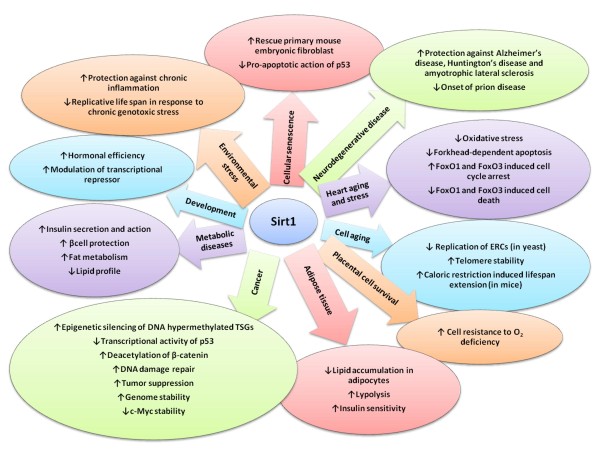
Sirt1 (member of the sirtuin family) is a nicotinamide adenosine dinucleotide (NAD)-dependent deacetylase that removes acetyl groups from various proteins. Sirt1 performs a wide variety of functions in biological systems. The current review focuses on the biological functions of Sirt1 in obesity-associated metabolic diseases, cancer, adipose tissue, aging, cellular senescence, cardiac aging and stress, prion-mediated neurodegeneration, inflammatory signaling in response to environmental stress, development and placental cell survival.
Overview
The claims and statistics of this paper haven’t been checked yet.
Free: it reads the open-access text and checks the first 5 claims that cite a source we can check. Create a free account to check every claim.
Integrity signals
Registry
Cites
Statistics
Figures
Verification
Claims the paper makes
The claims and statistics of this paper haven’t been checked yet.
Free: it reads the open-access text and checks the first 5 claims that cite a source we can check. Create a free account to check every claim.
Claims other papers make about this one
Each is checked against this paper’s own text: does it say what the citing paper says it does?
The source backs part of the claim, not all of it — or backs it for a different population, condition or comparison.
In the citing paper
“GLP-1 may improve the liver’s antioxidant capacity and metabolic function by activating Sirt1, thereby helping to alleviate the pathological changes associated with NASH.”
From Glucagon-like peptide-1 receptor: mechanisms and advances in therapy (2024) · cites this paper as [515]
Experimental — accuracy not yet measured
Self-check
Percentages, sums and reported differences re-computed from the paper’s own numbers.
The self-check needs the paper’s full text.
Citations
Cites
Lagouge, M., Argmann, C., Gerhart-Hines, Z., Meziane, H., Lerin, C., Daussin, F., Messadeq, N., Milne, J., Lambert, P., Elliott, P., et al. (2006) · Cell · doi:10.1016/j.cell.2006.11.013 · Cited by 4,057 · cited 1×
“Furthermore, CR upregulates Sirt1 in several mouse tissues and, importantly, in human muscle tissue [56-58].”
BackgroundTranscriptional silencing and longevity protein Sir2 is an NAD-dependent histone deacetylase
Imai, S.-I., Armstrong, C. M., Kaeberlein, M., & Guarente, L. (2000) · Nature · doi:10.1038/35001622 · Cited by 3,510 · cited 1×
“Sirt1 and its ortholog appear to have a key role in determining lifespan of yeast, flies, and mice [34-36].”
BackgroundStress-dependent regulation of FOXO transcription factors by the SIRT1 deacetylase
Brunet, A., Sweeney, L. B., Sturgill, J. F., Chua, K. F., Greer, P. L., Lin, Y., Tran, H., Ross, S. E., Mostoslavsky, R., Cohen, H. Y., et al. (2004) · Science · doi:10.1126/science.1094637 · Cited by 3,239 · cited 2×
“Thus, one way through which members of the Sir2 family of proteins may increase organismal longevity is by tipping FoxO dependent responses away from apoptosis and toward stress resistance [51].”
BackgroundhSIR2SIRT1 Functions as an NAD-Dependent p53 Deacetylase
Vaziri, H., Dessain, S. K., Eaton, E. N., Imai, S.-I., Frye, R. A., Pandita, T. K., Guarente, L., & Weinberg, R. A. (2001) · Cell · doi:10.1016/s0092-8674(01)00527-x · Cited by 2,659
Kaeberlein, M., McVey, M., & Guarente, L. (1999) · Genes & Development · doi:10.1101/gad.13.19.2570 · Cited by 2,253 · cited 3×
“Sirt1 and its ortholog appear to have a key role in determining lifespan of yeast, flies, and mice [34-36].”
BackgroundMammalian Sirtuins: Biological Insights and Disease Relevance
Haigis, M. C., & Sinclair, D. A. (2010) · Annual Review of Pathology: Mechanisms of Disease · doi:10.1146/annurev.pathol.4.110807.092250 · Cited by 2,085
Negative Control of p53 by Sir2α Promotes Cell Survival under Stress
Luo, J., Nikolaev, A. Y., Imai, S.-I., Chen, D., Su, F., Shiloh, A., Guarente, L., & Gu, W. (2001) · Cell · doi:10.1016/s0092-8674(01)00524-4 · Cited by 2,081
Sirt1 promotes fat mobilization in white adipocytes by repressing PPAR-γ
Picard, F., Kurtev, M., Chung, N., Topark-Ngarm, A., Senawong, T., Machado de Oliveira, R., Leid, M., McBurney, M. W., & Guarente, L. (2004) · Nature · doi:10.1038/nature02583 · Cited by 1,952
Calorie restriction promotes mammalian cell survival by inducing the SIRT1 deacetylase
Cohen, H. Y., Miller, C., Bitterman, K. J., Wall, N. R., Hekking, B., Kessler, B., Howitz, K. T., Gorospe, M., de Cabo, R., & Sinclair, D. A. (2004) · Science · doi:10.1126/science.1099196 · Cited by 1,924 · cited 1×
“Furthermore, CR upregulates Sirt1 in several mouse tissues and, importantly, in human muscle tissue [56-58].”
BackgroundSirtuins in mammals: insights into their biological function
Michan, S., & Sinclair, D. (2007) · Biochemical Journal · doi:10.1042/bj20070140 · Cited by 1,718
Cited by
Items 401–417 of 417
Zhang, Y., Zhao, R., Yang, X., Wang, T., Zhu, Y., Hou, Y., Chen, Z., & Chen, X. (2026) · BMC Genomics · doi:10.1186/s12864-026-13080-4
Awan, M., Musa, A., Khan, M., Ali, Q., Qazi, F., Dawood, H., & Jeffrey, S. (2026) · Journal of Ophthalmic Science · doi:10.14302/issn.2470-0436.jos-26-6357
인체 대장암세포에서 IL-1β에 의해 유도된 SIRT1의 c-Jun 탈아세틸화를 통한 친염증성 사이토카인 생성 효과
Jung, J. (2015) · Seoul National University Open Repository (Seoul National University)
Sung, J. Y., Choi, P.-R., Kim, S. G., & Choi, H. C. (2026) · Biochemical and Biophysical Research Communications · doi:10.1016/j.bbrc.2026.154439
Ai, J., Jiang, Y., & Tang, L. (2026) · Nutrition Reviews · doi:10.1093/nutrit/nuag137
SGLT2i NEUROPROTECTIVE PROPERTIES IN DEPRESSION, AUTISM SPECTRUM DISORDER AND EPILEPSY
Zając, D., Darasz, D., Jucha, J., Ochońska, I., Dziewięcka, O., Ziębka, W., Żołyński, M., Kaczorek, M., Machnik, K., & Łobaziewicz, M. (2026) · International Journal of Innovative Technologies in Social Science · doi:10.31435/ijitss.3(51).2026.6321
Tanvir, A., Konda, V. S., Kumar., R., Tarun, K., & Kumar, R. K. (2026) · Research Square · doi:10.21203/rs.3.rs-11265677/v1
Matei, I., Grimes, D., Suwanmanee, G., Bagnall, J., Spiller, D. G., & Paraoan, L. (2026) · Cells · doi:10.3390/cells15201846
Aboni, F., Manik, M. R. K., Mahmud, Z., Tamanna, S., Saba, A. A., Ansari, F., & Howlader, M. Z. H. (2026) · Journal of Genetic Engineering and Biotechnology · doi:10.1016/j.jgeb.2026.100833
Erol, İ., Özdemir, S., Küçükler, S., Özkaraca, M., Akarsu, S. A., Şimşek, H., Kızıl, H. E., Mutlu, H., & Kandemır, F. M. (2026) · Toxicology and Applied Pharmacology · doi:10.1016/j.taap.2026.118081
Dataset related to article "Immunometabolic interference between cancer and COVID-19"
Consonni, F. M., Durante, B., Manfredi, M., Bleve, A., Pandolfo, C., Garlatti, V., Vanella, V. V., Marengo, E., Barberis, E., Bottazzi, B., et al. (2023) · Zenodo (CERN European Organization for Nuclear Research) · doi:10.5281/zenodo.10171329
Upregulation of serum expression of miR-217 in non alcoholic fatty liver disease.
Sayed, O. N., Elamir, A. M., Hamad, E. A. G., & El-Sayed, M. M. (2026) · PubMed Central · doi:10.22099/mbrc.2026.56532.2319
Xing, X., Peng, J., Zhao, J., Shi, R., Wang, C., Zhang, Z., Wang, Z., Li, Z., & Wu, Z. (2023) · doi:10.3389/fnut.2023.1192758.s001
Shapira, G., Israel-Elgali, I., Grad, M., Avnat, E., Rachmany, L., Sarne, Y., & Shomron, N. (2023) · doi:10.3389/fnins.2023.1182932.s006
Supporting information 6 of Immunometabolic interference between cancer and COVID-19
Consonni, F. M., Durante, B., Manfredi, M., Bleve, A., Pandolfo, C., Garlatti, V., Vanella, V. V., Marengo, E., Barberis, E., Bottazzi, B., et al. (2023) · doi:10.3389/fimmu.2023.1168455.s006
Quercetin Alleviates PFOS-Induced Inflammatory Responses in Human Microvascular Endothelial Cells
Vajeethaveesin, N., Chujan, S., & Satayavivad, J. (2026) · Medical Sciences · doi:10.3390/medsci14070797
Metadata
- Authors
- Rahman, S., & Islam, R.
- Affiliations
- Islamic University (BD)
- Corresponding author
- Islam, Rezuanul
- ORCID
- Islam, Rezuanul
- Venue
- Cell Communication and Signaling
- Published
- 2011
- Volume
- 9
- Issue
- 1
- Pages
- 11
- ISSN
- 1478-811X (ISSN-L)
- PMC
- PMC3103488
- OpenAlex
- W2101720365
- Cited by
- 362
- References
- 83
- Citations by year
- 2026: 15 · 2025: 33 · 2024: 43 · 2023: 27 · 2022: 35 · 2021: 42 · 2020: 37 · 2019: 20 · 2018: 27 · 2017: 14 · 2016: 8 · 2015: 18 · 2014: 13 · 2013: 17 · 2012: 11
- FWCI
- 6.55
- Type
- journal article
- Language
- en
- Open access
- gold
- doi.org
- Licence
- cc-by
- Locations
- Cell Communication and Signaling (publishedVersion, cc-by)
- PubMed Central (publishedVersion, cc-by)
- PubMed (publishedVersion)
- DOAJ (DOAJ: Directory of Open Access Journals) (submittedVersion)
- Greater South Information System
- Topics
- Health Sciences › Medicine › Geriatrics and Gerontology › Sirtuins and Resveratrol in Medicine
- Health Sciences › Medicine › Physiology (medical) › Adipose Tissue and Metabolism
- Life Sciences › Biochemistry, Genetics and Molecular Biology › Molecular Biology › Nuclear Receptors and Signaling
- Keywords
- SIRT1, sirtuins, NAD+-dependent deacetylase, protein deacetylation, obesity, metabolic disorders, cancer, adipose tissue, aging, cellular senescence, cardiac aging, stress response, inflammation, placenta
About these checks
Registry, retraction, Cites and statistics results are computed, not judged, with one exception: a printed reference that no index lists is read once by a model before it counts as a citation error. Claims are extracted by a model and kept only when their quote appears verbatim in the text; each cited source is then checked, with a model’s help, for whether it says what the claim relies on. Those verdicts can be wrong — read the claim’s quote and the cited source before relying on one.
Statistics and arithmetic are recomputed, not judged.
Confidence bands are shown only for fields calibrated on our annotated test set. None is calibrated yet, so no band is shown.
What counts as a claim ›How we measure confidence ›How we check this ›
Are you an author, or do you see a problem with this page? Request a review
Data sources
Bibliographic data: Semantic Scholar, OpenAlex, Crossref.
Contains information from the Semantic Scholar Academic Graph Datasets, made available under the ODC Attribution License (ODC-BY 1.0).
Semantic Scholar’s data is described in: Kinney, R., et al. (2023). The Semantic Scholar Open Data Platform. arXiv:2301.10140.
