

A systematic review of the psychological and social benefits of participation in sport for children and adolescents: informing development of a conceptual model of health through sport
Open accessThe DOI matches its Crossref record; 69 of the 69 references it cites were found in a registry or an index.
Abstract
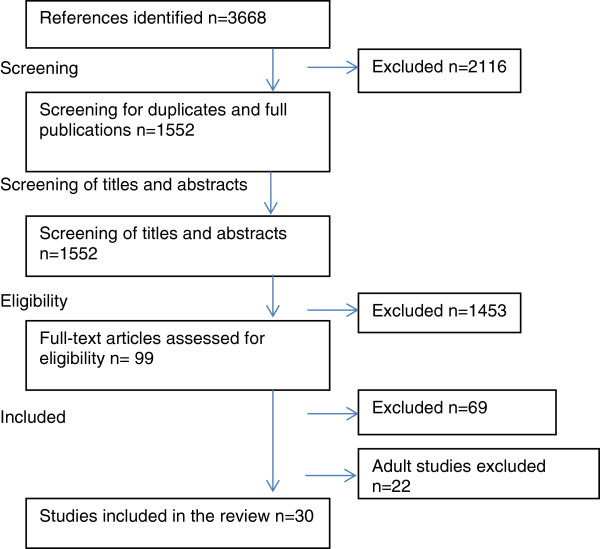
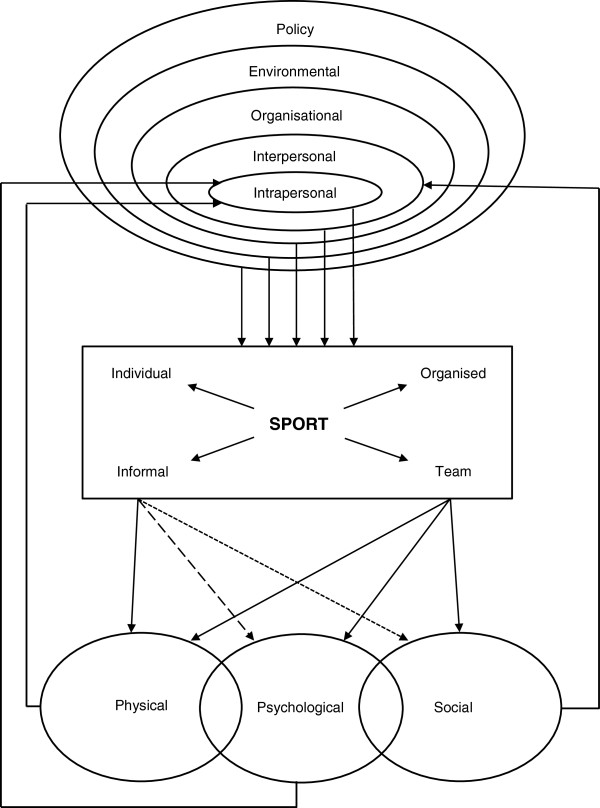
BACKGROUND: There are specific guidelines regarding the level of physical activity (PA) required to provide health benefits. However, the research underpinning these PA guidelines does not address the element of social health. Furthermore, there is insufficient evidence about the levels or types of PA associated specifically with psychological health. This paper first presents the results of a systematic review of the psychological and social health benefits of participation in sport by children and adolescents. Secondly, the information arising from the systematic review has been used to develop a conceptual model. METHODS: A systematic review of 14 electronic databases was conducted in June 2012, and studies published since 1990 were considered for inclusion. Studies that addressed mental and/or social health benefits from participation in sport were included. RESULTS: A total of 3668 publications were initially identified, of which 30 met the selection criteria. There were many different psychological and social health benefits reported, with the most commonly being improved self-esteem, social interaction followed by fewer depressive symptoms. Sport may be associated with improved psychosocial health above and beyond improvements attributable to participation in PA. Specifically, team sport seems to be associated with improved health outcomes compared to individual activities, due to the social nature of the participation. A conceptual model, Health through Sport, is proposed. The model depicts the relationship between psychological, psychosocial and social health domains, and their positive associations with sport participation, as reported in the literature. However, it is acknowledged that the capacity to determine the existence and direction of causal links between participation and health is limited by the fact that the majority of studies identified (n=21) were cross-sectional. CONCLUSION: It is recommended that community sport participation is advocated as a form of leisure time PA for children and adolescents, in an effort to not only improve physical health in relation to such matters as the obesity crisis, but also to enhance psychological and social health outcomes. It is also recommended that the causal link between participation in sport and psychosocial health be further investigated and the conceptual model of Health through Sport tested.
Overview
The claims and statistics of this paper haven’t been checked yet.
Free: it reads the open-access text and checks the first 5 claims that cite a source we can check. Create a free account to check every claim.
Integrity signals
Registry
Cites
Statistics
Figures
Verification
Claims the paper makes
The claims and statistics of this paper haven’t been checked yet.
Free: it reads the open-access text and checks the first 5 claims that cite a source we can check. Create a free account to check every claim.
Claims other papers make about this one
Each is checked against this paper’s own text: does it say what the citing paper says it does?
The source backs part of the claim, not all of it — or backs it for a different population, condition or comparison.
In the citing paper
“All six systematic reviews reported on organized sport activities and two also reported on organized non-sport activities (Cairns et al., 2014, Eime et al., 2013).”
From Impact of organized activities on mental health in children and adolescents: An umbrella review (2022) · cites this paper as Eime et al., 2013
Experimental — accuracy not yet measuredThe source backs part of the claim, not all of it — or backs it for a different population, condition or comparison.
In the citing paper
“Components of exercise interventions may represent important moderators of treatment effects.”
From Exercise for the treatment of anxiety in children and adolescents (2022) · cites this paper as Eime 2013
Experimental — accuracy not yet measuredThe source backs part of the claim, not all of it — or backs it for a different population, condition or comparison.
In the citing paper
“Indeed, intervention setting is another potential moderating factor, with group-based activities reported to confer a range of social benefits compared to individual activities (Eime 2013).”
From Exercise for the treatment of anxiety in children and adolescents (2022) · cites this paper as Eime 2013
Experimental — accuracy not yet measuredThe source backs part of the claim, not all of it — or backs it for a different population, condition or comparison.
In the citing paper
“We found evidence that children and adolescents who participated more frequently, who participated with higher intensity or who participated with longer duration (e.g. started at an early age or participated for a long period), had better mental health compared to their peers (Eime et al., 2013, Evans et al., 2017, Panza et al., 2020).”
From Impact of organized activities on mental health in children and adolescents: An umbrella review (2022) · cites this paper as Eime et al., 2013
Experimental — accuracy not yet measuredThe cited source says what the claim attributes to it.
In the citing paper
“Similarly, sports participation can be instrumental in the physical, social and emotional development of children and adolescents [30].”
2 more claims about this paper
Create a free account to see every claim other papers make about this one.
Self-check
Percentages, sums and reported differences re-computed from the paper’s own numbers.
The self-check needs the paper’s full text.
Citations
Cites
Kytle, J., & Bandura, A. (1978) · Contemporary Sociology · doi:10.2307/2065952 · Cited by 25,422
von Elm, E., Altman, D. G., Egger, M., Pocock, S. J., Gøtzsche, P. C., Vandenbroucke, J. P., & Initiative, F. T. S. (2007) · PLoS Medicine · doi:10.1371/journal.pmed.0040296 · Cited by 23,020
CONSORT 2010 Statement: updated guidelines for reporting parallel group randomised trials
the CONSORT Group, Schulz, K. F., Altman, D. G., & Moher, D. (2010) · BMC Medicine · doi:10.1186/1741-7015-8-18 · Cited by 13,371
Health Behavior and Health Education: Theory, Research, and Practice
(1992) · Annals of Internal Medicine · doi:10.7326/0003-4819-116-4-350_1 · Cited by 13,207
(1985) · Europe PMC (PubMed Central) · Cited by 9,143
Moher, D., Hopewell, S., Schulz, K. F., Montori, V., Gotzsche, P. C., Devereaux, P. J., Elbourne, D., Egger, M., & Altman, D. G. (2010) · BMJ · doi:10.1136/bmj.c869 · Cited by 8,883
An ecological perspective on health promotion programs
McLeroy, K. R., Bibeau, D., Steckler, A., & Glanz, K. (1988) · Health Education Quarterly · doi:10.1177/109019818801500401 · Cited by 8,502 · cited 2×
“The ‘determinants’ element is based on the well-established social ecological model [19,65] and is represented as concentric rings spreading out from the individual’s intrapersonal characteristics to widening spheres of influence.”
BackgroundDowns, S. H., & Black, N. (1998) · Journal of Epidemiology and Community Health · doi:10.1136/jech.52.6.377 · Cited by 8,252 · cited 1×
“Study quality was objectively appraised using the Downs and Black checklist [32].”
MethodJanssen, I., & LeBlanc, A. G. (2010) · International Journal of Behavioral Nutrition and Physical Activity · doi:10.1186/1479-5868-7-40 · Cited by 4,829
Measuring Health: A Guide to Rating Scales and Questionnaires
McDowell, I., & Newell, C. (1987) · Cited by 4,207
Ecological models of health behavior.
Sallis, J. F., Owen, N. G., & Fisher, E. B. (2008) · Swinburne figshare (Swinburne University of Technology) · Cited by 3,217
Wilson, I. B. (1995) · JAMA · doi:10.1001/jama.1995.03520250075037 · Cited by 3,027 · cited 1×
“Furthermore, there are many clinical conceptual models depicting health outcomes of clinical conditions, however they do not focus on the general population or on preventive health or health promotion [22].”
BackgroundCONSORT 2010 statement: Updated guidelines for reporting parallel group randomised trials
Schulz, K. F., Altman, D. G., & Moher, D. (2010) · Journal of Pharmacology and Pharmacotherapeutics · doi:10.4103/0976-500x.72352 · Cited by 2,165
Systematic review of sedentary behaviour and health indicators in school-aged children and youth.
Tremblay, M. S., LeBlanc, A. G., Kho, M. E., Saunders, T. J., Larouche, R., Colley, R. C., Goldfield, G., & Gorber, S. (2011) · International Journal of Behavioral Nutrition and Physical Activity · doi:10.1186/1479-5868-8-98 · Cited by 2,085 · cited 1×
“other systematic reviews within the physical activity and health field [33,34].”
BackgroundThe effectiveness of interventions to increase physical activityA systematic review1 and 2
KAHN, E., RAMSEY, L., BROWNSON, R., HEATH, G., HOWZE, E., POWELL, K., STONE, E., RAJAB, M., & CORSO, P. (2002) · American Journal of Preventive Medicine · doi:10.1016/s0749-3797(02)00434-8 · Cited by 2,022
von Elm, E., Altman, D. G., Egger, M., Pocock, S. J., Gøtzsche, P. C., Vandenbroucke, J. P., & Initiative, F. T. S. (2007) · Bulletin of the World Health Organization · doi:10.2471/blt.07.045120 · Cited by 1,632
Exercise treatment for depression
Dunn, A. L., Trivedi, M. H., Kampert, J. B., Clark, C. G., & Chambliss, H. O. (2005) · American Journal of Preventive Medicine · doi:10.1016/j.amepre.2004.09.003 · Cited by 1,208 · cited 2×
“Conversely, there is research indicating that children who are active through sport are more likely to be physically active in adulthood than those who do not participate in childhood sport [8,9].”
BackgroundThe Penguin Dictionary of Psychology
M., D. W., & Reber, A. S. (1986) · The American Journal of Psychology · doi:10.2307/1422298 · Cited by 981
Exercise for the Treatment of Depression
Knapen, J., Vancampfort, D., Schoubs, B., Probst, M., Sienaert, P., Haake, P., Peuskens, J., & Pieters, G. (2009) · The Open Complementary Medicine Journal · doi:10.2174/1876391x00901010078 · Cited by 911
Hansen, D. M., Larson, R. W., & Dworkin, J. B. (2003) · Journal of Research on Adolescence · doi:10.1111/1532-7795.1301006 · Cited by 852 · cited 6×
“Whilst positive social aspects of participation in sport have been consistently reported, it has also been found that young people involved with sport had higher rates of negative peer interaction [53].”
BackgroundInfluentialKriemler, S., Meyer, U., Martin, E., van Sluijs, E. M. F., Andersen, L. B., & Martin, B. W. (2011) · British Journal of Sports Medicine · doi:10.1136/bjsports-2011-090186 · Cited by 827 · cited 1×
“Extensive research has been conducted on the determinants of participation in PA [6,11] and on interventions that attempt to increase PA participation [12], with relatively little research focusing more specifically on sport [9,13].”
BackgroundChaplin, J. P. (2010) · DigitalGeorgetown (Georgetown University Library) · Cited by 736
Barber, B. L., Eccles, J. S., & Stone, M. R. (2001) · Journal of Adolescent Research · doi:10.1177/0743558401165002 · Cited by 695 · cited 4×
“lower social isolation [59], better social self-concept [64], and improved self-esteem [50].”
BackgroundInfluential(2009) · Nutrition Reviews · doi:10.1111/j.1753-4887.2008.00136.x · Cited by 593
A Controlled Trial of Physician Counseling to Promote the Adoption of Physical Activity
Calfas, K. J., Long, B. J., Sallis, J. F., Wooten, W. J., Pratt, M., & Patrick, K. (1996) · Preventive Medicine · doi:10.1006/pmed.1996.0050 · Cited by 565 · cited 1×
“Extensive research has been conducted on the determinants of participation in PA [6,11] and on interventions that attempt to increase PA participation [12], with relatively little research focusing more specifically on sport [9,13].”
BackgroundPromoting Healthy Adolescents: Synthesis of Youth Development Program Evaluations
Roth, J., Brooks-Gunn, J., Murray, L., & Foster, W. (1998) · Journal of Research on Adolescence · doi:10.1207/s15327795jra0804_2 · Cited by 485 · cited 1×
“The most frequently adopted construct (n=3) was the theory of Positive Youth Development [36,40,41], which propounds the notion that children are ‘resources to be developed’ rather than ‘problems to be solved’, and that all youth have the potential for positive development [66].”
BackgroundAdolescent participation in sports and adult physical activity
Tammelin, T., Näyhä, S., Hills, A. P., & Järvelin, M.-R. (2003) · American Journal of Preventive Medicine · doi:10.1016/s0749-3797(02)00575-5 · Cited by 461 · cited 1×
“Conversely, there is research indicating that children who are active through sport are more likely to be physically active in adulthood than those who do not participate in childhood sport [8,9].”
BackgroundSports participation and emotional wellbeing in adolescents
Steptoe, A. S., & Butler, N. (1996) · The Lancet · doi:10.1016/s0140-6736(96)91616-5 · Cited by 429 · cited 2×
“However, a few studies have investigated psychological and social health outcomes in relation to different levels of intensity of sport activities (low, moderate, vigorous, or high) [60,63] or frequency of participation and number of sport activities [48].”
BackgroundAdolescent Participation in Structured and Unstructured Activities: A Person-Oriented Analysis
Bartko, W. T., & Eccles, J. S. (2003) · Journal of Youth and Adolescence · doi:10.1023/a:1023056425648 · Cited by 417 · cited 3×
“Similarly, Bartko and Eccles (2003) reported that structured activities (sport being one of them) led to higher positive functioning for participants [55].”
BackgroundHarrison, P. A., & Narayan, G. (2003) · Journal of School Health · doi:10.1111/j.1746-1561.2003.tb03585.x · Cited by 354 · cited 4×
“(2003) defined team sport separately from other activities, their results were collated as sports only, activities only and sports and activities [52].”
BackgroundInfluentialHolt, N. L., Kingsley, B. C., Tink, L. N., & Scherer, J. (2011) · Psychology of Sport and Exercise · doi:10.1016/j.psychsport.2011.05.007 · Cited by 290 · cited 19×
“Only one of the 10 studies in the highest tertile score range incorporated a theoretical approach - the Theory of Youth Development [41].”
BackgroundMethodInfluentialPhysical Activity Behaviors and Perceived Life Satisfaction Among Public High School Adolescents
Valois, R. F., Zullig, K. J., Huebner, E. S., & Drane, J. W. (2004) · Journal of School Health · doi:10.1111/j.1746-1561.2004.tb04201.x · Cited by 262 · cited 5×
“Half of these 10 studies investigated differences in health measures between participants in sport/club sport and either other organised activities or no sport [41,43,49,53,62]; the other half more specifically investigated team sport participation in comparison to less or no team sport [39,42,46,51,52].”
BackgroundInfluentialJanssen, I. (2007) · Applied Physiology, Nutrition, and Metabolism · doi:10.1139/h07-109 · Cited by 238 · cited 1×
“benefits of participation in PA are not limited to physical health but also incorporate mental components [1,2].”
BackgroundZarrett, N., Fay, K., Li, Y., Carrano, J., Phelps, E., & Lerner, R. M. (2009) · Developmental Psychology · doi:10.1037/a0014577 · Cited by 231 · cited 2×
“Dimech and Seiler (2011) investigated sport only, categorised as non-participation, individual or team involvement [37], whereas Zarrett et al. (2009) investigated team or individual sport participation in comparison to participation in development programs, performing arts, arts and crafts, school…”
BackgroundResultThe effects of sports participation on young adolescents' emotional well-being.
Donaldson, S. J., & Ronan, K. R. (2006) · PubMed · Cited by 215
Come out and play: Shyness in childhood and the benefits of organized sports participation.
Findlay, L. C., & Coplan, R. J. (2008) · Canadian Journal of Behavioural Science / Revue canadienne des sciences du comportement · doi:10.1037/0008-400x.40.3.153 · Cited by 211 · cited 1×
“Similarly, Findlay and Coplan (2008) in a longitudinal analysis over a one-year period, did not find significant effects of sport participation over the year (neither main effects of time or participation-time interactions) on social skills, self-esteem, positive adjustment or externalising problem…”
BackgroundHealth-Related Quality of Life Differs Between Adolescent Athletes and Adolescent Nonathletes
Snyder, A. R., Martinez, J. C., Bay, R. C., Parsons, J. T., Sauers, E. L., & McLeod, T. C. V. (2010) · Journal of Sport Rehabilitation · doi:10.1123/jsr.19.3.237 · Cited by 207 · cited 1×
“Snyder et al. (2010) while reporting school and club participation, then combined them into a single ‘athletes’ category and compared them to non-athletes on health-related quality of life measures.”
BackgroundHowie, L. D., Lukacs, S. L., Pastor, P. N., Reuben, C. A., & Mendola, P. (2010) · Journal of School Health · doi:10.1111/j.1746-1561.2009.00475.x · Cited by 199 · cited 8×
“Consistent with the cross-sectional results of Linver et al. (2009) and Howie et al. (2010), Zarrett et al. (2009) concluded that a combination of sport plus other youth development programs was related to positive youth development, even after controlling for total time spent in the activities and…”
BackgroundResultInfluentialWiersma, L. D., & Fifer, A. M. (2008) · Journal of Leisure Research · doi:10.1080/00222216.2008.11950150 · Cited by 198 · cited 1×
“Similarly, in a qualitative study of focus groups of parents of young people participating in sport, social factors as well as life skills and self-concept were stated as benefits of participation [45].”
BackgroundLinver, M. R., Roth, J. L., & Brooks-Gunn, J. (2009) · Developmental Psychology · doi:10.1037/a0014133 · Cited by 190 · cited 18×
“activities outside school was associated with less positive development across the board [41].”
BackgroundResultInfluentialCasey, M. M., Eime, R. M., Payne, W. R., & Harvey, J. T. (2009) · Qualitative Health Research · doi:10.1177/1049732309338198 · Cited by 183 · cited 1×
“Determinants of PA are increasingly being understood using socio-ecological models, whereby intrapersonal, interpersonal, organisational, environmental and policy variables are identified as influences on participation [15-18].”
BackgroundSelf-citationTaliaferro, L. A., Rienzo, B. A., Miller, M. D., Pigg, R. M., & Dodd, V. J. (2008) · Journal of School Health · doi:10.1111/j.1746-1561.2008.00342.x · Cited by 181 · cited 5×
“Team sport participation has also been reported to protect against feelings of hopelessness and suicidality, even after controlling for levels of physical activity [42].”
BackgroundInfluentialConceptual models for health education research and practice
Earp, J. A., & Ennett, S. T. (1991) · Health Education Research · doi:10.1093/her/6.2.163 · Cited by 181 · cited 3×
“a set of concepts believed to be related to a specific public health problem” [14] (p163).”
BackgroundBoone, E. M., & Leadbeater, B. J. (2006) · Journal of Research on Adolescence · doi:10.1111/j.1532-7795.2006.00122.x · Cited by 168
Cleland, V. J., Ball, K., Hume, C., Timperio, A. F., King, A. C., & Crawford, D. A. (2010) · Social Science & Medicine · doi:10.1016/j.socscimed.2010.02.028 · Cited by 168 · cited 1×
“Determinants of PA are increasingly being understood using socio-ecological models, whereby intrapersonal, interpersonal, organisational, environmental and policy variables are identified as influences on participation [15-18].”
BackgroundPhysical activity recommendations for health: what should Europe do?
Oja, P., Bull, F. C., Fogelholm, M., & Martin, B. W. (2010) · BMC Public Health · doi:10.1186/1471-2458-10-10 · Cited by 166
The relationship between sports participation and self-esteem during early adolescence.
Bowker, A. (2006) · Canadian Journal of Behavioural Science / Revue canadienne des sciences du comportement · doi:10.1037/cjbs2006009 · Cited by 161
The Effects of Participation in Sport during the Last Two Years of High School
Marsh, H. W. (1993) · Sociology of Sport Journal · doi:10.1123/ssj.10.1.18 · Cited by 159 · cited 11×
“Marsh H: The effects of participation in sport during the last two years of high school.”
BackgroundMethodInfluentialDimech, A. S., & Seiler, R. (2011) · Psychology of sport and exercise · doi:10.1016/j.psychsport.2011.03.007 · Cited by 157 · cited 10×
“Dimech and Seiler (2011) investigated sport only, categorised as non-participation, individual or team involvement [37], whereas Zarrett et al.”
BackgroundMethodInfluentialUnderstanding the Contexts of Adolescent Female Participation in Sport and Physical Activity
Eime, R., Harvey, J. T., Sawyer, N. A., Craike, M. J., Symons, C. M., Polman, R. C. J., & Payne, W. R. (2013) · Research Quarterly for Exercise and Sport · doi:10.1080/02701367.2013.784846 · Cited by 151 · cited 1×
“Sport is one type of leisure-time PA which is organised and usually competitive and played in a team or as an individual [5].”
BackgroundSelf-citationPhysical activity levels and determinants of change in young adults: a longitudinal panel study
Zimmermann-Sloutskis, D., Wanner, M., Zimmermann, E., & Martin, B. W. (2010) · International Journal of Behavioral Nutrition and Physical Activity · doi:10.1186/1479-5868-7-2 · Cited by 133 · cited 2×
“However there is evidence that participation in sport peaks at around 11–13 years before declining through adolescence [6,7].”
BackgroundSports Involvement as Protection against Depressed Mood
Gore, S., Farrell, F., & Gordon, J. (2001) · Journal of Research on Adolescence · doi:10.1111/1532-7795.00006 · Cited by 131 · cited 5×
“A US study in which high school students were interviewed at two time points one year apart, showed that for females, but not for males, team sport involvement was protective against depressed mood state associated with poor school performance [58].”
BackgroundInfluentialTeam Sports Achievement and Self-Esteem Development Among Urban Adolescent Girls
Pedersen, S., & Seidman, E. (2004) · Psychology of Women Quarterly · doi:10.1111/j.1471-6402.2004.00158.x · Cited by 127 · cited 7×
“lower social isolation [59], better social self-concept [64], and improved self-esteem [50].”
BackgroundInfluentialSport activity in adolescence: associations with health perceptions and experimental behaviours
Ferron, C. (1999) · Health Education Research · doi:10.1093/her/14.2.225 · Cited by 125
Eime, R. M., Payne, W. R., Casey, M. M., & Harvey, J. T. (2010) · Health Education Research · doi:10.1093/her/cyn060 · Cited by 116 · cited 1×
“Determinants of PA are increasingly being understood using socio-ecological models, whereby intrapersonal, interpersonal, organisational, environmental and policy variables are identified as influences on participation [15-18].”
BackgroundSelf-citationChildren and physical activity: a systematic review of barriers and facilitators
Brunton, G., Harden, A., Rees, R. W., Kavanagh, J., Oliver, S. R., & Oakley, A. (2003) · UCL Discovery (University College London) · Cited by 114
Moderate involvement in sports is related to lower depression levels among adolescents.
Sanders, C., Field, T. M., Diego, M., & Kaplan, M. (2000) · PubMed · Cited by 111
Physical activity guidelines for children and youth.
Janssen, I. (2007) · PubMed · Cited by 107
Adolescents and Sports: Risk or Benefit?
Steiner, H., McQuivey, R. W., Pavelski, R., Pitts, T., & Kraemer, H. (2000) · Clinical Pediatrics · doi:10.1177/000992280003900304 · Cited by 98 · cited 3×
“sport’ in general, without distinguishing between in-school and out-of-school settings [42,43,46,50,51,58,59,61].”
BackgroundPredicting Adolescent Self-Esteem from Participation in School Sports among Latino Subgroups
Erkut, S., & Tracy, A. J. (2002) · Hispanic Journal of Behavioral Sciences · doi:10.1177/0739986302238212 · Cited by 85 · cited 4×
“Edited by Vandenbos R. Washington: American Psychology Association; 2009.”
BackgroundInfluentialAcademic Achievement and the Structure of Competition.
Coleman, J. S. (1963) · John Wiley & Sons, Inc. eBooks · doi:10.1037/11302-020 · Cited by 80 · cited 3×
“The theoretical perspective of Marsh [64] was adopted from Coleman’s [69] seminal work which “implies a zero-sum model in which greater involvement in extracurricular activities necessitates a decreased involvement in more narrowly defined academic pursuits” (p.19) in a way that is complementary rather than multiple r…”
MethodPhysical Activity Behaviors and Emotional Self‐Efficacy: Is There a Relationship for Adolescents?
Valois, R. F., Umstattd, M. R., Zullig, K. J., & Paxton, R. J. (2008) · Journal of School Health · doi:10.1111/j.1746-1561.2008.00309.x · Cited by 74 · cited 6×
“Half of these 10 studies investigated differences in health measures between participants in sport/club sport and either other organised activities or no sport [41,43,49,53,62]; the other half more specifically investigated team sport participation in comparison to less or no team sport [39,42,46,51,52].”
BackgroundMethodInfluentialSport participation during adolescence and suicide ideation and attempts
Taliaferro, L. A., Eisenberg, M. E., Johnson, K. E., Nelson, T. F., & Neumark-Sztainer, D. (2011) · ijamh · doi:10.1515/ijamh.2011.002 · Cited by 72 · cited 4×
“A longitudinal study also reported benefits of participation in sport compared to no participation, in relation to lower rates of suicidal ideation including both thoughts and intentions [35].”
BackgroundInfluentialA Theoretical Analysis of Academic and Athletic Roles
Snyder, E. E. (1985) · Sociology of Sport Journal · doi:10.1123/ssj.2.3.210 · Cited by 72 · cited 1×
“(1995) Multiple Role theory [70] which proposes that adolescents take on multiple roles as both a student and an athlete.”
BackgroundToftegaard‐Støckel, J., Nielsen, G. A., Ibsen, B., & Andersen, L. B. (2011) · Scandinavian Journal of Medicine & Science in Sports · doi:10.1111/j.1600-0838.2010.01093.x · Cited by 70 · cited 1×
“Determinants of PA are increasingly being understood using socio-ecological models, whereby intrapersonal, interpersonal, organisational, environmental and policy variables are identified as influences on participation [15-18].”
BackgroundEffects of sport club activities on adolescent development in Germany
Brettschneider, W. (2001) · European Journal of Sport Science · doi:10.1080/17461390100071201 · Cited by 67 · cited 8×
“A study of club sport members compared to non-club members also did not show a systematic effect of club membership on most measures of psychological and social health in adolescents over three years [57].”
BackgroundInfluentialCorrelates of extracurricular sport participation among Swiss adolescents
Michaud, P., Jeannin, A., & Surís, J.-C. (2006) · European Journal of Pediatrics · doi:10.1007/s00431-006-0129-9 · Cited by 65 · cited 5×
“Another study investigated frequency of extracurricular sport and perceived health, health attitudes and behaviour [49].”
BackgroundInfluentialGill, T. P., Baur, L. A., Bauman, A. E., Steinbeck, K. S., Storlien, L. H., Fiatarone Singh, M. A., Brand‐Miller, J. C., Colagiuri, S., & Caterson, I. D. (2009) · Medical Journal of Australia · doi:10.5694/j.1326-5377.2009.tb02318.x · Cited by 54
High School Student Athletes: Associations Between Intensity of Participation and Health Factors
Pavelski, R., Quivey, R. W. M., Brassington, G. S., & Steiner, H. (2003) · Clinical Pediatrics · doi:10.1177/000992280304200805 · Cited by 29 · cited 1×
“Participation in competitive sports was found to be associated with lower frequency of mental health problems [54].”
Background
Cited by
Eime, R. M., Young, J. A., Harvey, J. T., Charity, M. J., & Payne, W. R. (2013) · International Journal of Behavioral Nutrition and Physical Activity · doi:10.1186/1479-5868-10-135 · Cited by 632
“In a previous study, a Health through Sport model was developed for children and adolescents [11].”
BackgroundMethodInfluentialSelf-citationHulteen, R. M., Smith, J. J., Morgan, P. J., Barnett, L. M., Hallal, P. C., Colyvas, K., & Lubans, D. R. (2017) · Preventive Medicine · doi:10.1016/j.ypmed.2016.11.027 · Cited by 609
Malm, C., Jakobsson, J., & Isaksson, A. (2019) · Sports · doi:10.3390/sports7050127 · Cited by 610
“[1], where the conclusion was that sporting children have better self-esteem, less depression, and better overall psychosocial health.”
BackgroundHulteen, R. M., Morgan, P. J., Barnett, L. M., Stodden, D. F., & Lubans, D. R. (2018) · Sports Medicine · doi:10.1007/s40279-018-0892-6 · Cited by 499
Physical Activity and Cognitive Functioning of Children: A Systematic Review
Bidzan-Bluma, I., & Lipowska, M. (2018) · International Journal of Environmental Research and Public Health · doi:10.3390/ijerph15040800 · Cited by 489
“Figure 1 [22] presents the relation between policy, environment, organizational, interpersonal, and intrapersonal factors that affect the undertaking of various types of sports activities, and the physical, psychological, and social benefits brought about by doing sport.”
Background
Metadata
- Authors
- Eime, R. M., Young, J. A., Harvey, J. T., Charity, M. J., & Payne, W. R.
- Affiliations
- Victoria University (AU)
- Federation University (AU)
- Corresponding author
- Eime, Rochelle M
- Venue
- International Journal of Behavioral Nutrition and Physical Activity
- Published
- 2013
- Volume
- 10
- Issue
- 1
- Pages
- 98
- ISSN
- 1479-5868 (ISSN-L)
- PMC
- PMC3751802
- OpenAlex
- W2150292700
- Semantic Scholar
- 7f8fcfa7ffe59c88cef9c12ca5965f488c4b7011
- Cited by
- 2,366
- References
- 69
- Citations by year
- 2026: 266 · 2025: 309 · 2024: 262 · 2023: 267 · 2022: 238 · 2021: 235 · 2020: 203 · 2019: 153 · 2018: 142 · 2017: 103 · 2016: 86 · 2015: 59 · 2014: 38 · 2013: 3
- FWCI
- 6.70
- Type
- journal article
- Language
- en
- Open access
- gold
- doi.org
- Licence
- cc-by
- Locations
- International Journal of Behavioral Nutrition and Physical Activity (publishedVersion, cc-by)
- Europe PMC (PubMed Central) (publishedVersion, cc-by)
- PubMed Central (publishedVersion, cc-by)
- PubMed (publishedVersion)
- Victoria University Research Repository (Victoria University) (submittedVersion, cc-by)
- FedUni ResearchOnline (Federation University Australia) (submittedVersion)
- Figshare (submittedVersion, cc-by)
- Topics
- Health Sciences › Medicine › Public Health, Environmental and Occupational Health › Physical Activity and Health
- Social Sciences › Psychology › Developmental and Educational Psychology › Youth Development and Social Support
- Social Sciences › Life-span and Life-course Studies › Recreational Sport and Physical Activity
- Keywords
- sports participation, children, adolescents, mental health, social health, self-esteem, depressive symptoms, social interaction, team sports, individual sports, psychosocial health, conceptual model, physical activity guidelines, community sports, leisure-time physical activity
- MeSH terms
- Adolescent, Child, Depression, Health, Humans, Interpersonal Relations, Personal Satisfaction, Self Concept, Sports, Health Behavior, Exercise
About these checks
Registry, retraction, Cites and statistics results are computed, not judged, with one exception: a printed reference that no index lists is read once by a model before it counts as a citation error. Claims are extracted by a model and kept only when their quote appears verbatim in the text; each cited source is then checked, with a model’s help, for whether it says what the claim relies on. Those verdicts can be wrong — read the claim’s quote and the cited source before relying on one.
Statistics and arithmetic are recomputed, not judged.
Confidence bands are shown only for fields calibrated on our annotated test set. None is calibrated yet, so no band is shown.
What counts as a claim ›How we measure confidence ›How we check this ›
Are you an author, or do you see a problem with this page? Request a review
Data sources
Bibliographic data: Semantic Scholar, OpenAlex, Crossref.
Contains information from the Semantic Scholar Academic Graph Datasets, made available under the ODC Attribution License (ODC-BY 1.0).
Semantic Scholar’s data is described in: Kinney, R., et al. (2023). The Semantic Scholar Open Data Platform. arXiv:2301.10140.
