

Randomised controlled feasibility trial of a web-based weight management intervention with nurse support for obese patients in primary care
Open accessThe DOI matches its Crossref record; 44 of the 44 references it cites were found in a registry or an index.
Abstract
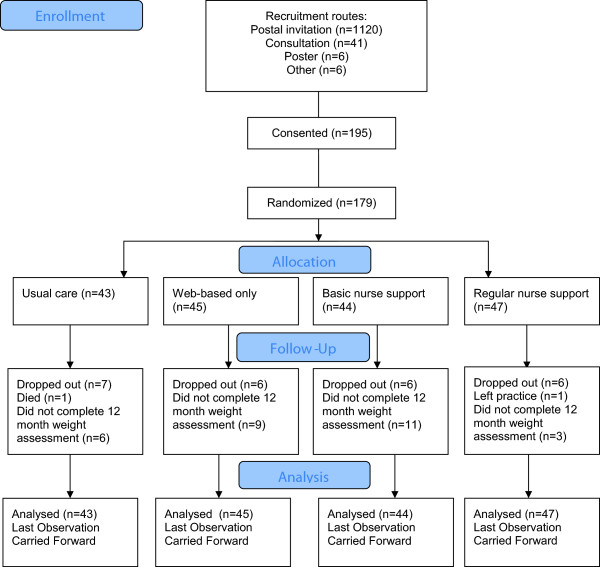
BACKGROUND: There is a need for cost-effective weight management interventions that primary care can deliver to reduce the morbidity caused by obesity. Automated web-based interventions might provide a solution, but evidence suggests that they may be ineffective without additional human support. The main aim of this study was to carry out a feasibility trial of a web-based weight management intervention in primary care, comparing different levels of nurse support, to determine the optimal combination of web-based and personal support to be tested in a full trial. METHODS: This was an individually randomised four arm parallel non-blinded trial, recruiting obese patients in primary care. Following online registration, patients were randomly allocated by the automated intervention to either usual care, the web-based intervention only, or the web-based intervention with either basic nurse support (3 sessions in 3 months) or regular nurse support (7 sessions in 6 months). The main outcome measure (intended as the primary outcome for the main trial) was weight loss in kg at 12 months. As this was a feasibility trial no statistical analyses were carried out, but we present means, confidence intervals and effect sizes for weight loss in each group, uptake and retention, and completion of intervention components and outcome measures. RESULTS: All randomised patients were included in the weight loss analyses (using Last Observation Carried Forward). At 12 months mean weight loss was: usual care group (n = 43) 2.44 kg; web-based only group (n = 45) 2.30 kg; basic nurse support group (n = 44) 4.31 kg; regular nurse support group (n = 47) 2.50 kg. Intervention effect sizes compared with usual care were: d = 0.01 web-based; d = 0.34 basic nurse support; d = 0.02 regular nurse support. Two practices deviated from protocol by providing considerable weight management support to their usual care patients. CONCLUSIONS: This study demonstrated the feasibility of delivering a web-based weight management intervention supported by practice nurses in primary care, and suggests that the combination of the web-based intervention with basic nurse support could provide an effective solution to weight management support in a primary care context. TRIAL REGISTRATION: Current Controlled Trials ISRCTN31685626.
Overview
The claims and statistics of this paper haven’t been checked yet.
Free: it reads the open-access text and checks the first 5 claims that cite a source we can check. Create a free account to check every claim.
Integrity signals
Registry
Cites
Statistics
Figures
Verification
Claims the paper makes
The claims and statistics of this paper haven’t been checked yet.
Free: it reads the open-access text and checks the first 5 claims that cite a source we can check. Create a free account to check every claim.
Claims other papers make about this one
Each is checked against this paper’s own text: does it say what the citing paper says it does?
The source backs part of the claim, not all of it — or backs it for a different population, condition or comparison.
In the citing paper
“interventions that have proven effective in trials involving tens of thousands of users.”
From The Person-Based Approach to Intervention Development: Application to Digital Health-Related Behavior Change Interventions (2015) · cites this paper as [18]
Experimental — accuracy not yet measuredThe source backs part of the claim, not all of it — or backs it for a different population, condition or comparison.
In the citing paper
“Analysis revealed that average website usage, defined as duration of page viewing, was similar across the intervention arms, but extremely variable within groups.”
From A Visualization Tool to Analyse Usage of Web-Based Interventions: The Example of Positive Online Weight Reduction (POWeR) (2015) · cites this paper as [11]
Experimental — accuracy not yet measuredThe cited source says what the claim attributes to it.
In the citing paper
“in our feasibility study of implementing POWeR [18] in a primary care setting, long-term outcomes did indeed prove better for those with only brief nurse support.”
From The Person-Based Approach to Intervention Development: Application to Digital Health-Related Behavior Change Interventions (2015) · cites this paper as [18]
In the citing paper
“The efficacy of the Web-based POWeR intervention and participants’ views of the specific content provided by the Web-based intervention have been the focus of previous qualitative studies [57] and randomized controlled trials within health care [58] and community settings [59].”
From Understanding Usage of a Hybrid Website and Smartphone App for Weight Management: A Mixed-Methods Study (2014) · cites this paper as [58]
In the citing paper
“As reported elsewhere [11], a randomized nonblinded feasibility trial of a Web-based weight management intervention (POWeR) for obese patients in primary care was used to compare 4 parallel groups: usual care, website only, website with basic nurse support, and website with regular nurse support.”
From A Visualization Tool to Analyse Usage of Web-Based Interventions: The Example of Positive Online Weight Reduction (POWeR) (2015) · cites this paper as [11]
4 more claims about this paper
Create a free account to see every claim other papers make about this one.
Self-check
Percentages, sums and reported differences re-computed from the paper’s own numbers.
The self-check needs the paper’s full text.
Citations
Cites
1 retracted
Psychological interventions for overweight or obesity
Shaw, K. A., O'Rourke, P., Del Mar, C., & Kenardy, J. (2005) · Cochrane Database of Systematic Reviews · doi:10.1002/14651858.cd003818.pub2 · Cited by 442 · cited 1×
“Meta-analyses suggest that behavioural weight management interventions, which help people to monitor and regulate their relative dietary intake and energy expenditure, on average result in clinically useful weight loss [3,4].”
BackgroundRetractedThe theory of planned behavior
Ajzen, I. (1991) · Organizational Behavior and Human Decision Processes · doi:10.1016/0749-5978(91)90020-t · Cited by 134,657
EuroQol: a new facility for the measurement of health-related quality of life
(1990) · Health Policy · doi:10.1016/0168-8510(90)90421-9 · Cited by 15,736 · cited 1×
“EQ-5D (Euroqol) [29] 5 items assessing general health-related quality of life, used to generate Quality Adjusted Life Years for cost-effectiveness analyses.”
Method‘Small Changes' to Diet and Physical Activity Behaviors for Weight Management
Hills, A. P., Byrne, N. M., Lindstrom, R., & Hill, J. O. (2013) · Obesity Facts · doi:10.1159/000345030 · Cited by 9,493
A simple method to assess exercise behavior in the community.
Godin, G., & Shephard, R. J. (1985) · PubMed · Cited by 4,760
Finucane, M. M., Stevens, G. A., Cowan, M. J., Danaei, G., Lin, J. K., Paciorek, C. J., Singh, G. M., Gutierrez, H. R., Lu, Y., Bahalim, A. N., et al. (2011) · The Lancet · doi:10.1016/s0140-6736(10)62037-5 · Cited by 4,050 · cited 1×
“Background Obesity is a major threat to public health internationally, and the prevalence has risen sharply in recent decades [1,2].”
BackgroundA tutorial on pilot studies: the what, why and how
Thabane, L., Ma, J., Chu, R., Cheng, J., Ismaila, A., Rios, L. P., Robson, R., Thabane, M., Giangregorio, L., & Goldsmith, C. H. (2010) · BMC Medical Research Methodology · doi:10.1186/1471-2288-10-1 · Cited by 3,384
Danaei, G., Ding, E. L., Mozaffarian, D., Taylor, B., Rehm, J., Murray, C. J. L., & Ezzati, M. (2009) · PLoS Medicine · doi:10.1371/journal.pmed.1000058 · Cited by 2,860 · cited 1×
“Background Obesity is a major threat to public health internationally, and the prevalence has risen sharply in recent decades [1,2].”
BackgroundFuller, N. R., Colagiuri, S., Schofield, D., Olson, A. D., Shrestha, R., Holzapfel, C., Wolfenstetter, S. B., Holle, R., Ahern, A. L., Hauner, H., et al. (2013) · International Journal of Obesity · doi:10.1038/ijo.2012.139 · Cited by 2,117
Using Pedometers to Increase Physical Activity and Improve Health: A Systematic Review
Bravata, D. M., Smith-Spangler, C., Sundaram, V., Gienger, A. L., Lin, N., Lewis, R., Stave, C. D., Olkin, I., & Sirard, J. R. (2007) · JAMA · doi:10.1001/jama.298.19.2296 · Cited by 2,064 · cited 1×
“Patients were also encouraged to increase their physical activity levels by choosing either a walking plan (in which case a pedometer was supplied [21]) or a self-selected mixture of other physical activities.”
Background
Cited by
Yardley, L., Morrison, L., Bradbury, K., & Muller, I. (2015) · Journal of Medical Internet Research · doi:10.2196/jmir.4055 · Cited by 1,442
“We concluded that brief nurse support for our intervention might be preferable to regular nurse support, and in our feasibility study of implementing POWeR [18] in a primary care setting, long-term outcomes did indeed prove better for those with only brief nurse support.”
ResultSelf-citationMa, C., Avenell, A., Bolland, M., Hudson, J., Stewart, F., Robertson, C., Sharma, P., Fraser, C., & MacLennan, G. (2017) · BMJ · doi:10.1136/bmj.j4849 · Cited by 464
Hutchesson, M. J., Rollo, M. E., Krukowski, R., Ells, L., Harvey, J., Morgan, P. J., Callister, R., Plotnikoff, R., & Collins, C. E. (2015) · Obesity Reviews · doi:10.1111/obr.12268 · Cited by 380
“Six of the studies compared an eHealth intervention alone (website n = 5 and mobile application n = 1) to the eHealth intervention combined with face-to-face sessions (53,55,57,59,60,62).”
BackgroundBeleigoli, A. M., Andrade, A. Q., Cançado, A. G., Paulo, M. N., Diniz, M. D. F. H., & Ribeiro, A. L. (2019) · Journal of Medical Internet Research · doi:10.2196/jmir.9609 · Cited by 278
“Absolute weight and BMI changes were reported in 10 [12-15,17-22] and 9 [12-20] studies, respectively.”
InfluentialWadden, T. A., Butryn, M. L., Hong, P. S., & Tsai, A. G. (2014) · JAMA · doi:10.1001/jama.2014.14173 · Cited by 248
Michaelides, A., Raby, C., Wood, M., Farr, K., & Toro-Ramos, T. (2016) · BMJ Open Diabetes Research & Care · doi:10.1136/bmjdrc-2016-000264 · Cited by 128
Beishuizen, C. R., Stephan, B. C., van Gool, W. A., Brayne, C., Peters, R. J., Andrieu, S., Kivipelto, M., Soininen, H., Busschers, W. B., Moll van Charante, E. P., et al. (2016) · Journal of Medical Internet Research · doi:10.2196/jmir.5218 · Cited by 128
“In 20 studies, outcome assessors were blinded [27,29,30,32,34-40,42,52,54,57,59,61,64,67,81], in 19 studies blinding was not mentioned or unclear [28,31,33,41,43,44,46,48,53,56,60,63,65,69,71,74,76,77,80], and in 18 studies outcome assessors were not blinded [26,45,47,49-51,55,58,62,66,68,70,72,73,75,78,79,82].”
Madigan, C. D., Graham, H. E., Sturgiss, E., Kettle, V. E., Gokal, K., Biddle, G., Taylor, G. M. J., & Daley, A. J. (2022) · BMJ · doi:10.1136/bmj-2021-069719 · Cited by 114
Morrison, L. G. (2015) · DIGITAL HEALTH · doi:10.1177/2055207615595335 · Cited by 116
“…may also enhance users’ sense of autonomy by encouraging the user to reflect on their own personal, intrinsic reasons for health behaviour change or DI usage (see Yardley et al. 2014), 24 and how these reasons fit with other core values (e.g. long-term health, quality of life, vitality etc.).”
BackgroundThe Role of Social Support and Self-efficacy for Planning Fruit and Vegetable Intake
Zhou, G., Gan, Y., Hamilton, K., & Schwarzer, R. (2016) · Journal of Nutrition Education and Behavior · doi:10.1016/j.jneb.2016.09.005 · Cited by 112
“Anonline weightmanagement intervention program designed to focus on selfregulatory skills and nurse social support suggested an effective solution to weight reduction for obese patients.(39) Future interventions can then draw on this knowledge to develop more effective planning interventions for health behavior change…”
BackgroundDesigning and undertaking a health economics study of digital health interventions
McNamee, P., Murray, E., Kelly, M. P., Bojke, L., Chilcott, J., Fischer, A., West, R., & Yardley, L. (2016) · American Journal of Preventive Medicine · doi:10.1016/j.amepre.2016.05.007 · Cited by 82
“These costs can be substantial, ranging from £20,000 (for a simple one-session intervention)(32) to £500,000 (or more) for a longitudinal, highly interactive intervention with extensive content, tailored to many different variables.(33) Many of these costs relate to iterative development and evaluation of the interven…”
BackgroundSelf-citationMorrison, L. G., Hargood, C., Lin, S. X., Dennison, L., Joseph, J., Hughes, S., Michaelides, D. T., Johnston, D., Johnston, M., Michie, S., et al. (2014) · Journal of Medical Internet Research · doi:10.2196/jmir.3579 · Cited by 79
“The efficacy of the Web-based POWeR intervention and participants’ views of the specific content provided by the Web-based intervention have been the focus of previous qualitative studies [57] and randomized controlled trials within health care [58] and community settings [59].”
Self-citationBoucher, S., Edwards, O., Gray, A., Nada-Raja, S., Lillis, J., Tylka, T. L., & Horwath, C. C. (2016) · JMIR Research Protocols · doi:10.2196/resprot.5861 · Cited by 76
“Furthermore, the significant increase in psychological flexibility suggests the ACT strategies were active in the intervention.”
Toro-Ramos, T., Lee, D.-H., Kim, Y., Michaelides, A., Oh, T. J., Kim, K. M., Jang, H. C., & Lim, S. (2017) · Metabolic Syndrome and Related Disorders · doi:10.1089/met.2017.0062 · Cited by 71
“38,39 The degree of coaching ( e.g. , professional, mentoring, or peer) was shown to impact the magnitude of weight loss, where those coached professionally lost weight more than the other groups.”
Flodgren, G., Gonçalves, D. C., & Summerbell, C. (2017) · Cochrane Database of Systematic Reviews · doi:10.1002/14651858.cd000984.pub3 · Cited by 84
Rotunda, W., Rains, C. B., Jacobs, S., Ng, V., Lee, R., Rutledge, S., Jackson, M. C., & Myers, K. (2024) · Preventing Chronic Disease · doi:10.5888/pcd21.230347 · Cited by 77
Morrison, D., Mair, F. S., Yardley, L., Kirby, S. E., & Thomas, M. D. (2016) · Chronic Respiratory Disease · doi:10.1177/1479972316660977 · Cited by 63
Self-citationCrilly, P., Hassanali, W., Khanna, G., Matharu, K., Patel, D., Patel, D., Rahman, F., & Kayyali, R. (2019) · Research in Social and Administrative Pharmacy · doi:10.1016/j.sapharm.2018.02.005 · Cited by 47
Dack, C., Ross, J., Stevenson, F. A., Pal, K., Gubert, E., Michie, S., Yardley, L., Barnard, M., May, C. R., Farmer, A. A., et al. (2019) · Internet Interventions · doi:10.1016/j.invent.2019.100241 · Cited by 55
Self-citationKloek, C. J. J., Bossen, D., de Bakker, D. H., Veenhof, C., & Dekker, J. (2017) · Journal of Medical Internet Research · doi:10.2196/jmir.8108 · Cited by 53
“Most interventions focused on one target behavior [20-30,32,34-46,48], and 3 interventions were focused on multiple behaviors (ie, nutrition and physical activity) [31,33,47].”
BackgroundInfluentialStrategies to reduce attrition in weight loss interventions: A systematic review and meta‐analysis
Pirotta, S., Joham, A., Hochberg, L., Moran, L., Lim, S., Hindle, A., & Brennan, L. (2019) · Obesity Reviews · doi:10.1111/obr.12914 · Cited by 45
“In line with National Health and Medical Research Council (NHMRC) clinical practice guidelines for weight management within the general population,(84) 11 studies continued monitoring for up to 52 weeks postintervention.(31,49,57,65,68,73,74,76,81-83,85,86) Only five studies provided a definition of attrition(32,37,43…”
BackgroundBradbury, K. J., Morton, K., Band, R. J., May, C. R., McManus, R. J., Little, P. S., & Yardley, L. (2017) · BMC Medical Informatics and Decision Making · doi:10.1186/s12911-016-0397-x · Cited by 54
“Since providing a rationale for behaviour change can support autonomy [32] we added evidence of the acceptability and effectiveness of CARE to HOME BP, including quotes from nurses and patients who had used or received an earlier version of this approach in our previous studies [13, 18, 33].”
BackgroundMethodSelf-citationLittle, P. S., Stuart, B. L., Hobbs, R. F., Kelly, J., Smith, E., Bradbury, K. J., Hughes, S. F., Smith, P. W. F., Moore, M. V., Lean, M. E. J., et al. (2017) · Health Technology Assessment · doi:10.3310/hta21040 · Cited by 59
“The Research for Patient Benefit-funded website was a prototype version and we demonstrated that this helped to support weight loss in a feasibility study.(22) Participants chose a low-calorie or a low-carbohydrate diet, and either a walking plan (with a supplied pedometer) or a self-selected mixture of physical activ…”
MethodSelf-citationAinsworth, B., Steele, M., Stuart, B., Joseph, J., Miller, S., Morrison, L., Little, P., & Yardley, L. (2017) · Annals of Behavioral Medicine · doi:10.1007/s12160-016-9866-9 · Cited by 41
“…use similar usage analyses to explore ‘ effective engagement thresholds ’ in interventions targeting different behaviors, such as weight management [39] or smoking cessation [40], and also examine whether interventions modified according to our analysis findings (e.g. core content in stand-alone…”
BackgroundSelf-citationNutritional Status and Diet in Cancer Prevention
Bail, J. R., Meneses, K., & Demark‐Wahnefried, W. (2016) · Seminars in Oncology Nursing · doi:10.1016/j.soncn.2016.05.004 · Cited by 47
Rotondi, A. J., Spring, M. B., Hanusa, B. H., Eack, S. M., & Haas, G. L. (2017) · JMIR Human Factors · doi:10.2196/humanfactors.6221 · Cited by 44
“eHealth technologies are being used increasingly in general medical care [13-16] and to a lesser, though growing, extent in mental health treatment [17-20] as a way to improve service receipt and reduce illness burden.”
BackgroundUsing mixed methods to develop and evaluate an online weight management intervention
Bradbury, K., Dennison, L., Little, P., & Yardley, L. (2015) · British Journal of Health Psychology · doi:10.1111/bjhp.12125 · Cited by 34
Self-citationBerks, D., Hoedjes, M., Raat, H., Franx, A., Looman, C. W. N., van Oostwaard, M. F., Papatsonis, D. N. M., Duvekot, J. J., & Steegers, E. A. P. (2018) · Pregnancy Hypertension · doi:10.1016/j.preghy.2018.12.004 · Cited by 38
Arden-Close, E. J., Smith, E., Bradbury, K., Morrison, L., Dennison, L., Michaelides, D., & Yardley, L. (2015) · JMIR Human Factors · doi:10.2196/humanfactors.4310 · Cited by 32
Self-citationRole of the family doctor in the management of adults with obesity: a scoping review
Sturgiss, E. A., Elmitt, N., Haesler, E., van Weel, C., & Douglas, K. A. (2018) · BMJ Open · doi:10.1136/bmjopen-2017-019367 · Cited by 37
25th European Congress on Obesity, Vienna, Austria, May 23-26, 2018: Abstracts
Bosch-Druck (2018) · Obesity Facts · doi:10.1159/000489691 · Cited by 32
Findings from a pilot Randomised trial of an Asthma Internet Self-management Intervention (RAISIN)
Morrison, D., Wyke, S., Saunderson, K., McConnachie, A., Agur, K., Chaudhuri, R., Thomas, M., Thomson, N. C., Yardley, L., & Mair, F. S. (2016) · BMJ Open · doi:10.1136/bmjopen-2015-009254 · Cited by 31
“These two facts combined lead us to conclude that it would be preferable to provide the core modules initially and then ‘release’ further sections weekly or fortnightly, a strategy that has been used successfully for a weight loss intervention also developed using LifeGuide software.(26) Qualitative process evaluation…”
MethodSelf-citationPodina, I. R., & Fodor, L. A. (2018) · Health Psychology · doi:10.1037/hea0000623 · Cited by 29
Murray, E., Ross, J., Pal, K., Li, J., Dack, C., Stevenson, F., Sweeting, M., Parrott, S., Barnard, M., Yardley, L., et al. (2018) · Programme Grants for Applied Research · doi:10.3310/pgfar06050 · Cited by 19
“It had been shown to be effective in a RCT.(140) 3.”
BackgroundSelf-citationNursing interventions with people with obesity in Primary Health Care: an integrative review
Braga, V. A. S., Jesús, M., Conz, C. A., Tavares, R. E., da Silva, M. H., & Merighi, M. A. B. (2018) · Revista da Escola de Enfermagem da USP · doi:10.1590/s1980-220x2017019203293 · Cited by 39
“Continue 5 Braga VAS, Jesus MCP, Conz CA, Tavares RE, Silva MH, Merighi MAB www.ee.usp.br/reeusp Rev Esc Enferm USP · 2017;51:e03293 Continuation Yardley et al., 2014(23) England Clinical trial, randomized, controlled n=179 The adult patients were divided into four intervention groups: normal care…”
BackgroundGastrointestinal Cancers: Screening and Early Detection
Griffin-Sobel, J. P. (2017) · Seminars in Oncology Nursing · doi:10.1016/j.soncn.2017.02.004 · Cited by 29
Kempf, K., Röhling, M., Martin, S., & Schneider, M. (2019) · BMJ Open · doi:10.1136/bmjopen-2018-022242 · Cited by 34
“Diastolic blood pressure (mm Hg) 90 (10) 89 (12) 89 (8)”
Lau, Y., Wong, S. H., Chee, D. G. H., Ng, B. S. P., Ang, W. W., Han, C. Y., & Cheng, L. J. (2024) · Obesity Reviews · doi:10.1111/obr.13699 · Cited by 27
“100 The RCTs were two-armed ( n = 25), three-armed ( n = 17), four-armed ( n = 3), 56,73,96 and five-armed ( n = 1).”
BackgroundSmith, E., Bradbury, K. J., Scott, L., Steele, M., Little, P. S., & Yardley, L. (2017) · Implementation Science · doi:10.1186/s13012-017-0596-6 · Cited by 32
“The downside of DIs is that engagement may be poor [6], but the addition of a brief amount of human support can improve engagement and outcomes [7].”
BackgroundMethodSelf-citationPilot trials in physical activity journals: a review of reporting and editorial policy
Horne, E., Lancaster, G. A., Matson, R., Cooper, A., Ness, A., & Leary, S. (2018) · Pilot and Feasibility Studies · doi:10.1186/s40814-018-0317-1 · Cited by 23
Chen, J. W., Kaye, L., Tuffli, M., Barrett, M., Jones-Ford, S., Shenouda, T., Gondalia, R., Henderson, K., Combs, V., Sickle, D. V., et al. (2019) · JMIR Formative Research · doi:10.2196/13286 · Cited by 26
“Emerging research suggests that digital health programs integrating providers [20] or human coaches may improve clinical outcomes, rates of engagement, and retention [21,22].”
BackgroundEffectiveness of a self‐regulation intervention for weight loss: A randomized controlled trial
Frie, K., Hartmann‐Boyce, J., Jebb, S. A., & Aveyard, P. N. (2020) · British Journal of Health Psychology · doi:10.1111/bjhp.12436 · Cited by 26
“Few allow for the iterative reformulation of personally chosen action plans, and when they do, the action plans are usually set for at least a week at a time (Benyamini et al., 2013; Yardley et al., 2014).”
BackgroundKempf, K., Röhling, M., Stichert, M., Fischer, G., Boschem, E., Könner, J., & Martin, S. (2018) · International Journal of Telemedicine and Applications · doi:10.1155/2018/7530602 · Cited by 23
Sittig, S., McGowan, A., & Iyengar, S. (2020) · Journal of Medical Systems · doi:10.1007/s10916-020-01591-w · Cited by 24
“Tunneling (PT) [56, 58–60, 62, 63] [46, 53, 64]”
Benton, J. S., Cotterill, S., Hawkes, R. E., Miles, L. M., & French, D. (2022) · Journal of Medical Internet Research · doi:10.2196/39483 · Cited by 21
“…a journal article describing the theoretical content of the HeLP-Diabetes intervention [24]; and (3) journal articles relating to the 3 pre-existing behavior change interventions that were integrated into the HeLP-Diabetes intervention—DownYourDrink [25,26], POWeR [27,28], and StopAdvisor [29,30].”
Hawkes, R. E., Benton, J. S., Cotterill, S., Sanders, C., & French, D. (2024) · JMIR Diabetes · doi:10.2196/56276 · Cited by 21
Ozaki, I., Watai, I., Nishijima, M., & Saito, N. (2019) · Journal of Occupational Health · doi:10.1002/1348-9585.12037 · Cited by 19
Hamlet, C., Williamson, H., & Harcourt, D. M. (2017) · Primary Health Care Research & Development · doi:10.1017/s1463423617000536 · Cited by 14
“With greater demand for self-management tools that can potentially complement, replace or prevent the need for costly alternatives (Barak and Grohol, 2011), GP practices are increasingly asked to host research evaluating web-based self-help interventions to address conditions such as obesity (Yardley et al., 2014), de…”
BackgroundBerry, M. P., Chwyl, C., Metzler, A. L., Sun, J. H., Dart, H., & Forman, E. M. (2022) · Health Psychology Review · doi:10.1080/17437199.2022.2125038 · Cited by 13
Clarkson, P., Vassilev, I., Rogers, A. E., Brooks, C., Wilson, N., Lawson, J., & Adams, J. (2020) · JMIR Formative Research · doi:10.2196/18565 · Cited by 11
Sen, A., Ho, A. K. Y., Goh, W. K. F., & Chew, H. S. J. (2025) · Nursing Outlook · doi:10.1016/j.outlook.2025.102377 · Cited by 10
The POWeR of looking into the black box
Brindal, E. (2016) · The Lancet Diabetes & Endocrinology · doi:10.1016/s2213-8587(16)30115-2 · Cited by 10
Ma, Y., McRae, C., Wu, Y.-H., & Dubé, L. (2021) · Frontiers in Public Health · doi:10.3389/fpubh.2021.634372 · Cited by 12
Pragmatic implementation of a fully automated online obesity treatment in primary care
Thomas, J. G., Panza, E. A., Espel‐Huynh, H., Goldstein, C. M., O’Leary, K. C., Benedict, N., Puerini, A. J., & Wing, R. R. (2022) · Obesity · doi:10.1002/oby.23502 · Cited by 10
“5% of initial body weight at 12 or 24 weeks in ITT analyses [13, 22, 23], and fully remote e-health programs have typically produced mean weight loss of 2.”
Sturgiss, E. A., O’Brien, K., Elmitt, N., Agostino, J., Ardouin, S., Douglas, K., & Clark, A. M. (2021) · Family Practice · doi:10.1093/fampra/cmab026 · Cited by 8
“bond, collaborative goal setting and agreement on tasks) (27).”
BackgroundMethodInfluentialGreenwell, K., Ainsworth, B., Bruton, A., Murray, E., Russell, D., Thomas, M., & Yardley, L. (2021) · npj Primary Care Respiratory Medicine · doi:10.1038/s41533-021-00248-6 · Cited by 8
Self-citationApplication of the Supportive Accountability Model in Digital Health Interventions: Scoping Review
Kwok, G., Cheung, S., Duffecy, J. L., & Devine, K. A. (2025) · Journal of Medical Internet Research · doi:10.2196/72639 · Cited by 11
“Health professionals included nurses and nurse interns [54,55]; a behavioral weight loss interventionist [56]; dietitians [57]; mental health providers, such as clinical psychologists [57,58]; therapists [59-61]; and clinic staff [49,50].”
Yıldız, E., & Karagözoğlu, Ş. (2023) · Obesity Surgery · doi:10.1007/s11695-023-06795-w · Cited by 13
Heredia, N. I., Lee, M., Hwang, K. O., Reininger, B. M., Fernández, M. E., & McNeill, L. H. (2019) · Contemporary Clinical Trials · doi:10.1016/j.cct.2019.06.006 · Cited by 9
Mata-González, E. E., Peña, C. M., & Saldaña, C. (2020) · Revista Española de Nutrición Humana y Dietética · doi:10.14306/renhyd.24.4.984 · Cited by 10
The Effects of mHealth Versus eHealth on Weight Loss in Adults: A Systematic Review
O'Boyle, J., & Davidson, P. (2022) · Topics in Clinical Nutrition · doi:10.1097/tin.0000000000000268 · Cited by 7
“An intriguing finding from Yardley et al 26 was that basic nurse support (3 phone calls) actually resulted in better outcomes at 12 months than the regular nurse support (7 phone calls).”
BackgroundInfluentialSlater, S., Lambkin, D., Schumacher, T. L., Williams, A., & Baillie, J. M. (2022) · Journal of Primary Health Care · doi:10.1071/hc21065 · Cited by 6
Fithria, F., Hartaty, N., & Susanti, S. S. (2023) · Asian Pacific Journal of Cancer Prevention · doi:10.31557/apjcp.2023.24.3.991 · Cited by 8
“The duration of intervention referred to a previous report by (Yardley et al., 2014), which stated that short-term intervention activities can last 2-6 months.”
BackgroundVitale, E., Genovese, V. V., & Allenet, B. (2021) · Education thérapeutique du patient - Therapeutic patient education · doi:10.1051/tpe/2021007 · Cited by 7
Renouf, S., Bradbury, K. J., Yardley, L., & Little, P. S. (2014) · Psychology Health & Medicine · doi:10.1080/13548506.2014.986138 · Cited by 10
“Positive Online Weight Reduction (POWeR) is a nurse-supported online weight management intervention (see Yardley et al., 2014).”
BackgroundResultInfluentialSelf-citationGoldstein, C. M., Panza, E. A., Hayes, J. F., Thomas, J. G., O’Leary, K. C., & Wing, R. R. (2024) · npj Cardiovascular Health · doi:10.1038/s44325-024-00030-w · Cited by 4
Jones, R. A. P., Mueller, J., Richards, R., Woolston, J., Stubbings, M., Whittle, F., Hill, A. J., Hughes, C. A., Duschinsky, R., Sharp, S. J., et al. (2025) · Obesity Science & Practice · doi:10.1002/osp4.70048 · Cited by 3
Lukács, L. (2017) · Mentálhigiéné és Pszichoszomatika · doi:10.1556/0406.18.2017.005 · Cited by 4
Lee, S.-A., & Park, J. (2026) · Journal of Medical Internet Research · doi:10.2196/81070 · Cited by 2
“The interventions targeted either diet alone or a combination of diet and physical activity [25-43]; notably, no study targeted physical activity alone.”
Hawkes, R. E., Marsden, A., Cotterill, S., Benton, J. S., & French, D. (2025) · Social Science & Medicine · doi:10.1016/j.socscimed.2025.117858 · Cited by 4
Lieffers, J. R. L., Haresign, H., Mehling, C., Arocha, J. F., & Hanning, R. M. (2018) · Canadian Journal of Dietetic Practice and Research · doi:10.3148/cjdpr-2017-035 · Cited by 2
Ross, J. (2016) · UCL Discovery (University College London) · Cited by 2
Online structured education for people newly diagnosed with type 2 diabetes
Poduval, S. (2019) · UCL Discovery (University College London) · Cited by 1
Pedagogical Innovation to Establish Partnerships in Adolescent Health Promotion
Kyle, R. G., Angus, N. J., Smith, J. M., Stewart, C., & MacLennan, F. (2015) · Pedagogy in Health Promotion · doi:10.1177/2373379915575531
“…for providing education that encourages positive lifestyle choices, for example, smoking cessation (Kells et al., 2013), weight loss advice (Yardley et al., 2014), delivery of nursing interventions such as Alcohol Brief Interventions (Watson, Munro, Wilson, Kerr, & Godwin, 2010), or…”
BackgroundLieffers, J. R. L. (2016) · UWSpace (University of Waterloo)
Feature-based Designs to Increase the Reach of Effective Weight-loss Programs
Staley, L. L. (2017) · VTechWorks (Virginia Tech)
Exploring the role of the general practitioner in obesity management in Australian primary care
Sturgiss, E. A. (2018) · ANU Open Research (Australian National University) · doi:10.25911/5d6512531e41e
労働者に対する保健指導におけるInformation and Communication Technologyを利用する際の阻害要因とその活用のための技術 ―保健師および栄養士の視点―
伊都子, 尾., Watai, I., & Miyagawa, S. (2019) · 日本地域看護学会誌 · doi:10.20746/jachn.22.2_89
Improving Nutrition Habits in Overweight Obese Adults with Physical Disabilities
Ullery, M. (2015) · UND Scholarly Commons (University of North Dakota)
Ahmadi, M., Gholami, M., & Natanzi, H. A. (2022) · doi:10.2196/preprints.44095 · Cited by 1
Cedillo, M., Kukhareva, P., Larsen, S. M., McTigue, K. M., Bryce, C. L., Gibbs, B. B., Hess, R., Huber, K., & Conroy, M. B. (2022) · Obesity · doi:10.1002/oby.23595
“Interestingly, a randomized controlled feasibility weight-loss trial conducted in the primary care clinics in the UK [6] found that a combination of EHR tools plus in-person coaching in different amounts and formats resulted in different clinical outcomes.”
BackgroundBukhari, A. S., Knowles, W. L., Reagan, J. J., Schwartz, J. A., Lindberg, T. J., Hough, H. L., Wagaman, L. M., Young, K. L., Harward, J. B., Feeney, K. A., et al. (2023) · Military Medicine · doi:10.1093/milmed/usad092
Web-based high-intensity interval training with calorie restriction for workplace metabolic-syndrome
So, R., Murai, F., Komatsu, M., Matsuda, W., & Matsuo, T. (2025) · Occupational Medicine · doi:10.1093/occmed/kqaf079
Pinto, J., Read, K., de Valois, B. A., Rochford, J., Charlesworth, K., & Bishop, F. L. (2026) · European Journal of Integrative Medicine · doi:10.1016/j.eujim.2026.102670
Metadata
- Authors
- Yardley, L., Ware, L. J., Smith, E. R., Williams, S., Bradbury, K. J., Arden-Close, E. J., Mullee, M. A., Moore, M. V., Peacock, J. L., Lean, M. E., Margetts, B. M., Byrne, C. D., Hobbs, R. F., & Little, P.
- Affiliations
- University of Southampton (GB)
- North-West University (ZA)
- Bournemouth University (GB)
- King's College London (GB)
- National Institute for Health and Care Research (GB)
- Corresponding author
- Yardley, Lucy
- ORCID
- Venue
- International Journal of Behavioral Nutrition and Physical Activity
- Published
- 2014
- Volume
- 11
- Issue
- 1
- Pages
- 67
- ISSN
- 1479-5868 (ISSN-L)
- PMC
- PMC4045942
- OpenAlex
- W2163775557
- Cited by
- 84
- References
- 44
- Citations by year
- 2026: 2 · 2025: 5 · 2024: 4 · 2023: 3 · 2022: 8 · 2021: 4 · 2020: 4 · 2019: 8 · 2018: 12 · 2017: 12 · 2016: 12 · 2015: 6 · 2014: 4
- FWCI
- 20.47
- Type
- journal article
- Language
- en
- Open access
- gold
- doi.org
- Licence
- cc-by
- Locations
- International Journal of Behavioral Nutrition and Physical Activity (publishedVersion, cc-by)
- PubMed Central (publishedVersion, cc-by)
- PubMed (publishedVersion)
- Research Portal (King's College London) (publishedVersion, other-oa)
- ENLIGHTEN (Jurnal Bimbingan dan Konseling Islam) (acceptedVersion)
- ePrints Soton (University of Southampton) (acceptedVersion)
- Bournemouth University Research Online (Bournemouth University) (submittedVersion)
- Boloka Institutional Repository (North-west University) (submittedVersion)
- Funders
- University Hospital Southampton NHS Foundation Trust
- National Institute for Health and Care Research (PB-PG-0808-17077)
- Economic and Social Research Council (ES/F029624/1)
- Research for Patient Benefit Programme
- Topics
- Health Sciences › Health Professions › General Health Professions › Mobile Health and mHealth Applications
- Health Sciences › Medicine › Public Health, Environmental and Occupational Health › Obesity and Health Practices
- Health Sciences › Medicine › Public Health, Environmental and Occupational Health › Obesity, Physical Activity, Diet
- Keywords
- obesity, weight management, online intervention, nursing support, primary care, weight loss, feasibility, practice nurses, online health interventions
- MeSH terms
- Adult, Aged, Aged, 80 and over, Cost-Benefit Analysis, Feasibility Studies, Female, Follow-Up Studies, Humans, Male, Middle Aged, Nurses, Obesity, Primary Health Care, Treatment Outcome, Internet, Young Adult, Weight Reduction Programs
About these checks
Registry, retraction, Cites and statistics results are computed, not judged, with one exception: a printed reference that no index lists is read once by a model before it counts as a citation error. Claims are extracted by a model and kept only when their quote appears verbatim in the text; each cited source is then checked, with a model’s help, for whether it says what the claim relies on. Those verdicts can be wrong — read the claim’s quote and the cited source before relying on one.
Statistics and arithmetic are recomputed, not judged.
Confidence bands are shown only for fields calibrated on our annotated test set. None is calibrated yet, so no band is shown.
What counts as a claim ›How we measure confidence ›How we check this ›
Are you an author, or do you see a problem with this page? Request a review
Data sources
Bibliographic data: Semantic Scholar, OpenAlex, Crossref.
Contains information from the Semantic Scholar Academic Graph Datasets, made available under the ODC Attribution License (ODC-BY 1.0).
Semantic Scholar’s data is described in: Kinney, R., et al. (2023). The Semantic Scholar Open Data Platform. arXiv:2301.10140.
