

Randomised controlled feasibility trial of a web-based weight management intervention with nurse support for obese patients in primary care
Open accessThe DOI matches its Crossref record; 44 of the 44 references it cites were found in a registry or an index.
Abstract
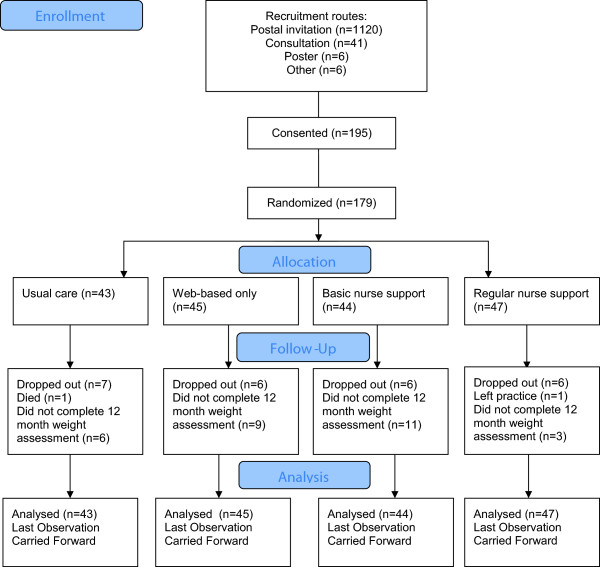
BACKGROUND: There is a need for cost-effective weight management interventions that primary care can deliver to reduce the morbidity caused by obesity. Automated web-based interventions might provide a solution, but evidence suggests that they may be ineffective without additional human support. The main aim of this study was to carry out a feasibility trial of a web-based weight management intervention in primary care, comparing different levels of nurse support, to determine the optimal combination of web-based and personal support to be tested in a full trial. METHODS: This was an individually randomised four arm parallel non-blinded trial, recruiting obese patients in primary care. Following online registration, patients were randomly allocated by the automated intervention to either usual care, the web-based intervention only, or the web-based intervention with either basic nurse support (3 sessions in 3 months) or regular nurse support (7 sessions in 6 months). The main outcome measure (intended as the primary outcome for the main trial) was weight loss in kg at 12 months. As this was a feasibility trial no statistical analyses were carried out, but we present means, confidence intervals and effect sizes for weight loss in each group, uptake and retention, and completion of intervention components and outcome measures. RESULTS: All randomised patients were included in the weight loss analyses (using Last Observation Carried Forward). At 12 months mean weight loss was: usual care group (n = 43) 2.44 kg; web-based only group (n = 45) 2.30 kg; basic nurse support group (n = 44) 4.31 kg; regular nurse support group (n = 47) 2.50 kg. Intervention effect sizes compared with usual care were: d = 0.01 web-based; d = 0.34 basic nurse support; d = 0.02 regular nurse support. Two practices deviated from protocol by providing considerable weight management support to their usual care patients. CONCLUSIONS: This study demonstrated the feasibility of delivering a web-based weight management intervention supported by practice nurses in primary care, and suggests that the combination of the web-based intervention with basic nurse support could provide an effective solution to weight management support in a primary care context. TRIAL REGISTRATION: Current Controlled Trials ISRCTN31685626.
Overview
The claims and statistics of this paper haven’t been checked yet.
Free: it reads the open-access text and checks the first 5 claims that cite a source we can check. Create a free account to check every claim.
Integrity signals
Registry
Cites
Statistics
Figures
Verification
Claims the paper makes
The claims and statistics of this paper haven’t been checked yet.
Free: it reads the open-access text and checks the first 5 claims that cite a source we can check. Create a free account to check every claim.
Claims other papers make about this one
Each is checked against this paper’s own text: does it say what the citing paper says it does?
The source backs part of the claim, not all of it — or backs it for a different population, condition or comparison.
In the citing paper
“interventions that have proven effective in trials involving tens of thousands of users.”
From The Person-Based Approach to Intervention Development: Application to Digital Health-Related Behavior Change Interventions (2015) · cites this paper as [18]
Experimental — accuracy not yet measuredThe source backs part of the claim, not all of it — or backs it for a different population, condition or comparison.
In the citing paper
“Analysis revealed that average website usage, defined as duration of page viewing, was similar across the intervention arms, but extremely variable within groups.”
From A Visualization Tool to Analyse Usage of Web-Based Interventions: The Example of Positive Online Weight Reduction (POWeR) (2015) · cites this paper as [11]
Experimental — accuracy not yet measuredThe cited source says what the claim attributes to it.
In the citing paper
“in our feasibility study of implementing POWeR [18] in a primary care setting, long-term outcomes did indeed prove better for those with only brief nurse support.”
From The Person-Based Approach to Intervention Development: Application to Digital Health-Related Behavior Change Interventions (2015) · cites this paper as [18]
In the citing paper
“The efficacy of the Web-based POWeR intervention and participants’ views of the specific content provided by the Web-based intervention have been the focus of previous qualitative studies [57] and randomized controlled trials within health care [58] and community settings [59].”
From Understanding Usage of a Hybrid Website and Smartphone App for Weight Management: A Mixed-Methods Study (2014) · cites this paper as [58]
In the citing paper
“As reported elsewhere [11], a randomized nonblinded feasibility trial of a Web-based weight management intervention (POWeR) for obese patients in primary care was used to compare 4 parallel groups: usual care, website only, website with basic nurse support, and website with regular nurse support.”
From A Visualization Tool to Analyse Usage of Web-Based Interventions: The Example of Positive Online Weight Reduction (POWeR) (2015) · cites this paper as [11]
4 more claims about this paper
Create a free account to see every claim other papers make about this one.
Self-check
Percentages, sums and reported differences re-computed from the paper’s own numbers.
The self-check needs the paper’s full text.
Citations
Cites
1 retracted
Psychological interventions for overweight or obesity
Shaw, K. A., O'Rourke, P., Del Mar, C., & Kenardy, J. (2005) · Cochrane Database of Systematic Reviews · doi:10.1002/14651858.cd003818.pub2 · Cited by 442 · cited 1×
“Meta-analyses suggest that behavioural weight management interventions, which help people to monitor and regulate their relative dietary intake and energy expenditure, on average result in clinically useful weight loss [3,4].”
BackgroundRetractedThe theory of planned behavior
Ajzen, I. (1991) · Organizational Behavior and Human Decision Processes · doi:10.1016/0749-5978(91)90020-t · Cited by 134,657
EuroQol: a new facility for the measurement of health-related quality of life
(1990) · Health Policy · doi:10.1016/0168-8510(90)90421-9 · Cited by 15,736 · cited 1×
“EQ-5D (Euroqol) [29] 5 items assessing general health-related quality of life, used to generate Quality Adjusted Life Years for cost-effectiveness analyses.”
Method‘Small Changes' to Diet and Physical Activity Behaviors for Weight Management
Hills, A. P., Byrne, N. M., Lindstrom, R., & Hill, J. O. (2013) · Obesity Facts · doi:10.1159/000345030 · Cited by 9,493
A simple method to assess exercise behavior in the community.
Godin, G., & Shephard, R. J. (1985) · PubMed · Cited by 4,760
Finucane, M. M., Stevens, G. A., Cowan, M. J., Danaei, G., Lin, J. K., Paciorek, C. J., Singh, G. M., Gutierrez, H. R., Lu, Y., Bahalim, A. N., et al. (2011) · The Lancet · doi:10.1016/s0140-6736(10)62037-5 · Cited by 4,050 · cited 1×
“Background Obesity is a major threat to public health internationally, and the prevalence has risen sharply in recent decades [1,2].”
BackgroundA tutorial on pilot studies: the what, why and how
Thabane, L., Ma, J., Chu, R., Cheng, J., Ismaila, A., Rios, L. P., Robson, R., Thabane, M., Giangregorio, L., & Goldsmith, C. H. (2010) · BMC Medical Research Methodology · doi:10.1186/1471-2288-10-1 · Cited by 3,384
Danaei, G., Ding, E. L., Mozaffarian, D., Taylor, B., Rehm, J., Murray, C. J. L., & Ezzati, M. (2009) · PLoS Medicine · doi:10.1371/journal.pmed.1000058 · Cited by 2,860 · cited 1×
“Background Obesity is a major threat to public health internationally, and the prevalence has risen sharply in recent decades [1,2].”
BackgroundFuller, N. R., Colagiuri, S., Schofield, D., Olson, A. D., Shrestha, R., Holzapfel, C., Wolfenstetter, S. B., Holle, R., Ahern, A. L., Hauner, H., et al. (2013) · International Journal of Obesity · doi:10.1038/ijo.2012.139 · Cited by 2,117
Using Pedometers to Increase Physical Activity and Improve Health: A Systematic Review
Bravata, D. M., Smith-Spangler, C., Sundaram, V., Gienger, A. L., Lin, N., Lewis, R., Stave, C. D., Olkin, I., & Sirard, J. R. (2007) · JAMA · doi:10.1001/jama.298.19.2296 · Cited by 2,064 · cited 1×
“Patients were also encouraged to increase their physical activity levels by choosing either a walking plan (in which case a pedometer was supplied [21]) or a self-selected mixture of other physical activities.”
BackgroundWhat is a pilot or feasibility study? A review of current practice and editorial policy
Arain, M., Campbell, M. J., Cooper, C. L., & Lancaster, G. A. (2010) · BMC Medical Research Methodology · doi:10.1186/1471-2288-10-67 · Cited by 1,483 · cited 1×
“As this was a feasibility trial to inform the design of a subsequent full trial, our target sample size was around 50 patients per group (which is normal for a dose response study of this kind [20]), which would allow us to estimate: the likely relationship between level of nurse support and change outcome; the variab…”
BackgroundA self-regulation program for maintenance of weight loss
Wing, R. R., Tate, D. F., Gorin, A. A., Raynor, H. A., & Fava, J. L. (2006) · New England Journal of Medicine · doi:10.1056/nejmoa061883 · Cited by 830 · cited 1×
“Face-toface support typically results in better outcomes than purely internet-based support for both weight loss and weight maintenance [11,12].”
BackgroundComparative Effectiveness of Weight-Loss Interventions in Clinical Practice
Appel, L. J., Clark, J. M., Yeh, H.-C., Wang, N.-Y., Coughlin, J. W., Daumit, G., Miller, E. R., Dalcin, A., Jerome, G. J., Geller, S., et al. (2011) · New England Journal of Medicine · doi:10.1056/nejmoa1108660 · Cited by 783 · cited 2×
“When a web-based intervention was supplemented by weekly phone calls for 3 months, followed by monthly phone calls throughout the 24 month study, adding face-to-face group sessions produced very little extra benefit [15].”
BackgroundMethodLevesque, C. S., Williams, G. C., Elliot, D., Pickering, M. A., Bodenhamer, B., & Finley, P. J. (2006) · Health Education Research · doi:10.1093/her/cyl148 · Cited by 663
Howie, J. G., Heaney, D. J., Maxwell, M., & Walker, J. J. (1998) · Family Practice · doi:10.1093/fampra/15.2.165 · Cited by 487 · cited 2×
“Howie JG, Heaney DJ, Maxwell M, Walker JJ: A comparison of a Patient Enablement Instrument (PEI) against two established satisfaction scales as an outcome measure of primary care consultations.”
BackgroundNeve, M., Morgan, P. J., Jones, P. R., & Collins, C. E. (2010) · Obesity Reviews · doi:10.1111/j.1467-789x.2009.00646.x · Cited by 459 · cited 1×
“However, there is huge variability in the outcomes of web-based weight management programmes, with a trend towards better outcomes in programmes with additional personal support [7,8].”
BackgroundTate, D. F., Jackvony, E. H., & Wing, R. R. (2006) · Archives of Internal Medicine · doi:10.1001/archinte.166.15.1620 · Cited by 427
Jolly, K., Lewis, A., Beach, J., Denley, J., Adab, P., Deeks, J. J., Daley, A., & Aveyard, P. (2011) · BMJ · doi:10.1136/bmj.d6500 · Cited by 359 · cited 2×
“Moreover, our sample, although somewhat underrepresenting men and those from ethnic minorities, was not young or highly educated and can be considered broadly typical of the primary care population eligible to take up this intervention if implemented [35].”
BackgroundResultGold, B. C., Burke, S., Pintauro, S., Buzzell, P., & Harvey‐Berino, J. (2007) · Obesity · doi:10.1038/oby.2007.520 · Cited by 212 · cited 1×
“However, studies of providing intensive online in-person counselling to users of an automated website have found that this can also significantly improve outcomes - but note that intensive online counselling is nearly as costly as face-to-face support, thus reducing the cost-effectiveness of the intervention [13,14].”
BackgroundInternet delivered behavioral obesity treatment
Harvey-Berino, J., West, D., Krukowski, R., Prewitt, E., VanBiervliet, A., Ashikaga, T., & Skelly, J. (2010) · Preventive Medicine · doi:10.1016/j.ypmed.2010.04.018 · Cited by 187 · cited 1×
“Face-toface support typically results in better outcomes than purely internet-based support for both weight loss and weight maintenance [11,12].”
BackgroundRothert, K., Strecher, V. J., Doyle, L. A., Caplan, W. M., Joyce, J. S., Jimison, H. B., Karm, L. M., Mims, A. D., & Roth, M. A. (2006) · Obesity · doi:10.1038/oby.2006.34 · Cited by 181 · cited 1×
“With regard to adherence to the intervention, patient completion of online sessions appeared comparable to most web-based weight management interventions, in which attrition is typically high [39], and importantly was better than the attrition rates typically observed in interventions with no health professional conta…”
A review of web-based weight loss interventions in adults
Arem, H., & Irwin, M. (2011) · Obesity Reviews · doi:10.1111/j.1467-789x.2010.00787.x · Cited by 172 · cited 1×
“The weight loss achieved in this group was better than the average weight loss achieved by web-based weight management programmes [34] and was very similar to the best of the six face-toface programmes compared in a UK primary context [35].”
ResultEffect of web-based lifestyle modification on weight control: a meta-analysis
Kodama, S., Saito, K., Tanaka, S., Horikawa, C., Fujiwara, K., Hirasawa, R., Yachi, Y., Iida, K., Shimano, H., Ohashi, Y., et al. (2011) · International Journal of Obesity · doi:10.1038/ijo.2011.121 · Cited by 151 · cited 2×
“However, there is huge variability in the outcomes of web-based weight management programmes, with a trend towards better outcomes in programmes with additional personal support [7,8].”
BackgroundNeve, M. J., Collins, C. E., & Morgan, P. J. (2010) · Journal of Medical Internet Research · doi:10.2196/jmir.1640 · Cited by 137 · cited 1×
“With regard to adherence to the intervention, patient completion of online sessions appeared comparable to most web-based weight management interventions, in which attrition is typically high [39], and importantly was better than the attrition rates typically observed in interventions with no health professional conta…”
Webber, K. H., Tate, D. F., Ward, D. S., & Bowling, J. M. (2010) · Journal of Nutrition Education and Behavior · doi:10.1016/j.jneb.2009.03.001 · Cited by 134 · cited 1×
“The basic nurse support schedule was timed to provide support during the period when autonomous motivation declines most sharply [38], but may have been too limited to foster dependence, or to become onerous.”
BackgroundA new evidence‐based model for weight management in primary care: the Counterweight Programme
The Counterweight Project Team (2004) · Journal of Human Nutrition and Dietetics · doi:10.1111/j.1365-277x.2004.00517.x · Cited by 127
Powell, L. H., Calvin, J. E., & Calvin, J. E. (2007) · American Psychologist · doi:10.1037/0003-066x.62.3.234 · Cited by 125 · cited 2×
“The intervention was developed based on behavioural theory and evidence from existing successful interventions [3,16,24], with extensive iterative qualitative piloting to check usability, accessibility and acceptability and to elicit and respond to user views.”
BackgroundMethodThe Internet for weight control in an obese sample: results of a randomised controlled trial
McConnon, Á., Kirk, S. F., Cockroft, J. E., Harvey, E. L., Greenwood, D. C., Thomas, J. D., Ransley, J. K., & Bojke, L. (2007) · BMC Health Services Research · doi:10.1186/1472-6963-7-206 · Cited by 124 · cited 3×
“The only UK study of Internet-based weight management in a (university) primary care setting observed slightly greater weight loss in the control group, and concluded that this was because no human support was provided [10].”
BackgroundAutonomy support, self-regulation, and weight loss.
Gorin, A. A., Powers, T. A., Koestner, R., Wing, R. R., & Raynor, H. A. (2014) · Health Psychology · doi:10.1037/a0032586 · Cited by 119 · cited 1×
“The intervention was intended to foster self-regulation skills to enable users to autonomously self-manage their weight [22], and drew on cognitive-behavioural techniques [23] to address problems such as motivation and relapse.”
BackgroundComparison of a Food Frequency Questionnaire with a Diet Record
MARGETTS, B. M., CADE, J. E., & OSMOND, C. (1989) · International Journal of Epidemiology · doi:10.1093/ije/18.4.868 · Cited by 111
Self-citationOutcomes of a 12-Month Web-Based Intervention for Overweight and Obese Men
Patrick, K., Calfas, K. J., Norman, G. J., Rosenberg, D., Zabinski, M. F., Sallis, J. F., Rock, C. L., & Dillon, L. W. (2011) · Annals of Behavioral Medicine · doi:10.1007/s12160-011-9296-7 · Cited by 107 · cited 1×
“Some studies of fully automated web-based interventions with no human contact have reported similar weight loss in intervention and control groups, suggesting that some human support may be crucial [9,10].”
BackgroundBishop, F. L., Yardley, L., & Lewith, G. T. (2005) · Complementary Therapies in Medicine · doi:10.1016/j.ctim.2005.01.005 · Cited by 89 · cited 1×
“Therapist perceptions scale [31] 5 items assessing perceptions of the nurse support provider”
BackgroundSelf-citationPhysical Activity and Weight Management Across the Lifespan
Goldberg, J. H., & King, A. C. (2007) · Annual Review of Public Health · doi:10.1146/annurev.publhealth.28.021406.144105 · Cited by 85 · cited 1×
“The intervention was developed based on behavioural theory and evidence from existing successful interventions [3,16,24], with extensive iterative qualitative piloting to check usability, accessibility and acceptability and to elicit and respond to user views.”
MethodGarip, G., & Yardley, L. (2011) · Clinical Obesity · doi:10.1111/j.1758-8111.2011.00021.x · Cited by 79 · cited 1×
“There are indications from the literature that some people given regular support may become dependent on it and find it difficult to maintain motivation independently when it is withdrawn [37], which could explain why the regular nurse support group lost most weight during the period that they had support but then reg…”
BackgroundSelf-citationvan Genugten, L., van Empelen, P., Boon, B., Borsboom, G., Visscher, T., & Oenema, A. (2012) · Journal of Medical Internet Research · doi:10.2196/jmir.1901 · Cited by 74 · cited 1×
“With regard to adherence to the intervention, patient completion of online sessions appeared comparable to most web-based weight management interventions, in which attrition is typically high [39], and importantly was better than the attrition rates typically observed in interventions with no health professional conta…”
What is the most effective way to maintain weight loss in adults?
Simpson, S. A., Shaw, C., & McNamara, R. (2011) · BMJ · doi:10.1136/bmj.d8042 · Cited by 59 · cited 2×
“The 12 month follow-up was selected as the primary outcome because the aim of the programme was to promote sustained weight management, and 12 months is typically regarded as an indicator of maintained weight loss [17].”
BackgroundThe Beck Diet Solution: Train Your Brain to Think Like a Thin Person
Pereira, M. O., & Beck, J. S. (2007) · Cited by 40
Integrating user perspectives into the development of a web‐based weight management intervention
Yardley, L., Williams, S., Bradbury, K., Garip, G., Renouf, S., Ware, L., Dorling, H., Smith, E., & Little, P. (2012) · Clinical Obesity · doi:10.1111/cob.12001 · Cited by 39 · cited 1×
“Further details of the intervention development are given elsewhere (including a complete taxonomy of behaviour change techniques used) [25].”
MethodSelf-citationWeight-reducing diets: Are there any differences?
Foreyt, J. P., Salas-Salvado, J., Caballero, B., Bulló, M., Gifford, K. D., Bautista, I., & Serra-Majem, L. (2009) · Nutrition Reviews · doi:10.1111/j.1753-4887.2009.00169.x · Cited by 32 · cited 1×
“To increase patient motivation we offered a choice of low calorie and low carbohydrate eating plans; since there have been few direct comparisons of these alternative approaches to weight loss [19], we were also interested in patient preferences and outcomes relating to each eating plan.”
BackgroundEffective UK weight management services for adults
McCombie, L., Lean, M., & Haslam, D. B. (2012) · Clinical Obesity · doi:10.1111/j.1758-8111.2012.00049.x · Cited by 19
Self-citationPrimary Care Providers’ Perspectives on Online Weight-Loss Programs: A Big Wish List
Hwang, K. O., Stuckey, H. L., Chen, M. C., Kraschnewski, J. L., Forjuoh, S. N., Poger, J. M., McTigue, K. M., & Sciamanna, C. (2012) · Journal of Medical Internet Research · doi:10.2196/jmir.1955 · Cited by 18
Exploring weight loss services in primary care and staff views on using a web-based programme
Ware, L. J., Williams, S., Bradbury, K., Brant, C., Little, P., Hobbs, F. R., & Yardley, L. (2013) · Journal of Innovation in Health Informatics · doi:10.14236/jhi.v20i4.18 · Cited by 18 · cited 2×
“Automated web-based programmes to support weight management might offer a potential solution [5,6].”
BackgroundSelf-citationPredicting adherence to exercise-based therapy in rehabilitation.
Yardley, L., & Donovan‐Hall, M. (2007) · Rehabilitation Psychology · doi:10.1037/0090-5550.52.1.56 · Cited by 17 · cited 1×
“PETS Adherence Questionnaire [32] 14 items assessing socially acceptable reasons for non-adherence, followed by 3 items asking how much of the time participants had followed the low calorie eating plan, the low carbohydrate eating plan and the physical activity plan”
MethodSelf-citationvan Genugten, G. L., van Empelen, E. P., Boon, B. J. F., Borsboom, G., Visscher, T. L. S., & Oenema, A. (2013) · Deep Blue (University of Michigan) · Cited by 17
Cited by
Yardley, L., Morrison, L., Bradbury, K., & Muller, I. (2015) · Journal of Medical Internet Research · doi:10.2196/jmir.4055 · Cited by 1,442
“We concluded that brief nurse support for our intervention might be preferable to regular nurse support, and in our feasibility study of implementing POWeR [18] in a primary care setting, long-term outcomes did indeed prove better for those with only brief nurse support.”
ResultSelf-citationMa, C., Avenell, A., Bolland, M., Hudson, J., Stewart, F., Robertson, C., Sharma, P., Fraser, C., & MacLennan, G. (2017) · BMJ · doi:10.1136/bmj.j4849 · Cited by 464
Hutchesson, M. J., Rollo, M. E., Krukowski, R., Ells, L., Harvey, J., Morgan, P. J., Callister, R., Plotnikoff, R., & Collins, C. E. (2015) · Obesity Reviews · doi:10.1111/obr.12268 · Cited by 380
“Six of the studies compared an eHealth intervention alone (website n = 5 and mobile application n = 1) to the eHealth intervention combined with face-to-face sessions (53,55,57,59,60,62).”
BackgroundBeleigoli, A. M., Andrade, A. Q., Cançado, A. G., Paulo, M. N., Diniz, M. D. F. H., & Ribeiro, A. L. (2019) · Journal of Medical Internet Research · doi:10.2196/jmir.9609 · Cited by 278
“Absolute weight and BMI changes were reported in 10 [12-15,17-22] and 9 [12-20] studies, respectively.”
InfluentialWadden, T. A., Butryn, M. L., Hong, P. S., & Tsai, A. G. (2014) · JAMA · doi:10.1001/jama.2014.14173 · Cited by 248
Metadata
- Authors
- Yardley, L., Ware, L. J., Smith, E. R., Williams, S., Bradbury, K. J., Arden-Close, E. J., Mullee, M. A., Moore, M. V., Peacock, J. L., Lean, M. E., Margetts, B. M., Byrne, C. D., Hobbs, R. F., & Little, P.
- Affiliations
- University of Southampton (GB)
- North-West University (ZA)
- Bournemouth University (GB)
- King's College London (GB)
- National Institute for Health and Care Research (GB)
- Corresponding author
- Yardley, Lucy
- ORCID
- Venue
- International Journal of Behavioral Nutrition and Physical Activity
- Published
- 2014
- Volume
- 11
- Issue
- 1
- Pages
- 67
- ISSN
- 1479-5868 (ISSN-L)
- PMC
- PMC4045942
- OpenAlex
- W2163775557
- Cited by
- 84
- References
- 44
- Citations by year
- 2026: 2 · 2025: 5 · 2024: 4 · 2023: 3 · 2022: 8 · 2021: 4 · 2020: 4 · 2019: 8 · 2018: 12 · 2017: 12 · 2016: 12 · 2015: 6 · 2014: 4
- FWCI
- 20.47
- Type
- journal article
- Language
- en
- Open access
- gold
- doi.org
- Licence
- cc-by
- Locations
- International Journal of Behavioral Nutrition and Physical Activity (publishedVersion, cc-by)
- PubMed Central (publishedVersion, cc-by)
- PubMed (publishedVersion)
- Research Portal (King's College London) (publishedVersion, other-oa)
- ENLIGHTEN (Jurnal Bimbingan dan Konseling Islam) (acceptedVersion)
- ePrints Soton (University of Southampton) (acceptedVersion)
- Bournemouth University Research Online (Bournemouth University) (submittedVersion)
- Boloka Institutional Repository (North-west University) (submittedVersion)
- Funders
- University Hospital Southampton NHS Foundation Trust
- National Institute for Health and Care Research (PB-PG-0808-17077)
- Economic and Social Research Council (ES/F029624/1)
- Research for Patient Benefit Programme
- Topics
- Health Sciences › Health Professions › General Health Professions › Mobile Health and mHealth Applications
- Health Sciences › Medicine › Public Health, Environmental and Occupational Health › Obesity and Health Practices
- Health Sciences › Medicine › Public Health, Environmental and Occupational Health › Obesity, Physical Activity, Diet
- Keywords
- obesity, weight management, online intervention, nursing support, primary care, weight loss, feasibility, practice nurses, online health interventions
- MeSH terms
- Adult, Aged, Aged, 80 and over, Cost-Benefit Analysis, Feasibility Studies, Female, Follow-Up Studies, Humans, Male, Middle Aged, Nurses, Obesity, Primary Health Care, Treatment Outcome, Internet, Young Adult, Weight Reduction Programs
About these checks
Registry, retraction, Cites and statistics results are computed, not judged, with one exception: a printed reference that no index lists is read once by a model before it counts as a citation error. Claims are extracted by a model and kept only when their quote appears verbatim in the text; each cited source is then checked, with a model’s help, for whether it says what the claim relies on. Those verdicts can be wrong — read the claim’s quote and the cited source before relying on one.
Statistics and arithmetic are recomputed, not judged.
Confidence bands are shown only for fields calibrated on our annotated test set. None is calibrated yet, so no band is shown.
What counts as a claim ›How we measure confidence ›How we check this ›
Are you an author, or do you see a problem with this page? Request a review
Data sources
Bibliographic data: Semantic Scholar, OpenAlex, Crossref.
Contains information from the Semantic Scholar Academic Graph Datasets, made available under the ODC Attribution License (ODC-BY 1.0).
Semantic Scholar’s data is described in: Kinney, R., et al. (2023). The Semantic Scholar Open Data Platform. arXiv:2301.10140.
