

The DOI matches its Crossref record; 76 of the 76 references it cites were found in a registry or an index.
Predicting short-term weight loss using four leading health behavior change theories
Open accessAbstract
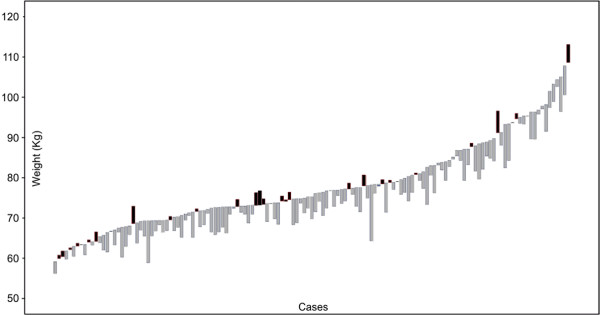
BACKGROUND: This study was conceived to analyze how exercise and weight management psychosocial variables, derived from several health behavior change theories, predict weight change in a short-term intervention. The theories under analysis were the Social Cognitive Theory, the Transtheoretical Model, the Theory of Planned Behavior, and Self-Determination Theory. METHODS: Subjects were 142 overweight and obese women (BMI = 30.2 +/- 3.7 kg/m2; age = 38.3 +/- 5.8 y), participating in a 16-week University-based weight control program. Body weight and a comprehensive psychometric battery were assessed at baseline and at program's end. RESULTS: Weight decreased significantly (-3.6 +/- 3.4%, p < .001) but with great individual variability. Both exercise and weight management psychosocial variables improved during the intervention, with exercise-related variables showing the greatest effect sizes. Weight change was significantly predicted by each of the models under analysis, particularly those including self-efficacy. Bivariate and multivariate analyses results showed that change in variables related to weight management had a stronger predictive power than exercise-specific predictors and that change in weight management self-efficacy was the strongest individual correlate (p < .05). Among exercise predictors, with the exception of self-efficacy, importance/effort and intrinsic motivation towards exercise were the stronger predictors of weight reduction (p < .05). CONCLUSION: The present models were able to predict 20-30% of variance in short-term weight loss and changes in weight management self-efficacy accounted for a large share of the predictive power. As expected from previous studies, exercise variables were only moderately associated with short-term outcomes; they are expected to play a larger explanatory role in longer-term results.
Overview
The claims and statistics of this paper haven’t been checked yet.
Run the check — free, no account needed. It reads the open-access text and checks the sources it cites.
Integrity signals
Registry
Cites
Statistics
Figures
Verification
Claims the paper makes
The claims and statistics of this paper haven’t been checked yet.
Run the check — free, no account needed. It reads the open-access text and checks the sources it cites.
Claims other papers make about this one
Each is checked against this paper’s own text: does it say what the citing paper says it does?
In the citing paper
“Supported by previous research (29,30) , our findings also suggest that baseline self-efficacy appraisals may be overly optimistic and unconnected to practical skills or opportunities to overcome possible obstacles encountered in personal life or at work.”
From Weight loss by mobile phone: a 1-year effectiveness study (2009) · cites this paper as [30]
Self-check
Percentages, sums and reported differences re-computed from the paper’s own numbers.
The self-check needs the paper’s full text.
Citations
Cites
The theory of planned behavior
Ajzen, I. (1991) · Organizational Behavior and Human Decision Processes · doi:10.1016/0749-5978(91)90020-t · Cited by 90,587
Ryan, R. M., & Deci, E. L. (2000) · American Psychologist · doi:10.1037//0003-066x.55.1.68 · Cited by 54,599
Self-efficacy: The exercise of control
Bandura, A., Freeman, W. H., & Lightsey, R. (1999) · Journal of Cognitive Psychotherapy · doi:10.1891/0889-8391.13.2.158 · Cited by 46,835
Self-efficacy: the exercise of control
(1997) · Choice Reviews Online · doi:10.5860/choice.35-1826 · Cited by 24,447
Applied Multiple Regression/Correlation Analysis for the Behavioral Sciences
Cohen, P., Cohen, P., West, S. G., & Aiken, L. S. (2014) · Psychology Press eBooks · doi:10.4324/9781410606266 · Cited by 20,852
Social Cognitive Theory: An Agentic Perspective
Bandura, A. (2001) · Annual Review of Psychology · doi:10.1146/annurev.psych.52.1.1 · Cited by 15,510
Efficacy of the Theory of Planned Behaviour: A meta‐analytic review
Armitage, C. J., & Conner, M. (2001) · British Journal of Social Psychology · doi:10.1348/014466601164939 · Cited by 9,970
‘Small Changes' to Diet and Physical Activity Behaviors for Weight Management
Hills, A. P., Byrne, N. M., Lindstrom, R. C., & Hill, J. O. (2013) · Obesity Facts · doi:10.1159/000345030 · Cited by 9,526
The Transtheoretical Model of Health Behavior Change.
Prochaska, J. O., & Velicer, W. F. (1997) · American Journal of Health Promotion · doi:10.4278/0890-1171-12.1.38 · Cited by 7,782
Genetics of Food Intake Self-Regulation in Childhood: Literature Review and Research Opportunities
Faith, M. S., Carnell, S., & Kral, T. V. E. (2013) · Human Heredity · doi:10.1159/000353879 · Cited by 7,633
Cited by
Sorted by citations
Items 101–168 of 168
Nezami, B. T., Valle, C. G., Wasser, H., Hurley, L., Hatley, K. E., & Tate, D. F. (2025) · Contemporary Clinical Trials · doi:10.1016/j.cct.2025.107808 · Cited by 5
Sorkin, D. H., Rook, K. S., Campos, B., Marquez, B., Solares, J., Mukamel, D. B., Marcus, B. H., Kilgore, D. B., Dow, E., Ngo‐Metzger, Q., et al. (2018) · Contemporary Clinical Trials · doi:10.1016/j.cct.2018.03.013 · Cited by 5
Martin, S. N., Heo, M., Jimenez, C. C., Lim, J. L., Lounsbury, D. W., Fredericks, L., Bouchard, M., Herrera, T., Sosa, A., & Wylie‐Rosett, J. (2019) · Child and Adolescent Obesity · doi:10.1080/2574254x.2019.1651169 · Cited by 5
Hajizadeh, H., Azar, P. S., Nadrian, H., Bajestani, F. S., Kolahi, S., & Gupta, K. (2021) · Health Promotion Perspectives · doi:10.34172/hpp.2021.57 · Cited by 5
The Biggest Loser Thinks Long-Term: Recency as a Predictor of Success in Weight Management
Koritzky, G., Rice, C., Dieterle, C., & Bechara, A. (2015) · Frontiers in Psychology · doi:10.3389/fpsyg.2015.01864 · Cited by 5
MODELO TRANSCONTEXTUAL DE LA MOTIVACIÓN EN LA PREDICCIÓN DE ESTILOS DE VIDA SALUDABLES
Batista, M., Román, M. L., Lobato, S., & Castuera, R. J. (2019) · Revista Internacional de Medicina y Ciencias de la Actividad Física y del Deporte · doi:10.15366/rimcafd2019.75.006 · Cited by 5
Marentes-Castillo, M., Castillo, I., Tomás-Marco, I., Zamarripa, J., & Álvarez, O. (2022) · Anales de Psicología · doi:10.6018/analesps.502421 · Cited by 7
Comșa, L. T., David, D., & David, D. O. (2022) · Journal of Rational-Emotive & Cognitive-Behavior Therapy · doi:10.1007/s10942-022-00455-1 · Cited by 7
Macdonald, T., Shepherd, C., Rickard, K. M., Hogan, A., Berscheid, J., & Drennen, A. R. (2013) · PsycEXTRA Dataset · doi:10.1037/e546872013-037 · Cited by 4
Bui, A. L., Moscoso‐Porras, M., Bernabé‐Ortiz, A., Checkley, W., Gilman, R. H., Smeeth, L. L., & Miranda, J. J. (2019) · BMC Obesity · doi:10.1186/s40608-019-0229-5 · Cited by 3
Roberts, S. B., Anton, S. D., & Dao, M. C. (2022) · Handbook of experimental pharmacology · doi:10.1007/164_2022_580 · Cited by 3
Determinants of Bone Mineral Screening Behavior among Three Ethno-Cultural Groups of Women in Israel
Edelstein, O. E., Achdut, N., Vered, I., & Sarid, O. (2020) · International Journal of Environmental Research and Public Health · doi:10.3390/ijerph17176138 · Cited by 4
Chung, L. M. Y., Fong, S. S. M., Law, Q. P. S., W., A. W., Chow, L. P. Y., & Chung, J. W. Y. (2015) · Journal of Telemedicine and Telecare · doi:10.1177/1357633x15595557 · Cited by 4
Sarge, M. A., & Knobloch‐Westerwick, S. (2017) · Journal of Communications In Healthcare · doi:10.1080/17538068.2017.1327128 · Cited by 3
Wou, C., Šilarova, B., Griffin, S. J., & Usher‐Smith, J. A. (2018) · Public Health · doi:10.1016/j.puhe.2018.09.006 · Cited by 3
Ghannadiasl, F., Mahdavi, R., & Jafarabadi, M. A. (2016) · Jundishapur Journal of Health Sciences · doi:10.5812/jjhs-42088 · Cited by 2
An integrated model for evaluating the effectiveness of cognitive-behavioral treatment of obesity
Malkina-Pykh, I. G. (2013) · Health Policy and Technology · doi:10.1016/j.hlpt.2013.03.003 · Cited by 2
Ghannadiasl, F., Mahdavi, R., & Jafarabadi, M. A. (2016) · Jundishapur Journal of Health Sciences · doi:10.17795/jjhs-42088 · Cited by 2
Hajizadeh, H., Nadrian, H., Farrin, N., Jafarabadi, M. A., Hezaveh, S. J. G., Kolahi, S., Azar, P. S., & Brennan-Olsen, S. L. (2019) · Health Care For Women International · doi:10.1080/07399332.2019.1640700 · Cited by 2
Thin, A. G., & Gotsis, M. (2013) · Lecture notes in computer science · doi:10.1007/978-3-642-39241-2_52 · Cited by 2
THE RELATIONSHIP OF SELF-EFFICACY AND WEIGHT LOSS MAINTENANCE IN POST-OPERATIVE BARIATRIC PATIENTS
McAllen, P. A. B. (2009) · OhioLink ETD Center (Ohio Library and Information Network) · Cited by 2
Effect of the Rehabilitation Setting on Motivation and Clinical Outcomes Post Stroke - a Pilot Study
Thompson, S. G. (2012) · Otago University Research Archive (University of Otago) · Cited by 2
Transtheoretical Model of Change
Craig, S. L., & D’Souza, S. A. (2018) · Oxford University Press eBooks · doi:10.1093/obo/9780195389678-0268 · Cited by 3
THE EFFECT OF A MUSIC EXERCISE AND HEALTHY EATING HABITS PROGRAM ON CHILDREN'S WEIGHT LOSS
Mori-Inoue, S. (2010) · Cited by 1
Cabrera, J. L., Wilks, E. G., Symons, J. E., Blankson, K. L., & Cole, R. E. (2012) · Military Medicine · doi:10.7205/milmed-d-11-00334 · Cited by 1
INVESTIGATING THE RELATIONSHIP BETWEEN LEARNING STYLE AND SUCCESSFUL WEIGHT MANAGEMENT STRATEGIES
Halas, G. (2008) · Cited by 1
Agreement between self-perception of body image and nutritional status in a Chilean population
Caro, P., Vidal, C., Jara, C. C., & Olivares-Keller, D. (2022) · Nutrición Hospitalaria · doi:10.20960/nh.04073 · Cited by 1
Merth, T. D. N. (2011) · Summit (Simon Fraser University) · Cited by 1
Mahdavi, R., Ghannadiasl, F., & Jafarabadi, M. A. (2016) · Iranian Red Crescent Medical Journal · doi:10.5812/ircmj.24390 · Cited by 1
Batista, M., Román, M. L., Lobato, S., & Jiménez‐Castuera, R. (2019) · Ágora/Ágora para la educación física y el deporte · doi:10.24197/aefd.0.2019.22-51 · Cited by 1
Formative evaluation of intervention methods designed to improve behavior change strategies
Nelson, E. M. (2014) · doi:10.31274/etd-180810-3769 · Cited by 1
Verigin, T. (2015) · NORA - Norwegian Open Research Archives · Cited by 1
EXAMINING THE EFFECTIVENESS OF BEHAVIORAL WEIGHT LOSS INTERVENTIONS AMONG AFRICAN AMERICAN WOMEN
Carr, L. T. B. (2017) · Cited by 1
INCREASING LONG TERM WEIGHT LOSS SUCCESS: AN INDIVIDUALIZED, HOLISTIC, SELF-CARE MODEL
Lane, A. D. (2014) · CSUSB ScholarWorks (California State University, San Bernardino)
Evaluating the efficacy of Internet based motivational interviewing group treatment for weight loss
Webber, K. (2019) · Carolina Digital Repository (University of North Carolina at Chapel Hill) · doi:10.17615/0t4z-8k13
Escajeda, J. (2015) · Arizona State University Library Digital Repository (Arizona State University)
Nijamkin, M. P. (2010) · FIU - Digital Commons (Florida International University) · doi:10.25148/etd.fi10112003
Cahill, J. M. (2009) · Texas ScholarWorks (Texas Digital Library)
Personality and social functioning to achieve a pre-determined weight loss target
Purcell, K., Sumithran, P., Prendergast, L. A., Bouniu, C. J., Delbridge, E., & Proietto, J. (2013) · Obesity Research & Clinical Practice · doi:10.1016/j.orcp.2013.12.573
Overweight, Obesity, and Mental Illnesses: Weight Loss Treatment
Huang, M. (2012) · Digital Commons - PCOM (Philadelphia College of Osteopathic Medicine)
Aguirre, T. M., Wilhelm, S. L., & Koehler, A. E. (2013) · Journal of Integrative Psychology and Therapeutics · doi:10.7243/2054-4723-1-1
Understanding Lifestyle-Related Psychosocial Processes After Prostate Cancer Diagnosis
Kassianos, A. P. (2013) · Surrey Research Insight Open Access (The University of Surrey)
Inna, M. (2015) · University Library - University of Saskatchewan (University of Saskatchewan)
Vargo, K. E. (2015) · FIU - Digital Commons (Florida International University) · doi:10.25148/etd.fidc000181
Dampak Pengeluaran Pemerintah Terhadap Pertumbuhan Dan Distribusi Pendapatan Di Sumatera Utara
Rahmanta, R. (2007) · UPT. Syiah Kuala University Library (Syiah Kuala University)
Palmeira, A. L., Teixeira, P. J., Silva, M. N., Markland, D. A., Branco, T. L., Martins, S., Minderico, C. S., Serpa, S., & Sardinha, L. B. (2008) · Portuguese National Funding Agency for Science, Research and Technology (RCAAP Project by FCT)
Self-citationLehmann, J. (2011) · Arizona State University Library Digital Repository (Arizona State University)
Commitment to Health Theory: A Graphic Model
Kelly, C. W. (2014) · Workplace Health & Safety · doi:10.1177/216507991406200202
iPhone Applications and Improvement in Weight and Health Parameters: A Randomized Controlled Trial
Thompson‐Felty, C. (2014)
Dyadic Processes in Weight Management
Cornelius, T. M. (2017) · OpenCommons - UConn (University of Connecticut)
Crane, M. M. (2019) · Carolina Digital Repository (University of North Carolina at Chapel Hill) · doi:10.17615/828s-0h30
(2017) · International Journal of Science and Research (IJSR) · doi:10.21275/art20175801
(2018) · Journal of Holistic Performance · doi:10.26712/012018
Mechanisms of change in cognitive-behavioral therapy for weight loss
Comșa, L. T., & David, D. (2023) · Elsevier eBooks · doi:10.1016/b978-0-323-85726-0.00044-2
Steffens, R. F. (2013) · UKnowledge (University of Kentucky)
Motivation for weight management behaviours : a self-determination theory perspective
Ng, Y. Y. J. (2013) · University of Birmingham Institutional Research Archive (University of Birmingham)
Liao, L. P., Murphy, B. M., Gan, G. C. H., Thomas, L., Fontana, L., McKinn, S., & Zaman, S. J. (2026) · Nutrients · doi:10.3390/nu18121857
Mapping of Eating Self-Efficacy Scales: A Scoping Review
de Andrade, R., da Silva, T. L., Figueiredo, N. R., & Feóli, A. M. P. (2026) · Nutrition Reviews · doi:10.1093/nutrit/nuag068
Psychological Determinants of the Weight Cycle: A Review of Perceived Stress and Self-Efficacy
Yıldırım, E. D., & Yıldırım, İ. G. (2026) · Current Obesity Reports · doi:10.1007/s13679-026-00739-y
Zhao, B., Wu, Q., 曹梅娟, Xue, E., Zhou, Y., & Shao, J. (2026) · International Journal of Nursing Studies · doi:10.1016/j.ijnurstu.2026.105717
Metadata
- Authors
- Palmeira, A. L., Teixeira, P. J., Branco, T. L., Martins, S. S., Minderico, C. S., Barata, J. T., Serpa, S. O., & Sardinha, L. B.
- Affiliations
- Universidade Técnica de Lisboa (PT)
- Corresponding author
- Palmeira, António L
- ORCID
- Venue
- International Journal of Behavioral Nutrition and Physical Activity
- Published
- 2007
- Volume
- 4
- Issue
- 1
- Pages
- 14
- ISSN
- 1479-5868 (ISSN-L)
- PMC
- PMC1868036
- OpenAlex
- W1978888299
- Cited by
- 167
- References
- 75
- Citations by year
- 2026: 5 · 2025: 1 · 2023: 2 · 2022: 9 · 2021: 6 · 2020: 8 · 2019: 12 · 2018: 7 · 2017: 11 · 2016: 12 · 2015: 14 · 2014: 10 · 2013: 16 · 2012: 15
- FWCI
- 13.67
- Type
- journal article
- Language
- en
- Open access
- gold
- doi.org
- Licence
- cc-by
- Locations
- International Journal of Behavioral Nutrition and Physical Activity (publishedVersion, cc-by)
- PubMed Central (publishedVersion, cc-by)
- PubMed (publishedVersion)
- DOAJ (DOAJ: Directory of Open Access Journals) (submittedVersion)
- Funders
- Fundação para a Ciência e a Tecnologia
- Topics
- Social Sciences › Psychology › Applied Psychology › Behavioral Health and Interventions
- Health Sciences › Medicine › Public Health, Environmental and Occupational Health › Obesity, Physical Activity, Diet
- Health Sciences › Medicine › Public Health, Environmental and Occupational Health › Physical Activity and Health
- Keywords
- weight loss prediction, health behavior change theories, social cognitive theory, transtheoretical model, theory of planned behavior, self-determination theory, exercise self-efficacy, intrinsic motivation, weight management interventions
About these checks
Registry, retraction, Cites and statistics results are computed, not judged, with one exception: a printed reference that no index lists is read once by a model before it counts as a citation error. Claims are extracted by a model and kept only when their quote appears verbatim in the text; each cited source is then checked, with a model’s help, for whether it says what the claim relies on. Those verdicts can be wrong — read the claim’s quote and the cited source before relying on one.
Statistics and arithmetic are recomputed, not judged.
Confidence bands are shown only for fields calibrated on our annotated test set. None is calibrated yet, so no band is shown.
What counts as a claim ›How we measure confidence ›How we check this ›
Are you an author, or do you see a problem with this page? Request a review
