

The DOI matches its Crossref record; 76 of the 76 references it cites were found in a registry or an index.
Predicting short-term weight loss using four leading health behavior change theories
Open accessAbstract
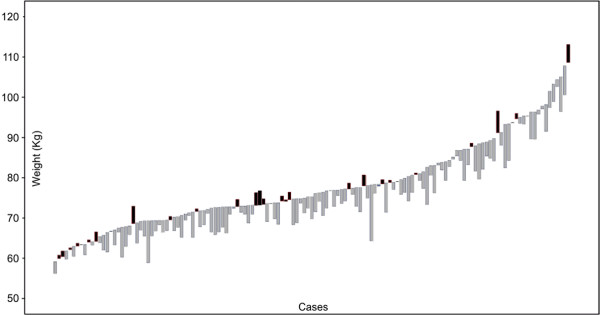
BACKGROUND: This study was conceived to analyze how exercise and weight management psychosocial variables, derived from several health behavior change theories, predict weight change in a short-term intervention. The theories under analysis were the Social Cognitive Theory, the Transtheoretical Model, the Theory of Planned Behavior, and Self-Determination Theory. METHODS: Subjects were 142 overweight and obese women (BMI = 30.2 +/- 3.7 kg/m2; age = 38.3 +/- 5.8 y), participating in a 16-week University-based weight control program. Body weight and a comprehensive psychometric battery were assessed at baseline and at program's end. RESULTS: Weight decreased significantly (-3.6 +/- 3.4%, p < .001) but with great individual variability. Both exercise and weight management psychosocial variables improved during the intervention, with exercise-related variables showing the greatest effect sizes. Weight change was significantly predicted by each of the models under analysis, particularly those including self-efficacy. Bivariate and multivariate analyses results showed that change in variables related to weight management had a stronger predictive power than exercise-specific predictors and that change in weight management self-efficacy was the strongest individual correlate (p < .05). Among exercise predictors, with the exception of self-efficacy, importance/effort and intrinsic motivation towards exercise were the stronger predictors of weight reduction (p < .05). CONCLUSION: The present models were able to predict 20-30% of variance in short-term weight loss and changes in weight management self-efficacy accounted for a large share of the predictive power. As expected from previous studies, exercise variables were only moderately associated with short-term outcomes; they are expected to play a larger explanatory role in longer-term results.
Overview
The claims and statistics of this paper haven’t been checked yet.
Run the check — free, no account needed. It reads the open-access text and checks the sources it cites.
Integrity signals
Registry
Cites
Statistics
Figures
Verification
Claims the paper makes
The claims and statistics of this paper haven’t been checked yet.
Run the check — free, no account needed. It reads the open-access text and checks the sources it cites.
Claims other papers make about this one
Each is checked against this paper’s own text: does it say what the citing paper says it does?
In the citing paper
“Supported by previous research (29,30) , our findings also suggest that baseline self-efficacy appraisals may be overly optimistic and unconnected to practical skills or opportunities to overcome possible obstacles encountered in personal life or at work.”
From Weight loss by mobile phone: a 1-year effectiveness study (2009) · cites this paper as [30]
Self-check
Percentages, sums and reported differences re-computed from the paper’s own numbers.
The self-check needs the paper’s full text.
Citations
Cites
The theory of planned behavior
Ajzen, I. (1991) · Organizational Behavior and Human Decision Processes · doi:10.1016/0749-5978(91)90020-t · Cited by 90,587
Ryan, R. M., & Deci, E. L. (2000) · American Psychologist · doi:10.1037//0003-066x.55.1.68 · Cited by 54,599
Self-efficacy: The exercise of control
Bandura, A., Freeman, W. H., & Lightsey, R. (1999) · Journal of Cognitive Psychotherapy · doi:10.1891/0889-8391.13.2.158 · Cited by 46,835
Self-efficacy: the exercise of control
(1997) · Choice Reviews Online · doi:10.5860/choice.35-1826 · Cited by 24,447
Applied Multiple Regression/Correlation Analysis for the Behavioral Sciences
Cohen, P., Cohen, P., West, S. G., & Aiken, L. S. (2014) · Psychology Press eBooks · doi:10.4324/9781410606266 · Cited by 20,852
Social Cognitive Theory: An Agentic Perspective
Bandura, A. (2001) · Annual Review of Psychology · doi:10.1146/annurev.psych.52.1.1 · Cited by 15,510
Efficacy of the Theory of Planned Behaviour: A meta‐analytic review
Armitage, C. J., & Conner, M. (2001) · British Journal of Social Psychology · doi:10.1348/014466601164939 · Cited by 9,970
‘Small Changes' to Diet and Physical Activity Behaviors for Weight Management
Hills, A. P., Byrne, N. M., Lindstrom, R. C., & Hill, J. O. (2013) · Obesity Facts · doi:10.1159/000345030 · Cited by 9,526
The Transtheoretical Model of Health Behavior Change.
Prochaska, J. O., & Velicer, W. F. (1997) · American Journal of Health Promotion · doi:10.4278/0890-1171-12.1.38 · Cited by 7,782
Genetics of Food Intake Self-Regulation in Childhood: Literature Review and Research Opportunities
Faith, M. S., Carnell, S., & Kral, T. V. E. (2013) · Human Heredity · doi:10.1159/000353879 · Cited by 7,633
Well-being : the foundations of hedonic psychology
Kahneman, D. J., Diener, E. F., & Schwarz, N. (1999) · Cited by 7,472
The Theory of Planned Behavior
Ajzen, I. (2012) · SAGE Publications Ltd eBooks · doi:10.4135/9781446249215.n22 · Cited by 5,514
Implementation intentions: Strong effects of simple plans.
Gollwitzer, P. M. (1999) · American Psychologist · doi:10.1037/0003-066x.54.7.493 · Cited by 5,478
Applied Multiple Regression/Correlation Analysis for the Behavioral Sciences.
Tufte, E. R., Cohen, J., & Cohen, P. (1979) · Journal of the American Statistical Association · doi:10.2307/2286442 · Cited by 5,214
Prevalence of overweight and obesity among US children, adolescents, and adults, 1999-2002.
Hedley, A. A., Ogden, C., Johnson, C. L., Carroll, M., Curtin, L. R., & Flegal, K. (2004) · Journal of the American Medical Association (JAMA) · doi:10.1001/jama.291.23.2847 · Cited by 4,670
Applied Multiple Regression/Correlation Analysis for the Behavioral Sciences.
Fong, G. T., Cohen, J., & Cohen, P. R. (1985) · Journal of the American Statistical Association · doi:10.2307/2287930 · Cited by 4,609
Moral Identity and Developmental Theory
Lapsley, D. K. (2015) · Human Development · doi:10.1159/000435926 · Cited by 3,843
Health promotion from the perspective of Social Cognitive Theory
Bandura, A. (1998) · Psychology & Health · doi:10.1080/08870449808407422 · Cited by 3,087
(1998) · American Journal of Clinical Nutrition · doi:10.1093/ajcn/68.4.899 · Cited by 2,719
McAuley, E., Duncan, T., & Tammen, V. V. (1989) · Research Quarterly for Exercise and Sport · doi:10.1080/02701367.1989.10607413 · Cited by 2,694
Mediators and Moderators of Treatment Effects in Randomized Clinical Trials
Kraemer, H. C., Wilson, G. T., Fairburn, C. G., & Agras, W. S. (2002) · Archives of General Psychiatry · doi:10.1001/archpsyc.59.10.877 · Cited by 2,562
Prevalence of obesity in the United States, 2009-2010.
Ogden, C. L., Carroll, M. D., Kit, B. K., & Flegal, K. M. (2012) · PubMed · Cited by 2,057
Motivational predictors of weight loss and weight-loss maintenance.
Williams, G. C., Grow, V. M., Freedman, Z. R., Ryan, R. M., & Deci, E. L. (1996) · Journal of Personality and Social Psychology · doi:10.1037//0022-3514.70.1.115 · Cited by 1,610
The development of scales to measure social support for diet and exercise behaviors
Sallis, J. F., Grossman, R. M., Pinski, R. B., Patterson, T. L., & Nader, P. R. (1987) · Preventive Medicine · doi:10.1016/0091-7435(87)90022-3 · Cited by 1,534
vernersson, I. (2000) · Cited by 1,481
(2020) · Wiley eBooks · doi:10.1002/9781119568124 · Cited by 1,279
Predicting health behaviour : research and practice with social cognition models
Conner, M. T., & Norman, P. (2005) · Cited by 1,248
A descriptive study of individuals successful at long-term maintenance of substantial weight loss
Klem, M., Wing, R., McGuire, M., Seagle, H., & Hill, J. (1997) · The American Journal of Clinical Nutrition · doi:10.1093/ajcn/66.2.239 · Cited by 1,060
Intrinsic motivation and exercise adherence.
Ryan, R. M., Frederick, C. M., Lepes, D., Rubio, N., & Sheldon, K. M. (1997) · International journal of sport psychology · Cited by 976
The development of self-efficacy scales for healthrelated diet and exercise behaviors
Sallis, J. F., Pinski, R. B., Grossman, R. M., Patterson, T. L., & Nader, P. R. (1988) · Health Education Research · doi:10.1093/her/3.3.283 · Cited by 826
Are Current Health Behavioral Change Models Helpful in Guiding Prevention of Weight Gain Efforts?
Baranowski, T., Cullen, K. W., Nicklas, T. A., Thompson, D., & Baranowski, J. C. (2003) · Obesity Research · doi:10.1038/oby.2003.222 · Cited by 750
Physical activity and determinants of physical activity in obese and non-obese children
Trost, S. G., Kerr, L., Ward, D. S., & Pate, R. R. (2001) · International Journal of Obesity · doi:10.1038/sj.ijo.0801621 · Cited by 740
The theory of planned behaviour and health behaviours.
Conner, M. T., & SPARKS, P. B. (1996) · Open University Press eBooks · Cited by 719
Self-efficacy in weight management.
Clark, M. M., Abrams, D. B., NIAURA, R. S., Eaton, C. A., & al, E. (1991) · Journal of Consulting and Clinical Psychology · doi:10.1037/0022-006x.59.5.739 · Cited by 693
Marshall, S. J., & Biddle, S. (2001) · Annals of Behavioral Medicine · doi:10.1207/s15324796abm2304_2 · Cited by 691
Schwartz, M. B., & Brownell, K. D. (2004) · Body Image · doi:10.1016/s1740-1445(03)00007-x · Cited by 637
Obesity: Responding to the global epidemic.
Wadden, T. A., Brownell, K. D., & Foster, G. D. (2002) · Journal of Consulting and Clinical Psychology · doi:10.1037//0022-006x.70.3.510 · Cited by 615
The Behavioral Determinants of Exercise: Implications for Physical Activity Interventions
Sherwood, N. E., & Jeffery, R. W. (2000) · Annual Review of Nutrition · doi:10.1146/annurev.nutr.20.1.21 · Cited by 606
The theory of planned behavior and healthy eating
Conner, M., Norman, P., & Bell, R. (2002) · Health Psychology · doi:10.1037/0278-6133.21.2.194 · Cited by 584
Goodwin, S. (2002) · Clinical Nurse Specialist · doi:10.1097/00002800-200205000-00016 · Cited by 561
Efficacy of Lifestyle Modification for Long‐Term Weight Control
Wadden, T. A., Butryn, M. L., & Byrne, K. J. (2004) · Obesity Research · doi:10.1038/oby.2004.282 · Cited by 511
Brug, J., Oenema, A., & Ferreira, I. (2005) · International Journal of Behavioral Nutrition and Physical Activity · doi:10.1186/1479-5868-2-2 · Cited by 464
Foster, G. D., Wadden, T. A., Vogt, R. A., & Brewer, G. (1997) · Journal of Consulting and Clinical Psychology · doi:10.1037//0022-006x.65.1.79 · Cited by 460
A review of psychosocial pre‐treatment predictors of weight control
Teixeira, P. J., Going, S. B., Sardinha, L. B., & Lohman, T. G. (2005) · Obesity Reviews · doi:10.1111/j.1467-789x.2005.00166.x · Cited by 449
Self-citationFoster, G. D., Wadden, T. A., Vogt, R. A., & Brewer, G. (1997) · Journal of Consulting and Clinical Psychology · doi:10.1037/0022-006x.65.1.79 · Cited by 447
PSYCHOSOCIAL CORRELATES OF DIETARY INTAKE: Advancing Dietary Intervention
Baranowski, T., Cullen, K. W., & Baranowski, J. (1999) · Annual Review of Nutrition · doi:10.1146/annurev.nutr.19.1.17 · Cited by 426
Prevalence of obesity in the United States
Baskin, M. L., Ard, J. D., Franklin, F. A., & Allison, D. B. (2005) · Obesity Reviews · doi:10.1111/j.1467-789x.2005.00165.x · Cited by 410
Prevalence of obesity in Great Britain
Rennie, K. L., & Jebb, S. A. (2005) · Obesity Reviews · doi:10.1111/j.1467-789x.2005.00164.x · Cited by 397
Rothman, A. J. (2004) · International Journal of Behavioral Nutrition and Physical Activity · doi:10.1186/1479-5868-1-11 · Cited by 322
Closing the Knowledge-Behavior Gap in Health Promotion: The Mediating Role of Self-Efficacy
Rimal, R. N. (2000) · Health Communication · doi:10.1207/s15327027hc1203_01 · Cited by 313
The use of implementation intentions and the decision balance sheet in promoting exercise behaviour
Prestwich, A., Lawton, R., & Conner, M. T. (2003) · Psychology and Health · doi:10.1080/08870440310001594493 · Cited by 245
Self-motivation and adherence to therapeutic exercise
Dishman, R. K., & Ickes, W. J. (1981) · Journal of Behavioral Medicine · doi:10.1007/bf00846151 · Cited by 241
Using goal setting as a strategy for dietary behavior change
Cullen, K. W., Baranowski, T., & SMITH, S. P. (2001) · Journal of the American Dietetic Association · doi:10.1016/s0002-8223(01)00140-7 · Cited by 233
Weight control self-efficacy types and transitions affect weight-loss outcomes in obese women
Dennis, K. E., & Goldberg, A. P. (1996) · Addictive Behaviors · doi:10.1016/0306-4603(95)00042-9 · Cited by 201
Exercise Motivation, Eating, and Body Image Variables as Predictors of Weight Control
TEIXEIRA, P. J., GOING, S. B., HOUTKOOPER, L. B., CUSSLER, E. C., METCALFE, L. L., BLEW, R. M., SARDINHA, L. B., & LOHMAN, T. G. (2006) · Medicine & Science in Sports & Exercise · doi:10.1249/01.mss.0000180906.10445.8d · Cited by 200
Self-citationReliability and Validity of Expected Outcomes and Barriers for Habitual Physical Activity
Steinhardt, M. A., & Dishman, R. K. (1989) · Journal of Occupational and Environmental Medicine · doi:10.1097/00043764-198906000-00011 · Cited by 194
Self-determination, smoking, diet and health
Williams, G. C. (2002) · Health Education Research · doi:10.1093/her/17.5.512 · Cited by 172
Interpretations of healthy and unhealthy eating, and implications for dietary change
Povey, R. C., Conner, M. T., SPARKS, P. B., James, R., & Shepherd, R. (1998) · Health Education Research · doi:10.1093/her/13.2.171 · Cited by 159
Teixeira, P. J., Going, S. B., HOUTKOOPER, L. B., CUSSLER, E. C., Martin, C. J., METCALFE, L. L., Finkenthal, N. R., Blew, R. M., Sardinha, L. B., & Lohman, T. G. (2002) · Journal of Behavioral Medicine · doi:10.1023/a:1020687832448 · Cited by 158
Self-citationRelationship of physical activity to eating behaviors and weight loss in women
Jakicic, J. M., Wing, R. R., & Winters, C. (2002) · Medicine & Science in Sports & Exercise · doi:10.1097/00005768-200210000-00018 · Cited by 128
Courneya, K. S., & Bobick, T. M. (2000) · Psychology of sport and exercise · doi:10.1016/s1469-0292(00)00006-6 · Cited by 127
Self‐Efficacy as a Predictor of Weight Change in African‐American Women
Martin, P. D., Dutton, G. R., & Brantley, P. J. (2004) · Obesity Research · doi:10.1038/oby.2004.74 · Cited by 124
Who will lose weight? A reexamination of predictors of weight loss in women
Teixeira, P. J., Palmeira, A. L., Branco, T. L., Martins, S. S., Minderico, C. S., Themudo-Barata, J. L., Silva, A. M., & Sardinha, L. B. (2004) · International Journal of Behavioral Nutrition and Physical Activity · doi:10.1186/1479-5868-1-12 · Cited by 124
Self-citationExercise and the maintenance of weight loss: 1-year follow-up of a controlled clinical trial.
Wadden, T. A., Vogt, R. A., Foster, G. D., & Anderson, D. A. (1998) · Journal of Consulting and Clinical Psychology · doi:10.1037/0022-006x.66.2.429 · Cited by 119
Exercise and the maintenance of weight loss: 1-year follow-up of a controlled clinical trial.
Wadden, T. A., Vogt, R. A., Foster, G. D., & Anderson, D. A. (1998) · Journal of Consulting and Clinical Psychology · doi:10.1037//0022-006x.66.2.429 · Cited by 119
Jones, L. W., Sinclair, R. C., Rhodes, R. E., & Courneya, K. S. (2004) · British Journal of Health Psychology · doi:10.1348/1359107042304605 · Cited by 108
Self-efficacy, attendance, and weight loss in obesity treatment
Fontaine, K. R., & Cheskin, L. J. (1997) · Addictive Behaviors · doi:10.1016/s0306-4603(96)00068-8 · Cited by 94
How can Health Behavior Theory be made more useful for intervention research?
Jeffery, R. W. (2004) · International Journal of Behavioral Nutrition and Physical Activity · doi:10.1186/1479-5868-1-10 · Cited by 84
Rose, E. A., Parfitt, G., & Williams, S. (2004) · Psychology of sport and exercise · doi:10.1016/j.psychsport.2004.07.002 · Cited by 68
Application of the transtheoretical model of behavior change for obesity in mexican american women
Surís, A., Trapp, M. D. C., DiClemente, C. C., & Cousins, J. (1998) · Addictive Behaviors · doi:10.1016/s0306-4603(98)00012-4 · Cited by 41
Stage of change as a predictor of success in weight control in adult women.
Jeffery, R. W., French, S. A., & Rothman, A. J. (1999) · Health Psychology · doi:10.1037//0278-6133.18.5.543 · Cited by 37
Lifestyle Modification in the Management of Obesity
Wadden, T. A., McGuckin, B. G., Rothman, R. A., & Sargent, S. L. (2003) · Journal of Gastrointestinal Surgery · doi:10.1016/s1091-255x(03)00048-9 · Cited by 36
Fonseca, A. M., & Brito, A. D. P. (2012) · Análise Psicológica · doi:10.14417/ap.344 · Cited by 28
Recent body-weight changes and weight loss practices in the European Union
Lappalainen, R. I., Tuomisto, M. T., Giachetti, I., D’Amicis, A., & Paquet, S. (1999) · Public Health Nutrition · doi:10.1017/s136898009900018x · Cited by 23
Exercise Motivation, Eating, and Body Image Variables as Predictors of Weight Control
Shephard, R. J. (2006) · Yearbook of Sports Medicine · doi:10.1016/s0162-0908(08)70378-7 · Cited by 13
THE RELIABILITY AND VALIDITY OF EXPECTED OUTCOMES AND BARRIERS FOR HABITUAL PHYSICAL ACTIVITY
Steinhardt, M. A., & Dishman, R. K. (1989) · Medicine & Science in Sports & Exercise · doi:10.1249/00005768-198904001-00302 · Cited by 10
Cited by
Sorted by citations
Hagger, M. S., & Chatzisarantis, N. L. D. (2009) · British Journal of Health Psychology · doi:10.1348/135910708x373959 · Cited by 538
Olander, E. K., Fletcher, H., Williams, S. L., Atkinson, L., Turner, A., & French, D. (2013) · International Journal of Behavioral Nutrition and Physical Activity · doi:10.1186/1479-5868-10-29 · Cited by 595
Mediators of Weight Loss and Weight Loss Maintenance in Middle‐aged Women
Teixeira, P. J., Silva, M. N., Coutinho, S. R., Palmeira, A. L., Mata, J., Vieira, P. N., Carraça, E. V., Santos, T. C., & Sardinha, L. B. (2010) · Obesity · doi:10.1038/oby.2009.281 · Cited by 404
Self-citationWeight loss by mobile phone: a 1-year effectiveness study
Haapala, I., Barengo, N. C., Biggs, S., Surakka, L., & Manninen, P. (2009) · Public Health Nutrition · doi:10.1017/s1368980009005230 · Cited by 280
Life Events and Change in Leisure Time Physical Activity
Engberg, E., Alén, M., Kukkonen-Harjula, K. T., Peltonen, J. E., Tikkanen, H. O., & Pekkarinen, H. (2012) · Sports Medicine · doi:10.2165/11597610-000000000-00000 · Cited by 222
Metadata
- Authors
- Palmeira, A. L., Teixeira, P. J., Branco, T. L., Martins, S. S., Minderico, C. S., Barata, J. T., Serpa, S. O., & Sardinha, L. B.
- Affiliations
- Universidade Técnica de Lisboa (PT)
- Corresponding author
- Palmeira, António L
- ORCID
- Venue
- International Journal of Behavioral Nutrition and Physical Activity
- Published
- 2007
- Volume
- 4
- Issue
- 1
- Pages
- 14
- ISSN
- 1479-5868 (ISSN-L)
- PMC
- PMC1868036
- OpenAlex
- W1978888299
- Cited by
- 167
- References
- 75
- Citations by year
- 2026: 5 · 2025: 1 · 2023: 2 · 2022: 9 · 2021: 6 · 2020: 8 · 2019: 12 · 2018: 7 · 2017: 11 · 2016: 12 · 2015: 14 · 2014: 10 · 2013: 16 · 2012: 15
- FWCI
- 13.67
- Type
- journal article
- Language
- en
- Open access
- gold
- doi.org
- Licence
- cc-by
- Locations
- International Journal of Behavioral Nutrition and Physical Activity (publishedVersion, cc-by)
- PubMed Central (publishedVersion, cc-by)
- PubMed (publishedVersion)
- DOAJ (DOAJ: Directory of Open Access Journals) (submittedVersion)
- Funders
- Fundação para a Ciência e a Tecnologia
- Topics
- Social Sciences › Psychology › Applied Psychology › Behavioral Health and Interventions
- Health Sciences › Medicine › Public Health, Environmental and Occupational Health › Obesity, Physical Activity, Diet
- Health Sciences › Medicine › Public Health, Environmental and Occupational Health › Physical Activity and Health
- Keywords
- weight loss prediction, health behavior change theories, social cognitive theory, transtheoretical model, theory of planned behavior, self-determination theory, exercise self-efficacy, intrinsic motivation, weight management interventions
About these checks
Registry, retraction, Cites and statistics results are computed, not judged, with one exception: a printed reference that no index lists is read once by a model before it counts as a citation error. Claims are extracted by a model and kept only when their quote appears verbatim in the text; each cited source is then checked, with a model’s help, for whether it says what the claim relies on. Those verdicts can be wrong — read the claim’s quote and the cited source before relying on one.
Statistics and arithmetic are recomputed, not judged.
Confidence bands are shown only for fields calibrated on our annotated test set. None is calibrated yet, so no band is shown.
What counts as a claim ›How we measure confidence ›How we check this ›
Are you an author, or do you see a problem with this page? Request a review
