

The DOI matches its Crossref record; 26 of the 26 references it cites were found in a registry or an index.
Patterns of GPS measured time outdoors after school and objective physical activity in English children: the PEACH project
Open accessAbstract
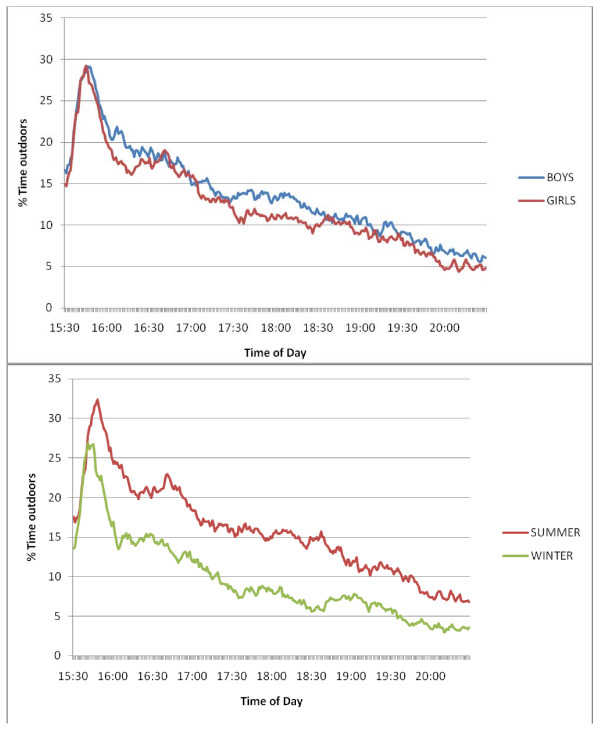
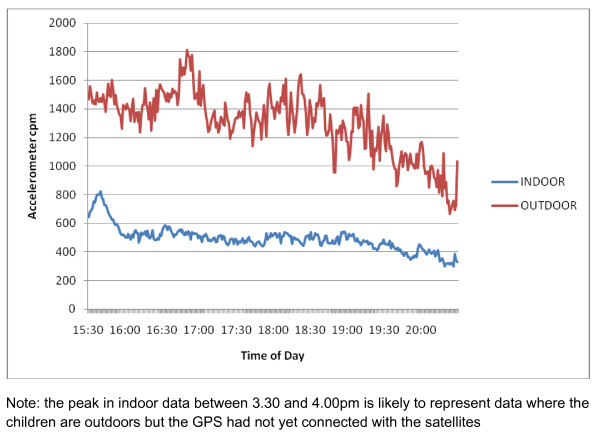
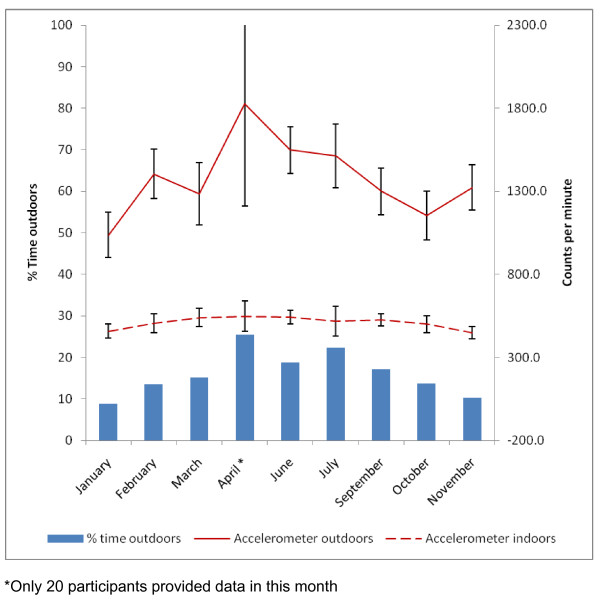
BACKGROUND: Observational studies have shown a positive association between time outdoors and physical activity in children. Time outdoors may be a feasible intervention target to increase the physical activity of youth, but methods are required to accurately measure time spent outdoors in a range of locations and over a sustained period. The Global Positioning System (GPS) provides precise location data and can be used to identify when an individual is outdoors. The aim of this study was to investigate whether GPS data recorded outdoors were associated with objectively measured physical activity. METHODS: Participants were 1010 children (11.0 +/- 0.4 years) recruited from 23 urban primary schools in South West England, measured between September 2006 and July 2008. Physical activity was measured by accelerometry (Actigraph GT1M) and children wore a GPS receiver (Garmin Foretrex 201) after school on four weekdays to record time outdoors. Accelerometer and GPS data were recorded at 10 second epochs and were combined to describe patterns of physical activity when both a GPS and accelerometer record were present (outdoors) and when there was accelerometer data only (indoors). ANOVA was used to investigate gender and seasonal differences in the patterns of outdoor and indoor physical activity, and linear regression was used to examine the cross-sectional associations between GPS-measured time outdoors and physical activity. RESULTS: GPS-measured time outdoors was a significant independent predictor of children's physical activity after adjustment for potential confounding factors. Physical activity was more than 2.5 fold higher outdoors than indoors (1345.8 +/- 907.3 vs 508.9 +/- 282.9 counts per minute; F = 783.2, p < .001). Overall, children recorded 41.7 +/- 46.1 minutes outdoors between 3.30 pm and 8.30 pm, with more time spent outdoors in the summer months (p < .001). There was no gender difference in time spent outdoors. Physical activity outdoors was higher in the summer than the winter (p < .001), whilst there was no seasonal variation in physical activity indoors. CONCLUSIONS: Duration of GPS recording is positively associated with objectively measured physical activity and is sensitive to seasonal differences. Minute by minute patterning of GPS and physical activity data is feasible and may be a useful tool to investigate environmental influences on children's physical activity and to identify opportunities for intervention.
Overview
The claims and statistics of this paper haven’t been checked yet.
Run the check — free, no account needed. It reads the open-access text and checks the sources it cites.
Integrity signals
Registry
Cites
Statistics
Figures
Verification
Claims the paper makes
The claims and statistics of this paper haven’t been checked yet.
Run the check — free, no account needed. It reads the open-access text and checks the sources it cites.
Claims other papers make about this one
Each is checked against this paper’s own text: does it say what the citing paper says it does?
The source backs part of the claim, not all of it — or backs it for a different population, condition or comparison.
In the citing paper
“For instance, self-reported duration is likely to be less accurate than measures obtained from geo-tracking individuals during specific visits39, or over several days40, and individuals may have been unsure about, or reluctant to discuss, certain issues which were included as covariates (e.g. long standing illness/disability).”
From Spending at least 120 minutes a week in nature is associated with good health and wellbeing (2019) · cites this paper as [40]
Experimental — accuracy not yet measured
Self-check
Percentages, sums and reported differences re-computed from the paper’s own numbers.
The self-check needs the paper’s full text.
Citations
Cites
Establishing a standard definition for child overweight and obesity worldwide: international survey
Cole, T. J. (2000) · BMJ · doi:10.1136/bmj.320.7244.1240 · Cited by 16,588
A review of correlates of physical activity of children and adolescents
SALLIS, J. F., PROCHASKA, J. J., & TAYLOR, W. C. (2000) · Medicine & Science in Sports & Exercise · doi:10.1097/00005768-200005000-00014 · Cited by 4,421
Evidence Based Physical Activity for School-age Youth
Strong, W. B., Malina, R. M., Blimkie, C. J. R., Daniels, S. R., Dishman, R. K., Gutin, B., Hergenroeder, A. C., Must, A., Nixon, P. A., Pivarnik, J. M., et al. (2005) · The Journal of Pediatrics · doi:10.1016/j.jpeds.2005.01.055 · Cited by 4,222
A self‐report measure of pubertal status: Reliability, validity and initial norms
Petersen, A. C., Crockett, L., Richards, M., & Boxer, A. (1988) · Journal of Youth and Adolescence · doi:10.1007/bf01537962 · Cited by 3,129
Andersen, L. B., Harro, M., Sardinha, L. B., Froberg, K., Ekelund, U., Brage, S., & Anderssen, S. A. (2006) · The Lancet · doi:10.1016/s0140-6736(06)69075-2 · Cited by 1,518
Environmental correlates of physical activity in youth – a review and update
Ferreira, I., Van Der Horst, K., Wendel‐Vos, W., Kremers, S., Van Lenthe, F. J., & Brug, J. (2007) · Obesity Reviews · doi:10.1111/j.1467-789x.2006.00264.x · Cited by 993 · cited 1×
“Time outdoors has been found to be a correlate of children's physical activity in most studies [5,6] and has been associated with higher objectively measured physical activity [7,8], with lower prevalence of overweight [8] and with higher independent mobility [9].”
BackgroundDavison, K. K., & Lawson, C. T. (2006) · International Journal of Behavioral Nutrition and Physical Activity · doi:10.1186/1479-5868-3-19 · Cited by 966
Veitch, J., Bagley, S., Ball, K., & Salmon, J. (2005) · Health & Place · doi:10.1016/j.healthplace.2005.02.009 · Cited by 632
Neighborhood Greenness and 2-Year Changes in Body Mass Index of Children and Youth
Bell, J. F., Wilson, J. S., & Liu, G. C. (2008) · American Journal of Preventive Medicine · doi:10.1016/j.amepre.2008.07.006 · Cited by 441
Cooper, A. R., Page, A. S., Foster, L. J., & Qahwaji, D. M. (2003) · American Journal of Preventive Medicine · doi:10.1016/s0749-3797(03)00205-8 · Cited by 435
Self-citationEkelund, U., Sardinha, L. B., Anderssen, S. A., Harro, M., Franks, P. W., Brage, S., Cooper, A. R., Andersen, L. B., Riddoch, C., & Froberg, K. (2004) · American Journal of Clinical Nutrition · doi:10.1093/ajcn/80.3.584 · Cited by 419
Self-citationParental Report of Outdoor Playtime as a Measure of Physical Activity in Preschool-aged Children
Burdette, H. L., Whitaker, R. C., & Daniels, S. R. (2004) · Archives of Pediatrics and Adolescent Medicine · doi:10.1001/archpedi.158.4.353 · Cited by 379
Observations on Physical Activity in Physical Locations: Ager Gender, Ethnicity, and Month Effects
Baranowski, T., Thompson, W. O., DuRant, R. H., Baranowski, J. C., & Puhl, J. L. (1993) · Research Quarterly for Exercise and Sport · doi:10.1080/02701367.1993.10608789 · Cited by 345
Cleland, V. J., Crawford, D. A., Baur, L. A., Hume, C., Timperio, A. F., & Salmon, J. (2008) · International Journal of Obesity · doi:10.1038/ijo.2008.171 · Cited by 321
Physical Activity Levels among Children Attending After-School Programs
Trost, S. G., Rosenkranz, R. R., & Dzewaltowski, D. A. (2008) · Medicine & Science in Sports & Exercise · doi:10.1249/mss.0b013e318161eaa5 · Cited by 289
Children's Pedometer-Determined Physical Activity during the Segmented School Day
Tudor-Locke, C. E., Lee, S. M., Morgan, C. F., Beighle, A. E., & Pangrazi, R. P. (2006) · Medicine & Science in Sports & Exercise · doi:10.1249/01.mss.0000230212.55119.98 · Cited by 284
Portable Global Positioning Units to Complement Accelerometry-Based Physical Activity Monitors
Rodrı́guez, D. A., BROWN, A. L., & Troped, P. J. (2005) · Medicine & Science in Sports & Exercise · doi:10.1249/01.mss.0000185297.72328.ce · Cited by 225
Children's Independent Movement in the Local Environment
Mackett, R. L., Brown, B., Gong, Y., Kitazawa, K., & Paskins, J. (2007) · Built Environment · doi:10.2148/benv.33.4.454 · Cited by 217
Page, A. S., Cooper, A. R., Griew, P., Davis, L., & Hillsdon, M. M. (2009) · International Journal of Behavioral Nutrition and Physical Activity · doi:10.1186/1479-5868-6-2 · Cited by 180
Self-citationPage, A. S., Cooper, A. R., Stamatakis, E. A., Foster, L. J., Crowne, E. C., Sabin, M. A., & Hamilton-Shield, J. P. (2005) · International Journal of Obesity · doi:10.1038/sj.ijo.0802993 · Cited by 178
Self-citationJones, A., Coombes, E. G., Griffin, S. J., & van Sluijs, E. M. F. (2009) · International Journal of Behavioral Nutrition and Physical Activity · doi:10.1186/1479-5868-6-42 · Cited by 166
GIS or GPS? A Comparison of Two Methods For Assessing Route Taken During Active Transport
Duncan, M. J., & Mummery, W. K. (2007) · American Journal of Preventive Medicine · doi:10.1016/j.amepre.2007.02.042 · Cited by 156
Mapping the Walk to School Using Accelerometry Combined with a Global Positioning System
Cooper, A. R., Page, A. S., Wheeler, B. W., Griew, P., Davis, L., Hillsdon, M. M., & Jago, R. (2010) · American Journal of Preventive Medicine · doi:10.1016/j.amepre.2009.10.036 · Cited by 143
Self-citationWen, L. M., Kite, J., Merom, D., & Rissel, C. E. (2009) · International Journal of Behavioral Nutrition and Physical Activity · doi:10.1186/1479-5868-6-15 · Cited by 124
The index of multiple deprivation 2000 access domain: a useful indicator for public health?
Niggebrugge, A., Haynes, R. M., Jones, A., Lovett, A. A., & Harvey, I. M. (2005) · Social Science & Medicine · doi:10.1016/j.socscimed.2004.11.026 · Cited by 80
Utility of Global Positioning System to Measure Active Transport in Urban Areas
Duncan, M. J., Mummery, W. K., & Dascombe, B. J. (2007) · Medicine & Science in Sports & Exercise · doi:10.1249/mss.0b013e31811ff31e · Cited by 53
Cited by
Sorted by citations
Molecular Mechanisms of Depression: Perspectives on New Treatment Strategies
Lang, U. E., & Borgwardt, S. (2013) · Cellular Physiology and Biochemistry · doi:10.1159/000350094 · Cited by 8,526
Spending at least 120 minutes a week in nature is associated with good health and wellbeing
White, M. P., Alcock, I., Grellier, J., Wheeler, B. W., Hartig, T., Warber, S. L., Bone, A., Depledge, M. H., & Fleming, L. E. (2019) · Scientific Reports · doi:10.1038/s41598-019-44097-3 · Cited by 1,125
Self-citationPosition Statement on Active Outdoor Play
Tremblay, M. S., Gray, C. E., Babcock, S., Barnes, J. D., Costas-Bradstreet, C., Carr, D., Chabot, G., Choquette, L., Chorney, D. W., Collyer, C., et al. (2015) · International Journal of Environmental Research and Public Health · doi:10.3390/ijerph120606475 · Cited by 552
Gray, C. E., Gibbons, R., Larouche, R., Sandseter, E. B. H., Bienenstock, A., BRUSSONI, M. J., Chabot, G., Herrington, S., Janssen, I., Pickett, W., et al. (2015) · International Journal of Environmental Research and Public Health · doi:10.3390/ijerph120606455 · Cited by 552
Tremblay, M. S., Barnes, J. D., González, S. A., Katzmarzyk, P. T., Onywera, V. O., Reilly, J. J., Tomkinson, G. R., & _, _. (2016) · Journal of Physical Activity and Health · doi:10.1123/jpah.2016-0594 · Cited by 451
Metadata
- Authors
- Cooper, A. R., Page, A. S., Wheeler, B. W., Hillsdon, M., Griew, P., & Jago, R.
- Affiliations
- University of Bristol (GB)
- Royal Cornwall Hospital (GB)
- University of Exeter (GB)
- Corresponding author
- Cooper, Ashley R
- Venue
- International Journal of Behavioral Nutrition and Physical Activity
- Published
- 2010
- Volume
- 7
- Issue
- 1
- Pages
- 31
- ISSN
- 1479-5868 (ISSN-L)
- PMC
- PMC2867989
- OpenAlex
- W2131894970
- Cited by
- 189
- References
- 26
- Citations by year
- 2026: 2 · 2025: 5 · 2024: 2 · 2023: 5 · 2022: 11 · 2021: 11 · 2020: 9 · 2019: 13 · 2018: 10 · 2017: 17 · 2016: 19 · 2015: 16 · 2014: 22 · 2013: 17 · 2012: 15
- FWCI
- 10.18
- Type
- journal article
- Language
- en
- Open access
- gold
- doi.org
- Licence
- cc-by
- Locations
- International Journal of Behavioral Nutrition and Physical Activity (publishedVersion, cc-by)
- Europe PMC (PubMed Central) (publishedVersion, cc-by)
- PubMed Central (publishedVersion, cc-by)
- PubMed (publishedVersion)
- DOAJ (DOAJ: Directory of Open Access Journals) (submittedVersion, cc-by-sa)
- Figshare (submittedVersion)
- Open Research Exeter (University of Exeter) (submittedVersion, cc-by)
- Explore Bristol Research (submittedVersion)
- Bristol Research (University of Bristol) (submittedVersion)
- Funders
- World Cancer Research Fund
- Topics
- Health Sciences › Medicine › Public Health, Environmental and Occupational Health › Physical Activity and Health
- Social Sciences › Urban Studies › Urban Green Space and Health
- Health Sciences › Medicine › Public Health, Environmental and Occupational Health › Obesity, Physical Activity, Diet
- Keywords
- outdoor time, children's physical activity, GPS tracking, accelerometry, seasonal variation, gender differences, elementary school students
About these checks
Registry, retraction, Cites and statistics results are computed, not judged, with one exception: a printed reference that no index lists is read once by a model before it counts as a citation error. Claims are extracted by a model and kept only when their quote appears verbatim in the text; each cited source is then checked, with a model’s help, for whether it says what the claim relies on. Those verdicts can be wrong — read the claim’s quote and the cited source before relying on one.
Statistics and arithmetic are recomputed, not judged.
Confidence bands are shown only for fields calibrated on our annotated test set. None is calibrated yet, so no band is shown.
What counts as a claim ›How we measure confidence ›How we check this ›
Are you an author, or do you see a problem with this page? Request a review
