

Systematic review of the health benefits of physical activity and fitness in school-aged children and youth
Open accessThe DOI matches its Crossref record; 114 of the 116 references it cites were found in a registry or an index; none of the 128 sources its claims cite is checked for support yet.
Abstract
BACKGROUND: The purpose was to: 1) perform a systematic review of studies examining the relation between physical activity, fitness, and health in school-aged children and youth, and 2) make recommendations based on the findings. METHODS: The systematic review was limited to 7 health indicators: high blood cholesterol, high blood pressure, the metabolic syndrome, obesity, low bone density, depression, and injuries. Literature searches were conducted using predefined keywords in 6 key databases. A total of 11,088 potential papers were identified. The abstracts and full-text articles of potentially relevant papers were screened to determine eligibility. Data was abstracted for 113 outcomes from the 86 eligible papers. The evidence was graded for each health outcome using established criteria based on the quantity and quality of studies and strength of effect. The volume, intensity, and type of physical activity were considered. RESULTS: Physical activity was associated with numerous health benefits. The dose-response relations observed in observational studies indicate that the more physical activity, the greater the health benefit. Results from experimental studies indicate that even modest amounts of physical activity can have health benefits in high-risk youngsters (e.g., obese). To achieve substantive health benefits, the physical activity should be of at least a moderate intensity. Vigorous intensity activities may provide even greater benefit. Aerobic-based activities had the greatest health benefit, other than for bone health, in which case high-impact weight bearing activities were required. CONCLUSION: The following recommendations were made: 1) Children and youth 5-17 years of age should accumulate an average of at least 60 minutes per day and up to several hours of at least moderate intensity physical activity. Some of the health benefits can be achieved through an average of 30 minutes per day. [Level 2, Grade A]. 2) More vigorous intensity activities should be incorporated or added when possible, including activities that strengthen muscle and bone [Level 3, Grade B]. 3) Aerobic activities should make up the majority of the physical activity. Muscle and bone strengthening activities should be incorporated on at least 3 days of the week [Level 2, Grade A].
Overview
CoChat Summary
TL;DR
This systematic review found physical activity is associated with numerous health benefits in school-aged children and youth, with observational dose-response evidence suggesting more activity yields greater benefit. It recommends an average of at least 60 minutes per day of at least moderate activity, with some benefits achievable at 30 minutes per day, plus added vigorous and muscle/bone-strengthening activities.
Key findings
- From 11,088 unique citations, 86 eligible papers yielded 113 outcomes across 7 health indicators. Physical activity was associated with benefits; observational studies showed dose-response relations, and experimental studies indicated even modest activity can benefit high-risk youngsters (e.g., obese).
- Metabolic syndrome: summary odds ratio for least active vs most active was 1.68 (95% CI 1.22–2.31) in 3 self-report studies; least fit vs most fit was 6.79 (95% CI 5.11–9.03) in 4 fitness studies. Obesity: median odds ratio was 1.33 for self-reported activity and 3.79 for objective measures. Cholesterol: unfit girls were 1.89 (1.12–3.17) times and unfit boys 3.68 (2.55–5.31) times more likely to have hypercholesterolemia than moderately/high fit peers.
- Recommendations: children and youth 5–17 years should accumulate an average of at least 60 minutes per day and up to several hours of at least moderate intensity activity; some health benefits can be achieved through an average of 30 minutes per day [Level 2, Grade A]. More vigorous activities should be incorporated when possible, including muscle- and bone-strengthening activities [Level 3, Grade B]; aerobic activities should make up the majority, with muscle and bone strengthening on at least 3 days per week [Level 2, Grade A].
- Bone: as little as 10 minutes of moderate-to-high impact activities on as little as 2 or 3 days per week can have a modest effect on bone mineral density when combined with general weight-bearing aerobic activities. Injuries: all 3 included studies reported higher injury rates in active children/youth and clear dose-response relations; vigorous sports risk estimates were high.
Methods
- Systematic review limited to 7 health indicators: high blood cholesterol, high blood pressure, metabolic syndrome, obesity, low bone density, depression, and injuries. Searches used predefined keywords in 6 databases (MEDLINE, EMBASE, CINAHL, PsycINFO, Evidence-Based Medicine Reviews, SPORTDiscus) to January 2008, limited to human participants, English language, and ages 5–17 years.
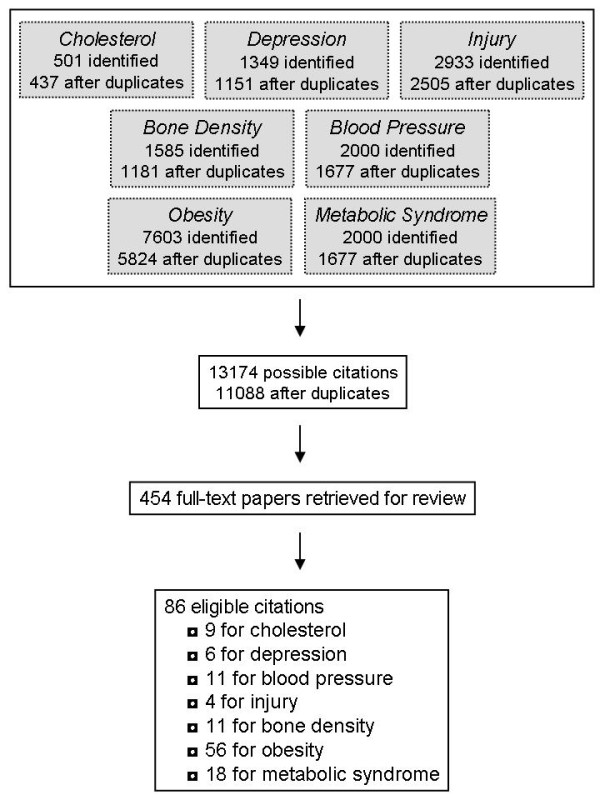
- After duplicates, 11,088 unique citations were screened; 454 full-text articles were reviewed; 86 unique citations met eligibility and 113 outcomes were abstracted. Observational studies had to report dichotomous outcomes; intervention studies were excluded if they included dietary or other behavioral components that could independently affect outcomes.
- Evidence was graded using pre-specified criteria based on quantity/quality of studies and strength of effect; meta-analyses were performed when at least 4 studies were available. RCT quality was assessed with the Downs and Black checklist, and effect sizes used Cohen’s d and ratio-score criteria.
Limitations
- Stated: unpublished and non-English studies were excluded, no extensive cross-referencing of reference lists was performed, the review was limited to 7 health outcomes, and many observational studies were excluded because they did not report dichotomous outcomes; these may have biased results and recommendations.
- Stated RCT limitations: samples were small and non-representative, statistical power was often lacking, adverse events were rarely reported, dropout details were limited, and intent-to-treat analyses were not performed; therefore Level 2 was the highest level assignable to any recommendation.
- Evident from the text: the nature of dose-response relations (linear vs curvilinear) often remained unclear, and the moderating effects of age and sex were not systematically addressed across outcomes.
Model-written summary. Check it against the paper before relying on it.
Integrity signals
Registry
Cites
Statistics
Figures
Verification
Claims the paper makes
0 Valid · 0 Not valid · 42 Not checked · 127 Own results and interpretations
A result the paper reports from its own data — it cites no other source for it, so there is none to check. The quote shows it is in the paper.
In the paper
“Results from experimental studies indicate that even modest amounts of physical activity can have health benefits in high-risk youngsters (e.g., obese).”
§ Systematic review of the health benefits of physical activity and fitness in school-aged children and youth > Abstract > Results
hedgedstates a cause- Asserted: passes — The authors put it forward as true.
- Checkable: passes — It can be checked against evidence.
- Load-bearing: passes — The paper’s conclusions depend on it.
- Based: passes — The paper gives a reason why it holds.
A result the paper reports from its own data — it cites no other source for it, so there is none to check. The quote shows it is in the paper.
In the paper
“Physical activity was associated with numerous health benefits.”
§ Systematic review of the health benefits of physical activity and fitness in school-aged children and youth > Abstract > Results
plainstates an association- Asserted: passes — The authors put it forward as true.
- Checkable: passes — It can be checked against evidence.
- Load-bearing: passes — The paper’s conclusions depend on it.
- Based: passes — The paper gives a reason why it holds.
A result the paper states — it cites no source for it, so there is none to check. The quote shows it is in the paper.
In the paper
“Aerobic-based activities had the greatest health benefit, other than for bone health, in which case high-impact weight bearing activities were required.”
§ Systematic review of the health benefits of physical activity and fitness in school-aged children and youth > Abstract > Results
plainstates an association- Asserted: passes — The authors put it forward as true.
- Checkable: passes — It can be checked against evidence.
- Load-bearing: passes — The paper’s conclusions depend on it.
- Based: passes — The paper gives a reason why it holds.
A result the paper reports from its own data — it cites no other source for it, so there is none to check. The quote shows it is in the paper.
In the paper
“The dose-response relations observed in observational studies indicate that the more physical activity, the greater the health benefit.”
§ Systematic review of the health benefits of physical activity and fitness in school-aged children and youth > Abstract > Results
hedgedstates an association- Asserted: passes — The authors put it forward as true.
- Checkable: passes — It can be checked against evidence.
- Load-bearing: passes — The paper’s conclusions depend on it.
- Based: passes — The paper gives a reason why it holds.
None of the sources cited for this claim have been checked yet.
In the paper
“The results indicated that unfit girls, defined as the lowest 20% fit, were 1.89 (95% confidence interval: 1.12-3.17) times more likely to have hypercholesterolemia and 1.03 (0.74-1.43) times more likely to have a low HDL-cholesterol by comparison to moderately and high fit girls.”
§ Systematic review of the health benefits of physical activity and fitness in school-aged children and youth > Results > Cholesterol and blood lipids
hedgedstates an associationn = 3,110- Asserted: passes — The authors put it forward as true.
- Checkable: passes — It can be checked against evidence.
- Load-bearing: passes — The paper’s conclusions depend on it.
- Based: passes — The paper gives a reason why it holds.
103 more claims
Create a free account to see all 169 claims and every source verdict.
- Probably not a substantial claim. 26
- The quote only partly states this claim. 2
- It may state two separate claims as one. 37
Claims other papers make about this one
Each is checked against this paper’s own text: does it say what the citing paper says it does?
The source backs part of the claim, not all of it — or backs it for a different population, condition or comparison.
In the citing paper
“Research indicates that those who are physically active show or report better overall physical and mental health, a higher level of fitness and a lower level of obesity than their sedentary or physically inactive counterparts1–4”
From Physical activity and health in Chinese children and adolescents: expert consensus statement (2020) (2020) · cites this paper as [2]
Experimental — accuracy not yet measuredThe cited source says what the claim attributes to it.
In the citing paper
“The association with overweight/obesity tends to be stronger when moderate to vigorous-intensity physical activities are performed.2”
From Physical activity and health in Chinese children and adolescents: expert consensus statement (2020) (2020) · cites this paper as [2]
The cited source says what the claim attributes to it.
In the citing paper
“Among physical activity interventions, the effects of physical activity independent of dietary changes on measures indicative of weight reduction (eg, BMI, total fat, abdominal fat) tend to be in the small range.2”
From Physical activity and health in Chinese children and adolescents: expert consensus statement (2020) (2020) · cites this paper as [2]
The cited source says what the claim attributes to it.
In the citing paper
“In general, as the level of physical activity increases, the likelihood of injury increases.2”
From Physical activity and health in Chinese children and adolescents: expert consensus statement (2020) (2020) · cites this paper as [2]
The cited source says what the claim attributes to it.
In the citing paper
“Systematic reviews have shown that physical activity (PA) is associated with greater mental health, 6 and a reduced risk of mental ill-health, specifically depression and anxiety.7,8”
From Domain-Specific Physical Activity and Mental Health: A Meta-analysis (2017) · cites this paper as [8]
2 more claims about this paper
Create a free account to see every claim other papers make about this one.
Self-check
Percentages, sums and reported differences re-computed from the paper’s own numbers.
Each contradiction between two passages listed here was confirmed by an independent check.
Rated major: it would touch a result — a value a result rests on, reported and recomputed p-values on opposite sides of the significance level, two passages that conflict with no sign which is right, or a cited work retracted before this paper was published.
In the paper
§ Systematic review of the health benefits of physical activity and fitness in school-aged children and youth > Discussion > Recommendations based on systematic review
“More vigorous intensity activities should be incorporated or added when possible, including activities that strengthen muscle and bone. [Level 3, Grade B].”
§ Systematic review of the health benefits of physical activity and fitness in school-aged children and youth > Discussion > Recommendations based on systematic review
“This recommendation was given a lower grade (Grade C) because of the potential increase in injury risk associated with more vigorous intensity activities and sports.”
Rated minor: it would not touch a result — a value no result rests on, a p-value that stays on the same side of the significance level, or a conflict that is clerical, resolved elsewhere in the paper, or outside its own findings.
In the paper
§ Systematic review of the health benefits of physical activity and fitness in school-aged children and youth > Results > Metabolic syndrome
“Sixteen articles examining the metabolic syndrome met the inclusion criteria.”
§ Systematic review of the health benefits of physical activity and fitness in school-aged children and youth > Results > Metabolic syndrome
“Eight of the 17 identified studies were observational in nature”
Rated minor: it would not touch a result — a value no result rests on, a p-value that stays on the same side of the significance level, or a conflict that is clerical, resolved elsewhere in the paper, or outside its own findings.
In the paper
“A total of 31 observational studies (24 cross-sectional, 3 prospective cohort, 2 case-control, 1 mixed) were retrieved”
§ Systematic review of the health benefits of physical activity and fitness in school-aged children and youth > Results > Overweight and obesity
Reported 31 · recomputed 30
Rated minor: it would not touch a result — a value no result rests on, a p-value that stays on the same side of the significance level, or a conflict that is clerical, resolved elsewhere in the paper, or outside its own findings.
In the paper
“437 citations were identified for cholesterol, 1151 for depression, 2505 for injury, 1181 for bone density, 1677 for blood pressure, 5824 for obesity, and 1677 for the metabolic syndrome. Thus, the grand total was 13174.”
§ Systematic review of the health benefits of physical activity and fitness in school-aged children and youth > Results > Literature review
Reported 13174 · recomputed 14452
Citations
Cites
Downs, S. H., & Black, N. (1998) · Journal of Epidemiology and Community Health · doi:10.1136/jech.52.6.377 · Cited by 8,252
Evidence Based Physical Activity for School-age Youth
Strong, W. B., Malina, R. M., Blimkie, C. J. R., Daniels, S. R., Dishman, R. K., Gutin, B., Hergenroeder, A. C., Must, A., Nixon, P. A., Pivarnik, J. M., et al. (2005) · The Journal of Pediatrics · doi:10.1016/j.jpeds.2005.01.055 · Cited by 4,222
Systematic Reviews: Synthesis of Best Evidence for Clinical Decisions
Cook, D. J., Mulrow, C. D., & Haynes, R. B. (1997) · Annals of Internal Medicine · doi:10.7326/0003-4819-126-5-199703010-00006 · Cited by 2,184
Andersen, L. B., Harro, M., Sardinha, L. B., Froberg, K., Ekelund, U., Brage, S., & Anderssen, S. A. (2006) · The Lancet · doi:10.1016/s0140-6736(06)69075-2 · Cited by 1,473
Lau, D. C. W., Douketis, J. D., Morrison, K. M., Hramiak, I. M., Sharma, A. M., Ur, E., & Panel, F. M. O. T. O. C. C. P. G. E. (2007) · Canadian Medical Association Journal · doi:10.1503/cmaj.061409 · Cited by 1,154
Paterson, D. H., & Warburton, D. E. (2010) · International Journal of Behavioral Nutrition and Physical Activity · doi:10.1186/1479-5868-7-38 · Cited by 953
A systematic review of the evidence for Canada's Physical Activity Guidelines for Adults
Warburton, D. E., Charlesworth, S., Ivey, A., Nettlefold, L., & Bredin, S. S. (2010) · International Journal of Behavioral Nutrition and Physical Activity · doi:10.1186/1479-5868-7-39 · Cited by 902 · cited 1×
“This report was part of a much larger project around Canada's physical activity guidelines, and comparable systematic reviews for adults [ 10 ] and older adults [11] have also been published in the journal.”
A meta-regression to examine the relationship between aerobic fitness and cognitive performance
Etnier, J. L., Nowell, P. M., Landers, D. M., & Sibley, B. A. (2006) · Brain Research Reviews · doi:10.1016/j.brainresrev.2006.01.002 · Cited by 749
Is the Canadian childhood obesity epidemic related to physical inactivity?
Tremblay, M. S., & Willms, J. D. (2003) · International Journal of Obesity · doi:10.1038/sj.ijo.0802376 · Cited by 517
Nassis, G. P., Papantakou, K., Skenderi, K., Triandafillopoulou, M., Kavouras, S. A., Yannakoulia, M., Chrousos, G. P., & Sidossis, L. S. (2005) · Metabolism · doi:10.1016/j.metabol.2005.05.013 · Cited by 469
Research works printed but not linked: 1
- Petitti DB Meta-Analysis, Decision Analysis, and Cost-Effective Analysis 1994 New York, NY: Oxford University Press
Cited by
Items 1,901–2,000 of 4,834
Psychophysiological Benefits of Real-Time Heart Rate Feedback in Physical Education
Stöckel, T., & Grimm, R. (2021) · Frontiers in Psychology · doi:10.3389/fpsyg.2021.651065 · Cited by 29
Kruse, F., Büchel, S., & Brühwiler, C. (2024) · Frontiers in Psychology · doi:10.3389/fpsyg.2024.1393966 · Cited by 30
Neshteruk, C. D., Burkart, S. A., Flanagan, E. W., Melnick, E. M., Luecking, C. T., & Kracht, C. L. (2023) · Preventive Medicine · doi:10.1016/j.ypmed.2023.107606 · Cited by 20
Meijer, A., Pouwels, P. J. W., Smith, J., Visscher, C., Bosker, R., Hartman, E., Oosterlaan, J., & Königs, M. (2021) · Journal of Neuroscience Research · doi:10.1002/jnr.24851 · Cited by 16
Akinrolie, O., Barclay, R., Strachan, S. M., Gupta, A., Jasper, U. S., Jumbo, S. U., Askin, N., Rabbani, R., Zarychanski, R., & Abou-Setta, A. M. (2020) · Physical & Occupational Therapy In Geriatrics · doi:10.1080/02703181.2020.1725217 · Cited by 17
Project SMART: A cooperative educational game to increase physical activity in elementary schools
Julien, C., Castelli, D. M., Bray, D., Lee, S., Burson, S. L., & Jung, Y. (2020) · Smart Health · doi:10.1016/j.smhl.2020.100163 · Cited by 18
“Because of the high coincidence of low academic performance and low levels of physical activity [16, 13, 17, 18], Project SMART attempts a school-based intervention to increase children’s awareness of and participation in physical activity.”
BackgroundGilliland, J., Clark, A. F., Tucker, P., Prapavessis, H., Avison, W. R., & Wilk, P. (2015) · BMC Public Health · doi:10.1186/s12889-015-2637-x · Cited by 19
McWhannell, N., Triggs, C., & Moss, S. L. (2017) · European Physical Education Review · doi:10.1177/1356336x17743048 · Cited by 17
Kennedy, S., Smith, B., Sobhiyeh, S., Dechenaud, M. E., Wong, M. C., Kelly, N. N., Shepherd, J., & Heymsfield, S. B. (2021) · European Journal of Clinical Nutrition · doi:10.1038/s41430-021-00938-x · Cited by 15
Physical activity of Poles – Critical analysis of research 2010–2014
Kantanista, A., & Osiński, W. (2014) · Annals of Agricultural and Environmental Medicine · doi:10.5604/12321966.1129944 · Cited by 15
OECD (2017) · Health at a glance · doi:10.1787/health_glance-2017-73-en · Cited by 20
SCHOOL CULTURE AND PHYSICAL ACTIVITY: A SYSTEMATIC REVIEW
Rickwood, G. (2013) · Canadian Journal of Educational Administration and Policy · Cited by 30
A dual process model to predict adolescents’ screen time and physical activity
Aulbach, M. B., Konttinen, H. M., Gardner, B., Kujala, E., Araújo‐Soares, V., Sniehotta, F. F., Lintunen, T., Haukkala, A., & Hankonen, N. E. (2021) · Psychology and Health · doi:10.1080/08870446.2021.1988598 · Cited by 17
Meehan, A. J., Maughan, B., & Barker, E. D. (2019) · Journal of Psychopathology and Behavioral Assessment · doi:10.1007/s10862-019-09756-9 · Cited by 15
Trends in social inequality in physical inactivity among Danish adolescents 1991–2014
Johnsen, N. F., Toftager, M., Melkevik, O., Holstein, B. E., & Rasmussen, M. (2017) · SSM - Population Health · doi:10.1016/j.ssmph.2017.04.003 · Cited by 14
Pohjola, V., Puolakka, A., Kunttu, K., & Virtanen, J. I. (2019) · Acta Odontologica Scandinavica · doi:10.1080/00016357.2019.1649457 · Cited by 16
Metabolic Syndrome and Daily Ambulation in Children, Adolescents, and Young Adults
Gardner, A. W., Parker, D. E., Krishnan, S., & Chalmers, L. J. (2013) · Medicine & Science in Sports & Exercise · doi:10.1249/mss.0b013e3182699239 · Cited by 13
da Costa, B. G. G., da Silva, K. S., da Silveira, P. M., Berria, J., Machado, A. R., & Petróski, E. L. (2019) · Revista Brasileira de Epidemiologia · doi:10.1590/1980-549720190065 · Cited by 17
Niveles de actividad física y acelerometría: recomendaciones y patrones de movimiento en escolares
Cañada, F. C., Torres‐Luque, G., Fernández, I. L., & Carnero, E. Á. (2014) · Cuadernos de Psicología del Deporte · doi:10.4321/s1578-84232014000300014 · Cited by 32
Li, Q. D., Kuang, X. M., & Qi, J. (2020) · Current Pharmaceutical Design · doi:10.2174/1381612826666200518110241 · Cited by 14
Results from Mexico’s 2014 Report Card on Physical Activity for Children and Youth
Martínez, M. D. P. R., Galaviz, K. I., Jáuregui-Ulloa, E. E., González-Casanova, I., & y Taylor, J. R. L. (2014) · Journal of Physical Activity and Health · doi:10.1123/jpah.2014-0172 · Cited by 15
Barriers to Implementation of Physical Activity in Danish Public Schools
Koch, S., Troelsen, J., Cassar, S., & Pawlowski, C. S. (2020) · Journal of Teaching in Physical Education · doi:10.1123/jtpe.2019-0158 · Cited by 15
“…Public Schools 49 Physical activity (PA) is generally promoted for its numerous physical health benefits, and schools 50 are considered ideal settings for PA promotion (Janssen & LeBlanc, 2010; Morton, Atkin, Corder, 51 Suhrcke, & van Sluijs, 2016; Watson, Timperio, Brown, Best, & Hesketh, 2017).”
First Physical Activity Report Card for Children and Youth in Lebanon
Nader, P. A., Majed, L., Sayegh, S., Mattar, L., Hadla, R., Chamieh, M. C., Habib-Mourad, C., Fares, E.-J., Hawa, Z., & Bélanger, M. F. (2019) · Journal of Physical Activity and Health · doi:10.1123/jpah.2018-0473 · Cited by 13
Yabe, Y., Hagiwara, Y., Sekiguchi, T., Momma, H., Tsuchiya, M., Kuroki, K., Kanazawa, K., Koide, M., Itaya, N., Yoshida, S., et al. (2019) · The Tohoku Journal of Experimental Medicine · doi:10.1620/tjem.248.107 · Cited by 25
Marshall, Z. A., Mackintosh, K. A., Lewis, M. J., Ellins, E. A., & McNarry, M. A. (2020) · Pediatric Diabetes · doi:10.1111/pedi.13159 · Cited by 15
Mang, R. (2013) · Cited by 36
van den Berg, V., Vos, E., de Groot, R. H. M., Singh, A. S., & Chinapaw, M. J. M. (2018) · International Journal of Environmental Research and Public Health · doi:10.3390/ijerph15122713 · Cited by 22
Xie, S., Zhou, Y., Yin, Y., Shao, R., Fang, L., & Shao, W. (2023) · Frontiers in Public Health · doi:10.3389/fpubh.2023.1023662 · Cited by 24
Influencia del índice de masa corporal en la autoestima de niños y niñas de 12-14 años
Becerra, M. A. O., Muros, J. J., Cuadros, J. P., Sánchez, J. A., & González, M. C. (2015) · Anales de Pediatría · doi:10.1016/j.anpedi.2014.11.017 · Cited by 29
HIITCopter: Analysis of the Suitability of VR Exergaming for High-Intensity Interval Training
She, H., Young, J., Wittenberg, O., Poole, P., Mercer, A., Shaw, A., & Wünsche, B. C. (2020) · Australian Conference on Human-Computer Interaction (OzCHI) · doi:10.1145/3441000.3441009 · Cited by 18
Tracking of Physical Activity With Accelerometers Over a 2-Year Time Period
Dencker, M., Tanha, T., Wollmer, P., Karlsson, M. K., Andersen, L. B., & Thorsson, O. (2013) · Journal of Physical Activity and Health · doi:10.1123/jpah.10.2.241 · Cited by 17
Combined high‐intensity interval training as an obesity‐management strategy for adolescents
Videira‐Silva, A., Hetherington‐Rauth, M., Sardinha, L. B., & Fonseca, H. (2021) · European Journal of Sport Science · doi:10.1080/17461391.2021.1995508 · Cited by 17
Sun, Y., Yin, X., Li, Y., Bi, C., Li, M., Yang, X., Zhang, T., Zhang, F., Junfang, C., Guo, Y., et al. (2020) · Medicine · doi:10.1097/md.0000000000021367 · Cited by 19
The Influence of Nutritional Status on Gross and Fine Motor Skills Development in Early Childhood
Zulkarnaen, Z. (2019) · Asian Social Science · doi:10.5539/ass.v15n5p75 · Cited by 18
“Physical activity is important for numerous aspects of children’s health and development (Janssen & Leblanc, 2010).”
BackgroundLongitudinal patterns of lifestyle behaviours in adolescence: a latent transition analysis
Dakin, M., Manneville, F., Langlois, J., Legrand, K., Lecomte, E., Briançon, S., & Omorou, A. Y. (2020) · British Journal Of Nutrition · doi:10.1017/s0007114520004316 · Cited by 17
Comparing backstories of a Socially Assistive Robot exercise buddy for adolescent youth
Swift-Spong, K., Wen, C. K. F., Spruijt‐Metz, D., & Matarić, M. J. (2016) · IEEE RO-MAN · doi:10.1109/roman.2016.7745233 · Cited by 19
Lane, C., Nathan, N., Reeves, P., Sutherland, R., Wolfenden, L., Shoesmith, A., & Hall, A. E. (2022) · Implementation Science · doi:10.1186/s13012-022-01215-6 · Cited by 17
Rodríguez‐Rodríguez, F., Cristi‐Montero, C., & Castro‐Piñero, J. (2020) · International Journal of Environmental Research and Public Health · doi:10.3390/ijerph17124529 · Cited by 18
Queiroz, D. D. R., Alarcón-Aguilar, J., Guimarães, T. G. M., Hardman, C. M., Lima, R. A., Duncan, M. J., dos Santos, M. A. M., & de Barros, M. V. G. (2020) · Annals of Human Biology · doi:10.1080/03014460.2020.1779815 · Cited by 17
MURPHY, M. H., O’Kane, S. M., Carlin, A., Lahart, I. M., Doherty, L. C., Jago, R., McDermott, G., Faulkner, M., & Gallagher, A. M. (2024) · International Journal of Behavioral Nutrition and Physical Activity · doi:10.1186/s12966-024-01563-0 · Cited by 19
Changes in physical activity behavior and development of cardiovascular risk in children
Lona, G., Hauser, C., Köchli, S., Infanger, D., Endes, K., Faude, O., & Hanssen, H. (2021) · Scandinavian Journal of Medicine and Science in Sports · doi:10.1111/sms.13931 · Cited by 18
Effects of Virtual Reality during Exercise in Children
Cebolla, A., Botella, C., Lurbe, E., Guixeres, J., Sáiz, J., Lisón, J. F., Pitti, J. Á., Cantero, L., Alcañíz, M., Escobar, P., et al. (2013) · Repositori UJI (Universitat Jaume I) · doi:10.3217/jucs-019-09-1199 · Cited by 14
“PA in addition to dietary changes has proven to be beneficial to improving body composition, blood pressure levels, lipid profile, insulin sensitivity, self esteem, neurocognitive function and cardio-respiratory fitness (CRF) (Ian Janssen 2007; Physical Activity Guidelines Advisory Committee 2008; Ian Janssen & LeBlan…”
BackgroundFricke, H., Frölich, M., Huber, M., & Lechner, M. (2020) · Journal of Applied Econometrics · doi:10.1002/jae.2764 · Cited by 18
Blais, A. Z., Lougheed, J., Yaraskavitch, J., Adamo, K. B., & Longmuir, P. E. (2020) · Child Care Health and Development · doi:10.1111/cch.12754 · Cited by 15
Duncan, S., White, K., Sa’uLilo, L., & Schofield, G. (2011) · Pediatric Exercise Science · doi:10.1123/pes.23.3.399 · Cited by 20
Ahmed, S., Khan, D. S., & Mehmood, A. S. (2023) · Academy of Education and Social Sciences Review · doi:10.48112/aessr.v3i4.660 · Cited by 40
Wahi, G., Boyle, M. H., Morrison, K. M., & Georgiades, K. (2014) · Canadian Journal of Public Health · doi:10.17269/cjph.105.4288 · Cited by 17
Wang, L., Cheng, Y., Jiang, S., & Zhou, Z. (2023) · Child Indicators Research · doi:10.1007/s12187-023-10024-2 · Cited by 14
Biological and environmental influences on motor coordination in Peruvian children and adolescents
Pereira, S., Bustamante, A., Santos, C., Hedeker, D., Tani, G., Garganta, R., Vasconcelos, O., Baxter-Jones, A. D. G., Katzmarzyk, P. T., & Maia, J. A. R. (2021) · Scientific Reports · doi:10.1038/s41598-021-95075-7 · Cited by 23
García-Villamisar, D. A., Dattilo, J., & Muela, C. (2017) · Adapted Physical Activity Quarterly · doi:10.1123/apaq.2015-0071 · Cited by 18
Environmental influences on physical activity – Romanian youths' perspectives
Sandu, P., Cherecheș, R. M., Baba, C. O., Revnic, R., & Mocean, F. (2018) · Children and Youth Services Review · doi:10.1016/j.childyouth.2018.10.020 · Cited by 19
Adolescents with Type 2 Diabetes: Overcoming Barriers to Effective Weight Management
Salama, M., Biggs, B. K., Creo, A. L., Prissel, R., Nofal, A. A., & Kumar, S. (2023) · Diabetes Metabolic Syndrome and Obesity · doi:10.2147/dmso.s365829 · Cited by 17
Potter, M., Spence, J. C., Boulé, N. G., Stearns, J. A., & Carson, V. (2017) · Applied Physiology, Nutrition, and Metabolism · doi:10.1139/apnm-2016-0419 · Cited by 18
“Conversely, higher levels of fitness are associated with reduced blood pressure, less abdominal obesity, improved bone mineral density, and reduced depression, anxiety, and stress (Ortega et al. 2008; Tremblay et al. 2010; Janssen and Leblanc 2010).”
BackgroundExploring Factors Influencing Girls' Continued Participation in Competitive Dance
Shannon, C. S. (2016) · Journal of Leisure Research · doi:10.18666/jlr-2016-v48-i4-6601 · Cited by 21
Bremer, E., Ginis, K. A. M., Bassett-Gunter, R. L., & Arbour‐Nicitopoulos, K. P. (2020) · International Journal of Environmental Research and Public Health · doi:10.3390/ijerph17165925 · Cited by 19
Indirekte Gesundheitseffekte des Unterrichtsprogramms HealthyPEP
Demetriou, Y., Sudeck, G., & Höner, O. (2014) · German Journal of Exercise and Sport Research · doi:10.1007/s12662-014-0324-1 · Cited by 13
Oluwasanu, M. M., Oladepo, O., & Ibitoye, S. E. (2021) · BMC Public Health · doi:10.1186/s12889-021-12327-x · Cited by 23
Fernández-Espínola, C., Almagro, B. J., & Tamayo-Fajardo, J. A. (2020) · Retos · doi:10.47197/retos.v37i37.70946 · Cited by 33
Voskuil, V. R., Stroup, S., & Leyden, M. (2020) · Physical Activity and Health · doi:10.5334/paah.51 · Cited by 16
Thompson, H. R., Hewawitharana, S. C., Kao, J., Rider, C. D., Talmage, E., Gosliner, W. A., Whetstone, L. M., & Woodward-Lopez, G. M. (2020) · Preventive Medicine Reports · doi:10.1016/j.pmedr.2020.101222 · Cited by 13
Bergier, B., Stępień, E., Niźnikowska, E. A., et al. (2014) · Medycyna Ogólna i Nauki o Zdrowiu · doi:10.5604/20834543.1112232 · Cited by 13
Strategies to Improve Physical Activity Surveillance among Youth in the United States
Dunton, G. F., Berrigan, D. A., Young, D. R., Pfeiffer, K. A., Lee, S. M., Slater, S. J., & Pate, R. R. (2019) · The Journal of Pediatrics · doi:10.1016/j.jpeds.2019.03.022 · Cited by 15
Health-Related Fitness of American Indian Youth
Brusseau, T. A., Finkelstein, T., Kulinna, P. H., & Pangrazi, C. (2014) · Research Quarterly for Exercise and Sport · doi:10.1080/02701367.2014.893050 · Cited by 13
Temperament and Physical Activity in Childhood
Song, M., CORWYN, R. F., Bradley, R. H., & Lumeng, J. C. (2017) · Journal of Physical Activity and Health · doi:10.1123/jpah.2016-0633 · Cited by 17
Norman, Å., Bohman, B., Nyberg, G., & Elinder, L. S. (2017) · Health Education & Behavior · doi:10.1177/1090198117699506 · Cited by 15
“Regarding PA, 82.3% of the children were active in moderate and vigorous intensity for at least 60 minutes per day on average, which is the recommendation regarding PA for children (Janssen & Leblanc, 2010).”
BackgroundInfluentialPhysical Fitness and Peer Relationships in Spanish Preadolescents
Bustos, J. G. F., Vicedo, J. C. P., González-Martí, I., & Cuevas, R. (2020) · International Journal of Environmental Research and Public Health · doi:10.3390/ijerph17061890 · Cited by 13
Evaluating Changes in Perceived Enjoyment throughout a 12-Week School-Based Exergaming Intervention
Röglin, L., Stoll, O., Ketelhut, K., Martin‐Niedecken, A. L., & Ketelhut, S. (2023) · Children · doi:10.3390/children10010144 · Cited by 19
Engaging With the Community to Promote Physical Activity in Urban Neighborhoods
Deatrick, J. A., Klusaritz, H. A., Atkins, R., Bolick, A., Bowman, C., Lado, J. J., Schroeder, K., & Lipman, T. H. (2018) · American Journal of Health Promotion · doi:10.1177/0890117118807405 · Cited by 16
Pedagogical Concerns in Sports and Physical Education for Child Growth and Health Promotion
Branquinho, L., Forte, P. M., & Ferraz, R. M. P. (2022) · International Journal of Environmental Research and Public Health · doi:10.3390/ijerph19138128 · Cited by 20
Zhang, R., Jiang, Q., Cheng, M., & Rhim, Y.-T. (2024) · Psicologia Reflexão e Crítica · doi:10.1186/s41155-024-00308-z · Cited by 37
“Short-term appropriate physical activity can reduce negative emotion and induce positive emotion (Janssen & LeBlanc, 2010), while long-term appropriate physical exercise can alleviate loneliness in adolescents (Aljomaa et al., 2016).”
BackgroundObjectively measured active transportation to school and other destinations among 10–13 year olds
Williams, G. C., Borghese, M. M., & Janssen, I. (2018) · International Journal of Behavioral Nutrition and Physical Activity · doi:10.1186/s12966-017-0634-4 · Cited by 16
Self-citationBergier, J., Niźnikowska, E. A., Bergier, B., Ács, P., Salonna, F., & Junger, J. (2018) · Human Movement · doi:10.1515/humo-2017-0009 · Cited by 21
A qualitative, prospective study of children's understanding of weight gain
Rodgers, R. F., Wertheim, E. H., Damiano, S. R., Gregg, K. J., & Paxton, S. J. (2019) · British Journal of Developmental Psychology · doi:10.1111/bjdp.12279 · Cited by 14
Tigers and Lions, Oh My! Effect of a Guided Imagery Intervention on Children's Active Play
Guerrero, M., Tobin, D., Munroe‐Chandler, K. J., & Hall, C. R. (2015) · Journal of Applied Sport Psychology · doi:10.1080/10413200.2015.1030797 · Cited by 17
Using Video Direct Observation to Assess Children’s Physical Activity During Recess
Howe, C. A., Clevenger, K. A., Plow, B., Porter, S., & Sinha, G. (2018) · Pediatric Exercise Science · doi:10.1123/pes.2017-0203 · Cited by 13
Are We Overestimating Physical Activity Prevalence in Children?
Price, L., Wyatt, K. M., Lloyd, J., Abraham, C., Creanor, S., Dean, S. G., & Hillsdon, M. M. (2018) · Journal of Physical Activity and Health · doi:10.1123/jpah.2018-0030 · Cited by 19
Luiggi, M., Rey, O., Travert, M., & Griffet, J. (2020) · BMC Public Health · doi:10.1186/s12889-021-11752-2 · Cited by 16
Frazer, A. D., Voss, C., Winters, M., Naylor, P., Higgins, J., & McKay, H. A. (2015) · Preventive Medicine Reports · doi:10.1016/j.pmedr.2015.02.008 · Cited by 16
CaiHong, H., Memon, A. R., Liang, C., Hong, J.-T., Lin, Y., & Chen, S. (2021) · Frontiers in Public Health · doi:10.3389/fpubh.2021.719742 · Cited by 21
Willis, K., Tibbitts, B., Sebire, S. J., Reid, T., MacNeill, S., Sanderson, E., Hollingworth, W., Kandiyali, R., Campbell, R. M., Kipping, R., et al. (2019) · BMC Public Health · doi:10.1186/s12889-019-7012-x · Cited by 15
Sebire, S. J., Haase, A. M., Montgomery, A. A., McNeill, J., & Jago, R. (2014) · Journal of Physical Activity and Health · doi:10.1123/jpah.2012-0034 · Cited by 23
Perceptions of physical education students and teachers on physical education learning
Nugraha, B. S., Suharjana, S., & Lumintuarso, R. (2022) · Jurnal Cakrawala Pendidikan · doi:10.21831/cp.v41i2.39887 · Cited by 26
“To optimize children's mental health, they need to do 60-minute exercises every day (Carlson et al., 2013; Füssenich et al., 2016; Janssen & LeBlanc, 2010; Parfitt & Eston, 2005; Ryan & Deci, 2000), not just 4 hours per week.”
BackgroundZhang, Y., Niu, L., Zhang, D., Ip, P., Ho, F., Jiang, Y., Sun, W., Zhu, Q., & Jiang, F. (2019) · The Journal of Pediatrics · doi:10.1016/j.jpeds.2018.11.045 · Cited by 13
Brouwer, S. I., Stolk, R. P., & Corpeleijn, E. (2019) · BMC Pediatrics · doi:10.1186/s12887-019-1784-0 · Cited by 20
Honório, S., Batista, M., & Silva, R. (2019) · American Journal of Lifestyle Medicine · doi:10.1177/1559827619878661 · Cited by 21
McQuinn, S., Belton, S., Staines, A. S., & Sweeney, M. R. (2022) · Pilot and Feasibility Studies · doi:10.1186/s40814-022-01149-2 · Cited by 11
Mackintosh, K. A., Ridgers, N. D., & McNarry, M. A. (2019) · Journal of Sports Sciences · doi:10.1080/02640414.2019.1574543 · Cited by 13
Wu, L., Ma, X., Shi, Y., Tao, S., Yu, Y., Wang, S., Luo, L., Xin, T., & Li, Y. (2019) · Research Quarterly for Exercise and Sport · doi:10.1080/02701367.2019.1603762 · Cited by 22
Tanveer, M., Asghar, E., Bădicu, G., Tanveer, U., Roy, N., Zeba, A., Al-Mhanna, S. B., & Batrakoulis, A. (2024) · Sports · doi:10.3390/sports12090235 · Cited by 31
“Schools are a vital component of childhood, particularly in countries like Pakistan, where a significant percentage of the population consists of children and adolescents [6,7,10].”
BackgroundJaakkola, T. T., Yli-Piipari, S. R., Stodden, D. F., Huhtiniemi, M., Salin, K., Seppälä, S., Hakonen, H., & Gråstén, A. (2020) · Translational Sports Medicine · doi:10.1002/tsm2.156 · Cited by 13
Mood and Ambulatory Monitoring of Physical Activity Patterns in Youth with Polycystic Ovary Syndrome
Michael, J. C., El Nokali, N. E., Black, J. J., & Rofey, D. L. (2015) · Journal of Pediatric and Adolescent Gynecology · doi:10.1016/j.jpag.2014.10.010 · Cited by 13
Navti, L. K., Atanga, M. B. S., & Niba, L. L. (2017) · BMC Obesity · doi:10.1186/s40608-017-0171-3 · Cited by 16
Jussila, A.-M., Vasankari, T. J., Paronen, O., Sievänen, H. T., Tokola, K., Vähä‐Ypyä, H., Broberg, A., & Aittasalo, M. (2015) · BMC Public Health · doi:10.1186/s12889-015-2007-8 · Cited by 20
Adolescent Physical Activity and Motivational Profiles While Keeping a Physical Activity Record
Fullmer, M., Wilkinson, C., Prusak, K. A., Eggett, D. L., & Pennington, T. R. (2017) · Journal of Teaching in Physical Education · doi:10.1123/jtpe.2017-0072 · Cited by 17
Scheller, D. A., Sterr, K., Humpe, A., Mess, F., & Bachner, J. (2024) · Health & Place · doi:10.1016/j.healthplace.2024.103361 · Cited by 19
Network Effects on Adolescents’ Perceived Barriers to Physical Activity
Prochnow, T. M., van Woudenberg, T. J., & Patterson, M. S. (2020) · Journal of Physical Activity and Health · doi:10.1123/jpah.2019-0655 · Cited by 18
Sasayama, K., Watanabe, M., & Ogawa, T. (2021) · Journal of Transport & Health · doi:10.1016/j.jth.2021.101077 · Cited by 15
Johnson, A. M., Tandon, P. S., Hafferty, K. R., Senturia, K., Garrett, K., Bollinger, B. J., & Kroshus, E. (2022) · Health Education Research · doi:10.1093/her/cyac036 · Cited by 16
Physical Activity and Sedentary Behavior in Obese Youth
Adamo, K. B., Colley, R. C., Hadjiyannakis, S., & Goldfield, G. S. (2015) · The Journal of Pediatrics · doi:10.1016/j.jpeds.2015.01.001 · Cited by 13
Physical Activity Research in Hong Kong From 1987 to 2012: Evidence on Children and Adolescents
He, G., Huang, Y., & Wong, S. H. (2013) · Asia Pacific Journal of Public Health · doi:10.1177/1010539513499623 · Cited by 15
Metadata
- Authors
- Janssen, I., & LeBlanc, A. G.
- Affiliations
- Queen's University (CA)
- Corresponding author
- Janssen, Ian
- Venue
- International Journal of Behavioral Nutrition and Physical Activity
- Published
- 2010
- Volume
- 7
- Issue
- 1
- Pages
- 40
- ISSN
- 1479-5868 (ISSN-L)
- PMC
- PMC2885312
- OpenAlex
- W2145702257
- Semantic Scholar
- ef8d55efd11b9d5e4a4814b6a38ff3d60d820d37
- Cited by
- 4,829
- References
- 116
- Citations by year
- 2026: 185 · 2025: 257 · 2024: 310 · 2023: 304 · 2022: 371 · 2021: 451 · 2020: 459 · 2019: 401 · 2018: 387 · 2017: 490 · 2016: 302 · 2015: 280 · 2014: 250 · 2013: 191 · 2012: 109
- FWCI
- 12.18
- Type
- journal article
- Language
- en
- Open access
- gold
- doi.org
- Licence
- cc-by
- Locations
- International Journal of Behavioral Nutrition and Physical Activity (publishedVersion, cc-by)
- PubMed Central (publishedVersion, cc-by)
- PubMed (publishedVersion)
- DOAJ (DOAJ: Directory of Open Access Journals) (submittedVersion, cc-by-sa)
- Funders
- Public Health Agency of Canada
- Public Health Agency
- Topics
- Health Sciences › Medicine › Public Health, Environmental and Occupational Health › Physical Activity and Health
- Health Sciences › Medicine › Public Health, Environmental and Occupational Health › Obesity, Physical Activity, Diet
- Social Sciences › Life-span and Life-course Studies › Recreational Sport and Physical Activity
- Keywords
- physical activity, physical fitness, school-aged children, youth, health benefits, serum cholesterol, blood pressure, metabolic syndrome, childhood obesity, bone mineral density, depression, injuries, dose-response relationship, aerobic exercise, physical activity guidelines
About these checks
Registry, retraction, Cites and statistics results are computed, not judged, with one exception: a printed reference that no index lists is read once by a model before it counts as a citation error. Claims are extracted by a model and kept only when their quote appears verbatim in the text; each cited source is then checked, with a model’s help, for whether it says what the claim relies on. Those verdicts can be wrong — read the claim’s quote and the cited source before relying on one.
A language model drew the claims from the paper on 2026-10-10, under version 3 of the claim definition (model deepseek-v4.1-flash, prompt extract-v3).
A second model labelled each claim on 2026-10-10 (model jev-1.13-20260917, definition revision gold-guideline-v0.2).
Statistics and arithmetic are recomputed, not judged.
Confidence bands are shown only for fields calibrated on our annotated test set. None is calibrated yet, so no band is shown.
What counts as a claim ›How we measure confidence ›How we check this ›
Are you an author, or do you see a problem with this page? Request a review
Data sources
Bibliographic data: Semantic Scholar, OpenAlex, Crossref.
Contains information from the Semantic Scholar Academic Graph Datasets, made available under the ODC Attribution License (ODC-BY 1.0).
Semantic Scholar’s data is described in: Kinney, R., et al. (2023). The Semantic Scholar Open Data Platform. arXiv:2301.10140.
