

Systematic review of the health benefits of physical activity and fitness in school-aged children and youth
Open accessThe DOI matches its Crossref record; 114 of the 116 references it cites were found in a registry or an index; none of the 128 sources its claims cite is checked for support yet.
Abstract
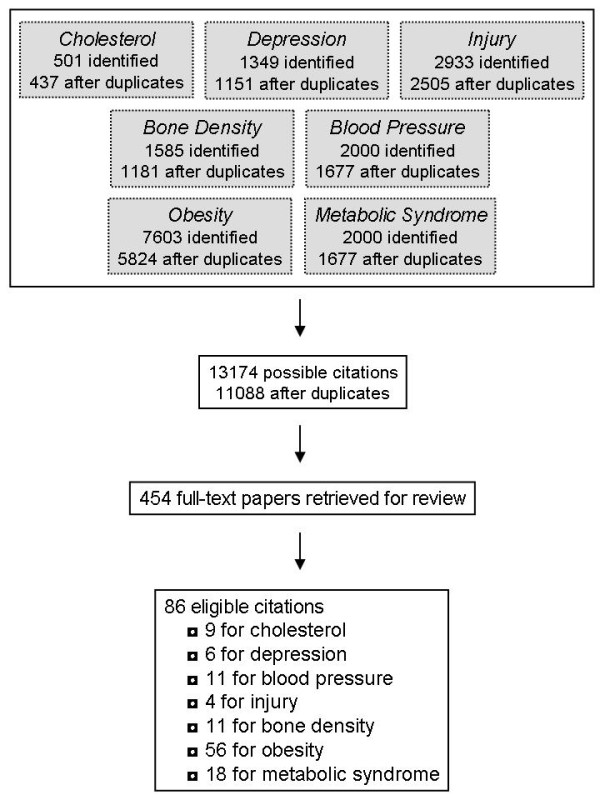
BACKGROUND: The purpose was to: 1) perform a systematic review of studies examining the relation between physical activity, fitness, and health in school-aged children and youth, and 2) make recommendations based on the findings. METHODS: The systematic review was limited to 7 health indicators: high blood cholesterol, high blood pressure, the metabolic syndrome, obesity, low bone density, depression, and injuries. Literature searches were conducted using predefined keywords in 6 key databases. A total of 11,088 potential papers were identified. The abstracts and full-text articles of potentially relevant papers were screened to determine eligibility. Data was abstracted for 113 outcomes from the 86 eligible papers. The evidence was graded for each health outcome using established criteria based on the quantity and quality of studies and strength of effect. The volume, intensity, and type of physical activity were considered. RESULTS: Physical activity was associated with numerous health benefits. The dose-response relations observed in observational studies indicate that the more physical activity, the greater the health benefit. Results from experimental studies indicate that even modest amounts of physical activity can have health benefits in high-risk youngsters (e.g., obese). To achieve substantive health benefits, the physical activity should be of at least a moderate intensity. Vigorous intensity activities may provide even greater benefit. Aerobic-based activities had the greatest health benefit, other than for bone health, in which case high-impact weight bearing activities were required. CONCLUSION: The following recommendations were made: 1) Children and youth 5-17 years of age should accumulate an average of at least 60 minutes per day and up to several hours of at least moderate intensity physical activity. Some of the health benefits can be achieved through an average of 30 minutes per day. [Level 2, Grade A]. 2) More vigorous intensity activities should be incorporated or added when possible, including activities that strengthen muscle and bone [Level 3, Grade B]. 3) Aerobic activities should make up the majority of the physical activity. Muscle and bone strengthening activities should be incorporated on at least 3 days of the week [Level 2, Grade A].
Overview
CoChat Summary
TL;DR
This systematic review found physical activity is associated with numerous health benefits in school-aged children and youth, with observational dose-response evidence suggesting more activity yields greater benefit. It recommends an average of at least 60 minutes per day of at least moderate activity, with some benefits achievable at 30 minutes per day, plus added vigorous and muscle/bone-strengthening activities.
Key findings
- From 11,088 unique citations, 86 eligible papers yielded 113 outcomes across 7 health indicators. Physical activity was associated with benefits; observational studies showed dose-response relations, and experimental studies indicated even modest activity can benefit high-risk youngsters (e.g., obese).
- Metabolic syndrome: summary odds ratio for least active vs most active was 1.68 (95% CI 1.22–2.31) in 3 self-report studies; least fit vs most fit was 6.79 (95% CI 5.11–9.03) in 4 fitness studies. Obesity: median odds ratio was 1.33 for self-reported activity and 3.79 for objective measures. Cholesterol: unfit girls were 1.89 (1.12–3.17) times and unfit boys 3.68 (2.55–5.31) times more likely to have hypercholesterolemia than moderately/high fit peers.
- Recommendations: children and youth 5–17 years should accumulate an average of at least 60 minutes per day and up to several hours of at least moderate intensity activity; some health benefits can be achieved through an average of 30 minutes per day [Level 2, Grade A]. More vigorous activities should be incorporated when possible, including muscle- and bone-strengthening activities [Level 3, Grade B]; aerobic activities should make up the majority, with muscle and bone strengthening on at least 3 days per week [Level 2, Grade A].
- Bone: as little as 10 minutes of moderate-to-high impact activities on as little as 2 or 3 days per week can have a modest effect on bone mineral density when combined with general weight-bearing aerobic activities. Injuries: all 3 included studies reported higher injury rates in active children/youth and clear dose-response relations; vigorous sports risk estimates were high.
Methods
- Systematic review limited to 7 health indicators: high blood cholesterol, high blood pressure, metabolic syndrome, obesity, low bone density, depression, and injuries. Searches used predefined keywords in 6 databases (MEDLINE, EMBASE, CINAHL, PsycINFO, Evidence-Based Medicine Reviews, SPORTDiscus) to January 2008, limited to human participants, English language, and ages 5–17 years.
- After duplicates, 11,088 unique citations were screened; 454 full-text articles were reviewed; 86 unique citations met eligibility and 113 outcomes were abstracted. Observational studies had to report dichotomous outcomes; intervention studies were excluded if they included dietary or other behavioral components that could independently affect outcomes.
- Evidence was graded using pre-specified criteria based on quantity/quality of studies and strength of effect; meta-analyses were performed when at least 4 studies were available. RCT quality was assessed with the Downs and Black checklist, and effect sizes used Cohen’s d and ratio-score criteria.
Limitations
- Stated: unpublished and non-English studies were excluded, no extensive cross-referencing of reference lists was performed, the review was limited to 7 health outcomes, and many observational studies were excluded because they did not report dichotomous outcomes; these may have biased results and recommendations.
- Stated RCT limitations: samples were small and non-representative, statistical power was often lacking, adverse events were rarely reported, dropout details were limited, and intent-to-treat analyses were not performed; therefore Level 2 was the highest level assignable to any recommendation.
- Evident from the text: the nature of dose-response relations (linear vs curvilinear) often remained unclear, and the moderating effects of age and sex were not systematically addressed across outcomes.
Model-written summary. Check it against the paper before relying on it.
Integrity signals
Registry
Cites
Statistics
Figures
Verification
Claims the paper makes
0 Valid · 0 Not valid · 42 Not checked · 127 Own results and interpretations
A result the paper reports from its own data — it cites no other source for it, so there is none to check. The quote shows it is in the paper.
In the paper
“Results from experimental studies indicate that even modest amounts of physical activity can have health benefits in high-risk youngsters (e.g., obese).”
§ Systematic review of the health benefits of physical activity and fitness in school-aged children and youth > Abstract > Results
hedgedstates a cause- Asserted: passes — The authors put it forward as true.
- Checkable: passes — It can be checked against evidence.
- Load-bearing: passes — The paper’s conclusions depend on it.
- Based: passes — The paper gives a reason why it holds.
A result the paper reports from its own data — it cites no other source for it, so there is none to check. The quote shows it is in the paper.
In the paper
“Physical activity was associated with numerous health benefits.”
§ Systematic review of the health benefits of physical activity and fitness in school-aged children and youth > Abstract > Results
plainstates an association- Asserted: passes — The authors put it forward as true.
- Checkable: passes — It can be checked against evidence.
- Load-bearing: passes — The paper’s conclusions depend on it.
- Based: passes — The paper gives a reason why it holds.
A result the paper states — it cites no source for it, so there is none to check. The quote shows it is in the paper.
In the paper
“Aerobic-based activities had the greatest health benefit, other than for bone health, in which case high-impact weight bearing activities were required.”
§ Systematic review of the health benefits of physical activity and fitness in school-aged children and youth > Abstract > Results
plainstates an association- Asserted: passes — The authors put it forward as true.
- Checkable: passes — It can be checked against evidence.
- Load-bearing: passes — The paper’s conclusions depend on it.
- Based: passes — The paper gives a reason why it holds.
A result the paper reports from its own data — it cites no other source for it, so there is none to check. The quote shows it is in the paper.
In the paper
“The dose-response relations observed in observational studies indicate that the more physical activity, the greater the health benefit.”
§ Systematic review of the health benefits of physical activity and fitness in school-aged children and youth > Abstract > Results
hedgedstates an association- Asserted: passes — The authors put it forward as true.
- Checkable: passes — It can be checked against evidence.
- Load-bearing: passes — The paper’s conclusions depend on it.
- Based: passes — The paper gives a reason why it holds.
None of the sources cited for this claim have been checked yet.
In the paper
“The results indicated that unfit girls, defined as the lowest 20% fit, were 1.89 (95% confidence interval: 1.12-3.17) times more likely to have hypercholesterolemia and 1.03 (0.74-1.43) times more likely to have a low HDL-cholesterol by comparison to moderately and high fit girls.”
§ Systematic review of the health benefits of physical activity and fitness in school-aged children and youth > Results > Cholesterol and blood lipids
hedgedstates an associationn = 3,110- Asserted: passes — The authors put it forward as true.
- Checkable: passes — It can be checked against evidence.
- Load-bearing: passes — The paper’s conclusions depend on it.
- Based: passes — The paper gives a reason why it holds.
103 more claims
Create a free account to see all 169 claims and every source verdict.
- Probably not a substantial claim. 26
- The quote only partly states this claim. 2
- It may state two separate claims as one. 37
Claims other papers make about this one
Each is checked against this paper’s own text: does it say what the citing paper says it does?
The source backs part of the claim, not all of it — or backs it for a different population, condition or comparison.
In the citing paper
“Research indicates that those who are physically active show or report better overall physical and mental health, a higher level of fitness and a lower level of obesity than their sedentary or physically inactive counterparts1–4”
From Physical activity and health in Chinese children and adolescents: expert consensus statement (2020) (2020) · cites this paper as [2]
Experimental — accuracy not yet measuredThe cited source says what the claim attributes to it.
In the citing paper
“The association with overweight/obesity tends to be stronger when moderate to vigorous-intensity physical activities are performed.2”
From Physical activity and health in Chinese children and adolescents: expert consensus statement (2020) (2020) · cites this paper as [2]
The cited source says what the claim attributes to it.
In the citing paper
“Among physical activity interventions, the effects of physical activity independent of dietary changes on measures indicative of weight reduction (eg, BMI, total fat, abdominal fat) tend to be in the small range.2”
From Physical activity and health in Chinese children and adolescents: expert consensus statement (2020) (2020) · cites this paper as [2]
The cited source says what the claim attributes to it.
In the citing paper
“In general, as the level of physical activity increases, the likelihood of injury increases.2”
From Physical activity and health in Chinese children and adolescents: expert consensus statement (2020) (2020) · cites this paper as [2]
The cited source says what the claim attributes to it.
In the citing paper
“Systematic reviews have shown that physical activity (PA) is associated with greater mental health, 6 and a reduced risk of mental ill-health, specifically depression and anxiety.7,8”
From Domain-Specific Physical Activity and Mental Health: A Meta-analysis (2017) · cites this paper as [8]
2 more claims about this paper
Create a free account to see every claim other papers make about this one.
Self-check
Percentages, sums and reported differences re-computed from the paper’s own numbers.
Each contradiction between two passages listed here was confirmed by an independent check.
Rated major: it would touch a result — a value a result rests on, reported and recomputed p-values on opposite sides of the significance level, two passages that conflict with no sign which is right, or a cited work retracted before this paper was published.
In the paper
§ Systematic review of the health benefits of physical activity and fitness in school-aged children and youth > Discussion > Recommendations based on systematic review
“More vigorous intensity activities should be incorporated or added when possible, including activities that strengthen muscle and bone. [Level 3, Grade B].”
§ Systematic review of the health benefits of physical activity and fitness in school-aged children and youth > Discussion > Recommendations based on systematic review
“This recommendation was given a lower grade (Grade C) because of the potential increase in injury risk associated with more vigorous intensity activities and sports.”
Rated minor: it would not touch a result — a value no result rests on, a p-value that stays on the same side of the significance level, or a conflict that is clerical, resolved elsewhere in the paper, or outside its own findings.
In the paper
§ Systematic review of the health benefits of physical activity and fitness in school-aged children and youth > Results > Metabolic syndrome
“Sixteen articles examining the metabolic syndrome met the inclusion criteria.”
§ Systematic review of the health benefits of physical activity and fitness in school-aged children and youth > Results > Metabolic syndrome
“Eight of the 17 identified studies were observational in nature”
Rated minor: it would not touch a result — a value no result rests on, a p-value that stays on the same side of the significance level, or a conflict that is clerical, resolved elsewhere in the paper, or outside its own findings.
In the paper
“A total of 31 observational studies (24 cross-sectional, 3 prospective cohort, 2 case-control, 1 mixed) were retrieved”
§ Systematic review of the health benefits of physical activity and fitness in school-aged children and youth > Results > Overweight and obesity
Reported 31 · recomputed 30
Rated minor: it would not touch a result — a value no result rests on, a p-value that stays on the same side of the significance level, or a conflict that is clerical, resolved elsewhere in the paper, or outside its own findings.
In the paper
“437 citations were identified for cholesterol, 1151 for depression, 2505 for injury, 1181 for bone density, 1677 for blood pressure, 5824 for obesity, and 1677 for the metabolic syndrome. Thus, the grand total was 13174.”
§ Systematic review of the health benefits of physical activity and fitness in school-aged children and youth > Results > Literature review
Reported 13174 · recomputed 14452
Citations
Cites
Downs, S. H., & Black, N. (1998) · Journal of Epidemiology and Community Health · doi:10.1136/jech.52.6.377 · Cited by 8,252
Evidence Based Physical Activity for School-age Youth
Strong, W. B., Malina, R. M., Blimkie, C. J. R., Daniels, S. R., Dishman, R. K., Gutin, B., Hergenroeder, A. C., Must, A., Nixon, P. A., Pivarnik, J. M., et al. (2005) · The Journal of Pediatrics · doi:10.1016/j.jpeds.2005.01.055 · Cited by 4,222
Systematic Reviews: Synthesis of Best Evidence for Clinical Decisions
Cook, D. J., Mulrow, C. D., & Haynes, R. B. (1997) · Annals of Internal Medicine · doi:10.7326/0003-4819-126-5-199703010-00006 · Cited by 2,184
Andersen, L. B., Harro, M., Sardinha, L. B., Froberg, K., Ekelund, U., Brage, S., & Anderssen, S. A. (2006) · The Lancet · doi:10.1016/s0140-6736(06)69075-2 · Cited by 1,473
Lau, D. C. W., Douketis, J. D., Morrison, K. M., Hramiak, I. M., Sharma, A. M., Ur, E., & Panel, F. M. O. T. O. C. C. P. G. E. (2007) · Canadian Medical Association Journal · doi:10.1503/cmaj.061409 · Cited by 1,154
Paterson, D. H., & Warburton, D. E. (2010) · International Journal of Behavioral Nutrition and Physical Activity · doi:10.1186/1479-5868-7-38 · Cited by 953
A systematic review of the evidence for Canada's Physical Activity Guidelines for Adults
Warburton, D. E., Charlesworth, S., Ivey, A., Nettlefold, L., & Bredin, S. S. (2010) · International Journal of Behavioral Nutrition and Physical Activity · doi:10.1186/1479-5868-7-39 · Cited by 902 · cited 1×
“This report was part of a much larger project around Canada's physical activity guidelines, and comparable systematic reviews for adults [ 10 ] and older adults [11] have also been published in the journal.”
A meta-regression to examine the relationship between aerobic fitness and cognitive performance
Etnier, J. L., Nowell, P. M., Landers, D. M., & Sibley, B. A. (2006) · Brain Research Reviews · doi:10.1016/j.brainresrev.2006.01.002 · Cited by 749
Is the Canadian childhood obesity epidemic related to physical inactivity?
Tremblay, M. S., & Willms, J. D. (2003) · International Journal of Obesity · doi:10.1038/sj.ijo.0802376 · Cited by 517
Nassis, G. P., Papantakou, K., Skenderi, K., Triandafillopoulou, M., Kavouras, S. A., Yannakoulia, M., Chrousos, G. P., & Sidossis, L. S. (2005) · Metabolism · doi:10.1016/j.metabol.2005.05.013 · Cited by 469
Gutin, B., Barbeau, P., Owens, S., Lemmon, C. R., Bauman, M., Allison, J., Kang, H.-S., & Litaker, M. S. (2002) · The American Journal of Clinical Nutrition · doi:10.1093/ajcn/75.5.818 · Cited by 461
Morris, F. L., Naughton, G. A., Gibbs, J. L., Carlson, J. S., & Wark, J. D. (1997) · Journal of Bone and Mineral Research · doi:10.1359/jbmr.1997.12.9.1453 · Cited by 451
Objectively Measured Physical Activity and Fat Mass in a Large Cohort of Children
Ness, A. R., Leary, S. D., Mattocks, C., Blair, S. N., Reilly, J. J., Wells, J., Ingle, S., Tilling, K., Smith, G. D., & Riddoch, C. (2007) · PLoS Medicine · doi:10.1371/journal.pmed.0040097 · Cited by 447
Meyer, A. A., Kundt, G., Lenschow, U., Schuff-Werner, P., & Kienast, W. (2006) · Journal of the American College of Cardiology · doi:10.1016/j.jacc.2006.07.035 · Cited by 434
Carnethon, M. R. (2005) · JAMA · doi:10.1001/jama.294.23.2981 · Cited by 417
Norris, R., Carroll, D., & Cochrane, R. (1992) · Journal of Psychosomatic Research · doi:10.1016/0022-3999(92)90114-h · Cited by 409
Hernández, B., Gortmaker, S., Colditz, G., Peterson, K., Laird, N., & Parra-Cabrera, S. (1999) · International Journal of Obesity · doi:10.1038/sj.ijo.0800962 · Cited by 401
Janssen, I., Katzmarzyk, P. T., Boyce, W. F., King, M. A., & Pickett, W. (2004) · Journal of Adolescent Health · doi:10.1016/j.jadohealth.2003.11.095 · Cited by 391
Self-citationEthnic Differences in Physical Activity and Inactivity Patterns and Overweight Status
Gordon‐Larsen, P., Adair, L. S., & Popkin, B. M. (2002) · Obesity Research · doi:10.1038/oby.2002.23 · Cited by 350
Prevalence of and risk factors for childhood overweight and obesity
Veugelers, P. J., & Fitzgerald, A. L. (2005) · Canadian Medical Association Journal · doi:10.1503/cmaj.050445 · Cited by 349
Petit, M. A., Mckay, H. A., Mackelvie, K. J., Heinonen, A., Khan, K. M., & Beck, T. J. (2002) · Journal of Bone and Mineral Research · doi:10.1359/jbmr.2002.17.3.363 · Cited by 333
Effects of Resistance Training on Insulin Sensitivity in Overweight Latino Adolescent Males
SHAIBI, G. Q., CRUZ, M. L., BALL, G. D. C., WEIGENSBERG, M. J., SALEM, G. J., CRESPO, N. C., & GORAN, M. I. (2006) · Medicine & Science in Sports & Exercise · doi:10.1249/01.mss.0000227304.88406.0f · Cited by 327
Hanley, A. J., Harris, S. B., Gittelsohn, J., Wolever, T. M., Saksvig, B., & Zinman, B. (2000) · The American Journal of Clinical Nutrition · doi:10.1093/ajcn/71.3.693 · Cited by 324
McKay, H. A., Petit, M. A., Schutz, R. W., Prior, J. C., Barr, S. I., & Khan, K. M. (2000) · The Journal of Pediatrics · doi:10.1016/s0022-3476(00)70095-3 · Cited by 321
Physical Activity, TV Viewing, and Weight in U.S. Youth: 1999 Youth Risk Behavior Survey
Eisenmann, J. C., Bartee, R. T., & Wang, M. Q. (2002) · Obesity Research · doi:10.1038/oby.2002.52 · Cited by 320
A school-based exercise intervention augments bone mineral accrual in early pubertal girls
MacKelvie, K. J., McKay, H. A., Khan, K. M., & Crocker, P. R. E. (2001) · The Journal of Pediatrics · doi:10.1067/mpd.2001.118190 · Cited by 318
Carrel, A. L., Clark, R. R., Peterson, S. E., Nemeth, B. A., Sullivan, J., & Allen, D. B. (2005) · Archives of Pediatrics & Adolescent Medicine · doi:10.1001/archpedi.159.10.963 · Cited by 318
Anderssen, S. A., Cooper, A. R., Riddoch, C., Sardinha, L. B., Harro, M., Brage, S., & Andersen, L. B. (2007) · European Journal of Cardiovascular Prevention & Rehabilitation · doi:10.1097/hjr.0b013e328011efc1 · Cited by 315
Endurance Training and Aerobic Fitness in Young People
Baquet, G., Van Praagh, E., & Berthoin, S. (2003) · Sports Medicine · doi:10.2165/00007256-200333150-00004 · Cited by 308
MacKelvie, K. J., Khan, K. M., Petit, M. A., Janssen, P. A., & McKay, H. A. (2003) · Pediatrics · doi:10.1542/peds.112.6.e447 · Cited by 294
Physical Activity Guidelines for Children and Adolescents: A Critical Review
Twisk, J. W. R. (2001) · Sports Medicine · doi:10.2165/00007256-200131080-00006 · Cited by 288
MacKelvie, K. J., Petit, M. A., Khan, K. M., Beck, T. J., & McKay, H. A. (2004) · Bone · doi:10.1016/j.bone.2003.12.017 · Cited by 274
McMurray, R. G., Harrell, J. S., Deng, S., Bradley, C. B., Cox, L. M., & Bangdiwala, S. I. (2000) · Obesity Research · doi:10.1038/oby.2000.14 · Cited by 259
Janssen, I. (2007) · Applied Physiology, Nutrition, and Metabolism · doi:10.1139/h07-109 · Cited by 238
Self-citationMcKay, H. A., MacLean, L., Petit, M., MacKelvie-O’Brien, K., Janssen, P., Beck, T., & Khan, K. M. (2005) · British Journal of Sports Medicine · doi:10.1136/bjsm.2004.014266 · Cited by 222
Bell, L. M., Watts, K., Siafarikas, A., Thompson, A., Ratnam, N., Bulsara, M., Finn, J., O’Driscoll, G., Green, D. J., Jones, T. W., et al. (2007) · The Journal of Clinical Endocrinology & Metabolism · doi:10.1210/jc.2007-0779 · Cited by 220
Ferguson, M., Gutin, B., Le, N.-A., Karp, W., Litaker, M., Humphries, M., Okuyama, T., Riggs, S., & Owens, S. (1999) · International Journal of Obesity · doi:10.1038/sj.ijo.0800968 · Cited by 219
Effect of physical training on total and visceral fat in obese children
OWENS, S., GUTIN, B., ALLISON, J., RIGGS, S., FERGUSON, M., LITAKER, M., & THOMPSON, W. (1999) · Medicine & Science in Sports & Exercise · doi:10.1097/00005768-199901000-00022 · Cited by 218
Active Transportation to School Over 2 Years in Relation to Weight Status and Physical Activity
Rosenberg, D. E., Sallis, J. F., Conway, T. L., Cain, K. L., & McKenzie, T. L. (2006) · Obesity · doi:10.1038/oby.2006.204 · Cited by 218
Folate, DNA methylation and colo-rectal cancer
Pufulete, M., Emery, P. W., & Sanders, T. A. B. (2003) · Proceedings of the Nutrition Society · doi:10.1079/pns2003265 · Cited by 214
te Velde, S. J., De Bourdeaudhuij, I., Thorsdottir, I., Rasmussen, M., Hagströmer, M., Klepp, K.-I., & Brug, J. (2007) · BMC Public Health · doi:10.1186/1471-2458-7-16 · Cited by 201
Effect of 4 weeks of Pilates on the body composition of young girls
Jago, R., Jonker, M. L., Missaghian, M., & Baranowski, T. (2006) · Preventive Medicine · doi:10.1016/j.ypmed.2005.11.010 · Cited by 199
Andersen, L. B., Hasselstrøm, H., Grønfeldt, V., Hansen, S. E., & Karsten, F. (2004) · International Journal of Behavioral Nutrition and Physical Activity · doi:10.1186/1479-5868-1-6 · Cited by 196
Laxmaiah, A., Nagalla, B., Vijayaraghavan, K., & Nair, M. (2007) · Obesity · doi:10.1038/oby.2007.165 · Cited by 185
Relationship of Physical Fitness to Prevalence and Incidence of Overweight among Schoolchildren
Kim, J., Must, A., Fitzmaurice, G. M., Gillman, M. W., Chomitz, V., Kramer, E., McGowan, R., & Peterson, K. E. (2005) · Obesity Research · doi:10.1038/oby.2005.148 · Cited by 178
Daily physical activity related to body fat in children aged 8-11 years
Dencker, M., Thorsson, O., Karlsson, M. K., Lindén, C., Eiberg, S., Wollmer, P., & Andersen, L. B. (2006) · The Journal of Pediatrics · doi:10.1016/j.jpeds.2006.02.002 · Cited by 173
Kelly, A. S., Steinberger, J., Olson, T. P., & Dengel, D. R. (2007) · Metabolism · doi:10.1016/j.metabol.2007.03.009 · Cited by 165
Brosnahan, J., Steffen, L. M., Lytle, L., Patterson, J., & Boostrom, A. (2004) · Archives of Pediatrics & Adolescent Medicine · doi:10.1001/archpedi.158.8.818 · Cited by 162
Hagberg, J. M., Goldring, D., Ehsani, A. A., Heath, G. W., Hernandez, A., Schechtman, K., & Holloszy, J. O. (1983) · The American Journal of Cardiology · doi:10.1016/0002-9149(83)90412-5 · Cited by 162
Dasgupta, K., O’Loughlin, J., Chen, S., Karp, I., Paradis, G., Tremblay, J., Hamet, P., & Pilote, L. (2006) · Circulation · doi:10.1161/circulationaha.106.624536 · Cited by 160
Reilly, J. J., & McDowell, Z. C. (2003) · Proceedings of The Nutrition Society · doi:10.1079/pns2003276 · Cited by 150
Effects of resistance training on bone mineral content and density in adolescent females
Blimkie, C. J. R., Rice, S., Webber, C. E., Martin, J., Levy, D., & Gordon, C. L. (1996) · Canadian Journal of Physiology and Pharmacology · doi:10.1139/cjpp-74-9-1025 · Cited by 149
Predictor factors for childhood obesity in a Spanish case-control study
Ochoa, M. C., Moreno-Aliaga, M. J., Martínez‐González, M. Á., Martínez, J. A., & Martí, A. (2007) · Nutrition · doi:10.1016/j.nut.2007.02.004 · Cited by 149
Resistance training and bone mineral density in adolescent females
Nichols, D. L., Sanborn, C. F., & Love, A. M. (2001) · The Journal of Pediatrics · doi:10.1067/mpd.2001.116698 · Cited by 148
Kelley, G. A., Kelley, K. S., & Tran, Z. V. (2003) · Preventive Cardiology · doi:10.1111/j.1520-037x.2003.01224.x · Cited by 146
Linden, C., Ahlborg, H. G., Besjakov, J., Gardsell, P., & Karlsson, M. K. (2006) · Journal of Bone and Mineral Research · doi:10.1359/jbmr.060304 · Cited by 138
Risk of Obesity in Relation to Physical Activity Tracking from Youth to Adulthood
YANG, X., TELAMA, R., VIIKARI, J., & RAITAKARI, O. T. (2006) · Medicine & Science in Sports & Exercise · doi:10.1249/01.mss.0000218121.19703.f7 · Cited by 128
The association between high blood pressure, physical fitness, and body mass index in adolescents
Nielsen, G. A., & Andersen, L. B. (2003) · Preventive Medicine · doi:10.1016/s0091-7435(02)00017-8 · Cited by 126
The Effect of Aerobic Exercise Training on the Lipid-Lipoprotein Profile of Children and Adolescents
Tolfrey, K., Jones, A. M., & Campbell, I. G. (2000) · Sports Medicine · doi:10.2165/00007256-200029020-00003 · Cited by 125
Influence of Bouts of Physical Activity on Overweight in Youth
Mark, A. E., & Janssen, I. (2009) · American Journal of Preventive Medicine · doi:10.1016/j.amepre.2009.01.027 · Cited by 120
Self-citationEffect of weight training on blood pressure and hemodynamics in hypertensive adolescents
Hagberg, J. M., Ehsani, A. A., Goldring, D., Hernandez, A., Sinacore, D. R., & Holloszy, J. O. (1984) · The Journal of Pediatrics · doi:10.1016/s0022-3476(84)80615-0 · Cited by 116
Lazaar, N., Aucouturier, J., Ratel, S., Rance, M., Meyer, M., & Duché, P. (2007) · Acta Paediatrica · doi:10.1111/j.1651-2227.2007.00426.x · Cited by 116
Kuriyan, R., Bhat, S., Thomas, T., Vaz, M., & Kurpad, A. V. (2007) · Nutrition Journal · doi:10.1186/1475-2891-6-25 · Cited by 115
Television, computer use, physical activity, diet and fatness in Australian adolescents
Burke, V., Beilin, L. J., Durkin, K., Stritzke, W. G. K., Houghton, S., & Cameron, C. A. (2006) · International Journal of Pediatric Obesity · doi:10.1080/17477160600984975 · Cited by 113
Physical activity guidelines for children and youth.
Janssen, I. (2007) · PubMed · Cited by 107
Self-citationHaarasilta, L. M. (2004) · The European Journal of Public Health · doi:10.1093/eurpub/14.3.280 · Cited by 105
Determinants of childhood overweight and obesity in China
Li, Y., Zhai, F., Yang, X., Schouten, E. G., Hu, X., He, Y., Luan, D., & Ma, G. (2007) · British Journal of Nutrition · doi:10.1017/s0007114507280559 · Cited by 103
Ewart, C. K., Young, D. R., & Hagberg, J. M. (1998) · American Journal of Public Health · doi:10.2105/ajph.88.6.949 · Cited by 102
Kelishadi, R., Razaghi, E. M., Gouya, M. M., Ardalan, G., Gheiratmand, R., Delavari, A., Motaghian, M., Ziaee, V., Siadat, Z. D., Majdzadeh, R., et al. (2007) · Hormone Research in Paediatrics · doi:10.1159/000096121 · Cited by 101
Effects of strength training on intra-abdominal adipose tissue in obese prepubertal girls
TREUTH, M. S., HUNTER, G. R., FIGUEROA-COLON, R., & GORAN, M. I. (1998) · Medicine & Science in Sports & Exercise · doi:10.1097/00005768-199812000-00013 · Cited by 101
Physical Activity, Calcium Intake and Bone Health in Children and Adolescents
Ondrak, K. S., & Morgan, D. W. (2007) · Sports Medicine · doi:10.2165/00007256-200737070-00003 · Cited by 97 · cited 1×
“Bone mineral density Many observational studies have examined the relation between physical activity and continuous measures of bone mineral density such as bone mineral content values in grams, bone density values in g/cm2, and cortical bone area measures in cm2 (see review [99]).”
Stevens, J., Murray, D. M., Baggett, C. D., Elder, J. P., Lohman, T. G., Lytle, L. A., Pate, R. R., Pratt, C. A., Treuth, M. S., Webber, L. S., et al. (2007) · American Journal of Epidemiology · doi:10.1093/aje/kwm202 · Cited by 95
Goldfield, G. S., Mallory, R., Parker, T., Cunningham, T., Legg, C., Lumb, A., Parker, K., Prud'homme, D., & Adamo, K. B. (2007) · Journal of Pediatric Psychology · doi:10.1093/jpepsy/jsm017 · Cited by 90
Utility of pedometer step recommendations for predicting overweight in children
Eisenmann, J. C., Laurson, K. R., Wickel, E. E., Gentile, D. A., & Walsh, D. (2007) · International Journal of Obesity · doi:10.1038/sj.ijo.0803553 · Cited by 86
Kes�niemi, A., Riddoch, C. J., Reeder, B., Blair, S. N., & S�rensen, T. I. (2010) · International Journal of Behavioral Nutrition and Physical Activity · doi:10.1186/1479-5868-7-41 · Cited by 84
Tao, F. B., Xu, M. L., Kim, S. D., Sun, Y., Su, P. Y., & Huang, K. (2007) · Journal of Paediatrics and Child Health · doi:10.1111/j.1440-1754.2007.01217.x · Cited by 84
Process description and evaluation of Canadian Physical Activity Guidelines development
Tremblay, M. S., Kho, M. E., Tricco, A. C., & Duggan, M. (2010) · International Journal of Behavioral Nutrition and Physical Activity · doi:10.1186/1479-5868-7-42 · Cited by 81
Fiore, H., Travis, S., Whalen, A. C., Auinger, P., & Ryan, S. A. (2006) · Journal of the American Dietetic Association · doi:10.1016/j.jada.2005.09.046 · Cited by 80
Exercise Training and Cardiovascular Risk Factors in Type 1 Diabetic Adolescent Girls
Heyman, E., Toutain, C., Delamarche, P., Berthon, P., Briard, D., Youssef, H., DeKerdanet, M., & Gratas-Delamarche, A. (2007) · Pediatric Exercise Science · doi:10.1123/pes.19.4.408 · Cited by 79
Mattila, V. M., Parkkari, J. P., Kannus, P., et al. (2004) · European Journal of Epidemiology · doi:10.1023/b:ejep.0000027355.85493.cb · Cited by 77
Physical activity buffers the effects of chronic stress on adiposity in youth
Yin, Z., Davis, C. L., Moore, J. B., & Treiber, F. A. (2005) · Annals of Behavioral Medicine · doi:10.1207/s15324796abm2901_5 · Cited by 75
Kontulainen, S. A., Kannus, P. A., Pasanen, M. E., Sievänen, H. T., Heinonen, A. O., Oja, P., & Vuori, I. (2002) · International Journal of Sports Medicine · doi:10.1055/s-2002-35543 · Cited by 70
Risk factors of obesity among Brazilian adolescents: a case–control study
Neutzling, M. B., Taddei, J. A. D. A. C., & Gigante, D. P. (2003) · Public Health Nutrition · doi:10.1079/phn2003490 · Cited by 63
O’Loughlin, J. L., Paradis, G., Rénaud, L., Meshefedjian, G. A., & Gray‐Donald, K. (1998) · Annals of Epidemiology · doi:10.1016/s1047-2797(98)00009-x · Cited by 61
Essential Epidemiology: Principles and Applications
Oleckno, W. A. (2002) · Medical Entomology and Zoology · Cited by 59
Brawley, L. R., & Latimer‐Cheung, A. E. (2007) · PubMed · Cited by 59
Kahle, E., Zijpf, W., Lamb, D., Horswill, C., & Ward, K. (1996) · International Journal of Sports Medicine · doi:10.1055/s-2007-972799 · Cited by 53
Annesi, J. J. (2005) · Psychological Reports · doi:10.2466/pr0.96.3c.891-898 · Cited by 49
EIBERGHANSEN, S., Hasselstrøm, H., Grønfeldt, V., Froberg, K., & ANDERSEN, L. (2004) · Preventive Medicine · doi:10.1016/j.ypmed.2004.09.017 · Cited by 49
Is Childhood Obesity Associated with High‐Fat Foods and Low Physical Activity?
Muecke, L., Simons‐Morton, B. G., Huang, I. W., & Parcel, G. S. (1992) · Journal of School Health · doi:10.1111/j.1746-1561.1992.tb01213.x · Cited by 48
Relationship between physical activity and obesity in children and adolescents.
Guerra, S., Teixeira-Pinto, A. M., Ribeiro, J. C., Ascensão, A. A. M. R., Magalhães, J., Andersen, L. B., Duarte, J. A., & Mota, J. A. P. S. (2006) · PubMed · Cited by 47
Treatment of Childhood Syndrome X
Hardin, D. S., Hebert, J. D., Bayden, T., Dehart, M., & Mazur, L. (1997) · Pediatrics · doi:10.1542/peds.100.2.e5 · Cited by 44
Short-term predictors of abdominal obesity in children
Psarra, G., Nassis, G. P., & Sidossis, L. S. (2005) · European Journal of Public Health · doi:10.1093/eurpub/cki196 · Cited by 43
Hasselstrøm, H., Karlsson, K. M., Hansen, S. E., Grønfeldt, V., Froberg, K., & Andersen, L. B. (2007) · Calcified Tissue International · doi:10.1007/s00223-006-0137-9 · Cited by 41
Essential Epidemiology: Principles and Applications.
Taylor, F. W. (2003) · International Journal of Epidemiology · doi:10.1093/ije/dyg219 · Cited by 40
Body mass index, physical activity and dietary behaviours among adolescents in the Kingdom of Tonga
Smith, B., Phongsavan, P., Havea, D., Halavatau, V, Chey, T., & and Members of the Health Behaviour and Lifestyle of Pacific Youth Survey Collaborating Group and Tonga Core Survey Team (2007) · Public Health Nutrition · doi:10.1017/s1368980007226060 · Cited by 37
Influence of Multiple Risk Behaviors on Physical Activity–Related Injuries in Adolescents
Janssen, I., Dostaler, S. M., Boyce, W. F., & Pickett, W. (2007) · PEDIATRICS · doi:10.1542/peds.2006-0339 · Cited by 36
Self-citationAcute physical activity and sports injuries in children
Collard, D. C. M., Verhagen, E. A. L. M., Chinapaw, M. J. M., & van Mechelen, W. (2008) · Applied Physiology, Nutrition, and Metabolism · doi:10.1139/h07-182 · Cited by 33
Exercise as a treatment for hypertension in low-socioeconomic-status Black children.
Danforth, J. S., Allen, K. D., Fitterling, J. M., Danforth, J. A., Farrar, D., Brown, M., & Drabman, R. S. (1990) · Journal of Consulting and Clinical Psychology · doi:10.1037//0022-006x.58.2.237 · Cited by 32
Prevalence of Risk for Type 2 Diabetes in School Children
Urrutia‐Rojas, X., & Menchaca, J. T. (2006) · Journal of School Health · doi:10.1111/j.1746-1561.2006.00093.x · Cited by 30
Eiberg, S., Hasselstrøm, H., Grønfeldt, V., Froberg, K., Cooper, A. R., & Andersen, L. B. (2005) · Pediatric Exercise Science · doi:10.1123/pes.17.2.161 · Cited by 29
The physiological and psychological effects of resistance training on Chinese obese adolescents
Lau, W. C., Yu, C., Lee, A. M., & Sung, R. Y. T. (2006) · HKBU Institutional Repository (Hong Kong Baptist University) · Cited by 29
The physiological and psychological effects of resistance training on Chinese obese adolescents
Lau, P. (2004) · The HKU Scholars Hub (University of Hong Kong) · Cited by 25
Exercise as a treatment for hypertension in low-socioeconomic-status Black children.
Danforth, J. S., Allen, K. D., Fitterling, J. M., et al. (1990) · Journal of Consulting and Clinical Psychology · doi:10.1037/0022-006x.58.2.237 · Cited by 24
Rowland, T. (2006) · Yearbook of Sports Medicine · doi:10.1016/s0162-0908(08)70432-x · Cited by 24
Delva, J., O’Malley, P. M., & Johnston, L. D. (2007) · Revista Panamericana de Salud Pública · doi:10.1590/s1020-49892007000100002 · Cited by 23
Ha, A., Bae, S., Urrutia‐Rojas, X., & Singh, K. P. (2005) · Nutrition Research · doi:10.1016/j.nutres.2005.09.010 · Cited by 22
The effects of endurance training on selected coronary risk factors in children
Stergioulas, A., Tripolitsioti, A., Messinis, D., Bouloukos, A., & Nounopoulos, C. (1998) · Acta Paediatrica · doi:10.1111/j.1651-2227.1998.tb01467.x · Cited by 22
Weight, Physical Activity, and Smoking as Determinants of Insulinemia in Adolescents
Ramı́rez-López, G., González‐Villalpando, C., Sánchez‐Corona, J., Salmerón, J., González-Ortı́z, M., la Rosa, A. C.-D., & Valles-Sánchez, V. (2001) · Archives of Medical Research · doi:10.1016/s0188-4409(01)00270-3 · Cited by 21
Annesi, J. J. (2005) · Psychological Reports · doi:10.2466/pr0.96.3.891-898 · Cited by 20
Exercise and Resting Blood Pressure in Children and Adolescents: A Meta-Analysis
Kelley, G. A., & Kelley, K. S. (2003) · Pediatric Exercise Science · doi:10.1123/pes.15.1.83 · Cited by 17
The effects of an extracurricular physical activity program on obese adolescents.
Jetté, M., Barry, W., & Pearlman, L. (1977) · PubMed · Cited by 15
The effects of endurance training on selected coronary risk factors in children
Stergioulas, A. T. A. (1998) · Acta Paediatrica · doi:10.1080/08035259850156986 · Cited by 6
School type, stress and sport-related injuries in middle school students in central Taiwan
Tsuang, H., Guo, Y. L., Lin, Y.-C., et al. (2001) · Safety Science · doi:10.1016/s0925-7535(00)00057-6 · Cited by 5
Research works printed but not linked: 1
- Petitti DB Meta-Analysis, Decision Analysis, and Cost-Effective Analysis 1994 New York, NY: Oxford University Press
Cited by
Hartig, T., Mitchell, R., de Vries, S., & Frumkin, H. (2014) · Annual Review of Public Health · doi:10.1146/annurev-publhealth-032013-182443 · Cited by 3,638
“Physical activity promotes physical and mental health across the life span (10, 61).”
BackgroundEime, R. M., Young, J. A., Harvey, J. T., Charity, M. J., & Payne, W. R. (2013) · International Journal of Behavioral Nutrition and Physical Activity · doi:10.1186/1479-5868-10-98 · Cited by 2,366
Poitras, V. J., Gray, C. E., Borghese, M. M., Carson, V., Chaput, J.-P., Janssen, I., Katzmarzyk, P. T., Pate, R. R., Connor Gorber, S., Kho, M. E., et al. (2016) · Applied Physiology, Nutrition, and Metabolism · doi:10.1139/apnm-2015-0663 · Cited by 2,217
“Physical activity (PA) is vital to the physical, psychological/ social, and cognitive health of school-aged children and youth (Janssen and LeBlanc 2010; Tremblay et al. 2010b).”
BackgroundResultInfluentialSelf-citationSystematic review of sedentary behaviour and health indicators in school-aged children and youth.
Tremblay, M. S., LeBlanc, A. G., Kho, M. E., Saunders, T. J., Larouche, R., Colley, R. C., Goldfield, G., & Gorber, S. (2011) · International Journal of Behavioral Nutrition and Physical Activity · doi:10.1186/1479-5868-8-98 · Cited by 2,085
“Engaging in regular physical activity is widely accepted as an effective preventative measure for a variety of health risk factors across all age, gender, ethnic and socioeconomic subgroups [1-6].”
BackgroundSelf-citationMigueles, J. H., Cadenas-Sanchez, C., Ekelund, U., Delisle Nyström, C., Mora-Gonzalez, J., Löf, M., Labayen, I., Ruiz, J. R., & Ortega, F. B. (2017) · Sports Medicine · doi:10.1007/s40279-017-0716-0 · Cited by 1,868
Metadata
- Authors
- Janssen, I., & LeBlanc, A. G.
- Affiliations
- Queen's University (CA)
- Corresponding author
- Janssen, Ian
- Venue
- International Journal of Behavioral Nutrition and Physical Activity
- Published
- 2010
- Volume
- 7
- Issue
- 1
- Pages
- 40
- ISSN
- 1479-5868 (ISSN-L)
- PMC
- PMC2885312
- OpenAlex
- W2145702257
- Semantic Scholar
- ef8d55efd11b9d5e4a4814b6a38ff3d60d820d37
- Cited by
- 4,829
- References
- 116
- Citations by year
- 2026: 185 · 2025: 257 · 2024: 310 · 2023: 304 · 2022: 371 · 2021: 451 · 2020: 459 · 2019: 401 · 2018: 387 · 2017: 490 · 2016: 302 · 2015: 280 · 2014: 250 · 2013: 191 · 2012: 109
- FWCI
- 12.18
- Type
- journal article
- Language
- en
- Open access
- gold
- doi.org
- Licence
- cc-by
- Locations
- International Journal of Behavioral Nutrition and Physical Activity (publishedVersion, cc-by)
- PubMed Central (publishedVersion, cc-by)
- PubMed (publishedVersion)
- DOAJ (DOAJ: Directory of Open Access Journals) (submittedVersion, cc-by-sa)
- Funders
- Public Health Agency of Canada
- Public Health Agency
- Topics
- Health Sciences › Medicine › Public Health, Environmental and Occupational Health › Physical Activity and Health
- Health Sciences › Medicine › Public Health, Environmental and Occupational Health › Obesity, Physical Activity, Diet
- Social Sciences › Life-span and Life-course Studies › Recreational Sport and Physical Activity
- Keywords
- physical activity, physical fitness, school-aged children, youth, health benefits, serum cholesterol, blood pressure, metabolic syndrome, childhood obesity, bone mineral density, depression, injuries, dose-response relationship, aerobic exercise, physical activity guidelines
About these checks
Registry, retraction, Cites and statistics results are computed, not judged, with one exception: a printed reference that no index lists is read once by a model before it counts as a citation error. Claims are extracted by a model and kept only when their quote appears verbatim in the text; each cited source is then checked, with a model’s help, for whether it says what the claim relies on. Those verdicts can be wrong — read the claim’s quote and the cited source before relying on one.
A language model drew the claims from the paper on 2026-10-10, under version 3 of the claim definition (model deepseek-v4.1-flash, prompt extract-v3).
A second model labelled each claim on 2026-10-10 (model jev-1.13-20260917, definition revision gold-guideline-v0.2).
Statistics and arithmetic are recomputed, not judged.
Confidence bands are shown only for fields calibrated on our annotated test set. None is calibrated yet, so no band is shown.
What counts as a claim ›How we measure confidence ›How we check this ›
Are you an author, or do you see a problem with this page? Request a review
Data sources
Bibliographic data: Semantic Scholar, OpenAlex, Crossref.
Contains information from the Semantic Scholar Academic Graph Datasets, made available under the ODC Attribution License (ODC-BY 1.0).
Semantic Scholar’s data is described in: Kinney, R., et al. (2023). The Semantic Scholar Open Data Platform. arXiv:2301.10140.
