

The DOI matches its Crossref record; 47 of the 48 references it cites were found in a registry or an index; none of the 24 sources its claims cite is checked for support yet.
Levels of physical activity and sedentary time among 10- to 12-year-old boys and girls across 5 European countries using accelerometers: an observational study within the ENERGY-project
Open accessAbstract
BACKGROUND: The study aim was to objectively assess levels of sedentary time, light, moderate and vigorous physical activity (PA) among 10-12 year olds across five European countries and to examine differences in sedentary time and PA according to gender and country. METHODS: 686 children (mean age = 11.6 ± 0.8 years, 53% girls, mean BMI = 19.0 ± 3.4 kg/m(2)) from Belgium, Greece, Hungary, the Netherlands and Switzerland wore Actigraph accelerometers and had at least 2 weekdays with minimum 10 h-wearing time and 1 weekend day with minimum 8 h-wearing time. Data were analyzed using multivariate analyses of covariance. RESULTS: Girls spent significantly more time sedentary (500 minutes/day) than boys (474 minutes/day) and significantly less time in light (267 minutes/day) and moderate-to-vigorous PA (32 minutes/day) than boys (284 minutes/day; 43 minutes/day respectively; p < 0.001). 4.6% of the girls and 16.8% of the boys met moderate-to-vigorous PA recommendations of at least 60 minutes/day. Greek boys were more sedentary (510 minutes/day; all at p < 0.05) than other boys. Dutch girls were less sedentary (457 minutes/day; all at p < 0.05) than other girls. Swiss girls displayed more moderate-to-vigorous PA (43 minutes/day; at p < 0.05) than other girls. CONCLUSIONS: Large proportions of children across different European countries did not meet PA recommendations and spent a lot of time sedentary. Mean time spent in moderate-to-vigorous PA was significantly lower than the recommended 60 minutes. Obesity prevention programmes focusing on both decreasing sedentary time and increasing light, moderate and vigorous PA are needed for European children, particularly girls.
Overview
AI snapshot
Written from the paper’s full text.
TL;DR
This cross-European observational study objectively measured sedentary time and physical activity in 10- to 12-year-olds using accelerometers. It found that most children did not meet MVPA recommendations, with girls more sedentary and less active than boys.
Key findings
- Girls spent significantly more time sedentary (500 min/day) than boys (474 min/day) and significantly less time in light PA (267 vs. 284 min/day) and MVPA (32 vs. 43 min/day; all p < 0.001).
- Only 4.6% of girls and 16.8% of boys met the MVPA recommendation of at least 60 min/day.
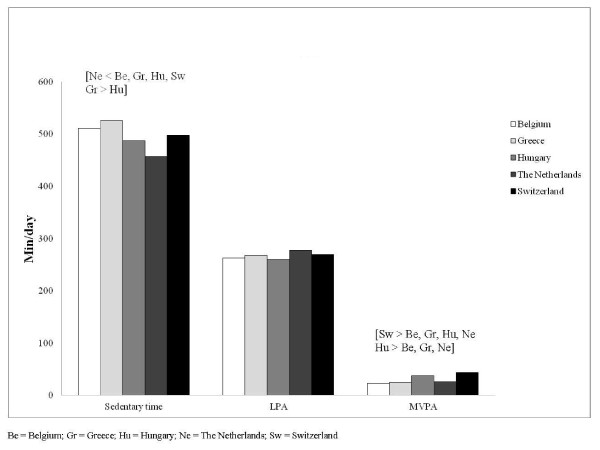
- Greek boys were more sedentary (510 min/day) than other boys, Dutch girls were less sedentary (457 min/day) than other girls, and Swiss girls had more MVPA (43 min/day) than other girls (all at p < 0.05).
- No significant differences were found in LPA between the five countries.
Methods
- Cross-sectional observational study within the ENERGY-project; 686 children (mean age 11.6 ± 0.8 years, 53% girls, mean BMI 19.0 ± 3.4 kg/m²) from Belgium, Greece, Hungary, the Netherlands, and Switzerland.
- Children wore Actigraph accelerometers and were included with at least 2 weekdays of ≥10 h wearing time and 1 weekend day of ≥8 h wearing time; sedentary, LPA, MPA, and VPA were estimated using Treuth cut-points.
- Multivariate analyses of covariance examined differences by gender and country, adjusted for age, month of wearing, accelerometer model, and language spoken at home.
Limitations
- The paper states that accelerometers do not measure arm movement or swimming, do not distinguish lying, sitting, and standing still, and underestimate cycling and some other activities.
- The paper reports a relatively large drop-out of accelerometer data due to insufficient valid days, and notes that dropouts may have been less active or, conversely, more active and inconvenienced by wearing the device.
- The paper notes use of three Actigraph models (GT1M, GT3X, Actitrainer) and that reduced sensitivity in low-count ranges in the GT1M may make it somewhat less suited for monitoring sedentary time and LPA; the cross-sectional design also makes causal inference impossible (evident from the text).
Model-written summary. Check it against the paper before relying on it.
Integrity signals
Registry
Cites
Statistics
Figures
Verification
Claims the paper makes
16 Own result · 13 Not checked yet · 8 Own method · 6 Own interpretation · 3 No basis given
A result the paper reports from its own data — it cites no other source for it, so there is none to check. The quote shows it is in the paper.
In the paper
“For Belgian, Hungarian and Dutch girls, the percentage of girls meeting MVPA recommendations ranged from 1.5 to 2.1%”
§ Levels of physical activity and sedentary time among 10- to 12-year-old boys and girls across 5 European countries using accelerometers: an observational study within the ENERGY-project > Results > MVPA recommendations
plain- Asserted: passes — The authors put it forward as true.
- Checkable: passes — It can be checked against evidence.
- Load-bearing: unclear — It is unclear whether the paper’s conclusions depend on it.
- Based: passes — The paper gives a reason why it holds.
A result the paper reports from its own data — it cites no other source for it, so there is none to check. The quote shows it is in the paper.
In the paper
“Dutch girls were less sedentary (457 minutes/day; all at p < 0.05) than other girls.”
- Also stated in: § Country differences · plain
“Dutch girls were less sedentary than all other girls with an average of 457 minutes per day (all at p < 0.05).”
§ Levels of physical activity and sedentary time among 10- to 12-year-old boys and girls across 5 European countries using accelerometers: an observational study within the ENERGY-project > Abstract > Results
plain- Asserted: passes — The authors put it forward as true.
- Checkable: passes — It can be checked against evidence.
- Load-bearing: unclear — It is unclear whether the paper’s conclusions depend on it.
- Based: passes — The paper gives a reason why it holds.
- Also stated in: § Country differences · plain
A result the paper reports from its own data — it cites no other source for it, so there is none to check. The quote shows it is in the paper.
In the paper
“Swiss girls displayed more moderate-to-vigorous PA (43 minutes/day; at p < 0.05) than other girls.”
- Also stated in: § Country differences · plain
“Swiss girls spent more time in MVPA than all other girls with 43 minutes per day (all at p < 0.05).”
§ Levels of physical activity and sedentary time among 10- to 12-year-old boys and girls across 5 European countries using accelerometers: an observational study within the ENERGY-project > Abstract > Results
plain- Asserted: passes — The authors put it forward as true.
- Checkable: passes — It can be checked against evidence.
- Load-bearing: unclear — It is unclear whether the paper’s conclusions depend on it.
- Based: passes — The paper gives a reason why it holds.
- Also stated in: § Country differences · plain
A result the paper reports from its own data — it cites no other source for it, so there is none to check. The quote shows it is in the paper.
In the paper
“whereas this was 12.5% in Swiss girls.”
§ Levels of physical activity and sedentary time among 10- to 12-year-old boys and girls across 5 European countries using accelerometers: an observational study within the ENERGY-project > Results > MVPA recommendations
plain- Asserted: passes — The authors put it forward as true.
- Checkable: passes — It can be checked against evidence.
- Load-bearing: unclear — It is unclear whether the paper’s conclusions depend on it.
- Based: passes — The paper gives a reason why it holds.
A result the paper reports from its own data — it cites no other source for it, so there is none to check. The quote shows it is in the paper.
In the paper
“compared to 16.8% of the boys (see Table 2)”
- Also stated in: § Results · plain
“4.6% of the girls and 16.8% of the boys met moderate-to-vigorous PA recommendations of at least 60 minutes/day.”
§ Levels of physical activity and sedentary time among 10- to 12-year-old boys and girls across 5 European countries using accelerometers: an observational study within the ENERGY-project > Results > MVPA recommendations
plain- Asserted: passes — The authors put it forward as true.
- Checkable: passes — It can be checked against evidence.
- Load-bearing: unclear — It is unclear whether the paper’s conclusions depend on it.
- Based: passes — The paper gives a reason why it holds.
- Also stated in: § Results · plain
A result the paper reports from its own data — it cites no other source for it, so there is none to check. The quote shows it is in the paper.
In the paper
“and significantly less time in light (267 minutes/day) and moderate-to-vigorous PA (32 minutes/day) than boys (284 minutes/day; 43 minutes/day respectively; p < 0.001).”
§ Levels of physical activity and sedentary time among 10- to 12-year-old boys and girls across 5 European countries using accelerometers: an observational study within the ENERGY-project > Abstract > Results
plain- Asserted: passes — The authors put it forward as true.
- Checkable: passes — It can be checked against evidence.
- Load-bearing: passes — The paper’s conclusions depend on it.
- Based: passes — The paper gives a reason why it holds.
A result the paper reports from its own data — it cites no other source for it, so there is none to check. The quote shows it is in the paper.
In the paper
“In boys, approximately one fourth of the Swiss boys met MVPA recommendations (27.8%).”
§ Levels of physical activity and sedentary time among 10- to 12-year-old boys and girls across 5 European countries using accelerometers: an observational study within the ENERGY-project > Results > MVPA recommendations
hedged- Asserted: passes — The authors put it forward as true.
- Checkable: passes — It can be checked against evidence.
- Load-bearing: unclear — It is unclear whether the paper’s conclusions depend on it.
- Based: passes — The paper gives a reason why it holds.
A result the paper reports from its own data — it cites no other source for it, so there is none to check. The quote shows it is in the paper.
In the paper
“The lowest percentage of boys meeting MVPA recommendations was found in Greece: 9.5%.”
§ Levels of physical activity and sedentary time among 10- to 12-year-old boys and girls across 5 European countries using accelerometers: an observational study within the ENERGY-project > Results > MVPA recommendations
plain- Asserted: passes — The authors put it forward as true.
- Checkable: passes — It can be checked against evidence.
- Load-bearing: unclear — It is unclear whether the paper’s conclusions depend on it.
- Based: passes — The paper gives a reason why it holds.
A result the paper reports from its own data — it cites no other source for it, so there is none to check. The quote shows it is in the paper.
In the paper
“and significantly less time in light (267 minutes/day) and moderate-to-vigorous PA (32 minutes/day) than boys (284 minutes/day; 43 minutes/day respectively; p < 0.001).”
§ Levels of physical activity and sedentary time among 10- to 12-year-old boys and girls across 5 European countries using accelerometers: an observational study within the ENERGY-project > Abstract > Results
plaincorrelational- Asserted: passes — The authors put it forward as true.
- Checkable: passes — It can be checked against evidence.
- Load-bearing: passes — The paper’s conclusions depend on it.
- Based: passes — The paper gives a reason why it holds.
A result the paper reports from its own data — it cites no other source for it, so there is none to check. The quote shows it is in the paper.
In the paper
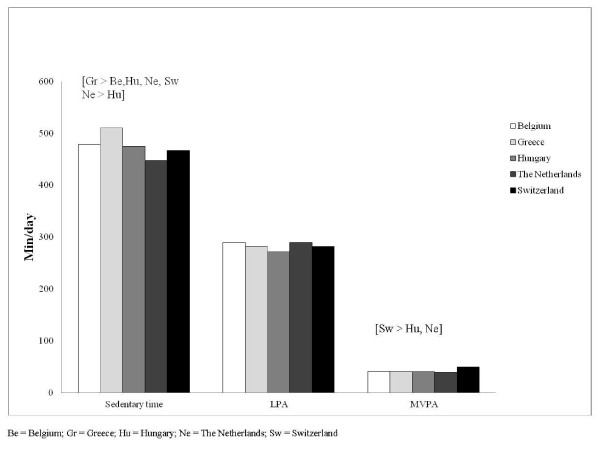
“No significant differences were found in LPA between the five countries.”
§ Levels of physical activity and sedentary time among 10- to 12-year-old boys and girls across 5 European countries using accelerometers: an observational study within the ENERGY-project > Results > Country differences
plain- Asserted: passes — The authors put it forward as true.
- Checkable: passes — It can be checked against evidence.
- Load-bearing: unclear — It is unclear whether the paper’s conclusions depend on it.
- Based: passes — The paper gives a reason why it holds.
- The quote only partly states this claim. 1
- It may state two separate claims as one. 11
- Probably not a substantial claim. 10
A result the paper reports from its own data — it cites no other source for it, so there is none to check. The quote shows it is in the paper.
In the paper
“Girls spent significantly more time sedentary (500 minutes/day) than boys (474 minutes/day)”
- Also stated in: § Gender differences · plain
“After adjusting for age, girls spent significantly more time sedentary and less time in all PA intensities than boys (all at p < 0.001).”
§ Levels of physical activity and sedentary time among 10- to 12-year-old boys and girls across 5 European countries using accelerometers: an observational study within the ENERGY-project > Abstract > Results
plaincorrelational- Asserted: passes — The authors put it forward as true.
- Checkable: passes — It can be checked against evidence.
- Load-bearing: passes — The paper’s conclusions depend on it.
- Based: passes — The paper gives a reason why it holds.
The quote only partly states this claim.
- Also stated in: § Gender differences · plain
A result the paper reports from its own data — it cites no other source for it, so there is none to check. The quote shows it is in the paper.
In the paper
“Greek girls spent the most time sedentary (526 minutes per day), although they did not significantly differ from Belgian (511 minutes per day) and Swiss girls (498 minutes per day).”
§ Levels of physical activity and sedentary time among 10- to 12-year-old boys and girls across 5 European countries using accelerometers: an observational study within the ENERGY-project > Results > Country differences
plain- Asserted: passes — The authors put it forward as true.
- Checkable: passes — It can be checked against evidence.
- Load-bearing: unclear — It is unclear whether the paper’s conclusions depend on it.
- Based: passes — The paper gives a reason why it holds.
It may state two separate claims as one.
A result the paper reports from its own data — it cites no other source for it, so there is none to check. The quote shows it is in the paper.
In the paper
“Swiss boys spent the most minutes in MVPA (50 minutes per day), although they did not significantly differ from Belgian (42 minutes per day) and Greek boys (41 minutes per day).”
§ Levels of physical activity and sedentary time among 10- to 12-year-old boys and girls across 5 European countries using accelerometers: an observational study within the ENERGY-project > Results > Country differences
plain- Asserted: passes — The authors put it forward as true.
- Checkable: passes — It can be checked against evidence.
- Load-bearing: unclear — It is unclear whether the paper’s conclusions depend on it.
- Based: passes — The paper gives a reason why it holds.
It may state two separate claims as one.
A conclusion the paper draws from its own results — it cites no other source for it, so there is none to check. The quote shows it is in the paper.
In the paper
“the current study disclosed some cross-European differences in the levels of sedentary time and PA, possibly due to political and environmental differences.”
§ Levels of physical activity and sedentary time among 10- to 12-year-old boys and girls across 5 European countries using accelerometers: an observational study within the ENERGY-project > Discussion
hedgedconditional- Asserted: passes — The authors put it forward as true.
- Checkable: passes — It can be checked against evidence.
- Load-bearing: passes — The paper’s conclusions depend on it.
- Based: passes — The paper gives a reason why it holds.
It may state two separate claims as one.
- Rests on an assumption: Hungarian and Swiss schools provide three hours of physical education per week, whereas Belgian, Greek and Dutch schools provide two hours per week.
A conclusion the paper draws from its own results — it cites no other source for it, so there is none to check. The quote shows it is in the paper.
In the paper
“Boys did somewhat better than girls, and rather large differences between countries were observed.”
§ Levels of physical activity and sedentary time among 10- to 12-year-old boys and girls across 5 European countries using accelerometers: an observational study within the ENERGY-project > Discussion
plaincorrelational- Asserted: passes — The authors put it forward as true.
- Checkable: passes — It can be checked against evidence.
- Load-bearing: unclear — It is unclear whether the paper’s conclusions depend on it.
- Based: passes — The paper gives a reason why it holds.
It may state two separate claims as one.
A conclusion the paper draws from its own results — it cites no other source for it, so there is none to check. The quote shows it is in the paper.
In the paper
“In conclusion, the present study shows low levels of PA and high sedentary time in schoolchildren in five countries across Europe.”
§ Levels of physical activity and sedentary time among 10- to 12-year-old boys and girls across 5 European countries using accelerometers: an observational study within the ENERGY-project > Conclusion
plain- Asserted: passes — The authors put it forward as true.
- Checkable: passes — It can be checked against evidence.
- Load-bearing: passes — The paper’s conclusions depend on it.
- Based: passes — The paper gives a reason why it holds.
It may state two separate claims as one.
- Rests on an assumption: The sample of children from the selected cities and schools is representative of 10- to 12-year-old children in the five European countries.
- Rests on an assumption: Children who dropped out of the accelerometer data collection did not differ systematically in PA or sedentary time from those included.
None of the sources cited for this claim have been checked yet.
In the paper
“Comparable to previous studies [37-39], the current study established gender differences in both sedentary time and PA across all countries.”
§ Levels of physical activity and sedentary time among 10- to 12-year-old boys and girls across 5 European countries using accelerometers: an observational study within the ENERGY-project > Discussion
What the sources say
- Not checked yetcites [37]
- Not checked yetcites [38]
- Not checked yetcites [39]
plaincorrelational- Asserted: passes — The authors put it forward as true.
- Checkable: passes — It can be checked against evidence.
- Load-bearing: passes — The paper’s conclusions depend on it.
- Based: passes — The paper gives a reason why it holds.
It may state two separate claims as one.
In the paper
“Accelerometry enables distinguishing between different levels of PA (light, moderate, vigorous) and between light PA (LPA) and sedentary time [16].”
§ Levels of physical activity and sedentary time among 10- to 12-year-old boys and girls across 5 European countries using accelerometers: an observational study within the ENERGY-project > Introduction
What the sources say
- Not checked yetcites [16]
plaindirect- Asserted: passes — The authors put it forward as true.
- Checkable: passes — It can be checked against evidence.
- Load-bearing: passes — The paper’s conclusions depend on it.
- Based: passes — The paper gives a reason why it holds.
It may state two separate claims as one.
In the paper
“In general, Actigraph accelerometers have shown adequate reproducibility, validity and feasibility in children and adolescents [23].”
§ Levels of physical activity and sedentary time among 10- to 12-year-old boys and girls across 5 European countries using accelerometers: an observational study within the ENERGY-project > Methods > Measurement
What the sources say
- Not checked yetcites [23]
plain- Asserted: passes — The authors put it forward as true.
- Checkable: passes — It can be checked against evidence.
- Load-bearing: passes — The paper’s conclusions depend on it.
- Based: passes — The paper gives a reason why it holds.
Probably not a substantial claim.
What the paper did — it cites no source for this, so there is none to check. The quote shows it is in the paper.
In the paper
“accelerometers do not measure arm movement or swimming activities, do not distinguish between lying, sitting and standing still and underestimate the intensity of cycling and some other activities.”
§ Levels of physical activity and sedentary time among 10- to 12-year-old boys and girls across 5 European countries using accelerometers: an observational study within the ENERGY-project > Discussion
plain- Asserted: passes — The authors put it forward as true.
- Checkable: passes — It can be checked against evidence.
- Load-bearing: passes — The paper’s conclusions depend on it.
- Based: fails — The paper may give no reason why it holds.
Probably not a substantial claim. The paper may give no reason why it holds. It may state two separate claims as one.
What the paper did — it cites no source for this, so there is none to check. The quote shows it is in the paper.
In the paper
“Researchers responsible for the accelerometer data collection were trained to work according to a standardized accelerometer protocol.”
§ Levels of physical activity and sedentary time among 10- to 12-year-old boys and girls across 5 European countries using accelerometers: an observational study within the ENERGY-project > Methods > Measurement
plain- Asserted: passes — The authors put it forward as true.
- Checkable: passes — It can be checked against evidence.
- Load-bearing: fails — The paper’s conclusions may not depend on it.
- Based: passes — The paper gives a reason why it holds.
Probably not a substantial claim. The paper’s conclusions may not depend on it.
What the paper did — it cites no source for this, so there is none to check. The quote shows it is in the paper.
In the paper
“A final possible limitation is the use of three different models of Actigraph accelerometers (GT1M, GT3X and Actitrainer).”
§ Levels of physical activity and sedentary time among 10- to 12-year-old boys and girls across 5 European countries using accelerometers: an observational study within the ENERGY-project > Discussion
hedged- Asserted: passes — The authors put it forward as true.
- Checkable: passes — It can be checked against evidence.
- Load-bearing: fails — The paper’s conclusions may not depend on it.
- Based: passes — The paper gives a reason why it holds.
Probably not a substantial claim. The paper’s conclusions may not depend on it.
None of the sources cited for this claim have been checked yet.
In the paper
“Moreover, recent studies showed that both behaviours independently contribute to the development of chronic diseases and overweight and obesity [9-12].”
§ Levels of physical activity and sedentary time among 10- to 12-year-old boys and girls across 5 European countries using accelerometers: an observational study within the ENERGY-project > Introduction
What the sources say
- Not checked yetcites [9]
- Not checked yetcites [10]
- Not checked yetcites [11]
- Not checked yetcites [12]
plaindirect- Asserted: passes — The authors put it forward as true.
- Checkable: passes — It can be checked against evidence.
- Load-bearing: passes — The paper’s conclusions depend on it.
- Based: passes — The paper gives a reason why it holds.
It may state two separate claims as one.
What the paper did — it cites no source for this, so there is none to check. The quote shows it is in the paper.
In the paper
“Four covariates were included: (a) age, (b) month of wearing the accelerometer (since Switzerland has started somewhat later with the accelerometer data collection), (c) accelerometer model (since different accelerometer models were used across countries) and (d) language spoken at home (native vs. non-native) as an indicator of ethnicity.”
§ Levels of physical activity and sedentary time among 10- to 12-year-old boys and girls across 5 European countries using accelerometers: an observational study within the ENERGY-project > Methods > Statistical analyses
plain- Asserted: passes — The authors put it forward as true.
- Checkable: passes — It can be checked against evidence.
- Load-bearing: passes — The paper’s conclusions depend on it.
- Based: passes — The paper gives a reason why it holds.
Probably not a substantial claim.
What the paper did — it cites no source for this, so there is none to check. The quote shows it is in the paper.
In the paper
“Children were included in the study if they had at least 2 weekdays with minimum 10 h-wearing time and 1 weekend day with minimum 8 h-wearing time.”
§ Levels of physical activity and sedentary time among 10- to 12-year-old boys and girls across 5 European countries using accelerometers: an observational study within the ENERGY-project > Methods > Measurement
plain- Asserted: passes — The authors put it forward as true.
- Checkable: passes — It can be checked against evidence.
- Load-bearing: passes — The paper’s conclusions depend on it.
- Based: passes — The paper gives a reason why it holds.
Probably not a substantial claim.
None of the sources cited for this claim have been checked yet.
In the paper
“Physical activity (PA) is important for physical and mental health, and is acknowledged as an important target in obesity prevention [1-3].”
§ Levels of physical activity and sedentary time among 10- to 12-year-old boys and girls across 5 European countries using accelerometers: an observational study within the ENERGY-project > Introduction
What the sources say
- Not checked yetcites [1]
- Not checked yetcites [2]
- Not checked yetcites [3]
plain- Asserted: passes — The authors put it forward as true.
- Checkable: fails — It may be too vague to check against evidence.
- Load-bearing: fails — The paper’s conclusions may not depend on it.
- Based: passes — The paper gives a reason why it holds.
Probably not a substantial claim. It may be too vague to check against evidence. The paper’s conclusions may not depend on it. It may state two separate claims as one.
None of the sources cited for this claim have been checked yet.
In the paper
“Accelerometers are considered valid and reliable instruments and feasible to use in large-scale observational and intervention studies [14,15].”
§ Levels of physical activity and sedentary time among 10- to 12-year-old boys and girls across 5 European countries using accelerometers: an observational study within the ENERGY-project > Introduction
What the sources say
- Not checked yetcites [14]
- Not checked yetcites [15]
plain- Asserted: passes — The authors put it forward as true.
- Checkable: passes — It can be checked against evidence.
- Load-bearing: passes — The paper’s conclusions depend on it.
- Based: passes — The paper gives a reason why it holds.
It may state two separate claims as one.
None of the sources cited for this claim have been checked yet.
In the paper
“According to this evidence, it has been recommended for children to participate in at least 60 minutes per day moderate-to-vigorous intensity PA (MVPA) [4-6].”
§ Levels of physical activity and sedentary time among 10- to 12-year-old boys and girls across 5 European countries using accelerometers: an observational study within the ENERGY-project > Introduction
What the sources say
- Not checked yetcites [4]
- Not checked yetcites [5]
- Not checked yetcites [6]
plain- Asserted: passes — The authors put it forward as true.
- Checkable: passes — It can be checked against evidence.
- Load-bearing: passes — The paper’s conclusions depend on it.
- Based: passes — The paper gives a reason why it holds.
Probably not a substantial claim.
In the paper
“A recent study of Trost et al. [30] stated that the cut-point of 100 cpm for sedentary time exhibited good to excellent classification accuracy.”
§ Levels of physical activity and sedentary time among 10- to 12-year-old boys and girls across 5 European countries using accelerometers: an observational study within the ENERGY-project > Methods > Measurement
What the sources say
- Not checked yetcites [30]
plain- Asserted: passes — The authors put it forward as true.
- Checkable: passes — It can be checked against evidence.
- Load-bearing: fails — The paper’s conclusions may not depend on it.
- Based: passes — The paper gives a reason why it holds.
Probably not a substantial claim. The paper’s conclusions may not depend on it.
In the paper
“Reilly et al. [29] suggested that the most appropriate cut-point for MPA lies in the range 3000-3600 cpm.”
§ Levels of physical activity and sedentary time among 10- to 12-year-old boys and girls across 5 European countries using accelerometers: an observational study within the ENERGY-project > Methods > Measurement
What the sources say
- Not checked yetcites [29]
hedged- Asserted: fails — The authors may not put it forward as true.
- Checkable: passes — It can be checked against evidence.
- Load-bearing: fails — The paper’s conclusions may not depend on it.
- Based: passes — The paper gives a reason why it holds.
Probably not a substantial claim. The authors may not put it forward as true. The paper’s conclusions may not depend on it.
The paper relies on this without support.
The sample of children from the selected cities and schools is representative of 10- to 12-year-old children in the five European countries.
“representative samples of 10- to 12-year-old children across five countries in Europe”
The paper relies on this without support.
Children who dropped out of the accelerometer data collection did not differ systematically in PA or sedentary time from those included.
“It is possible that the children who dropped out were less physically active and not interested in wearing an accelerometer or conversely, were more active and experienced the accelerometer as an inconvenience during exercise.”
The paper relies on this without support.
There are no policy measures in the European countries with regard to sedentary time.
“To our knowledge, there are no policy measures in the European countries with regard to sedentary time.”
The paper relies on this without support.
Hungarian and Swiss schools provide three hours of physical education per week, whereas Belgian, Greek and Dutch schools provide two hours per week.
“e.g. Hungarian and Swiss schools provide three hours of physical education per week, whereas Belgian, Greek and Dutch schools provide two hours per week.”
Claims other papers make about this one
Each is checked against this paper’s own text: does it say what the citing paper says it does?
In the citing paper
“some studies indicate that most children spend a large proportion of their awake time being active at low levels of intensity [39–41], especially girls [40].”
From Proportion of children meeting recommendations for 24-hour movement guidelines and associations with adiposity in a 12-country study (2016) · cites this paper as [41]
In the citing paper
“suggesting that sex and age differences that are typically observed in sitting time [33, 34] may be exacerbated during the COVID-19 pandemic”
From Early effects of the COVID-19 pandemic on physical activity and sedentary behavior in children living in the U.S. (2020) · cites this paper as [34]
Self-check
Percentages, sums and reported differences re-computed from the paper’s own numbers.
Each contradiction between two passages listed here was confirmed by an independent check.
Rated minor: it would not touch a result — a value no result rests on, a p-value that stays on the same side of the significance level, or a conflict that is clerical, resolved elsewhere in the paper, or outside its own findings.
In the paper
§ Levels of physical activity and sedentary time among 10- to 12-year-old boys and girls across 5 European countries using accelerometers: an observational study within the ENERGY-project > Methods > Measurement
“| Total sample (n = 687) | 33% | 43% | 24% |”
§ Levels of physical activity and sedentary time among 10- to 12-year-old boys and girls across 5 European countries using accelerometers: an observational study within the ENERGY-project > Methods > Measurement
“| Belgium (n = 109) | 0% | 96% | 4% | | Greece (n = 142) | 0% | 0% | 100% | | Hungary (n = 140) | 67% | 0% | 33% | | The Netherlands (n = 104) | 0% | 0% | 100% | | Switzerland (n = 192) | 37% | 63% | 0% |”
Citations
Cites
Physical Activity in the United States Measured by Accelerometer
TROIANO, R. P., BERRIGAN, D., DODD, K. W., MÂSSE, L. C., TILERT, T., & MCDOWELL, M. (2008) · Medicine & Science in Sports & Exercise · doi:10.1249/mss.0b013e31815a51b3 · Cited by 7,638 · cited 1×
“We specifically focused on 10- to 12-year-old children since the transition from childhood to adolescence represents a critical period for declining PA levels and increasing sedentary time [18,19].”
BackgroundJanssen, I., & LeBlanc, A. G. (2010) · International Journal of Behavioral Nutrition and Physical Activity · doi:10.1186/1479-5868-7-40 · Cited by 4,829 · cited 1×
“According to this evidence, it has been recommended for children to participate in at least 60 minutes per day moderate-to-vigorous intensity PA (MVPA) [4-6].”
BackgroundEvidence Based Physical Activity for School-age Youth
Strong, W. B., Malina, R. M., Blimkie, C. J. R., Daniels, S. R., Dishman, R. K., Gutin, B., Hergenroeder, A. C., Must, A., Nixon, P. A., Pivarnik, J. M., et al. (2005) · The Journal of Pediatrics · doi:10.1016/j.jpeds.2005.01.055 · Cited by 4,222 · cited 1×
“According to this evidence, it has been recommended for children to participate in at least 60 minutes per day moderate-to-vigorous intensity PA (MVPA) [4-6].”
BackgroundAndersen, L. B., Harro, M., Sardinha, L. B., Froberg, K., Ekelund, U., Brage, S., & Anderssen, S. A. (2006) · The Lancet · doi:10.1016/s0140-6736(06)69075-2 · Cited by 1,518 · cited 1×
“Physical activity (PA) is important for physical and mental health, and is acknowledged as an important target in obesity prevention [1-3].”
BackgroundAge and gender differences in objectively measured physical activity in youth
Trost, S. G., PATE, R. R., Sallis, J. F., Freedson, P., Taylor, W. C., Dowda, M. C., & Sirard, J. R. (2002) · Medicine & Science in Sports & Exercise · doi:10.1097/00005768-200202000-00025 · Cited by 1,451 · cited 1×
“Comparable to previous studies [37-39], the current study established gender differences in both sedentary time and PA across all countries.”
ResultComparison of Accelerometer Cut Points for Predicting Activity Intensity in Youth
TROST, S. G., LOPRINZI, P. D., MOORE, R., & PFEIFFER, K. A. (2011) · Medicine & Science in Sports & Exercise · doi:10.1249/mss.0b013e318206476e · Cited by 1,360 · cited 1×
“[30] stated that the cut-point of 100 cpm for sedentary time exhibited good to excellent classification accuracy.”
BackgroundThe evolving definition of “sedentary.”
Pate, R. R., O'Neill, J. R., & Lobelo, F. (2008) · Exercise and Sport Sciences Reviews · doi:10.1097/jes.0b013e3181877d1a · Cited by 1,280 · cited 2×
“Accelerometry enables distinguishing between different levels of PA (light, moderate, vigorous) and between light PA (LPA) and sedentary time [16].”
BackgroundJanssen, I., Katzmarzyk, P. T., Boyce, W. F., Vereecken, C., Mulvihill, C., Roberts, C., Currie, C., Pickett, W., & The Health Behaviour in School‐Aged Children Obesity Working Group (2005) · Obesity Reviews · doi:10.1111/j.1467-789x.2005.00176.x · Cited by 1,169
The level and tempo of children???s physical activities: an observational study
Bailey, R. C., Olson, J., Pepper, S. L., Pórszász, J., Barstow, T. J., & Cooper, D. M. (1995) · Medicine & Science in Sports & Exercise · doi:10.1249/00005768-199507000-00012 · Cited by 978 · cited 1×
“A 15-sec recording epoch was selected in order to capture short duration PA of high intensity [25,26].”
MethodPhysical activity levels and patterns of 9- and 15-yr-old European children
RIDDOCH, C. J., BO ANDERSEN, L., WEDDERKOPP, N., HARRO, M., KLASSON-HEGGEBØ, L., SARDINHA, L. B., COOPER, A. R., & EKELUND, U. (2004) · Medicine & Science in Sports & Exercise · doi:10.1249/01.mss.0000106174.43932.92 · Cited by 900 · cited 2×
“One previous study, as part of the European Youth Heart Study, has compared MVPA levels of children across four European countries using accelerometers [17].”
Background
Cited by
Sorted by citations
Items 201–254 of 254
Propiedades Psicométricas de la BPNES Adaptada a la Educación Física en Argentina, España y Colombia
Álvarez, E. F., López, J. C., Gómez, V., & Brito, J. (2017) · Revista Evaluar · doi:10.35670/1667-4545.v17.n2.18724 · Cited by 3
Morphological indicators of physical activity in modern student youth
Sineva, I. M., Николаевна, З. С., Permyakova, E. Y., Khafizova, A. A., Iudina, A. M., & Negasheva, M. A. (2020) · Moscow University Anthropology Bulletin (Vestnik Moskovskogo Universiteta Seria XXIII Antropologia) · doi:10.32521/2074-8132.2020.1.005-015 · Cited by 3
The effects of lifestyle changes on serum lipid levels in children in a real life setting
Opina, A. D., Cephus, C. E., Wang, Y., Younan, S. A., & Moodie, D. S. (2018) · Congenital Heart Disease · doi:10.1111/chd.12580 · Cited by 3
Sedentary Behaviors in Children and Adolescents: What Is the Influence on Bone Strength?
Higgins, S., Belcher, S. L., & Lewis, R. D. (2018) · Springer eBooks · doi:10.1007/978-3-319-98464-3_9 · Cited by 3
Álvarez, E. F., López, J. C., & Martínez, H. A. (2019) · Diversitas · doi:10.15332/s1794-9998.2019.0001.04 · Cited by 3
Niklasson, M. (2013) · KTH Publication Database DiVA (KTH Royal Institute of Technology) · Cited by 3
Bombaci, B., Passanisi, S., Torre, A., Sbilordo, S., Ini’, E., Papa, M., Valenzise, M., Lombardo, F., & Salzano, G. (2025) · Diabetology · doi:10.3390/diabetology6090090 · Cited by 6
A cross-cultural study of physical activity and sedentariness in youth from Mozambique and Portugal
dos Santos, F. K., Prista, A., Gomes, T. N., de Souza, M. C., Tchonga, F., Damasceno, A., Katzmarzyk, P. T., & Maia, J. A. R. (2017) · Motriz Revista de Educação Física · doi:10.1590/s1980-6574201700si0087 · Cited by 2
Los efectos neurofisiológicos de la actividad física en los niños: revisión sistemática
Vaquerizo, E. J. (2022) · Revista Iberoamericana de Ciencias de la Actividad Física y el Deporte · doi:10.24310/riccafd.2022.v11i2.14533 · Cited by 2
Ludyga, S., Hanke, M., Schwarz, A., Leuenberger, R., Bruggisser, F., Looser, V. N., & Gerber, M. (2024) · Chronic Stress · doi:10.1177/24705470241261581 · Cited by 2
Wong, J. E., Palarea‐Albaladejo, J., Lee, S. T., Koh, D., Khouw, I. M. S. L., Poh, B. K., & _, _. (2024) · Journal of Physical Activity and Health · doi:10.1123/jpah.2024-0161 · Cited by 3
Pelemiš, V. M., Pavlović, S. L., Mitrović, N., Nikolić, I. A., Stević, D., & Trajković, N. (2024) · Journal of Functional Morphology and Kinesiology · doi:10.3390/jfmk9040220 · Cited by 3
Just Dance? Teachers Perspectives on Implementing a Daily Classroom Physical Activity Break
Janssen, M., van den Berg, V., de Groot, A., & Singh, A. S. (2020) · Translational Journal of the American College of Sports Medicine · doi:10.1249/tjx.0000000000000128 · Cited by 2
“Accelerometer-based data suggest that these percentages are actually much lower among 10- to 12-yr-old boys and girls (3), indicating the need for interventions successfully promoting PA among this age-group.”
BackgroundSánchez López, M., & Martínez Vizcaíno, V. (2021) · Divulgatio · doi:10.18239/divulga_2021.12.00 · Cited by 2
The assessment of physical activity
Hildebrand, M., & Ekelund, U. (2017) · Oxford University Press eBooks · doi:10.1093/med/9780198757672.003.0021 · Cited by 3
Rodríguez-Maimón, M. G. (2023) · Retos · doi:10.47197/retos.v48.95725 · Cited by 2
Type of recess and its influence on girls physical activity levels
Martínez, M. H., García-Jiménez, J. V., García-Pellicer, J. J., et al. (2023) · Retos · doi:10.47197/retos.v51.100958 · Cited by 2
Haapala, E. A. (2015) · UEF eRepo (University of Eastern Finland) · Cited by 2
Udeskole—Pupils’ Physical Activity and Gender Perspectives
Mygind, E. (2022) · Springer eBooks · doi:10.1007/978-3-031-04108-2_7 · Cited by 2
Toscani, A., & Pedersen, A. V. (2024) · Frontiers in Sports and Active Living · doi:10.3389/fspor.2024.1383575 · Cited by 1
Cai, Z., Herold, F., Zhou, L., Lubans, D. R., Gerber, M., Chen, J., Werneck, A. O., Pan, S., Aikeremu, A., Mavilidi, M. F., et al. (2026) · Mental health and physical activity · doi:10.1016/j.mhpa.2026.100795 · Cited by 1
Batalau, R., Cruz, J., Gonçalves, R., Santos, M., Leal, J., & Palmeira, A. L. (2017) · Motriz Revista de Educação Física · doi:10.1590/s1980-6574201700020005 · Cited by 1
Gourlan, M., Takito, M. Y., Lambert, C., Fregeac, B., Alméras, N., Coste, O., Pereira, B., & Cousson‐Gélie, F. (2018) · International Quarterly of Community Health Education · doi:10.1177/0272684x17749563 · Cited by 1
Weekday and weekend days correlates of sedentary time and screen-Based behaviors in children
Calvo, J. M. F., Solana, A. A., Bernalte, E. I., Lanaspa, E. G., & Casterad, J. Z. (2018) · Zaguan (University of Zaragoza Repository) · Cited by 3
Matejek, Č., & Planinšec, J. (2022) · Croatian Journal of Education - Hrvatski časopis za odgoj i obrazovanje · doi:10.15516/cje.v24i1.4231 · Cited by 5
“Studies show that there are still many children who are not physically active enough (Verloigne et al., 2012), which means that there are still many children with a predominant sedentary lifestyle who are not fit, so it is important to enable them to get involved in appropriate intervention…”
BackgroundDing, H., Jiang, L., Seo, H., & Chun, B. (2025) · Journal of Sports Sciences · doi:10.1080/02640414.2025.2547160 · Cited by 2
“Sex-specific analyses have consistently shown that girls engage in lower levels of PA and accumulate more sedentary time compared to boys (Patnode et al., 2010; Telford et al., 2016; Verloigne et al., 2012).”
Use Accelerometer to Monitoring the Exercise Status: Held the Push-Ups Movement as an Example
Chen, Y., Sha, L.-W., & Chiu, W. (2020) · Smart innovation, systems and technologies · doi:10.1007/978-981-15-4917-5_4 · Cited by 1
Prediction Model for Physical Activity Level in Primary School Students
Villaverde, M. A., Martínez, J. M., Toja-Reboredo, B., & Valeiro, M. G. (2022) · International Journal of Environmental Research and Public Health · doi:10.3390/ijerph19052987 · Cited by 1
“The physical activity level (PAL) is higher in boys than in girls [7,8].”
BackgroundBecker, C., Schmidt, S., Neuberger, E. W. I., Kirsch, P., Simon, P. D., & Dettweiler, U. (2018) · Preprints.org · doi:10.20944/preprints201804.0182.v1 · Cited by 1
South County Food, Fitness, and Fun Program: A Comprehensive Intervention on Childhood Obesity
Tassoni, A. (2013) · doi:10.23860/thesis-tassoni-amanda-2013
“The Actigraph GT3X is a triaxial accelerometer that has shown adequate reproducibility, validity and feasibility in children and adolescents (De Vries et al., 2006) Verloigne et al., 2012) (Yildirim et al., 2011).”
MethodProtzner, A., Trájer, E., Bosnyák, E., Udvardy, A., Szőts, G., Tóth, M., & Szmodis, M. (2015) · European Scientific Journal ESJ
Distribuzione del grasso corporeo e attività fisica in bambini italiani
Toselli, S., Brasili, P., & Michele, R. D. (2014)
Feasibility and Evaluation of an After-School Jump Rope Program
Albers, J. (2015) · University of Minnesota Digital Conservancy (University of Minnesota)
Childhood obesity in Ireland: recent trends and modifiable determinants
Keane, E. (2014) · Cork Open Research Archive (University College Cork, Ireland)
Álvarez, E. F. (2015) · UPM Digital Archive (Technical University of Madrid) · doi:10.20868/upm.thesis.39647
Cañada, F. C., Torres‐Luque, G., Fernández, I. L., & Carnero, E. Á. (2014)
Kann, V. (2017) · Research Publications (Maastricht University) · doi:10.26481/dis.20170309dvk
Physical Activity and Sedentary Behaviors
Cadieux, A. M. (2017) · Springer eBooks · doi:10.1007/978-3-319-55924-7_4
de Jaén, U., Suárez-Manzano, S., Ruiz‐Ariza, A., López-Serrano, S., & López, E. J. M. (2017) · MLS Educational Research · doi:10.29314/mlser.v1i1.21 · Cited by 1
Sport Parents’ Perspectives of Children’s Free Play and Sport and their Accompanying Messages
Watchman, T. (2017) · ERA: Education and Research Archive (University of Alberta) · doi:10.7939/r3g737g5b
Barbosa, J. P. D. A. S., Gomes, T. N., Forjaz, C. L. M., & Maia, J. A. R. (2018) · Revista Brasileira de Educação Física e Esporte · doi:10.11606/1807-5509201700020505
Executive function, intent to exercise, and consideration of future consequences: A mediation model
Simmons, C. S. (2019) · ThinkTech (Texas Tech University)
Borges, A. (2014) · Portuguese National Funding Agency for Science, Research and Technology (RCAAP Project by FCT) · doi:10.34626/86ha-bk66
de Bruijn, A. G. M. (2020) · Neuropraxis · doi:10.1007/s12474-020-00248-1
O’Loughlin, E. K. (2019) · Spectrum Research Repository (Concordia University)
Ré, A. H. N., Feitoza, A. H. P., Monteiro, C. B. D. M., da Silva, E., Tudela, M. C., & Cattuzzo, M. T. (2019) · Revista Brasileira de Educação Física e Esporte · doi:10.11606/issn.1981-4690.v33i1p49-59
“Final de semana 49,8 (22,7)a, b 18,2 109,3 70,8 (32,9)a, b 20,0 150,9 61,5 (30,6)b”
Ali, S. (2015) · UEF eRepo (University of Eastern Finland) · doi:10.13140/rg.2.1.2654.8327
Dynamization of the Recesses of Children of 3, 4, and 5 Years
Martínez-Martínez, J. (2021) · Advances in early childhood and K-12 education · doi:10.4018/978-1-7998-7585-7.ch014
Assessment of physical activity behaviours: methods, levels, and time trends
Dalene, K. E., & Ekelund, U. (2023) · Oxford University Press eBooks · doi:10.1093/med/9780192843968.003.0015 · Cited by 1
Masini, A., Sanmarchi, F., & Dallolio, L. (2024) · Elsevier eBooks · doi:10.1016/b978-0-323-95650-5.00006-9
Opportunities for Enhancing Motor Behavior through Physical Education at School
Flôres, F. S. (2024) · Education and human development · doi:10.5772/intechopen.1007094
Bernal, C. M. M. (2020) · theses.fr (ABES) · doi:10.70675/fbf2f2f2z3773z49c7zab5dz8e20a3c8eedf
Metadata
- Authors
- Verloigne, M., Van Lippevelde, W., Maes, L., Yildirim, M., Chinapaw, M., Manios, Y., Androutsos, O., Kovacs, E., Bringolf-Isler, B., Brug, J., & De Bourdeaudhuij, I.
- Affiliations
- Ghent University (BE)
- Amsterdam Public Health (NL)
- Harokopio University of Athens (GR)
- University of Pecs (HU)
- Venue
- International Journal of Behavioral Nutrition and Physical Activity
- Published
- 2012
- Volume
- 9
- Issue
- 1
- Pages
- 34
- ISSN
- 1479-5868 (ISSN-L)
- PMC
- PMC3359200
- OpenAlex
- W2137633832
- Semantic Scholar
- e6c957695ff0b20f020e7cdaba54ac13cdfc7708
- Cited by
- 258
- References
- 48
- Citations by year
- 2026: 2 · 2025: 3 · 2024: 11 · 2023: 7 · 2022: 17 · 2021: 20 · 2020: 27 · 2019: 15 · 2018: 26 · 2017: 28 · 2016: 27 · 2015: 24 · 2014: 27 · 2013: 22 · 2012: 2
- FWCI
- 16.08
- Type
- journal article
- Language
- en
- Open access
- gold
- doi.org
- Licence
- cc-by
- Locations
- International Journal of Behavioral Nutrition and Physical Activity (publishedVersion, cc-by)
- Europe PMC (PubMed Central) (publishedVersion, cc-by)
- PubMed Central (publishedVersion, cc-by)
- PubMed (publishedVersion)
- Pure Amsterdam UMC (publishedVersion, other-oa)
- Amsterdam UMC (VU Amsterdam) - Institutional Repository (publishedVersion, other-oa)
- edoc (University of Basel) (acceptedVersion)
- Data Archiving and Networked Services (DANS) (submittedVersion, other-oa)
- Ghent University Academic Bibliography (Ghent University) (submittedVersion, other-oa)
- Digital Academic REpository of VU University Amsterdam (Vrije Universiteit Amsterdam) (submittedVersion)
- DOAJ (DOAJ: Directory of Open Access Journals) (submittedVersion, cc-by-sa)
- Open access LMU (Ludwid Maxmilian's Universitat Munchen) (submittedVersion)
- edoc (University of Basel)
- Funders
- European Commission (FP7-HEALTH-2007-B, 223254)
- Bundesamt für Gesundheit
- Bundesamt für Sport
- World Cancer Research Fund
- FP7 Health
- Topics
- Health Sciences › Medicine › Public Health, Environmental and Occupational Health › Physical Activity and Health
- Health Sciences › Medicine › Public Health, Environmental and Occupational Health › Obesity, Physical Activity, Diet
- Social Sciences › Life-span and Life-course Studies › Recreational Sport and Physical Activity
- Keywords
- physical activity, sedentary time, children, moderate-to-vigorous physical activity, light physical activity, sex differences, cross-national comparison, accelerometer-measured activity, physical activity guidelines, obesity prevention, energy projects
- MeSH terms
- Anthropometry, Belgium, Child, Cross-Sectional Studies, Female, Greece, Humans, Hungary, Male, Motor Activity, Netherlands, Obesity, Sex Factors, Switzerland, Multivariate Analysis, Sedentary Behavior
About these checks
Registry, retraction, Cites and statistics results are computed, not judged, with one exception: a printed reference that no index lists is read once by a model before it counts as a citation error. Claims are extracted by a model and kept only when their quote appears verbatim in the text; each cited source is then checked, with a model’s help, for whether it says what the claim relies on. Those verdicts can be wrong — read the claim’s quote and the cited source before relying on one.
A language model drew the claims from the paper on 2026-10-10, under version 3 of the claim definition (model deepseek-v4.1-flash, prompt extract-v3).
A second model labelled each claim on 2026-10-10 (model jev-1.13-20260917, definition revision gold-guideline-v0.2).
Statistics and arithmetic are recomputed, not judged.
Confidence bands are shown only for fields calibrated on our annotated test set. None is calibrated yet, so no band is shown.
What counts as a claim ›How we measure confidence ›How we check this ›
Are you an author, or do you see a problem with this page? Request a review
