

Exercise, physical activity, and self-determination theory: A systematic review
Open accessThe DOI matches its Crossref record; 108 of the 110 references it cites were found in a registry or an index; 6 of the 97 sources its claims cite were checked for support.
Abstract
Systematic review of 66 empirical studies on self-determination theory constructs and exercise outcomes.
Overview
CoChat Summary
## TL;DR
This systematic review synthesized 66 empirical studies on self-determination theory (SDT) and exercise/physical activity published up to June 2011. It found the most consistent support for autonomous motivation—especially identified and intrinsic regulation—and for competence satisfaction and intrinsic motives as positive predictors of exercise participation.
## Key findings
- Across 66 studies comprising 72 independent samples, the review found consistent positive associations between more autonomous forms of motivation and exercise; for example, 37 of 42 cross-sectional studies, 10 prospective studies, 7 experimental studies, and 2 mixed designs were represented among the regulation studies.
- Identified regulation showed positive associations with exercise in 28 samples (74%) in multivariate analyses and 22 samples (85%) in bivariate analyses; intrinsic motivation was positively associated in 23 or 22 samples (62% or 92%) depending on analysis type, and no study reported negative associations for intrinsic motivation.
- Competence satisfaction was the most frequently assessed basic need and was positively associated with physical activity in 56% of independent samples in multivariate analysis and 92% in correlational analysis; relatedness showed no positive multivariate association with exercise (K = 4, 100% no association).
- In SDT-based interventions, 7 interventions were identified and 6 (86%) found significant differences favoring the SDT group for perceived autonomy support, need satisfaction, autonomous and introjected regulations, and self-reported exercise; in the longest trial, only autonomous regulations mediated long-term exercise effects.
## Methods
- Systematic review of empirical SDT–exercise studies published up to June 2011; searches were run in PsycINFO and SportDiscus for studies from 1960 to June 2011, limited to English-language, peer-reviewed journal articles on adult, non-athletic samples.
- Included 66 studies / 72 independent samples with experimental, cross-sectional, prospective, and mixed designs; outcomes included actual or self-reported exercise/physical activity, attendance, relapse, dropout, and stages of change.
- Evidence was summarized quantitatively by counting independent samples showing significant positive, negative, or null associations; the unit of analysis was the independent sample, and significance was set at 0.05.
## Limitations
- The paper states that it was limited to English-language, peer-reviewed articles and excluded gray literature, unpublished studies, non-English publications, non-adult samples, adolescents/children, and competitive athletic samples.
- The authors state that classifying and quantifying results was “somewhat arbitrary,” that only direct paths were evaluated, and that lumping together self-report and direct measures, attendance, and stages of change is “clearly not without reproach.”
- Evident from the text: most included studies were descriptive/non-experimental and many samples were mixed, so causal inference and subgroup-specific conclusions are limited.
Model-written summary. Check it against the paper before relying on it.
Integrity signals
Registry
Cites
Statistics
Figures
Verification
Claims the paper makes
3 Valid · 5 Not valid · 58 Not checked · 143 Own results and interpretations
The cited sources support only part of this claim — read each source’s verdict below.
In the paper
“Satisfaction of these basic needs results in increased feelings of vitality and well-being [15].”
§ Exercise, physical activity, and self-determination theory: A systematic review > Introduction
What the sources say
- Partly supportedcites [15] matched to “Testing a self‐determination theory‐based teaching style intervention in the exercise domain” (2008) sourceExperimental — accuracy not yet measured
The discussion of basic psychological need satisfaction (p. 5) says that satisfying needs, together with more autonomous motivation, is expected to produce adaptive affective responses. The findings (p. 24) link competence need satisfaction to less negative affect. Neither passage establishes that need satisfaction results in increased vitality or well-being specifically, and the claim states the relationship more definitively than the paper does. (LLM, conf=0.84)
plainstates a cause- Asserted: passes — The authors put it forward as true.
- Checkable: passes — It can be checked against evidence.
- Load-bearing: passes — The paper’s conclusions depend on it.
- Based: passes — The paper gives a reason why it holds.
- Partly supported
The cited sources support only part of this claim — read each source’s verdict below.
In the paper
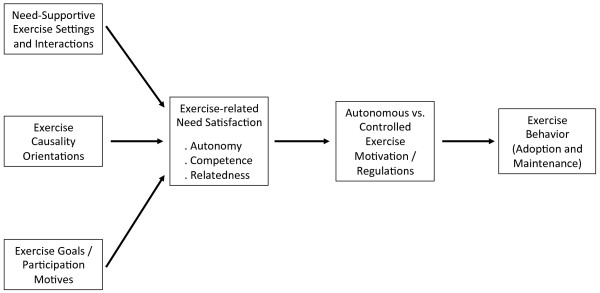
“Relations from perceived autonomy support to exercise behavior, via psychological needs and regulatory styles have been tested (in part or all) in several studies and in general these confirm the proposed sequences [17,44,43,77,76,38,33].”
§ Exercise, physical activity, and self-determination theory: A systematic review > Discussion > Need satisfaction and exercise
What the sources say
- Supportedcites [17] matched to “Exercise motivation: a cross-sectional analysis examining its relationships with frequency, intensity, and duration of exercise” (2010) source
The Background (page unavailable) says the study tested relationships between behavioral regulations and exercise frequency, intensity, and duration—one part of the proposed sequence. The Results (page unavailable) report that all three exercise indices correlated more strongly with autonomous than controlling regulations, broadly supporting the sequence. The citing sentence expressly allows studies to have tested it only “in part.” (LLM, conf=0.87)
- Partly supportedcites [44] matched to “Mediators of physical activity behaviour change among adult non-clinical populations: a review update” (2010) sourceExperimental — accuracy not yet measured
The Results section (‘Evidence of Mediation by Theory’; page not provided) reports support in one study for a link between autonomy support and physical activity. But the other self-determination-theory study found no changes in its constructs or behavior, and neither established the proposed sequence through psychological needs and regulatory styles. The review therefore does not support saying that the studies generally confirmed that sequence. (LLM, conf=0.88)
- Not checked — no full text of the sourcecites [43] matched to “The Independent Effects of Goal Contents and Motives on Well-Being: It’s Both What You Pursue and Why You Pursue It” (2004) source
- Not matchedcites [77]
The reference list we hold has no entry [77].
- Not matchedcites [76]
The reference list we hold has no entry [76].
- Not checked — no full text of the sourcecites [38] matched to “Body image and body shape ideals in magazines: exposure, awareness, and internalization” (1997) source
- Not checked — no full text of the sourcecites [33] matched to “Go Figure? Body-Shape Motives are Associated with Decreased Physical Activity Participation Among Midlife Women” (2006) source
plainstates an association- Asserted: passes — The authors put it forward as true.
- Checkable: passes — It can be checked against evidence.
- Load-bearing: passes — The paper’s conclusions depend on it.
- Based: passes — The paper gives a reason why it holds.
- Supported
A result the paper reports from its own data — it cites no other source for it, so there is none to check. The quote shows it is in the paper.
In the paper
“The literature is also consistent in that competence satisfaction and more intrinsic motives positively predict exercise participation across a range of samples and settings.”
§ Exercise, physical activity, and self-determination theory: A systematic review > Abstract > Results
boostedstates an association- Asserted: passes — The authors put it forward as true.
- Checkable: passes — It can be checked against evidence.
- Load-bearing: passes — The paper’s conclusions depend on it.
- Based: passes — The paper gives a reason why it holds.
A result the paper reports from its own data — it cites no other source for it, so there is none to check. The quote shows it is in the paper.
In the paper
“and intrinsic motivation being more predictive of long-term exercise adherence”
§ Exercise, physical activity, and self-determination theory: A systematic review > Abstract > Results
plainstates an association- Asserted: passes — The authors put it forward as true.
- Checkable: passes — It can be checked against evidence.
- Load-bearing: passes — The paper’s conclusions depend on it.
- Based: passes — The paper gives a reason why it holds.
A result the paper states — it cites no source for it, so there is none to check. The quote shows it is in the paper.
In the paper
“but similar results are found across cross-sectional, prospective, and experimental designs”
§ Exercise, physical activity, and self-determination theory: A systematic review > Abstract > Results
plain- Asserted: passes — The authors put it forward as true.
- Checkable: passes — It can be checked against evidence.
- Load-bearing: passes — The paper’s conclusions depend on it.
- Based: passes — The paper gives a reason why it holds.
99 more claims
Create a free account to see all 209 claims and to verify the 2 references still open.
- It may state two separate claims as one. 74
- Probably not a substantial claim. 39
Claims other papers make about this one
Each is checked against this paper’s own text: does it say what the citing paper says it does?
The source backs part of the claim, not all of it — or backs it for a different population, condition or comparison.
In the citing paper
“As of today, merely one systematic review in the exercise context (Teixeira et al., 2012), having SDT as theoretical background, has analyzed the satisfaction (although not frustration) of basic psychological needs, the motivational regulation, and the way these can predict different physiological outcomes (i.e., energy expenditure, body mass index).”
From Can Interpersonal behavior influence the persistence and adherence to physical exercise practice in adults? A systematic review (2018) · cites this paper as Teixeira et al., 2012
Experimental — accuracy not yet measuredThe source backs part of the claim, not all of it — or backs it for a different population, condition or comparison.
In the citing paper
“which might be justified by the fact that most of them so far cannot yet distinguish this regulation from identified regulation, given that both share the same principles”
From Can Interpersonal behavior influence the persistence and adherence to physical exercise practice in adults? A systematic review (2018) · cites this paper as Teixeira et al., 2012
Experimental — accuracy not yet measuredThe source backs part of the claim, not all of it — or backs it for a different population, condition or comparison.
In the citing paper
“Conversely, structured exercise programs foster intrinsic motivation (65), self-regulation, and a positive relationship with the body, promoting sustained engagement even after pharmacotherapy discontinuation.”
From GLP-1 agonists and exercise: the future of lifestyle prioritization (2025) · cites this paper as [65]
Experimental — accuracy not yet measuredThe source backs part of the claim, not all of it — or backs it for a different population, condition or comparison.
In the citing paper
“a study by Teixeira et al. [31] highlights that exercise not only improves physical health but also promotes a positive self-image and resilience”
From Sociodemographic influences on Student Mental Health and their association with activation-regulating functional impairments (2026) · cites this paper as [31]
Experimental — accuracy not yet measuredThe cited source says what the claim attributes to it.
In the citing paper
“The instruments described herein have been used in various contexts, for example to assess to what extent a medical professional (Williams et al., 2009), healthcare intervention (Williams et al., 2011; Teixeira et al., 2012) or a procedure (Ng et al., 2012) supports autonomy.”
From Designing for Motivation, Engagement and Wellbeing in Digital Experience (2018) · cites this paper as Teixeira et al., 2012
9 more claims about this paper
Create a free account to see every claim other papers make about this one.
Self-check
Percentages, sums and reported differences re-computed from the paper’s own numbers.
Rated minor: it would not touch a result — a value no result rests on, a p-value that stays on the same side of the significance level, or a conflict that is clerical, resolved elsewhere in the paper, or outside its own findings.
In the paper
“A total of 57 samples (53 studies) analyzed associations between regulations and exercise behavior. Of these, 37 were used in cross-sectional designs, 10 in prospective designs, 7 in experimental studies, and 2 in mixed designs.”
§ Exercise, physical activity, and self-determination theory: A systematic review > Results > Motivational predictors of exercise-related outcomes
Reported 57 · recomputed 56
Citations
Cites
Ryan, R. M., & Deci, E. L. (2000) · American Psychologist · doi:10.1037//0003-066x.55.1.68 · Cited by 54,599
Self-citationThe "what" and "why" of goal pursuits: Human needs and the self-determination of behavior
Deci, E. L., & Ryan, R. M. (2000) · Psychological Inquiry · doi:10.1207/s15327965pli1104_01 · Cited by 34,210 · cited 5×
“determination and volition with respect to the target behavior [12].”
BackgroundInfluentialSelf-citationIntrinsic Motivation and Self-Determination in Human Behavior
Deci, E. L., & Ryan, R. M. (1985) · doi:10.1007/978-1-4899-2271-7 · Cited by 26,772
Self-citationIntrinsic Motivation and Self-Determination in Human Behavior
Miller, K. A., Deci, E. L., & Ryan, R. M. (1988) · Contemporary Sociology · doi:10.2307/2070638 · Cited by 15,312
Self-citationMediation in experimental and nonexperimental studies: New procedures and recommendations.
Shrout, P. E., & Bolger, N. (2002) · Psychological Methods · doi:10.1037/1082-989x.7.4.422 · Cited by 11,335 · cited 1×
“, mediated) effects between them [75].”
Garber, C. E., Blissmer, B., Deschenes, M. R., Franklin, B. A., Lamonte, M. J., Lee, I.-M., Nieman, D. C., & Swain, D. P. (2011) · Medicine & Science in Sports & Exercise · doi:10.1249/mss.0b013e318213fefb · Cited by 9,319
A simple method to assess exercise behavior in the community.
Godin, G., & Shephard, R. J. (1985) · PubMed · Cited by 4,760
Moral Identity and Developmental Theory
Lapsley, D. (2015) · Human Development · doi:10.1159/000435926 · Cited by 3,819
Perceived locus of causality and internalization: Examining reasons for acting in two domains.
Ryan, R. M., & Connell, J. P. (1989) · Journal of Personality and Social Psychology · doi:10.1037/0022-3514.57.5.749 · Cited by 3,311 · cited 2×
“Autonomous motivation includes the identified regulation and intrinsic motivation subscales of the Exercise Self-Regulation Questionnaire [84].”
Self-citation(2002) · Cited by 3,047
Self-citation
Research works printed but not linked: 1
- Koestner R Losier GF In Handbook of self-determination research Distinguishing three ways of being internally motivated: a closer look at introjection, identification, and intrinsic motivation 2002 Edited by Deci EL, Ryan RM, Rochester, NY: University of Rochester Press 101 121
Cited by
Items 1,201–1,300 of 2,926
Camp, N., Vagnetti, R., Penner, S., Ramos, C., Hunter, K. A., Hough, J., & Magistro, D. (2024) · Healthcare · doi:10.3390/healthcare12161663 · Cited by 17
“Our results partly support that of the wider literature; in a review of 13 studies testing amotivation and physical activity in the general population, 9 of the studies found a negative association between amotivation and physical activity, whereas the other 4 studies found no association [29].”
BackgroundResultYang, Z. Y., Huang, H., Xu, L., Gao, Y., Zhang, C., & Wang, A. (2024) · BMC Nursing · doi:10.1186/s12912-024-02617-1 · Cited by 11
Fridberg, H., Wiklund, M., Snellman, F., Rosendahl, E., Hedlund, M., Boraxbekk, C., & Lindelöf, N. (2025) · BMC Geriatrics · doi:10.1186/s12877-024-05635-5 · Cited by 10
Influences of motivation and personality on physical activity behavior: A systematic review
Macali, I. C., Smith, L., Dale, M., Lind, E., DeShong, H. L., & Holmes, M. E. (2025) · Journal of Sports Sciences · doi:10.1080/02640414.2025.2468998 · Cited by 14
“Previous literature has considered the independent influence of both motivation and personality (Teixeira et al., 2012; Wilson & Dishman, 2015a), however, the nuance of human behavior, require researchers to consider the combined inter-play of both constructs to more effectively understand…”
Sabiston, C. M., Prichard, I. J., & Thøgersen‐Ntoumani, C. (2025) · Psychology of sport and exercise · doi:10.1016/j.psychsport.2025.102959 · Cited by 12
Derakhshanrad, S. A., Piven, E., & Ghoochani, B. Z. (2020) · Health Promotion Perspectives · doi:10.34172/hpp.2020.22 · Cited by 9
Bachner, J., Sturm, D. J., García‐Massó, X., Molina‐García, J., & Demetriou, Y. (2020) · Frontiers in Psychology · doi:10.3389/fpsyg.2020.580563 · Cited by 10
Corella, C., Sos, A. A., Gallardo, L. O., Martín-Albó, J., & Casterad, J. Z. (2021) · Current Psychology · doi:10.1007/s12144-020-01269-z · Cited by 15
Jenssen, O. R. N., & Dillern, T. (2021) · International Journal of Police Science & Management · doi:10.1177/14613557211027189 · Cited by 12
Fathi, B., Nadrian, H., Hashemiparast, M., Nikookheslat, S. D., Esmaeilzadeh, S., & Zarnaq, R. K. (2021) · Health Promotion Perspectives · doi:10.34172/hpp.2021.60 · Cited by 12
Chan, G., Alslaity, A., Reen, J. K., Anukem, S., & Orji, R. (2023) · Lecture notes in computer science · doi:10.1007/978-3-031-30933-5_22 · Cited by 14
Duff, S., Kimbel, J. D., Grant-Beuttler, M., Sukal‐Moulton, T., Moreau, N. G., & Friel, K. M. (2023) · Behavioral Sciences · doi:10.3390/bs13060504 · Cited by 12
“Autonomous forms of motivation can positively predict the likelihood and duration of exercise participation [32].”
BackgroundThaiss, C. A. (2023) · Science · doi:10.1126/science.adi6329 · Cited by 11
Rocliffe, P., O’Keeffe, B. T., Sherwin, I., McNamara, P., & MacDonncha, C. (2023) · Education Sciences · doi:10.3390/educsci13070699 · Cited by 12
The role of mobile fitness applications in student leisure activities
Berbeka, J., Borodako, K., Rudnicki, M., & Łapczyński, M. (2023) · Journal of Leisure Research · doi:10.1080/00222216.2023.2249892 · Cited by 10
“In light of self-determination theory (SDT), often used for PA exploration (Alexandris et al., 2002; Iso-Ahola & Park, 1996; Teixeira et al., 2012), autonomous motives are crucial for obtaining sustained engagement.”
MethodThe role of anticipated affect in the context of physical activity: a scoping review
Feil, K., Fritsch, J., Weyland, S., Warmbrunn, U., & Jekauc, D. (2023) · International Review of Sport and Exercise Psychology · doi:10.1080/1750984x.2023.2275249 · Cited by 13
“However, promoting extrinsic motivation to avoid negative emotions, such as regret, guilt, and shame, may not be e ff ective for long-term physical activity promotion (Teixeira et al., 2012).”
Andrade, A. J., Bastos, V., & Teixeira, D. D. S. (2024) · Cuadernos de Psicología del Deporte · doi:10.6018/cpd.569371 · Cited by 13
Phipps, D. J., Green, W. T., Aho, R., Kettunen, E., Biddle, S., Hamilton, K., Laukkanen, A., Aunola, K., Chan, D. K. C., Hankonen, N. E., et al. (2024) · JMIR Research Protocols · doi:10.2196/55960 · Cited by 11
“…to performing physical activity, individuals who perform physical activities for autonomous motives are more likely to form intentions to perform physical activity in the future and are more likely to develop routines and habits, which can translate to long-term physical activity persistence [18].”
BackgroundMeng, Y., Zhu, T., Chen, W., Zhou, H., Tao, L., Wang, X., Li, M., Zhang, X., Wang, D., Wu, X., et al. (2024) · Frontiers in Psychology · doi:10.3389/fpsyg.2024.1377430 · Cited by 12
Du, Y., Sun, G., & Heinen, E. (2024) · Journal of Transport Geography · doi:10.1016/j.jtrangeo.2024.103858 · Cited by 12
Collen, M. R. (2015) · Journal of Pain & Palliative Care Pharmacotherapy · doi:10.3109/15360288.2015.1063563 · Cited by 13
Engström, A., Abildsnes, E., & Mildestvedt, T. (2016) · International Journal of Qualitative Studies on Health and Well-Being · doi:10.3402/qhw.v11.32744 · Cited by 13
Evaluation of a Person-Centered, Theory-Based Intervention to Promote Health Behaviors
Worawong, C., Borden, M. J., Cooper, K. M., Pérez, Ó. A., & Lauver, D. (2017) · Nursing Research · doi:10.1097/nnr.0000000000000254 · Cited by 10
Behaviour Change Theories and Techniques for Promoting Physical Activity Among Older People
Morgan, K., & Tan, M. P. (2018) · Springer eBooks · doi:10.1007/978-3-319-71291-8_11 · Cited by 11
Promoting motivation during robot-assisted rehabilitation
Novak, D. (2018) · Elsevier eBooks · doi:10.1016/b978-0-12-811995-2.00010-2 · Cited by 13
DePaul, V. G., Bosch, J., Oczkowski, W., Wishart, L. R., O'Donnell, M. J., & Hart, R. G. (2019) · Disability and Rehabilitation · doi:10.1080/09638288.2019.1587012 · Cited by 11
Schmid, J., Gut, V., Yanagida, T., & Conzelmann, A. (2019) · Applied Psychology Health and Well-Being · doi:10.1111/aphw.12186 · Cited by 12
Wiemeyer, J. (2019) · Int. J. Comput. Sci. Sport · doi:10.2478/ijcss-2019-0016 · Cited by 13
Coumans, J. M. J., Bolman, C. A. W., Oenema, A., & Lechner, L. (2020) · Journal of Medical Internet Research · doi:10.2196/15024 · Cited by 10
Jenkins, M., Hargreaves, E. A., & Hodge, K. P. (2020) · Journal of Sport and Exercise Psychology · doi:10.1123/jsep.2018-0276 · Cited by 12
Masiero, M. A., Keyworth, H. L., Pravettoni, G., Cropley, M., & Bailey, A. (2020) · Healthcare · doi:10.3390/healthcare8040425 · Cited by 13
Zanten, J. V., Fenton, S. A. M., Rouse, P. C., Ntoumanis, N., Osailan, A., Yu, C.-A., Metsios, G. S., Kitas, G. D., & Duda, J. L. (2021) · Psychology of sport and exercise · doi:10.1016/j.psychsport.2021.101904 · Cited by 12
Davies, K. F., Watson, P. M., Rudd, J. R., Roberts, S. J., Bardid, F., Knowles, Z. R., & Foweather, L. (2021) · Psychology of sport and exercise · doi:10.1016/j.psychsport.2021.101915 · Cited by 12
Development and cross-cultural validation of the Goal Content for Weight Maintenance Scale (GCWMS)
Encantado, J., Marques, M. M., Palmeira, A. L., Sebire, S. J., Teixeira, P. J., Stubbs, R. J., Heitmann, B. L., & Gouveia, M. J. (2021) · Eating and Weight Disorders - Studies on Anorexia Bulimia and Obesity · doi:10.1007/s40519-021-01148-x · Cited by 10
Self-citationHayotte, M., Martinent, G., Nègre, V., Thérouanne, P., & d’Arripe-Longueville, F. (2021) · International Journal of Obesity · doi:10.1038/s41366-021-00813-6 · Cited by 13
Autonomy support in student’s resilience through a cognitive-social model of motivation
Salazar-Ayala, C. M., Gastélum-Cuadras, G., Hernández, E. H., & Murcia, J. A. M. (2021) · European Journal of Education and Psychology · doi:10.32457/ejep.v14i1.1548 · Cited by 25
Nan, Q., Gao, X., Zhang, X., Fu, J., Wang, Y., & Li, R. (2021) · International Journal of Environmental Research and Public Health · doi:10.3390/ijerph18126643 · Cited by 14
Rey-Barth, S., Pinsault, N., Terrisse, H., Eychenne, C., Rolland, C., Foote, A., Guyot, C., & Bosson, J. (2022) · Medical Engineering & Physics · doi:10.1016/j.medengphy.2022.103758 · Cited by 10
Sanz-Remacha, M., García‐González, L., Sevil‐Serrano, J., & Solana, A. A. (2022) · Research Quarterly for Exercise and Sport · doi:10.1080/02701367.2021.1971149 · Cited by 10
Ashdown‐Franks, G., deJonge, M. L., Arbour‐Nicitopoulos, K. P., & Sabiston, C. M. (2022) · Qualitative Research in Sport Exercise and Health · doi:10.1080/2159676x.2021.2019098 · Cited by 13
Motives and Passion of Adults from Pakistan toward Physical Activity
Habib, M. B., Khoo, S., & Morris, T. (2022) · International Journal of Environmental Research and Public Health · doi:10.3390/ijerph19063298 · Cited by 16
Purc‐Stephenson, R. J., Zimmerman, T., & Edwards, R. (2022) · Frontiers in Sports and Active Living · doi:10.3389/fspor.2022.954086 · Cited by 16
Physical Exercise Interventions on Quality of Life in Parkinson Disease: A Network Meta-analysis
Lorenzo‐García, P., de Arenas‐Arroyo, S. N., Cavero‐Redondo, I., Guzmán‐Pavón, M. J., Priego-Jiménez, S., & Álvarez‐Bueno, C. (2022) · Neurology Report · doi:10.1097/npt.0000000000000414 · Cited by 16
Son, W. H., & Yang, J. (2022) · European Journal of Psychology Open · doi:10.1024/2673-8627/a000032 · Cited by 12
Active over 45: a step-up jogging programme for inactive female hospital staff members aged 45+
Pfister, P. B., Niedermann, K., Sidelnikov, E., & Bischoff-Ferrari, H. A. (2013) · European Journal of Public Health · doi:10.1093/eurpub/ckt027 · Cited by 10
Exercise gaming – a motivational approach for older adults with vestibular dysfunction
Smærup, M., Grönvall, E., Larsen, S. B., Læssøe, U., Henriksen, J., & Damsgaard, E. M. S. (2016) · Disability and Rehabilitation Assistive Technology · doi:10.3109/17483107.2015.1104560 · Cited by 9
Understanding the Reasons behind Anticipated Regret for Missing Regular Physical Activity
Rhodes, R. E., & Mistry, C. D. (2016) · Frontiers in Psychology · doi:10.3389/fpsyg.2016.00700 · Cited by 11
Facial Expressions to Evaluate Advertising: A Laboratory versus Living Room Study
Ausín, J. M., Guixeres, J., Bigné, E., et al. (2017) · Springer eBooks · doi:10.1007/978-3-658-18731-6_9 · Cited by 9
Benau, E. M., Plumhoff, J., & Timko, C. A. (2018) · International Journal of Sport and Exercise Psychology · doi:10.1080/1612197x.2017.1421683 · Cited by 12
Cornelius, T. M., Gettens, K. M., Lenz, E. M., Wojtanowski, A. C., Foster, G. D., & Gorin, A. A. (2018) · Health Psychology · doi:10.1037/hea0000630 · Cited by 9
Müller, A. M., Tan, C. S., Chu, A. H. Y., van Dam, R. M., & Müller‐Riemenschneider, F. (2019) · International Journal of Public Health · doi:10.1007/s00038-019-01203-6 · Cited by 10
Lewis, L. S., Shaw, B., Banerjee, S., Dieguez, P., Hernon, J. M., Belshaw, N. J., & Saxton, J. (2019) · Journal of Aging and Physical Activity · doi:10.1123/japa.2018-0279 · Cited by 9
Culinary Education Programs for Children in Low-Income Households: A Scoping Review
Li, P. P., Mackey, G., Callender, C. S., Dave, J. M., Olvera, N. E., Alford, S., & Thompson, D. I. (2020) · Children · doi:10.3390/children7050047 · Cited by 16
Sweeney, A. M., Wilson, D. K., Zarrett, N. R., Horn, M. L. V., & Resnicow, K. (2020) · Health Promotion Practice · doi:10.1177/1524839920939572 · Cited by 11
Planning and preparing for later life
Preston, C., Burch, S., Forwood, S., Drydakis, N., & Ellen-Hughes, S. (2018) · doi:10.31077/ageing.better.2018.09a · Cited by 16
Sustaining youth physical activity in times of challenge and change: lessons from COVID-19
Trask, S., Lockyer, P. A., Hildreth, J. R., D’Souza, E., Buklijaš, T., Menzies, R., Vickers, M. H., & Bay, J. L. (2023) · Health Promotion International · doi:10.1093/heapro/daad038 · Cited by 11
Mendonca, C. J., Malone, L. A., Mohanraj, S., & Thirumalai, M. (2023) · JMIR Rehabilitation and Assistive Technologies · doi:10.2196/41993 · Cited by 11
Cao, M., Yang, H., & Chen, D. (2023) · Behavioral Sciences · doi:10.3390/bs13110901 · Cited by 13
“This result is consistent with previous studies that show that physical activity can be viewed as a protective mechanism [68,69].”
ResultVega-Díaz, M., Martinent, G., & González‐García, H. (2024) · Journal of Health Psychology · doi:10.1177/13591053241240981 · Cited by 11
“On the other hand, in the work of Teixeira et al. (2012) it was observed that many intrinsic reasons for the person to exercise are related to the search for affiliation (relatedness).”
InfluentialMappanasingam, A., Madigan, K., Kalu, M. E., Maximos, M., & Bello-Haas, V. P. M. D. (2024) · Journal of Ageing and Longevity · doi:10.3390/jal4020011 · Cited by 11
Systematic review of educator behaviours associated with physical activity of early years children
Wright, C., Kirkhope, S., & Buckler, E. J. (2024) · Child Care Health and Development · doi:10.1111/cch.13308 · Cited by 11
Torre, S. A. D. L., Mistiri, M. E., Hekler, E. B., Predrag, K., Marlin, B. M., Pavel, M., Spruijt‐Metz, D., & Rivera, D. E. (2024) · Journal of Biomedical Informatics · doi:10.1016/j.jbi.2024.104721 · Cited by 11
Thal, S. B., Graham, C., Ntoumanis, N., MYERS, B. J., Bright, S. J., Jones, J., & Quested, E. (2024) · Mental health and physical activity · doi:10.1016/j.mhpa.2024.100650 · Cited by 12
“The literature has consistently shown a positive association between psychological need satisfaction and exercise participation (Teixeira et al., 2012).”
InfluentialDaniels, K., Vonck, S., Robijns, J., Quadflieg, K., Bergs, J., Spooren, A. I. F., Hansen, D., & Bonnechère, B. (2025) · JMIR Aging · doi:10.2196/63348 · Cited by 19
“…design and content draw upon insights gained from cocreative workshops and are firmly grounded in the intervention functions of the BCW theoretical framework [29] as well as principles from self-identification theory [30,31] as key elements to motivating individuals toward healthier behaviors.”
Braga-Pereira, R., Furtado, G. E., Campos, F. J. A., Sampaio, A. R., & Teques, P. (2024) · PLoS ONE · doi:10.1371/journal.pone.0310931 · Cited by 22
Tannoubi, A., Bonsaksen, T., Mørk, G., Ahmedov, F., Setiawan, E., & Azaiez, F. (2025) · Frontiers in Education · doi:10.3389/feduc.2025.1512557 · Cited by 17
Elzeky, M. E. H., El-Shaboury, R. H. R., Salameh, B. S., Samaan, E., Shahine, N. F. M., & abdelhamid, A. (2025) · BMC Nephrology · doi:10.1186/s12882-025-04012-7 · Cited by 10
“Through this, more self-determined forms of motivation are associated with PA adoption and adherence [18].”
Herold, F., Ludyga, S., Mavilidi, M. F., Benzing, V., Vazou, S., Tomporowski, P. D., & Pesce, C. (2025) · Educational Psychology Review · doi:10.1007/s10648-025-10031-5 · Cited by 15
“…motivation to engage in a behavior, with examples such as structured physical activity in a physical education class during the school period in which teachers and peers can support such basic psychological needs (for review see Sun et al., 2017; Teixeira et al., 2012; Vasconcellos et al., 2020).”
Ying, L., & Yang, Q. (2025) · Frontiers in Psychology · doi:10.3389/fpsyg.2025.1659084 · Cited by 13
“When these needs are adequately satisfied, individuals’ intrinsic motivation is activated, thereby promoting mental health and enhancing subjective well-being (Teixeira et al., 2012).”
Process evaluation and proximal impact of an affect-based exercise intervention among adolescents
Schneider, M. L. (2013) · Translational Behavioral Medicine · doi:10.1007/s13142-013-0249-5 · Cited by 11
Antunes, R., Couto, N., Monteiro, D., Moutão, J. M. R. P., Marinho, D. A., & Cid, L. (2017) · Motricidade · doi:10.6063/motricidade.9541 · Cited by 12
Sharp, P., Stolp, S., Bottorff, J. L., Oliffe, J. L., Hunt, K., & Caperchione, C. M. (2020) · Health Promotion International · doi:10.1093/heapro/daaa120 · Cited by 11
Rodrigues, F. F., Cid, L., Faustino, T., & Monteiro, D. (2021) · Current Psychology · doi:10.1007/s12144-021-01824-2 · Cited by 9
Sedentary work and participation in leisure–time physical activity
van As, S., Beckers, D. G. J., Veling, H., Hooftman, W. E., Kompier, M. A. J., & Geurts, S. A. E. (2021) · International Archives of Occupational and Environmental Health · doi:10.1007/s00420-021-01750-7 · Cited by 11
Roordink, E. M., Steenhuis, I. H., Kroeze, W., Chinapaw, M. J. M., & van Stralen, M. M. (2021) · Health Psychology and Behavioral Medicine · doi:10.1080/21642850.2021.2014332 · Cited by 13
Inui, Y., Ogawa, T., Tanaka, Y., Hayashida, K., & Morioka, S. (2022) · Annals of Medicine · doi:10.1080/07853890.2022.2049860 · Cited by 13
Alpers, S. E., Furulund, E., Pallesen, S., Mamen, A., Dyrstad, S. M., & Fadnes, L. T. (2022) · Substance Abuse Research and Treatment · doi:10.1177/11782218221111840 · Cited by 17
Psychological needs and exercise behaviour: a comparison of two psychological needs models
Wierts, C. M., Faulkner, G., Rhodes, R. E., Zumbo, B. D., & Beauchamp, M. R. (2022) · Psychology and Health · doi:10.1080/08870446.2022.2141484 · Cited by 10
Sultoni, K., Peralta, L. R., & Cotton, W. G. (2022) · PLoS ONE · doi:10.1371/journal.pone.0269759 · Cited by 15
Robles, A., Zapata‐Lamana, R., Gutierrez, M. A., Cigarroa, I., Nazar, G., Salas-Bravo, C., Sánchez‐López, M., & Reyes‐Molina, D. (2023) · Retos · doi:10.47197/retos.v48.96211 · Cited by 22
Rubio, M. A., Arbelaez, C. M. M., Wilches-Mogollon, M. A., Moreno, S., Finck, C., Rosas, L. G., Romero, S. A., Guevara, P., Cabas, S., Rubiano, O., et al. (2023) · Pilot and Feasibility Studies · doi:10.1186/s40814-023-01253-x · Cited by 12
Renninger, D., Bachner, J., García‐Massó, X., Molina‐García, J., Reimers, A. K., Marzi, I., Beck, F., & Demetriou, Y. (2023) · Behavioral Sciences · doi:10.3390/bs13030272 · Cited by 11
Reyes‐Molina, D., Nazar, G., Cigarroa, I., Carrasco‐Marín, F., Cárcamo-Regla, R., Rozas, K., Martorell, M., Ochoa‐Rosales, C., Ulloa, N., & Zapata‐Lamana, R. (2023) · Retos · doi:10.47197/retos.v49.97141 · Cited by 15
Lv, H., Zhang, T., Li, B., & Wang, R. (2024) · BMC Public Health · doi:10.1186/s12889-023-17509-3 · Cited by 11
“According to control value theory, control beliefs are an individual’s subjective evaluation of his or her behavior and his or her ability to influence outcomes, mainly in the form of outcome expectations, self-efficacy, success and failure attributions, and self-concept [13].”
BackgroundExercise Motivation among Fitness Center Members: A Combined Qualitative and Q-Sorting Approach
Nam, T. T., Suwanbamrung, C., Dadras, O., Hou, X., Phu, D. H., Tin, P. T., Quang, H. K., Thuy, T. T. N., Ageru, T. A., Aekwarankoon, S., et al. (2023) · Journal of Human Earth and Future · doi:10.28991/hef-2023-04-03-07 · Cited by 9
“Both amotivation and extrinsic motivation have been identified as contributors to increased discontinuation rates in exercise routines, illustrating a negative trajectory [26].”
BackgroundInfluentialLiang, Y., Rascle, O., Hanel, P. H. P., Yang, J., & Souchon, N. (2024) · Frontiers in Psychology · doi:10.3389/fpsyg.2023.1304019 · Cited by 13
“Finally, numerous studies have made use of the self-determination theory (Ryan and Deci, 2020) to understand physical activity (e.g., Teixeira et al., 2012).”
Rocliffe, P., Tapia‐Serrano, M. Á., García‐González, L., Adamakis, M., Walsh, L., Bannon, A., Mulhall, E., Sherwin, I., O’Keeffe, B. T., McNamara, P., et al. (2024) · Adolescent Research Review · doi:10.1007/s40894-023-00231-x · Cited by 36
Safi, A., Deb, S. K., Kelly, A. L., Cole, M., Walker, N., & Zariwala, M. G. (2024) · Frontiers in Public Health · doi:10.3389/fpubh.2023.1121936 · Cited by 12
“Previous research determined that being autonomous, extrinsic, and intrinsic motivation can lead to increased exercise participation (61, 62).”
BackgroundDiscontinuation and nonpublication of clinical trials in orthopaedic oncology
Singh, G., Wague, A., Arora, A., Rao, V., Ward, D., & Barry, J. J. (2024) · Journal of Orthopaedic Surgery and Research · doi:10.1186/s13018-024-04601-6 · Cited by 11
“Prior literature found that intrinsic motivation, cultural influences, and lifestyle factors can make it difficult for patients to adopt behaviors they can sustain over a reasonable period of time [27].”
BackgroundAbdelkarim, O., El-Gyar, N., Shalaby, A. M., & Aly, M. (2024) · Children · doi:10.3390/children11070842 · Cited by 13
Gust, A. M. (2024) · Journal of Health Psychology · doi:10.1177/13591053241275308 · Cited by 10
“This is not surprising as obesity is a strong determinant of physical inactivity (Bauman et al., 2012) and lack of exercise motivation is correlated with lack of PA (Teixeira et al., 2012).”
Alfrey, K.-L. R., Gardner, B., Judd, J. A., Askew, C. D., Vandelanotte, C., & Rebar, A. L. (2024) · Behavioral Sciences · doi:10.3390/bs14100965 · Cited by 8
“This aligns with theory and evidence that these aspects of motivation are important in influencing physical activity behaviour, e.g., [61–64].”
BackgroundWidhalm, K., Maul, L., Durstberger, S., Pütz, P., Klupper, C., & Werner, F. (2024) · JMIR Serious Games · doi:10.2196/51771 · Cited by 9
Motivation, self-esteem and life satisfaction in women practicing fitness classes
Borges-Silva, F., Ruiz-González, L., Salar-Andreu, C., & Murcia, J. A. M. (2017) · Cultura Ciencia y Deporte · doi:10.12800/ccd.v12i34.831 · Cited by 20
Volfson, Z., McPherson, A. C., Tomasone, J. R., Faulkner, G., & Arbour‐Nicitopoulos, K. P. (2020) · Disability and health journal · doi:10.1016/j.dhjo.2020.100922 · Cited by 10
Fadli, F., Prestwich, A., & Sykes‐Muskett, B. (2018) · Jurnal Ilmiah Peuradeun · doi:10.26811/peuradeun.v6i1.156 · Cited by 8
Shen, B., Luo, X., Bo, J., Garn, A. C., & Kulik, N. L. (2019) · Psychology Health & Medicine · doi:10.1080/13548506.2019.1619790 · Cited by 13
La actividad física y el deporte saludable en exdeportistas de élite
Torregrossa, M., Conde, E., Pérez-Rivases, A., Ramis, Y., & Soriano, G. (2019) · Cuadernos de Psicología del Deporte · doi:10.6018/cpd.350791 · Cited by 12
Novais, F. V., Simões, E. J., Schmaltz, C., & Ramos, L. R. (2019) · Journal of Physical Activity and Health · doi:10.1123/jpah.2017-0502 · Cited by 8
Six-Minute Walk Test in Community-Dwelling Older Adults: Treadmill Versus Corridor Walking Distances
Chuang, C.-Y., Lin, S., Li, M., Chang, Y., & Hsu, M. (2019) · Topics in Geriatric Rehabilitation · doi:10.1097/tgr.0000000000000243 · Cited by 9
Metadata
- Authors
- Teixeira, P. J., Carraça, E. V., Markland, D., Silva, M. N., & Ryan, R. M.
- Affiliations
- Universidade Técnica de Lisboa (PT)
- Bangor University (GB)
- University of Rochester (US)
- Corresponding author
- Teixeira, Pedro J
- Venue
- International Journal of Behavioral Nutrition and Physical Activity
- Published
- 2012
- Volume
- 9
- Issue
- 1
- Pages
- 78
- ISSN
- 1479-5868 (ISSN-L)
- PMC
- PMC3441783
- OpenAlex
- W2120612383
- Semantic Scholar
- 91c1a302b1ba3d78f18d769090d5c285c36d9567
- Cited by
- 2,963
- References
- 110
- Citations by year
- 2026: 399 · 2025: 332 · 2024: 260 · 2023: 244 · 2022: 242 · 2021: 279 · 2020: 256 · 2019: 215 · 2018: 202 · 2017: 162 · 2016: 141 · 2015: 100 · 2014: 66 · 2013: 59 · 2012: 3
- FWCI
- 10.23
- Type
- journal article
- Language
- en
- Open access
- gold
- doi.org
- Licence
- cc-by
- Locations
- International Journal of Behavioral Nutrition and Physical Activity (publishedVersion, cc-by)
- Europe PMC (PubMed Central) (publishedVersion, cc-by)
- PubMed Central (publishedVersion, cc-by)
- PubMed (publishedVersion)
- DOAJ (DOAJ: Directory of Open Access Journals) (submittedVersion)
- Topics
- Social Sciences › Psychology › Social Psychology › Motivation and Self-Concept in Sports
- Social Sciences › Psychology › Applied Psychology › Behavioral Health and Interventions
- Health Sciences › Medicine › Public Health, Environmental and Occupational Health › Physical Activity and Health
- Keywords
- self-determination theory, exercise motivation, physical activity, autonomous motivation, intrinsic motivation, identified regulation, introjected regulation, competence satisfaction, need satisfaction, exercise adherence, exercise self-regulation, exercise intervention, exercise behavior
- MeSH terms
- Health Promotion, Humans, Motor Activity, Personal Satisfaction, Health Behavior, Exercise, Databases, Factual, Personal Autonomy, Empirical Research
About these checks
Registry, retraction, Cites and statistics results are computed, not judged, with one exception: a printed reference that no index lists is read once by a model before it counts as a citation error. Claims are extracted by a model and kept only when their quote appears verbatim in the text; each cited source is then checked, with a model’s help, for whether it says what the claim relies on. Those verdicts can be wrong — read the claim’s quote and the cited source before relying on one.
The claim verdicts this report counts are experimental: their accuracy is not yet measured.
A language model drew the claims from the paper on 2026-10-10, under version 3 of the claim definition (model deepseek-v4.1-flash, prompt extract-v3).
A second model labelled each claim on 2026-10-10 (model jev-1.13-20260917, definition revision gold-guideline-v0.2).
Cited sources are checked with a language model’s help (gpt-6-sol).
Statistics and arithmetic are recomputed, not judged.
Confidence bands are shown only for fields calibrated on our annotated test set. None is calibrated yet, so no band is shown.
What counts as a claim ›How we measure confidence ›How we check this ›
Are you an author, or do you see a problem with this page? Request a review
Data sources
Bibliographic data: Semantic Scholar, OpenAlex, Crossref.
Contains information from the Semantic Scholar Academic Graph Datasets, made available under the ODC Attribution License (ODC-BY 1.0).
Semantic Scholar’s data is described in: Kinney, R., et al. (2023). The Semantic Scholar Open Data Platform. arXiv:2301.10140.
