

Exercise, physical activity, and self-determination theory: A systematic review
Open accessThe DOI matches its Crossref record; 108 of the 110 references it cites were found in a registry or an index; 6 of the 97 sources its claims cite were checked for support.
Abstract
Systematic review of 66 empirical studies on self-determination theory constructs and exercise outcomes.
Overview
CoChat Summary
## TL;DR
This systematic review synthesized 66 empirical studies on self-determination theory (SDT) and exercise/physical activity published up to June 2011. It found the most consistent support for autonomous motivation—especially identified and intrinsic regulation—and for competence satisfaction and intrinsic motives as positive predictors of exercise participation.
## Key findings
- Across 66 studies comprising 72 independent samples, the review found consistent positive associations between more autonomous forms of motivation and exercise; for example, 37 of 42 cross-sectional studies, 10 prospective studies, 7 experimental studies, and 2 mixed designs were represented among the regulation studies.
- Identified regulation showed positive associations with exercise in 28 samples (74%) in multivariate analyses and 22 samples (85%) in bivariate analyses; intrinsic motivation was positively associated in 23 or 22 samples (62% or 92%) depending on analysis type, and no study reported negative associations for intrinsic motivation.
- Competence satisfaction was the most frequently assessed basic need and was positively associated with physical activity in 56% of independent samples in multivariate analysis and 92% in correlational analysis; relatedness showed no positive multivariate association with exercise (K = 4, 100% no association).
- In SDT-based interventions, 7 interventions were identified and 6 (86%) found significant differences favoring the SDT group for perceived autonomy support, need satisfaction, autonomous and introjected regulations, and self-reported exercise; in the longest trial, only autonomous regulations mediated long-term exercise effects.
## Methods
- Systematic review of empirical SDT–exercise studies published up to June 2011; searches were run in PsycINFO and SportDiscus for studies from 1960 to June 2011, limited to English-language, peer-reviewed journal articles on adult, non-athletic samples.
- Included 66 studies / 72 independent samples with experimental, cross-sectional, prospective, and mixed designs; outcomes included actual or self-reported exercise/physical activity, attendance, relapse, dropout, and stages of change.
- Evidence was summarized quantitatively by counting independent samples showing significant positive, negative, or null associations; the unit of analysis was the independent sample, and significance was set at 0.05.
## Limitations
- The paper states that it was limited to English-language, peer-reviewed articles and excluded gray literature, unpublished studies, non-English publications, non-adult samples, adolescents/children, and competitive athletic samples.
- The authors state that classifying and quantifying results was “somewhat arbitrary,” that only direct paths were evaluated, and that lumping together self-report and direct measures, attendance, and stages of change is “clearly not without reproach.”
- Evident from the text: most included studies were descriptive/non-experimental and many samples were mixed, so causal inference and subgroup-specific conclusions are limited.
Model-written summary. Check it against the paper before relying on it.
Integrity signals
Registry
Cites
Statistics
Figures
Verification
Claims the paper makes
3 Valid · 5 Not valid · 58 Not checked · 143 Own results and interpretations
The cited sources support only part of this claim — read each source’s verdict below.
In the paper
“Satisfaction of these basic needs results in increased feelings of vitality and well-being [15].”
§ Exercise, physical activity, and self-determination theory: A systematic review > Introduction
What the sources say
- Partly supportedcites [15] matched to “Testing a self‐determination theory‐based teaching style intervention in the exercise domain” (2008) sourceExperimental — accuracy not yet measured
The discussion of basic psychological need satisfaction (p. 5) says that satisfying needs, together with more autonomous motivation, is expected to produce adaptive affective responses. The findings (p. 24) link competence need satisfaction to less negative affect. Neither passage establishes that need satisfaction results in increased vitality or well-being specifically, and the claim states the relationship more definitively than the paper does. (LLM, conf=0.84)
plainstates a cause- Asserted: passes — The authors put it forward as true.
- Checkable: passes — It can be checked against evidence.
- Load-bearing: passes — The paper’s conclusions depend on it.
- Based: passes — The paper gives a reason why it holds.
- Partly supported
The cited sources support only part of this claim — read each source’s verdict below.
In the paper
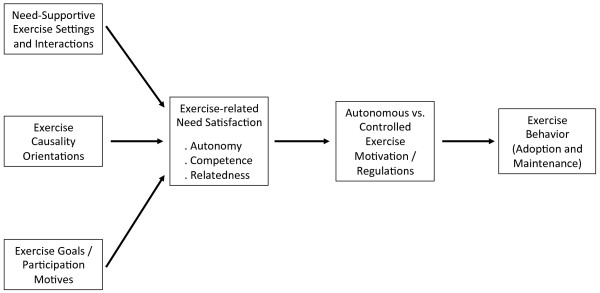
“Relations from perceived autonomy support to exercise behavior, via psychological needs and regulatory styles have been tested (in part or all) in several studies and in general these confirm the proposed sequences [17,44,43,77,76,38,33].”
§ Exercise, physical activity, and self-determination theory: A systematic review > Discussion > Need satisfaction and exercise
What the sources say
- Supportedcites [17] matched to “Exercise motivation: a cross-sectional analysis examining its relationships with frequency, intensity, and duration of exercise” (2010) source
The Background (page unavailable) says the study tested relationships between behavioral regulations and exercise frequency, intensity, and duration—one part of the proposed sequence. The Results (page unavailable) report that all three exercise indices correlated more strongly with autonomous than controlling regulations, broadly supporting the sequence. The citing sentence expressly allows studies to have tested it only “in part.” (LLM, conf=0.87)
- Partly supportedcites [44] matched to “Mediators of physical activity behaviour change among adult non-clinical populations: a review update” (2010) sourceExperimental — accuracy not yet measured
The Results section (‘Evidence of Mediation by Theory’; page not provided) reports support in one study for a link between autonomy support and physical activity. But the other self-determination-theory study found no changes in its constructs or behavior, and neither established the proposed sequence through psychological needs and regulatory styles. The review therefore does not support saying that the studies generally confirmed that sequence. (LLM, conf=0.88)
- Not checked — no full text of the sourcecites [43] matched to “The Independent Effects of Goal Contents and Motives on Well-Being: It’s Both What You Pursue and Why You Pursue It” (2004) source
- Not matchedcites [77]
The reference list we hold has no entry [77].
- Not matchedcites [76]
The reference list we hold has no entry [76].
- Not checked — no full text of the sourcecites [38] matched to “Body image and body shape ideals in magazines: exposure, awareness, and internalization” (1997) source
- Not checked — no full text of the sourcecites [33] matched to “Go Figure? Body-Shape Motives are Associated with Decreased Physical Activity Participation Among Midlife Women” (2006) source
plainstates an association- Asserted: passes — The authors put it forward as true.
- Checkable: passes — It can be checked against evidence.
- Load-bearing: passes — The paper’s conclusions depend on it.
- Based: passes — The paper gives a reason why it holds.
- Supported
A result the paper reports from its own data — it cites no other source for it, so there is none to check. The quote shows it is in the paper.
In the paper
“The literature is also consistent in that competence satisfaction and more intrinsic motives positively predict exercise participation across a range of samples and settings.”
§ Exercise, physical activity, and self-determination theory: A systematic review > Abstract > Results
boostedstates an association- Asserted: passes — The authors put it forward as true.
- Checkable: passes — It can be checked against evidence.
- Load-bearing: passes — The paper’s conclusions depend on it.
- Based: passes — The paper gives a reason why it holds.
A result the paper reports from its own data — it cites no other source for it, so there is none to check. The quote shows it is in the paper.
In the paper
“and intrinsic motivation being more predictive of long-term exercise adherence”
§ Exercise, physical activity, and self-determination theory: A systematic review > Abstract > Results
plainstates an association- Asserted: passes — The authors put it forward as true.
- Checkable: passes — It can be checked against evidence.
- Load-bearing: passes — The paper’s conclusions depend on it.
- Based: passes — The paper gives a reason why it holds.
A result the paper states — it cites no source for it, so there is none to check. The quote shows it is in the paper.
In the paper
“but similar results are found across cross-sectional, prospective, and experimental designs”
§ Exercise, physical activity, and self-determination theory: A systematic review > Abstract > Results
plain- Asserted: passes — The authors put it forward as true.
- Checkable: passes — It can be checked against evidence.
- Load-bearing: passes — The paper’s conclusions depend on it.
- Based: passes — The paper gives a reason why it holds.
99 more claims
Create a free account to see all 209 claims and to verify the 2 references still open.
- It may state two separate claims as one. 74
- Probably not a substantial claim. 39
Claims other papers make about this one
Each is checked against this paper’s own text: does it say what the citing paper says it does?
The source backs part of the claim, not all of it — or backs it for a different population, condition or comparison.
In the citing paper
“As of today, merely one systematic review in the exercise context (Teixeira et al., 2012), having SDT as theoretical background, has analyzed the satisfaction (although not frustration) of basic psychological needs, the motivational regulation, and the way these can predict different physiological outcomes (i.e., energy expenditure, body mass index).”
From Can Interpersonal behavior influence the persistence and adherence to physical exercise practice in adults? A systematic review (2018) · cites this paper as Teixeira et al., 2012
Experimental — accuracy not yet measuredThe source backs part of the claim, not all of it — or backs it for a different population, condition or comparison.
In the citing paper
“which might be justified by the fact that most of them so far cannot yet distinguish this regulation from identified regulation, given that both share the same principles”
From Can Interpersonal behavior influence the persistence and adherence to physical exercise practice in adults? A systematic review (2018) · cites this paper as Teixeira et al., 2012
Experimental — accuracy not yet measuredThe source backs part of the claim, not all of it — or backs it for a different population, condition or comparison.
In the citing paper
“Conversely, structured exercise programs foster intrinsic motivation (65), self-regulation, and a positive relationship with the body, promoting sustained engagement even after pharmacotherapy discontinuation.”
From GLP-1 agonists and exercise: the future of lifestyle prioritization (2025) · cites this paper as [65]
Experimental — accuracy not yet measuredThe source backs part of the claim, not all of it — or backs it for a different population, condition or comparison.
In the citing paper
“a study by Teixeira et al. [31] highlights that exercise not only improves physical health but also promotes a positive self-image and resilience”
From Sociodemographic influences on Student Mental Health and their association with activation-regulating functional impairments (2026) · cites this paper as [31]
Experimental — accuracy not yet measuredThe cited source says what the claim attributes to it.
In the citing paper
“The instruments described herein have been used in various contexts, for example to assess to what extent a medical professional (Williams et al., 2009), healthcare intervention (Williams et al., 2011; Teixeira et al., 2012) or a procedure (Ng et al., 2012) supports autonomy.”
From Designing for Motivation, Engagement and Wellbeing in Digital Experience (2018) · cites this paper as Teixeira et al., 2012
9 more claims about this paper
Create a free account to see every claim other papers make about this one.
Self-check
Percentages, sums and reported differences re-computed from the paper’s own numbers.
Rated minor: it would not touch a result — a value no result rests on, a p-value that stays on the same side of the significance level, or a conflict that is clerical, resolved elsewhere in the paper, or outside its own findings.
In the paper
“A total of 57 samples (53 studies) analyzed associations between regulations and exercise behavior. Of these, 37 were used in cross-sectional designs, 10 in prospective designs, 7 in experimental studies, and 2 in mixed designs.”
§ Exercise, physical activity, and self-determination theory: A systematic review > Results > Motivational predictors of exercise-related outcomes
Reported 57 · recomputed 56
Citations
Cites
Ryan, R. M., & Deci, E. L. (2000) · American Psychologist · doi:10.1037//0003-066x.55.1.68 · Cited by 54,599
Self-citationThe "what" and "why" of goal pursuits: Human needs and the self-determination of behavior
Deci, E. L., & Ryan, R. M. (2000) · Psychological Inquiry · doi:10.1207/s15327965pli1104_01 · Cited by 34,210 · cited 5×
“determination and volition with respect to the target behavior [12].”
BackgroundInfluentialSelf-citationIntrinsic Motivation and Self-Determination in Human Behavior
Deci, E. L., & Ryan, R. M. (1985) · doi:10.1007/978-1-4899-2271-7 · Cited by 26,772
Self-citationIntrinsic Motivation and Self-Determination in Human Behavior
Miller, K. A., Deci, E. L., & Ryan, R. M. (1988) · Contemporary Sociology · doi:10.2307/2070638 · Cited by 15,312
Self-citationMediation in experimental and nonexperimental studies: New procedures and recommendations.
Shrout, P. E., & Bolger, N. (2002) · Psychological Methods · doi:10.1037/1082-989x.7.4.422 · Cited by 11,335 · cited 1×
“, mediated) effects between them [75].”
Garber, C. E., Blissmer, B., Deschenes, M. R., Franklin, B. A., Lamonte, M. J., Lee, I.-M., Nieman, D. C., & Swain, D. P. (2011) · Medicine & Science in Sports & Exercise · doi:10.1249/mss.0b013e318213fefb · Cited by 9,319
A simple method to assess exercise behavior in the community.
Godin, G., & Shephard, R. J. (1985) · PubMed · Cited by 4,760
Moral Identity and Developmental Theory
Lapsley, D. (2015) · Human Development · doi:10.1159/000435926 · Cited by 3,819
Perceived locus of causality and internalization: Examining reasons for acting in two domains.
Ryan, R. M., & Connell, J. P. (1989) · Journal of Personality and Social Psychology · doi:10.1037/0022-3514.57.5.749 · Cited by 3,311 · cited 2×
“Autonomous motivation includes the identified regulation and intrinsic motivation subscales of the Exercise Self-Regulation Questionnaire [84].”
Self-citation(2002) · Cited by 3,047
Self-citation
Research works printed but not linked: 1
- Koestner R Losier GF In Handbook of self-determination research Distinguishing three ways of being internally motivated: a closer look at introjection, identification, and intrinsic motivation 2002 Edited by Deci EL, Ryan RM, Rochester, NY: University of Rochester Press 101 121
Cited by
Items 1,601–1,700 of 2,926
Chen, Y., Guo, X., Ye, T., & Zhao, W. (2025) · Personality and Individual Differences · doi:10.1016/j.paid.2025.113405 · Cited by 4
Sahinovic, A., Lau, N. S., Sabag, A., Gordon, R., Cox, A. J., Walker, K., Irwin, C. G., Desbrow, B., Johnson, N. A., Austin, P. J., et al. (2025) · Sports Medicine - Open · doi:10.1186/s40798-025-00895-w · Cited by 5
“Exercise enjoyment may also be a mediating factor for adherence (i.e. to training, exercise interventions) [34, 35] as greater enjoyment has been demonstrated to increase the likelihood of performing exercise [36].”
Yi, J., Fang, C., Chen, I., Lin, Y.-C., Hou, W., Aljaberi, M. A. A., Lai, Y.-C., Chen, J., Lin, I., Griffiths, M. D., et al. (2025) · Current Psychology · doi:10.1007/s12144-025-08339-0 · Cited by 5
“Consequently, this intricate interaction fosters a vicious cycle that progres - sively influences individuals’ engagement in PA. SDT emphasizes that intrinsic motivation for PA is driven by the fulfillment of three psychological needs: autonomy, competence, and relatedness (Teixeira et al., 2012 ).”
Comprehensive exercise recommendations for pediatric asthma: an evidence synthesis
Xu, H., Lin, N., Bai, G., Liu, Y., Jia, X., Huang, C. X., Hu, L., Shao, H., Shang, Q.-Y., Zhang, L., et al. (2025) · World Journal of Pediatrics · doi:10.1007/s12519-025-00976-6 · Cited by 9
“Theoretical models, such as self-determination theory (SDT) [92], theory of planned behavior (TPB) [93], social cognitive theory (SCT) [94] and the transtheoretical model (TTM) [21, 95], provide frameworks for understanding and predicting exercise behavior.”
Korman, N., Stanton, R., Trott, M., Stubbs, B., Baker, A., Butler, C., Siskind, D. J., Rosenbaum, S., Firth, J., Martland, R., et al. (2025) · Australian & New Zealand Journal of Psychiatry · doi:10.1177/00048674251361681 · Cited by 4
“The psychological need for autonomy has been considered important for exercise engagement (Teixeira et al., 2012) and relevant for PA adoption in people with schizophrenia (Firth et al., 2016a; Vancampfort et al., 2015b).”
Golbus, J. R., Basu, T., Luff, E., Hu, Y., Zeng, D., Gesierich, C., Resnicow, K., Klasnja, P., & Nallamothu, B. K. (2025) · Circulation Heart Failure · doi:10.1161/circheartfailure.125.013082 · Cited by 5
Hoshuyama, T., Odashiro, K., Fukata, M., Maruyama, T., Saito, K., Wakana, C., 福光, ミ., & Fujino, T. (2015) · Journal of Occupational and Environmental Medicine · doi:10.1097/jom.0000000000000399 · Cited by 4
A Foucauldian Analysis on Discourse in Primary School Physical Education Classes in Singapore
Chung, H. J., Leng, H. K., & Park, C. (2019) · Physical Culture and Sport Studies and Research · doi:10.2478/pcssr-2019-0016 · Cited by 6
Pal, T. K., Dan, S., Bose, A., Bag, S., Biswas, A., Khanam, J., & Mandal, P. (2018) · Pharmacy & Pharmacology International Journal · doi:10.15406/ppij.2018.06.00221 · Cited by 5
Salway, R., Sebire, S. J., Tibbitts, B., Sanderson, E., Kandiyali, R., Willis, K. J., MacNeill, S., & Jago, R. (2020) · International Journal of Environmental Research and Public Health · doi:10.3390/ijerph17217980 · Cited by 6
Aleksejūnienė, J., Džiaugytė, L., Rastenienė, R., & Brukienė, V. (2022) · Health & Social Care in the Community · doi:10.1111/hsc.13974 · Cited by 9
Shoulder-to-Shoulder: How Pinball Supports Men's Wellbeing
Johnson, D. M., Wiley, K., Passmore, C. J., Horton, E. M., Altizer, R., & Mandryk, R. L. (2022) · Proceedings of the ACM on Human-Computer Interaction · doi:10.1145/3549514 · Cited by 6
Predicting implicit and explicit exercise identity from descriptive social norms regarding exercise
Pluta, K., More, K. R., & Phillips, L. A. (2023) · Psychology and Health · doi:10.1080/08870446.2022.2156580 · Cited by 7
Loerbroks, L., Kersten, L. J., & Freund, P. A. (2023) · Frontiers in Psychology · doi:10.3389/fpsyg.2023.1057178 · Cited by 5
Goal-Oriented Prevention: How to Fit a Square Peg into a Round Hole
Mold, J. W., DeWalt, D. A., & Duffy, F. D. (2023) · The Journal of the American Board of Family Medicine · doi:10.3122/jabfm.2022.220283r1 · Cited by 3
Poststructuralism and Skill Learning for Fitness Instruction
Markula, P. (2023) · Quest · doi:10.1080/00336297.2022.2150661 · Cited by 5
Nurmi, J., Knittle, K. P., Naughton, F., Sutton, S. R., Ginchev, T., Khattak, F., Castellano‐Tejedor, C., Lusilla, P., Ravaja, N., & Haukkala, A. (2023) · JMIR Formative Research · doi:10.2196/34232 · Cited by 7
Lambert, J. D., Taylor, A. H., Streeter, A., Greaves, C. J., Ingram, W. M., Dean, S. G., Jolly, K. B., Mutrie, N., Price, L., & Campbell, J. (2023) · Mental health and physical activity · doi:10.1016/j.mhpa.2023.100535 · Cited by 5
Motivational Correlates of Exercise Behavior Among College Students
Nieves, J., & Zenko, Z. (2023) · Communications in Kinesiology · doi:10.51224/cik.2023.47 · Cited by 4
“In their review, Teixeira et al. (2012) note that interventions based on self-determination theory demonstrate effectiveness, mixed relations between exercise and autonomy, and weak or nonexistent relations between exercise and relatedness.”
BackgroundResultInfluentialThomas, R., Williams, M. M. A., Aldous, J. W. F., & Wyld, K. (2023) · Nutraceuticals · doi:10.3390/nutraceuticals3030027 · Cited by 4
Xu, T., Tao, Y., Chen, R., Strachan, G., Cai, X., & Liu, C. (2023) · BMJ Open · doi:10.1136/bmjopen-2023-076123 · Cited by 4
GOÑI, I. L. (2023) · Retos · doi:10.47197/retos.v51.99218 · Cited by 12
Dijital Liderlik Araştırmaları Üzerine Bibliyometrik Bir Analiz
GÜLER, S. (2023) · Özgür Yayınları eBooks · doi:10.58830/ozgur.pub258.c1301 · Cited by 5
Baudot, A., Barth, N., Colas, C., Garros, M., Garcin, A., Oriol, M., Collange, F., Bongué, B., Roche, F., Chauvin, F., et al. (2024) · Frontiers in Public Health · doi:10.3389/fpubh.2023.1321230 · Cited by 5
“A systematic review of Teixeira et al. (56) has shown that the intrinsic motivation being more predictive of long-term exercise adherence ( 56).”
BackgroundRitter, Y., Pfister, D., Steckhan, G. M., Voelter‐Mahlknecht, S., Weber, B., Ellegast, R. P., Koch, C. A., Bausch, F., Grüber, M., & Schwenk, M. (2024) · European Review of Aging and Physical Activity · doi:10.1186/s11556-024-00356-5 · Cited by 4
“Intrinsic motivation is another beneficial factor for long-term maintenance PA behavior [36].”
BackgroundRobertson, M. C., Swartz, M. C., Basen‐Engquist, K., Li, Y., Jennings, K., Thompson, D. I., Baranowski, T., Volpi, E., & Lyons, E. (2024) · BMC Public Health · doi:10.1186/s12889-024-19662-9 · Cited by 6
“A growing literature supports the utility that SDT provides for understanding and influencing PA behaviors [45–50].”
BackgroundLambert, J. D., Dean, S. G., Terry, R. H., Charles, N., Greaves, C. J., Campbell, J. L., & Taylor, A. H. (2024) · BMJ Open · doi:10.1136/bmjopen-2023-080472 · Cited by 6
Exercise and Fitness Quantification in Clinical Practice: Why and How; and Where Are We Going?
Riopel-Meunier, J., Piché, M., & Poirier, P. (2024) · Canadian Journal of Cardiology · doi:10.1016/j.cjca.2024.11.032 · Cited by 4
Kokorelias, K. M., Ripat, J. D., Barclay, R., Jones, C. A., Mayo, N. E., Grant, T. L., Scodras, S., Alsbury‐Nealy, K., Ryder‐Burbidge, C., & Salbach, N. M. (2025) · BMC Geriatrics · doi:10.1186/s12877-024-05611-z · Cited by 6
Ferrando-Terradez, I., Núñez‐Cortés, R., López, L., Alcántara, E., Calatayud, J., Casaña, J., Parčina, I., & Dueñas, L. (2025) · BMC Women s Health · doi:10.1186/s12905-025-03576-8 · Cited by 8
“Moreover, enjoyment of physical activity is not only a motivational factor but also an essential component of psychological empowerment [13].”
Li, A., Ge, H., Huang, R., Liu, D., Liu, S., Jia, Y., Chai, J., Zheng, X., Liu, L., Chen, G., et al. (2025) · American Journal of Cancer Research · doi:10.62347/pnhn9442 · Cited by 4
Gard, A. J. M., & Lavallee, D. E. (2025) · Healthcare · doi:10.3390/healthcare13080856 · Cited by 9
The Role of Monitoring Effect in Risk Classification: Evidence from Telematics Adoption
Lee, H. C. B., Li, X., & Liu, S. (2025) · Management Science · doi:10.1287/mnsc.2022.00286 · Cited by 6
O'Neil, J., van Ierssel, J. J., & Pelletier, L. G. (2026) · Peer Community Journal · doi:10.24072/pcjournal.680 · Cited by 4
Beltrán, H. C., Ríos, L. J. C., Tamayo, I. M., Cajas, B., Enrique, R., & Garrido, R. E. R. (2015) · Dialnet (Universidad de la Rioja) · Cited by 4
Online Social Exergames for Seniors: A Pillar of Gamification for Clinical Practice
Konstantinidis, S. T., Brox, E., Kummervold, P. E., Hallberg, J., Evertsen, G., & Hirche, J. (2015) · Advances in medical technologies and clinical practice book series · doi:10.4018/978-1-4666-9522-1.ch012 · Cited by 6
Redefining Students' Success (Learning-oriented, Self-referenced) in Today's Physical Education
Fernández‐Río, J. (2017) · Journal of Physical Education Recreation & Dance · doi:10.1080/07303084.2016.1271251 · Cited by 4
Nel, K. A., & Tshikovhele, K. L. (2018) · Advances in Social Sciences Research Journal · doi:10.14738/assrj.52.4000 · Cited by 4
Motivation des personnes âgées à pratiquer une activité physique
Maillot, P., Becquard, C., & Perrot, A. (2018) · Gérontologie et société · doi:10.3917/gs1.156.0127 · Cited by 14
Lillis, J., & Bond, D. S. (2019) · BMJ Open · doi:10.1136/bmjopen-2018-025115 · Cited by 7
Miežienė, B., Šinkariova, L., & Jankauskienė, R. (2018) · Baltic Journal of Sport and Health Sciences · doi:10.33607/bjshs.v2i93.117 · Cited by 5
More, K. R., & Phillips, L. A. (2019) · Behavioral Medicine · doi:10.1080/08964289.2019.1644284 · Cited by 7
Transition Engagement of African American Youth With Disabilities: A Serial Mediation Model
Dutta, A., Kundu, M., Iwanaga, K., Ditchman, N., & Chan, F. (2019) · Exceptional Children · doi:10.1177/0014402919884542 · Cited by 7
CHANGING THE QUALITY OF MOTIVATION OVER TIME IN HEALTH AND FITNESS SETTINGS
Wasserkampf, A., Silva, M. N., & Teixeira, P. J. (2017) · ACSMʼs Health & Fitness Journal · doi:10.1249/fit.0000000000000327 · Cited by 4
Self-citationMellergård, E., Johnsson, P., & Eek, F. (2020) · Primary care diabetes · doi:10.1016/j.pcd.2020.09.008 · Cited by 4
Kolbuszewska, M. T., Anderson, J., & Milyavskaya, M. (2022) · Frontiers in Psychology · doi:10.3389/fpsyg.2022.1019714 · Cited by 6
Can your partner influence your physical activity? The role of social support provided by partners
Ferreira, R. W., & Domingues, M. R. (2021) · Revista Brasileira de Atividade Física & Saúde · doi:10.12820/rbafs.26e0195 · Cited by 7
Mindfulness in physical activity
Co, A., & Ullrich-French, S. C. (2021) · Society for Transparency, Openness, and Replication in Kinesiology eBooks · doi:10.51224/b1014 · Cited by 4
López, P. J. (2021) · SPORT TK-Revista EuroAmericana de Ciencias del Deporte · doi:10.6018/sportk.444571 · Cited by 8
Kobayashi, M. A., George, S. M. S., Leite, R. O., Esquives, B. S. N., Wetstone, R. A., Pulgarón, E. R., Prado, G. J., & Czaja, S. J. (2021) · Journal of Aging and Physical Activity · doi:10.1123/japa.2020-0481 · Cited by 5
Sørensen, M., Bentzen, M., & Farholm, A. (2021) · European Journal of Adapted Physical Activity · doi:10.5507/euj.2021.008 · Cited by 4
Robertson, M. C., Cox-Martin, E., Shegog, R., Markham, C. M., Fujimoto, K., Durand, C. P., Brewster, A., Lyons, E. J., Liao, Y., Flores, S. A., et al. (2022) · JMIR Cancer · doi:10.2196/31815 · Cited by 5
Leclerc, A.-M., Boulanger, M., Miquelon, P., & Rivard, M.-C. (2022) · International Journal of Environmental Research and Public Health · doi:10.3390/ijerph191610390 · Cited by 5
Chacón-Borrego, F., Gomis-Gomis, M. J., & Sousa, C. S. (2022) · Sportis Scientific Journal of School Sport Physical Education and Psychomotricity · doi:10.17979/sportis.2022.8.3.9152 · Cited by 4
Martín-Moya, R., Ruíz-Montero, P. J., & García, E. R. (2022) · Journal of Gerontology and Geriatrics · doi:10.36150/2499-6564-n520 · Cited by 4
Data Visualization Design Strategies for Promoting Exercise Motivation in Self-Tracking Applications
Huang, X. (2022) · ACM International Conference on Design of Communication (SIGDOC) · doi:10.1145/3513130.3558981 · Cited by 7
Hung, J., Brugaletta, S., & Spratt, J. (2022) · European Heart Journal Supplements · doi:10.1093/eurheartjsupp/suac055 · Cited by 4
Xu, S. S., Leung, K., Wong, T. W. L., Chung, K. K. H., & Chan, D. K. C. (2023) · Asian Journal of Sport and Exercise Psychology · doi:10.1016/j.ajsep.2023.08.001 · Cited by 7
Conde, S., Elor, A., Mateas, M., & Kurniawan, S. (2023) · Frontiers in Education · doi:10.3389/feduc.2023.1231907 · Cited by 9
Blacket, C., FULLER, J. T., Bennett, H., Crozier, A., Dziano, J. K., & Arnold, J. B. (2023) · Psychology of sport and exercise · doi:10.1016/j.psychsport.2023.102581 · Cited by 6
Translation and validation of the Breastfeeding Motivation Scale in China
Yu, Y., Zhang, L., Liu, Y., Zhang, L., & Guo, N. (2024) · International Breastfeeding Journal · doi:10.1186/s13006-023-00610-z · Cited by 8
“SDT has been applied in several health behavior domains, such as physical activity [16], oral health [17], weight control [18], tobacco cessation [19] and breast-feeding [15, 20–22].”
MethodRobertson, M. C., Cox-Martin, E., Basen‐Engquist, K., & Lyons, E. (2024) · JMIR mhealth and uhealth · doi:10.2196/51057 · Cited by 5
“The cognitive acceptance of physical activity has been shown to be associated with long-term changes in objectively measured physical activity, and integrated regulation is similarly predictive XSL • FO RenderX of physical activity [45,56].”
BackgroundMaudet-Coulomb, E., Martin‐Krumm, C., Tarquinio, C., & Mino, J. (2024) · Health Science Reports · doi:10.1002/hsr2.1644 · Cited by 6
“…concepts to motivation in the context of health, 19 sedentary behavior, 20 and PA, including the capacity to persist in engaging in PA. 19,21 – 23 Another variable of interest in issues related to engagement or persistence in PA is self ‐ efficacy, of which the links to PA are well…”
BackgroundLevinger, P., Dreher, B. L., Soh, S., Dow, B., Batchelor, F., & Hill, K. (2024) · Journal of Public Health · doi:10.1093/pubmed/fdae119 · Cited by 4
Fatores motivacionais de idosos praticantes do método Pilates
Dantas, R., Paz, G. A., Straatmann, V. S., & Lima, V. P. (2015) · Revista Brasileira em Promoção da saúde · doi:10.5020/18061230.2015.p251 · Cited by 22
Ma, C. M. S., Shek, D. T. L., & Lai, C. C. W. (2016) · International Journal on Disability and Human Development · doi:10.1515/ijdhd-2017-7009 · Cited by 5
Bermejo, J. P., Almagro, B. J., & González, J. A. R. (2018) · Retos · doi:10.47197/retos.v0i34.50748 · Cited by 21
Choice and perceptions of exercise: A test of three moderating variables
Caplandies, F. C., Brown, J. A., Murray, A. B., Rose, J. P., & Geers, A. L. (2018) · Psychology of sport and exercise · doi:10.1016/j.psychsport.2018.05.012 · Cited by 6
Back to the Future: The Köhler Motivation Gain in Exergames
Samendinger, S., Max, E. J., Feltz, D. L., & Kerr, N. L. (2020) · Elsevier eBooks · doi:10.1016/b978-0-12-849867-5.00005-7 · Cited by 5
Raposo, F. Z., Sánchez‐Oliva, D., Carraça, E. V., Palmeira, A. L., & Silva, M. N. (2020) · International Journal of Environmental Research and Public Health · doi:10.3390/ijerph17155377 · Cited by 7
Self-citationCalatayud, J., Navarro-Navarro, J., Carrasco, J. J., Pérez‐Alenda, S., Cruz‐Montecinos, C., Andersen, L. L., Querol‐Giner, F., & Casaña, J. (2020) · Journal of Clinical Medicine · doi:10.3390/jcm9092801 · Cited by 3
Goalkeeper: A Zero-Sum Exergame for Motivating Physical Activity
Niforatos, E., Tran, C., Pappas, I. O., & Giannakos, M. N. (2021) · Lecture notes in computer science · doi:10.1007/978-3-030-85613-7_5 · Cited by 6
Black, M., & Brunet, J. (2022) · Digital Health · doi:10.1177/20552076221093134 · Cited by 4
ADESÃO E DESISTÊNCIA DE PROGRAMAS DE TREINO PERSONALIZADO
Klain, I. P., Rombaldi, A. J., de Matos, D. G., et al. (2016) · Acceda (Universidad de Las Palmas de Gran Canaria) · Cited by 4
Design and validation of a Physical Activity Self-Regulation Scale
Campos-Uscanga, Y., Córdoba, R. L., Morales‐Romero, J., & Romo‐González, T. (2016) · Revista de psicología del deporte · Cited by 14
Readdy, T., & Raabe, J. J. (2016) · Journal of Intercollegiate Sport · doi:10.1123/jis.2016-0016 · Cited by 4
Internalizing Serious Leisure to Enhance Well-Being in Adventure Recreation
Lee, K. (2018) · Springer eBooks · doi:10.1007/978-3-319-70975-8_13 · Cited by 4
Park, S., Ntoumanis, N., Fenton, S. A. M., Stenling, A., Zanten, J. V., & Thøgersen‐Ntoumani, C. (2018) · The International Journal of Aging and Human Development · doi:10.1177/0091415018784763 · Cited by 6
Ha, Y., & Yang, S.-K. (2019) · Journal of Digital Convergence · doi:10.14400/jdc.2019.17.2.207 · Cited by 4
Kavanagh, D. J., Teixeira, H. M., Connolly, J., Andrade, J., May, J., Godfrey, S., Carroll, A., Taylor, K., & Connor, J. P. (2020) · British Journal of Health Psychology · doi:10.1111/bjhp.12422 · Cited by 5
Basarkod, G. (2019) · Research Bank (Australian Catholic University) · doi:10.26199/5dcc7d5fab0e8 · Cited by 9
Skills for life: A review of life skills and their measurability, malleability, and meaningfulness
McGrath, R. E., & Adler, A. (2022) · doi:10.18235/0004414 · Cited by 12
Blais, L. T., Mack, D. E., Wilson, P. M., & Blanchard, C. M. (2017) · Psychology, Health & Medicine · doi:10.1080/13548506.2016.1271440 · Cited by 3
Cederström, N., Nilsson, G., Dahan, R., Granér, S., & Ageberg, E. (2024) · BMJ Open Sport & Exercise Medicine · doi:10.1136/bmjsem-2024-002064 · Cited by 5
“This was based on previous research indicating that person-centred shared decision-making can increase intrinsic motivation, 20 which could allow for increased movement-relevant confidence and greater enjoyment, thereby influencing psychological readiness.”
Lederman, O., Moors-Mailei, A., Peacock, Y., McKeon, G., Llana, A., Burns, D., Rosenbaum, S., & Caperchione, C. M. (2025) · Health Promotion International · doi:10.1093/heapro/daae197 · Cited by 3
Zhou, F., Wang, W., Nie, Y., Shao, C. Y., Ma, W., Qiu, W., Qu, G., Gao, J., & Liu, C. (2025) · Frontiers in Psychology · doi:10.3389/fpsyg.2025.1566952 · Cited by 8
“For example, in the study “Exercise, Physical Activity, and Self-Determination Theory: A Systematic Review” published by Teixeira et al. (2012) although a positive association between more autonomous forms of motivation and exercise behavior was clearly identified, the importance of…”
Mannethodi, K., Joy, G. V., Singh, K. K., Pitiquen, E. E., Chaabna, N., Kunjavara, J., & Nashwan, A. J. (2025) · BMC Nursing · doi:10.1186/s12912-025-02967-4 · Cited by 9
“However, the study found that self-monitoring device usage was lower in the high physical activity group, suggesting that intrinsic motivation or other environmental factors might play a more significant role in sustaining high levels of physical activity in some cases [24].”
Bell, C., Cocks, A. J., Hills, L., & Kerner, C. (2025) · Journal of Health Psychology · doi:10.1177/13591053251329697 · Cited by 4
“SDT is a leading theory of human motivation (Ryan and Deci, 2017) and has been used extensively in the context of physical activity, sport and exercise (Teixeira et al., 2012).”
InfluentialHarbichová, I., Rusnáková, K., Scheier, L. M., & Komarc, M. (2025) · European Journal of Sport Science · doi:10.1002/ejsc.12286 · Cited by 4
Zhang, S., & Miao, C. (2025) · Behavioral Sciences · doi:10.3390/bs15060763 · Cited by 3
Kennedy, R. A., Archibald, D., Bury, S. M., Southby, A., Shrestha, R., Hedley, D., Taylor, N. F., Hawke, L. J., McKeown, G., & Shields, N. (2025) · Autism in Adulthood · doi:10.1089/aut.2024.0317 · Cited by 3
Lin, L., Li, X., & Cong, C. (2025) · Frontiers in Public Health · doi:10.3389/fpubh.2025.1573613 · Cited by 5
“Sports participation, as a voluntary and socially embedded activity, addresses these needs uniquely (4).”
Walking far and near in Singapore public housing town
Yuen, B., Yang, X., Chan, F., How, H. C., & Shum, E. (2025) · Cities · doi:10.1016/j.cities.2025.106297 · Cited by 4
Kumari, A., Khan, M., Singh, S., Niyati, Bajpai, P., & Nagpal, M. (2025) · Journal of Innovation and Entrepreneurship · doi:10.1186/s13731-025-00574-w · Cited by 14
“…leaders, flexibility in employee’s decision-making, independence, and diversity in talent management practices, will encourage employees’ attitudes towards organizations’ efforts and lead to their involvement and contribution (Teixeira, et al., 2012; Deepika, 2021) in the digital work environment.”
Griffin, A. C., Javier, S. J., Golding, M., Runnels, T. W., Matthias, M. S., Shimada, S. L., Higgins, D. M., Zulman, D. M., & Midboe, A. M. (2025) · Journal of Medical Internet Research · doi:10.2196/78173 · Cited by 4
“Early evidence suggests that health-related messages framed in this way may lead to positive health behaviors, including smoking cessation [10,11], increased physical activity [12,13], and healthy eating [14].”
Chao, Y., Wang, Y., & Yu, Y. (2025) · Frontiers in Psychology · doi:10.3389/fpsyg.2025.1612546 · Cited by 3
“Health motivation was also positively associated with participation frequency, aligning with numerous studies in the field (Oliveira-Brochado et al., 2017; Downward et al., 2014; Muñiz et al., 2014; Lera-López and Rapún-Gárate, 2011; Teixeira et al., 2012; García et al., 2011).”
Runswick, O. R., Smith, M., Rowland, H., Mahendru, L., Chahal, S., Valmaggia, L., Stubbs, B., Figgins, S. G., & Bruce, R. M. (2025) · Virtual Reality · doi:10.1007/s10055-025-01270-6 · Cited by 3
“Finally, “Motivation” reflects the cognitive processes that drive and inspire behaviour, and, alongside enjoyment, is a key predictor in the initial adoption of exercise (Gardner and Lally 2012 ; Teixeira et al. 2012 ).”
Wang, Y., Jin, Z. Y., Gao, M., & Wu, X. (2025) · Frontiers in Public Health · doi:10.3389/fpubh.2025.1699018 · Cited by 5
Wu, Q., Zhu, W., Zhang, Y., Lou, H., Liu, S., Wu, C., Xiang, J., Ren, N., & Cao, R. (2026) · BMC Public Health · doi:10.1186/s12889-025-26120-7 · Cited by 5
“A systematic review by Teixeira et al. further highlighted that autonomous motivation is positively associated with exercise persistence, with intrinsic motivation being particularly important for long-term maintenance [43].”
Wall, C., Sacre, A., McMeekin, P. J., Walker, R., Hetherington, V., Çelik, Y., Vitório, R., Morris, R., & Godfrey, A. (2026) · PLoS ONE · doi:10.1371/journal.pone.0340106 · Cited by 3
“That suggests that if CuePD produces visible and measurable outcomes it could significantly enhance engagement by satisfying basic psychological needs [61].”
Metadata
- Authors
- Teixeira, P. J., Carraça, E. V., Markland, D., Silva, M. N., & Ryan, R. M.
- Affiliations
- Universidade Técnica de Lisboa (PT)
- Bangor University (GB)
- University of Rochester (US)
- Corresponding author
- Teixeira, Pedro J
- Venue
- International Journal of Behavioral Nutrition and Physical Activity
- Published
- 2012
- Volume
- 9
- Issue
- 1
- Pages
- 78
- ISSN
- 1479-5868 (ISSN-L)
- PMC
- PMC3441783
- OpenAlex
- W2120612383
- Semantic Scholar
- 91c1a302b1ba3d78f18d769090d5c285c36d9567
- Cited by
- 2,963
- References
- 110
- Citations by year
- 2026: 399 · 2025: 332 · 2024: 260 · 2023: 244 · 2022: 242 · 2021: 279 · 2020: 256 · 2019: 215 · 2018: 202 · 2017: 162 · 2016: 141 · 2015: 100 · 2014: 66 · 2013: 59 · 2012: 3
- FWCI
- 10.23
- Type
- journal article
- Language
- en
- Open access
- gold
- doi.org
- Licence
- cc-by
- Locations
- International Journal of Behavioral Nutrition and Physical Activity (publishedVersion, cc-by)
- Europe PMC (PubMed Central) (publishedVersion, cc-by)
- PubMed Central (publishedVersion, cc-by)
- PubMed (publishedVersion)
- DOAJ (DOAJ: Directory of Open Access Journals) (submittedVersion)
- Topics
- Social Sciences › Psychology › Social Psychology › Motivation and Self-Concept in Sports
- Social Sciences › Psychology › Applied Psychology › Behavioral Health and Interventions
- Health Sciences › Medicine › Public Health, Environmental and Occupational Health › Physical Activity and Health
- Keywords
- self-determination theory, exercise motivation, physical activity, autonomous motivation, intrinsic motivation, identified regulation, introjected regulation, competence satisfaction, need satisfaction, exercise adherence, exercise self-regulation, exercise intervention, exercise behavior
- MeSH terms
- Health Promotion, Humans, Motor Activity, Personal Satisfaction, Health Behavior, Exercise, Databases, Factual, Personal Autonomy, Empirical Research
About these checks
Registry, retraction, Cites and statistics results are computed, not judged, with one exception: a printed reference that no index lists is read once by a model before it counts as a citation error. Claims are extracted by a model and kept only when their quote appears verbatim in the text; each cited source is then checked, with a model’s help, for whether it says what the claim relies on. Those verdicts can be wrong — read the claim’s quote and the cited source before relying on one.
The claim verdicts this report counts are experimental: their accuracy is not yet measured.
A language model drew the claims from the paper on 2026-10-10, under version 3 of the claim definition (model deepseek-v4.1-flash, prompt extract-v3).
A second model labelled each claim on 2026-10-10 (model jev-1.13-20260917, definition revision gold-guideline-v0.2).
Cited sources are checked with a language model’s help (gpt-6-sol).
Statistics and arithmetic are recomputed, not judged.
Confidence bands are shown only for fields calibrated on our annotated test set. None is calibrated yet, so no band is shown.
What counts as a claim ›How we measure confidence ›How we check this ›
Are you an author, or do you see a problem with this page? Request a review
Data sources
Bibliographic data: Semantic Scholar, OpenAlex, Crossref.
Contains information from the Semantic Scholar Academic Graph Datasets, made available under the ODC Attribution License (ODC-BY 1.0).
Semantic Scholar’s data is described in: Kinney, R., et al. (2023). The Semantic Scholar Open Data Platform. arXiv:2301.10140.
