

Exercise, physical activity, and self-determination theory: A systematic review
Open accessThe DOI matches its Crossref record; 108 of the 110 references it cites were found in a registry or an index; 6 of the 97 sources its claims cite were checked for support.
Abstract
Systematic review of 66 empirical studies on self-determination theory constructs and exercise outcomes.
Overview
CoChat Summary
## TL;DR
This systematic review synthesized 66 empirical studies on self-determination theory (SDT) and exercise/physical activity published up to June 2011. It found the most consistent support for autonomous motivation—especially identified and intrinsic regulation—and for competence satisfaction and intrinsic motives as positive predictors of exercise participation.
## Key findings
- Across 66 studies comprising 72 independent samples, the review found consistent positive associations between more autonomous forms of motivation and exercise; for example, 37 of 42 cross-sectional studies, 10 prospective studies, 7 experimental studies, and 2 mixed designs were represented among the regulation studies.
- Identified regulation showed positive associations with exercise in 28 samples (74%) in multivariate analyses and 22 samples (85%) in bivariate analyses; intrinsic motivation was positively associated in 23 or 22 samples (62% or 92%) depending on analysis type, and no study reported negative associations for intrinsic motivation.
- Competence satisfaction was the most frequently assessed basic need and was positively associated with physical activity in 56% of independent samples in multivariate analysis and 92% in correlational analysis; relatedness showed no positive multivariate association with exercise (K = 4, 100% no association).
- In SDT-based interventions, 7 interventions were identified and 6 (86%) found significant differences favoring the SDT group for perceived autonomy support, need satisfaction, autonomous and introjected regulations, and self-reported exercise; in the longest trial, only autonomous regulations mediated long-term exercise effects.
## Methods
- Systematic review of empirical SDT–exercise studies published up to June 2011; searches were run in PsycINFO and SportDiscus for studies from 1960 to June 2011, limited to English-language, peer-reviewed journal articles on adult, non-athletic samples.
- Included 66 studies / 72 independent samples with experimental, cross-sectional, prospective, and mixed designs; outcomes included actual or self-reported exercise/physical activity, attendance, relapse, dropout, and stages of change.
- Evidence was summarized quantitatively by counting independent samples showing significant positive, negative, or null associations; the unit of analysis was the independent sample, and significance was set at 0.05.
## Limitations
- The paper states that it was limited to English-language, peer-reviewed articles and excluded gray literature, unpublished studies, non-English publications, non-adult samples, adolescents/children, and competitive athletic samples.
- The authors state that classifying and quantifying results was “somewhat arbitrary,” that only direct paths were evaluated, and that lumping together self-report and direct measures, attendance, and stages of change is “clearly not without reproach.”
- Evident from the text: most included studies were descriptive/non-experimental and many samples were mixed, so causal inference and subgroup-specific conclusions are limited.
Model-written summary. Check it against the paper before relying on it.
Integrity signals
Registry
Cites
Statistics
Figures
Verification
Claims the paper makes
3 Valid · 5 Not valid · 58 Not checked · 143 Own results and interpretations
The cited sources support only part of this claim — read each source’s verdict below.
In the paper
“Satisfaction of these basic needs results in increased feelings of vitality and well-being [15].”
§ Exercise, physical activity, and self-determination theory: A systematic review > Introduction
What the sources say
- Partly supportedcites [15] matched to “Testing a self‐determination theory‐based teaching style intervention in the exercise domain” (2008) sourceExperimental — accuracy not yet measured
The discussion of basic psychological need satisfaction (p. 5) says that satisfying needs, together with more autonomous motivation, is expected to produce adaptive affective responses. The findings (p. 24) link competence need satisfaction to less negative affect. Neither passage establishes that need satisfaction results in increased vitality or well-being specifically, and the claim states the relationship more definitively than the paper does. (LLM, conf=0.84)
plainstates a cause- Asserted: passes — The authors put it forward as true.
- Checkable: passes — It can be checked against evidence.
- Load-bearing: passes — The paper’s conclusions depend on it.
- Based: passes — The paper gives a reason why it holds.
- Partly supported
The cited sources support only part of this claim — read each source’s verdict below.
In the paper
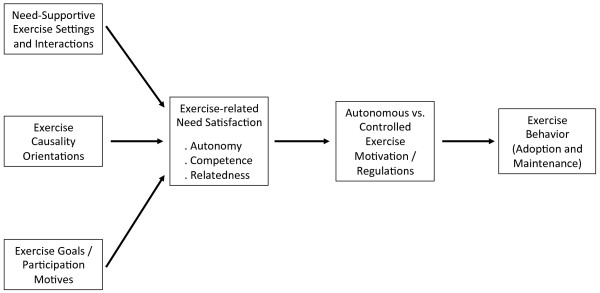
“Relations from perceived autonomy support to exercise behavior, via psychological needs and regulatory styles have been tested (in part or all) in several studies and in general these confirm the proposed sequences [17,44,43,77,76,38,33].”
§ Exercise, physical activity, and self-determination theory: A systematic review > Discussion > Need satisfaction and exercise
What the sources say
- Supportedcites [17] matched to “Exercise motivation: a cross-sectional analysis examining its relationships with frequency, intensity, and duration of exercise” (2010) source
The Background (page unavailable) says the study tested relationships between behavioral regulations and exercise frequency, intensity, and duration—one part of the proposed sequence. The Results (page unavailable) report that all three exercise indices correlated more strongly with autonomous than controlling regulations, broadly supporting the sequence. The citing sentence expressly allows studies to have tested it only “in part.” (LLM, conf=0.87)
- Partly supportedcites [44] matched to “Mediators of physical activity behaviour change among adult non-clinical populations: a review update” (2010) sourceExperimental — accuracy not yet measured
The Results section (‘Evidence of Mediation by Theory’; page not provided) reports support in one study for a link between autonomy support and physical activity. But the other self-determination-theory study found no changes in its constructs or behavior, and neither established the proposed sequence through psychological needs and regulatory styles. The review therefore does not support saying that the studies generally confirmed that sequence. (LLM, conf=0.88)
- Not checked — no full text of the sourcecites [43] matched to “The Independent Effects of Goal Contents and Motives on Well-Being: It’s Both What You Pursue and Why You Pursue It” (2004) source
- Not matchedcites [77]
The reference list we hold has no entry [77].
- Not matchedcites [76]
The reference list we hold has no entry [76].
- Not checked — no full text of the sourcecites [38] matched to “Body image and body shape ideals in magazines: exposure, awareness, and internalization” (1997) source
- Not checked — no full text of the sourcecites [33] matched to “Go Figure? Body-Shape Motives are Associated with Decreased Physical Activity Participation Among Midlife Women” (2006) source
plainstates an association- Asserted: passes — The authors put it forward as true.
- Checkable: passes — It can be checked against evidence.
- Load-bearing: passes — The paper’s conclusions depend on it.
- Based: passes — The paper gives a reason why it holds.
- Supported
A result the paper reports from its own data — it cites no other source for it, so there is none to check. The quote shows it is in the paper.
In the paper
“The literature is also consistent in that competence satisfaction and more intrinsic motives positively predict exercise participation across a range of samples and settings.”
§ Exercise, physical activity, and self-determination theory: A systematic review > Abstract > Results
boostedstates an association- Asserted: passes — The authors put it forward as true.
- Checkable: passes — It can be checked against evidence.
- Load-bearing: passes — The paper’s conclusions depend on it.
- Based: passes — The paper gives a reason why it holds.
A result the paper reports from its own data — it cites no other source for it, so there is none to check. The quote shows it is in the paper.
In the paper
“and intrinsic motivation being more predictive of long-term exercise adherence”
§ Exercise, physical activity, and self-determination theory: A systematic review > Abstract > Results
plainstates an association- Asserted: passes — The authors put it forward as true.
- Checkable: passes — It can be checked against evidence.
- Load-bearing: passes — The paper’s conclusions depend on it.
- Based: passes — The paper gives a reason why it holds.
A result the paper states — it cites no source for it, so there is none to check. The quote shows it is in the paper.
In the paper
“but similar results are found across cross-sectional, prospective, and experimental designs”
§ Exercise, physical activity, and self-determination theory: A systematic review > Abstract > Results
plain- Asserted: passes — The authors put it forward as true.
- Checkable: passes — It can be checked against evidence.
- Load-bearing: passes — The paper’s conclusions depend on it.
- Based: passes — The paper gives a reason why it holds.
99 more claims
Create a free account to see all 209 claims and to verify the 2 references still open.
- It may state two separate claims as one. 74
- Probably not a substantial claim. 39
Claims other papers make about this one
Each is checked against this paper’s own text: does it say what the citing paper says it does?
The source backs part of the claim, not all of it — or backs it for a different population, condition or comparison.
In the citing paper
“As of today, merely one systematic review in the exercise context (Teixeira et al., 2012), having SDT as theoretical background, has analyzed the satisfaction (although not frustration) of basic psychological needs, the motivational regulation, and the way these can predict different physiological outcomes (i.e., energy expenditure, body mass index).”
From Can Interpersonal behavior influence the persistence and adherence to physical exercise practice in adults? A systematic review (2018) · cites this paper as Teixeira et al., 2012
Experimental — accuracy not yet measuredThe source backs part of the claim, not all of it — or backs it for a different population, condition or comparison.
In the citing paper
“which might be justified by the fact that most of them so far cannot yet distinguish this regulation from identified regulation, given that both share the same principles”
From Can Interpersonal behavior influence the persistence and adherence to physical exercise practice in adults? A systematic review (2018) · cites this paper as Teixeira et al., 2012
Experimental — accuracy not yet measuredThe source backs part of the claim, not all of it — or backs it for a different population, condition or comparison.
In the citing paper
“Conversely, structured exercise programs foster intrinsic motivation (65), self-regulation, and a positive relationship with the body, promoting sustained engagement even after pharmacotherapy discontinuation.”
From GLP-1 agonists and exercise: the future of lifestyle prioritization (2025) · cites this paper as [65]
Experimental — accuracy not yet measuredThe source backs part of the claim, not all of it — or backs it for a different population, condition or comparison.
In the citing paper
“a study by Teixeira et al. [31] highlights that exercise not only improves physical health but also promotes a positive self-image and resilience”
From Sociodemographic influences on Student Mental Health and their association with activation-regulating functional impairments (2026) · cites this paper as [31]
Experimental — accuracy not yet measuredThe cited source says what the claim attributes to it.
In the citing paper
“The instruments described herein have been used in various contexts, for example to assess to what extent a medical professional (Williams et al., 2009), healthcare intervention (Williams et al., 2011; Teixeira et al., 2012) or a procedure (Ng et al., 2012) supports autonomy.”
From Designing for Motivation, Engagement and Wellbeing in Digital Experience (2018) · cites this paper as Teixeira et al., 2012
9 more claims about this paper
Create a free account to see every claim other papers make about this one.
Self-check
Percentages, sums and reported differences re-computed from the paper’s own numbers.
Rated minor: it would not touch a result — a value no result rests on, a p-value that stays on the same side of the significance level, or a conflict that is clerical, resolved elsewhere in the paper, or outside its own findings.
In the paper
“A total of 57 samples (53 studies) analyzed associations between regulations and exercise behavior. Of these, 37 were used in cross-sectional designs, 10 in prospective designs, 7 in experimental studies, and 2 in mixed designs.”
§ Exercise, physical activity, and self-determination theory: A systematic review > Results > Motivational predictors of exercise-related outcomes
Reported 57 · recomputed 56
Citations
Cites
Ryan, R. M., & Deci, E. L. (2000) · American Psychologist · doi:10.1037//0003-066x.55.1.68 · Cited by 54,599
Self-citationThe "what" and "why" of goal pursuits: Human needs and the self-determination of behavior
Deci, E. L., & Ryan, R. M. (2000) · Psychological Inquiry · doi:10.1207/s15327965pli1104_01 · Cited by 34,210 · cited 5×
“determination and volition with respect to the target behavior [12].”
BackgroundInfluentialSelf-citationIntrinsic Motivation and Self-Determination in Human Behavior
Deci, E. L., & Ryan, R. M. (1985) · doi:10.1007/978-1-4899-2271-7 · Cited by 26,772
Self-citationIntrinsic Motivation and Self-Determination in Human Behavior
Miller, K. A., Deci, E. L., & Ryan, R. M. (1988) · Contemporary Sociology · doi:10.2307/2070638 · Cited by 15,312
Self-citationMediation in experimental and nonexperimental studies: New procedures and recommendations.
Shrout, P. E., & Bolger, N. (2002) · Psychological Methods · doi:10.1037/1082-989x.7.4.422 · Cited by 11,335 · cited 1×
“, mediated) effects between them [75].”
Garber, C. E., Blissmer, B., Deschenes, M. R., Franklin, B. A., Lamonte, M. J., Lee, I.-M., Nieman, D. C., & Swain, D. P. (2011) · Medicine & Science in Sports & Exercise · doi:10.1249/mss.0b013e318213fefb · Cited by 9,319
A simple method to assess exercise behavior in the community.
Godin, G., & Shephard, R. J. (1985) · PubMed · Cited by 4,760
Moral Identity and Developmental Theory
Lapsley, D. (2015) · Human Development · doi:10.1159/000435926 · Cited by 3,819
Perceived locus of causality and internalization: Examining reasons for acting in two domains.
Ryan, R. M., & Connell, J. P. (1989) · Journal of Personality and Social Psychology · doi:10.1037/0022-3514.57.5.749 · Cited by 3,311 · cited 2×
“Autonomous motivation includes the identified regulation and intrinsic motivation subscales of the Exercise Self-Regulation Questionnaire [84].”
Self-citation(2002) · Cited by 3,047
Self-citation
Research works printed but not linked: 1
- Koestner R Losier GF In Handbook of self-determination research Distinguishing three ways of being internally motivated: a closer look at introjection, identification, and intrinsic motivation 2002 Edited by Deci EL, Ryan RM, Rochester, NY: University of Rochester Press 101 121
Cited by
Items 2,001–2,100 of 2,926
Palmer, K., Robbins, L. B., West, P. A., Ling, J., Kao, T. A., Pathak, D., & Smith, A. L. (2024) · The Journal of School Nursing · doi:10.1177/10598405241271257 · Cited by 1
“According to SDT (Ryan & Deci, 2017), interventions supporting the three Basic Psychological Needs of competence, autonomy, and relatedness can potentially improve intended outcomes (Teixeira et al., 2012).”
Wilson, K. E., & Shapiro, D. R. (2024) · Translational Journal of the American College of Sports Medicine · doi:10.1249/tjx.0000000000000274 · Cited by 1
Examining the link between exercise motivation and preferred exercise setting in college students
Huelskamp, A. C., Chen-Edinboro, L. P., Reich, J. C., & Franzidis, A. F. (2024) · Journal of American College Health · doi:10.1080/07448481.2024.2422326 · Cited by 2
Sudeck, G., Fiedler, D. V., Rosenstiel, S., & Peters, S. (2024) · B&G Bewegungstherapie und Gesundheitssport · doi:10.1055/a-2427-2519 · Cited by 1
Blair, C. K., Brown-Glaberman, U. A., Walters, S. T., Pestak, C. R., Boyce, T. W., Barriga, L., Burgess, E., Tawfik, B., Killough, C. M., Kinney, A. Y., et al. (2024) · JMIR Research Protocols · doi:10.2196/59504 · Cited by 2
Li, A., Huang, R., Ge, H., Liu, D., Liu, S., Jia, Y., Chai, J., Zheng, X., Liu, L., Chen, G., et al. (2024) · Journal of Cancer Research and Clinical Oncology · doi:10.1007/s00432-024-06065-x · Cited by 3
del Castillo, U. F., Martínez, L. M. O., Camacho-Hernández, F., & del Castillo, U. F. (2025) · Revista digital Actividad Física y Deporte · doi:10.31910/rdafd.v11.n1.2025.2745 · Cited by 2
Franco, S. F., Carraça, E. V., Nobre, I., Rodrigues, B., Ilharco, V., Kahlert, L., & Silva, M. N. (2025) · Pilot and Feasibility Studies · doi:10.1186/s40814-024-01587-0 · Cited by 2
“…to the ability to self-regulate one’s actions, reflecting a sense of ownership and responsibility over one’s behavior, competence reflects the need to master tasks and the experience of being effective, and relatedness concerns feeling socially connected, accepted, and respected by others [17, 18].”
Self-citationZhang, K., Qiu, C., Du, Y., Zhang, Y., Zhao, K., & Wang, Y. (2025) · Current Psychology · doi:10.1007/s12144-025-07367-0 · Cited by 1
“…emotions are associated with physical activity, mediated by regulation (Sabiston et al., 2010 ; Teixeira et al., 2012 ; Castonguay et al., 2015 ), and higher levels of autonomous behavior regu - lation are positively associated with physical activity (Deci & Ryan, 2008 ; Teixeira et al., 2012 ).”
Reyes‐Molina, D., Zapata‐Lamana, R., Bustos, C., Mella-Norambuena, J., Zañartu, I., Chávez-Castillo, Y., Aguayo, J. G., Castillo-Carreño, A., Cabezas, M.-F., Riquelme, V. C., et al. (2025) · Behavioral Sciences · doi:10.3390/bs15020114 · Cited by 2
“In particular, motivational factors have been widely addressed (Owen et al., 2014; Howard et al., 2021; Manninen et al., 2022; Teixeira et al., 2012) using the self-determination theory as one of the theoretical references (Deci & Ryan, 1985).”
Denehy, L., Abo, S., Swain, C. T. V., Short, C. E., Kiss, N. K., Khot, A. S., Wong, E., Purtill, D., O’Donnell, C., Klaic, M., et al. (2025) · BMC Cancer · doi:10.1186/s12885-025-13898-3 · Cited by 3
“Physiotherapists and dietitians will be trained by a behaviour change scientist in how to promote intrinsic motivation, self-efficacy and habit formation (i.e., key determinants of sustained behaviour change) [38, 39].”
Wiertsema, S., Kraaykamp, G., & Hoekman, R. (2025) · International Review for the Sociology of Sport · doi:10.1177/10126902251328439 · Cited by 2
“Theoretically, our fi ndings suggest that social support for sports participation may indeed help to generate and maintain (autonomous) motivation and positive involvement in sports (Ryan and Deci, 2000; Teixeira et al., 2012).”
Wright, B., Jones, P., Antrobus, M., & Baross, A. (2025) · European Journal of Applied Physiology · doi:10.1007/s00421-025-05785-3 · Cited by 3
“However, as modes (IWS and IHG) require the repetition of a single exercise, long-term adherence may be impacted by exercise monotony (Glaros and Janelle 2001) as autonomy of exercise choice and exercise versatility are positively associated with engagement (Teixeira et al. 2012; Wulf et al. 2014).”
Self-Reported Physical Activity Levels Among College Students with ADHD: Biological Sex Matters
Serrano, J. W., Miller, E. A., Abu-Ramadan, T. M., Stevens, A. E., Vasko, J. M., Willcutt, E. G., Flory, K., Smith, D. T., & Hartung, C. M. (2025) · Emerging Adulthood · doi:10.1177/21676968251334851 · Cited by 2
“SDT is a theory of motivation that is commonly applied to the study of PA engagement in the general population, across the lifespan, and in a variety of contexts (see Teixeira et al., 2012 for a review).”
Maziar, V., & Griban, G. (2025) · Scientific Journal of National Pedagogical Dragomanov University Series 15 Scientific and pedagogical problems of physical culture (physical culture and sports) · doi:10.31392/udu-nc.series15.2025.05k(191).26 · Cited by 1
Egan, K. J., Hodgson, W., Macdonald, B., Meiklem, R., Innes, R., Kirk, A. F., Fawcett, B., Dunlop, M. D., Maguire, R., Flynn, G., et al. (2025) · Journal of Medical Internet Research · doi:10.2196/56739 · Cited by 2
“Our findings highlight the value in aligning with carer-described goals—something that would align with multiple potential models of carer empowerment [53,54] and that would be of significant interest for future work.”
Xia, Y., Luo, M., Liu, B., Fan, Y., Tang, K., Tang, Y., & Zhang, X. (2025) · Frontiers in Psychology · doi:10.3389/fpsyg.2025.1560859 · Cited by 3
Jiang, Y., & Wang, T. (2025) · BMC Psychology · doi:10.1186/s40359-025-02998-1 · Cited by 2
Peng, T., Liang, W., Zhang, J., & Zhang, Z. (2025) · Frontiers in Sports and Active Living · doi:10.3389/fspor.2025.1574966 · Cited by 4
Pereira, H. V., Silva, M. N., González, J. J. P., Roberts, G. C., Sørensen, M., Andersen, E., Røynesdal, Ø. B., Wyke, S., Gray, C. M., Hunt, K., et al. (2025) · Journal of Physical Activity and Health · doi:10.1123/jpah.2024-0758 · Cited by 2
Self-citationMakuzo, L. T., Chaka, P. M., Shanu, R. N., Sithole, P., Mugova, I. H., Murape, L., Muchinani, H., Munyoro, I., Doyce, S. R., Tunduwani, T. D., et al. (2025) · PLOS Global Public Health · doi:10.1371/journal.pgph.0004866 · Cited by 3
“Engagement in group-based exercise is associated with forms of social support that strengthen exercise identity and increase motivation in individuals [45,50,65].”
InfluentialSellán, D. M. C., Cedillo, J. E. C., Palomeque, Y. D. R. G., & Fajardo, E. J. U. (2025) · Religación · doi:10.46652/rgn.v10i47.1506 · Cited by 1
Exergaming Versus On-Court Tennis: Comparing Enjoyment, Exertion, and Energy Expenditure in Training
Ngo, J. S., Hoe, S.-Z., & Rosly, M. M. (2025) · IEEE Access · doi:10.1109/access.2025.3588890 · Cited by 1
Molina‐Hidalgo, C., Amaro‐Gahete, F. J., Gonzalez-Hernandez, J., Jain, S., Oberlin, L., Catena, A., & Castillo, M. J. (2025) · Psychology of sport and exercise · doi:10.1016/j.psychsport.2025.102961 · Cited by 1
How older adults negotiate constraints to leisure-time physical activities following a heart attack
Sultana, S., Genoe, M. R., & Kulczycki, C. (2025) · World Leisure Journal · doi:10.1080/16078055.2025.2536781 · Cited by 1
Tullao, M. (2025) · Physical Education of Students · doi:10.15561/20755279.2025.0406 · Cited by 2
Schmid, S., Hoo, C. S., Pirkle, C. M., Phillips, M. M., Thompson, M. D., Yoshida, A., Smith, H. H., Ching, L. K., Finn, J., & Sentell, T. L. (2025) · Health Promotion International · doi:10.1093/heapro/daaf130 · Cited by 1
“This aligns with evidence that meaningful activities foster motivation, which is essential for sustaining PA (Teixeira et al. 2012).”
Behavioral regulation in sport questionnaire and sport motivation scale-II: a scale comparison
Bica, J., Jacinto, M., Matos, R. M. N., Amaro, N., Antunes, R., Couto, N., Cid, L., Forte, P. M., & Monteiro, D. (2025) · Frontiers in Psychology · doi:10.3389/fpsyg.2025.1652580 · Cited by 2
Gale, J. T., Bauman, A. E., & Richards, J. A. (2025) · Mental health and physical activity · doi:10.1016/j.mhpa.2025.100718 · Cited by 2
정, 에., 조, 남., & 최, 나. (2025) · 한국체육학회지 · doi:10.23949/kjpe.2025.7.64.4.31 · Cited by 1
Prieto-González, P., & Pacholek, M. (2025) · BMC Public Health · doi:10.1186/s12889-025-24426-0 · Cited by 5
“In contrast, physical exercise refers to a purposeful and structured form of physical activity specifically aimed at improving fitness levels or achieving targeted health outcomes [14].”
Ji, X., & Wu, Q. (2025) · Frontiers in Psychology · doi:10.3389/fpsyg.2025.1674562 · Cited by 5
Mehrabi, S., Drisdelle, S., Dutt, H. R., & Middleton, L. E. (2025) · Frontiers in Public Health · doi:10.3389/fpubh.2025.1643477 · Cited by 3
“Further, when not integrated, the absence of social interaction may hinder exercise enjoyment and motivation (56, 57).”
The Role of Motivation Theories in Physical Activity Engagement: A Theoretical Synthesis
Мкртічян, О. (2025) · Educological discourse · doi:10.28925/2312-5829/2025.3.5 · Cited by 3
Chen, C., & Wang, B. (2025) · Frontiers in Psychology · doi:10.3389/fpsyg.2025.1665652 · Cited by 1
“Unlike externally mandated exercise, autonomous participation amplifies these effects by minimizing perceived exertion and increasing enjoyment (Teixeira et al., 2012).”
Houchin, D., Scott, J., & Booth, R. J. (2025) · European Journal of Sport Science · doi:10.1002/ejsc.70065 · Cited by 1
Liu, C., Chu, J., Hughes, T., Follis, C., & Kan, K. M. (2025) · Journal of Pediatric Health Care · doi:10.1016/j.pedhc.2025.09.005 · Cited by 1
Thal, S. B., Ntoumanis, N., Bright, S. J., Quested, E., Kwaśnicka, D., Maung, M., & MYERS, B. J. (2025) · Drugs Education Prevention and Policy · doi:10.1080/09687637.2025.2566013 · Cited by 1
“High levels of autonomous motivation are associated with PA and health behaviour change maintenance (Ntoumanis et al., 2021; Teixeira et al., 2012).”
Han, Y., Wang, S., Zhang, Z., & Fan, J. (2025) · Frontiers in Sports and Active Living · doi:10.3389/fspor.2025.1691032 · Cited by 6
Mello, G. P., Mello, J. B., Zurita-Corvalán, N., Santos, M. P., Aguilar-Farías, N., & Rodríguez‐Rodríguez, F. (2025) · Journal of Physical Activity and Health · doi:10.1123/jpah.2025-0045 · Cited by 4
Seguin‐Fowler, R. A., Marshall, G. A., Eldridge, G. D., Hanson, K. L., Maddock, J. E., Graham, M. L., Nelson, M. E., & Villarreal, D. L. (2025) · Journal of Physical Activity and Health · doi:10.1123/jpah.2025-0325 · Cited by 3
Profiles of exercise adherence in late pregnancy: a latent profile analysis among Chinese women
Ma, H., Chen, H., Ouyang, L., Xu, S., Li, K., Xie, Z., Duan, D., & Zhou, C. (2026) · Frontiers in Public Health · doi:10.3389/fpubh.2026.1838413 · Cited by 3
Meachon, E. J., Schaffter, J. J., Klupp, S., & Möhring, W. (2025) · International Journal of Sport and Exercise Psychology · doi:10.1080/1612197x.2025.2578858 · Cited by 2
Promoting physical activity with open goals: A pilot randomised controlled trial
Goddard, S. G., Buchan, J., Clarke, M. M., Redden, G., Vandelanotte, C., & Swann, C. (2025) · Psychology of sport and exercise · doi:10.1016/j.psychsport.2025.103018 · Cited by 3
Liew, S. J., Wong, M. C. P., Yi, H., Young, D. Y. L., & Hui, R. J. Y. (2025) · BMC Geriatrics · doi:10.1186/s12877-025-06640-y · Cited by 1
“When programs are aligned with older adults’ personal sense of purpose and intrinsic motivators such as happiness and enjoyment, their acceptance and adherence to the programs will likely be improved [38].”
Li, Y., Zhong, S., & Li, L. (2025) · Frontiers in Psychiatry · doi:10.3389/fpsyt.2025.1713076 · Cited by 5
“(41).”
1000 meters at the time: self-determined motivation in extreme altitude climbing
Eikeland, P., Frühauf, A., Hetland, A., & Mehus, I. (2025) · Leisure Studies · doi:10.1080/02614367.2025.2596147 · Cited by 1
Zhang, W., Wang, D., Wang, M., Wu, J., Jia, T., & Wang, X. (2025) · Frontiers in Psychology · doi:10.3389/fpsyg.2025.1708179 · Cited by 5
Adamidou, K., & Tragantzopoulou, P. (2025) · Women · doi:10.3390/women5040045 · Cited by 4
An exploration of collaboration strategies across levels of co-presence in VR exergames
He, W., Li, X., Colley, M., Kristensson, P. O., Kan, G. L., & Liang, H. (2026) · Virtual Reality · doi:10.1007/s10055-026-01437-9 · Cited by 3
Svensson, G. L., & Bilberg, A. (2025) · BMJ Open · doi:10.1136/bmjopen-2025-106750 · Cited by 1
Adlan, O., Stewart, D. C., Ahmed, Y., Al-Ismail, M. S., Al-Omary, H., & Nazar, Z. J. (2025) · BMC Medical Education · doi:10.1186/s12909-025-08276-3 · Cited by 2
THE RELATIONSHIP BETWEEN EXERCISE ADDICTION AND PERCEIVED SERVICE QUALITY IN FITNESS CENTERS
Parlar, F. M. (2025) · Ankara Üniversitesi Beden Eğitimi ve Spor Yüksekokulu SPORMETRE Beden Eğitimi ve Spor Bilimleri Dergisi · doi:10.33689/spormetre.1702806 · Cited by 1
Thal, S. B., Ntoumanis, N., Bright, S. J., MYERS, B. J., Kwaśnicka, D., Verboon, P., Clarke, J., & Quested, E. (2026) · Psychology and Health · doi:10.1080/08870446.2025.2610270 · Cited by 2
Fu, Z., & Huang, Y. (2026) · Frontiers in Psychology · doi:10.3389/fpsyg.2025.1694324 · Cited by 2
Wang, H., Gong, M., & Liao, M. (2026) · Frontiers in Psychology · doi:10.3389/fpsyg.2025.1701055 · Cited by 3
“Previous research has found associations between physical exercise and the satisfaction of these three basic psychological needs, which may subsequently affect individual mental health levels and enhance overall psychological well-being (Teixeira et al., 2012; Kermavnar et al., 2024).”
Stoustrup, A. L., Christensen, K. K., Weinreich, U. M., & Andreasen, J. (2026) · Disability and Rehabilitation Assistive Technology · doi:10.1080/17483107.2025.2611104 · Cited by 1
“…enjoyable activities that are recognisable and comfortable, such as walking or cycling, are also factors that can increase long-term adherence [14,15]. several studies have shown that home-based exercise can be as effective as centre-based for persons with cOPD [5,16–18]. as such, they are…”
Li, S., Liu, G., Qiao, L., Yu, H., Zhang, Y.-Y., Pei, R., Lin, Y.-T., Ma, H., & Piao, M. (2026) · JMIR Serious Games · doi:10.2196/86793 · Cited by 6
Carraça, E. V., Rodrigues, B., Franco, S. F., Nobre, I., Jerónimo, F., Ilharco, V., Silva, P. F., Palmeira, A. L., & Silva, M. N. (2026) · International Journal of Behavioral Nutrition and Physical Activity · doi:10.1186/s12966-026-01873-5 · Cited by 3
“…to the environment, goal setting or action planning) known to be linked to long-term PA outcomes [18, 19], to foster self-deter-mined choices and the development of self-regulatory skills, seem to increase PA and well-being in general populations [20, 21] and breast cancer survivors [19, 22].”
Self-citationLi, X., Li, H.-Y., Hwang, J., & Gao, W.-J. (2026) · Frontiers in Psychology · doi:10.3389/fpsyg.2026.1763813 · Cited by 3
“When they become integrated into team relationships and experience recognition and emotional connection, their relatedness needs are satisfied (Coatsworth and Conroy, 2009; Jakobsen, 2023; Teixeira et al., 2012).”
Wilson, O. W. A., Wojcik, K. M., Kerr, E. M., Rivera, I., Tian, E., Schneider, J. D., Brick, R. S., Matthews, C. E., Tamura, K., Rogers, L. Q., et al. (2026) · Supportive Care in Cancer · doi:10.1007/s00520-026-10358-x · Cited by 1
“…importance of considering behavioral change theories when developing a tool and accompanying messages to promote exercise, especially since readiness to exercise is closely aligned with constructs from behavioral change theories such as self-efficacy, motivation, intention, and attitude [69–74].”
Inagaki, S., Kato, K., Matsuda, T., Abe, K., & Yasuda, H. (2026) · JMIR Formative Research · doi:10.2196/87236 · Cited by 1
“This transient elevation likely reflects a temporary sense of pressure to meet team expectations—an external regulatory process [20] that is, by nature, short-lived.”
Jang, J., & Park, J. H. (2026) · International Journal of Human-Computer Interaction · doi:10.1080/10447318.2026.2623220 · Cited by 1
“In this regard, Teixeira et al. (2012) reported that whilst extrinsic rewards are effective for initial motivation in health behavior change, intrinsic motivation is more important for long-term behavior maintenance.”
Vučković, V., Širok, K., & Bon, M. (2026) · Healthcare · doi:10.3390/healthcare14040478 · Cited by 2
Kirwan, M., Henson, C., Bancroft-Duroux, B., Colegate, K., Taylor, C., Meharg, D. P., Cohen, N. D., & Gwynne, K. G. (2026) · International Journal of Environmental Research and Public Health · doi:10.3390/ijerph23020252 · Cited by 1
Nomura, Y., Fukano, M., Kashiwabara, K., & HARUNA, M. (2026) · International Journal of Behavioral Nutrition and Physical Activity · doi:10.1186/s12966-026-01897-x · Cited by 1
“The postpartum PA program was developed by exercise specialists and a supervising midwife, and was explicitly informed by self-determination theory [33] and social cognitive theory [34].”
Pellegrini, C. A., Carlesso, L. C., & White, D. K. (2026) · Osteoarthritis and Cartilage · doi:10.1016/j.joca.2026.02.012 · Cited by 2
“The Self-Determination Theory (SDT) [34] is a theory that behavior is driven by motivation that can come from controlled (external) to autonomous (internal) sources, and the more autonomous forms of motivation are consistently related to greater physical activity than controlled forms [35].”
Mazzucato, M., Savastano, M., & Iudici, A. (2026) · Behavioral Sciences · doi:10.3390/bs16030357 · Cited by 1
Tymchyk, S. (2026) · Scientific Journal of National Pedagogical Dragomanov University Series 15 Scientific and pedagogical problems of physical culture (physical culture and sports) · doi:10.31392/udu-nc.series15.2026.02(201).34 · Cited by 3
Xiao, Z., & Guo, W. (2026) · Multidisciplinary Science Journal · doi:10.31893/multiscience.2026549 · Cited by 3
“Meta-analytic work has consistently supported SDT's applicability in physical activity c ontexts globally (Teixeira et al., 2012).”
Şentürk, H. E., Tanir, G., Yüce, Ü. E., Karatut, A., & Karakaş, E. (2026) · Healthcare · doi:10.3390/healthcare14070842 · Cited by 2
“This significant differentiation underscores the scale’s robust known-groups validity, demonstrating its capacity to reflect accurately individuals’ real-life behavioral statuses (e.g., participating in organized sports, holding an athletic license, attending regular training) [54–56].”
Li, H., Fang, Y., Li, B., Zhao, W., & Fan, J. (2026) · BMC Psychology · doi:10.1186/s40359-026-04436-2 · Cited by 1
“Within exercise contexts, technology-mediated monitoring may either support or undermine these needs depending on how it is utilised and experienced [21, 22].”
Kuhn, M., Wypyrsczyk, L., Lanfranconi, F., Balduzzi, A., Marriott, H., Solera-Sanchez, A., Wiskemann, J., Bauer, N., Karguth, N., Heißerer, B., et al. (2026) · JMIR Serious Games · doi:10.2196/75653 · Cited by 1
“Similarly, the lack of continuous supervision and real-time social interaction limits the extent to which the app can support the SDT need for relatedness [21,24].”
InfluentialAlmarjawi, A., Furzer, B. J., Mulders, W. H. A. M., Edwards, G., Tarawneh, H. Y., Linton, N., Austin, F., Wright, K. E., Jackson, B. S., Brennan‐Jones, C. G., et al. (2026) · Speech Language and Hearing · doi:10.1080/2050571x.2026.2652120 · Cited by 1
Liu, M., Chen, J., Liu, Y., Zheng, B., Han, X., & Zhou, Z. (2026) · Frontiers in Psychology · doi:10.3389/fpsyg.2026.1790913 · Cited by 2
The Partner Exercise Program (P.E.P.) for College Student Exercise and Fitness
Phan, L., Rini, E., & Biber, D. (2026) · Recreational Sports Journal · doi:10.1177/15588661261449222 · Cited by 1
“…P.E.P. as a recreation-based challenge or co-curricular wellness initiative, departments can leverage student autonomy and social accountability to enhance participation, which are key determinants of sustained exercise behavior in college settings (Teixeira et al., 2012; Wang et al., 2024).”
Aydın, A. E. (2026) · BMC Psychology · doi:10.1186/s40359-026-04693-1 · Cited by 1
“While prior research often reports negative or weak associations for these less self-determined forms of regulation, such effects are not always consistent [11, 50].”
Li, C., Zhou, Z., & Kim, K. (2026) · Frontiers in Public Health · doi:10.3389/fpubh.2026.1847304 · Cited by 2
“From the perspective of SDT, such behavior might reflect externally regulated or health-driven motivation, through which individuals initiate PA in response to illness or medical advice rather than intrinsic interest (50).”
Salvador, R., Cordeiro, F., Castuera, R. J., Rebelo‐Gonçalves, R., & Monteiro, D. (2026) · Healthcare · doi:10.3390/healthcare14111445 · Cited by 1
“In the exercise domain, acting out of body dissatisfaction typically fosters controlled motivation, increasing the risk of dysfunctional exercise patterns [21].”
InfluentialHill, V. E., Byrne, K. A., Daughenbaugh, D., & Caymol, M. (2026) · Psychology and Health · doi:10.1080/08870446.2026.2677085 · Cited by 1
Zhuang, L., Wang, Q., Liu, Y., Shi, Y., Lv, R., Liang, J., Zhou, Y., & Lipowski, M. (2026) · Frontiers in Sports and Active Living · doi:10.3389/fspor.2026.1757784 · Cited by 7
“For example, one study found adolescents with higher baseline fitness and resilience showed greater mood improvements with exercise, whereas very unfit youth may need a ramp-up period to see benefits (11, 76, 77).”
Dong, S., Li, R., & Zhao, Z. (2026) · Frontiers in Psychology · doi:10.3389/fpsyg.2026.1828463 · Cited by 1
Farias, S. T., Fox, J. M., Aralis, H. J., Harvey, D. J., Chan, M., Ryan, M., Weakley, A. M., Rahman, S., Luna, C. M., & Schmitter‐Edgecombe, M. (2026) · International Psychogeriatrics · doi:10.1016/j.inpsyc.2026.100231 · Cited by 1
董, 峰., & Sun, D. (2026) · Frontiers in Psychology · doi:10.3389/fpsyg.2026.1836772 · Cited by 3
“On one hand, their brevity is strongly autonomy-supportive in a time-poor university context: a student who chooses a 15-min session is exercising a real, calendar-feasible choice, which is the precise mechanism by which autonomy supports adherence in Teixeira et al.’s (2012) model.”
InfluentialAldabayan, Y. S., Elshaer, I. A., Kooli, Y., Alyahya, M. A., & Kooli, C. (2026) · Sports · doi:10.3390/sports14070280 · Cited by 1
“While several studies declared that intrinsic motivation is correlated with lower levels of anxiety, depression, and stress [9,35], other research argued that excessive commitment to learning new sports techniques might increase vulnerability to stress and emotional fatigue [36].”
InfluentialSalgado, R., Costa, P., Delmas, P., & Padilha, J. M. (2026) · International Journal of Nursing Studies Advances · doi:10.1016/j.ijnsa.2026.100623 · Cited by 1
“Evidence suggests that interventions informed by Self-Determination Theory can enhance engagement in physical activity, support long-term behavior change, and improve both physical and emotional quality of life in people living with chronic conditions (Benzo et al., 2025; Teixeira et al., 2012).”
Chow, E. J., Lee, E. D., Hershberger, M., Jenssen, K. M., Di, C., Doody, D. R., Hogue, B., Mendoza, J. A., Muller, T., Schenk, J. M., et al. (2026) · JMIR Research Protocols · doi:10.2196/104572 · Cited by 1
“The study’s underlying theoretical model for behavior change was based on the self-determination theory (SDT), a well-accepted model supporting PA and dietary change intervention studies [19,20].”
MOTIVACIÓN SITUACIONAL Y ESTADO AFECTIVO EN CLASES DIRIGIDAS DE ACTIVIDAD FÍSICA
Broo, N., Ballart, P., Juan, B., Valls, A., & Latinjak, A. T. (2012) · European journal of human movement · Cited by 8
Plan physical activities for spring men based on their physical condition
Pryshva, O. (2016) · Слобожанський науково-спортивний вісник · doi:10.15391/snsv.2016-2.016 · Cited by 1
Factors Leading to Viral Intention on Exercise Posts
Kim, W., & Park, T. (2016) · Lecture notes in computer science · doi:10.1007/978-3-319-39910-2_12 · Cited by 2
Determinants of Demand for Physical Activity among Students in Krakow
Kościółek, S. (2017) · Physical Culture and Sport Studies and Research · doi:10.1515/pcssr-2017-0009 · Cited by 1
Rigby, B. P., Buckley, B. J. R., Kelly, M. C., & Hanson, C. L. (2017) · Sport & Exercise Psychology Review · doi:10.53841/bpssepr.2017.13.2.60 · Cited by 1
Moss, L., Moss, M. C., & McInnes, L. (2018) · International Journal of Psychological Studies · doi:10.5539/ijps.v10n1p1 · Cited by 2
Le rôle de l'engagement dans la remédiation cognitive chez les adolescents
Mercier, A., Fredricks, J. A., & Cellard, C. (2018) · Elsevier eBooks · doi:10.1016/b978-2-294-75915-4.00029-3 · Cited by 1
Rural–Urban Disparities in Physical Activity Among Service Member and Veteran Cancer Survivors
McDaniel, J. T., Saidou, F., Brewer, K., Moss, A., Yahaya, M., Lockett, B., Alruwaili, M., Godfrey, K., & Albright, D. L. (2018) · Military Behavioral Health · doi:10.1080/21635781.2018.1490228 · Cited by 1
A Retrospective Comparative Analysis on the Effectiveness of Pharmacologic Weight Loss
DUNN, E. Z. (2018) · UKnowledge (University of Kentucky) · Cited by 2
Arrogi, A., Schotte, A., Bogaerts, A., Boen, F., & Seghers, J. (2019) · Journal of Physical Activity and Health · doi:10.1123/jpah.2018-0148 · Cited by 2
Lucas, K., & Moore, E. (2020) · Women in Sport and Physical Activity Journal · doi:10.1123/wspaj.2018-0025 · Cited by 1
Duro, L., Campos, P., Romão, T., & Karapanos, E. (2019) · Biannual Conference of the Italian SIGCHI Chapter (CHItaly) · doi:10.1145/3351995.3352043 · Cited by 3
Steel, R. P., Hussey, B., Mastana, S. S., Lindley, M. R., & Taylor, I. M. (2020) · Health Psychology · doi:10.1037/hea0000795 · Cited by 1
Metadata
- Authors
- Teixeira, P. J., Carraça, E. V., Markland, D., Silva, M. N., & Ryan, R. M.
- Affiliations
- Universidade Técnica de Lisboa (PT)
- Bangor University (GB)
- University of Rochester (US)
- Corresponding author
- Teixeira, Pedro J
- Venue
- International Journal of Behavioral Nutrition and Physical Activity
- Published
- 2012
- Volume
- 9
- Issue
- 1
- Pages
- 78
- ISSN
- 1479-5868 (ISSN-L)
- PMC
- PMC3441783
- OpenAlex
- W2120612383
- Semantic Scholar
- 91c1a302b1ba3d78f18d769090d5c285c36d9567
- Cited by
- 2,963
- References
- 110
- Citations by year
- 2026: 399 · 2025: 332 · 2024: 260 · 2023: 244 · 2022: 242 · 2021: 279 · 2020: 256 · 2019: 215 · 2018: 202 · 2017: 162 · 2016: 141 · 2015: 100 · 2014: 66 · 2013: 59 · 2012: 3
- FWCI
- 10.23
- Type
- journal article
- Language
- en
- Open access
- gold
- doi.org
- Licence
- cc-by
- Locations
- International Journal of Behavioral Nutrition and Physical Activity (publishedVersion, cc-by)
- Europe PMC (PubMed Central) (publishedVersion, cc-by)
- PubMed Central (publishedVersion, cc-by)
- PubMed (publishedVersion)
- DOAJ (DOAJ: Directory of Open Access Journals) (submittedVersion)
- Topics
- Social Sciences › Psychology › Social Psychology › Motivation and Self-Concept in Sports
- Social Sciences › Psychology › Applied Psychology › Behavioral Health and Interventions
- Health Sciences › Medicine › Public Health, Environmental and Occupational Health › Physical Activity and Health
- Keywords
- self-determination theory, exercise motivation, physical activity, autonomous motivation, intrinsic motivation, identified regulation, introjected regulation, competence satisfaction, need satisfaction, exercise adherence, exercise self-regulation, exercise intervention, exercise behavior
- MeSH terms
- Health Promotion, Humans, Motor Activity, Personal Satisfaction, Health Behavior, Exercise, Databases, Factual, Personal Autonomy, Empirical Research
About these checks
Registry, retraction, Cites and statistics results are computed, not judged, with one exception: a printed reference that no index lists is read once by a model before it counts as a citation error. Claims are extracted by a model and kept only when their quote appears verbatim in the text; each cited source is then checked, with a model’s help, for whether it says what the claim relies on. Those verdicts can be wrong — read the claim’s quote and the cited source before relying on one.
The claim verdicts this report counts are experimental: their accuracy is not yet measured.
A language model drew the claims from the paper on 2026-10-10, under version 3 of the claim definition (model deepseek-v4.1-flash, prompt extract-v3).
A second model labelled each claim on 2026-10-10 (model jev-1.13-20260917, definition revision gold-guideline-v0.2).
Cited sources are checked with a language model’s help (gpt-6-sol).
Statistics and arithmetic are recomputed, not judged.
Confidence bands are shown only for fields calibrated on our annotated test set. None is calibrated yet, so no band is shown.
What counts as a claim ›How we measure confidence ›How we check this ›
Are you an author, or do you see a problem with this page? Request a review
Data sources
Bibliographic data: Semantic Scholar, OpenAlex, Crossref.
Contains information from the Semantic Scholar Academic Graph Datasets, made available under the ODC Attribution License (ODC-BY 1.0).
Semantic Scholar’s data is described in: Kinney, R., et al. (2023). The Semantic Scholar Open Data Platform. arXiv:2301.10140.
