

Exercise, physical activity, and self-determination theory: A systematic review
Open accessThe DOI matches its Crossref record; 108 of the 110 references it cites were found in a registry or an index; 6 of the 97 sources its claims cite were checked for support.
Abstract
Systematic review of 66 empirical studies on self-determination theory constructs and exercise outcomes.
Overview
CoChat Summary
## TL;DR
This systematic review synthesized 66 empirical studies on self-determination theory (SDT) and exercise/physical activity published up to June 2011. It found the most consistent support for autonomous motivation—especially identified and intrinsic regulation—and for competence satisfaction and intrinsic motives as positive predictors of exercise participation.
## Key findings
- Across 66 studies comprising 72 independent samples, the review found consistent positive associations between more autonomous forms of motivation and exercise; for example, 37 of 42 cross-sectional studies, 10 prospective studies, 7 experimental studies, and 2 mixed designs were represented among the regulation studies.
- Identified regulation showed positive associations with exercise in 28 samples (74%) in multivariate analyses and 22 samples (85%) in bivariate analyses; intrinsic motivation was positively associated in 23 or 22 samples (62% or 92%) depending on analysis type, and no study reported negative associations for intrinsic motivation.
- Competence satisfaction was the most frequently assessed basic need and was positively associated with physical activity in 56% of independent samples in multivariate analysis and 92% in correlational analysis; relatedness showed no positive multivariate association with exercise (K = 4, 100% no association).
- In SDT-based interventions, 7 interventions were identified and 6 (86%) found significant differences favoring the SDT group for perceived autonomy support, need satisfaction, autonomous and introjected regulations, and self-reported exercise; in the longest trial, only autonomous regulations mediated long-term exercise effects.
## Methods
- Systematic review of empirical SDT–exercise studies published up to June 2011; searches were run in PsycINFO and SportDiscus for studies from 1960 to June 2011, limited to English-language, peer-reviewed journal articles on adult, non-athletic samples.
- Included 66 studies / 72 independent samples with experimental, cross-sectional, prospective, and mixed designs; outcomes included actual or self-reported exercise/physical activity, attendance, relapse, dropout, and stages of change.
- Evidence was summarized quantitatively by counting independent samples showing significant positive, negative, or null associations; the unit of analysis was the independent sample, and significance was set at 0.05.
## Limitations
- The paper states that it was limited to English-language, peer-reviewed articles and excluded gray literature, unpublished studies, non-English publications, non-adult samples, adolescents/children, and competitive athletic samples.
- The authors state that classifying and quantifying results was “somewhat arbitrary,” that only direct paths were evaluated, and that lumping together self-report and direct measures, attendance, and stages of change is “clearly not without reproach.”
- Evident from the text: most included studies were descriptive/non-experimental and many samples were mixed, so causal inference and subgroup-specific conclusions are limited.
Model-written summary. Check it against the paper before relying on it.
Integrity signals
Registry
Cites
Statistics
Figures
Verification
Claims the paper makes
3 Valid · 5 Not valid · 58 Not checked · 143 Own results and interpretations
The cited sources support only part of this claim — read each source’s verdict below.
In the paper
“Satisfaction of these basic needs results in increased feelings of vitality and well-being [15].”
§ Exercise, physical activity, and self-determination theory: A systematic review > Introduction
What the sources say
- Partly supportedcites [15] matched to “Testing a self‐determination theory‐based teaching style intervention in the exercise domain” (2008) sourceExperimental — accuracy not yet measured
The discussion of basic psychological need satisfaction (p. 5) says that satisfying needs, together with more autonomous motivation, is expected to produce adaptive affective responses. The findings (p. 24) link competence need satisfaction to less negative affect. Neither passage establishes that need satisfaction results in increased vitality or well-being specifically, and the claim states the relationship more definitively than the paper does. (LLM, conf=0.84)
plainstates a cause- Asserted: passes — The authors put it forward as true.
- Checkable: passes — It can be checked against evidence.
- Load-bearing: passes — The paper’s conclusions depend on it.
- Based: passes — The paper gives a reason why it holds.
- Partly supported
The cited sources support only part of this claim — read each source’s verdict below.
In the paper
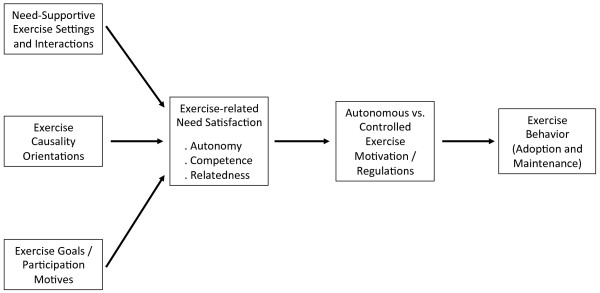
“Relations from perceived autonomy support to exercise behavior, via psychological needs and regulatory styles have been tested (in part or all) in several studies and in general these confirm the proposed sequences [17,44,43,77,76,38,33].”
§ Exercise, physical activity, and self-determination theory: A systematic review > Discussion > Need satisfaction and exercise
What the sources say
- Supportedcites [17] matched to “Exercise motivation: a cross-sectional analysis examining its relationships with frequency, intensity, and duration of exercise” (2010) source
The Background (page unavailable) says the study tested relationships between behavioral regulations and exercise frequency, intensity, and duration—one part of the proposed sequence. The Results (page unavailable) report that all three exercise indices correlated more strongly with autonomous than controlling regulations, broadly supporting the sequence. The citing sentence expressly allows studies to have tested it only “in part.” (LLM, conf=0.87)
- Partly supportedcites [44] matched to “Mediators of physical activity behaviour change among adult non-clinical populations: a review update” (2010) sourceExperimental — accuracy not yet measured
The Results section (‘Evidence of Mediation by Theory’; page not provided) reports support in one study for a link between autonomy support and physical activity. But the other self-determination-theory study found no changes in its constructs or behavior, and neither established the proposed sequence through psychological needs and regulatory styles. The review therefore does not support saying that the studies generally confirmed that sequence. (LLM, conf=0.88)
- Not checked — no full text of the sourcecites [43] matched to “The Independent Effects of Goal Contents and Motives on Well-Being: It’s Both What You Pursue and Why You Pursue It” (2004) source
- Not matchedcites [77]
The reference list we hold has no entry [77].
- Not matchedcites [76]
The reference list we hold has no entry [76].
- Not checked — no full text of the sourcecites [38] matched to “Body image and body shape ideals in magazines: exposure, awareness, and internalization” (1997) source
- Not checked — no full text of the sourcecites [33] matched to “Go Figure? Body-Shape Motives are Associated with Decreased Physical Activity Participation Among Midlife Women” (2006) source
plainstates an association- Asserted: passes — The authors put it forward as true.
- Checkable: passes — It can be checked against evidence.
- Load-bearing: passes — The paper’s conclusions depend on it.
- Based: passes — The paper gives a reason why it holds.
- Supported
A result the paper reports from its own data — it cites no other source for it, so there is none to check. The quote shows it is in the paper.
In the paper
“The literature is also consistent in that competence satisfaction and more intrinsic motives positively predict exercise participation across a range of samples and settings.”
§ Exercise, physical activity, and self-determination theory: A systematic review > Abstract > Results
boostedstates an association- Asserted: passes — The authors put it forward as true.
- Checkable: passes — It can be checked against evidence.
- Load-bearing: passes — The paper’s conclusions depend on it.
- Based: passes — The paper gives a reason why it holds.
A result the paper reports from its own data — it cites no other source for it, so there is none to check. The quote shows it is in the paper.
In the paper
“and intrinsic motivation being more predictive of long-term exercise adherence”
§ Exercise, physical activity, and self-determination theory: A systematic review > Abstract > Results
plainstates an association- Asserted: passes — The authors put it forward as true.
- Checkable: passes — It can be checked against evidence.
- Load-bearing: passes — The paper’s conclusions depend on it.
- Based: passes — The paper gives a reason why it holds.
A result the paper states — it cites no source for it, so there is none to check. The quote shows it is in the paper.
In the paper
“but similar results are found across cross-sectional, prospective, and experimental designs”
§ Exercise, physical activity, and self-determination theory: A systematic review > Abstract > Results
plain- Asserted: passes — The authors put it forward as true.
- Checkable: passes — It can be checked against evidence.
- Load-bearing: passes — The paper’s conclusions depend on it.
- Based: passes — The paper gives a reason why it holds.
99 more claims
Create a free account to see all 209 claims and to verify the 2 references still open.
- It may state two separate claims as one. 74
- Probably not a substantial claim. 39
Claims other papers make about this one
Each is checked against this paper’s own text: does it say what the citing paper says it does?
The source backs part of the claim, not all of it — or backs it for a different population, condition or comparison.
In the citing paper
“As of today, merely one systematic review in the exercise context (Teixeira et al., 2012), having SDT as theoretical background, has analyzed the satisfaction (although not frustration) of basic psychological needs, the motivational regulation, and the way these can predict different physiological outcomes (i.e., energy expenditure, body mass index).”
From Can Interpersonal behavior influence the persistence and adherence to physical exercise practice in adults? A systematic review (2018) · cites this paper as Teixeira et al., 2012
Experimental — accuracy not yet measuredThe source backs part of the claim, not all of it — or backs it for a different population, condition or comparison.
In the citing paper
“which might be justified by the fact that most of them so far cannot yet distinguish this regulation from identified regulation, given that both share the same principles”
From Can Interpersonal behavior influence the persistence and adherence to physical exercise practice in adults? A systematic review (2018) · cites this paper as Teixeira et al., 2012
Experimental — accuracy not yet measuredThe source backs part of the claim, not all of it — or backs it for a different population, condition or comparison.
In the citing paper
“Conversely, structured exercise programs foster intrinsic motivation (65), self-regulation, and a positive relationship with the body, promoting sustained engagement even after pharmacotherapy discontinuation.”
From GLP-1 agonists and exercise: the future of lifestyle prioritization (2025) · cites this paper as [65]
Experimental — accuracy not yet measuredThe source backs part of the claim, not all of it — or backs it for a different population, condition or comparison.
In the citing paper
“a study by Teixeira et al. [31] highlights that exercise not only improves physical health but also promotes a positive self-image and resilience”
From Sociodemographic influences on Student Mental Health and their association with activation-regulating functional impairments (2026) · cites this paper as [31]
Experimental — accuracy not yet measuredThe cited source says what the claim attributes to it.
In the citing paper
“The instruments described herein have been used in various contexts, for example to assess to what extent a medical professional (Williams et al., 2009), healthcare intervention (Williams et al., 2011; Teixeira et al., 2012) or a procedure (Ng et al., 2012) supports autonomy.”
From Designing for Motivation, Engagement and Wellbeing in Digital Experience (2018) · cites this paper as Teixeira et al., 2012
9 more claims about this paper
Create a free account to see every claim other papers make about this one.
Self-check
Percentages, sums and reported differences re-computed from the paper’s own numbers.
Rated minor: it would not touch a result — a value no result rests on, a p-value that stays on the same side of the significance level, or a conflict that is clerical, resolved elsewhere in the paper, or outside its own findings.
In the paper
“A total of 57 samples (53 studies) analyzed associations between regulations and exercise behavior. Of these, 37 were used in cross-sectional designs, 10 in prospective designs, 7 in experimental studies, and 2 in mixed designs.”
§ Exercise, physical activity, and self-determination theory: A systematic review > Results > Motivational predictors of exercise-related outcomes
Reported 57 · recomputed 56
Citations
Cites
Ryan, R. M., & Deci, E. L. (2000) · American Psychologist · doi:10.1037//0003-066x.55.1.68 · Cited by 54,599
Self-citationThe "what" and "why" of goal pursuits: Human needs and the self-determination of behavior
Deci, E. L., & Ryan, R. M. (2000) · Psychological Inquiry · doi:10.1207/s15327965pli1104_01 · Cited by 34,210 · cited 5×
“determination and volition with respect to the target behavior [12].”
BackgroundInfluentialSelf-citationIntrinsic Motivation and Self-Determination in Human Behavior
Deci, E. L., & Ryan, R. M. (1985) · doi:10.1007/978-1-4899-2271-7 · Cited by 26,772
Self-citationIntrinsic Motivation and Self-Determination in Human Behavior
Miller, K. A., Deci, E. L., & Ryan, R. M. (1988) · Contemporary Sociology · doi:10.2307/2070638 · Cited by 15,312
Self-citationMediation in experimental and nonexperimental studies: New procedures and recommendations.
Shrout, P. E., & Bolger, N. (2002) · Psychological Methods · doi:10.1037/1082-989x.7.4.422 · Cited by 11,335 · cited 1×
“, mediated) effects between them [75].”
Garber, C. E., Blissmer, B., Deschenes, M. R., Franklin, B. A., Lamonte, M. J., Lee, I.-M., Nieman, D. C., & Swain, D. P. (2011) · Medicine & Science in Sports & Exercise · doi:10.1249/mss.0b013e318213fefb · Cited by 9,319
A simple method to assess exercise behavior in the community.
Godin, G., & Shephard, R. J. (1985) · PubMed · Cited by 4,760
Moral Identity and Developmental Theory
Lapsley, D. (2015) · Human Development · doi:10.1159/000435926 · Cited by 3,819
Perceived locus of causality and internalization: Examining reasons for acting in two domains.
Ryan, R. M., & Connell, J. P. (1989) · Journal of Personality and Social Psychology · doi:10.1037/0022-3514.57.5.749 · Cited by 3,311 · cited 2×
“Autonomous motivation includes the identified regulation and intrinsic motivation subscales of the Exercise Self-Regulation Questionnaire [84].”
Self-citation(2002) · Cited by 3,047
Self-citation
Research works printed but not linked: 1
- Koestner R Losier GF In Handbook of self-determination research Distinguishing three ways of being internally motivated: a closer look at introjection, identification, and intrinsic motivation 2002 Edited by Deci EL, Ryan RM, Rochester, NY: University of Rochester Press 101 121
Cited by
Items 2,401–2,500 of 2,926
Fiteens tookit promoçao de comportamentos relacionados com a saúde em contexto educacional
García‐González, L., Abós, Á., & Sanz-Remacha, M. (2023) · Universidad de Zaragoza eBooks · doi:10.26754/uz.978-84-10169-04-3
FITeens Toolkit. Promoción de comportamientos relacionados con la salud en el contexto educativo
García‐González, L., Abós, Á., & Sanz-Remacha, M. (2023) · Universidad de Zaragoza eBooks · doi:10.26754/uz.978-84-10169-02-9
Longlalerng, K., Watanasiripakdee, S., Jeenduang, N., Habuddha, V., Piya-amornphan, N., & Damchuai, T. (2024) · Sleep Science · doi:10.1055/s-0043-1777708 · Cited by 2
Andersen, L. N., Jepsen, N. Z., & Møller, M. (2023) · Forum for idræt · doi:10.7146/ffi.v38i.136294
EFEKTIVITAS MOTIVASI PENDERITA HIPERTENSI DALAM MELAKUKAN AKTIVITAS FISIK: LITERATURE REVIEW
Dianita, M. K., Indriarini, M. Y., & Parulian, T. S. (2022) · Jurnal Sahabat Keperawatan · doi:10.32938/jsk.v4i01.2342
Mouton, A., Weerts, J.-P., & Carl, J. (2024) · Research Square · doi:10.21203/rs.3.rs-4172988/v1
Jaber, M., Gang, G. R., Johnson, E., Khaleghifar, M., Mleziva, P., Zuppan, K., & Daher, N. S. (2024) · Physical & Occupational Therapy In Geriatrics · doi:10.1080/02703181.2024.2335490
“24 According to a previous study, there are several strategies physical therapists can use to facilitate commitment and foster adherence to exercise programs.”
InfluentialHOLISTIC RECONDITIONING FOR THE ELDERLY: EMBRACING INTEGRATIVE APPROACHES
Shah, M., & Gupta, L. (2024) · Anti-Aging Eastern Europe · doi:10.56543/aaeeu.2024.3.1.02 · Cited by 1
Public Health, Public Health Education, and their Future Prospects
(2024) · Frontiers research topics · doi:10.3389/978-2-8325-4776-2
Investigating the Misinformation Effect and Physical Activity in an Online Study
Paoloni, V. C. (2023) · San José State University ScholarWorks (San Jose State University) · doi:10.31979/etd.sne4-7phc
Motivating Runners in Real Time: A Field ExperimentPreprint
Kim, D., Son, Y., Khern-am-nuai, W., & Cohen, M. C. (2024) · SSRN Electronic Journal · doi:10.2139/ssrn.4778848 · Cited by 1
Shaffer, J. A., Matlock, D. D., Boylan, J. M., Vagnini, K. M., Rush, C. L., Martin, R., & Masters, K. S. (2024) · Journal of Clinical Psychology in Medical Settings · doi:10.1007/s10880-024-10014-8 · Cited by 1
“Importantly, SDT interventions have effectively improved the adoption and maintenance of healthy behaviors, especially related to physical activity (e.g., Teixeira et al., 2012 and Hooker et al., 2020), making them well suited for health promotion and CVD prevention.”
Comparação da Autoestima e da Autoeficácia em Diferentes Modalidades de Treinamento Físico
Batista, L. O., Porto, T. I., Murgo, C. S., & Júnior, J. R. G. (2024) · Revista FSA · doi:10.12819/2024.21.4.9 · Cited by 1
Tallis, J. A., Richardson, D. L., Shelley, S. P., Clarke, N. D., Morris, R. O., Noon, M. R., Duncan, M. J., & Eyre, E. L. J. (2024) · Journal of Aging and Physical Activity · doi:10.1123/japa.2023-0279 · Cited by 1
“These factors can be linked to basic psychological needs that form part of self-determination theory (Teixeira et al., 2012), which has been used as a model for behavior change in a PA context (Fortier et al., 2007).”
Si, M., & Wang, J. K. (2024) · SSRN Electronic Journal · doi:10.2139/ssrn.4814740
Tucker, R., Reed, P., & Williams, C. (2024) · Research Square · doi:10.21203/rs.3.rs-4324428/v1 · Cited by 1
Physical Activity, Fitness, and Body Composition After a 5-yr Exercise Counseling Intervention
Neff, K. M. H., Launius, K. N., Schuh, L. M., Creel, D. B., & Inman, M. M. (2024) · Translational Journal of the American College of Sports Medicine · doi:10.1249/tjx.0000000000000262
Introducing a Weight-Inclusive Paradigm in Sport and Physical Education
Derbyshire, A., Lee, S.-M., Cordova, S., Crocker, G. H., & Zuest, L. (2024) · Strategies · doi:10.1080/08924562.2024.2326349
“Help students identify intrinsic motivators rather than external motivators (Teixeira et al., 2012).”
BackgroundJenssen, O. R. N., & Dillern, T. (2024) · Uniped · doi:10.18261/uniped.47.2.3 · Cited by 2
León-González, P. J. L. (2023) · Revista Metropolitana de Ciencias Aplicadas · doi:10.62452/1x7egb03
Pasión por el deporte y satisfacción con la vida en judocas de la provincia del Cañar
Bustos-Toalongo, N. A., Bravo-Navarro, W. H., & Barrachina-Fernández, G. (2023) · Revista Metropolitana de Ciencias Aplicadas · doi:10.62452/kvafh666 · Cited by 2
Beight, L., Mendoza, J. A., Leisenring, W. M., et al. (2024) · SSRN Electronic Journal · doi:10.2139/ssrn.4846219
Robin, N., Rieusset, L., Ruart, S., Ben-Rais, A., & Bourhis-Espiand, V. (2024) · Journal of Bodywork and Movement Therapies · doi:10.1016/j.jbmt.2024.06.005 · Cited by 1
NBH (Nutritious Balanced and Healthy) – An AI Enhanced Fitness AnalyzerPreprint
Nagarajan, I., ABITHA, V., AKSHAYA, P., DHANSARA, S., & DHARANGINEE, K. R. (2024) · SSRN Electronic Journal · doi:10.2139/ssrn.4852432
Link, H. D. (2024) · PDXScholar (Portland State University) · doi:10.15760/honors.1491
Physical Activities and Psychological Needs of Physical Education Students
Wang, X. (2024) · International Journal of Social Sciences and Public Administration · doi:10.62051/ijsspa.v3n2.16
Novert, P., Pelletier-Visa, M., Pereira, B., Lanhers, C., & Coudeyre, E. (2024) · Journal of Orthopaedic Surgery and Research · doi:10.1186/s13018-024-04766-0
“Then, the definition of exercise [3] is a physical activity which is usually regular and done with the intention of improving or maintaining physical fitness or health.”
BackgroundLeão, M., Jerónimo, A., & Pereira, H. V. (2024) · Retos · doi:10.47197/retos.v59.107218 · Cited by 1
Zavorski, E. B., Souza, R., Zanoni, É. M., Costa, P. M. D. A., Júnior, R. J. N., & Fin, G. (2024) · journal of physical education · doi:10.4025/jphyseduc.v35i1.3518
Meggs, J. (2024) · Mental Health Review Journal · doi:10.1108/mhrj-01-2024-0004
McManus, C., Jones, B. L., Rogerson, M., Butson, J., Micklewright, D. P., SANDERCOCK, G. R. H., & Swartz, A. (2024) · Heliyon · doi:10.1016/j.heliyon.2024.e36992 · Cited by 2
“…activity allows individuals to experience autonomy in terms of their volitional participation and via autonomy-supportive settings/environments [18], can enhance self-perceived competence (skill development and mastery) [19], and promote relatedness to others via social interaction and a…”
BackgroundPsychometric properties of behavioural Regulation in Exercise Questionnaire-4 in Chinese adolescents
Xu, Z., Samsudin, S., Yaacob, A., & Xi, M. (2024) · Cogent Psychology · doi:10.1080/23311908.2024.2395615 · Cited by 3
“…attribution of causality to one’s behaviour. as such, sDt has been widely used to study motivation in a Pa or other exercise setting (Ng et al., 2012; teixeira et al., 2012; Ryan et al., 2022). sDt focuses on the degree of behavioural willingness and individual determination. it stresses the…”
InfluentialLockyer, P. A., Fevre, D. M. L., & Vickers, M. H. (2024) · Education 3-13 · doi:10.1080/03004279.2024.2404697 · Cited by 1
“Furthermore Furthermore, meaningful experiences impact PA levels and intrinsic motivation, increasing the likelihood of individuals engaging in PA throughout their lifespan (Teixeira et al. 2012).”
Pinto, M., & Santos, I. (2024) · Revista Brasileira de Atividade Física & Saúde · doi:10.12820/rbafs.29e0352
Systematic review of the evidence on physical activity prescriptions for youth
Budd, E. L., Castro, E., Terral, H. F., Farley, Z. S., & Kelly, N. R. (2024) · Preventive Medicine · doi:10.1016/j.ypmed.2024.108145 · Cited by 1
Pabla, R. K., Graham, J. D., Watterworth, M. W. B., & Delfa, N. J. L. (2024) · Human Factors The Journal of the Human Factors and Ergonomics Society · doi:10.1177/00187208241293720
Investigating Key Factors Influencing Adhesion and Adherence in Weight Training
Bregalda, J., Daniel, M. D. A., Venera, M. E., Matias, T. S., Ferrari, R., & Delevatti, R. S. (2024) · International Journal of Physical Education Fitness and Sports · doi:10.54392/ijpefs2441 · Cited by 1
Browne, J., Battaglini, C. L., İmamoğlu, A., Stiles, B. J., Jarskog, L. F., Sheeran, P., Abrantes, A. M., Elliott, T., González, O., & Penn, D. L. (2024) · BMC Psychiatry · doi:10.1186/s12888-024-06250-9
“Virtual PACE-Life is a virtual group-based walking intervention for adults with schizophrenia guided by self-determination theory [24, 25], a theory of motivation (involving fulfillment of relatedness, autonomy, and competence needs), to improve cardiorespiratory fitness.”
MethodAlkaff, Z. A., Murukesu, R. R., Villar, D. D., Woerle, J., & Spitschan, M. (2024) · F1000Research · doi:10.12688/f1000research.157814.1 · Cited by 3
“86 91 Additionally, resources are available that elucidate the principles of the SDT and provide guidance for its application within the context of health, promoting and encouraging its utilisation.”
Malkawi, A. M. (2024) · Research Publications (Maastricht University) · doi:10.26481/dis.20241128am
Relationship between injuries and motivation in recreational runners
Matijašević, P., & Vuletić, P. R. (2024) · Journal of Kinesiology and Exercise Sciences · doi:10.5604/01.3001.0054.8525 · Cited by 1
Skinner, J. W., Fasczewski, K. S., Bramblett, P. N., & Ristanovic, M. (2024) · Gerontology and Geriatric Medicine · doi:10.1177/23337214241302664
“Often, these needs are met implicitly in programs (Teixeira et al., 2012), such as when participants form social bonds that enhance motivation.”
Rani., M. N. S., & Gienardy, M. (2024) · International Journal of Research in Business and Social Science (2147-4478) · doi:10.20525/ijrbs.v13i7.3628 · Cited by 2
“Motivation plays a crucial role in supporting continued exercise, highlighting the importance of psychological factors in maintaining physical engagement (Teixeira et al., 2012).”
Schoser, D. S., Mackenbrock, J., Lendt, C., Froböse, I., & Wilke, C. (2024) · German Journal of Exercise and Sport Research · doi:10.1007/s12662-024-00999-7 · Cited by 1
“…zeigen, dasssowohlbeiErwachsenenalsauchbei KinderndieMotivationentsprechendder Selbstbestimmungstheorie ( self determination theory , SDT) im Zusammenhang mitdemSport-undBewegungsverhalten steht (Owen, Smith, Lubans, Ng, & Lons-dale, 2014; Sebire et al., 2013; Schüler, 2020, Teixeira et al., 2012).”
Motivators and barriers to exercise in college students compared to faculty and staff
Muir, I. L., Moore, E. N., & Gilbertson, N. M. (2024) · Journal of American College Health · doi:10.1080/07448481.2024.2435950
“31 Given that such obligations likely do not involve activity, it can negatively influence their intention to exercise.”
InfluentialKyrönlahti, S. M., Lehtisalo, J., Tiia, N., Kivipelto, M., Strandberg, T. E., Antikaínen, R., Laatikainen, T. K., Hilkka, S., Jaakko, T., Havulinna, S., et al. (2024) · Scandinavian Journal of Medicine and Science in Sports · doi:10.1111/sms.14777 · Cited by 2
Hidrus, A., Kueh, Y. C., Kuan, G., Ramdzan, A. R., & Omar, A. (2024) · Lecture notes in bioengineering · doi:10.1007/978-981-97-4186-1_24
Cevhan, R., & Polat, E. (2024) · Ankara Üniversitesi Beden Eğitimi ve Spor Yüksekokulu SPORMETRE Beden Eğitimi ve Spor Bilimleri Dergisi · doi:10.33689/spormetre.1534693
Adaptation Of The Exercise Maintenance Motivation Scale To Turkish Culture
Öztaş, M., Kılcı, A., Erdoğan, A., & Şirin, E. F. (2024) · Turkish Journal of Sport and Exercise · doi:10.15314/tsed.1564647 · Cited by 4
Weight loss after 12 weeks of weight training using resistance bands in obese college student
Kuswahyudi, K., Taufik, M. S., Setiakarnawijaya, Y., Hazar, F., & Purwoto, S. P. (2024) · Jurnal SPORTIF Jurnal Penelitian Pembelajaran · doi:10.29407/js_unpgri.v10i3.22891 · Cited by 1
“Moreover, a study by (Teixeira et al., 2012) (Haapala, 2020; Jelleyman, 2015; Stricker, 2020).”
Wang, N., Lee, J.-H., & Cho, H. (2024) · Korean Journal of Leisure, Recreation & Park · doi:10.26446/kjlrp.2024.6.48.4.79
Engel, A. R., Rathwell, S., & Pope, J. P. (2025) · Recreational Sports Journal · doi:10.1177/15588661241313337
“For example, within the literature, connections have been made between exercise behavior such as frequency of use and personal factors such as motivation (Markland & Ingledew, 1997; Snelgrove et al., 2022; Teixeira et al., 2012).”
Running Punks: More than just turning up
King, P., & Morgan, A. (2025) · Punk & Post Punk · doi:10.1386/punk_00274_1
Self-Efficacy and Competence: A Physical Activity Experimental Comparison
Phillips, A. S. (2019) · University of North Texas Digital Library (University of North Texas) · doi:10.12794/metadc1538687
Si, M., & Wang, J. (2025) · Asian Journal of Sport and Exercise Psychology · doi:10.1016/j.ajsep.2025.01.002
Oliveira, R., Pedras, S., Veiga, C., Moreira, L. F., Santarém, D., Guedes, D., Paredes, H., & Silva, I. (2025) · Informatics for Health and Social Care · doi:10.1080/17538157.2025.2465527
“33 Regarding usability, the SUS questionnaire showed a high usability score.”
Supples, M., Chandler, A. M., Fanning, J. T., Snavely, A. C., Ashburn, N. P., Powell, S. L., Winslow, J. E., Stopyra, J. P., Moore, J. B., & Mahler, S. A. (2025) · Prehospital Emergency Care · doi:10.1080/10903127.2025.2479124
“By contrast, internal (e.g., appeal to values, developing an active identity) and intrinsic (e.g., identifying satisfying or enjoyable modes of activity) motivators are critical for lasting behavior change (41, 59).”
Seiffer, B., & Wolf, S. (2025) · German Journal of Exercise and Sport Research · doi:10.1007/s12662-025-01032-1 · Cited by 2
The Relationship Between Personal Values and Leisure‐Time Exercise: A Three‐Wave Study
Chen, G., Liang, J., Xie, C., & Wang, K. (2025) · PsyCh Journal · doi:10.1002/pchj.70012 · Cited by 1
“This finding is inconsistent with previous research, as numerous studies have demonstrated that identified regulation can directly and positively predict exercise-related outcomes (Teixeira et al. 2012).”
InfluentialHatib, A. A., Koh, H. L., & Sim, S. Z. (2025) · BMC Family Practice · doi:10.1186/s12875-025-02789-y · Cited by 1
“This is in keeping with studies by Markland et al. [43] and Teixeira et al. [41] that showed external regulation correlating with lower levels of physical activity.”
InfluentialSchoor, R., Bruce, J. M., Staggs, V. S., Fox, A. T., Bruce, A. S., LYNCH, S. G., & Catley, D. (2025) · Journal of Clinical Psychology · doi:10.1002/jclp.23796
Beddoe, A., Hings, R. F., & Kerner, C. (2025) · Journal of Adolescent Research · doi:10.1177/07435584251330810 · Cited by 1
“Although quantitative studies report a positive correlation between autonomous motivation and exercise (Teixeira et al., 2012), we found that boys who dislike PE could choose lower activities with MVPA, such as badminton or table tennis, allowing them to socialize with less supervision.”
Suffoletto, B. P., Mayer, W., Toth, C., Ashenburg, N. G., Lin, M., Losak, M., & Kim, D. A. (2025) · Aging Clinical and Experimental Research · doi:10.1007/s40520-025-03030-7 · Cited by 1
Heizmann, A.-N., Ollier, É., Labeix, P., Goujon, I., Roche, F., & Hello, C. L. (2025) · doi:10.2196/preprints.74115
Qi, Y., Li, F., Yao, Y., Lin, Q., Hamzah, S. H., & Peng, W. (2025) · Research Quarterly for Exercise and Sport · doi:10.1080/02701367.2025.2478870
“Self-motivation refers to people identifying with the value of an activity and ideally integrating it into their sense of self (Teixeira et al., 2012).”
Nabofa, O. E., Oniomovigho, U. T., & Gboro, S. (2025) · DELSU Journal of Educational Research and Development · doi:10.61448/djerd22135
“Similarly, Teixeira et al. (2012) emphasized that individuals with strong intrinsic motivation are more likely to overcome external barriers, including limited access to quality facilities.”
Mouton, A., Weerts, J.-P., & Carl, J. (2025) · BMC Sports Science Medicine and Rehabilitation · doi:10.1186/s13102-025-01175-6 · Cited by 3
“It is an important predictor of initiation and maintenance of long-term PA adherence across lifespan [62].”
Maguindanaon Indigenous Games and Skills-Related Fitness of Junior High School Students
Mohamad, R., & Usman, M. (2025) · Psychology and Education A Multidisciplinary Journal · doi:10.70838/pemj.390201 · Cited by 1
A Mapping Review of Existing Tools to Assess Physical Qualities of Manual Wheelchair Users
Barthod, C., Berthiaume, J., Schmouth, M.-È., Bédard, J., Routhier, F., & Best, K. L. (2025) · Disabilities · doi:10.3390/disabilities5020054
“For example, LTPA can be facilitated by creating physically accessible environments [24], developing customized and supportive programs [25,26], and making adaptations to both the environment and the activities themselves [27].”
Leisure Constraints and Anti-Aging Attributes
Girish, V. G., Cho, W. S., Kim, J. S., Chang, D.-Y., & Lee, C.-K. (2025) · Activities Adaptation & Aging · doi:10.1080/01924788.2025.2518844 · Cited by 2
“…role in the initiation and maintenance of exercise behavior among middle-aged adults and older people (Schutzer & Graves, 2004), exercise behavior (Teixeira et al., 2012), and relationships of motivational regulation and physical activity among different age groups (Brunet & Sabiston, 2011).”
Grønfeldt, B. M., Husted, R. S., Rathleff, M. S., Troelsen, A., Bandholm, T., & Kirk, J. W. (2025) · F1000Research · doi:10.12688/f1000research.164572.1
Goss, J. M., Watkins, J. M., Kwaiser, M. M., Medellin, A. M., Golzarri‐Arroyo, L., Schigur, A. P., Hobson, J. M., Kercher, V. M. M., & Kercher, K. A. (2025) · Sports · doi:10.3390/sports13070200 · Cited by 1
“Additionally, research supports that an increase in autonomy in exercise or in terms of motivation is predictive of exercise participation and the extent to which one will participate [26].”
Lambert, M., Ahmed, T., Bourget, P., Feldman, S., Loughlin, L., Manji, K. P., Chow, E., Pullattayil, A. K., Tomasone, J. R., & Fakolade, A. O. (2025) · Physical Therapy Reviews · doi:10.1080/10833196.2025.2522540
“For instance, Self-Determination Theory [46], a commonly used framework in developing exercise interventions [47], includes three constructs: autonomy, relatedness, and competence.”
Xiao, Y., Tang, J., & Lu, P. (2025) · World Leisure Journal · doi:10.1080/16078055.2025.2522791 · Cited by 1
“To assess motivation for participation, participants indicated their primary goal (intrinsic or extrinsic motivation) for engaging in informal sports, based on self-determination theory (Teixeira et al., 2012).”
Nunn, K., Brancamp, T., Evans, W. S., Hambridge, T., Harmon, T. G., Wallace, S. E., Biel, M., & Hula, W. D. (2025) · American Journal of Speech-Language Pathology · doi:10.1044/2025_ajslp-24-00404 · Cited by 1
Multidimensional exercise amotivation beliefs across exercise stages of change
Vlachopoulos, S. P., & Biddle, S. (2025) · Performance Enhancement & Health · doi:10.1016/j.peh.2025.100358
Effects of an in-school physical activity–based lifestyle intervention on mental well-being
Kirschner, M., Golsteijn, R. H. J., Kikkert, R., Savelberg, H. H. C. M., & de Groot, R. H. M. (2025) · Health Education Journal · doi:10.1177/00178969251352401 · Cited by 1
“Moreover, effective behaviour change often requires autonomous self-regulation, that is, students engaging in PA because they find it personally interesting or important (Teixeira et al., 2012).”
Martins, T. B., Mochizuki, L., do Nascimento, I. B., Okubo, R., & Santos, G. M. (2025) · Human Movement Science · doi:10.1016/j.humov.2025.103386
Fondacaro, D. V., Bonkova, V., & Grech, A. (2025) · The Journal of Sports Medicine and Physical Fitness · doi:10.23736/s0022-4707.25.16897-7 · Cited by 1
Söyler, M., Kurtoğlu, A., Aydın, E., Senol, I., Çar, B., Eken, Ö., & Aldhahi, M. I. (2025) · International Journal of Yoga · doi:10.4103/ijoy.ijoy_213_24
“[1] However, in recent years, the popularity of practices involving physical and mental disciplines, such as yoga, has increased.”
Criddle, J. M., Malvini, W., Jasper, H., & Bordieri, M. J. (2025) · Behavioral Sciences · doi:10.3390/bs15081095 · Cited by 1
“…demonstrated in exercise science research exploring motivation, such that higher levels of behavioral engagement and long-term change are correlated with intrinsic health motivation and personally chosen behavioral intentions (e.g., Kane et al., 2004; Teixeira et al., 2012; Webb & Sheeran, 2006).”
Hung, C., Ibrahim, S. T., & Katapally, T. R. (2025) · PeerJ · doi:10.7717/peerj.19793
“Likewise, research has shown a positive relationship between autonomous motivation ( i.e., motivation driven by personal interest, enjoyment, and values) and exercise ( Teixeira et al., 2012 ).”
John, T., Nawshin, T., Mohanraj, S., Mehta, T. S., & Thirumalai, M. (2025) · doi:10.2196/preprints.81441
Temporal landmarks help to change eating habits: the case of home delivered meals in Poland
Sojka, G., Mackiewicz, R., & Fałkowski, A. (2025) · Current Psychology · doi:10.1007/s12144-025-08301-0
“Studies also demonstrate that the desire to improve eating behaviors is often associated with broader aspirations for self-improvement and well-being (Teixeira et al., 2012 ).”
High-intensity functional training: functional movement, fitness, and physiatry
West, A. M., Gilbert, C., & Kotler, D. H. (2025) · Elsevier eBooks · doi:10.1016/b978-0-443-30014-1.00013-x
Couto, N., Antunes, R., Bento, T., Vitorino, A., Monteiro, D., & Cid, L. (2025) · Healthcare · doi:10.3390/healthcare13172086
“Research has found that when older people exercise to improve their image, self-care, self-esteem, and social identity [50], it can improve their physical condition and ability to experience more positive emotions [31,50].”
If you want to support the health and wellness of kids, stop focusing on their weight
Kelly, N. R., Giuliani, N. R., & Budd, E. L. (2021) · The Conversation · doi:10.64628/aai.jteadq4s9
Counteracting the Inactivity Epidemic: Should We Ring-Fence Paid Work Time for Physical Activity?
Funnell, M. P., Chauntry, A. J., Hutson, M. J., Tyne, W. P., Khunti, K., & Routen, A. C. (2025) · Journal of Physical Activity and Health · doi:10.1123/jpah.2025-0470
Gourlan, M., & Guéritat, J. (2025) · Journal of Nutrition Education and Behavior · doi:10.1016/j.jneb.2025.06.008 · Cited by 1
Li, M., Benjasirisan, C., Zhang, J., Sheng, J. Y.-S., Li, J., Allgood, S., Carducci, M. A., Thrul, J., & Lukkahatai, N. (2025) · Cancers · doi:10.3390/cancers17172850 · Cited by 2
“Moreover, feedback that focuses solely on quantitative metrics such as step counts may shift attention away from intrinsic motivation and enjoyment, making exercise seem obligatory rather than self-directed, which can hinder long-term adherence [15].”
Røynesdal, Ø. B., Smith, O. R. F., Sørensen, M., van Nassau, F., Jelsma, J. G. M., Wyke, S., Gray, C. M., Pereira, H. V., Andersen, E., Silva, M. N., et al. (2025) · International Journal of Sport and Exercise Psychology · doi:10.1080/1612197x.2025.2547364
“…can promote psychological needs satisfaction and autonomous motivation which lead to positive changes to PA (Ng et al., 2012; Ntoumanis et al., 2021; Rhodes et al., 2021; Sheeran et al., 2020, 2021; Teixeira et al., 2012; Teixeira et al., 2015) that are sustained long term (Sheeran et al., 2021).”
Self-citationMorton, A. L., Hornbuckle, L. M., Springer, C. M., Baldwin, D. R., & Bassett, D. R. (2025) · Journal of Health Psychology · doi:10.1177/13591053251367861
“According to Self-Determination Theory, supportive social environments can enhance autonomous motivation by satisfying psychological needs for autonomy, competence, and relatedness (Biddle and Nigg, 2000; Deci and Ryan, 2000; Teixeira et al., 2012).”
González-Devesa, D., Carballo-Afonso, R., Sánchez-Lastra, M. A., & Ayán, C. (2025) · Performance Enhancement & Health · doi:10.1016/j.peh.2025.100371
Yoga in augmented reality: comparison of a 3D experience versus traditional video of a lesson
Chittaro, L. (2025) · Virtual Reality · doi:10.1007/s10055-025-01231-z
“Self-assessment of compe - tence in a physical activity considers specific abilities and achievements of the considered performance context, with experiences of competence varying based on success or fail - ure in performing the physical tasks (Teixeira et al. 2012).”
Harmonious Hustle or Obsessive Grind: Exploring Passion Types, Psychological Needs, and FlowPreprint
Koehn, S., Stavrou, N. A. M., & Mouratidi, A. (2025) · Research Square · doi:10.21203/rs.3.rs-7622885/v1
Furman, C. R., Volz, S. C., Mann, T. L., & Rothman, A. J. (2025) · Psychology and Health · doi:10.1080/08870446.2025.2560360
Xu, K., Zhu, L. F., Li, Y., Cao, Y., & Zhang, G. (2025) · Frontiers in Psychology · doi:10.3389/fpsyg.2025.1636692 · Cited by 2
Development, validation and reliability of the Coach Feedback Analysis System
Corbett, R., Cope, E., Partington, M., Gannon, E., Ryan, L., & Mason, R. (2025) · Journal of Sports Sciences · doi:10.1080/02640414.2025.2561346 · Cited by 2
“This may also enhance the level of autonomy afforded to the learner, which has also been associated with enhanced performance, when compared with controlling feedback (Hooyman et al., 2014; Teixeira et al., 2012).”
Akyol, G. (2025) · Avrasya Spor Bilimleri ve Eğitim Dergisi · doi:10.47778/ejsse.1737714 · Cited by 3
Metadata
- Authors
- Teixeira, P. J., Carraça, E. V., Markland, D., Silva, M. N., & Ryan, R. M.
- Affiliations
- Universidade Técnica de Lisboa (PT)
- Bangor University (GB)
- University of Rochester (US)
- Corresponding author
- Teixeira, Pedro J
- Venue
- International Journal of Behavioral Nutrition and Physical Activity
- Published
- 2012
- Volume
- 9
- Issue
- 1
- Pages
- 78
- ISSN
- 1479-5868 (ISSN-L)
- PMC
- PMC3441783
- OpenAlex
- W2120612383
- Semantic Scholar
- 91c1a302b1ba3d78f18d769090d5c285c36d9567
- Cited by
- 2,963
- References
- 110
- Citations by year
- 2026: 399 · 2025: 332 · 2024: 260 · 2023: 244 · 2022: 242 · 2021: 279 · 2020: 256 · 2019: 215 · 2018: 202 · 2017: 162 · 2016: 141 · 2015: 100 · 2014: 66 · 2013: 59 · 2012: 3
- FWCI
- 10.23
- Type
- journal article
- Language
- en
- Open access
- gold
- doi.org
- Licence
- cc-by
- Locations
- International Journal of Behavioral Nutrition and Physical Activity (publishedVersion, cc-by)
- Europe PMC (PubMed Central) (publishedVersion, cc-by)
- PubMed Central (publishedVersion, cc-by)
- PubMed (publishedVersion)
- DOAJ (DOAJ: Directory of Open Access Journals) (submittedVersion)
- Topics
- Social Sciences › Psychology › Social Psychology › Motivation and Self-Concept in Sports
- Social Sciences › Psychology › Applied Psychology › Behavioral Health and Interventions
- Health Sciences › Medicine › Public Health, Environmental and Occupational Health › Physical Activity and Health
- Keywords
- self-determination theory, exercise motivation, physical activity, autonomous motivation, intrinsic motivation, identified regulation, introjected regulation, competence satisfaction, need satisfaction, exercise adherence, exercise self-regulation, exercise intervention, exercise behavior
- MeSH terms
- Health Promotion, Humans, Motor Activity, Personal Satisfaction, Health Behavior, Exercise, Databases, Factual, Personal Autonomy, Empirical Research
About these checks
Registry, retraction, Cites and statistics results are computed, not judged, with one exception: a printed reference that no index lists is read once by a model before it counts as a citation error. Claims are extracted by a model and kept only when their quote appears verbatim in the text; each cited source is then checked, with a model’s help, for whether it says what the claim relies on. Those verdicts can be wrong — read the claim’s quote and the cited source before relying on one.
The claim verdicts this report counts are experimental: their accuracy is not yet measured.
A language model drew the claims from the paper on 2026-10-10, under version 3 of the claim definition (model deepseek-v4.1-flash, prompt extract-v3).
A second model labelled each claim on 2026-10-10 (model jev-1.13-20260917, definition revision gold-guideline-v0.2).
Cited sources are checked with a language model’s help (gpt-6-sol).
Statistics and arithmetic are recomputed, not judged.
Confidence bands are shown only for fields calibrated on our annotated test set. None is calibrated yet, so no band is shown.
What counts as a claim ›How we measure confidence ›How we check this ›
Are you an author, or do you see a problem with this page? Request a review
Data sources
Bibliographic data: Semantic Scholar, OpenAlex, Crossref.
Contains information from the Semantic Scholar Academic Graph Datasets, made available under the ODC Attribution License (ODC-BY 1.0).
Semantic Scholar’s data is described in: Kinney, R., et al. (2023). The Semantic Scholar Open Data Platform. arXiv:2301.10140.
