

IGF-I increases markers of osteoblastic activity and reduces bone resorption via osteoprotegerin and RANK-ligand
Open accessThe DOI matches its Crossref record; 71 of the 72 references it cites were found in a registry or an index.
Abstract
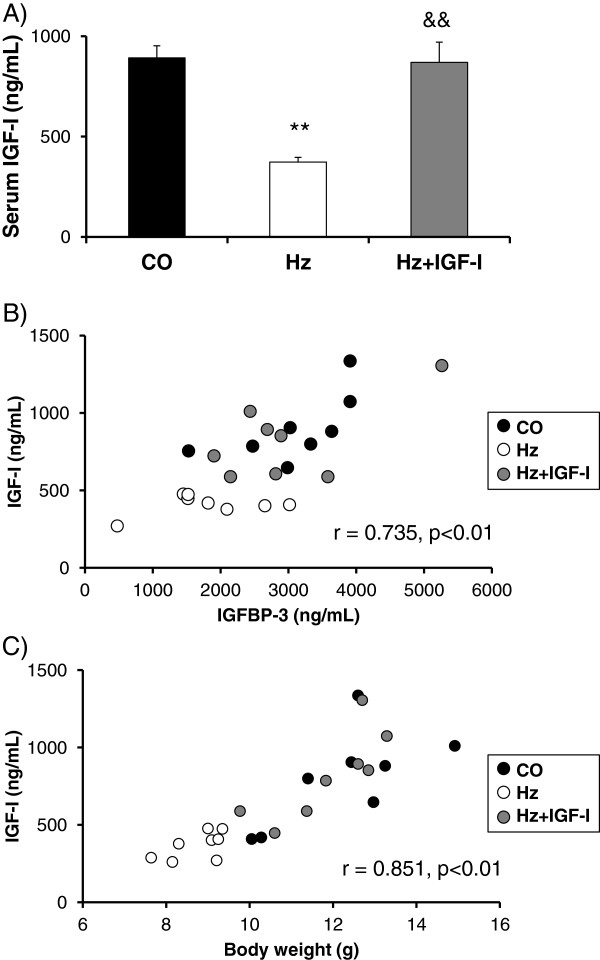
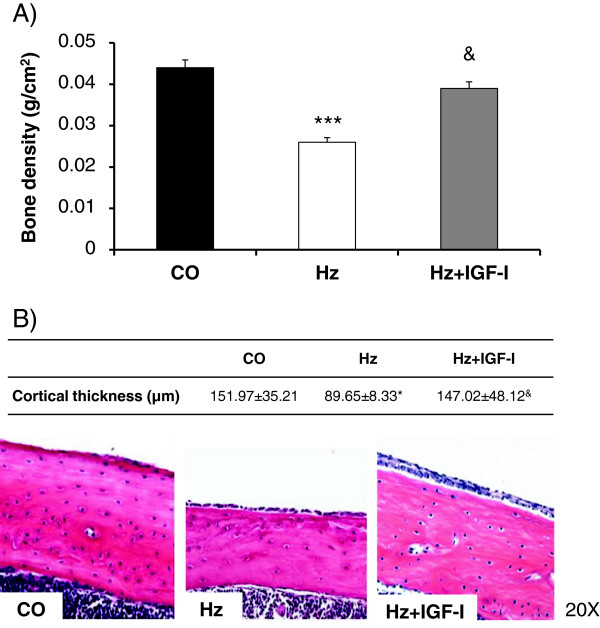
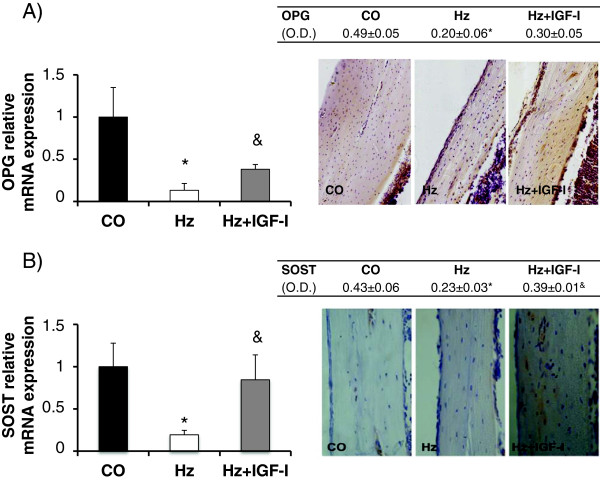
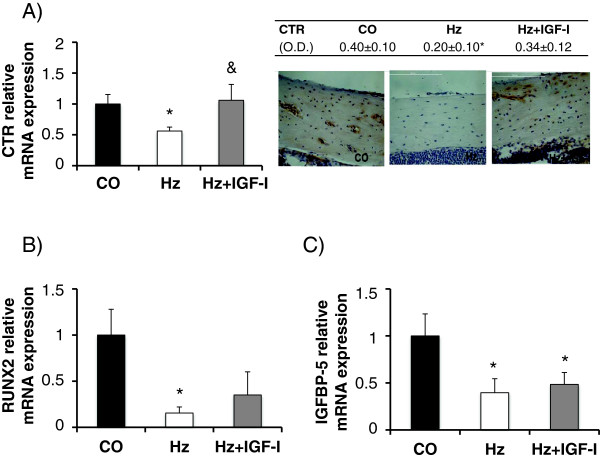
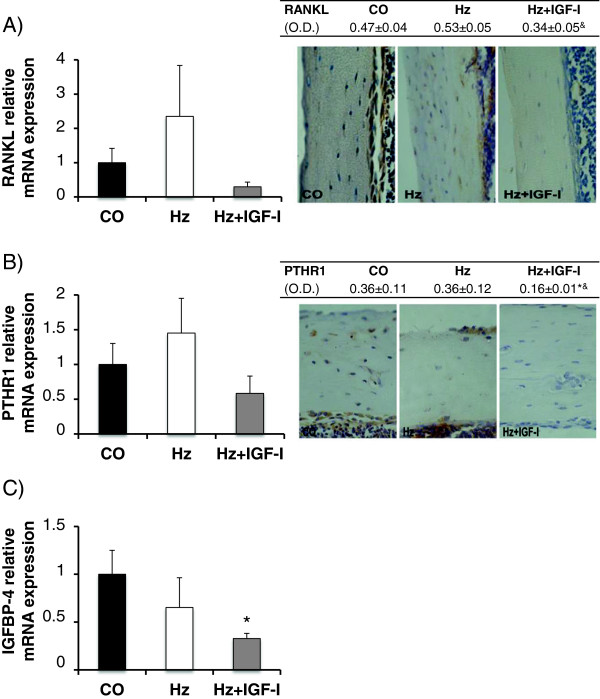
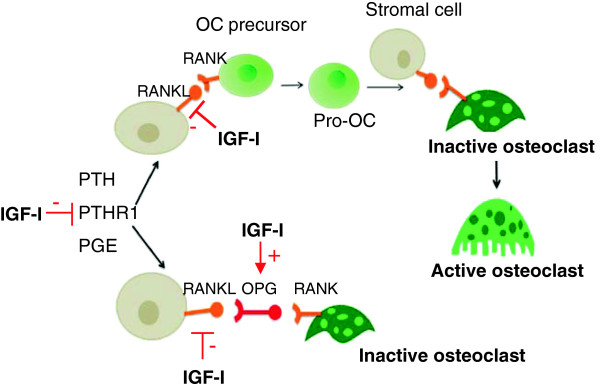
BACKGROUND: Bone is one of the major target tissues for Insulin-like Growth Factor I (IGF-I). Low doses of IGF-I were able to improve liver-associated osteopenia. In the present work, a model of partial IGF-I deficiency was used in order to provide insight into the mechanisms of the beneficial actions of IGF-I replacement therapy in bone. METHODS: Several proteins involved in osteoblastic/osteocyte and osteoclastic differentiation and activity were studied in the three experimental groups: control (CO) group (wild type mice, Igf+/+, n=10), heterozygous Igf+/- group with partial IGF-I deficiency (Hz, n=10), and heterozygous Igf+/- mice treated with IGF-I for 10 days (Hz+IGF-I, n=10). RESULTS: Data in this paper confirm that the simple partial IGF-I deficiency is responsible for osteopenia, determined by densitometry and histopathology. These findings are associated with a reduced gene expression of osteoprotegerin, sclerostin, calcitonin receptor (CTR), insulin-like growth factor binding protein 5 and RUNX2. IGF-I replacement therapy normalized CTR gene expression and reduced markers of osteoclastic activity. CONCLUSIONS: Low doses of IGF-I constituted a real replacement therapy that normalized IGF-I serum levels improving the expression of most of these proteins closely involved in bone-forming, and reducing bone resorption by mechanisms related to osteoprotegerin, RANKL and PTH receptor.
Overview
The claims and statistics of this paper haven’t been checked yet.
Free: it reads the open-access text and checks the first 5 claims that cite a source we can check. Create a free account to check every claim.
Integrity signals
Registry
Cites
Statistics
Figures
Verification
Claims the paper makes
The claims and statistics of this paper haven’t been checked yet.
Free: it reads the open-access text and checks the first 5 claims that cite a source we can check. Create a free account to check every claim.
Claims other papers make about this one
Each is checked against this paper’s own text: does it say what the citing paper says it does?
The source backs part of the claim, not all of it — or backs it for a different population, condition or comparison.
In the citing paper
“Experimental data show that low doses of IGF-1 increase bone mass in cirrhotic rats [65,69,70].”
From Bone diseases in patients with chronic liver disease (2019) · cites this paper as [65]
Experimental — accuracy not yet measuredIn the citing paper
“In advanced liver cirrhosis, IGF-1 serum levels decrease as a result of diminished hepatocellular biosynthetic function and progressive loss of GH receptors on hepatocytes [65,72].”
From Bone diseases in patients with chronic liver disease (2019) · cites this paper as [65]
In the citing paper
“The administration of IGF-1 appears to be beneficial in rats, but no studies of IGF-1 use in humans exist [65,67,69,73,196].”
From Bone diseases in patients with chronic liver disease (2019) · cites this paper as [65]
Self-check
Percentages, sums and reported differences re-computed from the paper’s own numbers.
The self-check needs the paper’s full text.
Citations
Cites
Yasuda, H., Shima, N., Nakagawa, N., Yamaguchi, K., Kinosaki, M., Mochizuki, S.-I., Tomoyasu, A., Yano, K., Goto, M., Murakami, A., et al. (1998) · Proceedings of the National Academy of Sciences · doi:10.1073/pnas.95.7.3597 · Cited by 4,228 · cited 2×
“Consequently, these patients are exposed to an increased risk of bone fractures, which are a source of morbidity in advanced stages of the disease and after liver transplantation [15,58].”
BackgroundLiu, J.-P., Baker, J., Perkins, A. S., Robertson, E. J., & Efstratiadis, A. (1993) · Cell · doi:10.1016/s0092-8674(05)80084-4 · Cited by 2,855
Role of insulin-like growth factors in embryonic and postnatal growth
Baker, J., Liu, J.-P., Robertson, E. J., & Efstratiadis, A. (1993) · Cell · doi:10.1016/s0092-8674(05)80085-6 · Cited by 2,463 · cited 1×
“[36-48].”
Biology of RANK, RANKL, and osteoprotegerin
Boyce, B. F., & Xing, L. (2007) · Arthritis Research & Therapy · doi:10.1186/ar2165 · Cited by 957 · cited 4×
“IGFBP-5 has been described as an IGF-I carrier protein that promotes its actions in bone [27,32,33,35] and, although IGF-I replacement therapy did not module its hypoexpression, it could also be involved in the reduction of bone mass observed in these heterozygous mice.”
BackgroundInfluentialInsulin-like growth factors and their binding proteins
Sara, V. R., & Hall, K. (1990) · Physiological Reviews · doi:10.1152/physrev.1990.70.3.591 · Cited by 925
Insulin-like Growth Factor Binding Proteins
Rechler, M. M. (1993) · Vitamins & Hormones · doi:10.1016/s0083-6729(08)60444-6 · Cited by 755
SOST is a target gene for PTH in bone
Keller, H., & Kneissel, M. (2005) · Bone · doi:10.1016/j.bone.2005.03.018 · Cited by 616 · cited 1×
“This outcome is consistent with previous data [64,65], where osteocyte PTH receptor 1 activation was shown sufficient to decrease SOST expression.”
ResultInsulin-like growth factor 1 (IGF-1): a growth hormone
Laron, Z. (2001) · Molecular Pathology · doi:10.1136/mp.54.5.311 · Cited by 608 · cited 1×
“Liver cirrhosis is associated with osteopenia and low levels of IGF-I [8-10], constituting a well established condition of IGF-I deficiency [11,12].”
BackgroundGrowth factors and the regulation of bone remodeling.
Canalis, E., McCarthy, T., & Centrella, M. (1988) · Journal of Clinical Investigation · doi:10.1172/jci113318 · Cited by 602 · cited 1×
“Background Bone is one of the major target organs for insulin-like growth factor I (IGF-I) [1-4], an anabolic hormone produced mainly by the liver upon growth hormone (GH) stimulation [5-7].”
BackgroundMOHAN, S., & BAYLINK, D. J. (1991) · Clinical Orthopaedics and Related Research · doi:10.1097/00003086-199102000-00004 · Cited by 519
Cited by
Yan, J., & Charles, J. F. (2018) · Calcified Tissue International · doi:10.1007/s00223-018-0395-3 · Cited by 123
“Moreover, mice heterozygous for Igf1 demonstrated lower serum IGF-1 levels and decreased cortical thickness and tissue bone mineral density, which were rescued by exogenous IGF-1 injection [32].”
40 YEARS OF IGF1: Role of IGF-binding proteins in regulating IGF responses to changes in metabolism
Clemmons, D. R. (2018) · Journal of Molecular Endocrinology · doi:10.1530/jme-18-0016 · Cited by 118
Bone diseases in patients with chronic liver disease
Jeong, H., & Kim, D. (2019) · International Journal of Molecular Sciences · doi:10.3390/ijms20174270 · Cited by 113
Yang, Y. J., & Kim, D. J. (2021) · International Journal of Molecular Sciences · doi:10.3390/ijms22052604 · Cited by 112
Algate, K., Haynes, D. R., Bartold, P. M., Crotti, T. N., & Cantley, M. D. (2015) · Journal of Periodontal Research · doi:10.1111/jre.12339 · Cited by 123
Metadata
- Authors
- Guerra-Menéndez, L., Sádaba, M. C., Puche, J. E., Lavandera, J. L., de Castro, L. F., de Gortázar, A. R., & Castilla-Cortázar, I.
- Affiliations
- Universidad San Pablo CEU (ES)
- ORCID
- Puche, Juan E
- Venue
- Journal of Translational Medicine
- Published
- 2013-10-25
- Volume
- 11
- Issue
- 1
- Pages
- 271-271
- ISSN
- 1479-5876 (ISSN-L)
- PMC
- PMC4231608
- OpenAlex
- W2158531247
- Cited by
- 64
- References
- 71
- Citations by year
- 2026: 1 · 2025: 6 · 2024: 11 · 2023: 6 · 2022: 3 · 2021: 8 · 2020: 4 · 2019: 4 · 2018: 7 · 2017: 4 · 2016: 4 · 2015: 5 · 2014: 1
- FWCI
- 1.49
- Type
- journal article
- Language
- en
- Open access
- gold
- doi.org
- Licence
- cc-by
- Locations
- Journal of Translational Medicine (publishedVersion, cc-by)
- PubMed Central (publishedVersion, cc-by)
- PubMed (publishedVersion)
- Topics
- Life Sciences › Biochemistry, Genetics and Molecular Biology › Molecular Biology › Bone Metabolism and Diseases
- Health Sciences › Medicine › Endocrinology, Diabetes and Metabolism › Growth Hormone and Insulin-like Growth Factors
- Health Sciences › Medicine › Orthopedics and Sports Medicine › Bone health and osteoporosis research
- Keywords
- insulin-like growth factor I, IGF-1 deficiency, bone resorption, osteoblast activity, osteoprotegerin, RANKL, sclerostin, calcitonin receptor, IGFBP-5, Runx2, osteopenia, parathyroid hormone receptor, osteoclasts
- MeSH terms
- Animals, Bone Resorption, Insulin-Like Growth Factor I, Mice, Transgenic, Osteoblasts, Biomarkers, Reverse Transcriptase Polymerase Chain Reaction, Mice, Osteoprotegerin, RANK Ligand
About these checks
Registry, retraction, Cites and statistics results are computed, not judged, with one exception: a printed reference that no index lists is read once by a model before it counts as a citation error. Claims are extracted by a model and kept only when their quote appears verbatim in the text; each cited source is then checked, with a model’s help, for whether it says what the claim relies on. Those verdicts can be wrong — read the claim’s quote and the cited source before relying on one.
Statistics and arithmetic are recomputed, not judged.
Confidence bands are shown only for fields calibrated on our annotated test set. None is calibrated yet, so no band is shown.
What counts as a claim ›How we measure confidence ›How we check this ›
Are you an author, or do you see a problem with this page? Request a review
How to cite
Cite CoChat for the checks on this page, and the paper for its own findings.
- This page
- CoChat. (2026). Citation check: IGF-I increases markers of osteoblastic activity and reduces bone resorption via osteoprotegerin and RANK-ligand. https://app.cochat.ai/papers/10.1186/1479-5876-11-271
- The paper
- Guerra-Menéndez, L., Sádaba, M. C., Puche, J. E., Lavandera, J. L., de Castro, L. F., de Gortázar, A. R., & Castilla-Cortázar, I. (2013). IGF-I increases markers of osteoblastic activity and reduces bone resorption via osteoprotegerin and RANK-ligand. Journal of Translational Medicine. https://doi.org/10.1186/1479-5876-11-271
Data sources
Bibliographic data: Semantic Scholar, OpenAlex, Crossref.
Contains information from the Semantic Scholar Academic Graph Datasets, made available under the ODC Attribution License (ODC-BY 1.0).
Semantic Scholar’s data is described in: Kinney, R., et al. (2023). The Semantic Scholar Open Data Platform. arXiv:2301.10140.
