

Histamine release and fibrinogen adsorption mediate acute inflammatory responses to biomaterial implants in humans
Open accessThe DOI matches its Crossref record; 22 of the 22 references it cites were found in a registry or an index.
Abstract
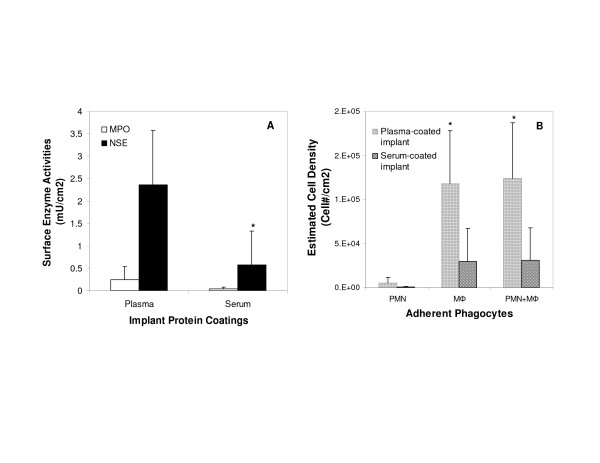
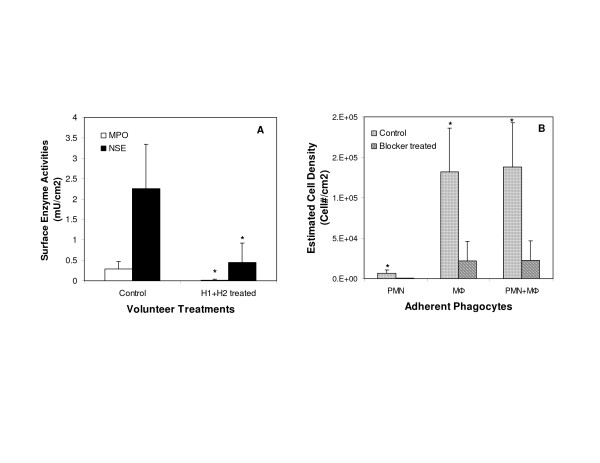
BACKGROUND: Medical implants often fail as a result of so-called foreign body reactions during which inflammatory cells are recruited to implant surfaces. Despite the clinical importance of this phenomenon, the mechanisms involved in these reactions to biomedical implants in humans are not well understood. The results from animal studies suggest that both fibrinogen adsorption to the implant surface and histamine release by local mast cells are involved in biomaterial-mediated acute inflammatory responses. The purpose of this study was to test this hypothesis in humans. METHODS: Thirteen male medical student volunteers (Caucasian, 21-30 years of age) were employed for this study. To assess the importance of fibrinogen adsorption, six volunteers were implanted with polyethylene teraphthalate disks pre-coated with their own (fibrinogen-containing) plasma or (fibrinogen-free) serum. To evaluate the importance of histamine, seven volunteers were implanted with uncoated disks with or without prior oral administration of histamine receptor antagonists. The acute inflammatory response was estimated 24 hours later by measuring the activities of implant-associated phagocyte-specific enzymes. RESULTS: Plasma coated implants accumulated significantly more phagocytes than did serum coated implants and the recruited cells were predominantly macrophage/monocytes. Administration of both H1 and H2 histamine receptor antagonists greatly reduced the recruitment of macrophages/monocytes and neutrophils on implant surfaces. CONCLUSION: In humans--as in rodents--biomaterial-mediated inflammatory responses involve at least two crucial events: histamine-mediated phagocyte recruitment and phagocyte accumulation on implant surfaces engendered by spontaneously adsorbed host fibrinogen. Based on these results, we conclude that reducing fibrinogen:surface interactions should enhance biocompatibility and that administration of histamine receptor antagonists prior to, and shortly after, medical device implantation should improve the functionality and longevity of medical implants.
Overview
The claims and statistics of this paper haven’t been checked yet.
Free: it reads the open-access text and checks the first 5 claims that cite a source we can check. Create a free account to check every claim.
Integrity signals
Registry
Cites
Statistics
Figures
Verification
Claims the paper makes
The claims and statistics of this paper haven’t been checked yet.
Free: it reads the open-access text and checks the first 5 claims that cite a source we can check. Create a free account to check every claim.
Claims other papers make about this one
Each is checked against this paper’s own text: does it say what the citing paper says it does?
The cited source says what the claim attributes to it.
In the citing paper
“Mast cell degranulation with histamine release and fibrinogen adsorption is known to mediate acute inflammatory responses to implanted biomaterials.[6, 7]”
From Foreign body reaction to biomaterials (2008) · cites this paper as [6]
Self-check
Percentages, sums and reported differences re-computed from the paper’s own numbers.
The self-check needs the paper’s full text.
Citations
Cites
Faul, F., Erdfelder, E., Lang, A.-G., & Buchner, A. (2007) · Behavior Research Methods · doi:10.3758/bf03193146 · Cited by 65,971
Cytochemical Identification of Monocytes and Granulocytes
Yam, L. T., Li, C. Y., & Crosby, W. H. (1971) · American Journal of Clinical Pathology · doi:10.1093/ajcp/55.3.283 · Cited by 2,668
Craddock, P. R., Fehr, J., Dalmasso, A. P., Brighan, K. L., & Jacob, H. S. (1977) · Journal of Clinical Investigation · doi:10.1172/jci108710 · Cited by 991
Rapid neutrophil adhesion to activated endothelium mediated by GMP-140
Geng, J.-G., Bevilacquat, M. P., Moore, K. L., Mclntyre, T. M., Prescott, S. M., Kim, J. M., Bliss, G. A., Zimmerman, G. A., & McEver, R. P. (1990) · Nature · doi:10.1038/343757a0 · Cited by 956
Inflammatory Responses to Biomaterials
Tang, L., & Eaton, J. W. (1995) · American Journal of Clinical Pathology · doi:10.1093/ajcp/103.4.466 · Cited by 481
Self-citationFibrin(ogen) mediates acute inflammatory responses to biomaterials.
Tang, L., & Eaton, J. W. (1993) · The Journal of experimental medicine · doi:10.1084/jem.178.6.2147 · Cited by 449
Self-citationMolecular basis of biomaterial-mediated foreign body reactions
Hu, W.-J., Eaton, J. W., Ugarova, T. P., & Tang, L. (2001) · Blood · doi:10.1182/blood.v98.4.1231 · Cited by 431
Self-citationMast cells mediate acute inflammatory responses to implanted biomaterials
Tang, L., Jennings, T. A., & Eaton, J. W. (1998) · Proceedings of the National Academy of Sciences · doi:10.1073/pnas.95.15.8841 · Cited by 272
Self-citationHistamine induces leukocyte rolling in post-capillary venules. A P-selectin-mediated event.
Kubes, P., & Kanwar, S. (1994) · The Journal of Immunology · doi:10.4049/jimmunol.152.7.3570 · Cited by 236
Surface-mediated defense reactions. The plasma contact activation system.
Colman, R. W. (1984) · Journal of Clinical Investigation · doi:10.1172/jci111326 · Cited by 228
Molecular determinants of acute inflammatory responses to biomaterials.
Tang, L., Ugarova, T. P., Plow, E. F., & Eaton, J. W. (1996) · Journal of Clinical Investigation · doi:10.1172/jci118549 · Cited by 207
Self-citationAltieri, D. C., Agbanyo, F. R., Plescia, J., Ginsberg, M. H., Edgington, T. S., & Plow, E. F. (1990) · Journal of Biological Chemistry · doi:10.1016/s0021-9258(19)38316-4 · Cited by 193
Assay of the human leukocyte enzymes myeloperoxidase and eosinophil peroxidase
Bozeman, P. M., Learn, D. B., & Thomas, E. L. (1990) · Journal of Immunological Methods · doi:10.1016/0022-1759(90)90020-v · Cited by 170
Identification of a Novel Recognition Sequence for Integrin αMβ2 within the γ-chain of Fibrinogen
Ugarova, T. P., Solovjov, D. A., Zhang, L., Loukinov, D. I., Yee, V. C., Medved, L. V., & Plow, E. F. (1998) · Journal of Biological Chemistry · doi:10.1074/jbc.273.35.22519 · Cited by 148
Degradation of biomaterials by phagocyte-derived oxidants.
Sutherland, K., Mahoney, J. R., Coury, A. J., & Eaton, J. W. (1993) · Journal of Clinical Investigation · doi:10.1172/jci116841 · Cited by 144
Self-citationHISTOLOGICAL INVESTIGATION OF THE ETIOLOGY OF CAPSULE CONTRACTURE FOLLOWING AUGMENTATION MAMMAPLASTY
Domanskis, E. J., & Owsley, J. Q. (1976) · Plastic and Reconstructive Surgery · doi:10.1097/00006534-197612000-00006 · Cited by 128
Picha, G. J., Goldstein, J. A., & Stohr, E. (1990) · Plastic and Reconstructive Surgery · doi:10.1097/00006534-199006000-00011 · Cited by 60
The biologic interface between bone and cementless femoral endoprostheses
Kozinn, S. C., Johanson, N. A., & Bullough, P. G. (1986) · The Journal of Arthroplasty · doi:10.1016/s0883-5403(86)80015-8 · Cited by 59
Mechanisms and Clinical Relevance of Bacterial Adhesion to Polymers
Jansen, B., Peters, G., & Pulverer, G. (1987) · Journal of Biomaterials Applications · doi:10.1177/088532828700200402 · Cited by 56
Christenson, L., Aebischer, P., McMillan, P., & Galletti, P. M. (1989) · Journal of Biomedical Materials Research · doi:10.1002/jbm.820230704 · Cited by 53
Trumpy, I. G., & Lyberg, T. (1993) · Journal of Oral and Maxillofacial Surgery · doi:10.1016/s0278-2391(10)80259-9 · Cited by 37
Physical and chemical characterization of a horse serum carboxylesterase
Torres, J. L., Rush, R. S., & Main, A. R. (1988) · Archives of Biochemistry and Biophysics · doi:10.1016/0003-9861(88)90032-x · Cited by 21
Research works printed but not linked: 1
- Reiner E Aldridge WN Hoskin FCG Enzymes Hydrolysing Organophosphorous Compounds 1989 New York: Ellis Horwood (pub.), Halsted Press
Cited by
Foreign body reaction to biomaterials
Anderson, J. M., Rodriguez, A., & Chang, D. T. (2008) · Seminars in Immunology · doi:10.1016/j.smim.2007.11.004 · Cited by 5,138
Franz, S., Rammelt, S., Scharnweber, D., & Simon, J. C. (2011) · Biomaterials · doi:10.1016/j.biomaterials.2011.05.078 · Cited by 1,391
Biomaterials: Foreign Bodies or Tuners for the Immune Response?
Mariani, E., Lisignoli, G., Borzì, R. M., & Pulsatelli, L. (2019) · International Journal of Molecular Sciences · doi:10.3390/ijms20030636 · Cited by 706
Macrophages, Foreign Body Giant Cells and Their Response to Implantable Biomaterials
Sheikh, Z., Brooks, P., Barzilay, O., Fine, N., & Glogauer, M. (2015) · Materials · doi:10.3390/ma8095269 · Cited by 701
Ward, W. K. (2008) · Journal of Diabetes Science and Technology · doi:10.1177/193229680800200504 · Cited by 325
Metadata
- Authors
- Zdolsek, J., Eaton, J. W., & Tang, L.
- Affiliations
- Linköping University Hospital (SE)
- University of Louisville (US)
- The University of Texas at Arlington (US)
- Corresponding author
- Zdolsek, Johann
- Tang, Liping
- Venue
- Journal of Translational Medicine
- Published
- 2007-07-01
- Volume
- 5
- Issue
- 1
- Pages
- 31-31
- ISSN
- 1479-5876 (ISSN-L)
- PMC
- PMC1929055
- OpenAlex
- W2168715036
- Cited by
- 154
- References
- 22
- Citations by year
- 2026: 4 · 2025: 4 · 2024: 8 · 2023: 10 · 2022: 10 · 2021: 10 · 2020: 9 · 2019: 7 · 2018: 7 · 2017: 11 · 2016: 9 · 2015: 13 · 2014: 7 · 2013: 8 · 2012: 7
- FWCI
- 5.64
- Type
- journal article
- Language
- en
- Open access
- gold
- doi.org
- Licence
- cc-by
- creativecommons.org/licenses/by/2.0 (tdm)
- Locations
- Journal of Translational Medicine (publishedVersion, cc-by)
- PubMed Central (publishedVersion, cc-by)
- PubMed (publishedVersion)
- DOAJ (DOAJ: Directory of Open Access Journals) (submittedVersion, cc-by-sa)
- Funders
- National Institutes of Health
- National Institute of General Medical Sciences (R01GM074021)
- Topics
- Health Sciences › Medicine › Surgery › Orthopaedic implants and arthroplasty
- Physical Sciences › Materials Science › Surfaces, Coatings and Films › Polymer Surface Interaction Studies
- Health Sciences › Medicine › Surgery › Tissue Engineering and Regenerative Medicine
- Keywords
- foreign body reaction, implantable biomaterials, histamine release, fibrinogen adsorption, acute inflammation, mast cells, antihistamines, phagocyte recruitment, macrophages, biocompatibility
- MeSH terms
- Adsorption, Adult, Animals, Biocompatible Materials, Fibrinogen, Foreign-Body Reaction, Histamine Antagonists, Histamine Release, Humans, Male, Phagocytes, Polyethylene Terephthalates, Prosthesis Implantation, Serum, Mice, Young Adult
About these checks
Registry, retraction, Cites and statistics results are computed, not judged, with one exception: a printed reference that no index lists is read once by a model before it counts as a citation error. Claims are extracted by a model and kept only when their quote appears verbatim in the text; each cited source is then checked, with a model’s help, for whether it says what the claim relies on. Those verdicts can be wrong — read the claim’s quote and the cited source before relying on one.
Statistics and arithmetic are recomputed, not judged.
Confidence bands are shown only for fields calibrated on our annotated test set. None is calibrated yet, so no band is shown.
What counts as a claim ›How we measure confidence ›How we check this ›
Are you an author, or do you see a problem with this page? Request a review
Data sources
Bibliographic data: Semantic Scholar, OpenAlex, Crossref.
Contains information from the Semantic Scholar Academic Graph Datasets, made available under the ODC Attribution License (ODC-BY 1.0).
Semantic Scholar’s data is described in: Kinney, R., et al. (2023). The Semantic Scholar Open Data Platform. arXiv:2301.10140.
