

Creatine supplementation enhances muscle force recovery after eccentrically-induced muscle damage in healthy individuals
Open accessThe DOI matches its Crossref record; 39 of the 39 references it cites were found in a registry or an index.
Abstract
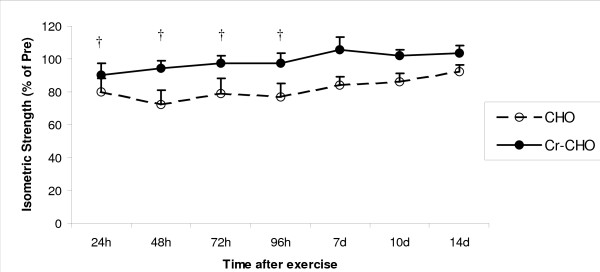
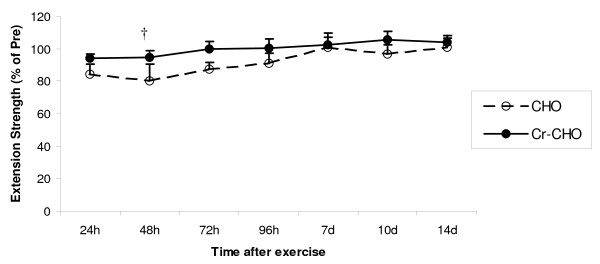
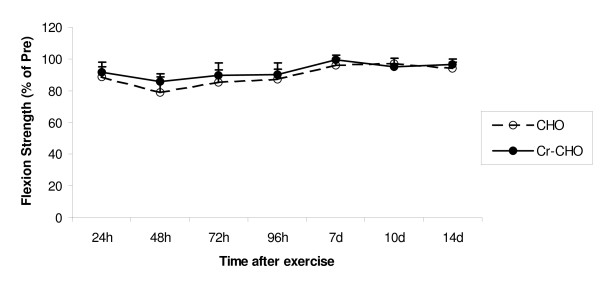
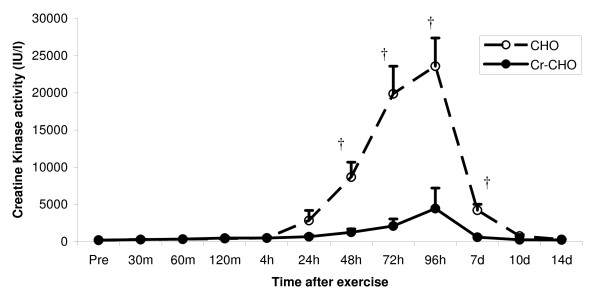
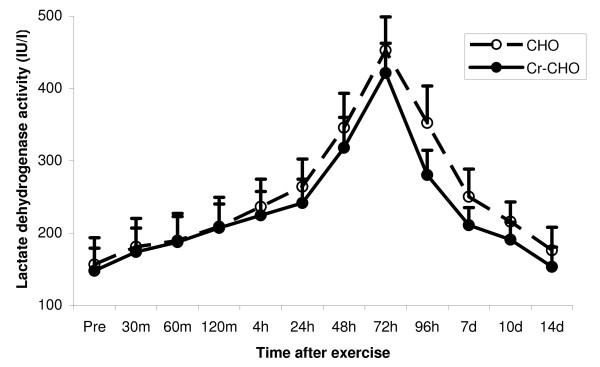
BACKGROUND: Eccentric exercise-induced damage leads to reductions in muscle force, increased soreness, and impaired muscle function. Creatine monohydrate's (Cr) ergogenic potential is well established; however few studies have directly examined the effects of Cr supplementation on recovery after damage. We examined the effects of Cr supplementation on muscle proteins and force recovery after eccentrically-induced muscle damage in healthy individuals. METHODS: Fourteen untrained male participants (22.1 +/- 2.3 yrs, 173 +/- 7.7 cm, 76.2 +/- 9.3 kg) were randomly separated into 2 supplement groups: i) Cr and carbohydrate (Cr-CHO; n = 7); or ii) carbohydrate (CHO; n = 7). Participants consumed their supplement for a period of 5 days prior to, and 14 days following a resistance exercise session. Participants performed 4 sets of 10 eccentric-only repetitions at 120% of their maximum concentric 1-RM on the leg press, leg extension and leg flexion exercise machine. Plasma creatine kinase (CK) and lactate dehydrogenase (LDH) activity were assessed as relevant blood markers of muscle damage. Muscle strength was examined by voluntary isokinetic knee extension using a Cybex dynamometer. Data were analyzed using repeated measures ANOVA with an alpha of 0.05. RESULTS: The Cr-supplemented group had significantly greater isokinetic (10% higher) and isometric (21% higher) knee extension strength during recovery from exercise-induced muscle damage. Furthermore, plasma CK activity was significantly lower (by an average of 84%) after 48 hrs (P < 0.01), 72 hrs (P < 0.001), 96 hrs (P < 0.0001), and 7 days (P < 0.001) recovery in the Cr-supplemented group. CONCLUSION: The major finding of this investigation was a significant improvement in the rate of recovery of knee extensor muscle function after Cr supplementation following injury.
Overview
The claims and statistics of this paper haven’t been checked yet.
Free: it reads the open-access text and checks the first 5 claims that cite a source we can check. Create a free account to check every claim.
Integrity signals
Registry
Cites
Statistics
Figures
Verification
Claims the paper makes
The claims and statistics of this paper haven’t been checked yet.
Free: it reads the open-access text and checks the first 5 claims that cite a source we can check. Create a free account to check every claim.
Claims other papers make about this one
Each is checked against this paper’s own text: does it say what the citing paper says it does?
The cited source says what the claim attributes to it.
In the citing paper
“It may also explain reports that creatine supplementation attenuates inflammatory and/or muscle damage in response to intense exercise [274,295,296,297].”
From Creatine in health and disease (2021) · cites this paper as [274]
The cited source says what the claim attributes to it.
In the citing paper
“Cooke and colleagues [126] reported that creatine supplementation during recovery from exercise-induced muscle damage promoted less muscle enzyme efflux and better maintenance of isokinetic muscle performance.”
From Common questions and misconceptions about creatine supplementation: what does the scientific evidence really show? (2021) · cites this paper as [126]
In the citing paper
“Cooke et al. [100] reported greater isokinetic (10% higher) and isometric (21% higher) knee extension strength in a group that supplemented with creatine (0.3 g/kg body weight × 5 days) following a bout of eccentric-only repetitions using 120% of the subjects’ 1RM on leg press, leg extension, and leg flexion exercise machines.”
From Creatine for exercise and sports performance, with recovery considerations for healthy populations (2021) · cites this paper as [100]
In the citing paper
“The authors noted attenuated creatine kinase levels (a common marker of muscle damage) at 48, 72, and 96 h, and 7 days, following a bout of eccentric exercise in the creatine supplementation group.”
From Creatine for exercise and sports performance, with recovery considerations for healthy populations (2021) · cites this paper as [100]
In the citing paper
“creatine supplementation may reduce circulating levels of muscle damage markers and help to more quickly restore the ability of the damaged muscle to produce force”
From Creatine for exercise and sports performance, with recovery considerations for healthy populations (2021) · cites this paper as [100]
1 more claim about this paper
Create a free account to see every claim other papers make about this one.
Self-check
Percentages, sums and reported differences re-computed from the paper’s own numbers.
The self-check needs the paper’s full text.
Citations
Cites
Essentials of Strength Training and Conditioning
Baechle, T. R., & Earle, R. (1994) · Cited by 1,535
Essentials of Strength Training and Conditioning
Phillips, N. (1997) · Physiotherapy · doi:10.1016/s0031-9406(05)66120-2 · Cited by 1,077
Skeletal muscle enzymes and fiber composition in male and female track athletes
Costill, D. L., Daniels, J., Evans, W., Fink, W., Krahenbuhl, G., & Saltin, B. (1976) · Journal of Applied Physiology · doi:10.1152/jappl.1976.40.2.149 · Cited by 699 · cited 1×
“Ltd, China) according to the method of [19].”
MethodNeuromuscular Function After Exercise-Induced Muscle Damage: Theoretical and Applied Implications
Byrne, C., Twist, C., & Eston, R. (2004) · Sports Medicine · doi:10.2165/00007256-200434010-00005 · Cited by 514 · cited 1×
“knee extensor/flexors muscles groups) and/or the protocol utilized to induce muscle damage [7,17,20].”
MethodEccentric exercise‐induced injuries to contractile and cytoskeletal muscle fibre components
Fridén, J., & Lieber, R. L. (2001) · Acta Physiologica Scandinavica · doi:10.1046/j.1365-201x.2001.00834.x · Cited by 419 · cited 1×
“The extent of, and recovery from, damage was evaluated by the following established, indirect markers of exercise-induced muscle damage; knee extension/flexion force development (MVC), and plasma CK and LDH activity [9,10].”
MethodOlsen, S., Aagaard, P., Kadi, F., Tufekovic, G., Verney, J., Olesen, J. L., Suetta, C., & Kjær, M. (2006) · The Journal of Physiology · doi:10.1113/jphysiol.2006.107359 · Cited by 319 · cited 2×
“(2006) supported such a suggestion by recently demonstrating for the first time in human skeletal muscle fibres that Cr supplementation amplifies the training-induced increase in satellite cell number and myonuclei concentration [23], and thus potentially, muscle regeneration.”
BackgroundCreatine Supplementation and Exercise Performance: Recent Findings
Bemben, M. G., & Lamont, H. S. (2005) · Sports Medicine · doi:10.2165/00007256-200535020-00002 · Cited by 270
Effects of creatine supplementation on performance and training adaptations
Kreider, R. B. (2003) · Molecular and Cellular Biochemistry · doi:10.1023/a:1022465203458 · Cited by 264 · cited 1×
“This procedure has been reported to consistently increase muscle Cr concentrations [11].”
BackgroundMaximum Strength-Power-Performance Relationships in Collegiate Throwers
STONE, M. H., SANBORN, K., OʼBRYANT, H. S., HARTMAN, M., STONE, M. E., PROULX, C., WARD, B., & HRUBY, J. (2003) · Journal of Strength and Conditioning Research · doi:10.1519/00124278-200311000-00019 · Cited by 254
Parise, G., Mihic, S., MacLennan, D., Yarasheski, K. E., & Tarnopolsky, M. A. (2001) · Journal of Applied Physiology · doi:10.1152/jappl.2001.91.3.1041 · Cited by 236 · cited 1×
“Although Cr supplementation was continued following the exercise bout in the second study by Rawson and colleagues [6], it is possible that the resistance exercise session, which was designed to be hypoxic in nature, as opposed to high force, eccentric exercise, may not have elicited enough muscle damage to unmask the…”
Background
Cited by
Items 101–138 of 138
The effect of creatine and magnesium supplementation on delayed onset muscle soreness
Landis, K. (2013) · Western CEDAR (Western Washington University) · doi:10.25710/c5r5-k294 · Cited by 1
Six Weeks of Creatine-Electrolyte Supplement Effects on Muscle Fatigability
Miller, D. R. (2017) · Western CEDAR (Western Washington University) · doi:10.25710/kqxh-ad36
Whinton, A. K. (2017) · The Atrium (University of Guelph)
Does Creatine Supplementation Reduce Lengthening Contraction Induced Muscle Damage
Robinson, N. (2017) · TSpace (University of Toronto)
Santi, M. C. (2018) · Digital Library of Theses and Dissertations (Universidade de São Paulo) · doi:10.11606/d.109.2018.tde-04062018-102828 · Cited by 1
Coqueiro, D. P., Bueno, P. C. D. S., & Simões, M. D. J. (2018) · Scientia Medica · doi:10.15448/1980-6108.2018.4.31470
“Plasma levels of the enzymes creatine kinase and lactate dehydrogenase, and inflammatory indicators such as prostaglandins, tumor necrosis factor alpha (TNF-α) and C-reactive protein were decreased with the use of this supplement [3-6].”
BackgroundRoy, K.-A. (2019) · The Atrium (University of Guelph)
Seccato, A. S., Bello, F. D., Queiroz, A. C. C., Marins, J. C. B., Miarka, B., de Carvalho, P. H. B., & Brito, C. J. (2019) · Motriz Revista de Educação Física · doi:10.1590/s1980-6574201900020012
Danial, M., Setijono, H., & Kusnanik, N. W. (2020) · Britain International of Exact Sciences (BIoEx) Journal · doi:10.33258/bioex.v2i1.113
Ziaolhagh, S. J., Darvishi, M., & Naghibi, S. (2020) · DOAJ (DOAJ: Directory of Open Access Journals) · doi:10.22054/nass.2020.53418.1066
Aalimahmoodi, A., Kooroshfard, N., Jahromi, M. K., & Hemmatinafar, M. (2021) · International Journal of Musculoskeletal Pain Prevention · doi:10.52547/ijmpp.6.1.451
“Apart from medical drugs, various food supplementations are widely used including cratin [15], anti-oxidants [16, 17] ,and protein or carbohydrate beverages [18] which were found to have some positive effects as well.”
BackgroundCreatine and Cognitive Functioning: What is the role of Exercise Frequency?
Banks, J., António, J., Holtzman, A. S., Marang, M., Weber, C., Alvarez-Beaton, A., Patel, A., & Tartar, J. L. (2020) · NSUWorks (Nova Southeastern University)
O'Brien, M. J. (2021) · Wiley eBooks · doi:10.1002/9781119413936.ch120
Shahriyari, M. (2021) · eDiss (Georg-August-Universität Göttingen) · doi:10.53846/goediss-8688
CREATINE SUPPLEMENTATION FOR POST-EXERCISE MUSCLE DAMAGE
Gao, M., & Yang, X. (2023) · Revista Brasileira de Medicina do Esporte · doi:10.1590/1517-8692202329012022_0405 · Cited by 1
ATUALIZAÇÃO SOBRE OS EFEITOS DA CREATINA NO ESPORTE
Dias, A. C. D. S., Silva, J. A. B., Eustáquio, J. M. J., & da Silva, M. L. T. (2022) · Editora Científica Digital eBooks · doi:10.37885/230212104
Optimizing Nutrition for Exercise and Sports
Gonzalez, D. E., Latt, S. L., Blalock, T., Leutholtz, B., & Kreider, R. B. (2023) · Nutrition and health · doi:10.1007/978-3-031-24663-0_29
Kostadinova, I., Danchev, N. D., Landzhov, B. V., Marinov, L., Ivanova, I., & Tsvetkova, D. D. (2023) · Pharmacia · doi:10.3897/pharmacia.70.e109446
Ansari, S., Gholamrezaei, S., AdibSaber, F., & Moradnia, M. (2022) · Journal of Sports Physiology and Athletic Conditioning · doi:10.61186/jspac.38872.2.5.50
Bisikletçilerde Glutamin ve Kreatin Kombine Tüketiminin Fonksiyonel Eşik Güç Üzerine Etkisi
Kargın, Z., Abdioğlu, M., Mor, H., Okur, S., Arslanoğlu, E., & Mor, A. (2024) · Spor ve Performans Araştırmaları Dergisi · doi:10.17155/omuspd.1423138 · Cited by 1
Trentman, C., Louissaint, L. G., & Enaohwo, O. (2024) · Springer eBooks · doi:10.1007/978-3-031-66885-2_1
Tang, Z., Li, J., Zhou, B., Zhang, B., Zhang, J., Cheng, S., Dong, W., Zhang, Y., Zhao, X., Zhang, Q., et al. (2025) · International Journal of Biological Macromolecules · doi:10.1016/j.ijbiomac.2025.145042
Boosting Cognitive Function in Athletes with Nano-nutrients
Karmakar, D., Das, A., Govindasamy, K., & Ștefănică, V. (2025) · Smart nanomaterials technology · doi:10.1007/978-981-96-5471-0_18
Top 5 Dietary Supplements for Bodybuilders
Haubenstricker, J. E., & Roberts, B. M. (2025) · Strength and conditioning journal · doi:10.1519/ssc.0000000000000925
Singh, S. (2025) · Preprints.org · doi:10.20944/preprints202508.0499.v1
Nutritional ergogenic aids for optimizing post-exercise recovery in athletes: A review article
Kumar, R., Singh, P. K., Singh, S., Chandel, S., & Meitei, A. N. (2025) · International Journal of Sports Health and Physical Education · doi:10.33545/26647559.2025.v7.i2b.231
Alimentación: requerimientos nutricionales adaptados a las exigencias de la vida militar
León-Ariza, H. H., & Zea‐Robles, A. C. (2025) · Escuela Militar de Cadetes Jose Maria Cordova eBooks · doi:10.21830/9786289730104.01
A associação de Creatina e Coenzima Q10 e seu possível potencial ergogênico no endurance
Costa, C., & Araujo, F. (2018) · LA Referencia (Red Federada de Repositorios Institucionales de Publicaciones Científicas)
Τhe role of creatine and vitamin D in performance of long-distance runners
Γκουντούρα, Ε. Χ., & Κελεπούρη, Δ.-Ε. Σ. (2024) · University of Thessaly Institutional Repository (University of Thessaly)
Creatine Supplementation - therapeutic use and benefits for athletes: A Review
Szmit, J., Wolszczak, M., & Wołodkiewicz, H. (2026) · Medical Science · doi:10.54905/disssi.v30i168.e37ms3747
Influência da saúde e bem-estar na qualidade do trabalho desenvolvido pelos Bombeiros Portugueses"
Fernandes, A. I. P. D. S. (2024) · Portuguese National Funding Agency for Science, Research and Technology (RCAAP Project by FCT)
Creatine monohydrate supplementation for recovery from muscle disuse: Timing matters
Stout, J. R., & Pabian, P. S. (2026) · Sports Medicine and Health Science · doi:10.1016/j.smhs.2026.05.006
“Cooke et al. reported enhanced force recovery and lower creatine kinase after eccentric exercise in healthy individuals, 32 while McKinnon et al. found no benefit for force loss, soreness, or rate of recovery after elbow-flexor damage with creatine supplementation.”
Hoffman, I. D.-V., & Combs, K. (2026) · Journal of Orthopaedic Case Reports · doi:10.13107/jocr.2026.v16.i06.7450
Qin, K., & Wu, J. (2026) · Frontiers in Nutrition · doi:10.3389/fnut.2026.1915252
“In an injured adolescent swimmer population, creatine supplementation during rehabilitation was associated with less loss of segmental lean mass, greater recovery of plantar-flexor torque, and lower pain and creatine kinase responses compared with placebo (64–66).”
Calf Injuries: Anatomy, Pathology, and Treatment
Hauer, T. M., Arner, J. W., Mauro, C. S., & Bradley, J. P. (2026) · Journal of the American Academy of Orthopaedic Surgeons · doi:10.5435/jaaos-d-25-01090
Combined strength and endurance exercise induced fatigue and recovery
Kilpelänaho, E. (2012) · Jyväskylä University Digital Archive (University of Jyväskylä)
Metadata
- Authors
- Cooke, M. B., Rybalka, E., Williams, A. D., Cribb, P. J., & Hayes, A.
- Affiliations
- Baylor University (US)
- Victoria University (AU)
- University of Tasmania (AU)
- Corresponding author
- Hayes, Alan
- Venue
- Journal of the International Society of Sports Nutrition
- Publisher
- Informa UK Limited
- Published
- 2009-01-06
- Volume
- 6
- Issue
- 1
- Pages
- 13-13
- ISSN
- 1550-2783 (ISSN-L)
- PMC
- PMC2697134
- OpenAlex
- W2100882387
- Cited by
- 126
- References
- 38
- Citations by year
- 2026: 7 · 2025: 11 · 2024: 10 · 2023: 7 · 2022: 8 · 2021: 14 · 2020: 11 · 2019: 5 · 2018: 6 · 2017: 7 · 2016: 3 · 2015: 5 · 2014: 4 · 2013: 7 · 2012: 9
- FWCI
- 2.97
- Type
- journal article
- Language
- en
- Open access
- gold
- doi.org
- Licence
- Locations
- Journal of the International Society of Sports Nutrition (publishedVersion, cc-by)
- PubMed Central (publishedVersion, cc-by)
- PubMed (publishedVersion)
- Minerva Access (University of Melbourne) (submittedVersion, cc-by)
- eCite Digital Repository (University of Tasmania) (submittedVersion)
- Victoria University Research Repository (Victoria University) (submittedVersion)
- DOAJ (DOAJ: Directory of Open Access Journals) (submittedVersion, cc-by-sa)
- Figshare (submittedVersion, cc-by)
- Funders
- Victoria University
- Topics
- Health Sciences › Nursing › Nutrition and Dietetics › Muscle metabolism and nutrition
- Health Sciences › Medicine › Physiology (medical) › Exercise and Physiological Responses
- Life Sciences › Biochemistry, Genetics and Molecular Biology › Molecular Biology › Muscle Physiology and Disorders
- Keywords
- creatine monohydrate, creatine supplementation, eccentric exercise, exercise-induced muscle damage, muscle force recovery, creatine kinase, lactate dehydrogenase, quadriceps strength, muscle strength, resistance training, muscle soreness
About these checks
Registry, retraction, Cites and statistics results are computed, not judged, with one exception: a printed reference that no index lists is read once by a model before it counts as a citation error. Claims are extracted by a model and kept only when their quote appears verbatim in the text; each cited source is then checked, with a model’s help, for whether it says what the claim relies on. Those verdicts can be wrong — read the claim’s quote and the cited source before relying on one.
Statistics and arithmetic are recomputed, not judged.
Confidence bands are shown only for fields calibrated on our annotated test set. None is calibrated yet, so no band is shown.
What counts as a claim ›How we measure confidence ›How we check this ›
Are you an author, or do you see a problem with this page? Request a review
Data sources
Bibliographic data: Semantic Scholar, OpenAlex, Crossref.
Contains information from the Semantic Scholar Academic Graph Datasets, made available under the ODC Attribution License (ODC-BY 1.0).
Semantic Scholar’s data is described in: Kinney, R., et al. (2023). The Semantic Scholar Open Data Platform. arXiv:2301.10140.
