

Creatine supplementation enhances muscle force recovery after eccentrically-induced muscle damage in healthy individuals
Open accessThe DOI matches its Crossref record; 39 of the 39 references it cites were found in a registry or an index.
Abstract
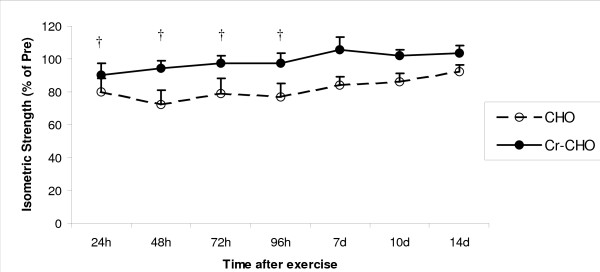
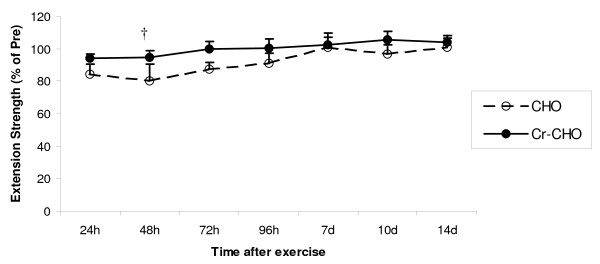
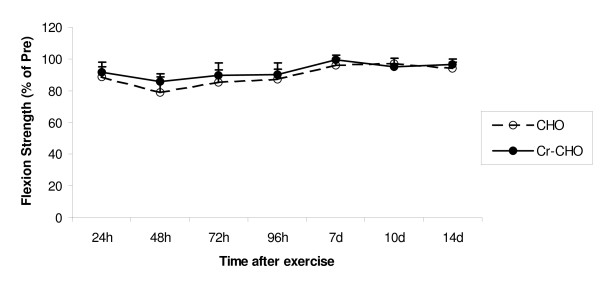
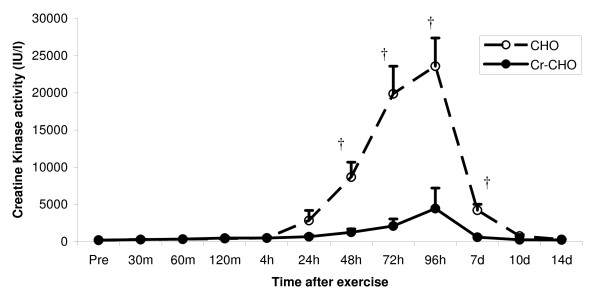
BACKGROUND: Eccentric exercise-induced damage leads to reductions in muscle force, increased soreness, and impaired muscle function. Creatine monohydrate's (Cr) ergogenic potential is well established; however few studies have directly examined the effects of Cr supplementation on recovery after damage. We examined the effects of Cr supplementation on muscle proteins and force recovery after eccentrically-induced muscle damage in healthy individuals. METHODS: Fourteen untrained male participants (22.1 +/- 2.3 yrs, 173 +/- 7.7 cm, 76.2 +/- 9.3 kg) were randomly separated into 2 supplement groups: i) Cr and carbohydrate (Cr-CHO; n = 7); or ii) carbohydrate (CHO; n = 7). Participants consumed their supplement for a period of 5 days prior to, and 14 days following a resistance exercise session. Participants performed 4 sets of 10 eccentric-only repetitions at 120% of their maximum concentric 1-RM on the leg press, leg extension and leg flexion exercise machine. Plasma creatine kinase (CK) and lactate dehydrogenase (LDH) activity were assessed as relevant blood markers of muscle damage. Muscle strength was examined by voluntary isokinetic knee extension using a Cybex dynamometer. Data were analyzed using repeated measures ANOVA with an alpha of 0.05. RESULTS: The Cr-supplemented group had significantly greater isokinetic (10% higher) and isometric (21% higher) knee extension strength during recovery from exercise-induced muscle damage. Furthermore, plasma CK activity was significantly lower (by an average of 84%) after 48 hrs (P < 0.01), 72 hrs (P < 0.001), 96 hrs (P < 0.0001), and 7 days (P < 0.001) recovery in the Cr-supplemented group. CONCLUSION: The major finding of this investigation was a significant improvement in the rate of recovery of knee extensor muscle function after Cr supplementation following injury.
Overview
The claims and statistics of this paper haven’t been checked yet.
Free: it reads the open-access text and checks the first 5 claims that cite a source we can check. Create a free account to check every claim.
Integrity signals
Registry
Cites
Statistics
Figures
Verification
Claims the paper makes
The claims and statistics of this paper haven’t been checked yet.
Free: it reads the open-access text and checks the first 5 claims that cite a source we can check. Create a free account to check every claim.
Claims other papers make about this one
Each is checked against this paper’s own text: does it say what the citing paper says it does?
The cited source says what the claim attributes to it.
In the citing paper
“It may also explain reports that creatine supplementation attenuates inflammatory and/or muscle damage in response to intense exercise [274,295,296,297].”
From Creatine in health and disease (2021) · cites this paper as [274]
The cited source says what the claim attributes to it.
In the citing paper
“Cooke and colleagues [126] reported that creatine supplementation during recovery from exercise-induced muscle damage promoted less muscle enzyme efflux and better maintenance of isokinetic muscle performance.”
From Common questions and misconceptions about creatine supplementation: what does the scientific evidence really show? (2021) · cites this paper as [126]
In the citing paper
“Cooke et al. [100] reported greater isokinetic (10% higher) and isometric (21% higher) knee extension strength in a group that supplemented with creatine (0.3 g/kg body weight × 5 days) following a bout of eccentric-only repetitions using 120% of the subjects’ 1RM on leg press, leg extension, and leg flexion exercise machines.”
From Creatine for exercise and sports performance, with recovery considerations for healthy populations (2021) · cites this paper as [100]
In the citing paper
“The authors noted attenuated creatine kinase levels (a common marker of muscle damage) at 48, 72, and 96 h, and 7 days, following a bout of eccentric exercise in the creatine supplementation group.”
From Creatine for exercise and sports performance, with recovery considerations for healthy populations (2021) · cites this paper as [100]
In the citing paper
“creatine supplementation may reduce circulating levels of muscle damage markers and help to more quickly restore the ability of the damaged muscle to produce force”
From Creatine for exercise and sports performance, with recovery considerations for healthy populations (2021) · cites this paper as [100]
1 more claim about this paper
Create a free account to see every claim other papers make about this one.
Self-check
Percentages, sums and reported differences re-computed from the paper’s own numbers.
The self-check needs the paper’s full text.
Citations
Cites
Essentials of Strength Training and Conditioning
Baechle, T. R., & Earle, R. (1994) · Cited by 1,535
Essentials of Strength Training and Conditioning
Phillips, N. (1997) · Physiotherapy · doi:10.1016/s0031-9406(05)66120-2 · Cited by 1,077
Skeletal muscle enzymes and fiber composition in male and female track athletes
Costill, D. L., Daniels, J., Evans, W., Fink, W., Krahenbuhl, G., & Saltin, B. (1976) · Journal of Applied Physiology · doi:10.1152/jappl.1976.40.2.149 · Cited by 699 · cited 1×
“Ltd, China) according to the method of [19].”
MethodNeuromuscular Function After Exercise-Induced Muscle Damage: Theoretical and Applied Implications
Byrne, C., Twist, C., & Eston, R. (2004) · Sports Medicine · doi:10.2165/00007256-200434010-00005 · Cited by 514 · cited 1×
“knee extensor/flexors muscles groups) and/or the protocol utilized to induce muscle damage [7,17,20].”
MethodEccentric exercise‐induced injuries to contractile and cytoskeletal muscle fibre components
Fridén, J., & Lieber, R. L. (2001) · Acta Physiologica Scandinavica · doi:10.1046/j.1365-201x.2001.00834.x · Cited by 419 · cited 1×
“The extent of, and recovery from, damage was evaluated by the following established, indirect markers of exercise-induced muscle damage; knee extension/flexion force development (MVC), and plasma CK and LDH activity [9,10].”
MethodOlsen, S., Aagaard, P., Kadi, F., Tufekovic, G., Verney, J., Olesen, J. L., Suetta, C., & Kjær, M. (2006) · The Journal of Physiology · doi:10.1113/jphysiol.2006.107359 · Cited by 319 · cited 2×
“(2006) supported such a suggestion by recently demonstrating for the first time in human skeletal muscle fibres that Cr supplementation amplifies the training-induced increase in satellite cell number and myonuclei concentration [23], and thus potentially, muscle regeneration.”
BackgroundCreatine Supplementation and Exercise Performance: Recent Findings
Bemben, M. G., & Lamont, H. S. (2005) · Sports Medicine · doi:10.2165/00007256-200535020-00002 · Cited by 270
Effects of creatine supplementation on performance and training adaptations
Kreider, R. B. (2003) · Molecular and Cellular Biochemistry · doi:10.1023/a:1022465203458 · Cited by 264 · cited 1×
“This procedure has been reported to consistently increase muscle Cr concentrations [11].”
BackgroundMaximum Strength-Power-Performance Relationships in Collegiate Throwers
STONE, M. H., SANBORN, K., OʼBRYANT, H. S., HARTMAN, M., STONE, M. E., PROULX, C., WARD, B., & HRUBY, J. (2003) · Journal of Strength and Conditioning Research · doi:10.1519/00124278-200311000-00019 · Cited by 254
Parise, G., Mihic, S., MacLennan, D., Yarasheski, K. E., & Tarnopolsky, M. A. (2001) · Journal of Applied Physiology · doi:10.1152/jappl.2001.91.3.1041 · Cited by 236 · cited 1×
“Although Cr supplementation was continued following the exercise bout in the second study by Rawson and colleagues [6], it is possible that the resistance exercise session, which was designed to be hypoxic in nature, as opposed to high force, eccentric exercise, may not have elicited enough muscle damage to unmask the…”
BackgroundExercise-induced muscle injury: A calpain hypothesis
Belcastro, A. N., Shewchuk, L. D., & Raj, D. A. (1998) · Molecular and Cellular Biochemistry · doi:10.1023/a:1006816123601 · Cited by 230
Rossi, A. M., Eppenberger, H. M., Volpe, P., Cotrufo, R., & Wallimann, T. (1990) · Journal of Biological Chemistry · doi:10.1016/s0021-9258(19)34115-8 · Cited by 215 · cited 3×
“high [ADP]/[ATP] ratio) that is unfavourable for ATPase function, and as a consequence, SR Ca2+ pump function may be diminished [28,31].”
BackgroundExercise-Induced Muscle Damage and the Potential Protective Role of Estrogen
Kendall, B., & Eston, R. (2002) · Sports Medicine · doi:10.2165/00007256-200232020-00003 · Cited by 204 · cited 2×
“The trauma created by this type of exercise initiates a myriad of events that lead to reductions in muscle force, increased soreness, and impaired muscle function [1,2].”
BackgroundMechanisms of stretch‐induced muscle damage in normal and dystrophic muscle: role of ionic changes
Allen, D. G., Whitehead, N. P., & Yeung, E. W. (2005) · The Journal of Physiology · doi:10.1113/jphysiol.2005.091694 · Cited by 196 · cited 2×
“Exercise-induced skeletal muscle injury is well understood as the product of unfamiliar or strenuous physical activity, and eccentric (lengthening) contractions under high loads are primarily responsible [1, 2 ].”
BackgroundEffects of Oral Creatine and Resistance Training on Myogenic Regulatory Factor Expression
WILLOUGHBY, D. S., & ROSENE, J. M. (2003) · Medicine & Science in Sports & Exercise · doi:10.1249/01.mss.0000069746.05241.f0 · Cited by 186 · cited 3×
“Willoughby and Rosene [22] have suggested that by continuing Cr supplementation after a resistance exercise bout (initial stimulus), Cr may act as a co-regulator, or direct manipulator of gene transcription of amino acid pools, thus enhancing myofibrillar protein synthesis during the recovery period post-injury.”
BackgroundInfluentialCribb, P. J., Williams, A. D., Carey, M. F., & Hayes, A. (2006) · International Journal of Sport Nutrition and Exercise Metabolism · doi:10.1123/ijsnem.16.5.494 · Cited by 177 · cited 1×
“Participants' diets were monitored and assessed as previously described by this laboratory [12].”
MethodSelf-citationThe repeated bout effect of reduced-load eccentric exercise on elbow flexor muscle damage
Nosaka, K., Sakamoto, K., Newton, M., & Sacco, P. (2001) · European Journal of Applied Physiology · doi:10.1007/s004210100430 · Cited by 174 · cited 1×
“The extent of, and recovery from, damage was evaluated by the following established, indirect markers of exercise-induced muscle damage; knee extension/flexion force development (MVC), and plasma CK and LDH activity [9,10].”
MethodEffects of Whey Isolate, Creatine, and Resistance Training on Muscle Hypertrophy
CRIBB, P. J., WILLIAMS, A. D., STATHIS, C. G., CAREY, M. F., & HAYES, A. (2007) · Medicine & Science in Sports & Exercise · doi:10.1249/01.mss.0000247002.32589.ef · Cited by 165 · cited 2×
“Indeed, this may be one of the explanations behind greater mass and strength gains observed in resistance trained participants ingesting Cr-containing supplements [25].”
BackgroundSelf-citationSantos, R. V. T., Bassit, R. A., Caperuto, E. C., & Costa Rosa, L. F. B. P. (2004) · Life Sciences · doi:10.1016/j.lfs.2003.11.036 · Cited by 162 · cited 3×
“Although well-over 200 studies have examined Cr's ergogenic potential in the last 20 years [4], few studies [ 5-8 ] have directly examined the effects of Cr supplementation on indicators of muscle damage and recovery after damage.”
BackgroundInfluentialHørder, M., Magid, E., Pitkänen, E., Härkönen, M., Strömme, J. H., Theodorsen, L., Gerhardt, W., & Waldenström, J. (1979) · Scandinavian Journal of Clinical and Laboratory Investigation · doi:10.3109/00365517909104932 · Cited by 159
Increased IGF mRNA in Human Skeletal Muscle after Creatine Supplementation
DELDICQUE, L., LOUIS, M., THEISEN, D., NIELENS, H., DEHOUX, M., THISSEN, J.-P., RENNIE, M. J., & FRANCAUX, M. (2005) · Medicine & Science in Sports & Exercise · doi:10.1249/01.mss.0000162690.39830.27 · Cited by 141 · cited 1×
“While the majority of studies have examined the role of Cr during the recovery period post exercise [25-27]; a number of studies have suggested a possible beneficial role during exercise [28-30].”
BackgroundDeldicque, L., Atherton, P., Patel, R., Theisen, D., Nielens, H., Rennie, M. J., & Francaux, M. (2008) · Journal of Applied Physiology · doi:10.1152/japplphysiol.00873.2007 · Cited by 141 · cited 1×
“While the majority of studies have examined the role of Cr during the recovery period post exercise [25-27]; a number of studies have suggested a possible beneficial role during exercise [28-30].”
BackgroundMaximal-intensity isometric and dynamic exercise performance after eccentric muscle actions
Byrne, C., & Eston, R. (2002) · Journal of Sports Sciences · doi:10.1080/026404102321011706 · Cited by 135 · cited 2×
“Previous research has shown this to be a successful means of reporting muscle strength and performance data, and removes any improvement in muscle performance recovery of the injured limb due to familiarization of the test [16,17].”
BackgroundMethodEffects of a 7-day eccentric training period on muscle damage and inflammation
CHEN, T. C., & HSIEH, S. S. (2001) · Medicine & Science in Sports & Exercise · doi:10.1097/00005768-200110000-00018 · Cited by 134
Response of males and females to high-force eccentric exercise
Rinard, J., Clarkson, P. M., Smith, L. L., & Grossman, M. (2000) · Journal of Sports Sciences · doi:10.1080/026404100364965 · Cited by 117 · cited 4×
“This is a common method of analysing loss of muscle strength following exerciseinduced damage [7,14,17], which therefore not only normalises data by accounting for any improvements during the recovery period as a result of familiarisation, but more importantly reduces the inter-individual variability in muscle strengt…”
BackgroundMethodResultInfluentialLavender, A. P., & Nosaka, K. (2005) · European Journal of Applied Physiology · doi:10.1007/s00421-005-0069-5 · Cited by 112 · cited 1×
“Myofibrillar enzymes CK and LDH are widely accepted as markers of muscle damage after prolonged exercise [ 32- 34 ].”
BackgroundFunctional coupling between sarcoplasmic‐reticulum‐bound creatine kinase and Ca2+‐ATPase
KORGE, P., BYRD, S. K., & CAMPBELL, K. B. (1993) · European Journal of Biochemistry · doi:10.1111/j.1432-1033.1993.tb17842.x · Cited by 107 · cited 2×
“high [ADP]/[ATP] ratio) that is unfavourable for ATPase function, and as a consequence, SR Ca2+ pump function may be diminished [28,31].”
BackgroundChanges in serum enzyme levels after exercise in trained and untrained subjects
Fowler, W. M., Chowdhury, S. R., Pearson, C. M., Gardner, G. W., & Bratton, R. (1962) · Journal of Applied Physiology · doi:10.1152/jappl.1962.17.6.943 · Cited by 99 · cited 1×
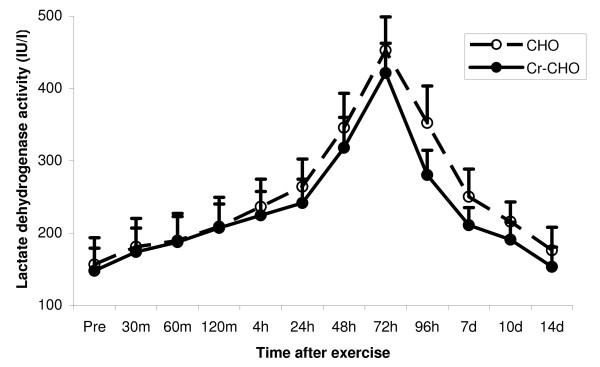
“Additionally, the differences in the magnitude of CK and LDH present in plasma following eccentric exercise (as seen in Figures 4 and 5) is possibly due to the larger molecular weight of LDH compared to CK and hence a decreased ability to diffuse from the muscle cell following injury [37].”
BackgroundThe Effects of Creatine Supplementation on Exercise-Induced Muscle Damage
RAWSON, E. S., GUNN, B., & CLARKSON, P. M. (2001) · Journal of Strength and Conditioning Research · doi:10.1519/00124278-200105000-00005 · Cited by 98
Mechanisms of reduced SR Ca2+ release induced by inorganic phosphate in rat skeletal muscle fibers
Duke, A. M., & Steele, D. S. (2001) · American Journal of Physiology-Cell Physiology · doi:10.1152/ajpcell.2001.281.2.c418 · Cited by 57 · cited 2×
“Furthermore, a decrease in [PCr] below 5 mM, which is characteristic of this increased ATPase activity; reduces local ATP regeneration potential of the CK/PCr system [29,30].”
BackgroundChanges in human skeletal muscle contractile function following stimulated eccentric exercise
Brown, S. J., Child, R. B., Donnelly, A., Saxton, J., & Day, S. H. (1996) · European Journal of Applied Physiology · doi:10.1007/bf00242284 · Cited by 57 · cited 3×
“This is a common method of analysing loss of muscle strength following exerciseinduced damage [7,14,17], which therefore not only normalises data by accounting for any improvements during the recovery period as a result of familiarisation, but more importantly reduces the inter-individual variability in muscle strengt…”
MethodResultCreatine Supplementation Does not Reduce Muscle Damage or Enhance Recovery From Resistance Exercise
Rawson, E. S., Conti, M. P., & Miles, M. P. (2007) · The Journal of Strength and Conditioning Research · doi:10.1519/r-21076.1 · Cited by 57
Gunst, J., Langlois, M. R., Delanghe, J., Buyzere, M. D., & Leroux-Roels, G. G. (1998) · Clinical Chemistry · doi:10.1093/clinchem/44.5.939 · Cited by 55 · cited 1×
“Myofibrillar enzymes CK and LDH are widely accepted as markers of muscle damage after prolonged exercise [ 32- 34 ].”
BackgroundGissel, H., & Clausen, T. (2000) · American Journal of Physiology-Regulatory, Integrative and Comparative Physiology · doi:10.1152/ajpregu.2000.279.3.r917 · Cited by 50 · cited 1×
“The delay in maximal elevation of CK and LDH activity is most likely caused by the increasing membrane permeability due to secondary or delayed onset damage as a result of increasing Ca2+ leakage into the muscle [36].”
BackgroundPlasma creatine kinase responses of 18- to 30-yr-old African-American men to eccentric exercise
SCHWANE, J. A., BUCKLEY, R. T., DiPaolo, D. P., ATKINSON, M. A. L., & Shepherd, J. (2000) · Medicine & Science in Sports & Exercise · doi:10.1097/00005768-200002000-00017 · Cited by 46 · cited 1×
“Myofibrillar enzymes CK and LDH are widely accepted as markers of muscle damage after prolonged exercise [ 32- 34 ].”
BackgroundDuke, A. M., & Steele, D. S. (1999) · The Journal of Physiology · doi:10.1111/j.1469-7793.1999.0447t.x · Cited by 34 · cited 2×
“Furthermore, a decrease in [PCr] below 5 mM, which is characteristic of this increased ATPase activity; reduces local ATP regeneration potential of the CK/PCr system [29,30].”
BackgroundStrength loss after eccentric contractions is unaffected by creatine supplementation
Warren, G. L., Fennessy, J. M., & Millard-Stafford, M. L. (2000) · Journal of Applied Physiology · doi:10.1152/jappl.2000.89.2.557 · Cited by 27 · cited 3×
“[8] demonstrated that recovery of mouse anterior crural muscle strength after damage (induced by 150 eccentric contractions) was unaffected following 2-weeks of Cr supplementation.”
BackgroundIs There a Physiologic Basis for Creatine Use in Children and Adolescents?
UNNITHAN, V. B., VEEHOF, S. H. E., VELLA, C. A., & KERN, M. (2001) · Journal of Strength and Conditioning Research · doi:10.1519/00124278-200111000-00021 · Cited by 18
Sorichter, S., Mair, J., Koller, A., Müller, E. A., Kremser, C., Judmaier, W., Haid, C., Rama, S., Calzolari, C., & Puschendorf, B. (1997) · Clinica Chimica Acta · doi:10.1016/s0009-8981(97)06543-1 · Cited by 18
Cited by
Kreider, R. B., Kalman, D. S., Antonio, J., Ziegenfuss, T. N., Wildman, R., Collins, R., Candow, D. G., Kleiner, S. M., Almada, A. L., & Lopez, H. L. (2017) · Journal of the International Society of Sports Nutrition · doi:10.1186/s12970-017-0173-z · Cited by 1,057
“For example, Cooke and associates [105] evaluated the effects of creatine supplementation on muscle force recovery and muscle damage following intense exercise.”
BackgroundLengthening our perspective: Morphological, cellular, and molecular responses to eccentric exercise
Hyldahl, R. D., & Hubal, M. J. (2014) · Muscle & Nerve · doi:10.1002/mus.24077 · Cited by 346
Antonio, J., Candow, D. G., Forbes, S. C., Gualano, B., Jagim, A. R., Kreider, R. B., Rawson, E. S., Smith-Ryan, A. E., VanDusseldorp, T. A., Willoughby, D. S., et al. (2021) · Journal of the International Society of Sports Nutrition · doi:10.1186/s12970-021-00412-w · Cited by 345
“For example, Cooke and colleagues [126] Antonio et al.”
Creatine supplementation with specific view to exercise/sports performance: An update
Cooper, R., Naclerio, F., Allgrove, J., & Jimenez, A. (2012) · Journal of the International Society of Sports Nutrition · doi:10.1186/1550-2783-9-33 · Cited by 306
Creatine in health and disease
Kreider, R. B., & Stout, J. R. (2021) · Nutrients · doi:10.3390/nu13020447 · Cited by 227
“Cooke and assistants [274] reported that creatine supplementation prior to (0.”
Background
Metadata
- Authors
- Cooke, M. B., Rybalka, E., Williams, A. D., Cribb, P. J., & Hayes, A.
- Affiliations
- Baylor University (US)
- Victoria University (AU)
- University of Tasmania (AU)
- Corresponding author
- Hayes, Alan
- Venue
- Journal of the International Society of Sports Nutrition
- Publisher
- Informa UK Limited
- Published
- 2009-01-06
- Volume
- 6
- Issue
- 1
- Pages
- 13-13
- ISSN
- 1550-2783 (ISSN-L)
- PMC
- PMC2697134
- OpenAlex
- W2100882387
- Cited by
- 126
- References
- 38
- Citations by year
- 2026: 7 · 2025: 11 · 2024: 10 · 2023: 7 · 2022: 8 · 2021: 14 · 2020: 11 · 2019: 5 · 2018: 6 · 2017: 7 · 2016: 3 · 2015: 5 · 2014: 4 · 2013: 7 · 2012: 9
- FWCI
- 2.97
- Type
- journal article
- Language
- en
- Open access
- gold
- doi.org
- Licence
- Locations
- Journal of the International Society of Sports Nutrition (publishedVersion, cc-by)
- PubMed Central (publishedVersion, cc-by)
- PubMed (publishedVersion)
- Minerva Access (University of Melbourne) (submittedVersion, cc-by)
- eCite Digital Repository (University of Tasmania) (submittedVersion)
- Victoria University Research Repository (Victoria University) (submittedVersion)
- DOAJ (DOAJ: Directory of Open Access Journals) (submittedVersion, cc-by-sa)
- Figshare (submittedVersion, cc-by)
- Funders
- Victoria University
- Topics
- Health Sciences › Nursing › Nutrition and Dietetics › Muscle metabolism and nutrition
- Health Sciences › Medicine › Physiology (medical) › Exercise and Physiological Responses
- Life Sciences › Biochemistry, Genetics and Molecular Biology › Molecular Biology › Muscle Physiology and Disorders
- Keywords
- creatine monohydrate, creatine supplementation, eccentric exercise, exercise-induced muscle damage, muscle force recovery, creatine kinase, lactate dehydrogenase, quadriceps strength, muscle strength, resistance training, muscle soreness
About these checks
Registry, retraction, Cites and statistics results are computed, not judged, with one exception: a printed reference that no index lists is read once by a model before it counts as a citation error. Claims are extracted by a model and kept only when their quote appears verbatim in the text; each cited source is then checked, with a model’s help, for whether it says what the claim relies on. Those verdicts can be wrong — read the claim’s quote and the cited source before relying on one.
Statistics and arithmetic are recomputed, not judged.
Confidence bands are shown only for fields calibrated on our annotated test set. None is calibrated yet, so no band is shown.
What counts as a claim ›How we measure confidence ›How we check this ›
Are you an author, or do you see a problem with this page? Request a review
Data sources
Bibliographic data: Semantic Scholar, OpenAlex, Crossref.
Contains information from the Semantic Scholar Academic Graph Datasets, made available under the ODC Attribution License (ODC-BY 1.0).
Semantic Scholar’s data is described in: Kinney, R., et al. (2023). The Semantic Scholar Open Data Platform. arXiv:2301.10140.
