

Intensive language training enhances brain plasticity in chronic aphasia
Open accessThe DOI matches its Crossref record; 33 of the 36 references it cites were found in a registry or an index.
Abstract
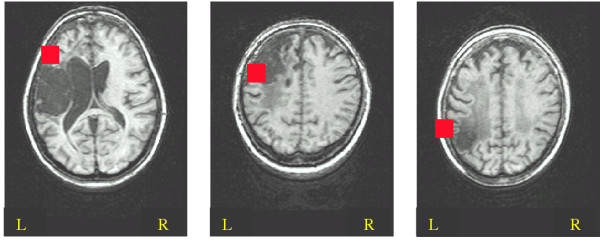
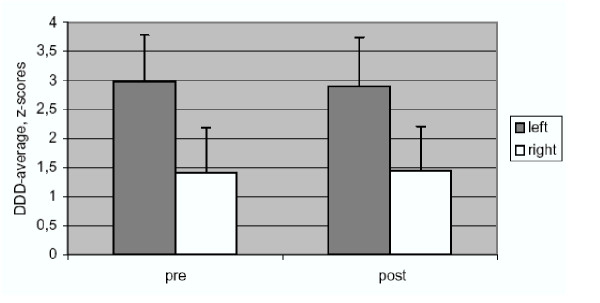
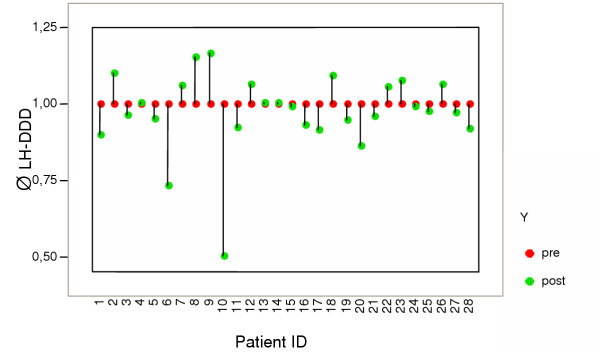
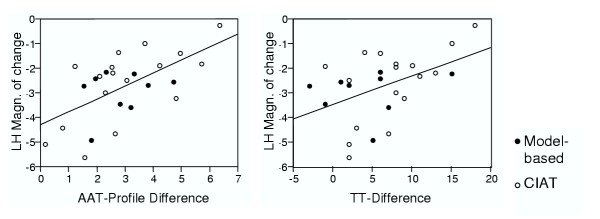
Background: Focal clusters of slow wave activity in the delta frequency range (1–4 Hz), as measured by magnetencephalography (MEG), are usually located in the vicinity of structural damage in the brain. Such oscillations are usually considered pathological and indicative of areas incapable of normal functioning owing to deafferentation from relevant input sources. In the present study we investigated the change in Delta Dipole Density in 28 patients with chronic aphasia (>12 months post onset) following cerebrovascular stroke of the left hemisphere before and after intensive speech and language therapy (3 hours/day over 2 weeks). Results: Neuropsychologically assessed language functions improved significantly after training. Perilesional delta activity decreased after therapy in 16 of the 28 patients, while an increase was evident in 12 patients. The magnitude of change of delta activity in these areas correlated with the amount of change in language functions as measured by standardized language tests. Conclusions: These results emphasize the significance of perilesional areas in the rehabilitation of aphasia even years after the stroke, and might reflect reorganisation of the language network that provides the basis for improved language functions after intensive training.
Overview
The claims and statistics of this paper haven’t been checked yet.
Free: it reads the open-access text and checks the first 5 claims that cite a source we can check. Create a free account to check every claim.
Integrity signals
Registry
Cites
Statistics
Figures
Verification
Claims the paper makes
The claims and statistics of this paper haven’t been checked yet.
Free: it reads the open-access text and checks the first 5 claims that cite a source we can check. Create a free account to check every claim.
Claims other papers make about this one
Each is checked against this paper’s own text: does it say what the citing paper says it does?
The cited source says what the claim attributes to it.
In the citing paper
“Thus, these results replicate other findings indicating that even in chronic aphasia, language improvements can be achieved through intensive therapy [60, 61] which makes use of a pragmatic approach, such as conversational therapy [12–16].”
From Conversational Therapy through Semi-Immersive Virtual Reality Environments for Language Recovery and Psychological Well-Being in Post Stroke Aphasia (2020) · cites this paper as [60]
Self-check
Percentages, sums and reported differences re-computed from the paper’s own numbers.
The self-check needs the paper’s full text.
Citations
Cites
The assessment and analysis of handedness: The Edinburgh inventory
Oldfield, R. C. (1971) · Neuropsychologia · doi:10.1016/0028-3932(71)90067-4 · Cited by 35,900
AFNI: Software for analysis and visualization of functional magnetic resonance neuroimages
Cox, R. W. (1996) · Computers and Biomedical Research · doi:10.1006/cbmr.1996.0014 · Cited by 10,913
Treatment-Induced Cortical Reorganization After Stroke in Humans
Liepert, J., Bauder, H., Miltner, W. H. R., Taub, E., & Weiller, C. (2000) · Stroke · doi:10.1161/01.str.31.6.1210 · Cited by 1,404
Aphasia in acute stroke: Incidence, determinants, and recovery
Pedersen, P. M., Stig Jørgensen, H., Nakayama, H., Raaschou, H. O., & Olsen, T. S. (1995) · Annals of Neurology · doi:10.1002/ana.410380416 · Cited by 820
Intensity of Aphasia Therapy, Impact on Recovery
Bhogal, S. K., Teasell, R., & Speechley, M. (2003) · Stroke · doi:10.1161/01.str.0000062343.64383.d0 · Cited by 719 · cited 1×
“In accordance with recent progress in neurorehabilitation, which takes into account evidence of the brain's capacity for reorganization [5-7], intensive language training (several hours per week) seems to be the premise for substantial improvement of language functions in the chronic stage [8].”
Motor cortex plasticity during constraint-induced movement therapy in stroke patients
Liepert, J., Miltner, W. H. R., Bauder, H., Sommer, M., Dettmers, C., Taub, E., & Weiller, C. (1998) · Neuroscience Letters · doi:10.1016/s0304-3940(98)00386-3 · Cited by 693
Constraint-Induced Therapy of Chronic Aphasia After Stroke
Pulvermüller, F., Neininger, B., Elbert, T., Mohr, B., Rockstroh, B., Koebbel, P., & Taub, E. (2001) · Stroke · doi:10.1161/01.str.32.7.1621 · Cited by 683 · cited 5×
“CIAT refers to patients treated according to the principles of Constrained-Induced aphasia therapy, MB refers to patients treated according to the principles of model-based aphasia therapy.”
InfluentialSelf-citationNew treatments in neurorehabiliation founded on basic research
Taub, E., Uswatte, G., & Elbert, T. (2002) · Nature Reviews Neuroscience · doi:10.1038/nrn754 · Cited by 641
Self-citationA meta-analysis of clinical outcomes in the treatment of aphasia
Robey, R. R. (1998) · Journal of Speech, Language, and Hearing Research · doi:10.1044/jslhr.4101.172 · Cited by 506 · cited 1×
“Additional rehabilitation efforts have produced beneficial effects, as reported for speech and language therapy on the basis of different performance indices [3,4].”
Therapy for naming disorders: Revisiting, revising, and reviewing
Nickels, L. (2002) · Aphasiology · doi:10.1080/02687030244000563 · Cited by 459
Research works printed but not linked: 1
- Huber H Poeck K Weniger D Willmes K Aachener Aphasie Test (AAT) – Handanweisung 1983 Göttingen: Hogrefe
Cited by
Items 201–221 of 221
Prädiktoren erfolgreichen Sprachlernens im Alter
Marschner-Preuth, N. A. (. (2011) · URN:NBN Resolver for Germany & Switzerland (German National Library)
Ergebnisse aus verschiedenen Orthographien
Mohamed, W. (2010) · KOPS (University of Konstanz)
Neurobehavioral Response to Increased Treatment Dosage in Chronic Aphasia
Mozeiko, J. L. (2014) · OpenCommons - UConn (University of Connecticut)
Ferreres, I. M. (2016) · Repositori UJI (Universitat Jaume I)
Raddþjálfun einstaklinga með parkinsonsveiki: Mat á árangri meðferðar
1983, H. K. (2012) · Skemman
Pérez Escolar, N. (2025) · UVaDOC UVaDOC University of Valladolid Documentary Repository (University of Valladolid)
Godecke, E., Armstrong, E., Rai, T., Ciccone, N., Rose, M. L., Middleton, S., Whitworth, A., Holland, A. L., Ellery, F., Hankey, G. J., et al. (2020) · Figshare · doi:10.25384/sage.13168769
脳磁図の臨床応用に関する文献レビュー (第6報) : 神経変性・脱髄疾患と神経リハビリテーション
勇, 尾., 義信, 井., Shiraishi, H., 良平, 石., 雅之, 平., 尚弘, 露., 恭輔, 鎌., 裕貴, 渡., 茂樹, 亀., & 勲, 橋. (2013) · 臨床神経生理学 · doi:10.11422/jscn.41.57
Implizites Lernen und sekundärer Spracherwerb:Modulation durch Ginkgo biloba
Strohmayer, G. (. (2014) · URN:NBN Resolver for Germany & Switzerland (German National Library)
Estudio neurofisiológico del lenguaje en pacientes afásicos crónicos. Efecto de la memantina
Barbancho-Fernandez, M. A. (2010) · LA Referencia (Red Federada de Repositorios Institucionales de Publicaciones Científicas)
脳磁図の臨床応用に関する文献レビュー(第2報) : 虚血性脳血管障害
尚弘, 露., 恭輔, 鎌., 信和, 中., 宇田, 武., 英敏, 池., 真一, 坂., 勇, 尾., 義信, 井., 雅之, 平., 茂樹, 亀., et al. (2012) · 臨床神経生理学 · doi:10.11422/jscn.40.195
Stoornisgerichte en/of functionele afasietherapie? Een commentaar
Witte, L. D. (2005) · Stem- Spraak- en Taalpathologie
Picture Description Performance of Normally Developing Children
Stern, J. (2013) · OhioLink ETD Center (Ohio Library and Information Network)
Favilla, M., & Ferroni, L. (2018) · IRIS UNIMORE (University of Modena and Reggio Emilia)
Kharitoshkina, E. A., & Bushueva, E. V. (2022) · Physical and rehabilitation medicine medical rehabilitation · doi:10.36425/rehab105619
Grut, E., & Kalerud, C. (2011) · Uppsala University Publications (Uppsala University)
Neurobehavioral response to increased treatment dosage in chronic, mild aphasia
Mozeiko, J. L., Myers, E., & Coelho, C. (2014) · The Aphasiology Archive (University of Pittsburgh)
An in depth analysis of aphasia, recovery management, and therapy approaches
Bremer, A. M. (2012) · UND Scholarly Commons (University of North Dakota)
Wolthuis, N., Bosma, I., Bastiaanse, R., Cherian, P. J., Smits, M., Veenstra, W., Wagemakers, M., Vincent, A., & Satoer, D. (2022) · doi:10.3389/fnhum.2022.748128.s001
Metadata
- Authors
- Meinzer, M., Elbert, T., Wienbruch, C., Djundja, D., Barthel, G., & Rockstroh, B.
- Affiliations
- University of Konstanz (DE)
- Corresponding author
- Meinzer, Marcus
- Venue
- BMC Biology
- Published
- 2004-08-25
- Volume
- 2
- Issue
- 1
- Pages
- 20-20
- ISSN
- 1741-7007 (ISSN-L)
- PMC
- PMC515310
- OpenAlex
- W2111736252
- Cited by
- 179
- References
- 36
- Citations by year
- 2026: 1 · 2025: 4 · 2024: 5 · 2023: 9 · 2022: 6 · 2021: 5 · 2020: 6 · 2019: 5 · 2018: 4 · 2017: 4 · 2016: 11 · 2015: 15 · 2014: 12 · 2013: 8 · 2012: 10
- FWCI
- 4.52
- Type
- journal article
- Language
- en
- Open access
- gold
- doi.org
- Licence
- cc-by
- Locations
- BMC Biology (publishedVersion, cc-by)
- Europe PMC (PubMed Central) (publishedVersion)
- PubMed Central (publishedVersion)
- PubMed (publishedVersion)
- KOPS (University of Konstanz) (submittedVersion)
- DOAJ (DOAJ: Directory of Open Access Journals) (submittedVersion)
- Funders
- Deutsche Forschungsgemeinschaft
- Topics
- Life Sciences › Neuroscience › Cognitive Neuroscience › Neurobiology of Language and Bilingualism
- Health Sciences › Medicine › Rehabilitation › Stroke Rehabilitation and Recovery
- Health Sciences › Medicine › Clinical Neurology › Traumatic Brain Injury Research
- Keywords
- chronic aphasia, neuroplasticity, stroke, language rehabilitation
- MeSH terms
- Adult, Aged, Aged, 80 and over, Aphasia, Brain, Female, Humans, Language Therapy, Male, Middle Aged, Neuronal Plasticity, Recovery of Function
About these checks
Registry, retraction, Cites and statistics results are computed, not judged, with one exception: a printed reference that no index lists is read once by a model before it counts as a citation error. Claims are extracted by a model and kept only when their quote appears verbatim in the text; each cited source is then checked, with a model’s help, for whether it says what the claim relies on. Those verdicts can be wrong — read the claim’s quote and the cited source before relying on one.
Statistics and arithmetic are recomputed, not judged.
Confidence bands are shown only for fields calibrated on our annotated test set. None is calibrated yet, so no band is shown.
What counts as a claim ›How we measure confidence ›How we check this ›
Are you an author, or do you see a problem with this page? Request a review
Data sources
Bibliographic data: Semantic Scholar, OpenAlex, Crossref.
Contains information from the Semantic Scholar Academic Graph Datasets, made available under the ODC Attribution License (ODC-BY 1.0).
Semantic Scholar’s data is described in: Kinney, R., et al. (2023). The Semantic Scholar Open Data Platform. arXiv:2301.10140.
