

The DOI matches its Crossref record; 73 of the 74 references it cites were found in a registry or an index.
Neuromuscular electrical stimulation for preventing skeletal-muscle weakness and wasting in critically ill patients: a systematic review
Open accessAbstract
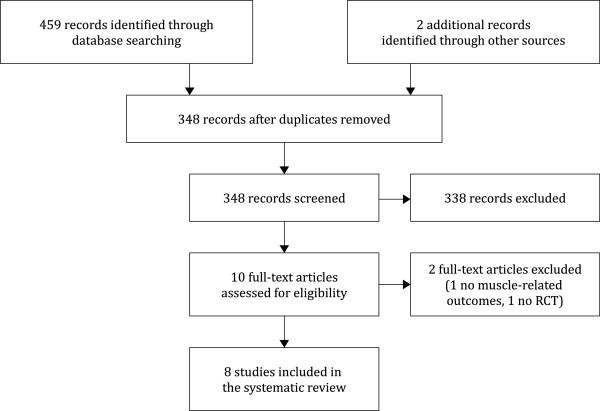
BACKGROUND: Neuromuscular electrical stimulation (NMES) therapy may be useful in early musculoskeletal rehabilitation during acute critical illness. The objective of this systematic review was to evaluate the effectiveness of NMES for preventing skeletal-muscle weakness and wasting in critically ill patients, in comparison with usual care. METHODS: We searched PubMed, CENTRAL, CINAHL, Web of Science, and PEDro to identify randomized controlled trials exploring the effect of NMES in critically ill patients, which had a well-defined NMES protocol, provided outcomes related to skeletal-muscle strength and/or mass, and for which full text was available. Two independent reviewers extracted data on muscle-related outcomes (strength and mass), and participant and intervention characteristics, and assessed the methodological quality of the studies. Owing to the lack of means and standard deviations (SDs) in some studies, as well as the lack of baseline measurements in two studies, it was impossible to conduct a full meta-analysis. When means and SDs were provided, the effect sizes of individual outcomes were calculated, and otherwise, a qualitative analysis was performed. RESULTS: The search yielded 8 eligible studies involving 172 patients. The methodological quality of the studies was moderate to high. Five studies reported an increase in strength or better preservation of strength with NMES, with one study having a large effect size. Two studies found better preservation of muscle mass with NMES, with small to moderate effect sizes, while no significant benefits were found in two other studies. CONCLUSIONS: NMES added to usual care proved to be more effective than usual care alone for preventing skeletal-muscle weakness in critically ill patients. However, there is inconclusive evidence for its benefit in prevention of muscle wasting.
Overview
The claims and statistics of this paper haven’t been checked yet.
Run the check — free, no account needed. It reads the open-access text and checks the sources it cites.
Integrity signals
Registry
Cites
Statistics
Figures
Verification
Claims the paper makes
The claims and statistics of this paper haven’t been checked yet.
Run the check — free, no account needed. It reads the open-access text and checks the sources it cites.
Claims other papers make about this one
Each is checked against this paper’s own text: does it say what the citing paper says it does?
The source backs part of the claim, not all of it — or backs it for a different population, condition or comparison.
In the citing paper
“Pulse frequencies used in skin surface stimulation are generally in the range of 8 to 100 Hz [102], and therefore below frequency ranges commonly observed in neural stimulation (see Table 4).”
From Safety of long-term electrical peripheral nerve stimulation: review of the state of the art (2019) · cites this paper as [102]
Experimental — accuracy not yet measured
Self-check
Percentages, sums and reported differences re-computed from the paper’s own numbers.
The self-check needs the paper’s full text.
Citations
Cites
Preferred Reporting Items for Systematic Reviews and Meta-Analyses: the PRISMA statement
Moher, D., Liberati, A., Tetzlaff, J., Altman, D. G., & for the PRISMA Group (2009) · BMJ · doi:10.1136/bmj.b2535 · Cited by 83,823
The Measurement of Observer Agreement for Categorical Data
Landis, J. R., & Koch, G. G. (1977) · Biometrics · doi:10.2307/2529310 · Cited by 81,148
Preferred Reporting Items for Systematic Reviews and Meta-Analyses: The PRISMA Statement
Moher, D., Liberati, A., Tetzlaff, J., Altman, D. G., & The PRISMA Group (2009) · PLoS Medicine · doi:10.1371/journal.pmed.1000097 · Cited by 64,042
Preferred reporting items for systematic reviews and meta-analyses: the PRISMA Statement.
(2009) · PubMed Central · Cited by 44,859
Discovering Statistics Using SPSS
Field, A. P., & Miles, J. N. V. (2000) · Medical Entomology and Zoology · Cited by 28,269
Preferred Reporting Items for Systematic Reviews and Meta-Analyses: The PRISMA Statement
Moher, D., Liberati, A., Tetzlaff, J., & Altman, D. G. (2009) · Journal of Clinical Epidemiology · doi:10.1016/j.jclinepi.2009.06.005 · Cited by 19,575
Vestbo, J., Hurd, S. S., Agustí, A. G., Jones, P. W., Vogelmeier, C., Anzueto, A., Barnes, P. J., Fabbri, L. M., Martinez, F. J., Nishimura, M., et al. (2013) · American Journal of Respiratory and Critical Care Medicine · doi:10.1164/rccm.201204-0596pp · Cited by 15,983
Wasserman, S. S., Hedges, L. V., & Olkin, I. (1988) · Journal of Educational Statistics · doi:10.2307/1164953 · Cited by 10,377
Estimating the mean and variance from the median, range, and the size of a sample
Hozo, S. P., Djulbegovic, B., & Hozo, I. (2005) · BMC Medical Research Methodology · doi:10.1186/1471-2288-5-13 · Cited by 9,062
Rabe, K. F., Hurd, S., Anzueto, A., Barnes, P. J., Buist, S. A., Calverley, P., Fukuchi, Y., Jenkins, C., Rodriguez-Roisin, R., van Weel, C., et al. (2007) · American Journal of Respiratory and Critical Care Medicine · doi:10.1164/rccm.200703-456so · Cited by 4,925
Cited by
Sorted by citations
Estimating the sample mean and standard deviation from commonly reported quantiles in meta-analysis
McGrath, S., Zhao, X., Steele, R. J., Thombs, B. D., Benedetti, A., Levis, B., Riehm, K. E., Saadat, N., Levis, A. W., Azar, M., et al. (2020) · Statistical Methods in Medical Research · doi:10.1177/0962280219889080 · Cited by 869
Clinical review: intensive care unit acquired weakness
Hermans, G., & Van den Berghe, G. (2015) · Critical Care · doi:10.1186/s13054-015-0993-7 · Cited by 792
Early mobilization in the critical care unit: A review of adult and pediatric literature
Cameron, S., Ball, I. M., Cepinskas, G., Choong, K. L. M., Doherty, T. J., Ellis, C. G., Martin, C. M., Mele, T. S., Sharpe, M. D., Shoemaker, J. K., et al. (2015) · Journal of Critical Care · doi:10.1016/j.jcrc.2015.03.032 · Cited by 280
The effect of early mobilization in critically ill patients: A meta‐analysis
Zang, K., Chen, B., Wang, M., Chen, D., Hui, L., Guo, S., Ji, T., & Shang, F. (2019) · Nursing in Critical Care · doi:10.1111/nicc.12455 · Cited by 296
Kayambu, G., Boots, R. J., & Paratz, J. D. (2015) · Intensive Care Medicine · doi:10.1007/s00134-015-3763-8 · Cited by 245
Metadata
- Authors
- Maffiuletti, N. A., Roig, M., Karatzanos, E., & Nanas, S.
- Affiliations
- Schulthess-Klinik (CH)
- University of Copenhagen (DK)
- National and Kapodistrian University of Athens (GR)
- Corresponding author
- Maffiuletti, Nicola A
- Venue
- BMC Medicine
- Published
- 2013-05-23
- Volume
- 11
- Issue
- 1
- Pages
- 137-137
- ISSN
- 1741-7015 (ISSN-L)
- PMC
- PMC3668245
- OpenAlex
- W2136166854
- Cited by
- 199
- References
- 74
- Citations by year
- 2026: 9 · 2025: 10 · 2024: 7 · 2023: 14 · 2022: 15 · 2021: 19 · 2020: 17 · 2019: 23 · 2018: 17 · 2017: 16 · 2016: 14 · 2015: 15 · 2014: 17 · 2013: 5
- FWCI
- 1.94
- Type
- journal article
- Language
- en
- Open access
- gold
- doi.org
- Licence
- Locations
- BMC Medicine (publishedVersion, cc-by)
- Europe PMC (PubMed Central) (publishedVersion, cc-by)
- PubMed Central (publishedVersion, cc-by)
- PubMed (publishedVersion)
- Research at the University of Copenhagen (University of Copenhagen) (publishedVersion, other-oa)
- Funders
- Elsass Fonden
- Topics
- Health Sciences › Medicine › Critical Care and Intensive Care Medicine › Intensive Care Unit Cognitive Disorders
- Health Sciences › Nursing › Nutrition and Dietetics › Clinical Nutrition and Gastroenterology
- Health Sciences › Medicine › Physiology (medical) › Nutrition and Health in Aging
- Keywords
- neuromuscular electrical stimulation, critical illness, skeletal muscle weakness, muscle atrophy, muscle strength, muscle mass, critically ill patients
- MeSH terms
- Electric Stimulation Therapy, Humans, Neuromuscular Junction, Randomized Controlled Trials as Topic, Critical Illness, Muscle Weakness, Muscle Strength
About these checks
Registry, retraction, Cites and statistics results are computed, not judged, with one exception: a printed reference that no index lists is read once by a model before it counts as a citation error. Claims are extracted by a model and kept only when their quote appears verbatim in the text; each cited source is then checked, with a model’s help, for whether it says what the claim relies on. Those verdicts can be wrong — read the claim’s quote and the cited source before relying on one.
Statistics and arithmetic are recomputed, not judged.
Confidence bands are shown only for fields calibrated on our annotated test set. None is calibrated yet, so no band is shown.
What counts as a claim ›How we measure confidence ›How we check this ›
Are you an author, or do you see a problem with this page? Request a review
