

The DOI matches its Crossref record; 77 of the 77 references it cites were found in a registry or an index.
IGF-I induced genes in stromal fibroblasts predict the clinical outcome of breast and lung cancer patients
Open accessAbstract
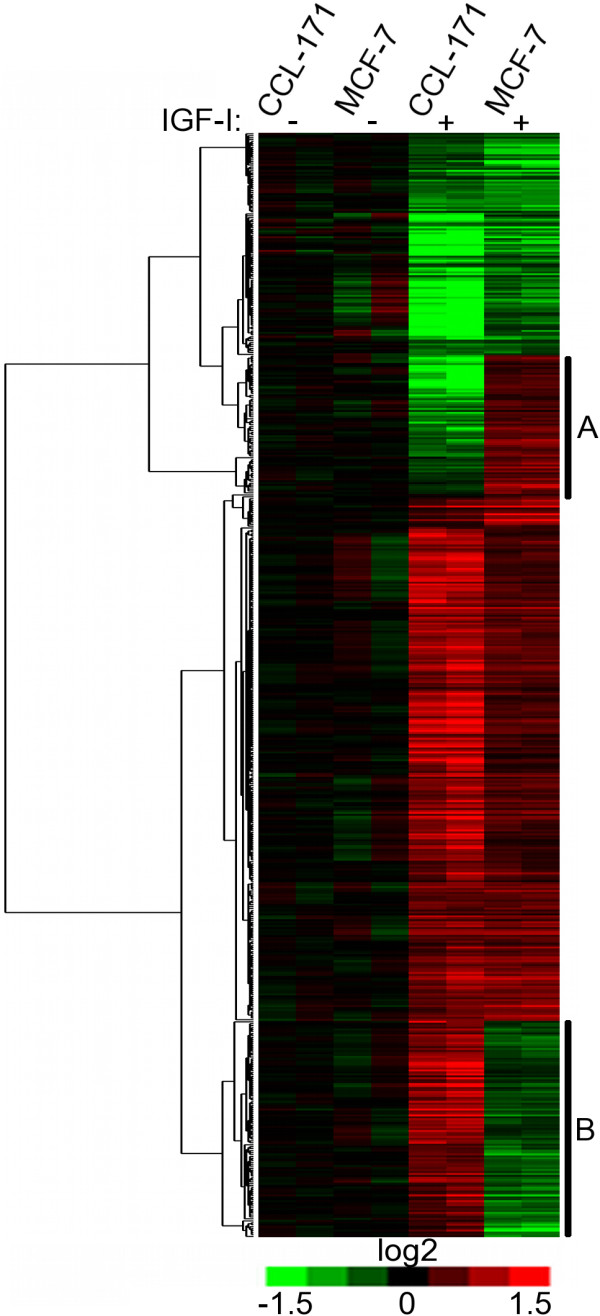
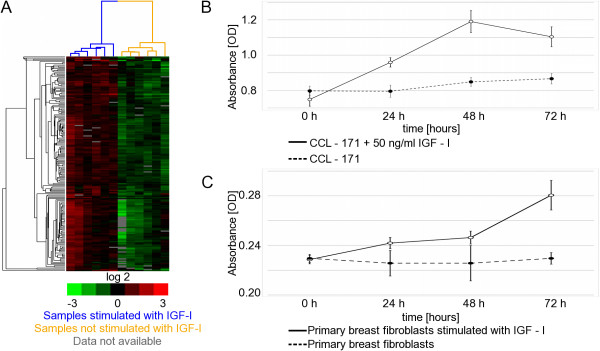
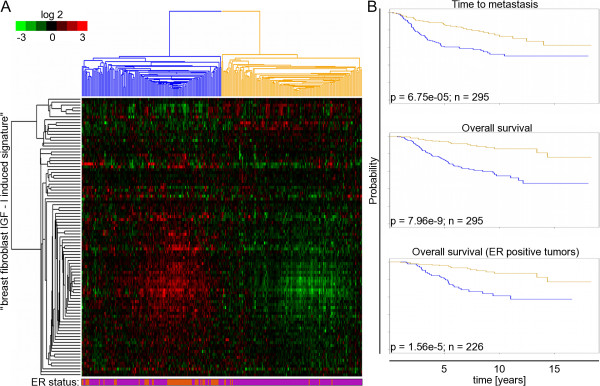
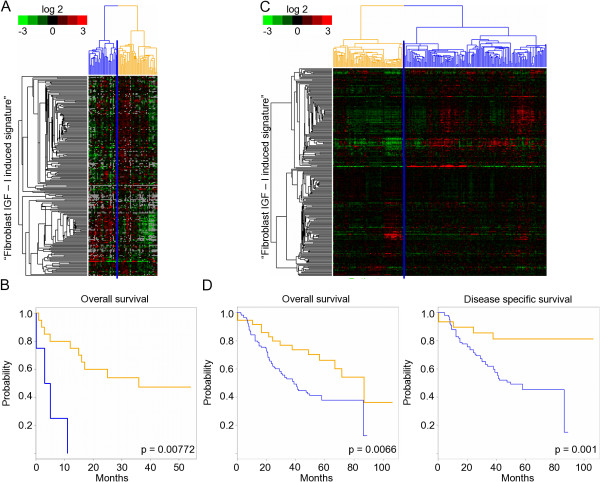
Background: Insulin-like growth factor-1 (IGF-I) signalling is important for cancer initiation and progression. Given the emerging evidence for the role of the stroma in these processes, we aimed to characterize the effects of IGF-I on cancer cells and stromal cells separately. Methods: We used an ex vivo culture model and measured gene expression changes after IGF-I stimulation with cDNA microarrays. In vitro data were correlated with in vivo findings by comparing the results with published expression datasets on human cancer biopsies. Results: Upon stimulation with IGF-I, breast cancer cells and stromal fibroblasts show some common and other distinct response patterns. Among the up-regulated genes in the stromal fibroblasts we observed a significant enrichment in proliferation associated genes. The expression of the IGF-I induced genes was coherent and it provided a basis for the segregation of the patients into two groups. Patients with tumours with highly expressed IGF-I induced genes had a significantly lower survival rate than patients whose tumours showed lower levels of IGF-I induced gene expression (P = 0.029 - Norway/Stanford and P = 7.96e-09 - NKI dataset). Furthermore, based on an IGF-I induced gene expression signature derived from primary lung fibroblasts, a separation of prognostically different lung cancers was possible (P = 0.007 - Bhattacharjee and P = 0.008 - Garber dataset). Conclusion: Expression patterns of genes induced by IGF-I in primary breast and lung fibroblasts accurately predict outcomes in breast and lung cancer patients. Furthermore, these IGF-I induced gene signatures derived from stromal fibroblasts might be promising predictors for the response to IGF-I targeted therapies. See the related commentary by Werner and Bruchim: http://www.biomedcentral.com/1741-7015/8/2
Overview
The claims and statistics of this paper haven’t been checked yet.
Run the check — free, no account needed. It reads the open-access text and checks the sources it cites.
Integrity signals
Registry
Cites
Statistics
Figures
Verification
Claims the paper makes
The claims and statistics of this paper haven’t been checked yet.
Run the check — free, no account needed. It reads the open-access text and checks the sources it cites.
Claims other papers make about this one
Each is checked against this paper’s own text: does it say what the citing paper says it does?
The check wasn’t confident either way, so it gives no verdict — never disputed.
In the citing paper
“Brief psychological interventions either using a CBT or ACT approach have demonstrated similar effects of reducing a range of mental health presentations.86 87”
From Acceptance and commitment therapy for mild traumatic brain injury (ACTion-mTBI): a quasiexperimental feasibility study (2025) · cites this paper as [86]
Experimental — accuracy not yet measured
Self-check
Percentages, sums and reported differences re-computed from the paper’s own numbers.
The self-check needs the paper’s full text.
Citations
Cites
1 retracted
Karp, D. D., Paz-Ares, L. G., Novello, S., Haluska, P., Garland, L. L., Cardenal, F., Blakely, L. J., Eisenberg, P. D., Langer, C. J., Blumenschein, G. R., et al. (2009) · Journal of Clinical Oncology · doi:10.1200/jco.2008.19.9331 · Cited by 260
RetractedR: A Language and Environment for Statistical Computing
R Core Team (2000) · doi:10.32614/r.manuals · Cited by 355,893
Molecular portraits of human breast tumours
Perou, C., Sørlie, T., Eisen, M., van de Rijn, M., Jeffrey, S., Rees, C. A., Pollack, J., Ross, D., Johnsen, H., Akslen, L., et al. (2000) · Nature · doi:10.1038/35021093 · Cited by 16,551
Cluster analysis and display of genome-wide expression patterns
Eisen, M. B., Spellman, P. T., Brown, P. O., & Botstein, D. (1998) · Proceedings of the National Academy of Sciences · doi:10.1073/pnas.95.25.14863 · Cited by 16,184
Gene Expression Omnibus: NCBI gene expression and hybridization array data repository
Edgar, R. (2002) · Nucleic Acids Research · doi:10.1093/nar/30.1.207 · Cited by 13,288
Sørlie, T., Perou, C. M., Tibshirani, R. J., Aas, T., Geisler, S. B., Johnsen, H., Hastie, T. J., Eisen, M. B., van de Rijn, M., Jeffrey, S. S., et al. (2001) · Proceedings of the National Academy of Sciences · doi:10.1073/pnas.191367098 · Cited by 11,506
In silico prediction of protein-protein interactions in human macrophages
Souiai, O., Guerfali, F. Z., Miled, S. B., Brun, C., & Benkahla, A. (2014) · BMC Research Notes · doi:10.1186/1756-0500-7-157 · Cited by 10,785
Significance analysis of microarrays applied to the ionizing radiation response
Tusher, V. G., Tibshirani, R., & Chu, G. (2001) · Proceedings of the National Academy of Sciences · doi:10.1073/pnas.091062498 · Cited by 10,568
Tree View: An application to display phylogenetic trees on personal computers
Page, R. (1996) · Computer applications in the biosciences · doi:10.1093/bioinformatics/12.4.357 · Cited by 10,223
Gene expression profiling predicts clinical outcome of breast cancer
van 't Veer, L. J., Dai, H., van de Vijver, M. J., He, Y. D., Hart, A. A. M., Mao, M., Peterse, H. L., van der Kooy, K., Marton, M. J., Witteveen, A. T., et al. (2002) · Nature · doi:10.1038/415530a · Cited by 9,536
Cited by
Sorted by citations
Calvo, F., Ege, N., Grande-Garcia, A., Hooper, S., Jenkins, R. P., Chaudhry, S. I., Harrington, K., Williamson, P., Moeendarbary, E., Charras, G., et al. (2013) · Nature Cell Biology · doi:10.1038/ncb2756 · Cited by 1,478
Knaul, F. M., Farmer, P. E., Krakauer, E. L., De Lima, L., Bhadelia, A., Jiang Kwete, X., Arreola-Ornelas, H., Gómez-Dantés, O., Rodriguez, N. M., Alleyne, G. A. O., et al. (2018) · The Lancet · doi:10.1016/s0140-6736(17)32513-8 · Cited by 1,456
Taxonomy of approaches to developing interventions to improve health: a systematic methods overview
O’Cathain, A., Croot, L., Sworn, K., Duncan, E., Rousseau, N. S., Turner, K. M., Yardley, L., & Hoddinott, P. (2019) · Pilot and Feasibility Studies · doi:10.1186/s40814-019-0425-6 · Cited by 625
Genetics and Molecular Pathogenesis of Gastric Adenocarcinoma
Tan, P. B. O., & Yeoh, K. G. (2015) · Gastroenterology · doi:10.1053/j.gastro.2015.05.059 · Cited by 503
Broad-spectrum bioactivities of silver nanoparticles: the emerging trends and future prospects
Rai, M., Kon, K. V., Ingle, A. P., Durán, N., Galdiero, S., & Galdiero, M. (2014) · Applied Microbiology and Biotechnology · doi:10.1007/s00253-013-5473-x · Cited by 490
Metadata
- Authors
- Rajski, M., Zanetti-Dällenbach, R., Vogel, B., Herrmann, R., Rochlitz, C., & Buess, M.
- Affiliations
- University of Basel (CH)
- Corresponding author
- Buess, Martin
- Venue
- BMC Medicine
- Published
- 2010-01-05
- Volume
- 8
- Issue
- 1
- Pages
- 1-1
- ISSN
- 1741-7015 (ISSN-L)
- PMC
- PMC2823652
- OpenAlex
- W2050096609
- Cited by
- 355
- References
- 76
- Citations by year
- 2026: 5 · 2025: 8 · 2024: 17 · 2023: 2 · 2022: 7 · 2021: 43 · 2020: 21 · 2019: 23 · 2018: 32 · 2017: 65 · 2016: 44 · 2015: 18 · 2014: 15 · 2013: 16 · 2012: 18
- FWCI
- 13.03
- Type
- journal article
- Language
- en
- Open access
- gold
- doi.org
- Licence
- Locations
- BMC Medicine (publishedVersion, cc-by)
- PubMed Central (publishedVersion, cc-by)
- PubMed (publishedVersion)
- DOAJ (DOAJ: Directory of Open Access Journals) (submittedVersion)
- Funders
- National Science Foundation
- Schweizerischer Nationalfonds zur Förderung der Wissenschaftlichen Forschung (112794, 320000)
- Oncosuisse
- Topics
- Health Sciences › Medicine › Endocrinology, Diabetes and Metabolism › Growth Hormone and Insulin-like Growth Factors
- Life Sciences › Biochemistry, Genetics and Molecular Biology › Cancer Research › Breast Cancer Treatment Studies
- Life Sciences › Biochemistry, Genetics and Molecular Biology › Molecular Biology › TGF-β signaling in diseases
- Keywords
- insulin-like growth factor I, tumor stroma, stromal fibroblasts, breast cancer, lung cancer, prognostic gene signature, patient survival prediction, tumor cell proliferation
- MeSH terms
- Breast Neoplasms, Female, Fibroblasts, Humans, Insulin-Like Growth Factor I, Lung Neoplasms, Prognosis, Stimulation, Chemical, Signal Transduction, Up-Regulation, Gene Expression Regulation, Neoplastic, Cluster Analysis, Stromal Cells, Oligonucleotide Array Sequence Analysis, Gene Expression Profiling, Databases, Genetic, Cell Line, Tumor, Cell Growth Processes, Kaplan-Meier Estimate
About these checks
Registry, retraction, Cites and statistics results are computed, not judged, with one exception: a printed reference that no index lists is read once by a model before it counts as a citation error. Claims are extracted by a model and kept only when their quote appears verbatim in the text; each cited source is then checked, with a model’s help, for whether it says what the claim relies on. Those verdicts can be wrong — read the claim’s quote and the cited source before relying on one.
Statistics and arithmetic are recomputed, not judged.
Confidence bands are shown only for fields calibrated on our annotated test set. None is calibrated yet, so no band is shown.
What counts as a claim ›How we measure confidence ›How we check this ›
Are you an author, or do you see a problem with this page? Request a review
