

The DOI matches its Crossref record; 172 of the 173 references it cites were found in a registry or an index, and 1 are not checked yet.
Microglia receptors and their implications in the response to amyloid β for Alzheimer’s disease pathogenesis
Open accessAbstract
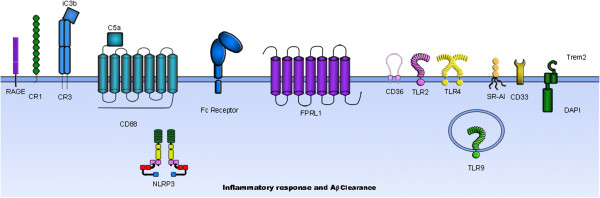
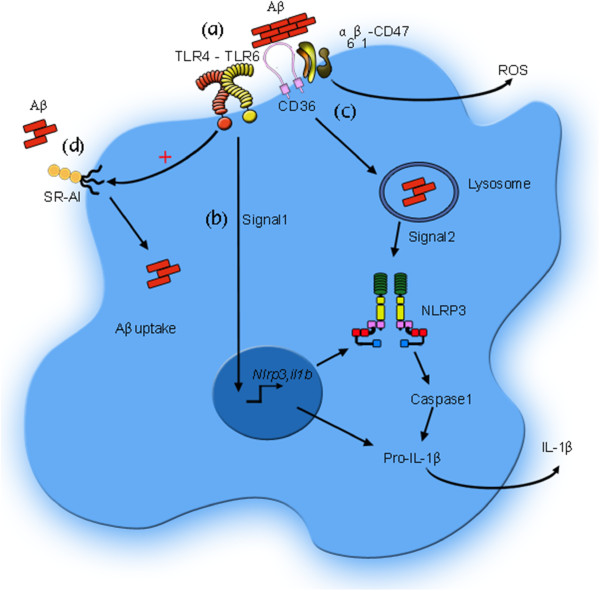
Alzheimer's disease (AD) is a major public health problem with substantial economic and social impacts around the world. The hallmarks of AD pathogenesis include deposition of amyloid β (Aβ), neurofibrillary tangles, and neuroinflammation. For many years, research has been focused on Aβ accumulation in senile plaques, as these aggregations were perceived as the main cause of the neurodegeneration found in AD. However, increasing evidence suggests that inflammation also plays a critical role in the pathogenesis of AD. Microglia cells are the resident macrophages of the brain and act as the first line of defense in the central nervous system. In AD, microglia play a dual role in disease progression, being essential for clearing Aβ deposits and releasing cytotoxic mediators. Aβ activates microglia through a variety of innate immune receptors expressed on these cells. The mechanisms through which amyloid deposits provoke an inflammatory response are not fully understood, but it is believed that these receptors cooperate in the recognition, internalization, and clearance of Aβ and in cell activation. In this review, we discuss the role of several receptors expressed on microglia in Aβ recognition, uptake, and signaling, and their implications for AD pathogenesis.
Overview
The claims and statistics of this paper haven’t been checked yet.
Run the check — free, no account needed. It reads the open-access text and checks the sources it cites.
Integrity signals
Registry
Cites
Statistics
Figures
Verification
Claims the paper makes
The claims and statistics of this paper haven’t been checked yet.
Run the check — free, no account needed. It reads the open-access text and checks the sources it cites.
Claims other papers make about this one
Each is checked against this paper’s own text: does it say what the citing paper says it does?
The source backs part of the claim, not all of it — or backs it for a different population, condition or comparison.
In the citing paper
“FCγR activation also promotes Aβ clearance via phagocytosis [139, 140].”
From Microglial function, INPP5D/SHIP1 signaling, and NLRP3 inflammasome activation: implications for Alzheimer’s disease (2023) · cites this paper as [140]
Experimental — accuracy not yet measuredThe source backs part of the claim, not all of it — or backs it for a different population, condition or comparison.
In the citing paper
“Microglial LRP1 mediates Aβ uptake and activation of microglia (20–22).”
From LRPAP1 is released from activated microglia and inhibits microglial phagocytosis and amyloid beta aggregation (2023) · cites this paper as [20]
Experimental — accuracy not yet measuredThe cited source says what the claim attributes to it.
In the citing paper
“Aβ fibrils also increase inflammation148 (Fig. 5, purple), which may unanchor residual PDE4A125, and further disinhibit stress signaling pathways.”
From Stress weakens prefrontal networks: molecular insults to higher cognition (2015) · cites this paper as [148]
The check wasn’t confident either way, so it gives no verdict — never disputed.
In the citing paper
“In mouse macrophages and COS cells, SHIP1 was shown to activate the ITIM of the inhibitory receptor FCγRIIβ, which inhibits the activating receptor FCγRIIA to block FCγRIIA-mediated phagocytosis (Fig. 3C).”
From Microglial function, INPP5D/SHIP1 signaling, and NLRP3 inflammasome activation: implications for Alzheimer’s disease (2023) · cites this paper as [140]
Experimental — accuracy not yet measuredThe check wasn’t confident either way, so it gives no verdict — never disputed.
In the citing paper
“SHIP1 also was shown to directly inhibit FCγRIIA by binding to its ITAM (Fig. 3C), which prevents the activation of PI3K [134, 137–140].”
From Microglial function, INPP5D/SHIP1 signaling, and NLRP3 inflammasome activation: implications for Alzheimer’s disease (2023) · cites this paper as [140]
Experimental — accuracy not yet measured
Self-check
Percentages, sums and reported differences re-computed from the paper’s own numbers.
The self-check needs the paper’s full text.
Citations
Cites
1 retracted
Retracted: ‘Clinical trials in Alzheimer’s disease’: immunotherapy approaches
Delrieu, J., Ousset, P., Caillaud, C., & Vellas, B. J. (2011) · Journal of Neurochemistry · doi:10.1111/j.1471-4159.2011.07458.x · Cited by 147
RetractedThe Amyloid Hypothesis of Alzheimer’s Disease: Progress and Problems on the Road to Therapeutics
Hardy, J., & Selkoe, D. J. (2002) · Science · doi:10.1126/science.1072994 · Cited by 13,864
Amyloid oligomers exacerbate tau pathology in a mouse model of tauopathy
Selenica, M.-L. B., Brownlow, M., Jimenez, J. P., Lee, D. C., Pena, G., Dickey, C. A., Gordon, M. N., & Morgan, D. (2013) · Neurodegenerative Diseases · doi:10.1159/000337230 · Cited by 10,359
Gout-associated uric acid crystals activate the NALP3 inflammasome
Martinon, F., Pétrilli, V., Mayor, A., Tardivel, A., & Tschopp, J. (2006) · Nature · doi:10.1038/nature04516 · Cited by 5,326
Cytokine-mediated regulation of CXCR4 expression in human neutrophils
Nagase, H., Miyamasu, M., Yamaguchi, M., Imanishi, M., Tsuno, N. H., Matsushima, K., Yamamoto, K., Morita, Y., & Hirai, K. (2002) · Journal of Leukocyte Biology · doi:10.1189/jlb.71.4.711 · Cited by 4,713
Lemaître, B., Nicolas, E., Michaut, L., Reichhart, J., & Hoffmann, J. A. (1996) · Cell · doi:10.1016/s0092-8674(00)80172-5 · Cited by 4,224
Kettenmann, H., Hanisch, U.-K., Noda, M., & Verkhratsky, A. (2011) · Physiological Reviews · doi:10.1152/physrev.00011.2010 · Cited by 3,547
Harold, D., Abraham, R., Hollingworth, P., Sims, R., Gerrish, A., Hamshere, M. L., Pahwa, J. S., Moskvina, V., Dowzell, K., Williams, A., et al. (2009) · Nature Genetics · doi:10.1038/ng.440 · Cited by 3,326
TREM2 Variants in Alzheimer's Disease
Guerreiro, R., Wojtas, A., Bras, J., Carrasquillo, M., Rogaeva, E., Majounie, E., Cruchaga, C., Sassi, C., Kauwe, J. S. K., Younkin, S., et al. (2013) · New England Journal of Medicine · doi:10.1056/nejmoa1211851 · Cited by 3,020
NLRP3 is activated in Alzheimer’s disease and contributes to pathology in APP/PS1 mice
Heneka, M. T., Kummer, M. P., Stutz, A., Delekate, A., Schwartz, S., Vieira-Saecker, A., Griep, A., Axt, D., Remus, A., Tzeng, T.-C., et al. (2013) · Nature · doi:10.1038/nature11729 · Cited by 2,898
Research works printed but not linked: 1
- 10.1146/annurev.bi.63.070194.003125 · DOI
Cited by
Sorted by citations
Neuroinflammation and microglial activation in Alzheimer disease: where do we go from here?
Leng, F., & Edison, P. (2021) · Nature Reviews Neurology · doi:10.1038/s41582-020-00435-y · Cited by 3,179
The Gut Microbiota and Alzheimer’s Disease
Jiang, C., Li, G., Huang, P., Liu, Z., & Zhao, B. (2017) · Journal of Alzheimer's Disease · doi:10.3233/jad-161141 · Cited by 852
TREM2 Is a Receptor for β-Amyloid that Mediates Microglial Function
Zhao, Y., Wu, X., Li, X., Jiang, L.-L., Gui, X., Liu, Y., Sun, Y., Zhu, B., Piña-Crespo, J. C., Zhang, M., et al. (2018) · Neuron · doi:10.1016/j.neuron.2018.01.031 · Cited by 763
Stress weakens prefrontal networks: molecular insults to higher cognition
Arnsten, A. F. T. (2015) · Nature Neuroscience · doi:10.1038/nn.4087 · Cited by 752
Hopperton, K. E., Mohammad, D., Trépanier, M. O., Giuliano, V, & Bazinet, R. P. (2018) · Molecular Psychiatry · doi:10.1038/mp.2017.246 · Cited by 567
Metadata
- Authors
- Doens, D., & Fernández, P. L.
- Affiliations
- Acharya Nagarjuna University (IN)
- Instituto de Investigaciones Científicas y Servicios de Alta Tecnología (PA)
- Corresponding author
- Fernández, Patricia L
- Venue
- Journal of Neuroinflammation
- Published
- 2014
- Volume
- 11
- Issue
- 1
- Pages
- 48
- ISSN
- 1742-2094 (ISSN-L)
- PMC
- PMC3975152
- OpenAlex
- W2100011299
- Cited by
- 348
- References
- 172
- Citations by year
- 2026: 22 · 2025: 42 · 2024: 33 · 2023: 33 · 2022: 36 · 2021: 27 · 2020: 24 · 2019: 24 · 2018: 27 · 2017: 26 · 2016: 24 · 2015: 25 · 2014: 5
- FWCI
- 2.16
- Type
- journal article
- Language
- en
- Open access
- gold
- doi.org
- Licence
- cc-by
- Locations
- Journal of Neuroinflammation (publishedVersion, cc-by)
- Europe PMC (PubMed Central) (publishedVersion, cc-by)
- PubMed Central (publishedVersion, cc-by)
- PubMed (publishedVersion)
- Greater South Information System
- Topics
- Life Sciences › Neuroscience › Neurology › Neuroinflammation and Neurodegeneration Mechanisms
- Life Sciences › Neuroscience › Cellular and Molecular Neuroscience › Alzheimer's disease research and treatments
- Life Sciences › Biochemistry, Genetics and Molecular Biology › Molecular Biology › Inflammasome and immune disorders
- Keywords
- Alzheimer's disease, amyloid-beta, microglia, innate immune receptors, neuroinflammation, amyloid clearance, receptor signaling, microglial activation, amyloid plaques, neurodegeneration
- MeSH terms
- Alzheimer Disease, Animals, Humans, Receptors, Immunologic, Amyloid beta-Peptides, Microglia
About these checks
Registry, retraction, Cites and statistics results are computed, not judged, with one exception: a printed reference that no index lists is read once by a model before it counts as a citation error. Claims are extracted by a model and kept only when their quote appears verbatim in the text; each cited source is then checked, with a model’s help, for whether it says what the claim relies on. Those verdicts can be wrong — read the claim’s quote and the cited source before relying on one.
Statistics and arithmetic are recomputed, not judged.
Confidence bands are shown only for fields calibrated on our annotated test set. None is calibrated yet, so no band is shown.
What counts as a claim ›How we measure confidence ›How we check this ›
Are you an author, or do you see a problem with this page? Request a review
