

The DOI matches its Crossref record; 167 of the 167 references it cites were found in a registry or an index.
Neuroinflammation and M2 microglia: the good, the bad, and the inflamed
Open accessAbstract
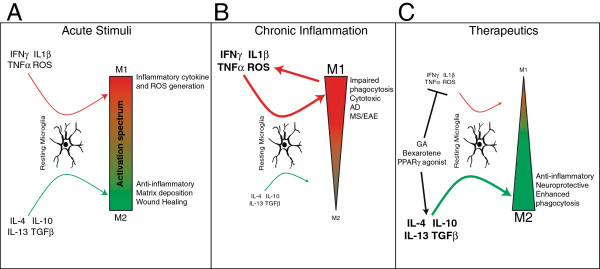
The concept of multiple macrophage activation states is not new. However, extending this idea to resident tissue macrophages, like microglia, has gained increased interest in recent years. Unfortunately, the research on peripheral macrophage polarization does not necessarily translate accurately to their central nervous system (CNS) counterparts. Even though pro- and anti-inflammatory cytokines can polarize microglia to distinct activation states, the specific functions of these states is still an area of intense debate. This review examines the multiple possible activation states microglia can be polarized to. This is followed by a detailed description of microglial polarization and the functional relevance of this process in both acute and chronic CNS disease models described in the literature. Particular attention is given to utilizing M2 microglial polarization as a potential therapeutic option in treating diseases.
Overview
The claims and statistics of this paper haven’t been checked yet.
Run the check — free, no account needed. It reads the open-access text and checks the sources it cites.
Integrity signals
Registry
Cites
Statistics
Figures
Verification
Claims the paper makes
The claims and statistics of this paper haven’t been checked yet.
Run the check — free, no account needed. It reads the open-access text and checks the sources it cites.
Claims other papers make about this one
Each is checked against this paper’s own text: does it say what the citing paper says it does?
In the citing paper
“The activation process of microglia varies heavily, depending on the stimuli, and is regulated by several intercellular interactions involving cell-surface molecules and soluble mediators, such as cytokines, ROS, and neurotransmitters [68].”
From Risk mitigation of immunogenicity: a key to personalized retinal gene therapy (2021) · cites this paper as [68]
In the citing paper
“The astrocytes and microglia could play a major role in the neuroinflammation associated with neurodegenerative diseases (Cherry et al., 2014).”
From The role of microglia in retinal neurodegeneration: Alzheimer’s disease, parkinson, and glaucoma. (2017) · cites this paper as Cherry et al., 2014
In the citing paper
“The change of microglia between M1 and M2 phenotypes is a dynamic process and microglial activation can switch from M2 to M1 phenotype during the course of disease (Cherry et al., 2014).”
From The role of microglia in retinal neurodegeneration: Alzheimer’s disease, parkinson, and glaucoma. (2017) · cites this paper as Cherry et al., 2014
Self-check
Percentages, sums and reported differences re-computed from the paper’s own numbers.
The self-check needs the paper’s full text.
Citations
Cites
2 retracted
Yang, J., Jiang, Z., Fitzgerald, D. C., Ma, C., Yu, S., Li, H., Zhao, Z., Li, Y., Ćirić, B., Curtis, M. T., et al. (2009) · Journal of Clinical Investigation · doi:10.1172/jci37914 · Cited by 194
RetractedRETRACTED: CD163 and its expanding functional repertoire
Akila, P., Prashant, A., Suma, M., Prashant, S., & Chaitra, T. R. (2012) · Clinica Chimica Acta · doi:10.1016/j.cca.2012.01.028 · Cited by 50
RetractedAmyloid oligomers exacerbate tau pathology in a mouse model of tauopathy
Selenica, M.-L. B., Brownlow, M., Jimenez, J. P., Lee, D. C., Pena, G., Dickey, C. A., Gordon, M. N., & Morgan, D. (2013) · Neurodegenerative Diseases · doi:10.1159/000337230 · Cited by 10,359
Exploring the full spectrum of macrophage activation
Mosser, D. M., & Edwards, J. P. (2008) · Nature Reviews Immunology · doi:10.1038/nri2448 · Cited by 9,144
Polazzi, E., Mengoni, I., Caprini, M., Peña‐Altamira, E., Kurtys, E., & Monti, B. (2012) · Neurosignals · doi:10.1159/000337115 · Cited by 9,023
The chemokine system in diverse forms of macrophage activation and polarization
MANTOVANI, A., SICA, A., SOZZANI, S., ALLAVENA, P., VECCHI, A., & LOCATI, M. (2004) · Trends in Immunology · doi:10.1016/j.it.2004.09.015 · Cited by 6,534
Macrophage plasticity and polarization: in vivo veritas
Sica, A., & Mantovani, A. (2012) · Journal of Clinical Investigation · doi:10.1172/jci59643 · Cited by 6,335
Alternative activation of macrophages
Gordon, S. (2003) · Nature Reviews Immunology · doi:10.1038/nri978 · Cited by 6,189
Resting microglial cells are highly dynamic surveillants of brain parenchyma in vivo
Nimmerjahn, A., Kirchhoff, F., & Helmchen, F. (2005) · Science · doi:10.1126/science.1110647 · Cited by 5,827
Sleep Drives Metabolite Clearance from the Adult Brain
Xie, L., Kang, H., Xu, Q., Chen, M. J., Liao, Y., Thiyagarajan, M., O’Donnell, J., Christensen, D. J., Nicholson, C., Iliff, J. J., et al. (2013) · Science · doi:10.1126/science.1241224 · Cited by 5,411
Research works printed but not linked: 1
- Del Rio-Hortega P: El tercer elemento de los centros nerviosos. Bio Soc Esp Biol. 1919, 9: 69-129.
Cited by
Sorted by citations
Azevedo, R. S. S., de Sousa, J. R., Araujo, M. T. F., Martins Filho, A. J., de Alcantara, B. N., Araujo, F. M. C., Queiroz, M. G. L., Cruz, A. C. R., Vasconcelos, B. H. B., Chiang, J. O., et al. (2018) · Scientific Reports · doi:10.1038/s41598-017-17765-5 · Cited by 3,478
Microglial M1/M2 polarization and metabolic states
Orihuela, R., McPherson, C. A., & Harry, G. J. (2016) · British Journal of Pharmacology · doi:10.1111/bph.13139 · Cited by 2,070
Microglia in physiology and disease
Wolf, S. A., Boddeke, H. W. G. M., & Kettenmann, H. (2017) · Annual Review of Physiology · doi:10.1146/annurev-physiol-022516-034406 · Cited by 1,426
Microglia polarization from M1 to M2 in neurodegenerative diseases
Guo, S., Wang, H., & Yin, Y. (2022) · Frontiers in Aging Neuroscience · doi:10.3389/fnagi.2022.815347 · Cited by 920
The Biology of Regeneration Failure and Success After Spinal Cord Injury
Tran, A. P., Warren, P. M., & Silver, J. (2018) · Physiological Reviews · doi:10.1152/physrev.00017.2017 · Cited by 903
Metadata
- Authors
- Cherry, J. D., Olschowka, J. A., & O’Banion, M. K.
- Affiliations
- University of Rochester Medicine (US)
- Corresponding author
- O’Banion, M Kerry
- Venue
- Journal of Neuroinflammation
- Published
- 2014-06-03
- Volume
- 11
- Issue
- 1
- Pages
- 98-98
- ISSN
- 1742-2094 (ISSN-L)
- PMC
- PMC4060849
- OpenAlex
- W2147180300
- Cited by
- 1,748
- References
- 167
- Citations by year
- 2026: 127 · 2025: 129 · 2024: 170 · 2023: 157 · 2022: 205 · 2021: 185 · 2020: 173 · 2019: 138 · 2018: 129 · 2017: 128 · 2016: 115 · 2015: 75 · 2014: 14
- FWCI
- 8.81
- Type
- journal article
- Language
- en
- Open access
- gold
- doi.org
- Licence
- cc-by
- Locations
- Journal of Neuroinflammation (publishedVersion, cc-by)
- PubMed Central (publishedVersion, cc-by)
- PubMed (publishedVersion)
- Funders
- National Aeronautics and Space Administration (NNX13AC33G)
- National Institutes of Health
- National Institute on Aging (R01AG030149)
- National Institute of Allergy and Infectious Diseases (U19AI091036)
- National Institute of Environmental Health Sciences (R01 ES020322)
- Topics
- Life Sciences › Neuroscience › Neurology › Neuroinflammation and Neurodegeneration Mechanisms
- Life Sciences › Immunology and Microbiology › Immunology › Immune cells in cancer
- Health Sciences › Medicine › Clinical Neurology › Multiple Sclerosis Research Studies
- Keywords
- microglia, M2 microglia, microglial polarization, neuroinflammation, central nervous system disorders, pro- and anti-inflammatory cytokines
- MeSH terms
- Animals, Central Nervous System, Encephalitis, Humans, Macrophage Activation, Microglia
About these checks
Registry, retraction, Cites and statistics results are computed, not judged, with one exception: a printed reference that no index lists is read once by a model before it counts as a citation error. Claims are extracted by a model and kept only when their quote appears verbatim in the text; each cited source is then checked, with a model’s help, for whether it says what the claim relies on. Those verdicts can be wrong — read the claim’s quote and the cited source before relying on one.
Statistics and arithmetic are recomputed, not judged.
Confidence bands are shown only for fields calibrated on our annotated test set. None is calibrated yet, so no band is shown.
What counts as a claim ›How we measure confidence ›How we check this ›
Are you an author, or do you see a problem with this page? Request a review
