

Lipopolysaccharide impairs amyloid beta efflux from brain: altered vascular sequestration, cerebrospinal fluid reabsorption, peripheral clearance and transporter function at the blood–brain barrier
Open accessThe DOI matches its Crossref record; 73 of the 73 references it cites were found in a registry or an index.
Abstract
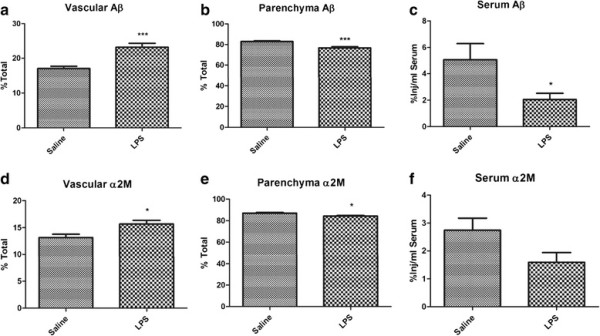
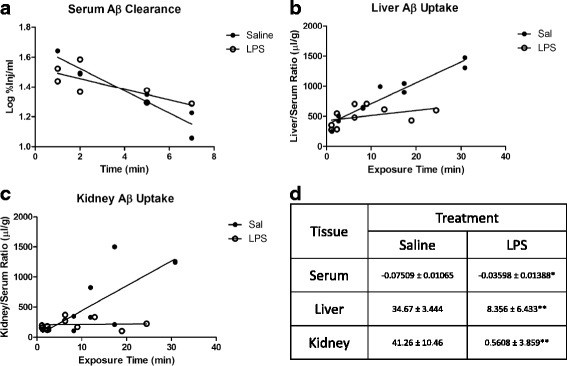
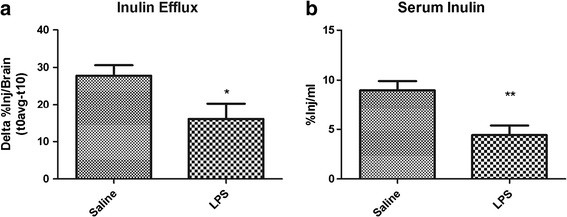
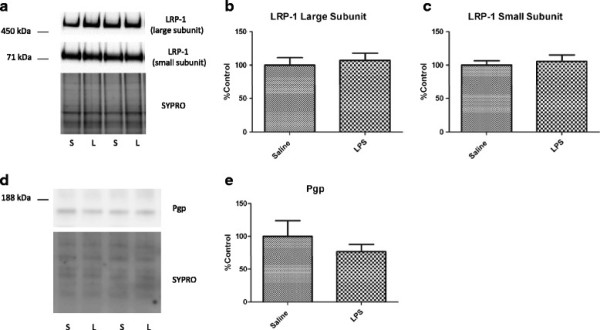
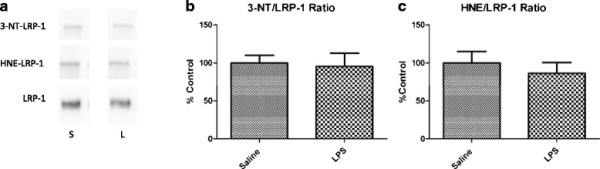
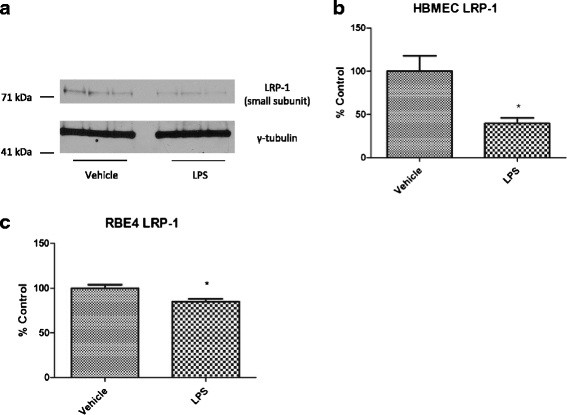
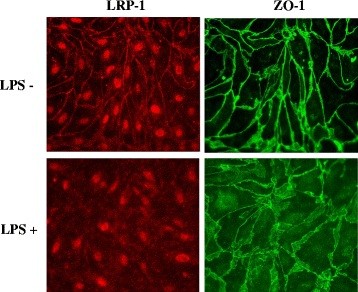
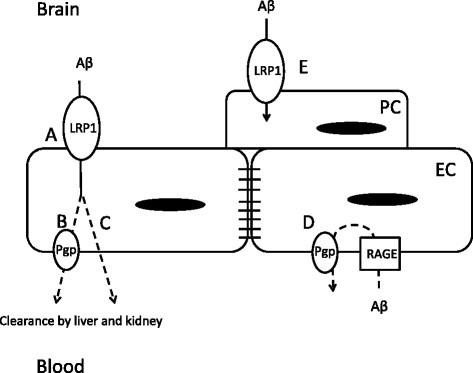
Background: Defects in the low density lipoprotein receptor-related protein-1 (LRP-1) and p-glycoprotein (Pgp) clearance of amyloid beta (Aβ) from brain are thought to contribute to Alzheimer’s disease (AD). We have recently shown that induction of systemic inflammation by lipopolysaccharide (LPS) results in impaired efflux of Aβ from the brain. The same treatment also impairs Pgp function. Here, our aim is to determine which physiological routes of Aβ clearance are affected following systemic inflammation, including those relying on LRP-1 and Pgp function at the blood–brain barrier. Methods: CD-1 mice aged between 6 and 8 weeks were treated with 3 intraperitoneal injections of 3 mg/kg LPS at 0, 6, and 24 hours and studied at 28 hours.125 I-Aβ 1-42 or 125 I-alpha-2-macroglobulin injected into the lateral ventricle of the brain (intracerebroventricular (ICV)) or into the jugular vein (intravenous (IV)) was used to quantify LRP-1-dependent partitioning between the brain vasculature and parenchyma and peripheral clearance, respectively. Disappearance of ICV-injected 14 C-inulin from brain was measured to quantify bulk flow of cerebrospinal fluid (CSF). Brain microvascular protein expression of LRP-1 and Pgp was measured by immunoblotting. Endothelial cell localization of LRP-1 was measured by immunofluorescence microscopy. Oxidative modifications to LRP-1 at the brain microvasculature were measured by immunoprecipitation of LRP-1 followed by immunoblotting for 4-hydroxynonenal and 3-nitrotyrosine. Results: We found that LPS: caused an LRP-1-dependent redistribution of ICV-injected Aβ from brain parenchyma to brain vasculature and decreased entry into blood; impaired peripheral clearance of IV-injected Aβ; inhibited reabsorption of CSF; did not significantly alter brain microvascular protein levels of LRP-1 or Pgp, or oxidative modifications to LRP-1; and downregulated LRP-1 protein levels and caused LRP-1 mislocalization in cultured brain endothelial cells. Conclusions: These results suggest that LRP-1 undergoes complex functional regulation following systemic inflammation which may depend on cell type, subcellular location, and post-translational modifications. Our findings that systemic inflammation causes deficits in both Aβ transport and bulk flow like those observed in AD indicate that inflammation could induce and promote the disease.
Overview
The claims and statistics of this paper haven’t been checked yet.
Free: it reads the open-access text and checks the first 5 claims that cite a source we can check. Create a free account to check every claim.
Integrity signals
Registry
Cites
Statistics
Figures
Verification
Claims the paper makes
The claims and statistics of this paper haven’t been checked yet.
Free: it reads the open-access text and checks the first 5 claims that cite a source we can check. Create a free account to check every claim.
Claims other papers make about this one
Each is checked against this paper’s own text: does it say what the citing paper says it does?
In the citing paper
“In addition, LPS impedes Aβ clearance by increasing the vascular sequestration of Aβ, reducing the bulk flow of cerebrospinal fluid and impairing Aβ transport across the BBB.238”
From Antiageing strategy for neurodegenerative diseases: from mechanisms to clinical advances (2025) · cites this paper as [238]
Self-check
Percentages, sums and reported differences re-computed from the paper’s own numbers.
The self-check needs the paper’s full text.
Citations
Cites
The Amyloid Hypothesis of Alzheimer’s Disease: Progress and Problems on the Road to Therapeutics
Hardy, J., & Selkoe, D. J. (2002) · Science · doi:10.1126/science.1072994 · Cited by 13,864
THE PREPARATION OF 131I-LABELLED HUMAN GROWTH HORMONE OF HIGH SPECIFIC RADIOACTIVITY
GREENWOOD, F., HUNTER, W., & GLOVER, J. (1963) · Biochemical Journal · doi:10.1042/bj0890114 · Cited by 10,152 · cited 1×
“Using the chloramine-T method [41], 5 μg of Aβ, albumin, or a2M was labeled with 0.”
MethodInflammation and Alzheimer’s disease
Akiyama, H. (2000) · Neurobiology of Aging · doi:10.1016/s0197-4580(00)00124-x · Cited by 4,514
Graphical Evaluation of Blood-to-Brain Transfer Constants from Multiple-Time Uptake Data
Patlak, C. S., Blasberg, R. G., & Fenstermacher, J. D. (1983) · Journal of Cerebral Blood Flow & Metabolism · doi:10.1038/jcbfm.1983.1 · Cited by 3,567 · cited 1×
“The rate of I-Aβ tissue uptake was determined using multiple-time regression analysis [43].”
2013 Alzheimer's disease facts and figures
Alzheimer's Association, Thies, W., & Bleiler, L. (2013) · Alzheimer's & Dementia · doi:10.1016/j.jalz.2013.02.003 · Cited by 3,328
RAGE mediates amyloid-β peptide transport across the blood-brain barrier and accumulation in brain
Deane, R., Du Yan, S., Submamaryan, R. K., LaRue, B., Jovanovic, S., Hogg, E., Welch, D., Manness, L., Lin, C., Yu, J., et al. (2003) · Nature Medicine · doi:10.1038/nm890 · Cited by 1,611 · cited 8×
“First, the receptor for advanced glycation endproducts (RAGE) has been identified as an influx transporter for Aβ [18].”
BackgroundInfluentialShibata, M., Yamada, S., Kumar, S. R., Calero, M., Bading, J., Frangione, B., Holtzman, D. M., Miller, C. A., Strickland, D. K., Ghiso, J., et al. (2000) · Journal of Clinical Investigation · doi:10.1172/jci10498 · Cited by 1,413 · cited 6×
“Other groups have shown LRP-1-dependent efflux of human forms of Aβ across the BBB [4,50], however, we have observed that murine Aβ1-42 also undergoes LRP-1-dependent BBB transport and is cleared at a faster rate across the murine BBB than human Aβ1-42 [7,51].”
BackgroundMethodInfluentialMolecular inflammation: Underpinnings of aging and age-related diseases
Chung, H. Y., Cesari, M., Anton, S., Marzetti, E., Giovannini, S., Seo, A. Y., Carter, C., Yu, B. P., & Leeuwenburgh, C. (2009) · Ageing Research Reviews · doi:10.1016/j.arr.2008.07.002 · Cited by 1,203 · cited 1×
“Because low-grade systemic inflammation is associated with many other diseases which have been considered comorbidities in AD [69], similar comparative studies would be useful in determining unifying pathological events at the neurovascular unit or related to brain fluid dynamics which would contribute to impaired Aβ…”
2011 Alzheimer's disease facts and figures
Alzheimer's Association (2011) · Alzheimer's & Dementia · doi:10.1016/j.jalz.2011.02.004 · Cited by 908
Multiplicity of cerebrospinal fluid functions: new challenges in health and disease
Johanson, C. E., Duncan, J. A., Klinge, P. M., Brinker, T., Stopa, E. G., & Silverberg, G. D. (2008) · Cerebrospinal Fluid Research · doi:10.1186/1743-8454-5-10 · Cited by 861
Cited by
Items 101–144 of 144
Ni, J., & Wu, Z. (2021) · Frontiers in Cellular Neuroscience · doi:10.3389/fncel.2021.638686 · Cited by 10
The brain washing system in sepsis-associated encephalopathy
Chen, T., Hu, J., Liao, Y., Xie, S., & Zhang, L. (2025) · Journal of Neuroinflammation · doi:10.1186/s12974-025-03602-4 · Cited by 8
“Following repeated intraperitoneal LPS administration in mice, the clearance of Aβ administered into the brain ventricles was reduced, while the peripheral Aβ concentration also decreased [140].”
Yong, Y., Cai, Y., Lin, J., Ma, L., Han, H., & Li, F. (2024) · Med-X · doi:10.1007/s44258-024-00021-7 · Cited by 13
“The entrance of blood driven molecules into interstitial space triggers the cascades of immune responses, leading to the reduction of convective flow, decreased CSF-ISF exchange, and impaired glymphatic clearance [311, 312].”
Photoacoustic detecting of brain lymphatic dysfunction in inflammatory models
Wang, M., Wang, D., Wang, Z., Shi, W., & Wang, Z. (2025) · Journal of Innovative Optical Health Sciences · doi:10.1142/s1793545825500154 · Cited by 9
Deep cervical lymph node analysis in central nervous system inflammatory disease
Giff, A., Clark, M. W., Bhattacharyya, S., Sage, P. T., Madore, B., Guenette, J. P., & Miyawaki, E. K. (2026) · Frontiers in Immunology · doi:10.3389/fimmu.2026.1747114 · Cited by 13
Efflux transport of serum amyloid P component at the blood-brain barrier
Veszelka, S., Laszy, J., Pázmány, T., Németh, L., Obál, I., Fábián, L., Szabó, G., Ábrahám, C. S., Deli, M. A., & Urbányi, Z. (2013) · European Journal of Microbiology and Immunology · doi:10.1556/eujmi.3.2013.4.8 · Cited by 11
“It should be noted that bacterial LPS increases brain levels of Aβ by increased infl ux and decreased effl ux mechanisms, as well as increased neuronal production of Aβ [57, 58].”
BackgroundDoes peripheral inflammation contribute to Alzheimer disease? Evidence from animal models
O’Banion, M. K. (2014) · Neurology · doi:10.1212/wnl.0000000000000663 · Cited by 8
Katsigianni, S., & Koutsouraki, E. (2026) · Molecular Neurobiology · doi:10.1007/s12035-026-05914-9 · Cited by 9
“It also impairs Aβ clearance by downregulating LRP-1 and P-glycoprotein (P-gp), disrupting BBB transport mechanisms [138].”
Rossi, L., Preziosa, P., Filippi, M., & Rocca, M. A. (2025) · Multiple Sclerosis and Related Disorders · doi:10.1016/j.msard.2025.106596 · Cited by 8
Linking alcohol use to Alzheimer’s disease: Interactions with aging and APOE along immune pathways
Monnig, M. A., & Shah, K. (2024) · Medical Research Archives · doi:10.18103/mra.v12i8.5228 · Cited by 7
Yang, Y., Chen, R., Che, Y., Yao, X., Fang, M., Wang, Y., Zhou, D., Li, N., & Hou, Y. (2023) · Phytotherapy Research · doi:10.1002/ptr.7858 · Cited by 6
Amyloid Beta Dynamics in Biological Fluids—Therapeutic Impact
Schreiner, T. G., & Popescu, B. O. (2021) · Journal of Clinical Medicine · doi:10.3390/jcm10245986 · Cited by 5
Yaacob, W. M. H. W., Long, I., Zakaria, R., & Othman, Z. (2020) · Oriental Pharmacy and Experimental Medicine · doi:10.1007/s13596-020-00449-3 · Cited by 5
“2009) and decreasing the central clearance of Aβ (Erickson et al. 2012).”
BackgroundPerspectives on the Intracellular Bacterium Chlamydia pneumoniae in Late-Onset Dementia
Balin, B. J., & Hudson, A. P. (2020) · Current Clinical Microbiology Reports · doi:10.1007/s40588-020-00146-4 · Cited by 4
Chlamydia Pneumoniae as an Etiologic Agent for Late-Onset Alzheimer's Disease
Balin, B. J., J., H., Scott, L. C., Hingley, S. T., Appelt, D. M., Whittum‐Hudson, J. A., Gerard Herve, C., & Hudson Alan, P. (2017) · Advances in Alzheimer's disease · doi:10.3233/978-1-61499-706-1-41 · Cited by 4
Dai, X., Zhang, Y., Fu, C., Gao, Z., Hou, X., Yan, Z., Zheng, C., Gao, L., & Liu, B. (2025) · npj Parkinson's Disease · doi:10.1038/s41531-025-00985-2 · Cited by 4
Banks, W. A., Erickson, M. A., Hansen, K. M., Reed, M. J., & Rhea, E. M. (2025) · Fluids and Barriers of the CNS · doi:10.1186/s12987-025-00748-4 · Cited by 4
“We compared the efflux of DTPA to that of the gold standard, inulin [28].”
Self-citationDisease Influence on BBB Transport in Neurodegenerative Disorders
de Lange, E. C. M. (2013) · AAPS advances in the pharmaceutical sciences series · doi:10.1007/978-1-4614-9105-7_22 · Cited by 3
LPS-Induced Neuroinflammation in Neurodegenerative Diseases: A Double-Edged Sword?
Mohammadi, A., Aghajan, A., Alipour, M., Ghorbani, A., Limoodehi, S. M., & Hedayati, M. (2026) · Molecular Neurobiology · doi:10.1007/s12035-026-06004-6 · Cited by 2
“For instance, systemic inflammation impairs amyloid-β (Aβ) efflux across the BBB and favors its accumulation in the brain [9], while chronic LPS-associated neuroinflammation may contribute to tau pathology and spreading in Alzheimer’s disease (AD) models [10, 11].”
Mitochondrial Treatment Improves Cognitive Impairment Induced by Lipopolysaccharide in Mice
Yan, Q., Liu, T., Liu, L., Wei, Y., Zhao, Y., Yu, C., Zhong, Z.-G., Huang, J.-L., & Wu, D. (2024) · Molecular Neurobiology · doi:10.1007/s12035-024-04368-1 · Cited by 2
“LPS-induced neuroin-flammation induces AD pathology by changing Aβ transport and reducing the central clearance of amyloid β (Aβ) [7, 8].”
Bällgren, F., Hammarlund‐Udenaes, M., & Loryan, I. (2024) · Fluids and Barriers of the CNS · doi:10.1186/s12987-024-00598-6 · Cited by 2
Hadzhipetrov, G. K., Tchekalarova, J. D., Krushovlieva, D., Ivanova, P., Ivanova, N. M., Hrischev, P., & Georgieva, K. N. (2026) · International Journal of Molecular Sciences · doi:10.3390/ijms27052131 · Cited by 1
“LPS-induced elevations in A β can reflect transient shifts in amyloid-beta precursor protein processing or impaired efflux/clearance [22,28] and may contribute to short-term cognitive dysfunction in non-degenerative contexts.”
Pathogenetic aspects of the development of autism spectrum disorders
Stupak, V. P., Keshishyan, E. S., & Garina, S. V. (2024) · Rossiyskiy Vestnik Perinatologii i Pediatrii (Russian Bulletin of Perinatology and Pediatrics) · doi:10.21508/1027-4065-2024-69-3-37-44 · Cited by 1
Pyun, J., Noor, A., Runwal, P., Mawal, C., Fuller, O. K., Egan, C. L., Febbraio, M. A., Donnelly, P. S., Short, J. L., Bush, A. I., et al. (2026) · ACS Chemical Neuroscience · doi:10.1021/acschemneuro.6c00252 · Cited by 1
Is amyloid beta peptide a driver of inflammaging?
Kechko, O. I., Moskalev, A. A., Franceschi, C., Mitkevich, V. A., & Makarov, A. А. (2026) · Ageing Research Reviews · doi:10.1016/j.arr.2026.103280 · Cited by 1
Peripheral Inflammation and Alzheimer’s Disease: Periodontal Disease
Kamer, A. R., Craig, R. G., & de Leon, M. J. (2016) · Springer eBooks · doi:10.1007/978-3-662-49699-2_8 · Cited by 1
Pathophysiology of the Blood–Brain Barrier in Neuroinflammatory Diseases
Majerová, P., & Kováč, A. (2017) · Springer eBooks · doi:10.1007/978-3-319-45514-3_4
Batista, L. L. (2020) · doi:10.14393/ufu.di.2020.770 · Cited by 23
Yaacob, W. M. H. W. (2020) · Universiti Sains Malaysia Institutional Repository (Universiti Sains Malaysia)
(2013) · Current Opinion in Lipidology · doi:10.1097/mol.0b013e32835f8a8c
Imaging blood-brain barrier function in aging
Verheggen, I. C. M. (2021) · Research Publications (Maastricht University) · doi:10.26481/dis.20210601iv
Xu, K., Liu, L., Yin, J., He, Y., & Zhou, H. (2022) · Scientia Sinica Vitae · doi:10.1360/ssv-2021-0355
Disease Influence on BBB Transport in Neurodegeneration
de Lange, E. C. M. (2022) · AAPS advances in the pharmaceutical sciences series · doi:10.1007/978-3-030-88773-5_22
Effect of Diet Patterns in the Prevention of Alzheimer’s Disease
Cosio, D. S., Rodriguez, S., Jayakumar, A. R., & Paidas, M. J. (2023) · Nutritional neurosciences · doi:10.1007/978-981-99-0677-2_13
Unfriendly dialogue of gut microbiota and lipid metabolism in Alzheimer's disease
Cao, Y., Liu, S., Zhang, H., Pan, W., & Wang, D. (2025) · Journal of Alzheimer s Disease · doi:10.1177/13872877251391771 · Cited by 1
Additional file 1 of ISO 10993 biological evaluation of novel hemostatic powder – 4SEAL®
Szymanski, L., Gołaszewska, K., Wiatrowska, A. K., Dropik, M., Szymanski, P., Gromadka, B., Krakowiak, P. A., Wierzchowska, J., & Matak, D. (2022) · Figshare · doi:10.6084/m9.figshare.19522682
Systemic Amyloid-β Metabolism in Alzheimer’s Disease
Dong-yu, F., Wang, J., Gu, B. J., Masters, C. L., & Wang, Y. (2026) · Springer eBooks · doi:10.1007/978-981-95-5222-1_7
Liu, X., Qiao, H., Li, C., Zhang, X., Gao, Y., Song, M., Wang, Y., & Yang, Y. (2026) · Journal of Clinical Medicine · doi:10.3390/jcm15062118
“Additionally, elderly patients often have underlying conditions such as systemic inflammation, which may also damage the GS [23].”
Jiang, Q., & Yan-Jiang, W. A. N. G. (2026) · Shengming kexue · doi:10.3724/cbls.2026100
Metabolic endotoxemia in metabolic and neurodegenerative diseases
Li, C., Jiang, W., & Lu, M. (2026) · Acta Biochimica et Biophysica Sinica · doi:10.3724/abbs.2026130
scMustree: a multi-scale functional hierarchy for single-cell transcriptomic analysis
Xu, Y., Wang, S., Ding, L., Li, H., & Wang, J. (2026) · Bioinformatics · doi:10.1093/bioinformatics/btag672 · Cited by 1
“Similarly, choroid plexus epithelial cells and ependymal cells are adjacent, both participating in cerebrospinal fluid circulation and waste clearance, processes implicated in A β accumulation (Erickson et al. 2012).”
Shen, S., Zhou, Y., Qian, J., Li, T., Hu, X., Ji, X., Zhang, X., & Zhou, D. (2026) · Journal of Neuroimmunology · doi:10.1016/j.jneuroim.2026.579102
Jiang, Z., Yue, W., Zhang, Y., Yu, S., 王海英, & Luo, T. (2026) · Journal of Integrative Neuroscience · doi:10.31083/jin50308
Metadata
- Authors
- Erickson, M. A., Hartvigson, P. E., Morofuji, Y., Owen, J. B., Butterfield, D. A., & Banks, W. A.
- Affiliations
- VA Puget Sound Health Care System (US)
- University of Washington (US)
- University of Kentucky (US)
- Corresponding author
- Banks, William A
- Venue
- Journal of Neuroinflammation
- Published
- 2012-06-29
- Volume
- 9
- Issue
- 1
- Pages
- 150-150
- ISSN
- 1742-2094 (ISSN-L)
- PMC
- PMC3410805
- OpenAlex
- W2116435444
- Cited by
- 145
- References
- 72
- Citations by year
- 2026: 13 · 2025: 13 · 2024: 13 · 2023: 7 · 2022: 11 · 2021: 12 · 2020: 7 · 2019: 6 · 2018: 10 · 2017: 11 · 2016: 11 · 2015: 6 · 2014: 13 · 2013: 10 · 2012: 2
- FWCI
- 6.65
- Type
- journal article
- Language
- en
- Open access
- gold
- doi.org
- Licence
- cc-by
- creativecommons.org/licenses/by/2.0 (tdm)
- creativecommons.org/licenses/by/2.0 (vor)
- Locations
- Journal of Neuroinflammation (publishedVersion, cc-by)
- Europe PMC (PubMed Central) (publishedVersion, cc-by)
- PubMed Central (publishedVersion, cc-by)
- PubMed (publishedVersion)
- UKnowledge (University of Kentucky) (submittedVersion, cc-by)
- DOAJ (DOAJ: Directory of Open Access Journals) (submittedVersion, cc-by-sa)
- Funders
- National Institutes of Health
- National Institute on Aging (R01AG029839, AG029839)
- National Institute of General Medical Sciences (T32GM008306)
- Topics
- Life Sciences › Neuroscience › Cellular and Molecular Neuroscience › Alzheimer's disease research and treatments
- Life Sciences › Neuroscience › Neurology › Barrier Structure and Function Studies
- Health Sciences › Medicine › Oncology › Drug Transport and Resistance Mechanisms
- Keywords
- lipopolysaccharide, amyloid-beta, blood-brain barrier, LRP1, P-glycoprotein, Alzheimer's disease, systemic inflammation, cerebrospinal fluid reabsorption, cerebral microvasculature, oxidative modification, brain endothelial cells, amyloid clearance, lipopolysaccharide-induced neuroinflammation
- MeSH terms
- Alzheimer Disease, Animals, Blood-Brain Barrier, Brain, Cell Movement, Cells, Cultured, Endothelium, Vascular, Humans, Lipopolysaccharides, Peptide Fragments, Subcellular Fractions, Amyloid beta-Peptides, Inflammation Mediators, Mice, Rats
About these checks
Registry, retraction, Cites and statistics results are computed, not judged, with one exception: a printed reference that no index lists is read once by a model before it counts as a citation error. Claims are extracted by a model and kept only when their quote appears verbatim in the text; each cited source is then checked, with a model’s help, for whether it says what the claim relies on. Those verdicts can be wrong — read the claim’s quote and the cited source before relying on one.
Statistics and arithmetic are recomputed, not judged.
Confidence bands are shown only for fields calibrated on our annotated test set. None is calibrated yet, so no band is shown.
What counts as a claim ›How we measure confidence ›How we check this ›
Are you an author, or do you see a problem with this page? Request a review
Data sources
Bibliographic data: Semantic Scholar, OpenAlex, Crossref.
Contains information from the Semantic Scholar Academic Graph Datasets, made available under the ODC Attribution License (ODC-BY 1.0).
Semantic Scholar’s data is described in: Kinney, R., et al. (2023). The Semantic Scholar Open Data Platform. arXiv:2301.10140.
