

The DOI matches its Crossref record; 52 of the 52 references it cites were found in a registry or an index.
Reduced serum concentrations of 25-hydroxy vitamin D in children with autism: Relation to autoimmunity
Open accessAbstract
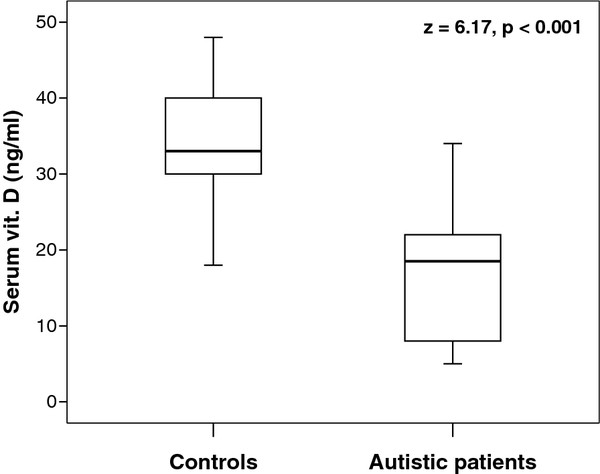
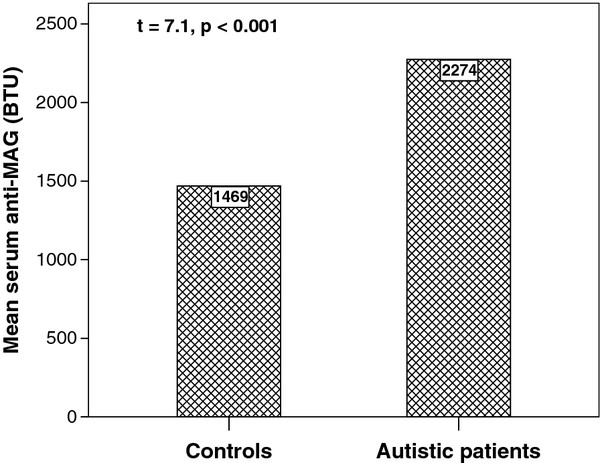
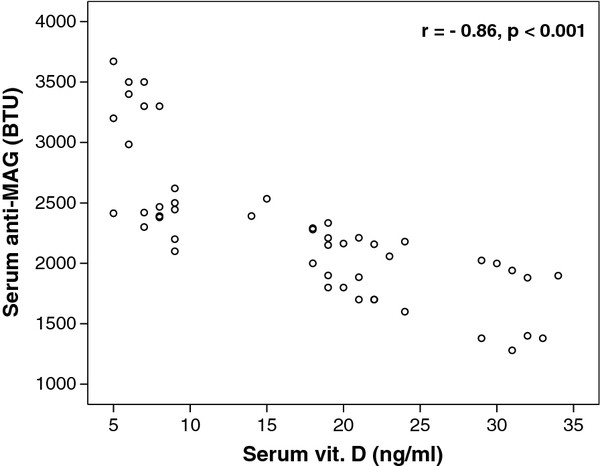
BACKGROUND: Aside from the skeletal health affection, vitamin D deficiency has been implicated as a potential environmental factor triggering for some autoimmune disorders. Vitamin D might play a role in the regulation of the production of auto-antibodies. Immunomodulatory effects of vitamin D may act not only through modulation of T-helper cell function, but also through induction of CD4(+)CD25(high) regulatory T-cells. We are the first to investigate the relationship between serum levels of 25-hydroxy vitamin D and anti-myelin-associated glycoprotein (anti-MAG) auto-antibodies in autistic children. METHODS: Serum levels of 25-hydroxy vitamin D and anti-MAG auto-antibodies were measured in 50 autistic children, aged between 5 and 12 years, and 30 healthy-matched children. Serum 25-hydroxy vitamin D levels 10-30 ng/mL and < 10 ng/mL were defined as vitamin D insufficiency and deficiency, respectively. RESULTS: Autistic children had significantly lower serum levels of 25-hydroxy vitamin D than healthy children (P < 0.001) with 40% and 48% being vitamin D deficient and insufficient, respectively. Serum 25-hydroxy vitamin D had significant negative correlations with Childhood Autism Rating Scale (P < 0.001). Increased levels of serum anti-MAG auto-antibodies were found in 70% of autistic patients. Serum 25-hydroxy vitamin D levels had significant negative correlations with serum levels of anti-MAG auto-antibodies (P < 0.001). CONCLUSIONS: Vitamin D deficiency was found in some autistic children and this deficiency may contribute to the induction of the production of serum anti-MAG auto-antibodies in these children. However, future studies looking at a potential role of vitamin D in the pathophysiology and treatment of autism are warranted.
Overview
The claims and statistics of this paper haven’t been checked yet.
Run the check — free, no account needed. It reads the open-access text and checks the sources it cites.
Integrity signals
Registry
Cites
Statistics
Figures
Verification
Claims the paper makes
The claims and statistics of this paper haven’t been checked yet.
Run the check — free, no account needed. It reads the open-access text and checks the sources it cites.
Claims other papers make about this one
Each is checked against this paper’s own text: does it say what the citing paper says it does?
The cited source says what the claim attributes to it.
In the citing paper
“Of 14 studies, nine reported significant differences in 25(OH)D concentrations between cases and controls [78,81,108,109,110,111,112,117,118], one borderline difference [114], and four found no significant differences among study groups [79,113,115,116].”
From Vitamin D and Autism Spectrum Disorder: A Literature Review (2016) · cites this paper as [109]
In the citing paper
“Furthermore, 25(OH)D concentrations correlated negatively with CARS scores, (r = −0.84, p < 0.001) and anti-MAG anti-autoantibodies (r = −0.86, p < 0.001).”
From Vitamin D and Autism Spectrum Disorder: A Literature Review (2016) · cites this paper as [109]
In the citing paper
“Cases also had significantly higher anti-myelin-associated glycoprotein (anti-MAG) anti-autoantibodies than controls.”
From Vitamin D and Autism Spectrum Disorder: A Literature Review (2016) · cites this paper as [109]
In the citing paper
“Children with ASD displayed significantly lower 25(OH)D concentration than healthy controls.”
From Vitamin D and Autism Spectrum Disorder: A Literature Review (2016) · cites this paper as [109]
In the citing paper
“Similarly, Mostafa and Al-Ayadi (2012) collected all blood samples from Saudi Arabian children with ASD and healthy controls during summer months [109].”
From Vitamin D and Autism Spectrum Disorder: A Literature Review (2016) · cites this paper as [109]
In the citing paper
“While 40% of children with ASD had 25(OH)D concentrations <25 nmol/L, no one from control group had 25(OH)D concentrations in that range.”
From Vitamin D and Autism Spectrum Disorder: A Literature Review (2016) · cites this paper as [109]
In the citing paper
“Children on the severe end of the spectrum had significantly higher anti-MAG anti-autoantibodies levels than those with mild/moderate ASD.”
From Vitamin D and Autism Spectrum Disorder: A Literature Review (2016) · cites this paper as [109]
In the citing paper
“Mostafa and Al-Ayadi reported significantly higher proportion of children with ASD having anti-MAG antiautoantibodies, anti-ganglioside M1, anti-neuronal and anti-nuclear antibodies than typically developing controls, that positively correlated with the severity of autism symptoms (CARS scores) [109,165,166,167].”
From Vitamin D and Autism Spectrum Disorder: A Literature Review (2016) · cites this paper as [109]
In the citing paper
“Furthermore, anti-MAG antiautoantibodies correlated negatively with serum 25(OH)D concentrations (r = −0.86, p < 0.001) [109], and anti-nuclear antibody positive healthy controls were significantly more likely to be deficient in vitamin D than antibody negative healthy controls (71% vs. 22%, respectively, p = 0.003) [172].”
From Vitamin D and Autism Spectrum Disorder: A Literature Review (2016) · cites this paper as [109]
In the citing paper
“Mostafa and Al-Ayadi reported significantly higher proportion of children with ASD having anti-MAG antiautoantibodies, anti-ganglioside M1, anti-neuronal and anti-nuclear antibodies than typically developing controls, that positively correlated with the severity of autism symptoms (CARS scores) [109,165,166,167].”
From Vitamin D and Autism Spectrum Disorder: A Literature Review (2016) · cites this paper as [109]
Self-check
Percentages, sums and reported differences re-computed from the paper’s own numbers.
The self-check needs the paper’s full text.
Citations
Cites
Diagnostic and Statistical Manual of Mental Disorders
American Psychiatric Association (2013) · doi:10.1176/appi.books.9780890425596 · Cited by 116,369
Diagnostic and Statistical Manual of Mental Disorders
Williams, J. B. W., & First, M. B. (2013) · Oxford University Press eBooks · doi:10.1093/acrefore/9780199975839.013.104 · Cited by 109,845
Holick, M. F. (2007) · New England Journal of Medicine · doi:10.1056/nejmra070553 · Cited by 13,720
Diagnostic and Statistical Manual of Mental Disorders, 5th Edition
(2013) · American Psychiatric Association Publishing eBooks · doi:10.1176/appi.books.9780890425596.893619 · Cited by 4,412
Vignali, D. A. A., Collison, L. W., & Workman, C. J. (2008) · Nature Reviews Immunology · doi:10.1038/nri2343 · Cited by 3,463
Induction and effector functions of TH17 cells
Bettelli, E., Korn, T., Oukka, M., & Kuchroo, V. K. (2008) · Nature · doi:10.1038/nature07036 · Cited by 1,243
Boonstra, A., Barrat, F. J., Crain, C., Heath, V. L., Savelkoul, H. F. J., & O’Garra, A. (2001) · The Journal of Immunology · doi:10.4049/jimmunol.167.9.4974 · Cited by 1,125
Eyles, D. W., Burne, T. H. J., & McGrath, J. J. (2012) · Frontiers in Neuroendocrinology · doi:10.1016/j.yfrne.2012.07.001 · Cited by 726
Vitamin D status, 1,25-dihydroxyvitamin D3, and the immune system
Cantorna, M. T., Zhu, Y., Froicu, M., & Wittke, A. (2004) · American Journal of Clinical Nutrition · doi:10.1093/ajcn/80.6.1717s · Cited by 703
Neuronal Cyclic AMP Controls the Developmental Loss in Ability of Axons to Regenerate
Cai, D., Qiu, J. J., Cao, Z., McAtee, M., Bregman, B. S., & Filbin, M. T. (2001) · Journal of Neuroscience · doi:10.1523/jneurosci.21-13-04731.2001 · Cited by 539
Research works printed but not linked: 1
- Schopler E: Reichler RJ, Renner BR: The Childhood Autism Rating Scale (CARS), for Diagnostic Screening and Classification in Autism. Irvington, New York, NY; 1986.
Cited by
Sorted by citations
Items 101–167 of 167
The Effects of Vitamin D3on Brain Development and Autism
Ucuz, İ., Dursun, O. B., & Aydın, N. (2015) · Klinik Psikofarmakoloji Bülteni-Bulletin of Clinical Psychopharmacology · doi:10.5455/bcp.20141024012912 · Cited by 7
Occurrence and Correlates of Vitamin D and Iron Deficiency in Children with Autism Spectrum Disorder
Koh, M. Y., Lee, A. J. W., Wong, H. C., & Aishworiya, R. (2025) · Nutrients · doi:10.3390/nu17172738 · Cited by 6
Gastrointestinal, nutritional, endocrine, and microbiota conditions in autism spectrum disorder
Loyacono, N., Sanz, M. L., Gerbi, M. D., Martínez, L. M., Ferreira, M. L., & Iermoli, R. H. (2020) · Archivos Argentinos de Pediatria · doi:10.5546/aap.2020.eng.e271 · Cited by 7
Santos, J. X., Rasga, C., & Vicente, A. M. (2021) · IntechOpen eBooks · doi:10.5772/intechopen.95758 · Cited by 6
Jayanath, S., Fong, C. Y., & Sarvananthan, R. (2021) · Research in Autism · doi:10.1016/j.rasd.2021.101786 · Cited by 5
Kim, J. (2024) · Journal of korean Academy of Child and Adolescent Psychiatry · doi:10.5765/jkacap.230063 · Cited by 6
The Genetic and Epigenetic Basis Involved in the Pathophysiology of ASD: Therapeutic Implications
Carrascosa-Romero, M. C., & de Cabo, C. (2017) · InTech eBooks · doi:10.5772/66854 · Cited by 5
The Effects of Vitamin D Deficiency on Neurodegenerative Diseases
Lauer, A. A., Janitschke, D., Hartmann, T., Grimm, H. S., & Grimm, M. O. W. (2019) · IntechOpen eBooks · doi:10.5772/intechopen.89160 · Cited by 5
Vitamin D deficiency and autism; a review on recent findings
Sotodehasl, N., Tamadon, M. R., & Malek, F. (2017) · Journal of Parathyroid Disease · doi:10.15171/jpd.2018.04 · Cited by 5
Authors' Response: More research on paracetamol is required
Brandlistuen, R. E., Ystrøm, E., Nulman, I., Koren, G., & Nordeng, H. (2014) · International Journal of Epidemiology · doi:10.1093/ije/dyu015 · Cited by 5
Vitamin D and Autism Spectrum Disorder: An Intriguing Association
Siddiqui, R. W., Siddiqui, T. W., & Siddiqui, S. W. (2024) · Annals of Child Neurology · doi:10.26815/acn.2023.00353 · Cited by 4
Associations Between Vitamin D and Core Symptoms in ASD: An Umbrella Review
Jiang, Y., Dang, W., Sui, L., Gao, T., Kong, X., Guo, J., Liu, S., Hong, N., & Jiang, Z. (2024) · Nutrition and Dietary Supplements · doi:10.2147/nds.s470462 · Cited by 5
Alabdali, A. N., Bacha, A. G. B., Alonazi, M. A., Abuaish, S., Almotairi, A. R., AL-Ayadhi, L. Y., & El-Ansary, A. K. (2025) · Frontiers in Molecular Neuroscience · doi:10.3389/fnmol.2025.1553438 · Cited by 4
Self-citationCase 2: New-Onset Seizure in a 5-year-old Boy with Autism Spectrum Disorder
Shah, E., & Marshall, I. H. (2019) · Pediatrics in Review · doi:10.1542/pir.2017-0217 · Cited by 4
Autism Spectrum Disorders: Role of Pre- and Post-Natal GammaDelta (γδ) T Cells and Immune Regulation
Anderson, G., & Medina, S. R. B. (2019) · Current Pharmaceutical Design · doi:10.2174/1381612825666191102170125 · Cited by 4
A Systematic Review on Environmental Factors associated with Autism Spectrum Disorder in Bangladesh
Khan, M. S., Tareq, S. M., & Kabir, M. A. (2022) · International Journal of Human and Health Sciences (IJHHS) · doi:10.31344/ijhhs.v6i3.454 · Cited by 4
Esnafoğlu, E. (2018) · Bozok Tıp Dergisi · doi:10.16919/bozoktip.390908 · Cited by 4
Liu, Q., & Yu, D. (2024) · Autism Research · doi:10.1002/aur.3241 · Cited by 3
Oral vitamin D, infants, toddlers, and autism in the United States: 1980 to 2010
Bittker, S. S. (2015) · Journal of Autism · doi:10.7243/2054-992x-2-1 · Cited by 3
Azhari, S. A. (2023) · Journal of Pharmaceutical Research International · doi:10.9734/jpri/2023/v35i107353 · Cited by 3
Autismo: aspectos nutrológicos das dietas e possível etiologia
Anderle, T., & de Mello, E. D. (2018) · International Journal of Nutrology · doi:10.1055/s-0038-1670668 · Cited by 4
[Research advances in the role of vitamin D in autism spectrum disorders].
Shan, L., Hu, X., Wang, B., & Jia, F. (2016) · PubMed Central · doi:10.7499/j.issn.1008-8830.2016.02.016 · Cited by 3
Iron, Vitamin D and B12 Levels of Young Children with Autism Spectrum Disorder at Diagnosis
Çelik, P., Sucaklı, İ. A., & Yakut, H. İ. (2022) · Journal of Dr Behcet Uz Children s Hospital · doi:10.4274/buchd.galenos.2022.79027 · Cited by 2
Role of autoimmunity in Neuronal damage in children with Autism spectrum disorder
Halepoto, D. M., AL-Ayadhi, L. Y., Alhowikan, A. M., & Elamin, N. E. (2023) · Pakistan Journal of Medical Sciences · doi:10.12669/pjms.39.6.6804 · Cited by 2
Self-citationNutraceutical approaches for Autism Spectrum Disorder treatment
Dobrachinski, F., Ribeiro, K. A., Bezerra, I. C., da Silva, A. J., Pereira, C. M. M., Vellasques, K., Padilha, H. A., Haas, S. E., Ávila, D. S., & Gubert, P. (2025) · Behavioural Brain Research · doi:10.1016/j.bbr.2025.115653 · Cited by 2
Vitamin D (steroid hormone) and the nervous system diseases (literature review)
Novotnyy, D. A., Жукова, Н. Г., Шперлинг, Л. П., Stolyarova, V. A., Zhukova, I. A., Agasheva, A. Е., Shtaimets, S. V., & Druzhinina, O. A. (2020) · Сибирский научный медицинский журнал · doi:10.15372/ssmj20200503 · Cited by 2
10.5937/specedreh13-4631 = Vitamin D across the life span
Pavlović, D., & Pavlovic, A. M. (2014) · Specijalna edukacija i rehabilitacija · doi:10.5937/specedreh13-4631 · Cited by 2
Feng, J., Li, H., Shan, L., Wang, B., Jia, F., & Du, L. (2019) · PubMed Central · doi:10.7499/j.issn.1008-8830.2019.04.007 · Cited by 2
Vitamin D and Autism Spectrum Disorder
Vegelin, M., Teodorowicz, G., & Savelkoul, H. F. J. (2021) · IntechOpen eBooks · doi:10.5772/intechopen.96928 · Cited by 2
Khadrawi, I. (2013) · Arrow - TU Dublin (Technological University Dublin) · doi:10.21427/d7x166 · Cited by 2
Autism Spectrum Disorder (ASD) and Diet
Anqodi, N. A., & Balushi, R. M. A. (2022) · Nutritional neurosciences · doi:10.1007/978-981-15-9781-7_8 · Cited by 1
Ce que nous avons appris sur les effets bénéfiques de la vitamine D en 2012
Grant, W. B. (2013) · NPG. Neurologie, psychiatrie, gériatrie/NPG · doi:10.1016/j.npg.2013.02.001 · Cited by 1
Autism Spectrum Disorder and Prenatal Risk Factors
Erden, S., & Nalbant, K. (2019) · Selçuk Tıp Dergisi · doi:10.30733/std.2019.00942 · Cited by 1
Vitamin D Deficiency in Patients with Attention Deficit Hyperactivity Disorder
Alruwaili, J. (2021) · Journal of Pharmaceutical Research International · doi:10.9734/jpri/2021/v33i531184 · Cited by 1
Clinical Roundup: Selected Treatment Options for Autism
(2015) · Alternative and Complementary Therapies · doi:10.1089/act.2015.21208 · Cited by 1
Al-Demirchi, J. Y., AL-Ghurabi, B. H., & AlKubaisy, W. (2024) · Journal of Baghdad College of Dentistry · doi:10.26477/jbcd.v36i4.3822 · Cited by 1
Ansari, S., Zidashti, Z. H., Elmieh, A., & Bidabadi, E. (2018) · Pars of Jahrom University of Medical Sciences · doi:10.52547/jmj.16.4.48 · Cited by 1
Neurodevelopmental Disorders in Children
Haskell, M. A. M. (2020) · Springer eBooks · doi:10.1007/978-3-030-30730-1_30 · Cited by 1
Rates of 61.5% and 38.5% for Vitamin D Deficiency and Insufficiency in Autism
Ghanizadeh, A. J. (2014) · Journal of Pediatric Gastroenterology and Nutrition · doi:10.1097/mpg.0000000000000550 · Cited by 1
Singh, S., Basera, P., Agarwal, P., Arya, A., Ali, W., Rohatgi, K., & Ozair, A. (2022) · medRxiv · doi:10.1101/2022.12.23.22283891 · Cited by 1
Emerging concepts in therapies for autism spectrum disorder
Absoud, M. (2016) · BJPsych Advances · doi:10.1192/apt.bp.115.015578
Jia, F., Shan, L., Feng, J., Wang, B., Li, H., & Du, L. (2014)
Taslaq, N., & Russo, S. E. (2017) · Research on humanities and social sciences
Bone Disorders with Brain and Behavioral Conditions
Oleson, C. V., Ransom, T. E., & Beckley, A. A. (2017) · Springer eBooks · doi:10.1007/978-3-319-45084-1_7
贾, 飞. (2014) · International Journal of Psychiatry and Neurology · doi:10.12677/ijpn.2014.34004
Ansari, S., Zidashti, Z. H., Elmieh, A., & Bidabadi, E. (2020) · Quarterly Journal of Child Mental Health · doi:10.29252/jcmh.6.4.2
Vitamin and mineral levels in children with autism spectrum disorder
Palaz, M., Civan, H. A., & Yılmaz, S. (2020) · COUNS-EDU| The International Journal of Counseling and Education · doi:10.23916/0020200528030
(2020) · Archivos Argentinos de Pediatria · doi:10.5546/aap.2020.e271
Is Deficiency of 25-Hydroxy Vitamin D A Risk Factor for Autism? A Preliminary Study
Hassan, M. M., Emam, A. M., Radwan, A. M., Abdelhameed, A., Eldin, S. S., & Mohamed, M. (2021) · Egyptian Journal of Ear Nose Throat and Allied Sciences · doi:10.21608/ejentas.2021.44200.1264
Evaluation of Serum Vitamin D in Children with Autism Spectrum Disorder
Afroz, S., Begum, S., Shahjadi, S., Siddiqi, U. R., & Mahruba, S. N. (2022) · Bangladesh Medical Research Council Bulletin · doi:10.3329/bmrcb.v47i1.55795
Nutritional Assessment of Autism Spectrum Disorder in Benghazi
Eltuhami, A., Nouh, F., Elfagi, S., Omar, M., Nasser, W., tawfiek, D., & Al-dain, S. N. (2021) · SAS Journal of Medicine · doi:10.36347/sasjm.2021.v07i08.004
Hassan, M. H., SHEHATA, G. A., Ahmed, A. E., El-Sawy, S. A., Tohamy, A. M., Sakhr, H. M., Bakri, A. H., F, H. A., Ameen, H. H., Abdallah, A. A. M., et al. (2023) · Gazzetta Medica Italiana Archivio per le Scienze Mediche · doi:10.23736/s0393-3660.22.04776-3
The Effects of Dietary Approaches and Nutritional Supplements in Autism
YILMAZ, A., & KÖSEOĞLU, S. Z. A. (2023) · European Journal of Science and Technology · doi:10.31590/ejosat.1295896
The role of food program to overcome obesity, overweight, and underweight among autistic children
Abu-Hussein, L. A. (2023) · THE SCIENTIFIC TEMPER · doi:10.58414/scientifictemper.2023.14.3.52
Importance of functional foods in the management of autism
Rai, S., Keservani, R. K., Kumar, P., Nikam, V. K., Kachave, R. N., Kumar, Y., & Kesharwani, R. K. (2024) · Elsevier eBooks · doi:10.1016/b978-0-443-18951-7.00008-6
Imbalance of Regulatory T Cells in Autism Spectrum Disorder: A Review Study
Yazdani, Z., & Rafiei, A. (2023) · Current Psychosomatic Research · doi:10.32598/cpr.1.4.130.1
El-Ansary, A., Saad, K., Bhat, R. S., Al-Haidan, A., & AL-Ayadhi, L. Y. (2024) · Elsevier eBooks · doi:10.1016/b978-0-443-27366-7.00017-1
Self-citationZalak, T. M., Abdulla, S. S. A., & Jaradat, M. A. (2024) · Advances in Science and Engineering Technology International Conferences (ASET) · doi:10.1109/aset60340.2024.10708772
Wenzell, M. L., Kindler, J. M., Sharp, W. G., Loechner, K. J., Gillespie, S. E., Burrell, T. L., Berry, R. C., Scahill, L. D., & Brasher, S. N. (2024) · Pediatric Nursing · doi:10.62116/pnj.2024.50.5.225
Miura, B. N. B., Rico, C., Baldo, I. C., & da Rocha, B. A. (2024) · Revista Omnia Saúde · doi:10.69719/ros.v7iesp..801
Efficacy of Vitamin Supplements in Autism Spectrum Disorder
Adıgüzel, E. (2024) · Springer eBooks · doi:10.1007/978-3-031-40858-8_76-1 · Cited by 1
Singh, S., Basera, P., Agarwal, P., Arya, A., Ali, W., Rohatgi, K., & Ozair, A. (2025) · doi:10.22541/au.173809129.93733113/v1
Mengesha, A. K., Beyna, A. T., Kidanu, G. E., Misker, M. F., & Ayele, H. S. (2025) · Scientific Reports · doi:10.1038/s41598-025-97654-4
Kette, S. D. (2025) · Preprints.org · doi:10.20944/preprints202512.0213.v1
Khallad, S., Mallah, E., Abu-Qatouseh, L., Abu-awwad, A., Mansoor, K., Abutaleb, S., Omari, K. W., Dib, H., & Arafat, T. (2025) · Research Journal of Pharmacy and Technology · doi:10.52711/0974-360x.2025.00759
Bhaskaran, D., Leena, M. L., M., A. V., Indiradevi, L., & Mahendran, P. (2026) · International Journal of Contemporary Pediatrics · doi:10.18203/2349-3291.ijcp20260101
Active Engagement: Development of Cooking Skills for Young Adults with Autism
Bailey‐Goldschmidt, J. (2015) · University Libraries (University of Maryland) · doi:10.13016/m2rw4z
Metadata
- Authors
- Mostafa, G. A., & AL-Ayadhi, L. Y.
- Affiliations
- King Saud University (SA)
- Corresponding author
- Mostafa, Gehan A
- ORCID
- AL-Ayadhi, Laila Y
- Venue
- Journal of Neuroinflammation
- Published
- 2012-08-17
- Volume
- 9
- Issue
- 1
- Pages
- 201-201
- ISSN
- 1742-2094 (ISSN-L)
- PMC
- PMC3476426
- OpenAlex
- W2109361390
- Cited by
- 168
- References
- 52
- Citations by year
- 2026: 1 · 2025: 5 · 2024: 13 · 2023: 12 · 2022: 10 · 2021: 12 · 2020: 19 · 2019: 9 · 2018: 19 · 2017: 14 · 2016: 11 · 2015: 11 · 2014: 22 · 2013: 9 · 2012: 1
- FWCI
- 9.94
- Type
- journal article
- Language
- en
- Open access
- gold
- doi.org
- Locations
- Journal of Neuroinflammation (publishedVersion, cc-by)
- PubMed Central (publishedVersion, cc-by)
- PubMed (publishedVersion)
- DOAJ (DOAJ: Directory of Open Access Journals) (submittedVersion)
- Funders
- King Abdulaziz City for Science and Technology
- National Plan for Science, Technology and Innovation
- Topics
- Health Sciences › Medicine › Endocrinology, Diabetes and Metabolism › Vitamin D Research Studies
- Life Sciences › Neuroscience › Cognitive Neuroscience › Autism Spectrum Disorder Research
- Health Sciences › Medicine › Psychiatry and Mental health › Child Nutrition and Feeding Issues
- Keywords
- autism spectrum disorder, vitamin D deficiency, 25-hydroxyvitamin D, anti-myelin-associated glycoprotein antibodies, autoimmunity, vitamin D insufficiency, immunomodulation, regulatory T cells, Childhood Autism Rating Scale, children
- MeSH terms
- Autistic Disorder, Autoantibodies, Autoimmune Diseases, Child, Child, Preschool, Cross-Sectional Studies, Female, Humans, Male, Vitamin D, Vitamin D Deficiency, Biomarkers, Myelin-Associated Glycoprotein
About these checks
Registry, retraction, Cites and statistics results are computed, not judged, with one exception: a printed reference that no index lists is read once by a model before it counts as a citation error. Claims are extracted by a model and kept only when their quote appears verbatim in the text; each cited source is then checked, with a model’s help, for whether it says what the claim relies on. Those verdicts can be wrong — read the claim’s quote and the cited source before relying on one.
Statistics and arithmetic are recomputed, not judged.
Confidence bands are shown only for fields calibrated on our annotated test set. None is calibrated yet, so no band is shown.
What counts as a claim ›How we measure confidence ›How we check this ›
Are you an author, or do you see a problem with this page? Request a review
