

The DOI matches its Crossref record; 52 of the 52 references it cites were found in a registry or an index.
Reduced serum concentrations of 25-hydroxy vitamin D in children with autism: Relation to autoimmunity
Open accessAbstract
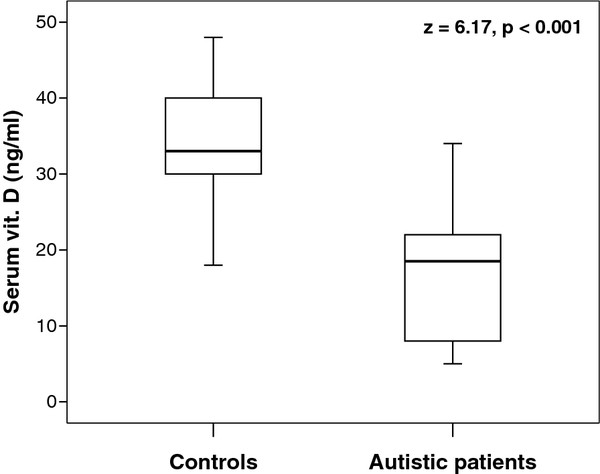
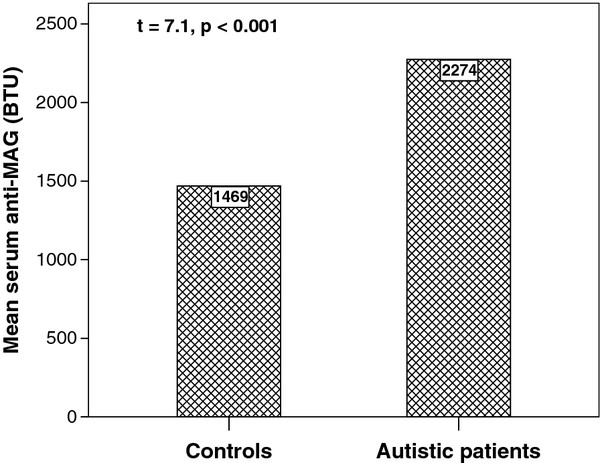
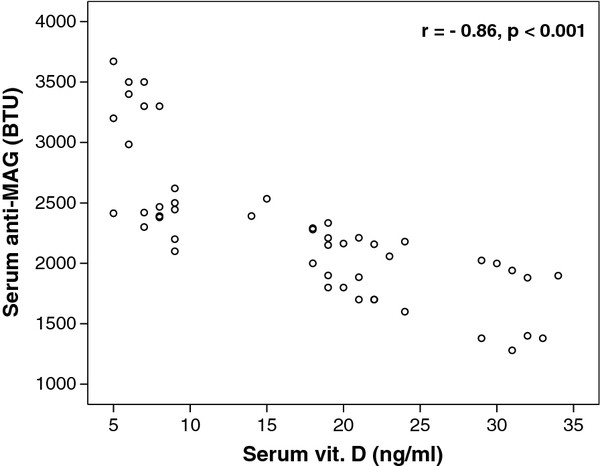
BACKGROUND: Aside from the skeletal health affection, vitamin D deficiency has been implicated as a potential environmental factor triggering for some autoimmune disorders. Vitamin D might play a role in the regulation of the production of auto-antibodies. Immunomodulatory effects of vitamin D may act not only through modulation of T-helper cell function, but also through induction of CD4(+)CD25(high) regulatory T-cells. We are the first to investigate the relationship between serum levels of 25-hydroxy vitamin D and anti-myelin-associated glycoprotein (anti-MAG) auto-antibodies in autistic children. METHODS: Serum levels of 25-hydroxy vitamin D and anti-MAG auto-antibodies were measured in 50 autistic children, aged between 5 and 12 years, and 30 healthy-matched children. Serum 25-hydroxy vitamin D levels 10-30 ng/mL and < 10 ng/mL were defined as vitamin D insufficiency and deficiency, respectively. RESULTS: Autistic children had significantly lower serum levels of 25-hydroxy vitamin D than healthy children (P < 0.001) with 40% and 48% being vitamin D deficient and insufficient, respectively. Serum 25-hydroxy vitamin D had significant negative correlations with Childhood Autism Rating Scale (P < 0.001). Increased levels of serum anti-MAG auto-antibodies were found in 70% of autistic patients. Serum 25-hydroxy vitamin D levels had significant negative correlations with serum levels of anti-MAG auto-antibodies (P < 0.001). CONCLUSIONS: Vitamin D deficiency was found in some autistic children and this deficiency may contribute to the induction of the production of serum anti-MAG auto-antibodies in these children. However, future studies looking at a potential role of vitamin D in the pathophysiology and treatment of autism are warranted.
Overview
The claims and statistics of this paper haven’t been checked yet.
Run the check — free, no account needed. It reads the open-access text and checks the sources it cites.
Integrity signals
Registry
Cites
Statistics
Figures
Verification
Claims the paper makes
The claims and statistics of this paper haven’t been checked yet.
Run the check — free, no account needed. It reads the open-access text and checks the sources it cites.
Claims other papers make about this one
Each is checked against this paper’s own text: does it say what the citing paper says it does?
The cited source says what the claim attributes to it.
In the citing paper
“Of 14 studies, nine reported significant differences in 25(OH)D concentrations between cases and controls [78,81,108,109,110,111,112,117,118], one borderline difference [114], and four found no significant differences among study groups [79,113,115,116].”
From Vitamin D and Autism Spectrum Disorder: A Literature Review (2016) · cites this paper as [109]
In the citing paper
“Furthermore, 25(OH)D concentrations correlated negatively with CARS scores, (r = −0.84, p < 0.001) and anti-MAG anti-autoantibodies (r = −0.86, p < 0.001).”
From Vitamin D and Autism Spectrum Disorder: A Literature Review (2016) · cites this paper as [109]
In the citing paper
“Cases also had significantly higher anti-myelin-associated glycoprotein (anti-MAG) anti-autoantibodies than controls.”
From Vitamin D and Autism Spectrum Disorder: A Literature Review (2016) · cites this paper as [109]
In the citing paper
“Children with ASD displayed significantly lower 25(OH)D concentration than healthy controls.”
From Vitamin D and Autism Spectrum Disorder: A Literature Review (2016) · cites this paper as [109]
In the citing paper
“Similarly, Mostafa and Al-Ayadi (2012) collected all blood samples from Saudi Arabian children with ASD and healthy controls during summer months [109].”
From Vitamin D and Autism Spectrum Disorder: A Literature Review (2016) · cites this paper as [109]
In the citing paper
“While 40% of children with ASD had 25(OH)D concentrations <25 nmol/L, no one from control group had 25(OH)D concentrations in that range.”
From Vitamin D and Autism Spectrum Disorder: A Literature Review (2016) · cites this paper as [109]
In the citing paper
“Children on the severe end of the spectrum had significantly higher anti-MAG anti-autoantibodies levels than those with mild/moderate ASD.”
From Vitamin D and Autism Spectrum Disorder: A Literature Review (2016) · cites this paper as [109]
In the citing paper
“Mostafa and Al-Ayadi reported significantly higher proportion of children with ASD having anti-MAG antiautoantibodies, anti-ganglioside M1, anti-neuronal and anti-nuclear antibodies than typically developing controls, that positively correlated with the severity of autism symptoms (CARS scores) [109,165,166,167].”
From Vitamin D and Autism Spectrum Disorder: A Literature Review (2016) · cites this paper as [109]
In the citing paper
“Furthermore, anti-MAG antiautoantibodies correlated negatively with serum 25(OH)D concentrations (r = −0.86, p < 0.001) [109], and anti-nuclear antibody positive healthy controls were significantly more likely to be deficient in vitamin D than antibody negative healthy controls (71% vs. 22%, respectively, p = 0.003) [172].”
From Vitamin D and Autism Spectrum Disorder: A Literature Review (2016) · cites this paper as [109]
In the citing paper
“Mostafa and Al-Ayadi reported significantly higher proportion of children with ASD having anti-MAG antiautoantibodies, anti-ganglioside M1, anti-neuronal and anti-nuclear antibodies than typically developing controls, that positively correlated with the severity of autism symptoms (CARS scores) [109,165,166,167].”
From Vitamin D and Autism Spectrum Disorder: A Literature Review (2016) · cites this paper as [109]
Self-check
Percentages, sums and reported differences re-computed from the paper’s own numbers.
The self-check needs the paper’s full text.
Citations
Cites
Diagnostic and Statistical Manual of Mental Disorders
American Psychiatric Association (2013) · doi:10.1176/appi.books.9780890425596 · Cited by 116,369
Diagnostic and Statistical Manual of Mental Disorders
Williams, J. B. W., & First, M. B. (2013) · Oxford University Press eBooks · doi:10.1093/acrefore/9780199975839.013.104 · Cited by 109,845
Holick, M. F. (2007) · New England Journal of Medicine · doi:10.1056/nejmra070553 · Cited by 13,720
Diagnostic and Statistical Manual of Mental Disorders, 5th Edition
(2013) · American Psychiatric Association Publishing eBooks · doi:10.1176/appi.books.9780890425596.893619 · Cited by 4,412
Vignali, D. A. A., Collison, L. W., & Workman, C. J. (2008) · Nature Reviews Immunology · doi:10.1038/nri2343 · Cited by 3,463
Induction and effector functions of TH17 cells
Bettelli, E., Korn, T., Oukka, M., & Kuchroo, V. K. (2008) · Nature · doi:10.1038/nature07036 · Cited by 1,243
Boonstra, A., Barrat, F. J., Crain, C., Heath, V. L., Savelkoul, H. F. J., & O’Garra, A. (2001) · The Journal of Immunology · doi:10.4049/jimmunol.167.9.4974 · Cited by 1,125
Eyles, D. W., Burne, T. H. J., & McGrath, J. J. (2012) · Frontiers in Neuroendocrinology · doi:10.1016/j.yfrne.2012.07.001 · Cited by 726
Vitamin D status, 1,25-dihydroxyvitamin D3, and the immune system
Cantorna, M. T., Zhu, Y., Froicu, M., & Wittke, A. (2004) · American Journal of Clinical Nutrition · doi:10.1093/ajcn/80.6.1717s · Cited by 703
Neuronal Cyclic AMP Controls the Developmental Loss in Ability of Axons to Regenerate
Cai, D., Qiu, J. J., Cao, Z., McAtee, M., Bregman, B. S., & Filbin, M. T. (2001) · Journal of Neuroscience · doi:10.1523/jneurosci.21-13-04731.2001 · Cited by 539
Research works printed but not linked: 1
- Schopler E: Reichler RJ, Renner BR: The Childhood Autism Rating Scale (CARS), for Diagnostic Screening and Classification in Autism. Irvington, New York, NY; 1986.
Cited by
Sorted by citations
Vitamin D as a neurosteroid affecting the developing and adult brain
Groves, N. J., McGrath, J. J., & Burne, T. H. J. (2014) · Annual Review of Nutrition · doi:10.1146/annurev-nutr-071813-105557 · Cited by 256
Saggese, G., Vierucci, F., Prodam, F., Cardinale, F., Cetin, I., Chiappini, E., Angelis, G. L. D., Massari, M., del Giudice, E. M., del Giudice, M. M., et al. (2018) · The Italian Journal of Pediatrics/Italian journal of pediatrics · doi:10.1186/s13052-018-0488-7 · Cited by 255
Immune Dysfunction and Autoimmunity as Pathological Mechanisms in Autism Spectrum Disorders
Hughes, H. K., Ko, E. M., Rose, D. R., & Ashwood, P. (2018) · Frontiers in Cellular Neuroscience · doi:10.3389/fncel.2018.00405 · Cited by 253
Saad, K., Abdel-rahman, A. A., Elserogy, Y. M., Al-Atram, A. A., Cannell, J. J., Bjørklund, G., Abdel-Reheim, M. K., Othman, H. A. K., El-Houfey, A. A., Abd El-Aziz, N. H. R., et al. (2016) · Nutritional Neuroscience · doi:10.1179/1476830515y.0000000019 · Cited by 244
Goldani, A. A. S., Downs, S. R., Widjaja, F., Lawton, B., & Hendren, R. L. (2014) · Frontiers in Psychiatry · doi:10.3389/fpsyt.2014.00100 · Cited by 220
Metadata
- Authors
- Mostafa, G. A., & AL-Ayadhi, L. Y.
- Affiliations
- King Saud University (SA)
- Corresponding author
- Mostafa, Gehan A
- ORCID
- AL-Ayadhi, Laila Y
- Venue
- Journal of Neuroinflammation
- Published
- 2012-08-17
- Volume
- 9
- Issue
- 1
- Pages
- 201-201
- ISSN
- 1742-2094 (ISSN-L)
- PMC
- PMC3476426
- OpenAlex
- W2109361390
- Cited by
- 168
- References
- 52
- Citations by year
- 2026: 1 · 2025: 5 · 2024: 13 · 2023: 12 · 2022: 10 · 2021: 12 · 2020: 19 · 2019: 9 · 2018: 19 · 2017: 14 · 2016: 11 · 2015: 11 · 2014: 22 · 2013: 9 · 2012: 1
- FWCI
- 9.94
- Type
- journal article
- Language
- en
- Open access
- gold
- doi.org
- Locations
- Journal of Neuroinflammation (publishedVersion, cc-by)
- PubMed Central (publishedVersion, cc-by)
- PubMed (publishedVersion)
- DOAJ (DOAJ: Directory of Open Access Journals) (submittedVersion)
- Funders
- King Abdulaziz City for Science and Technology
- National Plan for Science, Technology and Innovation
- Topics
- Health Sciences › Medicine › Endocrinology, Diabetes and Metabolism › Vitamin D Research Studies
- Life Sciences › Neuroscience › Cognitive Neuroscience › Autism Spectrum Disorder Research
- Health Sciences › Medicine › Psychiatry and Mental health › Child Nutrition and Feeding Issues
- Keywords
- autism spectrum disorder, vitamin D deficiency, 25-hydroxyvitamin D, anti-myelin-associated glycoprotein antibodies, autoimmunity, vitamin D insufficiency, immunomodulation, regulatory T cells, Childhood Autism Rating Scale, children
- MeSH terms
- Autistic Disorder, Autoantibodies, Autoimmune Diseases, Child, Child, Preschool, Cross-Sectional Studies, Female, Humans, Male, Vitamin D, Vitamin D Deficiency, Biomarkers, Myelin-Associated Glycoprotein
About these checks
Registry, retraction, Cites and statistics results are computed, not judged, with one exception: a printed reference that no index lists is read once by a model before it counts as a citation error. Claims are extracted by a model and kept only when their quote appears verbatim in the text; each cited source is then checked, with a model’s help, for whether it says what the claim relies on. Those verdicts can be wrong — read the claim’s quote and the cited source before relying on one.
Statistics and arithmetic are recomputed, not judged.
Confidence bands are shown only for fields calibrated on our annotated test set. None is calibrated yet, so no band is shown.
What counts as a claim ›How we measure confidence ›How we check this ›
Are you an author, or do you see a problem with this page? Request a review
