

The DOI matches its Crossref record; 39 of the 39 references it cites were found in a registry or an index.
Towards a comprehensive barcode library for arctic life—Ephemeroptera, Plecoptera, and Trichoptera of Churchill, Manitoba, Canada
Open accessAbstract
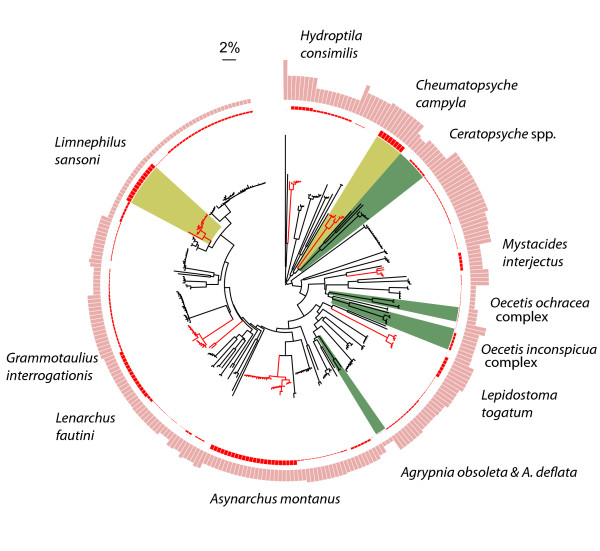
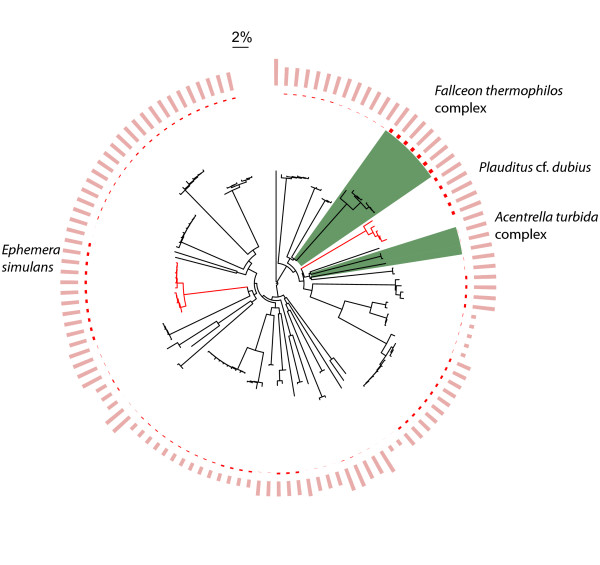
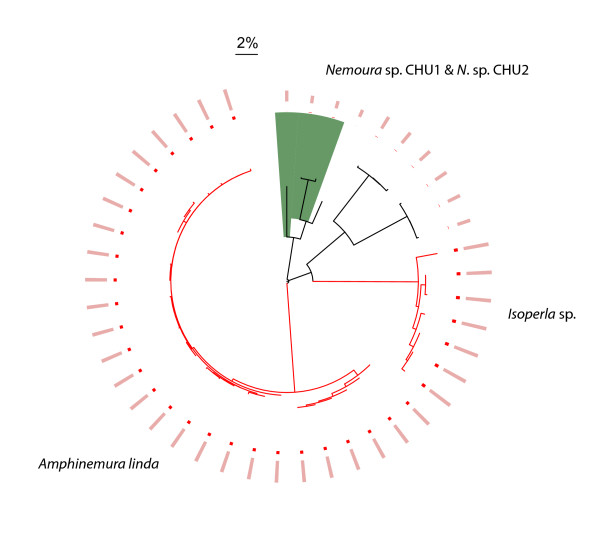
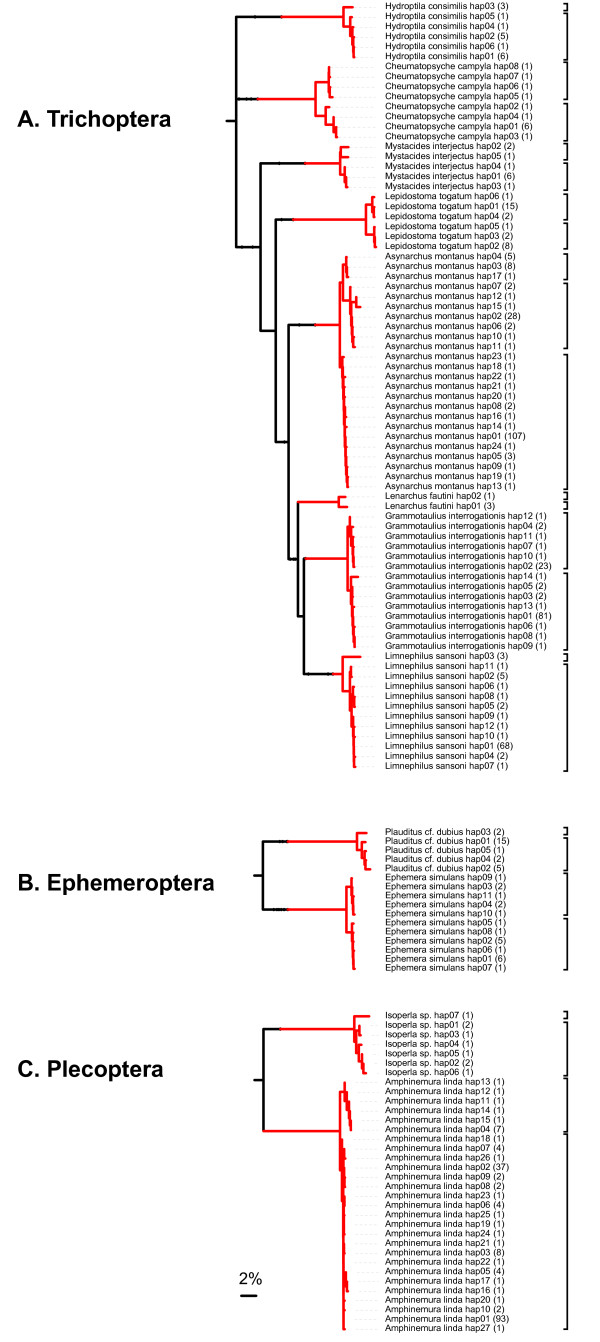
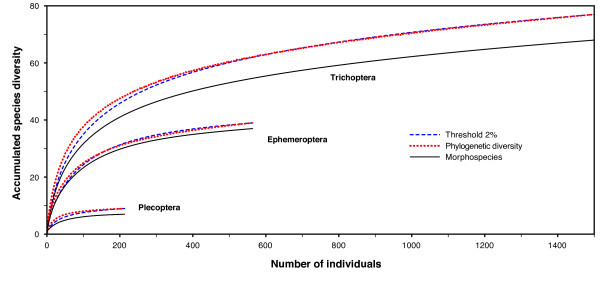
BACKGROUND: This study reports progress in assembling a DNA barcode reference library for Ephemeroptera, Plecoptera, and Trichoptera ("EPTs") from a Canadian subarctic site, which is the focus of a comprehensive biodiversity inventory using DNA barcoding. These three groups of aquatic insects exhibit a moderate level of species diversity, making them ideal for testing the feasibility of DNA barcoding for routine biotic surveys. We explore the correlation between the morphological species delineations, DNA barcode-based haplotype clusters delimited by a sequence threshold (2%), and a threshold-free approach to biodiversity quantification--phylogenetic diversity. RESULTS: A DNA barcode reference library is built for 112 EPT species for the focal region, consisting of 2277 COI sequences. Close correspondence was found between EPT morphospecies and haplotype clusters as designated using a standard threshold value. Similarly, the shapes of taxon accumulation curves based upon haplotype clusters were very similar to those generated using phylogenetic diversity accumulation curves, but were much more computationally efficient. CONCLUSION: The results of this study will facilitate other lines of research on northern EPTs and also bode well for rapidly conducting initial biodiversity assessments in unknown EPT faunas.
Overview
The claims and statistics of this paper haven’t been checked yet.
Run the check — free, no account needed. It reads the open-access text and checks the sources it cites.
Integrity signals
Registry
Cites
Statistics
Figures
Verification
Claims the paper makes
The claims and statistics of this paper haven’t been checked yet.
Run the check — free, no account needed. It reads the open-access text and checks the sources it cites.
Claims other papers make about this one
Each is checked against this paper’s own text: does it say what the citing paper says it does?
In the citing paper
“DNA barcoding allows for standardized and accurate species identification [15–18].”
Self-check
Percentages, sums and reported differences re-computed from the paper’s own numbers.
The self-check needs the paper’s full text.
Citations
Cites
R: A Language and Environment for Statistical Computing
R Core Team (2000) · doi:10.32614/r.manuals · Cited by 355,893
Kimura, M. (1980) · Journal of Molecular Evolution · doi:10.1007/bf01731581 · Cited by 29,778
MEGA4: Molecular Evolutionary Genetics Analysis (MEGA) Software Version 4.0
Tamura, K., Dudley, J. T., Nei, M., & Kumar, S. (2007) · Molecular Biology and Evolution · doi:10.1093/molbev/msm092 · Cited by 28,734
Proceedings of the National Academy of Sciences of the United States of America
Dowling, J. E., & Wald, G. (2009) · Nutrition Reviews · doi:10.1111/j.1753-4887.1981.tb06752.x · Cited by 17,937
Folmer, O., Black, M., Hoeh, W., Lutz, R., & Vrijenhoek, R. (1994) · PubMed · doi:10.5281/zenodo.15145663 · Cited by 15,546
APE: analyses of phylogenetics and evolution in R language
Paradis, E., Claude, J., & Strimmer, K. (2004) · Bioinformatics · doi:10.1093/bioinformatics/btg412 · Cited by 11,335
The genetic legacy of the Quaternary ice ages
Hewitt, G. M. (2000) · Nature · doi:10.1038/35016000 · Cited by 7,177
Gotelli, N., & Colwell, R. K. (2001) · Ecology Letters · doi:10.1046/j.1461-0248.2001.00230.x · Cited by 6,529
bold : The Barcode of Life Data System (http://www.barcodinglife.org)
RATNASINGHAM, S., & HEBERT, P. D. N. (2007) · Molecular Ecology Notes · doi:10.1111/j.1471-8286.2007.01678.x · Cited by 6,376
Self-citationConservation evaluation and phylogenetic diversity
Faith, D. (1992) · Biological Conservation · doi:10.1016/0006-3207(92)91201-3 · Cited by 5,495
Research works printed but not linked: 1
- Gaston KJ Blackburn TM Pattern and processes in macroecology 2000 Oxford: Blackwell Scientific
Cited by
Sorted by citations
Elbrecht, V., & Leese, F. (2015) · PLOS ONE · doi:10.1371/journal.pone.0130324 · Cited by 765
Cryptic biodiversity loss linked to global climate change
Bálint, M., Domisch, S., Engelhardt, C., Haase, P., Lehrian, S., Sauer, J., Theißinger, K., Pauls, S. U., & Nowak, C. (2011) · Nature Climate Change · doi:10.1038/nclimate1191 · Cited by 377
Carr, C. M., Mincks, S. L., Brown, T. M., Macdonald, T. A., & Hebert, P. D. N. (2011) · PLoS ONE · doi:10.1371/journal.pone.0022232 · Cited by 351
Self-citationGenomics in marine monitoring: New opportunities for assessing marine health status
Bourlat, S. J., Borja, Á., Gilbert, J. A., Taylor, M. I., Davies, N., Weisberg, S. B., Griffith, J. F., Lettieri, T., Field, D., Benzie, J., et al. (2013) · Marine Pollution Bulletin · doi:10.1016/j.marpolbul.2013.05.042 · Cited by 281
Short COI markers for freshwater macroinvertebrate metabarcoding
Vamos, E. E., Elbrecht, V., & Leese, F. (2017) · Metabarcoding and Metagenomics · doi:10.3897/mbmg.1.14625 · Cited by 237
Metadata
- Authors
- Zhou, X., Adamowicz, S. J., Jacobus, L. M., DeWalt, R. E., & Hebert, P. D.
- Affiliations
- University of Guelph (CA)
- Indiana University Bloomington (US)
- Illinois Natural History Survey (US)
- Corresponding author
- Zhou, Xin
- Venue
- Frontiers in Zoology
- Published
- 2009
- Volume
- 6
- Issue
- 1
- Pages
- 30
- ISSN
- 1742-9994 (ISSN-L)
- PMC
- PMC2800108
- OpenAlex
- W1965466602
- Cited by
- 153
- References
- 38
- Citations by year
- 2026: 5 · 2025: 4 · 2024: 6 · 2023: 2 · 2022: 5 · 2021: 8 · 2020: 8 · 2019: 11 · 2018: 11 · 2017: 13 · 2016: 16 · 2015: 8 · 2014: 13 · 2013: 11 · 2012: 9
- FWCI
- 9.32
- Type
- journal article
- Language
- en
- Open access
- gold
- doi.org
- Licence
- cc-by
- Locations
- Frontiers in Zoology (publishedVersion, cc-by)
- PubMed Central (publishedVersion, cc-by)
- PubMed (publishedVersion)
- DOAJ (DOAJ: Directory of Open Access Journals) (submittedVersion, cc-by-sa)
- Funders
- Purdue University
- Clemson University
- University of Minnesota
- Genome Canada
- Ontario Genomics
- Ontario Genomics Institute
- Imperial College London
- Natural Sciences and Engineering Research Council of Canada
- Topics
- Physical Sciences › Environmental Science › Ecology › Environmental DNA in Biodiversity Studies
- Life Sciences › Agricultural and Biological Sciences › Ecology, Evolution, Behavior and Systematics › Invertebrate Taxonomy and Ecology
- Physical Sciences › Environmental Science › Ecology › Freshwater macroinvertebrate diversity and ecology
- Keywords
- DNA barcoding, Ephemeroptera, Plecoptera, Trichoptera, phylogenetic diversity, species delimitation, Churchill, Manitoba, biodiversity survey
About these checks
Registry, retraction, Cites and statistics results are computed, not judged, with one exception: a printed reference that no index lists is read once by a model before it counts as a citation error. Claims are extracted by a model and kept only when their quote appears verbatim in the text; each cited source is then checked, with a model’s help, for whether it says what the claim relies on. Those verdicts can be wrong — read the claim’s quote and the cited source before relying on one.
Statistics and arithmetic are recomputed, not judged.
Confidence bands are shown only for fields calibrated on our annotated test set. None is calibrated yet, so no band is shown.
What counts as a claim ›How we measure confidence ›How we check this ›
Are you an author, or do you see a problem with this page? Request a review
