

Use of weighted Fourier linear combiner filters to estimate lower trunk 3D orientation from gyroscope sensors data
Open accessThe DOI matches its Crossref record; 19 of the 19 references it cites were found in a registry or an index.
Abstract
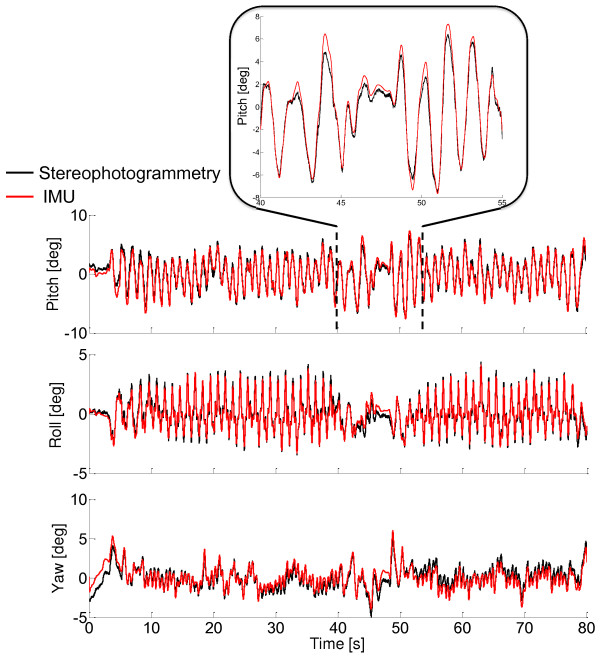
BACKGROUND: The present study aimed at devising a data processing procedure that provides an optimal estimation of the 3-D instantaneous orientation of an inertial measurement unit (IMU). This result is usually obtained by fusing the data measured with accelerometers, gyroscopes, and magnetometers. Nevertheless, issues related to compensation of integration errors and high sensitivity of these devices to magnetic disturbances call for different solutions. In this study, a method based on the use of gyroscope data only is presented, which uses a Weighted Fourier Linear Combiner adaptive filter to perform a drift-free estimate of the 3D orientation of an IMU located on the lower trunk during walking. METHODS: A tuning of the algorithm parameters and a sensitivity analysis to its initial conditions was performed using treadmill walking data from 3 healthy subjects. The accuracy of the method was then assessed using data collected from 15 young healthy subjects during treadmill walking at variable speeds and comparing the pitch, roll, and yaw angles estimated from the gyroscopes data to those obtained with a stereophotogrammetric system. Root mean square (RMS) difference and correlation coefficients (r) were used for this purpose. RESULTS: An optimal set of values of the algorithm parameters was established. At all the observed speeds, and also in all the various sub-phases, the investigated angles were all estimated to within an average RMS difference of less than 1.2 deg and an average r greater than 0.90. CONCLUSIONS: This study proved the effectiveness of the Weighted Fourier Linear Combiner method in accurately reconstructing the 3D orientation of an IMU located on the lower trunk of a subject during treadmill walking. This method is expected to also perform satisfactorily for overground walking data and to be applicable also to other "quasi-periodic" tasks, such as squatting, rowing, running, or swimming.
Overview
The claims and statistics of this paper haven’t been checked yet.
Free: it reads the open-access text and checks the first 5 claims that cite a source we can check. Create a free account to check every claim.
Integrity signals
Registry
Cites
Statistics
Figures
Verification
Claims the paper makes
The claims and statistics of this paper haven’t been checked yet.
Free: it reads the open-access text and checks the first 5 claims that cite a source we can check. Create a free account to check every claim.
Claims other papers make about this one
Each is checked against this paper’s own text: does it say what the citing paper says it does?
The check wasn’t confident either way, so it gives no verdict — never disputed.
In the citing paper
“Real-time tremor compensation in robotics surgical instruments, requires the processes of tremor sensing and compensation to finish within a very short time, maximum 30ms [37].”
From A Quaternion Weighted Fourier Linear Combiner for Modeling Physiological Tremor (2016) · cites this paper as [37]
Experimental — accuracy not yet measuredThe check wasn’t confident either way, so it gives no verdict — never disputed.
In the citing paper
“This delay is within the range suggested by [37] but could degrade accuracy.”
From A Quaternion Weighted Fourier Linear Combiner for Modeling Physiological Tremor (2016) · cites this paper as [37]
Experimental — accuracy not yet measured
Self-check
Percentages, sums and reported differences re-computed from the paper’s own numbers.
The self-check needs the paper’s full text.
Citations
Cites
(1991) · Springer eBooks · doi:10.1007/978-3-7091-2840-4 · Cited by 5,095
Human movement analysis using stereophotogrammetry
Leardini, A., Chiari, L., Croce, U. D., & Cappozzo, A. (2005) · Gait & Posture · doi:10.1016/j.gaitpost.2004.05.002 · Cited by 1,239
Self-citationEstimation of gait cycle characteristics by trunk accelerometry
Moe-Nilssen, R., & Helbostad, J. L. (2004) · Journal of Biomechanics · doi:10.1016/s0021-9290(03)00233-1 · Cited by 640 · cited 1×
“Background Inertial measurement units (IMUs) have gained in popularity as a tool to quantify human motion [1], thanks to their ease-of-use, robust design, and their small dimensions.”
BackgroundHuman movement analysis using stereophotogrammetry
Chiari, L., Croce, U. D., Leardini, A., & Cappozzo, A. (2005) · Gait & Posture · doi:10.1016/j.gaitpost.2004.04.004 · Cited by 441
Self-citationHuman movement analysis using stereophotogrammetryPart 1: theoretical background
CAPPOZZO, A., DELLACROCE, U., LEARDINI, A., & CHIARI, L. (2005) · Gait & Posture · doi:10.1016/s0966-6362(04)00025-6 · Cited by 398
Self-citationApplications of magnetic sensors for low cost compass systems
Caruso, M. J. (2002) · IEEE 2000. Position Location and Navigation Symposium (Cat. No.00CH37062) · doi:10.1109/plans.2000.838300 · Cited by 262 · cited 1×
“The additional use of magnetometers has been proposed to compensate for the integration errors, but their effectiveness is limited by their high sensitivity to magnetic disturbances [3,4].”
BackgroundAdaptive cancelling of physiological tremor for improved precision in microsurgery
Riviere, C. N., Rader, R. S., & Thakor, N. V. (1998) · IEEE Transactions on Biomedical Engineering · doi:10.1109/10.686791 · Cited by 260
Balasubramanian, C. K., Neptune, R. R., & Kautz, S. A. (2009) · Gait & Posture · doi:10.1016/j.gaitpost.2008.10.061 · Cited by 250 · cited 1×
“However, the BMFLC filter requires an a priori determined set of frequencies, which is not always available when dealing with human movement analysis applications [15,16].”
BackgroundAdaptive Fourier estimation of time-varying evoked potentials
Vaz, C. A., & Thakor, N. V. (1989) · IEEE Transactions on Biomedical Engineering · doi:10.1109/10.18751 · Cited by 159
Body position can be monitored in 3D using miniature accelerometers and earth-magnetic field sensors
Kemp, B., Janssen, A. J. M. W., & van der Kamp, B. (1998) · Electroencephalography and Clinical Neurophysiology/Electromyography and Motor Control · doi:10.1016/s0924-980x(98)00053-8 · Cited by 124
Cited by
Bergamini, E., Ligorio, G., Summa, A., Vannozzi, G., Cappozzo, A., & Sabatini, A. (2014) · Sensors · doi:10.3390/s141018625 · Cited by 267
Self-citationInertial Sensor Technology for Elite Swimming Performance Analysis: A Systematic Review
Mooney, R., Corley, G., Godfrey, A., Quinlan, L., & ÓLaighin, G. (2015) · Sensors · doi:10.3390/s16010018 · Cited by 168
“A Fourier filter has been shown to be accurate and effective for determining three dimensional orientations from a gyroscope in walking studies [168].”
MethodHuman–Robot–Environment Interaction Interface for Smart Walker Assisted Gait: AGoRA Walker
M., S. D. S., Garzón, M., Múnera, M., & Cifuentes, C. A. (2019) · Sensors · doi:10.3390/s19132897 · Cited by 80
“In fact, the Weighted-Fourier Linear Combiner (WFLC) is and adaptive filter for tracking of quasi-periodic signals [49], such as gait related signals (e.”
BackgroundMethodJoint Inertial Sensor Orientation Drift Reduction for Highly Dynamic Movements
Fasel, B., Spörri, J., Chardonnens, J., Kröll, J., Müller, E. A., & Aminian, K. (2017) · IEEE Journal of Biomedical and Health Informatics · doi:10.1109/jbhi.2017.2659758 · Cited by 86
Bonnet, V., Joukov, V., Kulić, D., Fraisse, P., Ramdani, N., & Venture, G. (2015) · IEEE Sensors Journal · doi:10.1109/jsen.2015.2503765 · Cited by 68
“only for 3D orientation of pseudo-periodic motion [12] and”
BackgroundSelf-citationBuganè, F., Benedetti, M., D’Angeli, V., & Leardini, A. (2014) · BioMedical Engineering OnLine · doi:10.1186/1475-925x-13-146 · Cited by 54
“Several relevant applications in natural walking characterization [20-22] and in patient rehabilitation have been reported already [23-25].”
BackgroundMethodResultA Quaternion Weighted Fourier Linear Combiner for Modeling Physiological Tremor
Adhikari, K., Tatinati, S., Ang, W. T., Veluvolu, K. C., & Nazarpour, K. (2016) · IEEE Transactions on Biomedical Engineering · doi:10.1109/tbme.2016.2530564 · Cited by 48
“This algorithm was called weighted Fourier linear combiner (wFLC) and it has been tested widely in different settings and extended to other applications, such as modeling of gait [21] or analysis of atological tremor [22].”
MethodRhythmic Extended Kalman Filter for Gait Rehabilitation Motion Estimation and Segmentation
Joukov, V., Bonnet, V., Karg, M. E., Venture, G., & Kulić, D. (2017) · IEEE Transactions on Neural Systems and Rehabilitation Engineering · doi:10.1109/tnsre.2017.2659730 · Cited by 47
“gyroscope measurements and integrate the Fourier series into a drift free pose estimate [18].”
BackgroundSelf-citationEstimate of lower trunk angles in pathological gaits using gyroscope data
Grimpampi, E., Bonnet, V., Taviani, A., & Mazzà, C. (2013) · Gait & Posture · doi:10.1016/j.gaitpost.2013.01.031 · Cited by 44
Self-citationCole, M. H., van den Hoorn, W., Kavanagh, J. J., Morrison, S., Hodges, P. W., SMEATHERS, J. E., & Kerr, G. (2014) · PLoS ONE · doi:10.1371/journal.pone.0098395 · Cited by 40
Human motion estimation on Lie groups using IMU measurements
Joukov, V., Ćesić, J., Westermann, K., Marković, I., Kulić, D., & Petrovic, I. K. (2017) · IEEE/RSJ International Conference on Intelligent Robots and Systems (IROS) · doi:10.1109/iros.2017.8206016 · Cited by 27
“Finally, having a model of the motion in addition to the kinematic constraints can further improve human pose estimation [2], [9].”
BackgroundMethodTowards an affordable mobile analysis platform for pathological walking assessment
Bonnet, V., Coste, C., Lapierre, L., Cadic, J., Fraisse, P., Zapata, R., Venture, G., & Gény, C. (2015) · Robotics and Autonomous Systems · doi:10.1016/j.robot.2014.12.002 · Cited by 24
Self-citationEstimation and Observability Analysis of Human Motion on Lie Groups
Joukov, V., Ćesić, J., Westermann, K., Marković, I., Petrovic, I. K., & Kulić, D. (2019) · IEEE Transactions on Cybernetics · doi:10.1109/tcyb.2019.2933390 · Cited by 21
“Combining the skeleton model with kinematic constraints or knowledge of the motion profile can further enhance the pose estimation accuracy [8], [15].”
MethodMagneto-Gyro Wearable Sensor Algorithm for Trunk Sway Estimation During Walking and Running Gait
Shull, P. B., Xu, J., Yu, B., & Zhu, X. (2016) · IEEE Sensors Journal · doi:10.1109/jsen.2016.2630938 · Cited by 21
“A gyroscope-based weighted Fourier linear combiner filter has been shown to estimate lower trunk kinematics with less drift than a standard gyroscope [8].”
Hejrati, B., Merryweather, A., & Abbott, J. J. (2017) · IEEE Transactions on Neural Systems and Rehabilitation Engineering · doi:10.1109/tnsre.2017.2740060 · Cited by 17
Rhythmic EKF for pose estimation during gait
Joukov, V., Bonnet, V., Karg, M. E., Venture, G., & Kulić, D. (2015) · IEEE-RAS International Conference on Humanoid Robots (Humanoids) · doi:10.1109/humanoids.2015.7363510 · Cited by 19
“However gyroscopes tend to drift and integrating the measurement accumulates error over time [4].”
BackgroundSelf-citationBitenc-Jasiejko, A., Konior, K., & Lietz–Kijak, D. (2020) · Pain Research and Management · doi:10.1155/2020/3967414 · Cited by 16
Integration of Human Walking Gyroscopic Data Using Empirical Mode Decomposition
Bonnet, V., Ramdani, S., Coste, C., Fraisse, P., Mazzà, C., & Cappozzo, A. (2013) · Sensors · doi:10.3390/s140100370 · Cited by 12
“In addition, an advantage of the adaptive filter approaches is that, contrary to the proposed method, they are suitable for real-time applications [3,5,6].”
BackgroundMethodInfluentialSelf-citationOnline System for Gait Parameters Estimation Using a LRF Sensor for Assistive Devices
Aguirre, A., M., S. D. S., Múnera, M., & Cifuentes, C. A. (2020) · IEEE Sensors Journal · doi:10.1109/jsen.2020.3028279 · Cited by 11
Position Estimation of an IMU Placed on Pelvis Through Meta-heuristically Optimised WFLC
Cardarelli, S., Verdini, F., Mengarelli, A., Strazza, A., Nardo, F. D., Burattini, L., & Fioretti, S. (2018) · World Congress on Medical Physics and Biomedical Engineering, September 7 - 12, 2009, Munich, Germany · doi:10.1007/978-981-10-9038-7_122 · Cited by 11
Gravenhorst, F., Muaremi, A., Kottmann, F., Tröster, G., Sigrist, R., Gerig, N., & Draper, C. (2014) · International Conference on Intelligent Sensors, Sensor Networks and Information Processing · doi:10.1109/issnip.2014.6827677 · Cited by 9
“Bonnet et al [1] focus on decreasing the drift problems of gyros for runners using a weighted Fourier linear combiner filter to create an estimation of the 3D orientation.”
MethodModeling 3D tremor signals with a quaternion weighted Fourier Linear Combiner
Adhikari, K., Tatinati, S., Veluvolu, K. C., & Nazarpour, K. (2015) · International IEEE/EMBS Conference on Neural Engineering · doi:10.1109/ner.2015.7146744 · Cited by 6
“In addition, the proposed QwFLC structure could be utilised in other applications such as, modelling of gait analysis [9] and modeling of respiratory body motions [10].”
MethodUKF Magnetometer-Free Sensor Fusion for Pelvis Pose Estimation During Treadmill Walking
Cardarelli, S., Mengarelli, A., Tigrini, A., Strazza, A., Nardo, F. D., Verdini, F., & Fioretti, S. (2019) · Annual International Conference of the IEEE Engineering in Medicine and Biology Society (EMBC) · doi:10.1109/embc.2019.8857914 · Cited by 5
Wang, J., & Barry, O. R. (2021) · IEEE Transactions on Biomedical Engineering · doi:10.1109/tbme.2021.3111878 · Cited by 3
Luo, Y., Gao, Y., Li, Q., & Zhao, J. (2018) · IEEE International Conference on Mechatronics and Automation (ICMA) · doi:10.1109/icma.2018.8484735 · Cited by 3
Desenvolvimento De Um Phase-Locked Loop A Partir De Um Combinador Linear De Fourier
de Barros, O., Frizera, A., & Encarnação, L. F. (2017) · Eletrônica de Potência · doi:10.18618/rep.2017.2.2664 · Cited by 2
Sensing Methodologies for Gait Parameters Estimation and Control
Pinto-Bernal, M. J., M., S. D. S., Múnera, M., & Cifuentes, C. A. (2021) · Springer eBooks · doi:10.1007/978-3-030-79630-3_5 · Cited by 2
Estimate of Lower Trunk Angles Using Gyroscope Data in Pathological Gait
Grimpampi, E., Bonnet, V., Taviani, A., & Mazzà, C. (2013) · Biosystems & biorobotics · doi:10.1007/978-3-642-34546-3_121 · Cited by 1
Self-citationLages, W. F., & Henriques, R. V. B. (2019) · Latin American Robotics Symposium, Brazilian Symposium on Robotics and Workshop on Robotics in Education (LARS/SBR/WRE) · doi:10.1109/lars-sbr-wre48964.2019.00034 · Cited by 1
“Many techniques have been proposed for this, using the complementary filter [2], [3], the Kalman filter [3], the extended Kalman filter [4], the unscented Kalman filter [5] or the weighted Fourier linear combiner [6] among others.”
MethodMultimodal programmes in the treatment of myofascial pain syndrome (MPS) – a two-step review
Konior, K., Bitenc-Jasiejko, A., Lietz–Kijak, D., Skomro, P., Kowacka, M., Kijak, K., & Śliwiński, Z. (2023) · doi:10.56984/8zg07b914 · Cited by 1
Sensores MEMS para Análise de Movimento Humano
Felipe, I., Caldas, R., & Rátiva, D. (2016) · Revista de Engenharia e Pesquisa Aplicada · doi:10.25286/repa.v2i1.377
“[4] Bonnet V, Mazzà C, McCamley J, Cappozzo A.”
BackgroundClassification of Altered Gait
Putvin, L. E. (2017) · NCSU Libraries Repository (North Carolina State University Libraries)
Entwicklung eines Konzeptes zur mobilen Aktivitätsmessung in der TLSO-Versorgung
Süberkrüb, L. (2015) · Digitalen Hochschulbibliothek Sachsen-Anhalt (Universitäts- und Landesbibliothek Sachsen-Anhalt) · doi:10.25673/5722
Mallat, R. (2021) · theses.fr (ABES) · doi:10.70675/ef5519a2z9500z4b2az9884zb56699882b1e · Cited by 1
Metadata
- Authors
- Bonnet, V., Mazzà, C., McCamley, J., & Cappozzo, A.
- Affiliations
- Foro Italico University of Rome (IT)
- Corresponding author
- Bonnet, Vincent
- Venue
- Journal of NeuroEngineering and Rehabilitation
- Published
- 2013
- Volume
- 10
- Issue
- 1
- Pages
- 29
- ISSN
- 1743-0003 (ISSN-L)
- PMC
- PMC3620521
- OpenAlex
- W2129010518
- Semantic Scholar
- 17554c40ee551b1fc905ed17f3ab803d4f04f633
- Cited by
- 32
- References
- 19
- Citations by year
- 2023: 1 · 2021: 3 · 2020: 2 · 2019: 4 · 2018: 2 · 2017: 5 · 2016: 3 · 2015: 5 · 2014: 4 · 2013: 3
- FWCI
- 8.05
- Type
- journal article
- Language
- en
- Open access
- gold
- doi.org
- Licence
- cc-by
- Locations
- Journal of NeuroEngineering and Rehabilitation (publishedVersion, cc-by)
- Europe PMC (PubMed Central) (publishedVersion, cc-by)
- PubMed Central (publishedVersion, cc-by)
- PubMed (publishedVersion)
- White Rose Research Online (University of Leeds, The University of Sheffield, University of York) (acceptedVersion)
- Funders
- Ministero dello Sviluppo Economico
- Topics
- Physical Sciences › Engineering › Aerospace Engineering › Inertial Sensor and Navigation
- Health Sciences › Health Professions › Physical Therapy, Sports Therapy and Rehabilitation › Balance, Gait, and Falls Prevention
- Physical Sciences › Engineering › Biomedical Engineering › Gait Recognition and Analysis
- Keywords
- gyroscope, inertial measurement unit, 3D orientation estimation, lower trunk, treadmill walking, adaptive filtering, gait analysis, stereophotogrammetry, quasi-periodic motion
- MeSH terms
- Acceleration, Adult, Algorithms, Biomechanical Phenomena, Data Interpretation, Statistical, Female, Fourier Analysis, Humans, Male, Middle Aged, Thorax, Least-Squares Analysis, Walking, Imaging, Three-Dimensional, Young Adult, Torso
About these checks
Registry, retraction, Cites and statistics results are computed, not judged, with one exception: a printed reference that no index lists is read once by a model before it counts as a citation error. Claims are extracted by a model and kept only when their quote appears verbatim in the text; each cited source is then checked, with a model’s help, for whether it says what the claim relies on. Those verdicts can be wrong — read the claim’s quote and the cited source before relying on one.
Statistics and arithmetic are recomputed, not judged.
Confidence bands are shown only for fields calibrated on our annotated test set. None is calibrated yet, so no band is shown.
What counts as a claim ›How we measure confidence ›How we check this ›
Are you an author, or do you see a problem with this page? Request a review
Data sources
Bibliographic data: Semantic Scholar, OpenAlex, Crossref.
Contains information from the Semantic Scholar Academic Graph Datasets, made available under the ODC Attribution License (ODC-BY 1.0).
Semantic Scholar’s data is described in: Kinney, R., et al. (2023). The Semantic Scholar Open Data Platform. arXiv:2301.10140.
