

The DOI matches its Crossref record; 106 of the 107 references it cites were found in a registry or an index.
Biofeedback in rehabilitation
Open accessAbstract
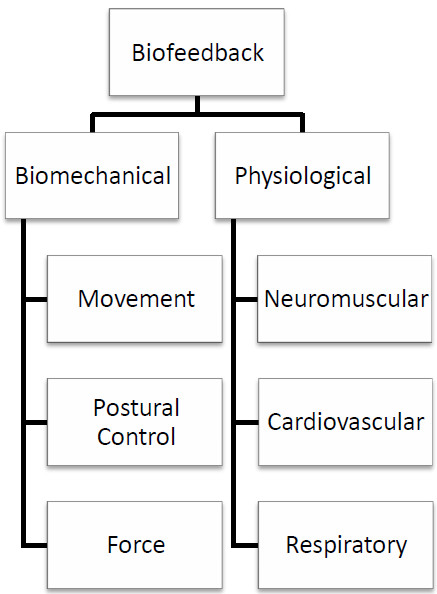
This paper reviews the literature relating to the biofeedback used in physical rehabilitation. The biofeedback methods used in rehabilitation are based on biomechanical measurements and measurements of the physiological systems of the body. The physiological systems of the body which can be measured to provide biofeedback are the neuromuscular system, the respiratory system and the cardiovascular system. Neuromuscular biofeedback methods include electromyography (EMG) biofeedback and real-time ultrasound imaging (RTUS) biofeedback. EMG biofeedback is the most widely investigated method of biofeedback and appears to be effective in the treatment of many musculoskeletal conditions and in post cardiovascular accident (CVA) rehabilitation. RTUS biofeedback has been demonstrated effective in the treatment of low back pain (LBP) and pelvic floor muscle dysfunction. Cardiovascular biofeedback methods have been shown to be effective in the treatment of a number of health conditions such as hypertension, heart failure, asthma, fibromyalgia and even psychological disorders however a systematic review in this field has yet to be conducted. Similarly, the number of large scale studies examining the use of respiratory biofeedback in rehabilitation is limited. Measurements of movement, postural control and force output can be made using a number of different devices and used to deliver biomechanical biofeedback. Inertial based sensing biofeedback is the most widely researched biomechanical biofeedback method, with a number of studies showing it to be effective in improving measures of balance in a number of populations. Other types of biomechanical biofeedback include force plate systems, electrogoniometry, pressure biofeedback and camera based systems however the evidence for these is limited. Biofeedback is generally delivered using visual displays, acoustic or haptic signals, however more recently virtual reality (VR) or exergaming technology have been used as biofeedback signals. VR and exergaming technology have been primarily investigated in post-CVA rehabilitation, however, more recent work has shown this type of biofeedback to be effective in improving exercise technique in musculoskeletal populations. While a number of studies in this area have been conducted, further large scale studies and reviews investigating different biofeedback applications in different clinical populations are required.
Overview
The claims and statistics of this paper haven’t been checked yet.
Run the check — free, no account needed. It reads the open-access text and checks the sources it cites.
Integrity signals
Registry
Cites
Statistics
Figures
Verification
Claims the paper makes
The claims and statistics of this paper haven’t been checked yet.
Run the check — free, no account needed. It reads the open-access text and checks the sources it cites.
Claims other papers make about this one
Each is checked against this paper’s own text: does it say what the citing paper says it does?
The source backs part of the claim, not all of it — or backs it for a different population, condition or comparison.
In the citing paper
“Force plate systems provide feedback on balance, movement, and gait and have been shown to reduce the incidence of falls.24”
From A Review of Movement and Functional Impairments in Fibromyalgia: Implications for Targeted Treatment (2025) · cites this paper as [24]
Experimental — accuracy not yet measuredThe source backs part of the claim, not all of it — or backs it for a different population, condition or comparison.
In the citing paper
“Moderate exercise, integrative neuromuscular training, Tai Chi, and Virtual Reality (VR) based exergaming show promise in improving postural stability and physical functioning.5,24”
From A Review of Movement and Functional Impairments in Fibromyalgia: Implications for Targeted Treatment (2025) · cites this paper as [24]
Experimental — accuracy not yet measuredThe cited source says what the claim attributes to it.
In the citing paper
“Providing patients with EMDR,4 CBT,9,12,17 biofeedback24 or rTMS26,33 may enable them to gain control over physical processes, allowing for improved functional task performance and increased autonomy in their rehabilitation.24”
From A Review of Movement and Functional Impairments in Fibromyalgia: Implications for Targeted Treatment (2025) · cites this paper as [24]
The cited source says what the claim attributes to it.
In the citing paper
“The addition of VR and therapeutic exergames offer patients opportunities to engage in meaningful, intensive, and enjoyable tasks related to their real-life interests and daily activities.24”
From A Review of Movement and Functional Impairments in Fibromyalgia: Implications for Targeted Treatment (2025) · cites this paper as [24]
Self-check
Percentages, sums and reported differences re-computed from the paper’s own numbers.
The self-check needs the paper’s full text.
Citations
Cites
Virtual Reality–Augmented Rehabilitation for Patients Following Stroke
Merians, A. S., Jack, D., Boian, R., Tremaine, M. M., Burdea, G., Adamovich, S., Recce, M. L., & Howard Poizner, A. (2002) · Physical Therapy · doi:10.1093/ptj/82.9.898 · Cited by 570
Karavidas, M. K., Lehrer, P. M., Vaschillo, E., Vaschillo, B., Marin, H., Buyske, S., Malinovsky, I., Radvanski, D., & Hassett, A. (2007) · Applied Psychophysiology and Biofeedback · doi:10.1007/s10484-006-9029-z · Cited by 440
The Use of Ultrasound Imaging of the Abdominal Drawing-in Maneuver in Subjects With Low Back Pain
Teyhen, D. S., Miltenberger, C. E., Deiters, H. M., Toro, Y. M. D., Pulliam, J. N., Childs, J. D., Boyles, R. E., & Flynn, T. W. (2005) · Journal of Orthopaedic and Sports Physical Therapy · doi:10.2519/jospt.2005.35.6.346 · Cited by 415
Standing balance training: effect on balance and locomotion in hemiparetic adults.
Winstein, C., Gardner, E. R., McNeal, D. R., Barto, P. S., & De, N. (1989) · PubMed · Cited by 337
Zucker, T. L., Samuelson, K. W., Muench, F., Greenberg, M. A., & Gevirtz, R. N. (2009) · Applied Psychophysiology and Biofeedback · doi:10.1007/s10484-009-9085-2 · Cited by 335
Recent developments in biofeedback for neuromotor rehabilitation
Huang, H., Wolf, S. L., & He, J. (2006) · Journal of NeuroEngineering and Rehabilitation · doi:10.1186/1743-0003-3-11 · Cited by 333
Geiger, R. A., Allen, J. B., O’Keefe, J., & Hicks, R. R. (2001) · Physical Therapy · doi:10.1093/ptj/81.4.995 · Cited by 333
Yamanouchi, K., Shinozaki, T., Chikada, K., Nishikawa, T., Ito, K., Shimizu, S., Ozawa, N., Suzuki, Y., Maeno, H., Kato, K., et al. (1995) · Diabetes Care · doi:10.2337/diacare.18.6.775 · Cited by 330 · cited 1×
“Much work has been conducted evaluating pedometers as a means of improving exercise compliance in people with diabetes, obesity and congestive heart failure [72-74].”
BackgroundHassett, A. L., Radvanski, D. C., Vaschillo, E. G., Vaschillo, B., Sigal, L. H., Karavidas, M. K., Buyske, S. G., & Lehrer, P. M. (2007) · Applied Psychophysiology and Biofeedback · doi:10.1007/s10484-006-9028-0 · Cited by 282
Balance Retraining After Stroke Using Force Platform Biofeedback
Nichols, D. S. (1997) · Physical Therapy · doi:10.1093/ptj/77.5.553 · Cited by 270
Research works printed but not linked: 1
- 10.1007/s10484-010-9140-z · DOI
Cited by
Sorted by citations
Items 701–761 of 761
Biyofiziksel Perspektifle Fizik Tedavi Modaliteleri
Karakoç, Y., Türker, B., Karabulut, Y., Aslan, M., Ünay, S., Mazi, A. R., Yükçü, F., Karaca, A., DEMİR, C., Karış, D., et al. (2026) · Akademisyen Kitabevi eBooks · doi:10.37609/akya.3998
Huang, C., & Ma, J. (2026) · Research Square · doi:10.21203/rs.3.rs-9025966/v1
John, R., Lemos, T., Ferreira, A. D. S., Imbiriba, L. A., & dos Anjos, F. V. (2026) · Applied Psychophysiology and Biofeedback · doi:10.1007/s10484-026-09779-5
Intelligent treatment strategies for knee cartilage injury repair
Li, S., Wang, W., & a, L. J. (2026) · Frontiers in Surgery · doi:10.3389/fsurg.2026.1763744
Bhardwaj, A., Dave, V., Baldha, G. L., Oza, P., & Kumar, H. (2026) · International Journal of Drug Delivery Technology · doi:10.25258/ijddt.16.3s.1
Bhardwaj, A., Dave, V., Baldha, G. L., Oza, P., & Kumar, H. (2026) · International Journal of Drug Delivery Technology · doi:10.25258/ijddt.16.3s.2
Coordination des muscles ischio-jambiers : de la performance à la blessure
Avrillon, S. (2019) · theses.fr (ABES) · doi:10.70675/25dd8725z93d8z4647za2edz64028df1e82a
Phelippeau, A. (2024) · theses.fr (ABES) · doi:10.70675/d1035ae7z6e0dz4d41za7a8z99200b7e60ab
Carrasco-Fernández, L., Gómez-del-Pino, Á., García-Sillero, M., González-Cañizares, P., García-Romero, J., Tomás, M. T., & Benítez‐Porres, J. (2026) · Sports · doi:10.3390/sports14040158
Role of biofeedback systems in rehabilitation of patients with cerebral palsy: a systematic review
Kadyrova, L. R., & Каraisaev, А. N. (2026) · Реабилитология. · doi:10.17749/2949-5873/rehabil.2025.52
Altavilla, G., D’Isanto, T., Franco, S. C. A., Escola Superior de Desporto de Rio Maior, I. P. D. S., & D’Elia, F. (2026) · Highlights of Sustainability · doi:10.54175/hsustain5020016
Psychological Treatments: Cognitive Behavioral and Behavioral Interventions
McElligott, C. (2025) · Elsevier eBooks · doi:10.1016/b978-0-443-10583-8.00016-7
A Comparison of Heart Rate Visual, Auditory, and Tactile Feedback Modality Design for Relaxation
Heidarikohol, N., & Borst, C. W. (2026) · IEEE Conference on Virtual Reality and 3D User Interfaces Abstracts and Workshops (VRW) · doi:10.1109/vrw70859.2026.00157
Chang, X., Yang, X., Zhang, M., & Zordan, M. (2025) · International Conference on Human-Engaged Computing (ICHEC) · doi:10.1145/3786995.3787042
Neurorehabilitation and AI-Driven Cognitive Therapy
Mavai, A. S., Mishra, D. K., & Sharma, A. (2026) · Cognitive systems monographs · doi:10.1007/978-3-032-18782-6_8
Boarini, M., Banchelli, F., Scognamiglio, D., Farella, G. M., Platano, D., Rizzo, S., Cavina, U., Rogati, G., Amadasi, R. R., Villa, G., et al. (2026) · BMJ Open · doi:10.1136/bmjopen-2025-114628
Chung, W. Y., & Lee, Y. (2026) · Sports Health A Multidisciplinary Approach · doi:10.1177/19417381261433558
Adaptive Rehabilitation Technologies for Postural Balance Enhancement and user Interaction
Deaconu, D., Buzenche, E., Fuior, R., & Corciovă, C. (2026) · World Congress on Medical Physics and Biomedical Engineering, September 7 - 12, 2009, Munich, Germany · doi:10.1007/978-3-032-24724-7_19
Kalantari, K. K., Ganjeh, S., Bijari, K., Roostayi, M. M., Aslani, H., Baghban, A. A., & Rezaeian, Z. S. (2026) · Journal of Medical Signals & Sensors · doi:10.4103/jmss.jmss_140_25
An open-source system for real-time visual feedback of kinematic data during rehabilitation
Ackun, P. E., Grubich, D., Foley, S. A., & Washabaugh, E. P. (2026) · Journal of Biomechanics Open · doi:10.1016/j.jbmo.2026.100011
Physiological Graph-MAE: Interpretable Anomaly Detection in Knee Rehabilitation
Ta, M.-T., Phan, M.-T., Tran, L.-G., & Thai, M. T. (2026) · International Symposium on Intelligent Robotics and Systems (ISoIRS) · doi:10.1109/isoirs70157.2026.11545315
Borjipour, M., & Delkhoush, C. T. (2026) · Journal of Athletic Training · doi:10.4085/1062-6050-0761.25
Psychotherapy Approaches and Behavioral Modification Strategies
Royuela-Colomer, E., Navarrete, J., Sanabria‐Mazo, J. P., Neblett, R., & Luciano, J. V. (2026) · Springer eBooks · doi:10.1007/978-3-032-21675-5_32
Current status and challenges in lumbar proprioception measurement: a narrative review
Zhao, X., Fu, M., Li, L., & Lv, C. (2026) · Frontiers in Neurology · doi:10.3389/fneur.2026.1747474
Smith, S. M., Schlosser, K. M., Munaim, R., Vu, S. H., Uh, J., & Liu, Y. K. (2026) · Muscle & Nerve · doi:10.1002/mus.70306
Jeanquartier, B., Descombes, C., Wermelinger, J., Schucht, P., Leyh, A., Zimmermann, N., Raabe, A., & Seidel, K. (2026) · Brain and Spine · doi:10.1016/j.bas.2026.106167
Mușat, C. L., Iordan, D. A., Onu, I., Sardaru, D. P., Neagu, S. G., Tudor, S. S., & Tupu, A. E. (2026) · Balneo and PRM Research Journal · doi:10.12680/balneo.2026.1018
Yadollaee, S., Zanjani, Z., Alvani, S. R., & Jalalati, N. (2026) · Journal of Pain Research · doi:10.2147/jpr.s593631
Restoring Symmetry After Sport-Related Concussion: A Viewpoint on Biofeedback-Guided Rehabilitation
Stavitz, J. (2026) · Symmetry · doi:10.3390/sym18071236
Smolarczyk, J., Dębski, P. G., Nikel, K., Lewandowska, A. J., Pałczyński, P., Turska-Czyż, D., Piegza, M. J., Kunert, Ł., & Gorczyca, P. W. (2026) · Acta Balneologica · doi:10.36740/abal202603102
Kovlen, D. V., Dmitriev, G. G., & Yusupov, V. V. (2026) · Humanitarian Military Journal · doi:10.17816/hmj707491
압력 바이오피드백을 적용한 신경근 운동이 ACLR후 관절성 근육 억제를 가진 청소년 환자의 통증, 근 활성도 및 관절가동범위에 미치는 영향
최, 규., & 이, 진. (2026) · 한국체육학회지 · doi:10.23949/kjpe.2026.5.65.3.13
Bhide, R., & Singh, H. (2026) · Cureus · doi:10.7759/cureus.113519
Mei, T., Wang, Y., Xu, W., Liu, X., & Li, L. (2026) · Healthcare · doi:10.3390/healthcare14162450
Gómez-del-Pino, Á., Carrasco-Fernández, L., Benítez‐Porres, J., Gijón-Noguerón, G., Moguer, J. P., & García-Sillero, M. (2026) · Sports · doi:10.3390/sports14080347
Garrido-Fernández, C., Caeiro, E. M. L., Escobio-Prieto, I., & Hernández-Lucas, P. (2026) · Journal of Clinical Medicine · doi:10.3390/jcm15166422
Adaptive biofeedback may make children jump higher while exergaming for exercise benefits
O'Brien, O., Kendrick, C., Ives, B. A., & Henry, J. (2026) · SeGAH ... IEEE ... International Conference on Serious Games and Applications for Health/IEEE International Conference on Serious Games and Applications for Health · doi:10.1109/segah69272.2026.11653333
Olsen, M., Castellar, F., Barker, S., Ackermann, B. J., & Herff, S. A. (2026) · Applied Ergonomics · doi:10.1016/j.apergo.2026.104869
Acar, E., Sevim, M., & Bıçaklar, D. (2026) · Türkiye Sağlık Bilimleri ve Araştırmaları Dergisi · doi:10.51536/tusbad.1937070
Viana, A. M. D., Pirwani, N., & Szabó, A. (2026) · Applied Psychophysiology and Biofeedback · doi:10.1007/s10484-026-09809-2
Ultrasound imaging in the hands of physical therapists: unlocking potential across specialties
Beneck, G. J., Rawat, M., Akins, S., Markowski, A., Ghaly, B., Boggs, R., Ramsey, S., Hayward, S., Maher, R. M., Wiley, J., et al. (2026) · Frontiers in Musculoskeletal Disorders · doi:10.3389/fmscd.2026.1816879
Grzechowiak, M., Purpura, A. A., Przybylska, Z., Rolski, W., Michalska, P., Przystaś, B., Hobot, M. P., Dobosz, G. P., & Podeszwa, S. (2026) · International Journal of Innovative Technologies in Social Science · doi:10.31435/ijitss.2(50).2026.5579
Escaldi, S., & Markos, S. (2026) · Elsevier eBooks · doi:10.1016/b978-0-443-23516-0.00130-6
Robots for Bilateral Upper Limb Rehabilitation in Post-Stroke Patients: A State-of-the-Art Review
Flores, J. E. C., Guzmán-Valdivia, C. H., Ortega, A. B., Abúndez‐Pliego, A., Alcudia-Zacarías, E., & Rivera, H. R. A. (2026) · Machines · doi:10.3390/machines14101117
Moggio, L., Ammendolia, A., Alessandro de, S. I. R. E., Marotta, N., Demeco, A., Mercurio, M., Galasso, O., Longo, U. G., & Mercurio, M. (2026) · Journal of Functional Morphology and Kinesiology · doi:10.3390/jfmk11040391
Moon, I.-Y., Jung, B.-E., Nam, Y. C., & Ko, C. (2026) · Journal of Mechanics in Medicine and Biology · doi:10.1142/s0219519426401093
Yoo, J.-Y., An, J., Kim, J.-Y., & Lee, B.-H. (2026) · The Journal of Korean Academy of Physical Therapy Science · doi:10.26862/jkpts.2026.09.33.3.1
sEMG dataset of simulated pain-related behaviours for robotic orthopaedic shoulder rehabilitation
Besi, G., Fava, A., Haoxiang, W., Garavini, S., Sabattini, L., & Ferraguti, F. (2026) · Data in Brief · doi:10.1016/j.dib.2026.113312
Wijaya, E. B., Thu, P.-W., & Chen, P. (2026) · Frontiers in Rehabilitation Sciences · doi:10.3389/fresc.2026.1942904
Relaxation interventions in neurological rehabilitation: a scoping review
Rings, P., Dziurla, J., Damme, T. V., Alaerts, K., Groll, C., & Zietz, D. (2026) · Journal of Rehabilitation Medicine · doi:10.2340/jrm.v58.45972
Handzlik-Waszkiewicz, P., Sulowska-Daszyk, I., & Suder, A. (2026) · Journal of Clinical Medicine · doi:10.3390/jcm15207860
Ali, M. U., Ghumman, U. N., Raja, M. S., Noor, E., & Ramzan, F. (2026) · Disability and Rehabilitation Assistive Technology · doi:10.1080/17483107.2026.2745368
Митьковский, С. В., Budnik, N. Y., Kiparisova, E. S., Ekusheva, E. V., & Gryaznova, Y. A. (2026) · Russian Journal of Physiotherapy Balneology and Rehabilitation · doi:10.17816/rjpbr713575
Biofeedback in medical rehabilitation of patients following musculoskeletal surgery
Nurlygayanov, R. Z., Gilmutdinova, L. T., Nurlygaianova, D. R., Gilmutdinov, B. R., & Bogdanova, J. A. (2026) · Реабилитология. · doi:10.17749/2949-5873/rehabil.2026.90
Jain, A., Ridolfo, A., Sheetz, R., Salsich, G. B., Watson, J. T., & Garg, K. (2026) · Regenesis repair rehabilitation. · doi:10.1016/j.rerere.2026.10.003
Design and build of an affordable DIY system for field motion capture: a volleyball spike field testPreprint
Nguyen, N. M. K., Hoang, T., & Prasad, S. R. (2026) · doi:10.31224/8613
Dehnavieh, R., Poursheikhali, A., Balochi, M., Eidgahi, Z. N., Masoud, A., & Hekmat, S. N. (2026) · Advances in 21st century human settlements · doi:10.1007/978-981-92-0359-8_7
Vrouva, S., Ksimitiris, N., Denaxa, N., Chanopoulos, K., Koumantakis, G. Α., & Gioftsos, G. (2026) · Healthcare · doi:10.3390/healthcare14213723
Hu, B., & Chai, D. (2026) · British Journal of Hospital Medicine · doi:10.31083/bjhm62007
Metadata
- Authors
- Giggins, O. M., Persson, U., & Caulfield, B.
- Affiliations
- University College Dublin (IE)
- Corresponding author
- Giggins, Oonagh M
- Venue
- Journal of NeuroEngineering and Rehabilitation
- Published
- 2013
- Volume
- 10
- Issue
- 1
- Pages
- 60
- ISSN
- 1743-0003 (ISSN-L)
- PMC
- PMC3687555
- OpenAlex
- W2158721732
- Cited by
- 760
- References
- 107
- Citations by year
- 2026: 75 · 2025: 86 · 2024: 90 · 2023: 72 · 2022: 59 · 2021: 61 · 2020: 87 · 2019: 55 · 2018: 52 · 2017: 27 · 2016: 49 · 2015: 32 · 2014: 15
- FWCI
- 5.04
- Type
- journal article
- Language
- en
- Open access
- gold
- doi.org
- Licence
- cc-by
- Locations
- Journal of NeuroEngineering and Rehabilitation (publishedVersion, cc-by)
- Europe PMC (PubMed Central) (publishedVersion, cc-by)
- PubMed Central (publishedVersion, cc-by)
- PubMed (publishedVersion)
- Lenus, The Irish Health Repository (Dr Steevens Hospital Library) (submittedVersion)
- Funders
- Science Foundation Ireland
- Topics
- Health Sciences › Medicine › Rehabilitation › Stroke Rehabilitation and Recovery
- Health Sciences › Health Professions › Physical Therapy, Sports Therapy and Rehabilitation › Medical Practices and Rehabilitation
- Physical Sciences › Engineering › Biomedical Engineering › Muscle activation and electromyography studies
- Keywords
- biofeedback, physical rehabilitation, EMG biofeedback, real-time ultrasound, respiratory biofeedback, inertial sensing, balance, stroke rehabilitation, low back pain, pelvic floor dysfunction, virtual reality, exergames, musculoskeletal disorders, haptic feedback
- MeSH terms
- Biofeedback, Psychology, Humans, Rehabilitation
About these checks
Registry, retraction, Cites and statistics results are computed, not judged, with one exception: a printed reference that no index lists is read once by a model before it counts as a citation error. Claims are extracted by a model and kept only when their quote appears verbatim in the text; each cited source is then checked, with a model’s help, for whether it says what the claim relies on. Those verdicts can be wrong — read the claim’s quote and the cited source before relying on one.
Statistics and arithmetic are recomputed, not judged.
Confidence bands are shown only for fields calibrated on our annotated test set. None is calibrated yet, so no band is shown.
What counts as a claim ›How we measure confidence ›How we check this ›
Are you an author, or do you see a problem with this page? Request a review
