

Accelerometer measurement of upper extremity movement after stroke: a systematic review of clinical studies
Open accessThe DOI matches its Crossref record; 25 of the 25 references it cites were found in a registry or an index; 1 of the 4 sources its claims cite were checked for support.
Abstract
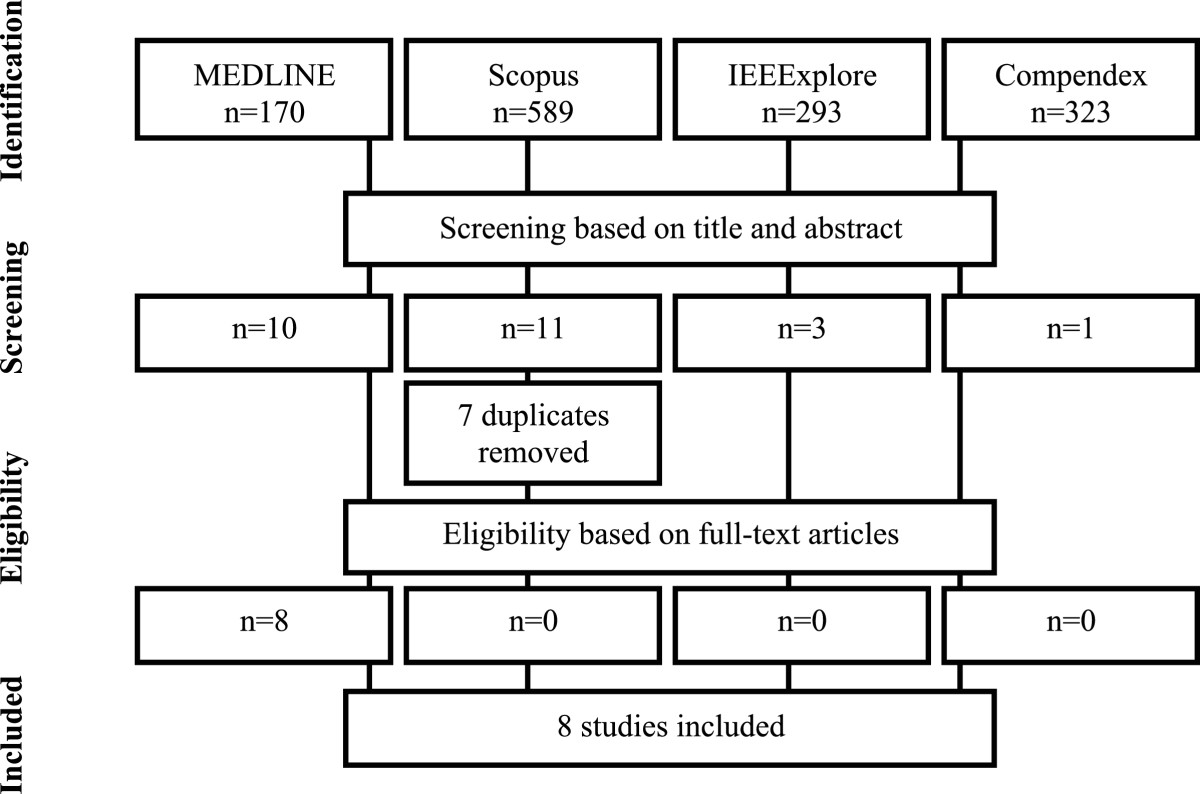
The aim of this review was to identify and summarise publications, which have reported clinical applications of upper limb accelerometry for stroke within free-living environments and make recommendations for future studies. Data was searched from MEDLINE, Scopus, IEEExplore and Compendex databases. The final search was 31st October 2013. Any study was included which reported clinical assessments in parallel with accelerometry in a free-living hospital or home setting. Study quality is reflected by participant numbers, methodological approach, technical details of the equipment used, blinding of clinical measures, whether safety and compliance data was collected. First author screened articles for inclusion and inclusion of full text articles and data extraction was confirmed by the third author. Out of 1375 initial abstracts, 8 articles were included. All participants were stroke patients. Accelerometers were worn for either 24 hours or 3 days. Data were collected as summed acceleration counts over a specified time or as the duration of active/inactive periods. Activity in both arms was reported by all studies and the ratio of impaired to unimpaired arm activity was calculated in six studies. The correlation between clinical assessments and accelerometry was tested in five studies and significant correlations were found. The efficacy of a rehabilitation intervention was assessed using accelerometry by three studies: in two studies both accelerometry and clinical test scores detected a post-treatment difference but in one study accelerometry data did not change despite clinical test scores showing motor and functional improvements. Further research is needed to understand the additional value of accelerometry as a measure of upper limb use and function in a clinical context. A simple and easily interpretable accelerometry approach is required.
Overview
CoChat Summary
## TL;DR
This systematic review found only 8 clinical studies of upper-limb accelerometry after stroke in free-living hospital or home settings, and concluded that accelerometry can measure overall arm activity but still needs clinical context for interpretation. The evidence suggests promising correlations with several clinical measures and some intervention studies, but the field lacks a simple, standardized, patient-friendly approach.
## Key findings
- Out of 1375 initial abstracts, only 8 articles met inclusion criteria; all included stroke patients and 3 studies assessed rehabilitation interventions, including 2 randomized controlled trials.
- Accelerometers were worn on both wrists for either 24 hours or 3 consecutive days; data were collected as either summed acceleration counts or active/inactive durations.
- The ratio of impaired to unimpaired arm activity was calculated in 6 studies; the review states that accelerometry correlated significantly with most clinical measures of impairment and function, including ARAT, WMFT, FIM, MAL, SIS Hand Function, ABILHAND, and NEADL.
- In the intervention studies, 2 of 3 found that both accelerometry and clinical tests detected post-treatment change, while 1 study found clinical improvement without an accelerometry change.
## Methods
- Systematic review of peer-reviewed original studies using stand-alone upper-limb accelerometers in free-living hospital or domiciliary settings after stroke, and comparing sensor data with clinical assessment.
- Databases searched: MEDLINE, Scopus, IEEExplore, and Compendex; final search date was 31 October 2013.
- Study selection was done by the first author, with inclusion of full texts and data extraction confirmed by the third author; 1375 abstracts were screened and 8 studies included.
## Limitations
- The paper states that included patients were younger than the average age of stroke occurrence in the UK (~75 years) and more often male, and there was a tendency to include people with mild to moderate impairment, reducing generalizability.
- Time since stroke varied widely, and no data safety or tolerance were reported except in one study; the authors say this limits relevance to typical neurological rehabilitation populations.
- Evident from the text: the review included only 8 studies, with heterogeneous accelerometer types, outcome definitions, and analysis methods, which makes synthesis and comparison difficult.
Model-written summary. Check it against the paper before relying on it.
Integrity signals
Registry
Cites
Statistics
Figures
Verification
Claims the paper makes
1 Valid · 0 Not valid · 2 Not checked · 7 Own results and interpretations
A result the paper reports from its own data — it cites no other source for it, so there is none to check. The quote shows it is in the paper.
In the paper
“All participants were stroke patients.”
- Also stated in: § Upper limb accelerometry applications in clinical stroke research · plain
“All included stroke patients without other neurological conditions represented.”
§ Accelerometer measurement of upper extremity movement after stroke: a systematic review of clinical studies > Abstract The aim of this review was to identify and summarise publications, which have reported clinical applications of upper limb accelerometry for stroke within free-living environments and make recommendations for future studies. Data was searched from MEDLINE®, Scopus, IEEExplore and Compendex databases. The final search was 31st October 2013. Any study was included which reported clinical assessments in parallel with accelerometry in a free-living hospital or home setting. Study quality is reflected by participant numbers, methodological approach, technical details of the equipment used, blinding of clinical measures, whether safety and compliance data was collected. First author screened articles for inclusion and inclusion of full text articles and data extraction was confirmed by the third author. Out of 1375 initial abstracts, 8 articles were included. All participants were stroke patients. Accelerometers were worn for either 24 hours or 3 days. Data were collected as summed acceleration counts over a specified time or as the duration of active/inactive periods. Activity in both arms was reported by all studies and the ratio of impaired to unimpaired arm activity was calculated in six studies. The correlation between clinical assessments and accelerometry was tested in five studies and significant correlations were found. The efficacy of a rehabilitation intervention was assessed using accelerometry by three studies: in two studies both accelerometry and clinical test scores detected a post-treatment difference but in one study accelerometry data did not change despite clinical test scores showing motor and functional improvements. Further research is needed to understand the additional value of accelerometry as a measure of upper limb use and function in a clinical context. A simple and easily interpretable accelerometry approach is required.
plain- Asserted: passes — The authors put it forward as true.
- Checkable: passes — It can be checked against evidence.
- Load-bearing: unclear — It is unclear whether the paper’s conclusions depend on it.
- Based: passes — The paper gives a reason why it holds.
- Also stated in: § Upper limb accelerometry applications in clinical stroke research · plain
A result the paper reports from its own data — it cites no other source for it, so there is none to check. The quote shows it is in the paper.
In the paper
“the ratio of impaired to unimpaired arm activity was calculated in six studies”
§ Accelerometer measurement of upper extremity movement after stroke: a systematic review of clinical studies > Abstract The aim of this review was to identify and summarise publications, which have reported clinical applications of upper limb accelerometry for stroke within free-living environments and make recommendations for future studies. Data was searched from MEDLINE®, Scopus, IEEExplore and Compendex databases. The final search was 31st October 2013. Any study was included which reported clinical assessments in parallel with accelerometry in a free-living hospital or home setting. Study quality is reflected by participant numbers, methodological approach, technical details of the equipment used, blinding of clinical measures, whether safety and compliance data was collected. First author screened articles for inclusion and inclusion of full text articles and data extraction was confirmed by the third author. Out of 1375 initial abstracts, 8 articles were included. All participants were stroke patients. Accelerometers were worn for either 24 hours or 3 days. Data were collected as summed acceleration counts over a specified time or as the duration of active/inactive periods. Activity in both arms was reported by all studies and the ratio of impaired to unimpaired arm activity was calculated in six studies. The correlation between clinical assessments and accelerometry was tested in five studies and significant correlations were found. The efficacy of a rehabilitation intervention was assessed using accelerometry by three studies: in two studies both accelerometry and clinical test scores detected a post-treatment difference but in one study accelerometry data did not change despite clinical test scores showing motor and functional improvements. Further research is needed to understand the additional value of accelerometry as a measure of upper limb use and function in a clinical context. A simple and easily interpretable accelerometry approach is required.
plain- Asserted: passes — The authors put it forward as true.
- Checkable: passes — It can be checked against evidence.
- Load-bearing: unclear — It is unclear whether the paper’s conclusions depend on it.
- Based: passes — The paper gives a reason why it holds.
A claim is checked only against the cited paper’s full text, never its abstract, and none is available for its sources.
In the paper
“The eight studies identified for the present review, including a large multicentre clinical trial (n = 222) [14] and a prospective randomised controlled trial (n = 20) [17], have demonstrated that accelerometry can be systematically applied as a method for measuring overall upper extremity activity.”
§ Accelerometer measurement of upper extremity movement after stroke: a systematic review of clinical studies > Discussion
What the sources say
- Not checked — no full text of the sourcecites [14] Uswatte G Taub E Morris D Light K Thompson PA The motor activity log-28: Assessing daily use of the hemiparetic arm after stroke Neurology 2006 67 7 1189 1194 10.1212/01.wnl.0000238164.90657.c2 17030751 source
- Not checked — no full text of the sourcecites [17] Liao WW Wu CY Hsieh YW Lin KC Chang WY Effects of robot-assisted upper limb rehabilitation on daily function and real-world arm activity in patients with chronic stroke: a randomized controlled trial Clin Rehabil 2012 26 2 111 120 10.1177/0269215511416383 21840917 source
boosted- Asserted: passes — The authors put it forward as true.
- Checkable: passes — It can be checked against evidence.
- Load-bearing: passes — The paper’s conclusions depend on it.
- Based: passes — The paper gives a reason why it holds.
A conclusion the paper draws from its own results — it cites no other source for it, so there is none to check. The quote shows it is in the paper.
In the paper
“These factors reduce the relevance of current evidence for typical neurological rehabilitation populations.”
§ Accelerometer measurement of upper extremity movement after stroke: a systematic review of clinical studies > Discussion > Study limitations
plainstates a cause- Asserted: passes — The authors put it forward as true.
- Checkable: passes — It can be checked against evidence.
- Load-bearing: passes — The paper’s conclusions depend on it.
- Based: passes — The paper gives a reason why it holds.
- It may state two separate claims as one. 5
- Probably not a substantial claim. 1
Citations
Cites
Conducting accelerometer-based activity assessments in field-based research
TROST, S. G., MCIVER, K. L., & PATE, R. R. (2005) · Medicine & Science in Sports & Exercise · doi:10.1249/01.mss.0000185657.86065.98 · Cited by 2,033
Estimates of the Prevalence of Acute Stroke Impairments and Disability in a Multiethnic Population
Lawrence, E. S., Coshall, C., Dundas, R., Stewart, J., Rudd, A. G., Howard, R., & Wolfe, C. D. A. (2001) · Stroke · doi:10.1161/01.str.32.6.1279 · Cited by 950
Human motion tracking for rehabilitation-A survey
Zhou, H., & Hu, H. (2008) · Biomedical Signal Processing and Control · doi:10.1016/j.bspc.2007.09.001 · Cited by 813
Accelerometer Data Reduction: A Comparison of Four Reduction Algorithms on Select Outcome Variables
MÂSSE, L. C., FUEMMELER, B. F., ANDERSON, C. B., MATTHEWS, C. E., TROST, S. G., CATELLIER, D. J., & TREUTH, M. (2005) · Medicine & Science in Sports & Exercise · doi:10.1249/01.mss.0000185674.09066.8a · Cited by 676
The Motor Activity Log-28: Assessing daily use of the hemiparetic arm after stroke
Uswatte, G., Taub, E., Morris, D., Light, K., & Thompson, P. A. (2006) · Neurology · doi:10.1212/01.wnl.0000238164.90657.c2 · Cited by 459
Comparing Stroke Incidence Worldwide: What Makes Studies Comparable?
Sudlow, C. L. M., & Warlow, C. P. (1996) · Stroke · doi:10.1161/01.str.27.3.550 · Cited by 451 · cited 1×
“Although we sought to identify studies in free-living rather than controlled laboratory settings, the patients included were still not typical of the stroke population, being younger than the average age of stroke occurrence in UK (~ 75 y) [26] and more often male.”
BackgroundHarris, J. E., Eng, J. J., Miller, W. C., & Dawson, A. S. (2009) · Stroke · doi:10.1161/strokeaha.108.544585 · Cited by 259
Uswatte, G., Giuliani, C., Winstein, C., Zeringue, A., Hobbs, L., & Wolf, S. L. (2006) · Archives of Physical Medicine and Rehabilitation · doi:10.1016/j.apmr.2006.06.006 · Cited by 241 · cited 3×
“Body worn motion sensors provide an opportunity for non-invasive, objective and accurate observation of patients’ movements during research and clinical rehabilitation [1-6].”
BackgroundUswatte, G., Foo, W. L., Olmstead, H., Lopez, K., Holand, A., & Simms, L. B. (2005) · Archives of Physical Medicine and Rehabilitation · doi:10.1016/j.apmr.2005.01.010 · Cited by 233
Upper Extremity Use in People with Hemiparesis in the First Few Weeks After Stroke
Lang, C. E., Wagner, J. M., Edwards, D. F., & Dromerick, A. W. (2007) · Journal of Neurologic Physical Therapy · doi:10.1097/npt.0b013e31806748bd · Cited by 216 · cited 9×
“All participants wore accelerometers on both wrists for either a single 24 hr period [11-13] or 3 consecutive days [8,14-17].”
BackgroundMethodInfluential
Cited by
Items 101–139 of 139
ACHARYA, A., BHAT, S., & Kanthi, M. (2022) · Advances in Electrical and Computer Engineering · doi:10.4316/aece.2022.04010 · Cited by 4
Zariffa, J., Starkey, M. L., Curt, A. E. P., & Kalsi‐Ryan, S. (2022) · Springer eBooks · doi:10.1007/978-3-031-08995-4_4 · Cited by 6
Ring-shaped wearable device for logging finger usage in daily life
Yamamoto, N., Matsumoto, T., Sudo, T., Miyashita, M., & Kondo, T. (2022) · International Symposium on Micro-NanoMechatronics and Human Science · doi:10.1109/mhs56725.2022.10092178 · Cited by 4
Kim, D., O'Shea, L., & Aghamohammadi, N. R. (2025) · Journal of NeuroEngineering and Rehabilitation · doi:10.1186/s12984-024-01513-8 · Cited by 6
Upper extremity asymmetry due to nerve injuries or central neurologic conditions: a scoping review
Bhat, S. G., Shin, A. Y., & Kaufman, K. R. (2023) · Journal of NeuroEngineering and Rehabilitation · doi:10.1186/s12984-023-01277-7 · Cited by 5
Monitoring physical activity after a cardiovascular event: What is ‘fit’ for purpose?
Ware, L. J., Rennie, K. L., & Schutte, A. E. (2017) · European Journal of Preventive Cardiology · doi:10.1177/2047487317744052 · Cited by 4
Influence of upper limb movement patterns on accelerometer measurements: a pediatric case series
Trac, J., Dawe, J., Likitlersuang, J., Musselman, K. E., & Zariffa, J. (2018) · Physiological Measurement · doi:10.1088/1361-6579/aab994 · Cited by 3
de Castro, K. N., Brown, E. V. D., Neilan, R. M., & Wallace, S. E. (2021) · Frontiers in Virtual Reality · doi:10.3389/frvir.2021.642434 · Cited by 3
Remote Cloud-Based Automated Stroke Rehabilitation Assessment Using Wearables
Halloran, S., Shi, J. Q., Guan, Y., Chen, X., Dunne-Willows, M., & Eyre, J. A. (2018) · IEEE International Conference on eScience · doi:10.1109/escience.2018.00063 · Cited by 3
Chadwell, A., Kenney, L. P. J., Thies, S. B., Galpin, A. J., & Head, J. S. (2018) · Frontiers in Neurorobotics · doi:10.3389/fnbot.2018.00015 · Cited by 5
Tse, T., Mak-Yuen, Y. Y. K., Young, W., & Darzins, S. W. (2024) · Brain Impairment · doi:10.1071/ib24008 · Cited by 2
Skvortsov, D. V., Александрович, Л. Д., Lobunko, A., Belonovskaya, N. K., & Ivanova, G. Е. (2025) · Diagnostics · doi:10.3390/diagnostics15070840 · Cited by 3
Ekerete, I., García-Constantino, M., Konios, A., Mustafa, M., Diaz-Skeete, Y., Nugent, C., & McLaughlin, J. A. (2021) · Applied Sciences · doi:10.3390/app11199096 · Cited by 2
Fast relative sensor orientation estimation in the presence of real-world disturbances
Remmerswaal, E., Weygers, I., Smit, G., & Kok, M. (2021) · European Control Conference (ECC) · doi:10.23919/ecc54610.2021.9654849 · Cited by 3
Designing smart garments for rehabilitation
Wang, Q. (2018) · TU/e Research Portal · Cited by 3
Leypold, T., Bahm, J., Schäfer, B., Beier, J. P., Dißelhorst-Klug, C., & Fonseca-Höflinger, L. C. (2024) · Scientific Reports · doi:10.1038/s41598-024-72845-7 · Cited by 1
Chen, D.-R. (2025) · IEEE Symposium on Computers and Communications (ISCC) · doi:10.1109/iscc65549.2025.11326113 · Cited by 1
Multimodal strategies for diagnosis, stratification, and therapeutic monitoring in ALS
López‐Blanch, R., Oriol‐Caballo, M., Estrela, J. M., & Obrador, E. (2026) · Neuroscience & Biobehavioral Reviews · doi:10.1016/j.neubiorev.2026.106727 · Cited by 3
Providing Hand Use Context for Outpatient Neurorehabilitation with Egocentric Object Detection
Kadambi, A., & Zariffa, J. (2023) · IEEE-EMBS International Conference on Biomedical and Health Informatics (BHI ...) · doi:10.1109/bhi58575.2023.10313375 · Cited by 1
Matuti, G. D. S., dos Santos, J. F., da Silva, M. L., de Oliveira, E. M., Lunardi, A. C., Biney, F., Uswatte, G., Taub, E., & Alouche, S. R. (2024) · Disability and Rehabilitation · doi:10.1080/09638288.2024.2305298 · Cited by 1
Comments on: Data science, big data and statistics
Shi, J. Q., & Halloran, S. (2019) · Test · doi:10.1007/s11749-019-00640-y · Cited by 1
Kim, S. (2021) · Journal of the Korean Chemical Society · doi:10.15207/jkcs.2021.12.2.095 · Cited by 1
Examining the Validity of Accelerometry for Measuring Arm Movements in Children
Dawe, J. (2017) · TSpace (University of Toronto) · Cited by 1
TRANSLATING MOVEMENT DATA IN PERFORMANCE OR DISABILITY METRICS USING BARCODE AND SIGNATURE
Falbriard, M., Anker, R., & Mariani, B. (2016) · ISBS - Conference Proceedings Archive
Ambulatory assessment of motor performance after stroke
van Meulen, F. (2017) · doi:10.3990/1.9789036543811
Peracini, A. P. P. (2019) · Digital Library of Theses and Dissertations (Universidade de São Paulo) · doi:10.11606/d.82.2019.tde-03052019-160314
Egocentric Video: A New Tool for Capturing Hand Use of Individuals with Spinal Cord Injury at HomePreprint
Likitlersuang, J., Sumitro, E. R., Cao, T., et al. (2018) · arXiv (Cornell University) · doi:10.48550/arxiv.1809.00928
Moving out of the lab: movement analyses in patients with osteoarthritis of the knee
Verlaan, L. (2020) · Research Publications (Maastricht University) · doi:10.26481/dis.20210122lv
Costa, J. D. L. T., Ballester, B. R., & Verschure, P. F. M. J. (2021) · Communications in computer and information science · doi:10.1007/978-3-030-94209-0_17
Robotic Technologies and Digital Health Metrics for Assessing Sensorimotor Disability
Kanzler, C. M., Bolliger, M., & Lambercy, O. (2022) · Springer eBooks · doi:10.1007/978-3-031-08995-4_15 · Cited by 1
Poitras, I. (2023) · Physical & Occupational Therapy In Pediatrics · doi:10.1080/01942638.2024.2284071
Kim, D., O'Shea, L., & Aghamohammadi, N. R. (2024) · doi:10.36227/techrxiv.170775143.35937204/v1
Kim, D., O'Shea, L., & Aghamohammadi, N. R. (2024) · doi:10.36227/techrxiv.170775143.35937204/v2
Kordi, R., Oskouie, I. M., Nakhjiri, M. T., & Smuck, M. (2026) · BMC Sports Science Medicine and Rehabilitation · doi:10.1186/s13102-026-01535-w
Sanders, Q. A. (2026) · Elsevier eBooks · doi:10.1016/b978-0-443-26466-5.00011-8
Perf, G. L., Pratola, B., Mottet, D., Laffont, I., & Bakhti, K. (2026) · Journal of NeuroEngineering and Rehabilitation · doi:10.1186/s12984-026-01978-9
Shenoy, A., Beyer, K. B., McIlroy, W. E., Ooteghem, K. V., Weber, K. S., Eng, J. J., Yao, J., Dukelow, S. P., Leung, G., Hill, M. D., et al. (2026) · Sensors · doi:10.3390/s26154881
Moeyersons, C., Embrechts, E., Hanssen, B., Firouzi, M., Raedt, S. D., Omelina, L., Dan, B., Ortega‐Martorell, S., Jansen, B., Degelaen, M., et al. (2026) · BMJ Open · doi:10.1136/bmjopen-2026-121574
Metadata
- Authors
- Noorkõiv, M., Rodgers, H., & Price, C. I.
- Affiliations
- Newcastle University (GB)
- Corresponding author
- Noorkõiv, Marika
- Venue
- Journal of NeuroEngineering and Rehabilitation
- Published
- 2014
- Volume
- 11
- Issue
- 1
- Pages
- 144
- ISSN
- 1743-0003 (ISSN-L)
- PMC
- PMC4197318
- OpenAlex
- W2117594417
- Cited by
- 141
- References
- 25
- Citations by year
- 2026: 6 · 2025: 5 · 2024: 12 · 2023: 9 · 2022: 17 · 2021: 20 · 2020: 11 · 2019: 17 · 2018: 15 · 2017: 12 · 2016: 12 · 2015: 5
- FWCI
- 1.21
- Type
- journal article
- Language
- en
- Open access
- gold
- doi.org
- Licence
- cc-by
- Locations
- Journal of NeuroEngineering and Rehabilitation (publishedVersion, cc-by)
- Europe PMC (PubMed Central) (publishedVersion, cc-by)
- PubMed Central (publishedVersion, cc-by)
- PubMed (publishedVersion)
- Newcastle University ePrints (Newcastle Univesity) (cc-by)
- Funders
- National Institute for Health and Care Research (NF-SI-0507-10249)
- Topics
- Health Sciences › Medicine › Rehabilitation › Stroke Rehabilitation and Recovery
- Physical Sciences › Computer Science › Computer Vision and Pattern Recognition › Context-Aware Activity Recognition Systems
- Health Sciences › Medicine › Public Health, Environmental and Occupational Health › Physical Activity and Health
- Keywords
- stroke, upper limb movement, accelerometry, activity monitoring, upper limb use, rehabilitation outcome assessment, free-living physical activity, wearable sensors
- MeSH terms
- Activities of Daily Living, Humans, Movement, Movement Disorders, Stroke, Upper Extremity, Accelerometry
About these checks
Registry, retraction, Cites and statistics results are computed, not judged, with one exception: a printed reference that no index lists is read once by a model before it counts as a citation error. Claims are extracted by a model and kept only when their quote appears verbatim in the text; each cited source is then checked, with a model’s help, for whether it says what the claim relies on. Those verdicts can be wrong — read the claim’s quote and the cited source before relying on one.
The claim verdicts this report counts are experimental: their accuracy is not yet measured.
A language model drew the claims from the paper on 2026-10-11, under version 3 of the claim definition (model deepseek-v4.1-flash, prompt extract-v3).
A second model labelled each claim on 2026-10-11 (model jev-1.13-20260917, definition revision gold-guideline-v0.2).
Statistics and arithmetic are recomputed, not judged.
Confidence bands are shown only for fields calibrated on our annotated test set. None is calibrated yet, so no band is shown.
What counts as a claim ›How we measure confidence ›How we check this ›
Are you an author, or do you see a problem with this page? Request a review
Data sources
Bibliographic data: Semantic Scholar, OpenAlex, Crossref.
Contains information from the Semantic Scholar Academic Graph Datasets, made available under the ODC Attribution License (ODC-BY 1.0).
Semantic Scholar’s data is described in: Kinney, R., et al. (2023). The Semantic Scholar Open Data Platform. arXiv:2301.10140.
