

Accelerometer measurement of upper extremity movement after stroke: a systematic review of clinical studies
Open accessThe DOI matches its Crossref record; 25 of the 25 references it cites were found in a registry or an index; 1 of the 4 sources its claims cite were checked for support.
Abstract
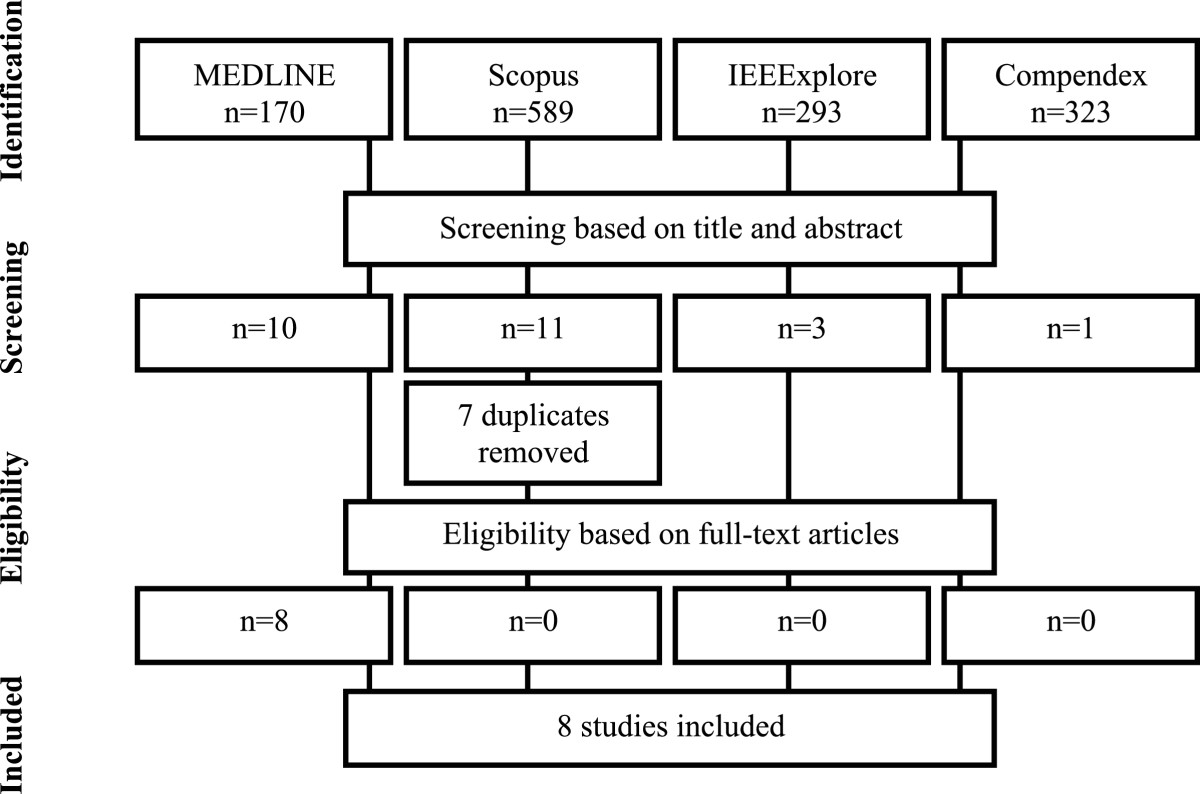
The aim of this review was to identify and summarise publications, which have reported clinical applications of upper limb accelerometry for stroke within free-living environments and make recommendations for future studies. Data was searched from MEDLINE, Scopus, IEEExplore and Compendex databases. The final search was 31st October 2013. Any study was included which reported clinical assessments in parallel with accelerometry in a free-living hospital or home setting. Study quality is reflected by participant numbers, methodological approach, technical details of the equipment used, blinding of clinical measures, whether safety and compliance data was collected. First author screened articles for inclusion and inclusion of full text articles and data extraction was confirmed by the third author. Out of 1375 initial abstracts, 8 articles were included. All participants were stroke patients. Accelerometers were worn for either 24 hours or 3 days. Data were collected as summed acceleration counts over a specified time or as the duration of active/inactive periods. Activity in both arms was reported by all studies and the ratio of impaired to unimpaired arm activity was calculated in six studies. The correlation between clinical assessments and accelerometry was tested in five studies and significant correlations were found. The efficacy of a rehabilitation intervention was assessed using accelerometry by three studies: in two studies both accelerometry and clinical test scores detected a post-treatment difference but in one study accelerometry data did not change despite clinical test scores showing motor and functional improvements. Further research is needed to understand the additional value of accelerometry as a measure of upper limb use and function in a clinical context. A simple and easily interpretable accelerometry approach is required.
Overview
CoChat Summary
## TL;DR
This systematic review found only 8 clinical studies of upper-limb accelerometry after stroke in free-living hospital or home settings, and concluded that accelerometry can measure overall arm activity but still needs clinical context for interpretation. The evidence suggests promising correlations with several clinical measures and some intervention studies, but the field lacks a simple, standardized, patient-friendly approach.
## Key findings
- Out of 1375 initial abstracts, only 8 articles met inclusion criteria; all included stroke patients and 3 studies assessed rehabilitation interventions, including 2 randomized controlled trials.
- Accelerometers were worn on both wrists for either 24 hours or 3 consecutive days; data were collected as either summed acceleration counts or active/inactive durations.
- The ratio of impaired to unimpaired arm activity was calculated in 6 studies; the review states that accelerometry correlated significantly with most clinical measures of impairment and function, including ARAT, WMFT, FIM, MAL, SIS Hand Function, ABILHAND, and NEADL.
- In the intervention studies, 2 of 3 found that both accelerometry and clinical tests detected post-treatment change, while 1 study found clinical improvement without an accelerometry change.
## Methods
- Systematic review of peer-reviewed original studies using stand-alone upper-limb accelerometers in free-living hospital or domiciliary settings after stroke, and comparing sensor data with clinical assessment.
- Databases searched: MEDLINE, Scopus, IEEExplore, and Compendex; final search date was 31 October 2013.
- Study selection was done by the first author, with inclusion of full texts and data extraction confirmed by the third author; 1375 abstracts were screened and 8 studies included.
## Limitations
- The paper states that included patients were younger than the average age of stroke occurrence in the UK (~75 years) and more often male, and there was a tendency to include people with mild to moderate impairment, reducing generalizability.
- Time since stroke varied widely, and no data safety or tolerance were reported except in one study; the authors say this limits relevance to typical neurological rehabilitation populations.
- Evident from the text: the review included only 8 studies, with heterogeneous accelerometer types, outcome definitions, and analysis methods, which makes synthesis and comparison difficult.
Model-written summary. Check it against the paper before relying on it.
Integrity signals
Registry
Cites
Statistics
Figures
Verification
Claims the paper makes
1 Valid · 0 Not valid · 2 Not checked · 7 Own results and interpretations
A result the paper reports from its own data — it cites no other source for it, so there is none to check. The quote shows it is in the paper.
In the paper
“All participants were stroke patients.”
- Also stated in: § Upper limb accelerometry applications in clinical stroke research · plain
“All included stroke patients without other neurological conditions represented.”
§ Accelerometer measurement of upper extremity movement after stroke: a systematic review of clinical studies > Abstract The aim of this review was to identify and summarise publications, which have reported clinical applications of upper limb accelerometry for stroke within free-living environments and make recommendations for future studies. Data was searched from MEDLINE®, Scopus, IEEExplore and Compendex databases. The final search was 31st October 2013. Any study was included which reported clinical assessments in parallel with accelerometry in a free-living hospital or home setting. Study quality is reflected by participant numbers, methodological approach, technical details of the equipment used, blinding of clinical measures, whether safety and compliance data was collected. First author screened articles for inclusion and inclusion of full text articles and data extraction was confirmed by the third author. Out of 1375 initial abstracts, 8 articles were included. All participants were stroke patients. Accelerometers were worn for either 24 hours or 3 days. Data were collected as summed acceleration counts over a specified time or as the duration of active/inactive periods. Activity in both arms was reported by all studies and the ratio of impaired to unimpaired arm activity was calculated in six studies. The correlation between clinical assessments and accelerometry was tested in five studies and significant correlations were found. The efficacy of a rehabilitation intervention was assessed using accelerometry by three studies: in two studies both accelerometry and clinical test scores detected a post-treatment difference but in one study accelerometry data did not change despite clinical test scores showing motor and functional improvements. Further research is needed to understand the additional value of accelerometry as a measure of upper limb use and function in a clinical context. A simple and easily interpretable accelerometry approach is required.
plain- Asserted: passes — The authors put it forward as true.
- Checkable: passes — It can be checked against evidence.
- Load-bearing: unclear — It is unclear whether the paper’s conclusions depend on it.
- Based: passes — The paper gives a reason why it holds.
- Also stated in: § Upper limb accelerometry applications in clinical stroke research · plain
A result the paper reports from its own data — it cites no other source for it, so there is none to check. The quote shows it is in the paper.
In the paper
“the ratio of impaired to unimpaired arm activity was calculated in six studies”
§ Accelerometer measurement of upper extremity movement after stroke: a systematic review of clinical studies > Abstract The aim of this review was to identify and summarise publications, which have reported clinical applications of upper limb accelerometry for stroke within free-living environments and make recommendations for future studies. Data was searched from MEDLINE®, Scopus, IEEExplore and Compendex databases. The final search was 31st October 2013. Any study was included which reported clinical assessments in parallel with accelerometry in a free-living hospital or home setting. Study quality is reflected by participant numbers, methodological approach, technical details of the equipment used, blinding of clinical measures, whether safety and compliance data was collected. First author screened articles for inclusion and inclusion of full text articles and data extraction was confirmed by the third author. Out of 1375 initial abstracts, 8 articles were included. All participants were stroke patients. Accelerometers were worn for either 24 hours or 3 days. Data were collected as summed acceleration counts over a specified time or as the duration of active/inactive periods. Activity in both arms was reported by all studies and the ratio of impaired to unimpaired arm activity was calculated in six studies. The correlation between clinical assessments and accelerometry was tested in five studies and significant correlations were found. The efficacy of a rehabilitation intervention was assessed using accelerometry by three studies: in two studies both accelerometry and clinical test scores detected a post-treatment difference but in one study accelerometry data did not change despite clinical test scores showing motor and functional improvements. Further research is needed to understand the additional value of accelerometry as a measure of upper limb use and function in a clinical context. A simple and easily interpretable accelerometry approach is required.
plain- Asserted: passes — The authors put it forward as true.
- Checkable: passes — It can be checked against evidence.
- Load-bearing: unclear — It is unclear whether the paper’s conclusions depend on it.
- Based: passes — The paper gives a reason why it holds.
A claim is checked only against the cited paper’s full text, never its abstract, and none is available for its sources.
In the paper
“The eight studies identified for the present review, including a large multicentre clinical trial (n = 222) [14] and a prospective randomised controlled trial (n = 20) [17], have demonstrated that accelerometry can be systematically applied as a method for measuring overall upper extremity activity.”
§ Accelerometer measurement of upper extremity movement after stroke: a systematic review of clinical studies > Discussion
What the sources say
- Not checked — no full text of the sourcecites [14] Uswatte G Taub E Morris D Light K Thompson PA The motor activity log-28: Assessing daily use of the hemiparetic arm after stroke Neurology 2006 67 7 1189 1194 10.1212/01.wnl.0000238164.90657.c2 17030751 source
- Not checked — no full text of the sourcecites [17] Liao WW Wu CY Hsieh YW Lin KC Chang WY Effects of robot-assisted upper limb rehabilitation on daily function and real-world arm activity in patients with chronic stroke: a randomized controlled trial Clin Rehabil 2012 26 2 111 120 10.1177/0269215511416383 21840917 source
boosted- Asserted: passes — The authors put it forward as true.
- Checkable: passes — It can be checked against evidence.
- Load-bearing: passes — The paper’s conclusions depend on it.
- Based: passes — The paper gives a reason why it holds.
A conclusion the paper draws from its own results — it cites no other source for it, so there is none to check. The quote shows it is in the paper.
In the paper
“These factors reduce the relevance of current evidence for typical neurological rehabilitation populations.”
§ Accelerometer measurement of upper extremity movement after stroke: a systematic review of clinical studies > Discussion > Study limitations
plainstates a cause- Asserted: passes — The authors put it forward as true.
- Checkable: passes — It can be checked against evidence.
- Load-bearing: passes — The paper’s conclusions depend on it.
- Based: passes — The paper gives a reason why it holds.
- It may state two separate claims as one. 5
- Probably not a substantial claim. 1
Citations
Cites
Conducting accelerometer-based activity assessments in field-based research
TROST, S. G., MCIVER, K. L., & PATE, R. R. (2005) · Medicine & Science in Sports & Exercise · doi:10.1249/01.mss.0000185657.86065.98 · Cited by 2,033
Estimates of the Prevalence of Acute Stroke Impairments and Disability in a Multiethnic Population
Lawrence, E. S., Coshall, C., Dundas, R., Stewart, J., Rudd, A. G., Howard, R., & Wolfe, C. D. A. (2001) · Stroke · doi:10.1161/01.str.32.6.1279 · Cited by 950
Human motion tracking for rehabilitation-A survey
Zhou, H., & Hu, H. (2008) · Biomedical Signal Processing and Control · doi:10.1016/j.bspc.2007.09.001 · Cited by 813
Accelerometer Data Reduction: A Comparison of Four Reduction Algorithms on Select Outcome Variables
MÂSSE, L. C., FUEMMELER, B. F., ANDERSON, C. B., MATTHEWS, C. E., TROST, S. G., CATELLIER, D. J., & TREUTH, M. (2005) · Medicine & Science in Sports & Exercise · doi:10.1249/01.mss.0000185674.09066.8a · Cited by 676
The Motor Activity Log-28: Assessing daily use of the hemiparetic arm after stroke
Uswatte, G., Taub, E., Morris, D., Light, K., & Thompson, P. A. (2006) · Neurology · doi:10.1212/01.wnl.0000238164.90657.c2 · Cited by 459
Comparing Stroke Incidence Worldwide: What Makes Studies Comparable?
Sudlow, C. L. M., & Warlow, C. P. (1996) · Stroke · doi:10.1161/01.str.27.3.550 · Cited by 451 · cited 1×
“Although we sought to identify studies in free-living rather than controlled laboratory settings, the patients included were still not typical of the stroke population, being younger than the average age of stroke occurrence in UK (~ 75 y) [26] and more often male.”
BackgroundHarris, J. E., Eng, J. J., Miller, W. C., & Dawson, A. S. (2009) · Stroke · doi:10.1161/strokeaha.108.544585 · Cited by 259
Uswatte, G., Giuliani, C., Winstein, C., Zeringue, A., Hobbs, L., & Wolf, S. L. (2006) · Archives of Physical Medicine and Rehabilitation · doi:10.1016/j.apmr.2006.06.006 · Cited by 241 · cited 3×
“Body worn motion sensors provide an opportunity for non-invasive, objective and accurate observation of patients’ movements during research and clinical rehabilitation [1-6].”
BackgroundUswatte, G., Foo, W. L., Olmstead, H., Lopez, K., Holand, A., & Simms, L. B. (2005) · Archives of Physical Medicine and Rehabilitation · doi:10.1016/j.apmr.2005.01.010 · Cited by 233
Upper Extremity Use in People with Hemiparesis in the First Few Weeks After Stroke
Lang, C. E., Wagner, J. M., Edwards, D. F., & Dromerick, A. W. (2007) · Journal of Neurologic Physical Therapy · doi:10.1097/npt.0b013e31806748bd · Cited by 216 · cited 9×
“All participants wore accelerometers on both wrists for either a single 24 hr period [11-13] or 3 consecutive days [8,14-17].”
BackgroundMethodInfluential
Cited by
Upper Limb Outcome Measures Used in Stroke Rehabilitation Studies: A Systematic Literature Review
Santisteban, L., Térémetz, M., Bleton, J.-P., Baron, J.-C., Maier, M. A., & Lindberg, P. G. (2016) · PLOS ONE · doi:10.1371/journal.pone.0154792 · Cited by 354
Interactive wearable systems for upper body rehabilitation: a systematic review
Wang, Q., Markopoulos, P., Yu, B., Chen, W., & Timmermans, A. (2017) · Journal of NeuroEngineering and Rehabilitation · doi:10.1186/s12984-017-0229-y · Cited by 348
Johansson, D., Malmgren, K., & Alt Murphy, M. (2018) · Journal of Neurology · doi:10.1007/s00415-018-8786-y · Cited by 188
O’Reilly, M., Caulfield, B., Ward, T., Johnston, W., & Doherty, C. (2018) · Sports Medicine · doi:10.1007/s40279-018-0878-4 · Cited by 186
Panwar, M., Biswas, D., Bajaj, H., Jobges, M., Turk, R., Maharatna, K., & Acharyya, A. (2019) · IEEE Transactions on Biomedical Engineering · doi:10.1109/tbme.2019.2899927 · Cited by 158
Chadwell, A., Kenney, L., Thies, S., Galpin, A., & Head, J. (2016) · Frontiers in Neurorobotics · doi:10.3389/fnbot.2016.00007 · Cited by 139
Lee, S. I., Adans-Dester, C. P., Grimaldi, M., Dowling, A. V., Horak, P. C., Black-Schaffer, R. M., Bonato, P., & Gwin, J. T. (2018) · IEEE Journal of Translational Engineering in Health and Medicine · doi:10.1109/jtehm.2018.2829208 · Cited by 119
Barzel, A., Ketels, G., Stark, A., Tetzlaff, B., Daubmann, A., Wegscheider, K., van den Bussche, H., & Scherer, M. (2015) · The Lancet Neurology · doi:10.1016/s1474-4422(15)00147-7 · Cited by 121
Wearable devices for patient monitoring in the early postoperative period: a literature review
Amin, T., Mobbs, R. J., Mostafa, N., Sy, L. W., & Choy, W. J. (2021) · mHealth · doi:10.21037/mhealth-20-131 · Cited by 123
Mobbs, R. J., Phan, K., Maharaj, M., & Rao, P. J. (2016) · Global Spine Journal · doi:10.1055/s-0035-1565259 · Cited by 96
The use of wearable sensors to assess and treat the upper extremity after stroke: a scoping review
Kim, G. J., Parnandi, A., Eva, S., & Schambra, H. M. (2021) · Disability and Rehabilitation · doi:10.1080/09638288.2021.1957027 · Cited by 110
Hsieh, Y., Wu, C., Wang, W., Lin, K., Chang, K., Chen, C.-C., & Liu, C.-T. (2016) · Clinical Rehabilitation · doi:10.1177/0269215516633275 · Cited by 66
Lum, P. S., Shu, L., Bochniewicz, E. M., Tran, T., Chang, L., Barth, J., & Dromerick, A. W. (2020) · Neurorehabilitation and neural repair · doi:10.1177/1545968320962483 · Cited by 67
Accelerometer-Based Monitoring of Upper Limb Movement in Older Adults With Acute and Subacute Stroke
Narai, E., Hagino, H., Komatsu, T., & Togo, F. (2015) · Journal of Geriatric Physical Therapy · doi:10.1519/jpt.0000000000000067 · Cited by 67
Li, Y., Zhang, X., Gong, Y., Cheng, Y., Gao, X., & Chen, X. '. (2017) · Sensors · doi:10.3390/s17030582 · Cited by 66
Egocentric video: a new tool for capturing hand use of individuals with spinal cord injury at home
Likitlersuang, J., Sumitro, E. R., Cao, T., Visée, R. J., Kalsi‐Ryan, S., & Zariffa, J. (2019) · Journal of NeuroEngineering and Rehabilitation · doi:10.1186/s12984-019-0557-1 · Cited by 63
Braito, I., Maselli, M., Sgandurra, G., Inguaggiato, E., Beani, E., Cecchi, F., Cioni, G., & Boyd, R. N. (2018) · Journal of NeuroEngineering and Rehabilitation · doi:10.1186/s12984-018-0447-y · Cited by 53
Lee, S. I., Liu, X., Rajan, S., Ramasarma, N., Choe, E. K., & Bonato, P. (2019) · PLoS ONE · doi:10.1371/journal.pone.0212484 · Cited by 46
Lee, J.-Y., Kwon, S., Kim, W., Hahn, S. J., Park, J.-H., & Paik, N. (2018) · PLoS ONE · doi:10.1371/journal.pone.0209607 · Cited by 45
Franck, J. A., Smeets, R., & Seelen, H. A. M. (2019) · PLoS ONE · doi:10.1371/journal.pone.0214651 · Cited by 46
DaSilva, R., Moore, S. A., Rodgers, H., Shaw, L. C., Sutcliffe, L., van Wijck, F., & Price, C. (2019) · Clinical Rehabilitation · doi:10.1177/0269215519834720 · Cited by 43
Self-citationThe use of a finger-worn accelerometer for monitoring of hand use in ambulatory settings
Liu, X., Rajan, S., Ramasarma, N., Bonato, P., & Lee, S. I. (2019) · IEEE Journal of Biomedical and Health Informatics · doi:10.1109/jbhi.2018.2821136 · Cited by 39
“approach to convert accelerometer data into a measurement of activity intensity in clinical research [11], [12].”
MethodSmith, B. A., & Lang, C. E. (2019) · Archives of Physical Medicine and Rehabilitation · doi:10.1016/j.apmr.2019.01.004 · Cited by 42
de Lucena, D. S., Stoller, O., Rowe, J. B., Chan, V., & Reinkensmeyer, D. J. (2017) · International Conference on Rehabilitation Robotics · doi:10.1109/icorr.2017.8009477 · Cited by 39
Kim, Y., Jung, H.-T., Park, J., Kim, Y., Ramasarma, N., Bonato, P., Choe, E. K., & Lee, S. I. (2019) · Proceedings of the ACM on Interactive Mobile Wearable and Ubiquitous Technologies · doi:10.1145/3369817 · Cited by 42
Dutta, D., Aruchamy, S., Mandal, S., & Sen, S. (2021) · IEEE Transactions on Biomedical Engineering · doi:10.1109/tbme.2021.3110432 · Cited by 36
de Quirós, M. B., Douma, E. H., van den Akker‐Scheek, I., Lamoth, C. J. C., & Maurits, N. M. (2022) · Sensors · doi:10.3390/s22031050 · Cited by 42
Kim, D. H., Nam, K. H., Choi, B. K., Han, I. H., Jeon, T. J., & Park, S. Y. (2019) · Journal of Korean Neurosurgical Society · doi:10.3340/jkns.2018.0131 · Cited by 38
Accelerometers for objective evaluation of physical activity following spine surgery
Rao, P. J., Phan, K. H., Maharaj, M. M., Pelletier, M. H., Walsh, W. R., & Mobbs, R. J. (2016) · Journal of Clinical Neuroscience · doi:10.1016/j.jocn.2015.05.064 · Cited by 35
Balance evaluation techniques and physical therapy in post-stroke patients: A literature review
Lendraitienė, E., Tamošauskaitė, A., Petruševičienė, D., & Savickas, R. (2016) · Neurologia i Neurochirurgia Polska · doi:10.1016/j.pjnns.2016.11.003 · Cited by 36
Bakri, N. A. C., Kwasnicki, R. M., Dhillon, K., Khan, N., Ghandour, O., Cairns, A., Darzi, A. W., & Leff, D. R. (2021) · Annals of Surgical Oncology · doi:10.1245/s10434-021-10458-4 · Cited by 29
Use of Accelerometry for Long Term Monitoring of Stroke Patients
Lucas, A., Hermiz, J., Labuzetta, J., Arabadzhi, Y., Karanjia, N., & Gilja, V. (2019) · IEEE Journal of Translational Engineering in Health and Medicine · doi:10.1109/jtehm.2019.2897306 · Cited by 26
Segmentation of shoulder rehabilitation exercises for single and multiple inertial sensor systems
Brennan, L. K., Bevilacqua, A., Kechadi, T., & Caulfield, B. (2020) · Journal of Rehabilitation and Assistive Technologies Engineering · doi:10.1177/2055668320915377 · Cited by 32
Pohl, J., Ryser, A., Veerbeek, J. M., Verheyden, G., Vogt, J. E., Luft, A. R., & Easthope, C. A. (2022) · Frontiers in Physiology · doi:10.3389/fphys.2022.952757 · Cited by 35
In-Bed Mobilization in Critically Ill Children: A Safety and Feasibility Trial
Chacón, M. C. T., Walker, R., Al-Harbi, S., Clark, H. R., Al-Mahr, G., Timmons, B. W., Thabane, L., & Choong, K. L. M. (2015) · Journal of Pediatric Intensive Care · doi:10.1055/s-0035-1563545 · Cited by 71
van der Geest, A., Essers, J. M. N. H., Bergsma, A., Jansen, M., & de Groot, I. J. M. (2019) · Muscle & Nerve · doi:10.1002/mus.26763 · Cited by 26
Likitlersuang, J., Sumitro, E. R., Theventhiran, P., Kalsi‐Ryan, S., & Zariffa, J. (2017) · Journal of Spinal Cord Medicine · doi:10.1080/10790268.2017.1349856 · Cited by 21
Whitford, M., Schearer, E. M., & Rowlett, M. (2018) · Physiotherapy Theory and Practice · doi:10.1080/09593985.2018.1493759 · Cited by 27
Kim, S. H., & Park, J. (2019) · Journal of Stroke and Cerebrovascular Diseases · doi:10.1016/j.jstrokecerebrovasdis.2019.104335 · Cited by 26
Detection of Unilateral Arm Paresis after Stroke by Wearable Accelerometers and Machine Learning
Wassélius, J., Finn, E. L., Persson, E., Ericson, P., Brogårdh, C. B., Lindgren, A. G., Ullberg, T., & Åström, K. (2021) · Sensors · doi:10.3390/s21237784 · Cited by 25
Ploderer, B., Fong, J., Klaic, M., Nair, S., Vetere, F., Cofré Lizama, L. E., & Galea, M. P. (2016) · JMIR Rehabilitation and Assistive Technologies · doi:10.2196/rehab.6182 · Cited by 22
“Related work shows that inertial sensors can provide information on the amount of arm movement and time spent using the arm in daily life [24].”
BackgroundHeld, J. P. O., Luft, A. R., & Veerbeek, J. M. (2018) · Frontiers in Neurology · doi:10.3389/fneur.2018.00013 · Cited by 24
Tenodesis Grasp Detection in Egocentric Video
Dousty, M., & Zariffa, J. (2020) · IEEE Journal of Biomedical and Health Informatics · doi:10.1109/jbhi.2020.3003643 · Cited by 26
Likitlersuang, J., & Zariffa, J. (2016) · IEEE Journal of Biomedical and Health Informatics · doi:10.1109/jbhi.2016.2636748 · Cited by 22
Lawrie, S., Dong, Y., Steins, D., Xia, Z., Esser, P., Sun, S., Li, F., Amor, J. D., James, C. J., Izadi, H., et al. (2018) · Pilot and Feasibility Studies · doi:10.1186/s40814-018-0345-x · Cited by 22
Measuring Hand Use in the Home after Cervical Spinal Cord Injury Using Egocentric Video
Bandini, A., Dousty, M., Hitzig, S. L., Craven, B. C., Kalsi‐Ryan, S., & Zariffa, J. (2022) · Journal of Neurotrauma · doi:10.1089/neu.2022.0156 · Cited by 22
Robotic and Wearable Sensor Technologies for Measurements/Clinical Assessments
Lambercy, O., Maggioni, S., Lünenburger, L., Gassert, R., & Bolliger, M. (2016) · Springer eBooks · doi:10.1007/978-3-319-28603-7_10 · Cited by 29
Feasibility of using acceleration-derived jerk to quantify bimanual arm use
Pan, Y.-C., Goodwin, B. M., Sabelhaus, E. K., Peters, K. M., Bjornson, K. F., Pham, K. L. D., Walker, W., & Steele, K. M. (2020) · Journal of NeuroEngineering and Rehabilitation · doi:10.1186/s12984-020-0653-2 · Cited by 25
A Deep Learning-Based Upper Limb Rehabilitation Exercise Status Identification System
Nair, B. B., & Sakthivel, N. R. (2022) · Arabian Journal for Science and Engineering · doi:10.1007/s13369-022-06702-y · Cited by 21
Assessment of lower arm movements using one inertial sensor
van Meulen, F., van Beijnum, B.-J. F., Buurke, J. H., & Veltink, P. H. (2017) · International Conference on Rehabilitation Robotics · doi:10.1109/icorr.2017.8009445 · Cited by 17
Murphy, M. A., Andersson, S., Danielsson, A., Wipenmyr, J., & Ohlsson, F. (2019) · Journal of Rehabilitation Medicine · doi:10.2340/16501977-2553 · Cited by 22
Sensor-Based Rehabilitation in Neurological Diseases: A Bibliometric Analysis of Research Trends
Facciorusso, S., Spina, S., Reebye, R. N., Turolla, A., Calabrò, R. S., Fiore, P., & Santamato, A. (2023) · Brain Sciences · doi:10.3390/brainsci13050724 · Cited by 19
Quantitative Upper Limb Impairment Assessment for Stroke Rehabilitation: A Review
Wang, X., Zhang, J., Xie, S. Q., Shi, C., Li, J., & Zhang, Z. (2024) · IEEE Sensors Journal · doi:10.1109/jsen.2024.3359811 · Cited by 23
Validating Accelerometry as a Measure of Arm Movement for Children With Hemiplegic Cerebral Palsy
Dawe, J., Yang, J. F., Fehlings, D. L., Likitlersuang, J., Rumney, P., Zariffa, J., & Musselman, K. E. (2019) · Physical Therapy · doi:10.1093/ptj/pzz022 · Cited by 19
Bandini, A., Kalsi‐Ryan, S., Craven, B. C., Zariffa, J., & Hitzig, S. L. (2021) · Journal of Spinal Cord Medicine · doi:10.1080/10790268.2021.1920787 · Cited by 17
Lee, S. I., Liu, Y., Vergara-Diaz, G. P., Pugliese, B. L., Black‐Schaffer, R. M., Stoykov, M. E., & Bonato, P. (2024) · Neurorehabilitation and neural repair · doi:10.1177/15459683241270066 · Cited by 20
Edwards, J. D., Black, S. E., Boe, S. G., Boyd, L. A., Chaves, A. R. D. A., Chen, R. E., Dukelow, S. P., Fung, J., Kirton, A., Meltzer, J. A., et al. (2021) · Neurorehabilitation and neural repair · doi:10.1177/1545968320981960 · Cited by 19
Suitability of accelerometry as an objective measure for upper extremity use in stroke patients
Heye, A.-L., Kersting, C., Kneer, M., & Barzel, A. (2022) · BMC Neurology · doi:10.1186/s12883-022-02743-w · Cited by 17
A Wearable Bracelet Device for Promoting Arm Use in Stroke Patients
Ballester, B. R., Lathe, A., Duarte, E., Duff, A., & Verschure, P. F. M. J. (2015) · International Congress on Neurotechnology, Electronics and Informatics · doi:10.5220/0005662300240031 · Cited by 13
Evaluation of suitability of a micro-processing unit of motion analysis for upper limb tracking
Madrigal, J. A. B., Cardiel, E., Rogeli, P., Leija, L., & Muñoz, R. (2016) · Medical Engineering & Physics · doi:10.1016/j.medengphy.2016.04.011 · Cited by 14
Likitlersuang, J., Visée, R. J., Kalsi‐Ryan, S., & Zariffa, J. (2021) · Spinal Cord Series and Cases · doi:10.1038/s41394-021-00382-w · Cited by 15
Poitras, I., Clouâtre, J., Campeau‐Lecours, A., & Mercier, C. (2022) · Sensors · doi:10.3390/s22031022 · Cited by 12
Otaki, R., Oouchida, Y., Aizu, N., Sudo, T., Hiroshi, S., Saito, Y., Takemura, S., & Izumi, S. (2022) · Frontiers in Systems Neuroscience · doi:10.3389/fnsys.2021.806257 · Cited by 15
Bruder, A. M., McClelland, J. A., Shields, N., Dodd, K., Hau, R., van de Water, A. T. M., & Taylor, N. F. (2017) · Disability and Rehabilitation · doi:10.1080/09638288.2017.1288764 · Cited by 15
Factors associated with upper extremity use after stroke: a scoping review of accelerometry studies
Gagné-Pelletier, L., Poitras, I., Roig, M., & Mercier, C. (2025) · Journal of NeuroEngineering and Rehabilitation · doi:10.1186/s12984-025-01568-1 · Cited by 16
Langerak, A. J., Regterschot, G. R. H., Evers, M., van Beijnum, B.-J. F., Meskers, C. G. M., Selles, R. W., Ribbers, G. M., & Bussmann, J. B. J. (2023) · Sensors · doi:10.3390/s23135868 · Cited by 12
Bandini, A., Dousty, M., & Zariffa, J. (2020) · Annual International Conference of the IEEE Engineering in Medicine and Biology Society (EMBC) · doi:10.1109/embc44109.2020.9176274 · Cited by 11
Wei, X. X., Fong, K. N. K., Chung, R. C. K., Myint, J., Cheung, H. K. Y., & Chow, E. S. L. (2017) · Assistive Technology · doi:10.1080/10400435.2017.1414085 · Cited by 11
Srinivasan, S. M., Amonkar, N., Kumavor, P. D., & Bubela, D. J. (2024) · American Journal of Occupational Therapy · doi:10.5014/ajot.2024.050443 · Cited by 11
Development and validation of a clinically applicable arm use monitor for people after stroke
Fanchamps, M. H. J., Selles, R. W., Stam, H. J., & Bussmann, J. B. J. (2018) · Journal of Rehabilitation Medicine · doi:10.2340/16501977-2358 · Cited by 10
Madrigal, J. A. B., Cantillo-Negrete, J., Muñoz, R., Rodríguez, L. A. C., & Sossa, H. (2020) · Journal of Applied Biomedicine · doi:10.1016/j.bbe.2020.04.008 · Cited by 12
Quantitative measurement of finger usage in stroke hemiplegia using ring-shaped wearable devices
Yamamoto, N., Matsumoto, T., Sudo, T., Miyashita, M., & Kondo, T. (2023) · Journal of NeuroEngineering and Rehabilitation · doi:10.1186/s12984-023-01199-4 · Cited by 12
Characteristics and Applications of Technology-Aided Hand Functional Assessment: A Systematic Review
Mennella, C., Alloisio, S., Novellino, A., & Viti, F. (2021) · Sensors · doi:10.3390/s22010199 · Cited by 13
Performance measures for upper extremity functions in persons with multiple sclerosis
Kahraman, T. (2018) · Nöro Psikiyatri Arşivi · doi:10.29399/npa.23317 · Cited by 14
Falck, R. S., Best, J. R., Li, M. C. R., Eng, J. J., & Liu-Ambrose, T. Y. L. (2019) · Frontiers in Aging Neuroscience · doi:10.3389/fnagi.2019.00203 · Cited by 10
TAMURA, T. (2017) · Springer eBooks · doi:10.1007/978-3-319-69362-0_8 · Cited by 9
Upper extremity post-stroke motion quality estimation with decision trees and bagging forests
Chaeibakhsh, S., Phillips, E., Buchanan, A., & Wade, E. (2016) · 2016 38th Annual International Conference of the IEEE Engineering in Medicine and Biology Society (EMBC) · doi:10.1109/embc.2016.7591748 · Cited by 9
“performance, the clinician rated the participant according to a three point (0–2) scale [5], [6].”
BackgroundMethodAn, Q., Zang, J., Zhang, Z., et al. (2024) · IEEE Sensors Journal · doi:10.1109/jsen.2024.3381628 · Cited by 8
12 versus 24 h bed rest after acute ischemic stroke thrombolysis: a preliminary experience
Silver, B., Hamid, T., Khan, M., Napoli, M. D., Behrouz, R., Saposnik, G., Sarafin, J.-A. M., Martin, S., Moonis, M., Henninger, N., et al. (2019) · Journal of the Neurological Sciences · doi:10.1016/j.jns.2019.116618 · Cited by 10
Arm impairment and walking speed explain real-life activity of the affected arm and leg after stroke
Andersson, S., Danielsson, A., Ohlsson, F., Wipenmyr, J., & Murphy, M. A. (2021) · Journal of Rehabilitation Medicine · doi:10.2340/16501977-2838 · Cited by 9
Tsai, M.-F., Atputharaj, S., Zariffa, J., & Wang, R. H. (2022) · Disability and Rehabilitation Assistive Technology · doi:10.1080/17483107.2022.2129851 · Cited by 8
Kadambi, A., Bandini, A., Ramkalawan, R. D., Hitzig, S. L., & Zariffa, J. (2023) · Topics in Spinal Cord Injury Rehabilitation · doi:10.46292/sci23-00015s · Cited by 6
Nunes, A. S., Potter, İ. Y., Mishra, R. K., Bonato, P., & Vaziri, A. (2024) · Frontiers in Neurology · doi:10.3389/fneur.2023.1295132 · Cited by 13
Visée, R. J., Likitlersuang, J., & Zariffa, J. (2020) · IEEE Transactions on Neural Systems and Rehabilitation Engineering · doi:10.1109/tnsre.2020.2968912 · Cited by 44
Automated Hand Prehension Assessment From Egocentric Video After Spinal Cord Injury
Zhao, N., & Zariffa, J. (2024) · IEEE Transactions on Neural Systems and Rehabilitation Engineering · doi:10.1109/tnsre.2024.3438436 · Cited by 11
An Upper Limb Rehabilitation Exercise Status Identification System Based on Machine Learning and IoT
Nair, B. B., & Sakthivel, N. R. (2021) · Arabian Journal for Science and Engineering · doi:10.1007/s13369-021-06152-y · Cited by 6
Machine Learning Improves Functional Upper Extremity Use Capture in Distal Radius Fracture Patients
Sequeira, S. B., Grainger, M. L., Mitchell, A. M., et al. (2022) · Plastic & Reconstructive Surgery Global Open · doi:10.1097/gox.0000000000004472 · Cited by 6
Signatures of knee osteoarthritis in women in the temporal and fractal dynamics of human gait
Vangeneugden, J., Verlaan, L., Oomen, P., Liu, W.-Y., Peters, M. J. M., Natour, N., Emans, P. J., & Meijer, K. (2020) · Clinical Biomechanics · doi:10.1016/j.clinbiomech.2020.105016 · Cited by 8
Hollis, A., Cole, L., Zewdie, E., Metzler, M. J., & Kirton, A. (2021) · Journal of NeuroEngineering and Rehabilitation · doi:10.1186/s12984-021-00962-9 · Cited by 5
Ekerete, I., García-Constantino, M., Diaz-Skeete, Y., Nugent, C., & McLaughlin, J. A. (2021) · Sensors · doi:10.3390/s21227560 · Cited by 6
Nam, H. S., Lee, W. H., Seo, H. G., et al. (2022) · Journal of International Medical Research · doi:10.1177/03000605221122750 · Cited by 5
Bard-Pondarré, R., Abiad, N. A., Verdun, S., Naaïm, A., Agopyan, H., Chaléat-Valayer, E., & Vuillerot, C. (2023) · Research in Developmental Disabilities · doi:10.1016/j.ridd.2023.104549 · Cited by 5
Yang, C.-L., Connell, L., & Eng, J. J. (2023) · Physiotherapy Canada · doi:10.3138/ptc-2022-0117 · Cited by 5
Patient-Generated Actigraphy Data as a Novel Outcomes Instrument in Carpal Tunnel Syndrome
McMahon, H. A., Heineman, J. T., & DeGeorge, B. R. (2020) · Annals of Plastic Surgery · doi:10.1097/sap.0000000000002269 · Cited by 6
Ng, W. L., Corea, S. S., Cruz, M. A., O’Brien, L., & Szekeres, M. (2025) · Journal of Hand Therapy · doi:10.1016/j.jht.2025.04.016 · Cited by 5
Effects of elbow immobilization on upper extremity activity
Webber, C. M., Shin, A. Y., & Kaufman, K. R. (2020) · Clinical Biomechanics · doi:10.1016/j.clinbiomech.2020.105106 · Cited by 4
Lo, C. N., Yeh, T., Tan, C. T., & Tsang, E. W. (2021) · Iberoamerican Journal of Medicine · doi:10.53986/ibjm.2021.0036 · Cited by 4
Emmerzaal, J., Filtjens, B., Vets, N., Vanrumste, B., Smeets, A., Groef, A. D., & Baets, L. D. (2024) · Scientific Reports · doi:10.1038/s41598-024-67497-6 · Cited by 5
Acceleration Based Activity Levels During Subacute Inpatient Stroke Rehabilitation
Murphy, M. A., Andersson, S., Danielsson, A., Ohlsson, F., & Wipenmyr, J. (2017) · Procedia Technology · doi:10.1016/j.protcy.2017.04.053 · Cited by 4
Villepinte, C., Cormier, C., Couderc, M., Lebely, C., Chih, H., Boissezon, X. D., Ranka, J. L., & Gasq, D. (2022) · Disability and Rehabilitation · doi:10.1080/09638288.2022.2055164 · Cited by 5
Metadata
- Authors
- Noorkõiv, M., Rodgers, H., & Price, C. I.
- Affiliations
- Newcastle University (GB)
- Corresponding author
- Noorkõiv, Marika
- Venue
- Journal of NeuroEngineering and Rehabilitation
- Published
- 2014
- Volume
- 11
- Issue
- 1
- Pages
- 144
- ISSN
- 1743-0003 (ISSN-L)
- PMC
- PMC4197318
- OpenAlex
- W2117594417
- Cited by
- 141
- References
- 25
- Citations by year
- 2026: 6 · 2025: 5 · 2024: 12 · 2023: 9 · 2022: 17 · 2021: 20 · 2020: 11 · 2019: 17 · 2018: 15 · 2017: 12 · 2016: 12 · 2015: 5
- FWCI
- 1.21
- Type
- journal article
- Language
- en
- Open access
- gold
- doi.org
- Licence
- cc-by
- Locations
- Journal of NeuroEngineering and Rehabilitation (publishedVersion, cc-by)
- Europe PMC (PubMed Central) (publishedVersion, cc-by)
- PubMed Central (publishedVersion, cc-by)
- PubMed (publishedVersion)
- Newcastle University ePrints (Newcastle Univesity) (cc-by)
- Funders
- National Institute for Health and Care Research (NF-SI-0507-10249)
- Topics
- Health Sciences › Medicine › Rehabilitation › Stroke Rehabilitation and Recovery
- Physical Sciences › Computer Science › Computer Vision and Pattern Recognition › Context-Aware Activity Recognition Systems
- Health Sciences › Medicine › Public Health, Environmental and Occupational Health › Physical Activity and Health
- Keywords
- stroke, upper limb movement, accelerometry, activity monitoring, upper limb use, rehabilitation outcome assessment, free-living physical activity, wearable sensors
- MeSH terms
- Activities of Daily Living, Humans, Movement, Movement Disorders, Stroke, Upper Extremity, Accelerometry
About these checks
Registry, retraction, Cites and statistics results are computed, not judged, with one exception: a printed reference that no index lists is read once by a model before it counts as a citation error. Claims are extracted by a model and kept only when their quote appears verbatim in the text; each cited source is then checked, with a model’s help, for whether it says what the claim relies on. Those verdicts can be wrong — read the claim’s quote and the cited source before relying on one.
The claim verdicts this report counts are experimental: their accuracy is not yet measured.
A language model drew the claims from the paper on 2026-10-11, under version 3 of the claim definition (model deepseek-v4.1-flash, prompt extract-v3).
A second model labelled each claim on 2026-10-11 (model jev-1.13-20260917, definition revision gold-guideline-v0.2).
Statistics and arithmetic are recomputed, not judged.
Confidence bands are shown only for fields calibrated on our annotated test set. None is calibrated yet, so no band is shown.
What counts as a claim ›How we measure confidence ›How we check this ›
Are you an author, or do you see a problem with this page? Request a review
Data sources
Bibliographic data: Semantic Scholar, OpenAlex, Crossref.
Contains information from the Semantic Scholar Academic Graph Datasets, made available under the ODC Attribution License (ODC-BY 1.0).
Semantic Scholar’s data is described in: Kinney, R., et al. (2023). The Semantic Scholar Open Data Platform. arXiv:2301.10140.
