

Control strategies for active lower extremity prosthetics and orthotics: a review
Open accessThe DOI matches its Crossref record; 235 of the 235 references it cites were found in a registry or an index.
Abstract
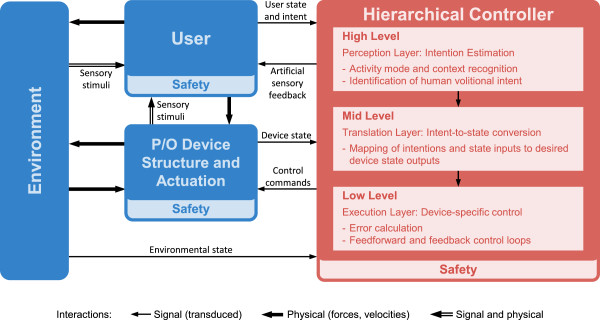
: Technological advancements have led to the development of numerous wearable robotic devices for the physical assistance and restoration of human locomotion. While many challenges remain with respect to the mechanical design of such devices, it is at least equally challenging and important to develop strategies to control them in concert with the intentions of the user.This work reviews the state-of-the-art techniques for controlling portable active lower limb prosthetic and orthotic (P/O) devices in the context of locomotive activities of daily living (ADL), and considers how these can be interfaced with the user's sensory-motor control system. This review underscores the practical challenges and opportunities associated with P/O control, which can be used to accelerate future developments in this field. Furthermore, this work provides a classification scheme for the comparison of the various control strategies.As a novel contribution, a general framework for the control of portable gait-assistance devices is proposed. This framework accounts for the physical and informatic interactions between the controller, the user, the environment, and the mechanical device itself. Such a treatment of P/Os--not as independent devices, but as actors within an ecosystem--is suggested to be necessary to structure the next generation of intelligent and multifunctional controllers.Each element of the proposed framework is discussed with respect to the role that it plays in the assistance of locomotion, along with how its states can be sensed as inputs to the controller. The reviewed controllers are shown to fit within different levels of a hierarchical scheme, which loosely resembles the structure and functionality of the nominal human central nervous system (CNS). Active and passive safety mechanisms are considered to be central aspects underlying all of P/O design and control, and are shown to be critical for regulatory approval of such devices for real-world use.The works discussed herein provide evidence that, while we are getting ever closer, significant challenges still exist for the development of controllers for portable powered P/O devices that can seamlessly integrate with the user's neuromusculoskeletal system and are practical for use in locomotive ADL.
Overview
The claims and statistics of this paper haven’t been checked yet.
Free: it reads the open-access text and checks the first 5 claims that cite a source we can check. Create a free account to check every claim.
Integrity signals
Registry
Cites
Statistics
Figures
Verification
Claims the paper makes
The claims and statistics of this paper haven’t been checked yet.
Free: it reads the open-access text and checks the first 5 claims that cite a source we can check. Create a free account to check every claim.
Claims other papers make about this one
Each is checked against this paper’s own text: does it say what the citing paper says it does?
The cited source says what the claim attributes to it.
In the citing paper
“Additional shortcomings include their limited environmental feedback, power supply, and failure to autonomously respond appropriately to external (possibly dangerous) stimuli.[24]”
From Flexible Electronics and Devices as Human–Machine Interfaces for Medical Robotics (2022) · cites this paper as [24]
The cited source says what the claim attributes to it.
In the citing paper
“Thus, the vast number of studies on different interface locations and various probing devices to record electrophysiological signals have established the foundation of user-communication with prosthetics.[24,286,287]”
From Flexible Electronics and Devices as Human–Machine Interfaces for Medical Robotics (2022) · cites this paper as [24]
Self-check
Percentages, sums and reported differences re-computed from the paper’s own numbers.
The self-check needs the paper’s full text.
Citations
Cites
Items 201–235 of 235
Powered Transtibial Prosthetic Device Control System Design, Implementation, and Bench Testing
Sun, J., & Voglewede, P. A. (2013) · Journal of Medical Devices · doi:10.1115/1.4025851 · Cited by 21
Motor Control in the Human Spinal Cord
Dimitrijevic, M. R., Persy, I., Forstner, C., Kern, H., & Dimitrijevic, M. M. (2005) · Artificial Organs · doi:10.1111/j.1525-1594.2005.29038.x · Cited by 21 · cited 4×
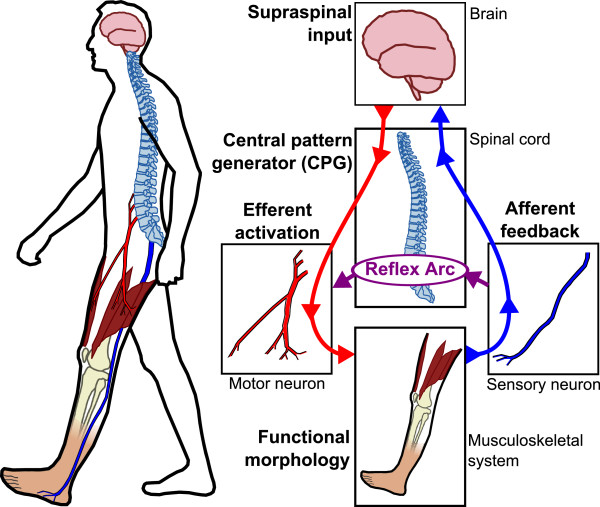
“These commands, along with afferent feedback via reflex arcs, modulate the basic patterns of the CPG.”
InfluentialA configuration dependent muscle model for the myoelectric control of a transfemoral prosthesis
Hoover, C. D., & Fite, K. B. (2011) · International Conference on Rehabilitation Robotics · doi:10.1109/icorr.2011.5975480 · Cited by 21 · cited 2×
“Surface EMG has been demonstrated for this purpose in transfemoral prostheses [61,120,130,132,149,150], virtual above- and below-knee prostheses [151], a hip and knee orthosis [152], knee orthoses [60,153,154], a transtibial prosthesis [66] and an ankle-foot orthosis [155].”
Evaluation of a coordinated control system for a pair of powered transfemoral prostheses
Lawson, B. E., Shultz, A. H., & Goldfarb, M. T. (2013) · Proceedings - IEEE International Conference on Robotics and Automation/Proceedings · doi:10.1109/icra.2013.6631124 · Cited by 20 · cited 4×
“However, this approach quickly becomes unwieldy, as the number of tunable variables rapidly increases with the number of parameters per control law, the number of states per activity, the number of activity modes, the number of joints to be actuated, and the number of limbs to be controlled [176].”
InfluentialMultifunctional above-knee prosthesis for stairs' walking
Koganezawa, K., Fujimoto, H., & Kato, I. (1987) · Prosthetics and Orthotics International · doi:10.3109/03093648709078198 · Cited by 20 · cited 1×
“[3,205,222],mechanically-variable impedance actuation [223,224] and the reciprocal transfer of power between joints [213,225-228] or between portions of the gait cycle [229-231].”
Zhang, F., Liu, M., & Huang, H. (2012) · Annual International Conference of the IEEE Engineering in Medicine and Biology Society (EMBC) · doi:10.1109/embc.2012.6346538 · Cited by 19 · cited 2×
“…discussed in the literature include inappropriate controller outputs due to misinterpretation of user intent or invalid sensor inputs [24,67,116,118,121, 136,176,214,239], unstable interactions with the user and environment [60,107,138,181,184,202], actuation failures due to overloading/saturating…”
Mechanisms for actuated assistive hip orthoses
Olivier, J., Ortlieb, A., Bouri, M., & Bleuler, H. (2014) · Robotics and Autonomous Systems · doi:10.1016/j.robot.2014.10.002 · Cited by 19 · cited 1×
“The renderable transparency of a device can also be used as a performance metric that is indicative of how well the physical dynamics of the device can be controlled [197-199].”
Self-citationA walking controller for a powered ankle prosthesis
Shultz, A. H., Mitchell, J. E., Truex, D., Lawson, B. E., Ledoux, E. D., & Goldfarb, M. T. (2014) · Annual International Conference of the IEEE Engineering in Medicine and Biology Society (EMBC) · doi:10.1109/embc.2014.6945046 · Cited by 18
Matthys, A., Cherelle, P., Damme, M. V., Bram, V., & Lefeber, D. (2012) · IEEE/RAS-EMBS International Conference on Biomedical Robotics and Biomechatronics (BioRob) · doi:10.1109/biorob.2012.6290833 · Cited by 16
Study on lower back electrotactile stimulation characteristics for prosthetic sensory feedback
Seps, M., Dermitzakis, K., & Arieta, A. H. (2011) · IEEE/RSJ International Conference on Intelligent Robots and Systems (IROS) · doi:10.1109/iros.2011.6095110 · Cited by 16 · cited 1×
“The majority of feedback systems transmit discrete information [95-97] but mo ving stimuli are also possible [76,98,99].”
BackgroundDevelopment of an assistive motorized hip orthosis: Kinematics analysis and mechanical design
Olivier, J., Bouri, M., Ortlieb, A., Bleuler, H., & Clavel, R. (2013) · International Conference on Rehabilitation Robotics · doi:10.1109/icorr.2013.6650495 · Cited by 15 · cited 2×
“The load carried by the physiological joint can be estimated from muscle activity [60,70,154,216] or through direct force measurement [217].”
Self-citationAn Echo-Based Gait Phase Determination Method of Lower Limb Prosthesis
Wang, W., Li, J., Li, W. D., & Sun, L. N. (2013) · Advanced materials research · doi:10.4028/www.scientific.net/amr.706-708.629 · Cited by 15 · cited 1×
“Echo control is a combination of time-based and normalized-trajectory control, in which the position trajectories of the unassisted limb are recorded and replayed on the assisted limb with some time delay and scaling during steady-state reciprocal gait [114,166,167].”
Estimation of foot orientation with respect to ground for an above knee robotic prosthesis
Scandaroli, G. G., Borges, G. A., Ishihara, J. Y., Terra, M. H., da Rocha, A. F., & Nascimento, F. A. D. O. (2009) · IEEE/RSJ International Conference on Intelligent Robots and Systems (IROS) · doi:10.1109/iros.2009.5354820 · Cited by 15 · cited 2×
“presented a method using gyroscopes and infrared sensors [112] for estimation of the ground slope and elevation of the foot above the ground.”
Design of an expert system to automatically calibrate impedance control for powered knee prostheses
Wang, D., Liu, M., Zhang, F., & Huang, H. (2013) · International Conference on Rehabilitation Robotics · doi:10.1109/icorr.2013.6650442 · Cited by 14 · cited 1×
“describe the use of an expert system to automatically tune the impedance parameters to match that of healthy human gait based on fuzzy logic inference [189].”
Pattern classification of terrain during amputee walking
Farrell, M. T. (2013) · DSpace@MIT (Massachusetts Institute of Technology) · Cited by 13
Modeling of WalkMECH: A fully-passive energy-efficient transfemoral prosthesis prototype
Ünal, R., Klijnstra, F., Burkink, B., Behrens, S. M., Hekman, E. E. G., Stramigioli, S., Koopman, H. F. J. M., & Carloni, R. (2013) · International Conference on Rehabilitation Robotics · doi:10.1109/icorr.2013.6650406 · Cited by 13 · cited 1×
“[3,206,223], mechanically-variable impedance actuation [224,225] and the reciprocal transfer of power between joints [214,226-229] or between portions of the gait cycle [230-232].”
Sensory feedback for lower limb prostheses
Zambarbieri, D., Schmid, M., & Verni, G. (2000) · The CRC Press international series on computational intelligence/International series on computational intelligence · doi:10.1201/9781420042122.ch4 · Cited by 13 · cited 3×
“However, information about the center of pressure [87] or gait asymmetries [88] can be visualized on a portable device, for example using a smart phone or headset.”
Wang, Q., Yuan, K., Zhu, J., & Wang, L. (2014) · IEEE International Workshop on Advanced Motion Control (AMC) · doi:10.1109/amc.2014.6823274 · Cited by 12 · cited 1×
“There are distinct advantages and disadvantages to each typ e of control, and there may be different conditions and gait phases that lend themselves to switching betwe en control modes [135,186, 213].”
BackgroundProportional EMG control for above knee pros-theses.
Donath, M. (1974) · DSpace@MIT (Massachusetts Institute of Technology) · Cited by 11
Preliminary evaluation of a lower-limb exoskeleton - Stair climbing
Chandrapal, M., Chen, X., & Wang, W. (2013) · IEEE/ASME International Conference on Advanced Intelligent Mechatronics · doi:10.1109/aim.2013.6584300 · Cited by 11 · cited 2×
“The load carried by the physiological joint can be estimated from muscle activity [60,70,154,216] or through direct force measurement [217].”
On the use of adaptable compliant actuators in prosthetics, rehabilitation and assistive robotics
Junius, K., Cherelle, P., Brackx, B., Geeroms, J., Schepers, T., Vanderborght, B., & Lefeber, D. (2013) · International Workshop on Robot Motion and Control · doi:10.1109/romoco.2013.6614575 · Cited by 11 · cited 1×
“[3,206,223], mechanically-variable impedance actuation [224,225] and the reciprocal tr ansfer of power between joints [214,226-229] or between portions of the gait cycle [230-232].”
BackgroundLee, M., Soon, K.-S., & Lin, C.-F. (2009) · Journal of Computers · doi:10.4304/jcp.4.10.1005-1011 · Cited by 10 · cited 1×
“Electrotactile [95,96,100,101] and vibrotactile [88,102 ,103] stimulation have been used to convey information about characteristics of gait and postural co ntrol and possible deviations.”
MethodAmputee Subject Testing Protocol, Results, and Analysis of a Powered Transtibial Prosthetic Device
Sun, J., Fritz, J. M., Toro, D. R. D., & Voglewede, P. A. (2014) · Journal of Medical Devices · doi:10.1115/1.4027497 · Cited by 9
Izumi, T., Hoshimiya, N., Fujii, A., & Handa, Y. (1988) · Systems and Computers in Japan · doi:10.1002/scj.4690190808 · Cited by 8 · cited 1×
“The majority of feedback systems transmit discrete information [94-96] but moving stimuli are also possible [97,98].”
What do walking humans want from mechatronics?
Collins, S. H. (2013) · IEEE International Conference on Mechatronics (ICM) · doi:10.1109/icmech.2013.6518504 · Cited by 8 · cited 2×
“Toward this end, Steven Collins [232] has called for the development of “universal wearable robot emulators” – devices for use in a laboratory that are tethered for power, control, and actuation (see e.g. [155,162,166,206,212,233]).”
Adaptation to knee flexion torque during gait
Sulzer, J. S., Gordon, K. E., Hornby, T. G., Peshkin, M. A., & Patton, J. L. (2009) · International Conference on Rehabilitation Robotics · doi:10.1109/icorr.2009.5209499 · Cited by 8 · cited 1×
“Phase-based controllers In time-based control, a set of actions is performed based on a programmed time delay following a clearly identifiable gait event, for example heel strike [160,161] or toe-off [162].”
Simulating prosthetic devices with human-inspired hybrid control
Sinnet, R. W., Zhao, H., & Ames, A. D. (2011) · IEEE/RSJ International Conference on Intelligent Robots and Systems (IROS) · doi:10.1109/iros.2011.6095186 · Cited by 8 · cited 1×
“Controllers can also be developed via numerical simulations [234] or robotic analogs [235].”
Human-Inspired Balancing Assistance: Application to a Knee Exoskeleton
Ajoudani, A. (2015) · Springer tracts in advanced robotics · doi:10.1007/978-3-319-24205-7_10 · Cited by 6
Biomimetic Stiffness for Transfemoral Prostheses
Pfeifer, S. (2014) · Repository for Publications and Research Data (ETH Zurich) · doi:10.3929/ethz-a-010261188 · Cited by 5 · cited 1×
“In a case study, an amputee subject successfully walked with CLME-controlled impedance [195].”
Electro-tactile sensation thresholds for an amputee gait-retraining system
Webb, G., Ewins, D., & Ghoussayni, S. (2012) · Surrey Research Insight Open Access (The University of Surrey) · Cited by 3
Intelligent Motor Powered Prosthetic Knee Joint
Einarsdóttir, H. (2011) · Journal of Medical Devices · doi:10.1115/1.3590866 · Cited by 3 · cited 1×
“In either case, an oft-cited hypothesis motivating the development of active P/Os is that only an actuated device would be capable of providing the full power-output capabilities of the corresponding physiological joints, and could thus enable gait patterns resembling those of unaffected persons across a wide variety…”
Lee, M., & Soon, K.-S. (2009) · Conference proceedings/Conference proceedings - IEEE International Conference on Systems, Man, and Cybernetics · doi:10.1109/icsmc.2009.5346337 · Cited by 3
Technical note—auditory feedback of knee angle for amputees
Gilbert, J. A., Maxwell, G. M., George, R. T., & McElhaney, J. H. (1982) · Prosthetics and Orthotics International · doi:10.3109/03093648209166775 · Cited by 3
Pagel, A., Oes, J., Pfeifer, S., Riener, R., & Vallery, H. (2013) · at - Automatisierungstechnik · doi:10.1524/auto.2013.0055 · Cited by 2 · cited 1×
“Experimentally assessing [105,106] or simulating [107] the user’s interactio n w th the orthotic or prosthetic device in conjunction with a feedback system may increase our un derstanding of which types of information are meaningful, superfluous or even incriminatory.”
BackgroundSelf-citationHuman-inspired balancing assistance: Application to a knee exoskeleton
Karavas, N. C., Ajoudani, A., Tsagarakis, N. G., & Caldwell, D. G. (2013) · IEEE International Conference on Robotics and Biomimetics (ROBIO) · doi:10.1109/robio.2013.6739474
Research works printed but not linked: 9
- Donath M. Proportional EMG control for above-knee prosthesis, MIT. Department of Mechanical Engineering, Masters Thesis; 1974. http://hdl. handle.net/1721.1/13775.
- Zambarbieri D, Schmid M, Magnaghi M, Vermi G, Macellari V, Fadda A. Biofeedback techniques for rehabilitation of the lower-limb prosthetic subject. In: Proc. VII Medicon. Lemesos, Cyprus: MEDICON; 1998. p. 1-5.
- Kawamura J, Sueda O, Harada K, Nishihara K, Isobe S. Sensory feedback systems for the lower-limb prosthesis. J Osaka Rosai Hospital 1981;5: 104-12.
- Webb G. Providing real-time biofeedback for amputee gait retraining using labview. In: NI days worldwide graphical system design conference. London, UK: National Instruments; 2011.
- Grimes DL. An active multimode above knee prosthesis controller, PhD thesis, Massachusetts Institute of Technology. Dept. of Mechanical Engineering; 1979. http://hdl.handle.net/1721.1/15998.
- Gancet J, Ilzkovitz M, Cheron G, Ivanenko Y, van der Kooij H, van der Helm F, et al. MINDWALKER: A brain controlled lower limbs exoskeleton for rehabilitation. Potential applications to space In: Workshop EA, editor. 11th Symposium on advanced space technologies in robotics and automation. Noordwijk, NL: European Space Agency; 2011. p. 12-14.
- Goffer A. Enhanced safety of gait in powered exoskeletons. Dynamic walking conference abstract -available online. Argo Medical Technologies, ReWalk 2014. http://dynamicwalking.org/ocs/index.php/ dw2014/dw2014/paper/viewFile/17/10.
- Huang GT. Wearable robots. Technol Rev. 2004;1:70-3.
- Li YD, Hsiao-Wecksler ET. Gait mode recognition and control for a portable-powered ankle-foot orthosis. In: Rehabilitation robotics (ICORR), 2013 IEEE international conference on; 2013. p. 1-8. doi:10.1109/ICORR.2013.6650373. · DOI · Paper page
Cited by
State of the Art and Future Directions for Lower Limb Robotic Exoskeletons
Young, A. J., & Ferris, D. P. (2017) · IEEE Transactions on Neural Systems and Rehabilitation Engineering · doi:10.1109/tnsre.2016.2521160 · Cited by 901
Qiu, S., Zhao, H., Jiang, N., Wang, Z., Liu, L., An, Y., Zhao, H., Miao, X., Liu, R., & Fortino, G. (2022) · Information Fusion · doi:10.1016/j.inffus.2021.11.006 · Cited by 671
Brain-Machine Interfaces: From Basic Science to Neuroprostheses and Neurorehabilitation
Lebedev, M. A., & Nicolelis, M. A. L. (2017) · Physiological Reviews · doi:10.1152/physrev.00027.2016 · Cited by 653
“169, 281, 411, 511, 663, 833), operation of a hand orthosis under BMI control (434, 436, 534, 610, 628), and BMIcontrolled leg exoskeletons (156, 205, 282, 425, 456, 768, 812).”
Flexible Electronics and Devices as Human–Machine Interfaces for Medical Robotics
Heng, W., Solomon, S., & Gao, W. (2022) · Advanced Materials · doi:10.1002/adma.202107902 · Cited by 609
A Review on Lower Limb Rehabilitation Exoskeleton Robots
Shi, D., Zhang, W., Zhang, W., & Ding, X. (2019) · Chinese Journal of Mechanical Engineering · doi:10.1186/s10033-019-0389-8 · Cited by 508
Metadata
- Authors
- Tucker, M. R., Olivier, J., Pagel, A., Bleuler, H., Bouri, M., Lambercy, O., Millán, J. D. R., Riener, R., Vallery, H., & Gassert, R.
- Affiliations
- ETH Zurich (CH)
- École Polytechnique Fédérale de Lausanne (CH)
- University of Zurich (CH)
- Corresponding author
- Tucker, Michael R
- ORCID
- Venue
- Journal of NeuroEngineering and Rehabilitation
- Published
- 2015
- Volume
- 12
- Issue
- 1
- Pages
- 1
- ISSN
- 1743-0003 (ISSN-L)
- PMC
- PMC4326520
- OpenAlex
- W2142114107
- Semantic Scholar
- 7fe25a0498cd3ccd98db0d8da50730c68d174d68
- Cited by
- 1,047
- References
- 232
- Citations by year
- 2026: 42 · 2025: 69 · 2024: 72 · 2023: 119 · 2022: 102 · 2021: 161 · 2020: 116 · 2019: 108 · 2018: 92 · 2017: 85 · 2016: 61 · 2015: 20
- FWCI
- 6.63
- Type
- journal article
- Language
- en
- Open access
- gold
- doi.org
- Licence
- cc-by
- Locations
- Journal of NeuroEngineering and Rehabilitation (publishedVersion, cc-by)
- Europe PMC (PubMed Central) (publishedVersion, cc-by)
- PubMed Central (publishedVersion, cc-by)
- PubMed (publishedVersion)
- Zurich Open Repository and Archive (University of Zurich) (acceptedVersion, cc-by)
- Repository for Publications and Research Data (ETH Zurich) (submittedVersion, cc-by)
- Infoscience (Ecole Polytechnique Fédérale de Lausanne) (submittedVersion)
- Infoscience (Ecole Polytechnique Fédérale de Lausanne) (submittedVersion, cc-by-nc-nd)
- Research Repository (Delft University of Technology) (submittedVersion, cc-by)
- Zurich Open Repository and Archive (University of Zurich) (submittedVersion, cc-by)
- Data Archiving and Networked Services (DANS) (submittedVersion, other-oa)
- ETH Zürich Research Collection (cc-by)
- Zurich Open Repository and Archive (University of Zurich)
- Funders
- National Science Foundation
- Schweizerischer Nationalfonds zur Förderung der Wissenschaftlichen Forschung
- Topics
- Physical Sciences › Engineering › Biomedical Engineering › Prosthetics and Rehabilitation Robotics
- Physical Sciences › Engineering › Biomedical Engineering › Muscle activation and electromyography studies
- Physical Sciences › Engineering › Control and Systems Engineering › Robotic Locomotion and Control
- Keywords
- orthoses, wearable robotic devices, gait assistance, control strategy, activities of daily living, sensorimotor control, hierarchical control architecture, safety mechanisms, regulatory approval
- MeSH terms
- Activities of Daily Living, Electromyography, Gait, Humans, Locomotion, Orthotic Devices, Prosthesis Design, Prostheses and Implants, Lower Extremity
About these checks
Registry, retraction, Cites and statistics results are computed, not judged, with one exception: a printed reference that no index lists is read once by a model before it counts as a citation error. Claims are extracted by a model and kept only when their quote appears verbatim in the text; each cited source is then checked, with a model’s help, for whether it says what the claim relies on. Those verdicts can be wrong — read the claim’s quote and the cited source before relying on one.
Statistics and arithmetic are recomputed, not judged.
Confidence bands are shown only for fields calibrated on our annotated test set. None is calibrated yet, so no band is shown.
What counts as a claim ›How we measure confidence ›How we check this ›
Are you an author, or do you see a problem with this page? Request a review
Data sources
Bibliographic data: Semantic Scholar, OpenAlex, Crossref.
Contains information from the Semantic Scholar Academic Graph Datasets, made available under the ODC Attribution License (ODC-BY 1.0).
Semantic Scholar’s data is described in: Kinney, R., et al. (2023). The Semantic Scholar Open Data Platform. arXiv:2301.10140.
