

The DOI matches its Crossref record; 78 of the 78 references it cites were found in a registry or an index.
The pivotal role of pyruvate dehydrogenase kinases in metabolic flexibility
Open accessAbstract
Metabolic flexibility is the capacity of a system to adjust fuel (primarily glucose and fatty acids) oxidation based on nutrient availability. The ability to alter substrate oxidation in response to nutritional state depends on the genetically influenced balance between oxidation and storage capacities. Competition between fatty acids and glucose for oxidation occurs at the level of the pyruvate dehydrogenase complex (PDC). The PDC is normally active in most tissues in the fed state, and suppressing PDC activity by pyruvate dehydrogenase (PDH) kinase (PDK) is crucial to maintain energy homeostasis under some extreme nutritional conditions in mammals. Conversely, inappropriate suppression of PDC activity might promote the development of metabolic diseases. This review summarizes PDKs' pivotal role in control of metabolic flexibility under various nutrient conditions and in different tissues, with emphasis on the best characterized PDK4. Understanding the regulation of PDC and PDKs and their roles in energy homeostasis could be beneficial to alleviate metabolic inflexibility and to provide possible therapies for metabolic diseases, including type 2 diabetes (T2D).
Overview
The claims and statistics of this paper haven’t been checked yet.
Run the check — free, no account needed. It reads the open-access text and checks the sources it cites.
Integrity signals
Registry
Cites
Statistics
Figures
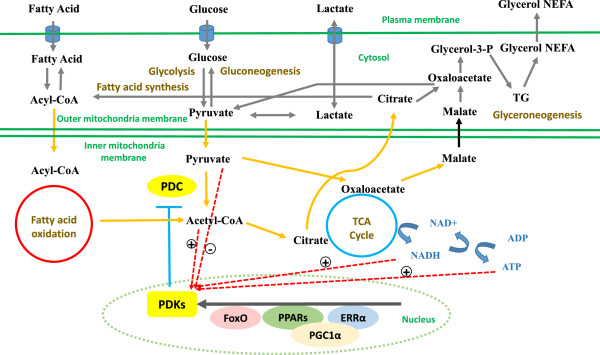
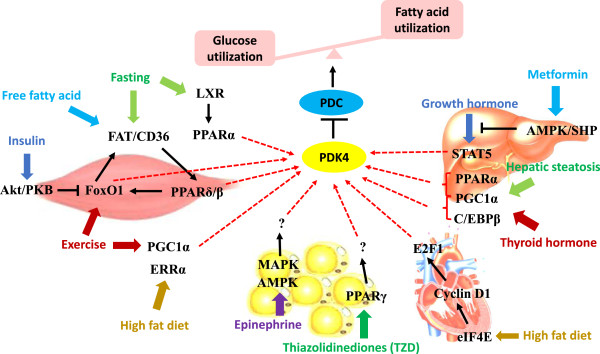
Verification
Claims the paper makes
The claims and statistics of this paper haven’t been checked yet.
Run the check — free, no account needed. It reads the open-access text and checks the sources it cites.
Claims other papers make about this one
Each is checked against this paper’s own text: does it say what the citing paper says it does?
In the citing paper
“competition between fatty acids and glucose occurs at the level of the pyruvate dehydrogenase complex”
From Metabolic Flexibility as an Adaptation to Energy Resources and Requirements in Health and Disease (2018) · cites this paper as [314]
Self-check
Percentages, sums and reported differences re-computed from the paper’s own numbers.
The self-check needs the paper’s full text.
Citations
Cites
Cancer cell metabolism: warburg and beyond
Hsu, P. P., & Sabatini, D. M. (2008) · Cell · doi:10.1016/j.cell.2008.08.021 · Cited by 2,452 · cited 1×
“They utilize increased glycolysis and suppress mitochondrial glucose oxidation to provide energy with a proliferative advantage, conducive to apoptosis resistance and even increased angiogenesis [74].”
Fuel selection in human skeletal muscle in insulin resistance: a reexamination.
Kelley, D. E., & Mandarino, L. J. (2000) · Diabetes · doi:10.2337/diabetes.49.5.677 · Cited by 1,017
Yao, J., Irwin, R. W., Zhao, L., Nilsen, J., Hamilton, R. T., & Brinton, R. D. (2009) · Proceedings of the National Academy of Sciences · doi:10.1073/pnas.0903563106 · Cited by 940
Metabolic Modulation of Glioblastoma with Dichloroacetate
Michelakis, E. D., Sutendra, G., Dromparis, P., Webster, L., Haromy, A., Niven, E. B., Maguire, C., Gammer, T.-L., Mackey, J. R., Fulton, D. S., et al. (2010) · Science Translational Medicine · doi:10.1126/scitranslmed.3000677 · Cited by 744
Non-CpG methylation of the PGC-1α promoter through DNMT3B controls mitochondrial density.
Barrès, R., Osler, M. E., Yan, J., Rune, A., Fritz, T., Caidahl, K., Krook, A., & Zierath, J. R. (2009) · Cell Metabolism · doi:10.1016/j.cmet.2009.07.011 · Cited by 602
The role of FoxO in the regulation of metabolism
Gross, D. N., van den Heuvel, A. P. J., & Birnbaum, M. J. (2008) · Oncogene · doi:10.1038/onc.2008.25 · Cited by 571
Metabolic flexibility and insulin resistance
Galgani, J. E., Moro, C., & Ravussin, E. (2008) · American Journal of Physiology-Endocrinology and Metabolism · doi:10.1152/ajpendo.90558.2008 · Cited by 532 · cited 2×
“The capacity for an organism to adapt fuel oxidation to fuel availability, that is, to preferentially utilize carbohydrate and lipid fuels and to be able to rapidly switch between them is termed metabolic flexibility [2,3].”
Regulation of pyruvate dehydrogenase complex activity by reversible phosphorylation
Holness, M. J., & Sugden, M. C. (2003) · Biochemical Society Transactions · doi:10.1042/bst0311143 · Cited by 479
Malonyl-CoA: the regulator of fatty acid synthesis and oxidation
Foster, D. W. (2012) · Journal of Clinical Investigation · doi:10.1172/jci63967 · Cited by 375
Wende, A. R., Huss, J. M., Schaeffer, P. J., Giguère, V., & Kelly, D. P. (2005) · Molecular and Cellular Biology · doi:10.1128/mcb.25.24.10684-10694.2005 · Cited by 354
Furuyama, T., Kitayama, K., Yamashita, H., & Mori, N. (2003) · Biochemical Journal · doi:10.1042/bj20030022 · Cited by 330
Randle, P. J. (1986) · Biochemical Society Transactions · doi:10.1042/bst0140799 · Cited by 313
Storlien, L., Oakes, N. D., & Kelley, D. E. (2004) · Proceedings of the Nutrition Society · doi:10.1079/pns2004349 · Cited by 291
Wu, P., Inskeep, K., Bowker-Kinley, M. M., Popov, K. M., & Harris, R. A. (1999) · Diabetes · doi:10.2337/diabetes.48.8.1593 · Cited by 290
Diversity of the Pyruvate Dehydrogenase Kinase Gene Family in Humans
Gudi, R., Bowker-Kinley, M. M., Kedishvili, N. Y., Zhao, Y., & Popov, K. M. (1995) · Journal of Biological Chemistry · doi:10.1074/jbc.270.48.28989 · Cited by 287
Sugden, M. C., & Holness, M. J. (2006) · Archives of Physiology and Biochemistry · doi:10.1080/13813450600935263 · Cited by 281
Pyruvate dehydrogenase kinase as a novel therapeutic target in oncology
Sutendra, G., & Michelakis, E. D. (2013) · Frontiers in Oncology · doi:10.3389/fonc.2013.00038 · Cited by 275
Roche, T. E., & Hiromasa, Y. (2007) · Cellular and Molecular Life Sciences · doi:10.1007/s00018-007-6380-z · Cited by 265
Brøns, C., Jacobsen, S. B., Nilsson, E., Rönn, T., Jensen, C. B., Storgaard, H., Poulsen, P., Groop, L., Ling, C., Astrup, A. V., et al. (2010) · The Journal of Clinical Endocrinology & Metabolism · doi:10.1210/jc.2009-2413 · Cited by 196
Glyceroneogenesis Is the Dominant Pathway for Triglyceride Glycerol Synthesis in Vivo in the Rat
Nye, C. K., Hanson, R. W., & Kalhan, S. C. (2008) · Journal of Biological Chemistry · doi:10.1074/jbc.m804393200 · Cited by 182
Transcriptional Regulation of Pyruvate Dehydrogenase Kinase
Jeong, J. Y., Jeoung, N. H., Park, K., & Lee, I. K. (2012) · Diabetes & Metabolism Journal · doi:10.4093/dmj.2012.36.5.328 · Cited by 179
Holness, M. J., Kraus, A., Harris, R. A., & Sugden, M. C. (2000) · Diabetes · doi:10.2337/diabetes.49.5.775 · Cited by 169
Mori, J., Alrob, O. A., Wagg, C. S., Harris, R. A., Lopaschuk, G. D., & Oudit, G. Y. (2013) · American Journal of Physiology-Heart and Circulatory Physiology · doi:10.1152/ajpheart.00636.2012 · Cited by 169
Jeoung, N. H., & Harris, R. A. (2008) · American Journal of Physiology-Endocrinology and Metabolism · doi:10.1152/ajpendo.00536.2007 · Cited by 162
Connaughton, S., Chowdhury, F., Attia, R. R., Song, S., Zhang, Y., Elam, M. B., Cook, G. A., & Park, E. A. (2009) · Molecular and Cellular Endocrinology · doi:10.1016/j.mce.2009.08.011 · Cited by 144
Role of pyruvate dehydrogenase kinase isoenzyme 4 (PDHK4) in glucose homoeostasis during starvation
Jeoung, N. H., Wu, P., Joshi, M., Jaskiewicz, J. A., Bock, C. B., DePaoli-Roach, A. A., & Harris, R. A. (2006) · Biochemical Journal · doi:10.1042/bj20060125 · Cited by 143
Clinical pharmacology and toxicology of dichloroacetate.
Stacpoole, P. W., Henderson, G. N., Yan, Z., & James, M. O. (1998) · Environmental Health Perspectives · doi:10.1289/ehp.98106s4989 · Cited by 141
Fuel economy in food‐deprived skeletal muscle: signaling pathways and regulatory mechanisms
de Lange, P., Moreno, M., Silvestri, E., Lombardi, A., Goglia, F., & Lanni, A. (2007) · The FASEB Journal · doi:10.1096/fj.07-8527rev · Cited by 137
Pilegaard, H., & Neufer, P. D. (2004) · Proceedings of The Nutrition Society · doi:10.1079/pns2004345 · Cited by 133
Nahlé, Z., Hsieh, M., Pietka, T., Coburn, C. T., Grimaldi, P. A., Zhang, M. Q., Das, D., & Abumrad, N. A. (2008) · Journal of Biological Chemistry · doi:10.1074/jbc.m706478200 · Cited by 122
Huang, B., Wu, P., Popov, K. M., & Harris, R. A. (2003) · Diabetes · doi:10.2337/diabetes.52.6.1371 · Cited by 122
Sugden, M. C., & Holness, M. J. (1994) · The FASEB Journal · doi:10.1096/fasebj.8.1.8299890 · Cited by 122
Zhao, G., Jeoung, N. H., Burgess, S. C., Rosaaen-Stowe, K. A., Inagaki, T., Latif, S., Shelton, J. M., McAnally, J., Bassel‐Duby, R., Harris, R. A., et al. (2007) · American Journal of Physiology-Heart and Circulatory Physiology · doi:10.1152/ajpheart.00870.2007 · Cited by 120
Kim, Y. I., Lee, F. N., Choi, W. S., Lee, S., & Youn, J. H. (2006) · Diabetes · doi:10.2337/db05-1606 · Cited by 119
Catoire, M., Mensink, M., Boekschoten, M. V., Hangelbroek, R., Müller, M., Schrauwen, P., & Kersten, S. (2012) · PLoS ONE · doi:10.1371/journal.pone.0051066 · Cited by 116
Pyruvate Dehydrogenase Kinase 4
Cadoudal, T., Distel, E., Durant, S., Fouque, F., Blouin, J., Collinet, M., Bortoli, S., Forest, C. D., & Benelli, C. (2008) · Diabetes · doi:10.2337/db08-0477 · Cited by 116
Wu, C.-A., Chao, Y., Shiah, S., & Lin, W. (2013) · Biochimica et Biophysica Acta (BBA) - Molecular Cell Research · doi:10.1016/j.bbamcr.2013.01.025 · Cited by 111
Sugden, M. C., KRAUS, A., Harris, R. A., & Holness, M. J. (2000) · Biochemical Journal · doi:10.1042/bj3460651 · Cited by 107
Skeletal Muscle Lipid Accumulation in Type 2 Diabetes May Involve the Liver X Receptor Pathway
Kase, E. T., Wensaas, A. J., Aas, V., Højlund, K., Levin, K., Thoresen, G. H., Beck‐Nielsen, H., Rustan, A. C., & Gaster, M. (2005) · Diabetes · doi:10.2337/diabetes.54.4.1108 · Cited by 102
Kulkarni, S. S., Salehzadeh, F., Fritz, T., Zierath, J. R., Krook, A., & Osler, M. E. (2011) · Metabolism · doi:10.1016/j.metabol.2011.06.014 · Cited by 98
AZD7545 is a selective inhibitor of pyruvate dehydrogenase kinase 2
Morrell, J., Orme, J. P., Butlin, R. J., Roche, T. E., Mayers, R. M., & Kilgour, E. (2003) · Biochemical Society Transactions · doi:10.1042/bst0311168 · Cited by 86
Sugden, M. C., LANGDOWN, M. L., Harris, R. A., & Holness, M. J. (2000) · Biochemical Journal · doi:10.1042/bj3520731 · Cited by 86
Holness, M. J., Bulmer, K., Smith, N. D., & Sugden, M. C. (2003) · Biochemical Journal · doi:10.1042/bj20021509 · Cited by 85
Role of Pyruvate Dehydrogenase Kinase 4 in Regulation of Blood Glucose Levels
Jeoung, N. H., & Harris, R. A. (2010) · Korean Diabetes Journal · doi:10.4093/kdj.2010.34.5.274 · Cited by 79
Regulation of Pyruvate Dehydrogenase Kinase 4 (PDK4) by Thyroid Hormone
Attia, R. R., Connaughton, S., Boone, L. R., Wang, F., Elam, M. B., Ness, G. C., Cook, G. A., & Park, E. A. (2009) · Journal of Biological Chemistry · doi:10.1074/jbc.m109.039081 · Cited by 72
Jha, M. K., Jeon, S., & Suk, K. (2012) · Current Neuropharmacology · doi:10.2174/157015912804143586 · Cited by 71
Selective modulation of promoter recruitment and transcriptional activity of PPARγ
Sears, D. D., Hsiao, A., Ofrecio, J. M., Chapman, J., He, W., & Olefsky, J. M. (2007) · Biochemical and Biophysical Research Communications · doi:10.1016/j.bbrc.2007.10.057 · Cited by 70
Constantin‐Teodosiu, D., Constantin, D., Stephens, F. B., Laithwaite, D., & Greenhaff, P. L. (2012) · Diabetes · doi:10.2337/db11-0799 · Cited by 65
PPARs and the orchestration of metabolic fuel selection
Sugden, M. C., Zariwala, M. G., & Holness, M. J. (2009) · Pharmacological Research · doi:10.1016/j.phrs.2009.03.014 · Cited by 64
Jha, M. K., Jeon, S., & Suk, K. (2012) · Current Neuropharmacology · doi:10.2174/157015912804499528 · Cited by 64
Araki, M., & Motojima, K. (2006) · FEBS Journal · doi:10.1111/j.1742-4658.2006.05183.x · Cited by 63
Hwang, B., Jeoung, N. H., & Harris, R. A. (2009) · Biochemical Journal · doi:10.1042/bj20090390 · Cited by 61
Tao, R., Xiong, X., Harris, R. A., White, M. F., & Dong, X. C. (2013) · PLoS ONE · doi:10.1371/journal.pone.0071997 · Cited by 60
Short-term regulation of the mammalian pyruvate dehydrogenase complex.
Strumiło, S. (2005) · Acta Biochimica Polonica · doi:10.18388/abp.2005_3387 · Cited by 53
Nellemann, B., Vendelbo, M. H., Nielsen, T. S., Bak, A. M., Høgild, M. L., Pedersen, S. B., Biensø, R. S., Pilegaard, H., Møller, N., Jessen, N., et al. (2013) · Acta Physiologica · doi:10.1111/apha.12183 · Cited by 53
Houten, S. M., Chegary, M., Brinke, H. T., Wijnen, W. J., Glatz, J. F. C., Luiken, J. J. F. P., Wijburg, F. A., & Wanders, R. J. A. (2009) · Cellular and Molecular Life Sciences · doi:10.1007/s00018-009-9066-x · Cited by 52
Poplawski, M. M., Mastaitis, J. W., Yang, X.-J., & Mobbs, C. V. (2010) · Endocrinology · doi:10.1210/en.2010-0702 · Cited by 51
Rinnankoski‐Tuikka, R., Silvennoinen, M., Karvinen, S. M., Hulmi, J. J., Lehti, M., Kivelä, R., Reunanen, H., & Kainulainen, H. (2012) · Nutrition & Metabolism · doi:10.1186/1743-7075-9-53 · Cited by 49
Epinephrine-mediated regulation of PDK4 mRNA in rat adipose tissue
Wan, Z., Thrush, A. B., Legare, M., Frier, B. C., Sutherland, L., Williams, D. B., & Wright, D. C. (2010) · American Journal of Physiology-Cell Physiology · doi:10.1152/ajpcell.00188.2010 · Cited by 48
Caton, P., Holness, M. J., Bishop‐Bailey, D., & Sugden, M. C. (2011) · Biochemical Journal · doi:10.1042/bj20110702 · Cited by 45
Regulation of PDK mRNA by high fatty acid and glucose in pancreatic islets
Xu, J., Han, J., Epstein, P. N., & Liu, Y. Q. (2006) · Biochemical and Biophysical Research Communications · doi:10.1016/j.bbrc.2006.03.211 · Cited by 44
Eivers, S. S., McGivney, B. A., Gu, J., MacHugh, D. E., Katz, L. M., & Hill, E. W. (2011) · Animal Genetics · doi:10.1111/j.1365-2052.2011.02238.x · Cited by 43
Sugden, M. C. (2003) · Obesity Research · doi:10.1038/oby.2003.26 · Cited by 36
Metabolomic analysis of pancreatic beta cells following exposure to high glucose
Wallace, M., Whelan, H., & Brennan, L. (2012) · Biochimica et Biophysica Acta (BBA) - General Subjects · doi:10.1016/j.bbagen.2012.10.025 · Cited by 33
Arumugam, R., Horowitz, E., Noland, R. C., Lu, D., Fleenor, D. E., & Freemark, M. (2010) · Endocrinology · doi:10.1210/en.2010-0049 · Cited by 32
Regulation of Pyruvate Dehydrogenase Kinase 4 (PDK4) by CCAAT/Enhancer-binding Protein β (C/EBPβ)
Attia, R. R., Sharma, P., Janssen, R. C., Friedman, J. E., Deng, X., Lee, J., Elam, M. B., Cook, G. A., & Park, E. A. (2011) · Journal of Biological Chemistry · doi:10.1074/jbc.m111.246389 · Cited by 31
Ding, F., Li, H. H., Li, J. Z., Myers, R., & Francke, U. (2010) · PLoS ONE · doi:10.1371/journal.pone.0009402 · Cited by 30
Kim, Y. D., Kim, Y., Tadi, S., Yu, J. H., Yim, Y., Jeoung, N. H., Shong, M., Hennighausen, L. G., Harris, R. A., Lee, I., et al. (2012) · Diabetes · doi:10.2337/db11-1665 · Cited by 28
Akhmedov, D., Marchi, U. D., Wollheim, C. B., & Wiederkehr, A. (2012) · Biochimica et Biophysica Acta (BBA) - Molecular Cell Research · doi:10.1016/j.bbamcr.2012.07.005 · Cited by 25
Nakai, N., Obayashi, M., Nagasaki, M., Sato, Y., Fujitsuka, N., Yoshimura, A., Miyazaki, Y., Sugiyama, S., & Shimomura, Y. (2000) · Life Sciences · doi:10.1016/s0024-3205(00)00947-4 · Cited by 24
Zhang, L., Mori, J., Wagg, C. S., & Lopaschuk, G. D. (2012) · FEBS Letters · doi:10.1016/j.febslet.2012.02.027 · Cited by 23
Sugden, M. C., Lall, H., Harris, R., & Holness, M. J. (2000) · Journal of Endocrinology · doi:10.1677/joe.0.1670339 · Cited by 23
Epinephrine Induces PDK4 mRNA Expression in Adipose Tissue From Obese, Insulin Resistant Rats
Wan, Z., Frier, B. C., Williams, D. B., & Wright, D. C. (2011) · Obesity · doi:10.1038/oby.2011.252 · Cited by 19
Role of pyruvate dehydrogenase kinase 4 in regulating PDH activation during acute muscle contraction
Herbst, E. A. F., Dunford, E. C. E., Harris, R. A., Vandenboom, R., LeBlanc, P. J., Roy, B. D., Jeoung, N. H., & Peters, S. J. (2012) · Applied Physiology Nutrition and Metabolism · doi:10.1139/h11-136 · Cited by 19
Hwang, B., Wu, P., & Harris, R. A. (2012) · FEBS Journal · doi:10.1111/j.1742-4658.2012.08569.x · Cited by 14
Sugden, M. C., Fryer, L. G. D., Priestman, D. A., Orfali, K. A., & Holness, M. J. (1996) · Molecular and Cellular Endocrinology · doi:10.1016/0303-7207(96)03817-8 · Cited by 13
Holness, M. J., Zariwala, M. G., Walker, C. G., & Sugden, M. C. (2012) · FEBS Open Bio · doi:10.1016/j.fob.2012.02.003 · Cited by 12
Randle (1998) · doi:10.1002/(sici)1099-0895(199812)14:4
Cited by
Sorted by citations
Metabolic Flexibility as an Adaptation to Energy Resources and Requirements in Health and Disease
Smith, R. L., Soeters, M. R., Wüst, R. C. I., & Houtkooper, R. H. (2018) · Endocrine Reviews · doi:10.1210/er.2017-00211 · Cited by 787
Judge, A., & Dodd, M. S. (2020) · Essays in Biochemistry · doi:10.1042/ebc20190041 · Cited by 421
Efferocytosis induces a novel SLC program to promote glucose uptake and lactate release
Morioka, S., Perry, J. S. A., Raymond, M. H., Medina, C. B., Zhu, Y., Zhao, L., Serbulea, V., Önengüt-Gümüşcü, S., Leitinger, N., Kucenas, S., et al. (2018) · Nature · doi:10.1038/s41586-018-0735-5 · Cited by 379
Atlas of Circadian Metabolism Reveals System-wide Coordination and Communication between Clocks
Dyar, K. A., Lutter, D., Artati, A., Ceglia, N., Liu, Y., Armenta, D., Jastroch, M., Schneider, S., de Mateo, S., Cervantes, M., et al. (2018) · Cell · doi:10.1016/j.cell.2018.08.042 · Cited by 345
PDK4 augments ER-mitochondria contact to dampen skeletal muscle insulin signaling during obesity
Thoudam, T., Ha, C.-M., Leem, J., Chanda, D., Park, J.-S., Kim, H.-J., Jeon, J.-H., Choi, Y.-K., Liangpunsakul, S., Huh, Y. H., et al. (2019) · Diabetes · doi:10.2337/db18-0363 · Cited by 207
Metadata
- Authors
- Zhang, S., Hulver, M. W., McMillan, R. P., Cline, M. A., & Gilbert, E. R.
- Affiliations
- Virginia Tech (US)
- Corresponding author
- Gilbert, Elizabeth R
- Venue
- Nutrition & Metabolism
- Published
- 2014-02-12
- Volume
- 11
- Issue
- 1
- Pages
- 10-10
- ISSN
- 1743-7075 (ISSN-L)
- PMC
- PMC3925357
- OpenAlex
- W2170096200
- Cited by
- 450
- References
- 78
- Citations by year
- 2026: 19 · 2025: 43 · 2024: 34 · 2023: 70 · 2022: 45 · 2021: 39 · 2020: 55 · 2019: 38 · 2018: 40 · 2017: 23 · 2016: 20 · 2015: 18 · 2014: 5
- FWCI
- 9.79
- Type
- journal article
- Language
- en
- Open access
- gold
- doi.org
- Licence
- cc-by
- Locations
- Nutrition & Metabolism (publishedVersion, cc-by)
- Europe PMC (PubMed Central) (publishedVersion, cc-by)
- PubMed Central (publishedVersion, cc-by)
- PubMed (publishedVersion)
- VTechWorks (Virginia Tech) (submittedVersion, cc-by)
- Topics
- Life Sciences › Biochemistry, Genetics and Molecular Biology › Biochemistry › Biochemical Acid Research Studies
- Life Sciences › Biochemistry, Genetics and Molecular Biology › Molecular Biology › Metabolism, Diabetes, and Cancer
- Health Sciences › Medicine › Physiology (medical) › Adipose Tissue and Metabolism
- Keywords
- pyruvate dehydrogenase kinase, pyruvate dehydrogenase complex, metabolic flexibility, PDK4, energy homeostasis, glucose oxidation, fatty acid oxidation, substrate competition, metabolic inflexibility, type 2 diabetes, metabolic disorders
About these checks
Registry, retraction, Cites and statistics results are computed, not judged, with one exception: a printed reference that no index lists is read once by a model before it counts as a citation error. Claims are extracted by a model and kept only when their quote appears verbatim in the text; each cited source is then checked, with a model’s help, for whether it says what the claim relies on. Those verdicts can be wrong — read the claim’s quote and the cited source before relying on one.
Statistics and arithmetic are recomputed, not judged.
Confidence bands are shown only for fields calibrated on our annotated test set. None is calibrated yet, so no band is shown.
What counts as a claim ›How we measure confidence ›How we check this ›
Are you an author, or do you see a problem with this page? Request a review
