

The DOI matches its Crossref record; 176 of the 177 references it cites were found in a registry or an index.
Role of carnitine in disease
Open accessAbstract
Carnitine is a conditionally essential nutrient that plays a vital role in energy production and fatty acid metabolism. Vegetarians possess a greater bioavailability than meat eaters. Distinct deficiencies arise either from genetic mutation of carnitine transporters or in association with other disorders such as liver or kidney disease. Carnitine deficiency occurs in aberrations of carnitine regulation in disorders such as diabetes, sepsis, cardiomyopathy, malnutrition, cirrhosis, endocrine disorders and with aging. Nutritional supplementation of L-carnitine, the biologically active form of carnitine, is ameliorative for uremic patients, and can improve nerve conduction, neuropathic pain and immune function in diabetes patients while it is life-saving for patients suffering primary carnitine deficiency. Clinical application of carnitine holds much promise in a range of neural disorders such as Alzheimer's disease, hepatic encephalopathy and other painful neuropathies. Topical application in dry eye offers osmoprotection and modulates immune and inflammatory responses. Carnitine has been recognized as a nutritional supplement in cardiovascular disease and there is increasing evidence that carnitine supplementation may be beneficial in treating obesity, improving glucose intolerance and total energy expenditure.
Overview
The claims and statistics of this paper haven’t been checked yet.
Run the check — free, no account needed. It reads the open-access text and checks the sources it cites.
Integrity signals
Registry
Cites
Statistics
Figures
Verification
Claims the paper makes
The claims and statistics of this paper haven’t been checked yet.
Run the check — free, no account needed. It reads the open-access text and checks the sources it cites.
Claims other papers make about this one
Each is checked against this paper’s own text: does it say what the citing paper says it does?
In the citing paper
“The bioavailability of L-carnitine in vegetarians (who are adapted to low-carnitine diets) was higher than in carnivores (42); therefore, less carnitine reaches the bacteria of the lower intestine in vegetarians.”
From Trimethylamine N -Oxide, the Microbiome, and Heart and Kidney Disease (2017) · cites this paper as [42]
In the citing paper
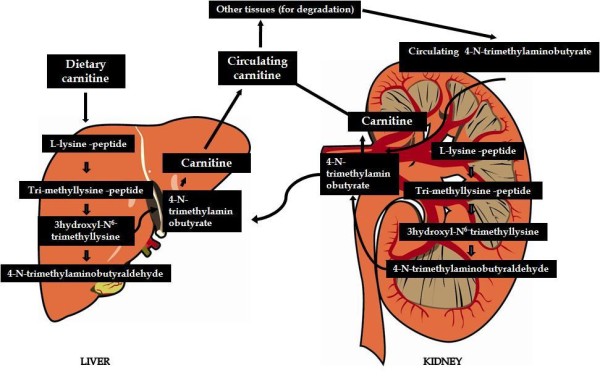
“Carnitine also can be synthesized endogenously from two essential amino acids, lysine and methionine (63).This occurs in kidney, liver, and brain (42).”
From Trimethylamine N -Oxide, the Microbiome, and Heart and Kidney Disease (2017) · cites this paper as [42]
In the citing paper
“Animal products like meat, fish, poultry, and milk (whey fraction) are highest in carnitine, whereas plants contain little carnitine (42).”
From Trimethylamine N -Oxide, the Microbiome, and Heart and Kidney Disease (2017) · cites this paper as [42]
Self-check
Percentages, sums and reported differences re-computed from the paper’s own numbers.
The self-check needs the paper’s full text.
Citations
Cites
Functional significance of cell volume regulatory mechanisms
LANG, F., BUSCH, G. L., RITTER, M., VÖLKL, H., WALDEGGER, S., GULBINS, E., & HÄUSSINGER, D. (1998) · Physiological Reviews · doi:10.1152/physrev.1998.78.1.247 · Cited by 1,891
Mutation nomenclature extensions and suggestions to describe complex mutations: A discussion
den Dunnen, J. T., & Antonarakis, S. E. (2000) · Human Mutation · doi:10.1002/(sici)1098-1004(200001)15:1 · Cited by 1,757
Watson, W. A., Litovitz, T. L., Rodgers, G. C., Klein‐Schwartz, W., Reid, N., Youniss, J., Flanagan, A., & Wruk, K. M. (2005) · The American Journal of Emergency Medicine · doi:10.1016/j.ajem.2005.05.001 · Cited by 1,147
Carnitine biosynthesis in mammals
Vaz, F. M., & Wanders, R. J. A. (2002) · Biochemical Journal · doi:10.1042/0264-6021:3610417 · Cited by 769
Ramassamy, C. (2006) · European Journal of Pharmacology · doi:10.1016/j.ejphar.2006.06.025 · Cited by 687 · cited 1×
“Based on the evidence that heat-shock proteins (Hsps) can exert neuroprotective effects against oxidative stress-related injury and that nutritional antioxidants are able to upregulate Hsps in neurons, use of nutritional antioxidants such as carnitine/acetyl-L-carnitine has been advocated to counteract the oxidative s…”
BackgroundCentral Administration of Oleic Acid Inhibits Glucose Production and Food Intake
Obici, S., Feng, Z., Morgan, K., Stein, D., Karkanias, G., & Rossetti, L. (2002) · Diabetes · doi:10.2337/diabetes.51.2.271 · Cited by 654 · cited 1×
“There is some debate in the literature regarding whether satiety depends on the cytosolic concentration of long-chain fatty acids, with the suggestion that an increased concentration correlates with satiety and decreased feeding and body weight [77-80].”
BackgroundDeCarli, L. M., & Lieber, C. S. (1967) · Journal of Nutrition · doi:10.1093/jn/91.3_suppl.331 · Cited by 607 · cited 1×
“Chronic ingestion of alcohol is known to cause hepatic steatosis [69,70].”
BackgroundWatson, W. A., Litovitz, T. L., Klein‐Schwartz, W., et al. (2004) · The American Journal of Emergency Medicine · doi:10.1016/j.ajem.2004.06.001 · Cited by 571
Pflugfelder, S. C., Tseng, S. C. G., Sanabria, O., Kell, H. Y., Garcia, C. G., Felix, C., Feuer, W. J., & Reis, B. L. (1998) · Cornea · doi:10.1097/00003226-199801000-00007 · Cited by 559 · cited 1×
“Dry eye is a common disease of the ocular surface that is associated with corneal surface irregularity and blurred vision [155-158].”
BackgroundNezu, J., Tamai, I., Oku, A., Ohashi, R., Yabuuchi, H., Hashimoto, N., Nikaido, H., Sai, Y., Koizumi, A., Shoji, Y., et al. (1999) · Nature Genetics · doi:10.1038/5030 · Cited by 553 · cited 2×
“Several mutations have been described [21,22,25,26, 29 ,31-33].”
Background
Research works printed but not linked: 1
- Rebouche C Shils M, Shike M, Ross A, et al Carnitine: Modern Nutrition in Health and Disease 2006 Philadelphia: Lippincott, Williams and Wilkins 537 544
Cited by
Sorted by citations
Revisiting Fluorescent Calixarenes: From Molecular Sensors to Smart Materials
Kumar, R., Sharma, A. K., Singh, H., Suating, P., Kim, H. S., Sunwoo, K., Shim, I., Gibb, B. C., & Kim, J. S. (2019) · Chemical Reviews · doi:10.1021/acs.chemrev.8b00605 · Cited by 546
Baudouin, C., Aragona, P., Messmer, E. S. B. M., Tomlinson, A., Calonge, M., Boboridis, K. G., Akova, Y. A., Geerling, G., Labétoulle, M., & Rolando, M. (2013) · The Ocular Surface · doi:10.1016/j.jtos.2013.07.003 · Cited by 511
Trimethylamine N -Oxide, the Microbiome, and Heart and Kidney Disease
Zeisel, S. H., & Warrier, M. (2017) · Annual Review of Nutrition · doi:10.1146/annurev-nutr-071816-064732 · Cited by 475
“Animal products like meat, fish, poultry, and milk (whey fraction) are highest in carnitine, whereas plants contain little carnitine (42).”
BackgroundFennema, D., Phillips, I. R., & Shephard, E. A. (2016) · Drug Metabolism and Disposition · doi:10.1124/dmd.116.070615 · Cited by 355
“Indeed, carnitine has proven efficacious for treatment of cardiovascular disease (Flanagan et al., 2010).”
BackgroundEffect of ethanol on lipid metabolism
You, M., & Arteel, G. E. (2019) · Journal of Hepatology · doi:10.1016/j.jhep.2018.10.037 · Cited by 357
Metadata
- Authors
- Flanagan, J. L., Simmons, P. A., Vehige, J., Willcox, M. D., & Garrett, Q.
- Affiliations
- Brien Holden Vision Institute (AU)
- Allergan (United States) (US)
- Corresponding author
- Flanagan, Judith L
- Venue
- Nutrition & Metabolism
- Published
- 2010
- Volume
- 7
- Issue
- 1
- Pages
- 30
- ISSN
- 1743-7075 (ISSN-L)
- PMC
- PMC2861661
- OpenAlex
- W2084023408
- Cited by
- 611
- References
- 176
- Citations by year
- 2026: 27 · 2025: 50 · 2024: 46 · 2023: 43 · 2022: 62 · 2021: 64 · 2020: 61 · 2019: 40 · 2018: 45 · 2017: 30 · 2016: 30 · 2015: 31 · 2014: 36 · 2013: 19 · 2012: 18
- FWCI
- 9.03
- Type
- journal article
- Language
- en
- Open access
- gold
- doi.org
- Licence
- cc-by
- Locations
- Nutrition & Metabolism (publishedVersion, cc-by)
- PubMed Central (publishedVersion, cc-by)
- PubMed (publishedVersion)
- UNSWorks (University of New South Wales, Sydney, Australia) (submittedVersion, cc-by-nc-nd)
- DOAJ (DOAJ: Directory of Open Access Journals) (submittedVersion)
- Funders
- Allergan
- Topics
- Life Sciences › Biochemistry, Genetics and Molecular Biology › Clinical Biochemistry › Metabolism and Genetic Disorders
- Health Sciences › Nursing › Nutrition and Dietetics › Clinical Nutrition and Gastroenterology
- Health Sciences › Nursing › Nutrition and Dietetics › Muscle metabolism and nutrition
- Keywords
- L-carnitine, carnitine deficiency, carnitine transporter, fatty acid metabolism, energy production, carnitine supplementation, primary carnitine deficiency, diabetes mellitus, sepsis, cardiomyopathy, malnutrition, liver cirrhosis, aging, uremia, neuropathic pain, Alzheimer's disease, hepatic encephalopathy, dry eye, obesity, impaired glucose tolerance, cardiovascular disease
About these checks
Registry, retraction, Cites and statistics results are computed, not judged, with one exception: a printed reference that no index lists is read once by a model before it counts as a citation error. Claims are extracted by a model and kept only when their quote appears verbatim in the text; each cited source is then checked, with a model’s help, for whether it says what the claim relies on. Those verdicts can be wrong — read the claim’s quote and the cited source before relying on one.
Statistics and arithmetic are recomputed, not judged.
Confidence bands are shown only for fields calibrated on our annotated test set. None is calibrated yet, so no band is shown.
What counts as a claim ›How we measure confidence ›How we check this ›
Are you an author, or do you see a problem with this page? Request a review
