

The DOI matches its Crossref record; 70 of the 70 references it cites were found in a registry or an index.
Placental DNA hypomethylation in association with particulate air pollution in early life
Open accessAbstract
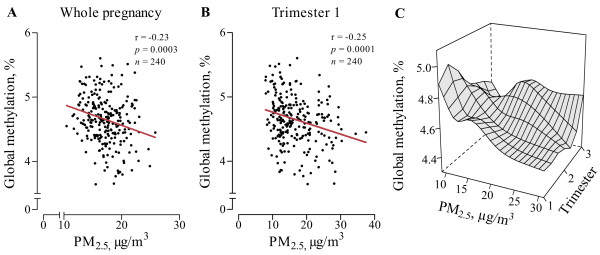
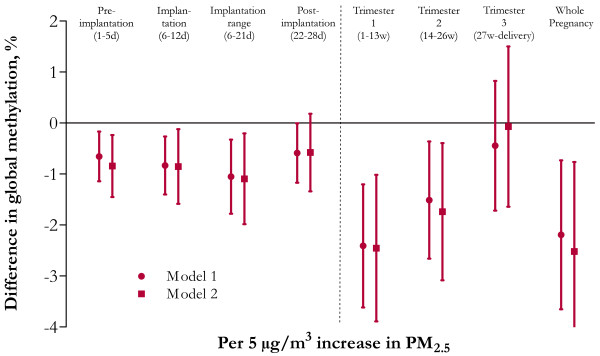
BACKGROUND: There is evidence that altered DNA methylation is an important epigenetic mechanism in prenatal programming and that developmental periods are sensitive to environmental stressors. We hypothesized that exposure to fine particles (PM2.5) during pregnancy could influence DNA methylation patterns of the placenta. METHODS: In the ENVIRONAGE birth cohort, levels of 5'-methyl-deoxycytidine (5-mdC) and deoxycytidine (dC) were quantified in placental DNA from 240 newborns. Multiple regression models were used to study placental global DNA methylation and in utero exposure to PM2.5 over various time windows during pregnancy. RESULTS: PM2.5 exposure during pregnancy averaged (25th-75th percentile) 17.4 (15.4-19.3) μg/m3. Placental global DNA methylation was inversely associated with PM2.5 exposures during whole pregnancy and relatively decreased by 2.19% (95% confidence interval [CI]: -3.65, -0.73%, p = 0.004) for each 5 μg/m3 increase in exposure to PM2.5. In a multi-lag model in which all three trimester exposures were fitted as independent variables in the same regression model, only exposure to PM2.5 during trimester 1 was significantly associated with lower global DNA methylation (-2.13% per 5 μg/m3 increase, 95% CI: -3.71, -0.54%, p = 0.009). When we analyzed shorter time windows of exposure within trimester 1, we observed a lower placental DNA methylation at birth during all implantation stages but exposure during the implantation range (6-21d) was strongest associated (-1.08% per 5 μg/m3 increase, 95% CI: -1.80, -0.36%, p = 0.004). CONCLUSIONS: We observed a lower degree of placental global DNA methylation in association with exposure to particulate air pollution in early pregnancy, including the critical stages of implantation. Future studies should elucidate genome-wide and gene-specific methylation patterns in placental tissue that could link particulate exposure during in utero life and early epigenetic modulations.
Overview
The claims and statistics of this paper haven’t been checked yet.
Run the check — free, no account needed. It reads the open-access text and checks the sources it cites.
Integrity signals
Registry
Cites
Statistics
Figures
Verification
Claims the paper makes
The claims and statistics of this paper haven’t been checked yet.
Run the check — free, no account needed. It reads the open-access text and checks the sources it cites.
Claims other papers make about this one
Each is checked against this paper’s own text: does it say what the citing paper says it does?
The source backs part of the claim, not all of it — or backs it for a different population, condition or comparison.
In the citing paper
“Studies support gestational PM2.5 exposure results in altered DNA methylation, including global hypomethylation in placental tissue [178], as well as gene specific alterations in methylation.”
From Air pollution and children’s health—a review of adverse effects associated with prenatal exposure from fine to ultrafine particulate matter (2021) · cites this paper as [178]
Experimental — accuracy not yet measuredThe source backs part of the claim, not all of it — or backs it for a different population, condition or comparison.
In the citing paper
“In a cohort study, exposure to PM2.5 during the first trimester was significantly associated with decreased (2.2%) global DNA methylation in placenta tissue [178] and was also significantly correlated with gene expression of S-adenosylmethionine (SAM), a key substrate involved in methyl group transfers [184].”
From Air pollution and children’s health—a review of adverse effects associated with prenatal exposure from fine to ultrafine particulate matter (2021) · cites this paper as [178]
Experimental — accuracy not yet measured
Self-check
Percentages, sums and reported differences re-computed from the paper’s own numbers.
The self-check needs the paper’s full text.
Citations
Cites
Regression Modeling Strategies
Harrell, F. E. (2001) · Springer series in statistics · doi:10.1007/978-1-4757-3462-1 · Cited by 9,270
Brook, R. D., Rajagopalan, S., Pope, C. A., Brook, J. R., Bhatnagar, A., Diez-Roux, A. V., Holguin, F., Hong, Y., Luepker, R. V., Mittleman, M. A., et al. (2010) · Circulation · doi:10.1161/cir.0b013e3181dbece1 · Cited by 6,548
Jaenisch, R., & Bird, A. (2003) · Nature Genetics · doi:10.1038/ng1089 · Cited by 6,325
Okano, M., Bell, D. W., Haber, D. A., & Li, E. (1999) · Cell · doi:10.1016/s0092-8674(00)81656-6 · Cited by 6,143
Persistent epigenetic differences associated with prenatal exposure to famine in humans
Heijmans, B. T., Tobi, E. W., Stein, A. D., Putter, H., Blauw, G. J., Susser, E. S., Slagboom, P. E., & Lumey, L. H. (2008) · Proceedings of the National Academy of Sciences · doi:10.1073/pnas.0806560105 · Cited by 3,082
Epigenetic Reprogramming in Mammalian Development
Reik, W., Dean, W., & Walter, J. (2001) · Science · doi:10.1126/science.1063443 · Cited by 3,078
Fetal nutrition and cardiovascular disease in adult life
Barker, D. J. P., Godfrey, K. M., Gluckman, P. D., Harding, J. E., Owens, J. A., & Robinson, J. S. (1993) · The Lancet · doi:10.1016/0140-6736(93)91224-a · Cited by 2,753
Epigenetic Transgenerational Actions of Endocrine Disruptors and Male Fertility
Anway, M. D., Cupp, A. S., Uzumcu, M., & Skinner, M. K. (2005) · Science · doi:10.1126/science.1108190 · Cited by 2,563
Environmental epigenomics and disease susceptibility
Jirtle, R. L., & Skinner, M. K. (2007) · Nature Reviews Genetics · doi:10.1038/nrg2045 · Cited by 2,492
Induction of tumors in mice by genomic hypomethylation
Gaudet, F., Hodgson, J. G., Eden, A., Jackson-Grusby, L., Dausman, J., Gray, J. W., Leonhardt, H., & Jaenisch, R. (2003) · Science · doi:10.1126/science.1083558 · Cited by 1,499 · cited 1×
“Both in animal and human cells, there is direct evidence for the role of hypomethylation for inducing genomic and chromosomal instability [29-31].”
Background
Cited by
Sorted by citations
Environmental Influences on the Epigenome: Exposure- Associated DNA Methylation in Human Populations
Martin, E. M., & Fry, R. C. (2018) · Annual Review of Public Health · doi:10.1146/annurev-publhealth-040617-014629 · Cited by 658
Johnson, N. M., Hoffmann, A. R., Behlen, J. C., Lau, C., Pendleton, D., Harvey, N., Shore, R., Li, Y., Chen, J., Tian, Y., et al. (2021) · Environmental Health and Preventive Medicine · doi:10.1186/s12199-021-00995-5 · Cited by 339
“2%) global DNA methylation in placenta tissue [178] and was also significantly correlated with gene expression of S-adenosylmethionine (SAM), a key substrate involved in methyl group transfers [184].”
BackgroundSaenen, N. D., Martens, D. S., Neven, K. Y., Alfano, R., Bové, H., Janssen, B. G., Roels, H. A., Plusquin, M., Vrijens, K., & Nawrot, T. S. (2019) · Clinical Epigenetics · doi:10.1186/s13148-019-0688-z · Cited by 267
Self-citationGruzieva, O., Xu, C.-J., Breton, C. V., Annesi-Maesano, I., Antó, J. M., Auffray, C., Ballereau, S., Bellander, T., Bousquet, J., Bustamante, M., et al. (2017) · Environmental Health Perspectives · doi:10.1289/ehp36 · Cited by 227
Janssen, B. G., Byun, H.-M., Gyselaers, W., Lefebvre, W., Baccarelli, A. A., & Nawrot, T. S. (2015) · Epigenetics · doi:10.1080/15592294.2015.1048412 · Cited by 187
Self-citationTraboulsi, H., Guerrina, N., Iu, M., Maysinger, D., Ariya, P. A., & Baglole, C. J. (2017) · International Journal of Molecular Sciences · doi:10.3390/ijms18020243 · Cited by 175
Effects of PM2.5 exposure on reproductive system and its mechanisms
Wang, L., Luo, D., Liu, X., Zhu, J., Wang, F., Li, B., & Li, L. (2020) · Chemosphere · doi:10.1016/j.chemosphere.2020.128436 · Cited by 166
DNA methylation and exposure to ambient air pollution in two prospective cohorts
Plusquin, M., Guida, F., Polidoro, S., Vermeulen, R. C. H., Raaschou‐Nielsen, O., Campanella, G., Hoek, G., Kyrtopoulos, S. Α., Georgiadis, P., Naccarati, A., et al. (2017) · Environment International · doi:10.1016/j.envint.2017.08.006 · Cited by 155
Self-citationPM2.5 Exposure and Birth Outcomes
Hyder, A., Lee, H. J., Ebisu, K., Koutrakis, P., Belanger, K. D., & Bell, M. L. (2013) · Epidemiology · doi:10.1097/ede.0000000000000027 · Cited by 157
Mitochondrial oxidative DNA damage and exposure to particulate air pollution in mother-newborn pairs
Grevendonk, L., Janssen, B. G., Vanpoucke, C., Lefebvre, W., Hoxha, M., Bollati, V., & Nawrot, T. S. (2016) · Environmental Health · doi:10.1186/s12940-016-0095-2 · Cited by 145
“5 exposure during pregnancy affects global DNA methylation levels in placental tissue [37], and we found subtle differences in methylation levels of specific regions in the mitochondrial genome [31].”
BackgroundSelf-citationCalderón‐Garcidueñas, L., Kulesza, R. J., Doty, R. L., D’Angiulli, A., & Torres‐Jardón, R. (2014) · Environmental Research · doi:10.1016/j.envres.2014.12.012 · Cited by 145
Saenen, N. D., Plusquin, M., Bijnens, E. M., Janssen, B. G., Gyselaers, W., Cox, B., Fierens, F., Molenberghs, G., Penders, J., Vrijens, K., et al. (2015) · Environmental Health Perspectives · doi:10.1289/ehp.1408549 · Cited by 130
Self-citationAbraham, É., Rousseaux, S., Agier, L., Giorgis-Allemand, L., Tost, J., Galineau, J., Hulin, A., Siroux, V., Vaiman, D., Charles, M.-A. A., et al. (2018) · Environment International · doi:10.1016/j.envint.2018.05.007 · Cited by 129
Nääv, Å., Erlandsson, L., Isaxon, C., Frostner, E. Å., Ehinger, J. K., Sporre, M. K., Krais, A. M., Strandberg, B., Lundh, T., Elmér, E., et al. (2020) · Frontiers in Endocrinology · doi:10.3389/fendo.2020.00075 · Cited by 129
Prenatal epigenetics diets play protective roles against environmental pollution
Li, S., Chen, M., Li, Y., & Tollefsbol, T. O. (2019) · Clinical Epigenetics · doi:10.1186/s13148-019-0659-4 · Cited by 129
Cai, J., Zhao, Y., Liu, P., Xia, B., Zhu, Q., Wang, X., Song, Q., Kan, H., & Zhang, Y. (2017) · The Science of The Total Environment · doi:10.1016/j.scitotenv.2017.07.029 · Cited by 122
Saenen, N. D., Vrijens, K., Janssen, B. G., Madhloum, N., Peusens, M., Gyselaers, W., Vanpoucke, C., Lefebvre, W., Roels, H. A., & Nawrot, T. S. (2016) · American Journal of Epidemiology · doi:10.1093/aje/kww007 · Cited by 112
Self-citationCohort Profile: The ENVIRonmental influenceONearly AGEing (ENVIRONAGE): a birth cohort study
Janssen, B. G., Madlhoum, N., Gyselaers, W., Bijnens, E. M., Clemente, D. B. P., Cox, B., Hogervorst, J. G. F., Luyten, L. J., Martens, D. S., Peusens, M., et al. (2017) · International Journal of Epidemiology · doi:10.1093/ije/dyw269 · Cited by 113
Self-citationBreton, C. V., Yao, J., Millstein, J., Gao, L., Siegmund, K. D., Mack, W. J., Whitfield, L., Lurmann, F. W., Hodis, H. N., Avol, E., et al. (2016) · Environmental Health Perspectives · doi:10.1289/ehp181 · Cited by 113
Luyten, L. J., Saenen, N. D., Janssen, B. G., Vrijens, K., Plusquin, M., Roels, H. A., Debacq‐Chainiaux, F., & Nawrot, T. S. (2018) · Environmental Research · doi:10.1016/j.envres.2018.03.025 · Cited by 112
Self-citationOutdoor Air Pollution and Childhood Respiratory Disease: The Role of Oxidative Stress
Dondi, A., Carbone, C., Manieri, E., Zama, D., Bono, C. D., Betti, L., Biagi, C., & Lanari, M. (2023) · International Journal of Molecular Sciences · doi:10.3390/ijms24054345 · Cited by 135
Air pollution-induced placental epigenetic alterations in early life: a candidate miRNA approach
Tsamou, M., Vrijens, K., Madhloum, N., Lefebvre, W., Vanpoucke, C., & Nawrot, T. S. (2018) · Epigenetics · doi:10.1080/15592294.2016.1155012 · Cited by 107
Self-citationParticulate matter exposure shapes DNA methylation through the lifespan
Ferrari, L., Carugno, M., & Bollati, V. (2019) · Clinical Epigenetics · doi:10.1186/s13148-019-0726-x · Cited by 107
Saenen, N. D., Vrijens, K., Janssen, B. G., Roels, H. A., Neven, K. Y., Vanden Berghe, W., Gyselaers, W., Vanpoucke, C., Lefebvre, W., De Boever, P., et al. (2017) · Environmental Health Perspectives · doi:10.1289/ehp38 · Cited by 104
Self-citationWeldy, C. S., Liu, Y., Liggitt, H. D., & Chin, M. T. (2014) · PLoS ONE · doi:10.1371/journal.pone.0088582 · Cited by 108
Ambient air pollution and adverse birth outcomes: A review of underlying mechanisms
Fussell, J. C., Jauniaux, E. R. M., Smith, R. B., & Burton, G. J. (2023) · BJOG An International Journal of Obstetrics & Gynaecology · doi:10.1111/1471-0528.17727 · Cited by 102
The Human Placental MethylomePreprint
Robinson, W. P., & Price, E. M. (2015) · Cold Spring Harbor Perspectives in Medicine · doi:10.1101/cshperspect.a023044 · Cited by 107
Ladd‐Acosta, C., Feinberg, J. I., Brown, S. C., Lurmann, F., Croen, L., Hertz‐Picciotto, I., Newschaffer, C. J., Feinberg, A. P., Fallin, M. D., & Volk, H. E. (2019) · Environment International · doi:10.1016/j.envint.2019.02.028 · Cited by 101
Isaevska, E., Moccia, C., Asta, F., Cibella, F., Gagliardi, L., Ronfani, L., Rusconi, F., Stazi, M. A., & Richiardi, L. (2020) · Environmental Research · doi:10.1016/j.envres.2020.110504 · Cited by 100
DNA methylation patterns in newborns exposed to tobacco in utero
Ivorra, C., Fraga, M. F., Bayón, G. F., Fernández, A. F., García-Vicent, C., Chaves, F. J., Redón, J., & Lurbe, E. (2015) · Journal of Translational Medicine · doi:10.1186/s12967-015-0384-5 · Cited by 93
Xiao, Q., Chen, H., Strickland, M. J., Kan, H., Chang, H. H., Klein, M., Yang, C., Meng, X., & Liu, Y. (2018) · Environment International · doi:10.1016/j.envint.2018.04.050 · Cited by 91
Mukherjee, S., Dasgupta, S., Mishra, P. K., & Chaudhury, K. (2021) · Environmental Science and Pollution Research · doi:10.1007/s11356-021-16056-x · Cited by 96
Maternal residential proximity to major roadways, birth weight, and placental DNA methylation
Kingsley, S. L., Eliot, M. N., Whitsel, E. A., Huang, Y.-T., Kelsey, K. T., Marsit, C. J., & Wellenius, G. A. (2016) · Environment International · doi:10.1016/j.envint.2016.03.020 · Cited by 88
Ghazi, T., Naidoo, P., Naidoo, R. N., & Chuturgoon, A. A. (2021) · Cells · doi:10.3390/cells10113025 · Cited by 92
Bijnens, E. M., Zeegers, M. P., Gielen, M., Kiciński, M., Hageman, G. J., Pachen, D. M. F. A., Derom, C. A., VLIETINCK, R. F., & Nawrot, T. S. (2015) · Environment International · doi:10.1016/j.envint.2015.02.008 · Cited by 85
Self-citationRoshanzadeh, A., Oyunbaatar, N., Ganjbakhsh, S. E., Park, S., Kim, D., Kanade, P. P., Lee, S., Lee, D., & Kim, E. (2021) · Biomaterials · doi:10.1016/j.biomaterials.2021.121175 · Cited by 84
de Oliveira, A. A. F., de Oliveira, T. F., Dias, M. F., de Medeiros, M. H. G., Mascio, P. D., Veras, M. M., Lemos, M., Marcourakis, T., Saldiva, P. H. N., & Loureiro, A. P. D. M. (2018) · Particle and Fibre Toxicology · doi:10.1186/s12989-018-0276-y · Cited by 82
Before the first breath: prenatal exposures to air pollution and lung development
Veras, M. M., Alves, N. D. O., Fajersztajn, L., & Saldiva, P. H. N. (2016) · Cell and Tissue Research · doi:10.1007/s00441-016-2509-4 · Cited by 80
Liu, X., Ye, Y., Chen, Y., Li, X., Feng, B., Cao, G., Xiao, J., Zeng, W., Li, X., Sun, J., et al. (2019) · Environment International · doi:10.1016/j.envint.2019.105177 · Cited by 75
Elemental Constituents of Particulate Matter and Newborn’s Size in Eight European Cohorts
Pedersen, M., Gehring, U., Beelen, R. M. J., Wang, M., Giorgis-Allemand, L., Andersen, A. N., Basagaña, X., Bernard, C., Cirach, M., Forastiere, F., et al. (2015) · Environmental Health Perspectives · doi:10.1289/ehp.1409546 · Cited by 76
Li, Q., Wang, Y. Y., Guo, Y., Zhou, H., Wang, X., Wang, Q., Shen, H., Zhang, Y., Yan, D., Zhang, Y. P., et al. (2018) · Environment International · doi:10.1016/j.envint.2018.10.025 · Cited by 74
Association of season of birth with DNA methylation and allergic disease
Lockett, G. A., Soto-Ramírez, N., Ray, M. A., Everson, T. M., Xu, C., Patil, V. K., Terry, W., Kaushal, A., Rezwan, F. I., Ewart, S., et al. (2016) · Allergy · doi:10.1111/all.12882 · Cited by 72
Wei, H., Liang, F., Meng, G., Nie, Z., Zhou, R., Cheng, W., Wu, X., Feng, Y., & Wang, Y. (2016) · Scientific Reports · doi:10.1038/srep33402 · Cited by 70
Basilio, E., Chen, R., Fernandez, A. C., Padula, A. M., Robinson, J. F., & Gaw, S. L. (2022) · International Journal of Environmental Research and Public Health · doi:10.3390/ijerph192113727 · Cited by 70
Prenatal air pollution and childhood IQ: Preliminary evidence of effect modification by folate
Loftus, C. T., Hazlehurst, M. F., Szpiro, A. A., Ni, Y., Tylavsky, F. A., Bush, N. R., Sathyanarayana, S., Carroll, K. N., Karr, C. J., & LeWinn, K. Z. (2019) · Environmental Research · doi:10.1016/j.envres.2019.05.036 · Cited by 70
Epigenetic mechanisms in nanomaterial-induced toxicity
Shyamasundar, S., Ng, C.-T., Yung, L. Y. L., Dheen, S. T., & Bay, B. (2015) · Epigenomics · doi:10.2217/epi.15.3 · Cited by 66
Short-Term Exposure to Urban Air Pollution and Influences on Placental Vascularization Indexes
Hettfleisch, K., Bernardes, L. S., Carvalho, M. A., Pastro, L. D. M., Vieira, S. E., Saldiva, S. R. D. M., Saldiva, P. H. N., & Francisco, R. P. V. (2016) · Environmental Health Perspectives · doi:10.1289/ehp300 · Cited by 66
Alvarado-Cruz, I., Alegría‐Torres, J. A., Montes-Castro, N., Jiménez-Garza, O., & Quintanilla‐Vega, B. (2018) · Annals of Global Health · doi:10.29024/aogh.909 · Cited by 66
Environmental Contaminants Exposure and Preterm Birth: A Systematic Review
Porpora, M. G., Piacenti, I., Scaramuzzino, S., Masciullo, L., Rech, F., & Panici, P. B. (2019) · Toxics · doi:10.3390/toxics7010011 · Cited by 69
Vilahur, N., Bustamante, M., Byun, H., Fernández, M. F., Santa‐Marina, L., Basterrechea, M., Ballester, F., Murcia, M., Tardón, A., Fernández‐Somoano, A., et al. (2014) · Environment International · doi:10.1016/j.envint.2014.06.006 · Cited by 63
Weldy, C. S., Liu, Y., Chang, Y.-C., Medvedev, I. O., Fox, J. R., Larson, T. V., Chien, W.-M., & Chin, M. T. (2013) · Particle and Fibre Toxicology · doi:10.1186/1743-8977-10-59 · Cited by 63
Polycyclic aromatic hydrocarbons, tobacco smoke, and epigenetic remodeling in asthma
Klingbeil, E., Hew, K. M., Nygaard, U. C., & Nadeau, K. C. (2014) · Immunologic Research · doi:10.1007/s12026-014-8508-1 · Cited by 63
Gestational exposure to PM2.5 impairs vascularization of the placenta
Yue, H., Ji, X., Zhang, Y., Li, G., & Sang, N. (2019) · The Science of The Total Environment · doi:10.1016/j.scitotenv.2019.02.101 · Cited by 62
Chen, J., Fang, J., Zhang, Y., Xu, Z., Byun, H., Li, P., Deng, F., Guo, X., Guo, L., & Wu, S. (2020) · The Science of The Total Environment · doi:10.1016/j.scitotenv.2020.143218 · Cited by 60
Yue, C., Ji, C., Zhang, H., Zhang, L. W., Tong, J., Jiang, Y., & Chen, T. (2017) · Environmental Toxicology · doi:10.1002/tox.22448 · Cited by 58
Deyssenroth, M. A., Li, Q., Li, A., Dassanayake, P. S., Xia, Y., Nanes, J. A., Landrigan, P. J., Stodgell, C., Aagaard, K. M., Schadt, E. E., et al. (2016) · Current Zoology · doi:10.1093/eep/dvv013 · Cited by 57
Cumulative lifetime maternal stress and epigenome-wide placental DNA methylation in the PRISM cohort
Brunst, K. J., Tignor, N. L., Just, A. C., Liu, Z., Lin, X., Hacker, M. R., Enlow, M. B., Wright, R. O., Wang, P., Baccarelli, A., et al. (2018) · Epigenetics · doi:10.1080/15592294.2018.1497387 · Cited by 57
Epigenetic mechanisms of particulate matter exposure: air pollution and hazards on human health
Covarrubias, D. G., Ramírez‐Díaz, I., Guzmán-Linares, J., Limón, I. D., Manuel-Sánchez, D. M., Molina-Herrera, A., Coral-García, M. Á., Anastasio, E., Anaya‐Hernández, A., López‐Salazar, P., et al. (2024) · Frontiers in Genetics · doi:10.3389/fgene.2023.1306600 · Cited by 65
Morris, R. H., Counsell, S. J., McGonnell, I. M., & Thornton, C. (2021) · BioEssays · doi:10.1002/bies.202000288 · Cited by 56
Zhang, Y., Wang, J., Chen, L., Yang, H., Zhang, B., Wang, Q., Hu, L., Zhang, N., Vedal, S., Xue, F., et al. (2019) · Environment International · doi:10.1016/j.envint.2019.02.062 · Cited by 52
Winckelmans, E., Cox, B., Martens, E., Fierens, F., Nemery, B., & Nawrot, T. S. (2015) · Environmental Research · doi:10.1016/j.envres.2015.05.015 · Cited by 52
Self-citationSun, B., Shi, Y., Yang, X., Zhao, T., Duan, J., & Sun, Z. (2018) · Ecotoxicology and Environmental Safety · doi:10.1016/j.ecoenv.2018.05.083 · Cited by 50
Patterson, W. B., Glasson, J., Naik, N. C., Jones, R. B., Berger, P. K., Plows, J. F., Minor, H. A., Lurmann, F., Goran, M. I., & Alderete, T. L. (2021) · Environmental Health · doi:10.1186/s12940-021-00753-8 · Cited by 52
Preeclampsia: From Cellular Wellness to Inappropriate Cell Death, and the Roles of Nutrition
Lokeswara, A. W., Hiksas, R., Irwinda, R., & Wibowo, N. (2021) · Frontiers in Cell and Developmental Biology · doi:10.3389/fcell.2021.726513 · Cited by 52
Erlandsson, L., Lindgren, R., Nääv, Å., Krais, A. M., Strandberg, B., Lundh, T., Boman, C., Isaxon, C., Hansson, S. R., & Malmqvist, E. (2020) · Environmental Pollution · doi:10.1016/j.envpol.2020.114790 · Cited by 52
Slama, R., Ballester, F., Casas, M., Cordier, S., Eggesbø, M. Å., Íñiguez, C., Nieuwenhuijsen, M. J., Philippat, C., Rey, S., Vandentorren, S., et al. (2013) · Epidemiologic Reviews · doi:10.1093/epirev/mxt011 · Cited by 52
Jiang, Y., Li, J., Ren, F., Ji, C., Aniagu, S., & Chen, T. (2019) · Environmental Pollution · doi:10.1016/j.envpol.2019.113331 · Cited by 46
Air Pollution and Epigenetics: Recent Findings
Breton, C. V., & Marutani, A. N. (2014) · Current Environmental Health Reports · doi:10.1007/s40572-013-0001-9 · Cited by 45
Genetics of the human placenta: implications for toxicokinetics
Gundacker, C., Neesen, J., Straka, E., Ellinger, I., Dolznig, H., & Hengstschläger, M. (2016) · Archives of Toxicology · doi:10.1007/s00204-016-1816-6 · Cited by 44
Carbon Nanotube- and Asbestos-Induced DNA and RNA Methylation Changes in Bronchial Epithelial Cells
Emerce, E., Ghosh, M., Öner, D., Duca, R. C., Vanoirbeek, J., Bekaert, B., Hoet, P., & Godderis, L. (2019) · Chemical Research in Toxicology · doi:10.1021/acs.chemrestox.8b00406 · Cited by 44
Self-citationPedersen, M., Garne, E., Hansen-Nord, N. S., Hjortebjerg, D., Ketzel, M., Raaschou‐Nielsen, O., Andersen, A. N., & Sørensen, M. (2017) · Environmental Research · doi:10.1016/j.envres.2017.07.031 · Cited by 44
Callahan, C. L., Bonner, M. R., Nie, J., Han, D., Wang, Y., Tao, M., Shields, P. G., Marian, C., Eng, K. H., Trevisan, M., et al. (2017) · Environmental Research · doi:10.1016/j.envres.2017.11.040 · Cited by 45
Select Early-Life Environmental Exposures and DNA Methylation in the Placenta
Mortillo, M., & Marsit, C. J. (2022) · Current Environmental Health Reports · doi:10.1007/s40572-022-00385-1 · Cited by 43
Carcinogenicity of ambient air pollution: use of biomarkers, lessons learnt and future directions.
Demetriou, C. A., & Vineis, P. (2015) · PubMed Central · doi:10.3978/j.issn.2072-1439.2014.12.31 · Cited by 41
Wang, K., Tian, Y., Zheng, H., Shan, S., Zhao, X., & Liu, C. (2019) · Environmental Health · doi:10.1186/s12940-019-0534-y · Cited by 37
Scarpato, R., Testi, S., Colosimo, V., García‐Crespo, C., Micheli, C., Azzarà, A., Tozzi, M. G., & Ghirri, P. (2019) · Mutation Research/Reviews in Mutation Research · doi:10.1016/j.mrrev.2019.108295 · Cited by 36
Prenatal exposure to particulate matter and placental gene expression
Enquobahrie, D. A., MacDonald, J. W., Hussey, M. R., Bammler, T. K., Loftus, C. T., Paquette, A. G., Byington, N., Marsit, C. J., Szpiro, A. A., Kaufman, J. D., et al. (2022) · Environment International · doi:10.1016/j.envint.2022.107310 · Cited by 36
The impact of prenatal insults on the human placental epigenome: A systematic review
Palma‐Gudiel, H., Cirera, F., Crispi, F., Eixarch, E., & Fañanás, L. (2018) · Neurotoxicology and Teratology · doi:10.1016/j.ntt.2018.01.001 · Cited by 37
Deyssenroth, M. A., Rosa, M. J., Eliot, M., Kelsey, K. T., Kloog, I., Schwartz, J. D., Wellenius, G. A., Peng, S., Hao, K., Marsit, C. J., et al. (2021) · Environmental Research · doi:10.1016/j.envres.2021.111342 · Cited by 40
Janssen, B. G., Byun, H., Cox, B., Gyselaers, W., Izzi, B., Baccarelli, A., & Nawrot, T. S. (2014) · Placenta · doi:10.1016/j.placenta.2014.06.371 · Cited by 34
Self-citationParticulate matter, the newborn methylome, and cardio-respiratory health outcomes in childhood
Breton, C. V., Gao, L., Yao, J., Siegmund, K. D., Lurmann, F. W., & Gilliland, F. D. (2016) · Current Zoology · doi:10.1093/eep/dvw005 · Cited by 33
Stingone, J. A., Luben, T. J., Carmichael, S. L., Aylsworth, A. S., Botto, L. D., Correa, A., Gilboa, S. M., Langlois, P. H., Nembhard, W. N., Richmond‐Bryant, J., et al. (2017) · American Journal of Epidemiology · doi:10.1093/aje/kwx139 · Cited by 37
Impact of air pollution on low birth weight in Spain: An approach to a National Level Study
Arroyo, V., Díaz, J., Salvador, P., & Linares, C. (2019) · Environmental Research · doi:10.1016/j.envres.2019.01.030 · Cited by 33
Duca, R. C., Grova, N., Ghosh, M., Do, J.-M., Hoet, P., Vanoirbeek, J. A., Appenzeller, B. M. R., & Godderis, L. (2018) · Scientific Reports · doi:10.1038/s41598-018-28911-y · Cited by 33
Self-citationEpigenetics and Development of Food Allergy (FA) in Early Childhood
Hong, X., & Wang, X. (2014) · Current Allergy and Asthma Reports · doi:10.1007/s11882-014-0460-6 · Cited by 31
Genetic and Epigenetic Mechanisms Linking Air Pollution and Congenital Heart Disease
Vecoli, C., Pulignani, S., & Andreassi, M. G. (2016) · Journal of Cardiovascular Development and Disease · doi:10.3390/jcdd3040032 · Cited by 31
Schmidt, R. J., Schroeder, D. I., Crary-Dooley, F. K., Barkoski, J. M., Tancredi, D. J., Walker, C. K., Ozonoff, S. J., Hertz‐Picciotto, I., & LaSalle, J. M. (2016) · Current Zoology · doi:10.1093/eep/dvw024 · Cited by 31
Dang, S., Ding, D., Lu, Y., Su, Q., Lin, T., Zhang, X., Zhang, H., Wang, X., Tan, H., Zhu, Z., et al. (2018) · Environmental Pollution · doi:10.1016/j.envpol.2018.09.065 · Cited by 30
Zanini, M. J., Domínguez, C., Fernández-Oliva, T., Sánchez, O., Toda, M. T., Foraster, M., Dadvand, P., & Llurba, E. (2020) · Current Hypertension Reports · doi:10.1007/s11906-020-01088-4 · Cited by 29
Zhu, W., Gu, Y. H., Li, M., Zhang, Z., Liu, J., Mao, Y., Zhu, Q., Zhao, L., Shen, Y., Chen, F., et al. (2022) · Clinical Epigenetics · doi:10.1186/s13148-022-01327-2 · Cited by 28
Biomarkers used in studying air pollution exposure during pregnancy and perinatal outcomes: a review
Desai, G. S., Chu, L., Guo, Y., Myneni, A. A., & Mu, L. (2017) · Biomarkers · doi:10.1080/1354750x.2017.1339294 · Cited by 29
Li, Q., Wang, Y. Y., Guo, Y., Zhou, H., Wang, X., Wang, Q., Shen, H.-P., Zhang, Y., Yan, D.-H., Li, S., et al. (2020) · Environmental Health Perspectives · doi:10.1289/ehp6386 · Cited by 28
King, K. E., Kane, J. B., Scarbrough, P. M., Hoyo, C., & Murphy, S. K. (2016) · Biodemography and Social Biology · doi:10.1080/19485565.2015.1126501 · Cited by 29
Nys, S. D., Duca, R. C., Nawrot, T. S., Hoet, P., MEERBEEK, B. V., LANDUYT, K. L. V., & Godderis, L. (2017) · Environment International · doi:10.1016/j.envint.2017.11.002 · Cited by 29
Self-citationNoaimi, G. A., Yunis, K. A., Asmar, K. E., Salem, F. K. A., Afif, C., Ghandour, L. A., Hamandi, A., & Dhaini, H. R. (2021) · Environmental Pollution · doi:10.1016/j.envpol.2021.117022 · Cited by 27
Zhou, Y., Zhu, Q., Wang, P., Li, J., Luo, R., Zhao, W., Zhang, L., Shi, H., & Zhang, Y. (2022) · Environmental Pollution · doi:10.1016/j.envpol.2022.119481 · Cited by 27
Association between long-term air pollution exposure and DNA methylation: The REGICOR study
Sayols-Baixeras, S., Fernández‐Sanlés, A., Prats‐Uribe, A., Subirana, I., Plusquin, M., Künzli, N., Marrugat, J., Basagaña, X., & Elosúa, R. (2019) · Environmental Research · doi:10.1016/j.envres.2019.108550 · Cited by 27
Self-citationParasin, N., Amnuaylojaroen, T., & Saokaew, S. (2024) · Toxics · doi:10.3390/toxics12070446 · Cited by 26
Assessing Health Impacts of Winter Smog in Lahore for Exposed Occupational Groups
Jabeen, F., Ali, Z., & Maharjan, A. (2021) · Atmosphere · doi:10.3390/atmos12111532 · Cited by 26
Prenatal Exposure to Ambient Air Pollution and Epigenetic Aging at Birth in Newborns
Song, A., Feinberg, J. I., Bakulski, K. M., Croen, L., Fallin, M. D., Newschaffer, C. J., Hertz‐Picciotto, I., Schmidt, R. J., Ladd‐Acosta, C., & Volk, H. E. (2022) · Frontiers in Genetics · doi:10.3389/fgene.2022.929416 · Cited by 26
Metadata
- Authors
- Janssen, B. G., Godderis, L., Pieters, N., Poels, K., Kiciński, M., Cuypers, A., Fierens, F., Penders, J., Plusquin, M., Gyselaers, W., & Nawrot, T. S.
- Affiliations
- Hasselt University (BE)
- KU Leuven (BE)
- Ziekenhuis Oost-Limburg (BE)
- Corresponding author
- Nawrot, Tim S
- ORCID
- Venue
- Particle and Fibre Toxicology
- Published
- 2013-06-07
- Volume
- 10
- Issue
- 1
- Pages
- 22-22
- ISSN
- 1743-8977 (ISSN-L)
- PMC
- PMC3686623
- OpenAlex
- W2143882086
- Cited by
- 222
- References
- 70
- Citations by year
- 2026: 19 · 2025: 7 · 2024: 14 · 2023: 11 · 2022: 25 · 2021: 31 · 2020: 10 · 2019: 22 · 2018: 18 · 2017: 16 · 2016: 19 · 2015: 14 · 2014: 12 · 2013: 3
- FWCI
- 7.17
- Type
- journal article
- Language
- en
- Open access
- gold
- doi.org
- Licence
- cc-by
- Locations
- Particle and Fibre Toxicology (publishedVersion, cc-by)
- Europe PMC (PubMed Central) (publishedVersion, cc-by)
- PubMed Central (publishedVersion, cc-by)
- PubMed (publishedVersion)
- Document Server@UHasselt (UHasselt) (submittedVersion, cc-by)
- Lirias (submittedVersion)
- Funders
- Fonds Wetenschappelijk Onderzoek
- KU Leuven
- Universiteit Hasselt
- Vlaamse regering
- Topics
- Life Sciences › Biochemistry, Genetics and Molecular Biology › Molecular Biology › Epigenetics and DNA Methylation
- Physical Sciences › Environmental Science › Health, Toxicology and Mutagenesis › Air Quality and Health Impacts
- Health Sciences › Medicine › Pediatrics, Perinatology and Child Health › Birth, Development, and Health
- Keywords
- placental DNA methylation, particulate matter, PM2.5, prenatal air pollution exposure, prenatal programming, epigenetics, implantation, first trimester, placenta, ENVIRONAGE birth cohort, 5-methylcytosine
- MeSH terms
- Adolescent, Adult, Deoxycytidine, Female, Gestational Age, Humans, Infant, Newborn, Placenta, Pregnancy, Pregnancy Trimesters, Biomarkers, Maternal Exposure, DNA Methylation, Inhalation Exposure, Epigenesis, Genetic, Particulate Matter, Young Adult
About these checks
Registry, retraction, Cites and statistics results are computed, not judged, with one exception: a printed reference that no index lists is read once by a model before it counts as a citation error. Claims are extracted by a model and kept only when their quote appears verbatim in the text; each cited source is then checked, with a model’s help, for whether it says what the claim relies on. Those verdicts can be wrong — read the claim’s quote and the cited source before relying on one.
Statistics and arithmetic are recomputed, not judged.
Confidence bands are shown only for fields calibrated on our annotated test set. None is calibrated yet, so no band is shown.
What counts as a claim ›How we measure confidence ›How we check this ›
Are you an author, or do you see a problem with this page? Request a review
